


 American Defense
Saif
Senior Member
- Joined
- Jan 24, 2024
- Messages
- 21,366
- Likes
- 9,715
- Nation

- Residence
- Axis Group

Different dimensions in trade deals between the US-EU-and the UK
Strategic economic analysts have been closely monitoring the different dimensions that have been evolving over the past few weeks pertaining to US tariff trade deals all over the world. James FitzGerald and Tom Geoghegan in their observations in BBC have tried in their own way to identify the winne
Different dimensions in trade deals between the US-EU-and the UK
Muhammad Zamir
Published :
Aug 10, 2025 22:43
Updated :
Aug 10, 2025 22:43

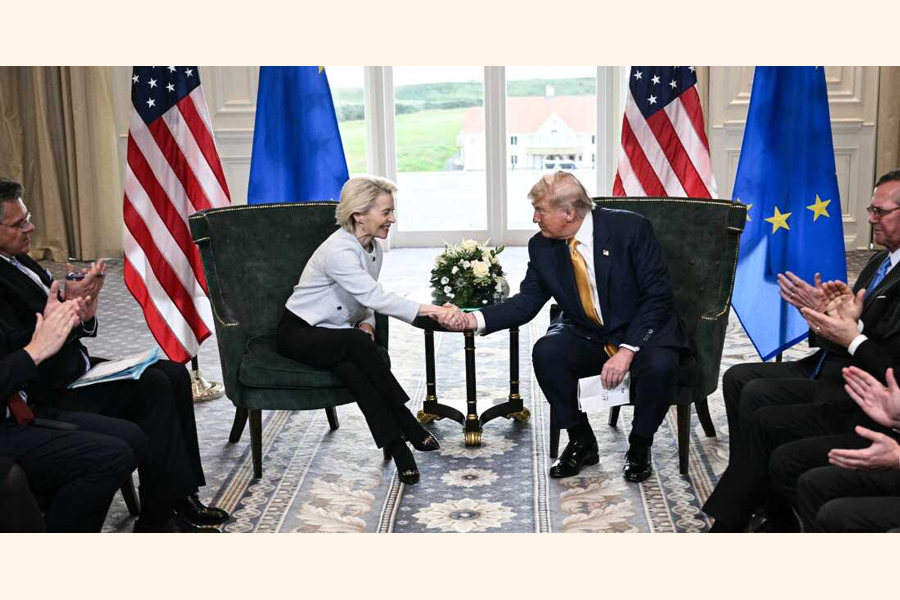
President Trump (R) shakes hands with European Commission President Ursula von der Leyen (L)on July 27 at his golf resort in Turnberry, Scotland, after the two leaders agreed to terms for a trade deal —Agency Photo
Strategic economic analysts have been closely monitoring the different dimensions that have been evolving over the past few weeks pertaining to US tariff trade deals all over the world. James FitzGerald and Tom Geoghegan in their observations in BBC have tried in their own way to identify the winners and losers regarding the US-EU trade deal that have been, in principle, agreed between US President Trump and EU Chief Ursula von der Leyen. It has been identified as the largest trade deal in history.
However, the glowing headlines for Trump may not last long if economic data due soon show that his radical reshaping of the US economy is backfiring. Figures on inflation, jobs, growth and consumer confidence will definitely give a clearer picture as to whether Trump's tariffs are delivering the required gain.
Ordinary Americans are already distressed at the increased cost of living and this deal could add to the burden by hiking prices on EU goods. While not as steep as it could have been, the hurdle represented by a 15 per cent tariff rate is still significant, and it is far more noticeable than the obstacles that existed before Trump returned to his Presidency. Tariffs are taxes charged on goods bought from other countries. Typically, they are a percentage of a product's value. So, a 15 per cent tariff means that a 100 US$ product imported to the US from the EU will have a tax of US$ 15 added on top, taking the total cost to the importer to US$ 115. There is also the other dimension that companies who bring foreign goods into the US have to pay the tax to the government, and it is likely that they will pass the extra cost on to the customers.
Some EU economists have been observing that such an Agreement has made European solidarity the loser. The deal will need to be signed off by all 27 members of the EU, each of which have differing interests and levels of reliance on export of goods to the US. While some members have given the agreement a cautious welcome, others have been critical-- hinting at divisions within the bloc, which is also trying to respond to other crises such as the ongoing war in Ukraine.
French Prime Minister Francois Bayrou has remarked: "It is a dark day when an alliance of free peoples, brought together to affirm their common values and to defend their common interests, resigns itself to submission." He was joined by at least two other French government Ministers as well as Viktor Orban, the Hungarian leader, who said that Trump "ate von der Leyen for breakfast".
One important area which has come into special focus is the matrix of export of EU cars to the USA. The tariff faced by importers bringing EU cars to the US has been nearly halved, from the rate of 27.5 per cent that was imposed by Trump in April to a new rate of 15 per cent. Cars are one of the EU's top exports to the US. And as the largest manufacturer of cars in the EU -- thanks to VW, Mercedes and BMW -- Germany has been watching closely. Consequently, German leader Friedrich Merz has welcomed the new pact, while admitting that he would have welcomed a "further easing of transatlantic trade". Nevertheless, the German car making trade body, the VDA, warned that even a rate of 15 per cent would "cost the German automotive industry billions annually".
Objectively, the carmakers in the US appear to be the winners. James FitzGerald and Tom Geoghegan have pointed out that "Trump is trying to boost US vehicle production. American carmakers received a boost when they learned that the EU was dropping its own tariff on US-made cars from 10 to 2.5 per cent. Theoretically that could result in more American cars being bought in Europe. That could be good for US sales overseas, but the pact is not all good news when it comes to domestic sales. That is down to the complex way that American cars are put together. Many of them are actually assembled abroad -- in Canada and Mexico, and Trump subjects them to a tariff of 25 per cent. That compares with a lower tariff rate of 15 per cent on EU vehicles. So, US car makers may now fear being undercut by European manufacturers".
Some confusion has emerged pertaining to EU pharmaceuticals. There is muddle around the tariff rate that will be levied on European-made drugs being bought in the US. The EU wants drugs to be subject to the lowest rate possible, to benefit sales. Trump appears to have hinted that pharmaceuticals were not covered by the deal announced on Sunday, under which the rate on a number of products was lowered to 15 per cent. But von der Leyen has said they were included. This aspect is important for some European countries which attach great importance to medicines. European pharma companies had initially hoped for a total tariff exemption. It may be noted that this industry currently enjoys high exposure to the US marketplace thanks to products like Ozempic, a star type-2 diabetes drug made in Denmark. This aspect has also been highlighted in Ireland, where opposition parties have pointed out the importance of the industry and criticised the damaging effect of uncertainty.
Two other dimensions-- energy and the aviation industry have also come under scrutiny. Trump has observed that due to the evolving dimensions the US has emerged as the winner.
Trump has indicated that the EU will purchase US$ 750 billion of US energy, in addition to increasing overall investment in the US by US$ 600 billion. In this context Von der Leyen has observed: "We will replace Russian gas and oil with significant purchases of US LNG (liquified natural gas), oil and nuclear fuels." Analysts James FitzGerald and Tom Geoghegan have observed that "this will deepen links between European energy security and the US at a time when it has been pivoting away from importing Russian gas since its full-scale invasion of Ukraine".
Von der Leyen has also said that some "strategic products" will not attract any tariffs, including aircraft and plane parts, certain chemicals and some agricultural products. This is being interpreted as a format where firms making components for airplanes will have friction-free trade between the huge trading blocs. She has also added that the EU still hoped to get more "zero-for-zero" agreements, notably for wines and spirits, in the coming days.
Analyst Ben Chu was carefully following Trump's discussions with the British Prime Minister in Scotland. It has been observed by Ben Chu that the new tariff structure of 15 per cent for EU goods is higher than the 10 per cent that has been agreed earlier with the UK. Most analysts judge the UK's agreement with the US to be more advantageous to the UK than the EU's agreement with the US will be for the EU, given the UK's lower headline tariff rate.
On the face of it, the UK's lower baseline tariff rate (10 per cent vs 15 per cent) could offer an advantage to UK-based firms competing with EU-based companies for sales into the US, allowing UK exports to be more competitively priced for the US market after the tariffs have been applied.
Economic strategist Michael Gasiorek Director of the Centre for Inclusive Trade Policy (CITP) has observed that "in principle, the UK is in a more advantageous position than other countries - so there is the potential to benefit from this."
This observation appears to have surfaced because of the complexities in the two agreements and the lack of sufficient precision.
Nevertheless, one needs to note that in the case of car exports, the UK-US agreement specifies that exports of cars from the UK to the US will face a 10 per cent tariff, which is lower than the rate faced by EU firms selling cars in the US. However, the UK's 10 per cent rate only applies to a quota of 100,000 vehicles a year, which more or less roughly reflects the number of cars the UK sells to the US at the moment. Interestingly, each vehicle sold above that quota would be hit with 25 per cent tariff, which would be higher than the 15 per cent tariff facing all EU car exports. It needs to be noted that in 2024 the EU sold about 758,000 vehicles to the US, almost seven times UK exports to America in that year.
The UK-US agreement also says the UK will negotiate an agreement to avoid future US tariffs on pharmaceutical imports.
Before concluding one also needs to refer to the subject of steel export from the UK to the US. UK steel exported to the US is currently subject to a 25 per cent tariff, which is lower than the 50 per cent global rate on imports of the metal imposed by Donald Trump in June. It has surfaced that UK officials are working with their US counterparts to resolve technical issues that they hope will mean UK firms will be able to export steel to the US up to a certain quota that avoids even this 25 per cent tariff. That would seem to significantly benefit UK steel exporters compared to their EU counterparts when it comes to selling to the US.
The economic dimensions of the trade deals have not reached their final point. We need to see what happens eventually. Trump's highly political trade deal agreed upon with the UK and the EU will have an osmotic effect on the rest of the world including Bangladesh. The whole perspective is important because Bangladesh is preparing to sign an Agreement with the US this month that would impose an additional 20 per cent additional duty on Bangladeshi products entering the US.
We need to monitor carefully how the scenario evolves by next year. It has several dimensions for us and we have to take extra care in what we decide.
Muhammad Zamir, a former Ambassador is an analyst specialised in foreign affairs, right to information and good governance.
Muhammad Zamir
Published :
Aug 10, 2025 22:43
Updated :
Aug 10, 2025 22:43
President Trump (R) shakes hands with European Commission President Ursula von der Leyen (L)on July 27 at his golf resort in Turnberry, Scotland, after the two leaders agreed to terms for a trade deal —Agency Photo
Strategic economic analysts have been closely monitoring the different dimensions that have been evolving over the past few weeks pertaining to US tariff trade deals all over the world. James FitzGerald and Tom Geoghegan in their observations in BBC have tried in their own way to identify the winners and losers regarding the US-EU trade deal that have been, in principle, agreed between US President Trump and EU Chief Ursula von der Leyen. It has been identified as the largest trade deal in history.
However, the glowing headlines for Trump may not last long if economic data due soon show that his radical reshaping of the US economy is backfiring. Figures on inflation, jobs, growth and consumer confidence will definitely give a clearer picture as to whether Trump's tariffs are delivering the required gain.
Ordinary Americans are already distressed at the increased cost of living and this deal could add to the burden by hiking prices on EU goods. While not as steep as it could have been, the hurdle represented by a 15 per cent tariff rate is still significant, and it is far more noticeable than the obstacles that existed before Trump returned to his Presidency. Tariffs are taxes charged on goods bought from other countries. Typically, they are a percentage of a product's value. So, a 15 per cent tariff means that a 100 US$ product imported to the US from the EU will have a tax of US$ 15 added on top, taking the total cost to the importer to US$ 115. There is also the other dimension that companies who bring foreign goods into the US have to pay the tax to the government, and it is likely that they will pass the extra cost on to the customers.
Some EU economists have been observing that such an Agreement has made European solidarity the loser. The deal will need to be signed off by all 27 members of the EU, each of which have differing interests and levels of reliance on export of goods to the US. While some members have given the agreement a cautious welcome, others have been critical-- hinting at divisions within the bloc, which is also trying to respond to other crises such as the ongoing war in Ukraine.
French Prime Minister Francois Bayrou has remarked: "It is a dark day when an alliance of free peoples, brought together to affirm their common values and to defend their common interests, resigns itself to submission." He was joined by at least two other French government Ministers as well as Viktor Orban, the Hungarian leader, who said that Trump "ate von der Leyen for breakfast".
One important area which has come into special focus is the matrix of export of EU cars to the USA. The tariff faced by importers bringing EU cars to the US has been nearly halved, from the rate of 27.5 per cent that was imposed by Trump in April to a new rate of 15 per cent. Cars are one of the EU's top exports to the US. And as the largest manufacturer of cars in the EU -- thanks to VW, Mercedes and BMW -- Germany has been watching closely. Consequently, German leader Friedrich Merz has welcomed the new pact, while admitting that he would have welcomed a "further easing of transatlantic trade". Nevertheless, the German car making trade body, the VDA, warned that even a rate of 15 per cent would "cost the German automotive industry billions annually".
Objectively, the carmakers in the US appear to be the winners. James FitzGerald and Tom Geoghegan have pointed out that "Trump is trying to boost US vehicle production. American carmakers received a boost when they learned that the EU was dropping its own tariff on US-made cars from 10 to 2.5 per cent. Theoretically that could result in more American cars being bought in Europe. That could be good for US sales overseas, but the pact is not all good news when it comes to domestic sales. That is down to the complex way that American cars are put together. Many of them are actually assembled abroad -- in Canada and Mexico, and Trump subjects them to a tariff of 25 per cent. That compares with a lower tariff rate of 15 per cent on EU vehicles. So, US car makers may now fear being undercut by European manufacturers".
Some confusion has emerged pertaining to EU pharmaceuticals. There is muddle around the tariff rate that will be levied on European-made drugs being bought in the US. The EU wants drugs to be subject to the lowest rate possible, to benefit sales. Trump appears to have hinted that pharmaceuticals were not covered by the deal announced on Sunday, under which the rate on a number of products was lowered to 15 per cent. But von der Leyen has said they were included. This aspect is important for some European countries which attach great importance to medicines. European pharma companies had initially hoped for a total tariff exemption. It may be noted that this industry currently enjoys high exposure to the US marketplace thanks to products like Ozempic, a star type-2 diabetes drug made in Denmark. This aspect has also been highlighted in Ireland, where opposition parties have pointed out the importance of the industry and criticised the damaging effect of uncertainty.
Two other dimensions-- energy and the aviation industry have also come under scrutiny. Trump has observed that due to the evolving dimensions the US has emerged as the winner.
Trump has indicated that the EU will purchase US$ 750 billion of US energy, in addition to increasing overall investment in the US by US$ 600 billion. In this context Von der Leyen has observed: "We will replace Russian gas and oil with significant purchases of US LNG (liquified natural gas), oil and nuclear fuels." Analysts James FitzGerald and Tom Geoghegan have observed that "this will deepen links between European energy security and the US at a time when it has been pivoting away from importing Russian gas since its full-scale invasion of Ukraine".
Von der Leyen has also said that some "strategic products" will not attract any tariffs, including aircraft and plane parts, certain chemicals and some agricultural products. This is being interpreted as a format where firms making components for airplanes will have friction-free trade between the huge trading blocs. She has also added that the EU still hoped to get more "zero-for-zero" agreements, notably for wines and spirits, in the coming days.
Analyst Ben Chu was carefully following Trump's discussions with the British Prime Minister in Scotland. It has been observed by Ben Chu that the new tariff structure of 15 per cent for EU goods is higher than the 10 per cent that has been agreed earlier with the UK. Most analysts judge the UK's agreement with the US to be more advantageous to the UK than the EU's agreement with the US will be for the EU, given the UK's lower headline tariff rate.
On the face of it, the UK's lower baseline tariff rate (10 per cent vs 15 per cent) could offer an advantage to UK-based firms competing with EU-based companies for sales into the US, allowing UK exports to be more competitively priced for the US market after the tariffs have been applied.
Economic strategist Michael Gasiorek Director of the Centre for Inclusive Trade Policy (CITP) has observed that "in principle, the UK is in a more advantageous position than other countries - so there is the potential to benefit from this."
This observation appears to have surfaced because of the complexities in the two agreements and the lack of sufficient precision.
Nevertheless, one needs to note that in the case of car exports, the UK-US agreement specifies that exports of cars from the UK to the US will face a 10 per cent tariff, which is lower than the rate faced by EU firms selling cars in the US. However, the UK's 10 per cent rate only applies to a quota of 100,000 vehicles a year, which more or less roughly reflects the number of cars the UK sells to the US at the moment. Interestingly, each vehicle sold above that quota would be hit with 25 per cent tariff, which would be higher than the 15 per cent tariff facing all EU car exports. It needs to be noted that in 2024 the EU sold about 758,000 vehicles to the US, almost seven times UK exports to America in that year.
The UK-US agreement also says the UK will negotiate an agreement to avoid future US tariffs on pharmaceutical imports.
Before concluding one also needs to refer to the subject of steel export from the UK to the US. UK steel exported to the US is currently subject to a 25 per cent tariff, which is lower than the 50 per cent global rate on imports of the metal imposed by Donald Trump in June. It has surfaced that UK officials are working with their US counterparts to resolve technical issues that they hope will mean UK firms will be able to export steel to the US up to a certain quota that avoids even this 25 per cent tariff. That would seem to significantly benefit UK steel exporters compared to their EU counterparts when it comes to selling to the US.
The economic dimensions of the trade deals have not reached their final point. We need to see what happens eventually. Trump's highly political trade deal agreed upon with the UK and the EU will have an osmotic effect on the rest of the world including Bangladesh. The whole perspective is important because Bangladesh is preparing to sign an Agreement with the US this month that would impose an additional 20 per cent additional duty on Bangladeshi products entering the US.
We need to monitor carefully how the scenario evolves by next year. It has several dimensions for us and we have to take extra care in what we decide.
Muhammad Zamir, a former Ambassador is an analyst specialised in foreign affairs, right to information and good governance.


