Home Watch Videos Wars Movies Login

[🇧🇩] Automobile Industry of Bangladesh including parts

Latest Posts Countries Wars Q&A

[🇧🇩] Automobile Industry of Bangladesh including parts
72
7K
More threads by Saif

G Bangladesh Defense

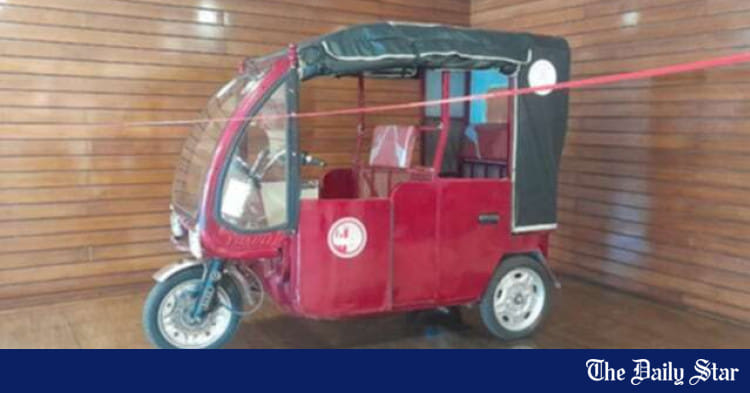
Buet-designed battery-run rickshaws set to roll out in Paltan, Dhanmondi, Uttara

1751157204820.webp

Photo: Collected

Battery-run auto-rickshaws, developed by Bangladesh University of Engineering and Technology (Buet), will soon hit the streets of Paltan, Dhanmondi, and Uttara in a pilot initiative aimed at streamlining urban transport.

LGRD Adviser Asif Mahmud Shojib Bhuyain made the announcement at a programme held at the Dhaka North City Corporation (DNCC) headquarters today.

1751157232115.webp

Photo: Collected

The event marked the inauguration of a training programme for drivers of these electric rickshaws, organised by the DNCC.

Asif Mahmud said, "Unlike the current unregulated system, each area will have a designated number of rickshaws. We are committed to ensuring that drivers are not subjected to extortion or any form of harassment."

1751157253955.webp

Photo: Collected

DNCC Administrator Mohammad Azaz said the newly designed rickshaws are expected to begin operating from early August.

"We aim to train and licence one lakh auto-rickshaw drivers under this initiative," he said.

He added that work is underway to set up charging stations, ensuring the vehicles are powered only at approved points.​
 
Analyze

Analyze Post

Add your ideas here:
Highlight Cite Respond
  • Like (+1)
Reactions: Bilal9

The first motor car on the streets of Dhaka

1751157403553.webp

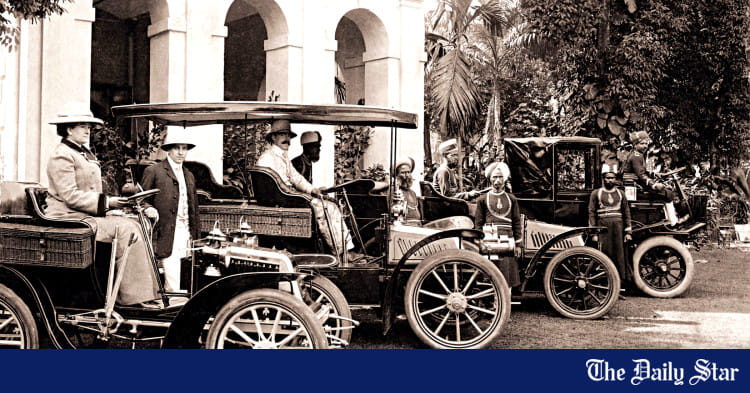
Nawab Salimullah’s motorcade in Dhaka with Lady Curzon and Lord Curzon in 1904 Photo: Fritz Kapp

Before we delve into the story of the first motor car in Dhaka, it's worth exploring an earlier question: When did four-wheelers first appear on the city's roads?

Back in 1790, the Collector of Dhaka noted that a group of soldiers stationed in the city had introduced a hired horse-drawn carriage service. It was likely established to transport goods from Begunbari in Tejgaon -- then an army quarters -- to the main city. However, this service did not last long.

Still, by the early 19th century, Dhaka did have at least one known horse-drawn carriage. During his visit in 1824, Bishop Heber of Calcutta noted that the Naib Nazim of Dhaka used an old landau carriage drawn by four horses of Shamsuddaula.

But for a more structured public transportation system, Dhaka had to wait a bit longer. The credit for this goes largely to an Armenian businessman named Shircore, who introduced thika gari (rental carriages) around 1856. His business, Harmony Carriage, quickly became profitable, inspiring other local businessmen to follow suit.

By 1867, about 60 rental carriages were operating in Dhaka; by 1878 this number had grown to 300, and a decade later, it had doubled.

As with horse-drawn carriages, the introduction of motor vehicles in Dhaka followed the lead of Kolkata. According to Radharaman Mitra's "Kolkata Darpan", the first passenger motor vehicle appeared on the streets of Kolkata in 1896, though some accounts suggest it was 1897. That vehicle, used during British rule, was made by the French company De Dion-Bouton. The De Dion model was first introduced in Kolkata by H H Reynolds, and the first Bengali to purchase a motor vehicle was C Basak.

Naturally, this leads to a key question: When did the first motor car appear in Dhaka?

Could it have been in 1904?

On February 18 of that year, the Viceroy Lord Curzon arrived in Dhaka with his wife, Lady Curzon. The Nawabs' garden house in Shahbagh was lavishly decorated for the occasion. To honour the visit, Nawab Khwaja Salimullah purchased several motor cars from Kolkata. In a historic photograph, Lady Curzon is seen with her hand on the steering wheel, Lord Curzon standing beside her, and four cars parked in front of the house.

However, a slightly different account is found in the autobiography of British car dealer Montague Grahame-White, "At the Wheel Ashore and Afloat: Reminiscences of Motoring, Yachting and Travel Over a Period of Forty Years".

According to him, the Nawab didn't buy the cars in haste for the Viceroy's visit. In fact, the decision came after a carefully considered plan.

In January 1903, Nawab Salimullah met Montague Grahame-White. Inspired by their meeting, the Nawab decided to purchase motor vehicles. By the end of that year, three cars ordered by him had arrived at Ahsan Manzil. According to "The Motor Magazine (1943)", these included a 10-horsepower and a 15-horsepower Mors, and an 8-horsepower Renault.

As mentioned earlier, in 1904, Nawab Khwaja Salimullah showcased his newly purchased automobiles at his Shahbagh garden house. This historic moment was captured by the renowned German photographer Fritz Kapp. These early automobiles thus became silent witnesses to Dhaka's evolving history. By 1915–16, the number of cars in Bengal had exceeded 1,000. Car manufacturers began organising roadshows, distributing flyers, and launching promotions to expand the market. Over time, the fascination with automobiles spread to other parts of the region.​
 
Analyze

Analyze Post

Add your ideas here:
Highlight Cite Respond
  • Like (+1)
Reactions: Bilal9

Made in Bangladesh Mitsubishi Xpander launched

1751247293061.png

Photos: Md. Zahidur Rabbi.

Rancon Auto Industries has officially launched the Bangladeshi-manufactured Mitsubishi Xpander, a seven-seater family SUV powered by a 1.5L MIVEC engine.

According to a press release, all units of the Mitsubishi Xpander are being manufactured at the 52-acre RANCON Industrial Park in Gazipur, which also houses production lines for global brands such as Suzuki, Mercedes-Benz bus chassis, Proton, JAC, LG, and Toshiba.

Takao Kato, CEO of Mitsubishi Motors Corporation, said, "This is just the beginning of a promising journey. With Dual AC, Xpander is engineered specifically for ASEAN markets and has received an overwhelmingly positive response across the region. Bangladesh has a proven track record. Together with RANCON, we look forward to building a future of excellence and reliability with the Bangladeshi-made Xpander."

Mentioning Rancon being the official distributor of Mitsubishi Motors in Bangladesh for the last 50 years, Romo Rouf Chowdhury, GMD of RANCON, said, "We've built the best-in-class paint shop, assembly lines, and a team of professionals trained directly by Japanese experts. Each Xpander has a 5-year warranty and 2 years of servicing included. With 11 after-sales service touchpoints, we want to ensure safety, quality, and value for the people of Bangladesh."

Mitsubishi SUV Bangladesh

1751247347485.png


The Bangladeshi-manufactured Mitsubishi Xpander is currently available at a special introductory price of BDT 34 lakh.​
 
Analyze

Analyze Post

Add your ideas here:
Highlight Cite Respond
  • Love (+3)
Reactions: Bilal9
Akij group of Bangladesh has made a car that looks like a Rolls Royce. It's darn cheap. Only Tk.3 lac.


Analyze

Analyze Post

Add your ideas here:
Highlight Cite Respond
  • Like (+1)
Reactions: Bilal9
Akij group of Bangladesh has made a car that looks like a Rolls Royce. It's darn cheap. Only Tk.3 lac.


That is a glorified golf-cart, hence quite inexpensive. I don't think the speed attained will be that high, and probably not usable on the roads, except as an auto or EZ-Bike situation. Maybe suitable for college/university/large-factory campuses and also in places like Cox's Bazaar beach.
 
Analyze

Analyze Post

Add your ideas here:
Highlight Cite Respond
That is a glorified golf-cart, hence quite inexpensive. I don't think the speed attained will be that high, and probably not usable on the roads, except as an auto or EZ-Bike situation. Maybe suitable for college/university/large-factory campuses and also in places like Cox's Bazaar beach.
I think this car can be used as an alternative to CNG.
 
Analyze

Analyze Post

Add your ideas here:
Highlight Cite Respond
  • Like (+1)
Reactions: Bilal9
Bangladesh's automobile industry is a growing but evolving sector, historically dominated by reconditioned Japanese cars, but now seeing increased interest in new vehicles, electric vehicles (EVs), and local assembly, supported by government policies aimed at boosting domestic manufacturing, though facing challenges from foreign exchange shortages and inflation impacting sales. Key players include Toyota, Mitsubishi, Hino, and local assemblers like Runner, with a strong market for motorcycles and three-wheelers alongside passenger cars and commercial vehicles.
Key Characteristics & Trends:
  • Shift Towards New & Local: While reconditioned cars (mostly Japanese) long dominated, new vehicle sales and local assembly are rising, driven by younger buyers and supportive policies like the 2021 Automobile Industry Development Policy.​
  • Motorcycle Dominance: Motorcycles account for the largest share of motorized vehicles, fueled by ride-sharing and delivery demands, notes LightCastle Partners.​
  • Emerging EV Market: Local groups are investing in EV manufacturing, with projections for significant growth, especially in Special Economic Zones, say Scribd and The Daily Star.​
  • Local Assembly & Parts: Companies like IFAD, Aftab, and Runner are assembling vehicles, and local production of auto parts (like filters by Bogra Motors) is growing, reports The Financial Express | First Financial Daily of Bangladesh and The Daily Star.​
  • Market Dominance: Toyota is the top brand in advertisements, valued for reliability, while Japanese imports remain popular in the used car market, notes Bikroy Blog and LightCastle Partners.​
Challenges:
  • Economic Headwinds: Recent years have seen falling sales due to foreign exchange shortages, inflation, and reduced purchasing power, notes The Daily Star.​

Opportunities:
  • Government Support: Policies aim to attract investment, boost local production, and foster job creation, say The Daily Star and Invest Bangladesh.​
  • Growing Demand: Rising incomes and economic development spur demand for passenger and commercial vehicles, notes www.fmassociatesbd.com and www.boi.gov.bd.​
  • Infrastructure Hubs: Special Economic Zones offer potential hubs for future automotive manufacturing, says Scribd.​
 
Analyze

Analyze Post

Add your ideas here:
Highlight Cite Respond
  • Like (+1)
Reactions: Bilal9

Bangladesh’s vehicle imports surge ahead of election, port revenue gets a boost

UNB
Published :
Jan 21, 2026 19:51
Updated :
Jan 21, 2026 19:51

1769041789237.webp


Vehicle imports through Bangladesh’s main seaport have jumped sharply ahead of the national election through Chattogram port, giving a significant boost to government revenue.

More than 7,000 vehicles were cleared through the port over the past six months, generating over Tk 12 billion in customs revenue, according to data provided by port and customs officials.

The volume marks a record for both Chattogram Port Authority and Chattogram Customs House, driven by stronger demand and faster clearance following policy interventions by the National Board of Revenue (NBR).

The officials said importers have accelerated deliveries in recent months, partly to meet pre-election demand and partly to avoid the risk of higher tariffs in the future.

For years, hundreds of imported vehicles had remained stuck in the port’s car sheds as legal disputes and procedural delays prevented importers from taking delivery. Recent measures by the NBR have helped unlock those bottlenecks, allowing both older stock and newly imported vehicles to clear more quickly.

As a result, importers are now taking delivery of at least 50 vehicles a day, easing congestion and encouraging fresh imports. Under port regulations, vehicles left uncleared for more than 30 days are transferred to Customs for auction. Currently, only 103 vehicles meet the criteria for auction — a sharp decline from previous years.

Data from the Chattogram Port Authority shows a steady rise in monthly imports since the start of the current fiscal year. In July, just 450 vehicles arrived through the port. The number crossed 1,000 in August and climbed to 1,058 vehicles in December.

In total, importers brought in 841 brand-new vehicles and 6,225 other vehicles through 16 specialised roll-on/roll-off (Ro-Ro) ships over the six-month period.

“Vehicle imports have increased significantly compared to the beginning of the fiscal year,” said Omar Faruk, Director (Administration) of the Chattogram Port Authority. “Faster clearance has helped reduce congestion in the port’s car sheds.”

Customs data points to a similar trend. Sharif Md. Al-Amin, Assistant Commissioner at Chattogram Customs House, said that during the first six months of the last fiscal year, the port cleared 6,651 vehicles, generating Tk 11.53 billion in revenue.

“Compared to the previous fiscal year, this represents an increase of 1,034 vehicles and an additional Tk 1.24 billion in revenue,” he said.

Industry insiders say the surge reflects broader dynamics in Bangladesh’s vehicle import market.

Mohammed Habibur Rahman, former Senior Vice President of the Bangladesh Reconditioned Vehicles Importers and Dealers Association (BARVIDA), said the country imports more than 20,000 cars annually, primarily from Japan and other markets.

While Chattogram handles a large share of those imports, many traders prefer Mongla port, citing lower costs and quicker processing times, he added.

Still, the recent uptick at Chattogram has sharply reduced backlog. Only 471 vehicles are currently waiting for delivery at the port’s two car sheds, which together can accommodate 1,250 vehicles. In previous months, the number had hovered around 2,000.

With clearance speeding up and revenue climbing, officials say the port’s vehicle yards are now operating at a fraction of the pressure seen earlier, an uncommon development ahead of a national election, when trade flows typically face uncertainty.​
 
Analyze

Analyze Post

Add your ideas here:
Highlight Cite Respond
  • Like (+1)
Reactions: Bilal9

Members Online

No members online now.

Latest Posts

Back
 
G
O
 
H
O
M
E