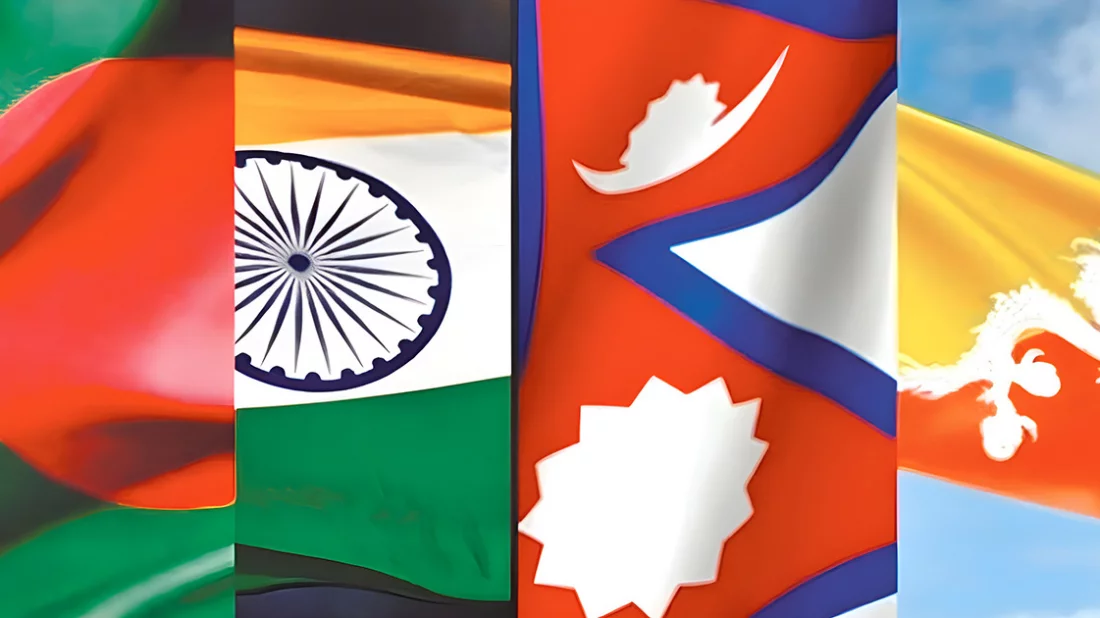
[🇧🇩] BBIN MVA--- Bangladesh-Bhutan-India-Nepal Motor Vehicles Agreement

[🇧🇩] BBIN MVA--- Bangladesh-Bhutan-India-Nepal Motor Vehicles Agreement
12
2K
More threads by Saif

G Bangladesh Defense

Saif

Senior Member
Joined
Jan 24, 2024
Messages
18,330
Likes
8,633
Nation

Residence

Axis Group

'Bhutan mulling joining BBIN soon'​


1709765325977.webp


Bhutan is actively considering rejoining the Bangladesh-Bhutan-India-Nepal (BBIN) process soon.

This was communicated by a Bhutanese delegation at a meeting on the implementation of BBN Motor Vehicles Agreement (BBIN MVA) held at the Pan Pacific Sonargaon Hotel in Dhaka from 5-6 March 2024, according to a foreign ministry statement.

The delegations from Nepal, India and Bangladesh attended the meeting. Bhutan participated in the meeting as an observer.

The Bangladesh delegation was led by Rokebul Haque, director general (South Asia), Ministry of Foreign Affairs. Indian delegation was led by Smita Pant, joint secretary (Bangladesh and Myanmar Division) of Ministry of External Affairs while Bhimarjun Adhikari, joint secretary of Ministry of Physical Infrastructure and Transport led the Nepalese delegation.

All the delegates expressed hope that BBIN MVA will open a new era for physical connectivity among the countries of this sub-region.

The meeting discussed the progress made, so far, under the BBIN MVA and details of the draft protocol for movement of cargo vehicles under the BBIN MVA.

Once operationalised, this framework would contribute to the economy of contracting countries not only by expanding trade and commerce, but also by creating more opportunity to promote people-to-people contact which is fundamental in promoting trust and faith among these countries, the statement said.

During these meetings, all contracting countries expressed their sincere commitments in early implementation of BBIN process for promoting greater regional cooperation as envisioned by the leaders.

The BBIN MVA for the Regulation of Passenger, Personal and Cargo Vehicular Traffic between Bangladesh, Bhutan, India and Nepal was signed on 15 June 2015 in Thimphu, Bhutan.

The last meeting on the implementation of BBIN MVA was held in 7-8 March 2022 in New Delhi, India.​
 

What will it take to connect the Bangladesh, Bhutan, India, Nepal (BBIN) sub-region?​


Trucks laden with export goods waiting to cross the Indo-Bangladesh border. Photo by Dilip Banerjee

Trucks laden with export goods waiting to cross the Indo-Bangladesh border. Photo by Dilip Banerjee

“Crossing the India-Bangladesh border is very challenging,” says Bapi Sikdar, an Indian trucker who has ferried cargo between the two countries for 35 years. Sikdar is one of the thousands of truckers who queue up regularly at the Petrapole-Benapole crossing - the busiest and most important land border in South Asia.

Mr. Sikdar had to wait for 15 days just to enter the integrated check post at Petrapole on the Indian side before crossing over. It took him another three days to offload the cargo at Benapole on the Bangladesh side of the border before the job was finally done. In most other parts of the world, including in East Africa, it takes less than six hours to clear similar volumes.

Unfortunately, Mr. Sikdar’s experience is far too common. The long delays at the borders contribute to the high costs of trade between the countries of the BBIN sub-region - Bangladesh, Bhutan, India, and Nepal.

These are largely due to the inadequate infrastructure at border crossings, a plethora of paper-based procedures, restrictive policies and regulations, and inefficient logistics for cargo handling.


The complex geography of the area compounds the issue. Bhutan and Nepal are landlocked mountainous countries with difficult connectivity, while the only road within India that connects its north eastern states with the mainland must navigate the narrow Siliguri Corridor, the Chicken’s Neck.

Not surprisingly, these countries find it easier to trade with distant lands than with their neighbors. The World Bank’s Connecting to Thrive report finds it is about 15–20 percent cheaper for an Indian company to trade with Brazil or Germany than with adjoining Bangladesh.

As a result, regional trade has barely scratched the surface of its potential. Although trade between the BBIN countries grew six-fold between 2005 and 2019, the unexploited potential remains massive, estimated at 93 percent for Bangladesh, 50 percent for India and 76 percent for Nepal.

So, what will it take to improve trade and connectivity in the BBIN sub-region?

Cutting red tape, together with the digitization and automation of customs procedures, can reduce the long delays at the borders in the Bangladesh, Bhutan, India, and Nepal (BBIN) sub-region. Photo of Bhomra land port between Bangladesh and India by Erik Nora.

Cutting red tape, together with the digitization and automation of customs procedures, can reduce the long delays at the borders in the Bangladesh, Bhutan, India, and Nepal (BBIN) sub-region. Photo of Bhomra land port between Bangladesh and India by Erik Nora.

Cut red tape

First, simpler regulations will help ease the movement of cargo. At present, around 22 documents and 55 signatures are needed to trade between Bangladesh and India. In Bhutan, importers need to submit their documents to different authorities 86 times on average, while exporters need to do so 74 times.

Second, cutting down the physical inspection of goods can reduce delays. At some borders, customs officials examine 80-100 percent of all the goods that pass through. If countries adopted advanced risk management practices, consignments could be cleared far more quickly.

Third, the early implementation of the BBIN Motor Vehicles Agreement (MVA) can lead to shorter transport routes, quicker travel times, and lower costs, in addition to a smaller carbon footprint. World Bank analysis finds that under the MVA, a truck traveling from Agartala in India’s north east to Kolkata port will take 65 percent less time and be 68 percent cheaper.

In addition, OECD data shows that if countries in the region were to fully implement the WTO Trade Facilitation Agreement (TFA) - which aims to simplify paperwork and harmonize customs procedures - trade costs for lower middle-income economies such as the BBIN nations could come down by over 17 percent.

Digitize, Automate

The digitization and automation of customs and other procedures can also lead to faster and more transparent clearances. Digitization has the added advantage of enabling countries to harmonize their data, facilitating data exchanges and allowing traders and government officials to take evidence-based decisions.

At the moment, however, large gaps remain. While many South Asian countries are moving towards digitization, the United Nations Global Survey on Trade Facilitation and Paperless Trade finds that if this is implemented fully, trade costs can come down by as much as 40 percent.

Towards this end, the World Bank is supporting Bangladesh and Nepal in developing single electronic gateways that will allow importers and exporters to file their documents electronically. Once fully operational, these National Single Windows are expected to dramatically reduce clearance times.

Along with these measures, upgrading procedures for cargo handling, storage, tariff calculation and payment at border points can ease the complexity of cross-border trade.

In Bangladesh, seamless connectivity with India can raise national income by as much as 17 percent, while India would gain by 8 percent. Photo of Benapole Check Post on the Indo-Bangladesh border by Erik Nora

In Bangladesh, seamless connectivity with India can raise national income by as much as 17 percent, while India would gain by 8 percent. Photo of Benapole Check Post on the Indo-Bangladesh border by Erik Nora

Bridge Infrastructure Gaps

On the infrastructure front, an integrated multimodal transport network will go far in promoting the smoother movement of goods. Currently, even within nations, multimodal freight operations are limited; this is even less so for cross-border movement. Stronger efforts are needed to move freight onto rail networks and inland waterways to make the most of the multimodal nature of marine containers.

Roads too will need attention. Although roads carry around 70 percent of the freight on these regional corridors, most are crowded two-lane thoroughfares where trucks travel at 30 kilometers per hour or less, and some sections are incapable of carrying larger vehicles or containers. This is especially so for access roads that make the “last mile” transportation of goods slow and inefficient.

A further impediment is the mismatch in handling capacity between the various check posts. While India’s Petrapole border can handle up to 750 trucks a day, Bangladesh’s Benapole point on the other side can only clear 370 of them.
In Nepal, large scale investments in infrastructure have made a difference. At the Birgunj- Raxaul border with India, crossing times have reduced by nearly 50 percent.

BBIN Infographic


Enormous gains to be made

Together, these measures can bestow enormous benefits on the countries of the sub-region. In Bangladesh, for instance, seamless connectivity with India can raise national income by as much as 17 percent, while India would gain by 8 percent. Bhutan and Nepal can be expected to see similar results, spurring robust, resilient, and sustainable growth across the region.

And Mr. Sikdar, the Indian trucker, can undertake many more journeys, earning him a better income.

Planning for the BBIN transport improvements received funding from Program for Asia Connectivity and Trade, a trust fund supported by the United Kingdom’s Foreign, Commonwealth and Development Office, and the South Asia Regional Trade Facilitation Program, a trust fund supported by Australia’s Department of Foreign Trade.
 

‘With few amendments, BBIN presents a win-win proposition’​


The sub-regional trade and transit challenges and prospects for India, Nepal, and Bangladesh were the key focus of the policy brief
https://www.dhakatribune.com/320130

‘With few amendments, BBIN presents a win-win proposition’

Nurul Islam Hasib
Publish : 10 Jul 2023, 11:42 PMUpdate : 10 Jul 2023, 11:42 PM

The Bangladesh-Bhutan-India-Nepal (BBIN) presents a “win-win proposition”, offering opportunities for enhanced collaboration, mutual benefits, and shared prosperity among the participating nations with few amendments, according to a policy brief of a Nepalese think-tank.

“This sub-regional cooperation framework has the potential to grow and become a successful model of sub regional cooperation that benefits all member countries,” said the Asian Institute of Diplomacy and International Affairs (AIDIA), as the policy brief examines the challenges and prospects related to sub-regional trade and transit involving India, Nepal, and Bangladesh.

It also emphasises BBIN cooperation. But to make it happen, the paper suggested a few amendments to BBIN regulations, such as amending Article VII (3) of Motor Vehicle Agreement (MVA) to respect the special transit rights of land-locked developing countries (LLDCs) by removing the provision of an imposition of fees and charges.

The sub-regional trade and transit challenges and prospects for India, Nepal, and Bangladesh were the key focus of the policy brief.

The researchers said the key challenges faced by the three nations in promoting trade and transit include inadequate infrastructure, bureaucratic complexities, negative perceptions of certain political parties in Nepal and Bangladesh on India, and poor regional connectivity.

Despite these challenges, the region has immense opportunities for enhanced trade and transit cooperation between these countries. Furthermore, the study discusses the potential benefits of improving infrastructure, streamlining customs procedures, and harmonising regulations to facilitate trade and transit within the sub-region.

“By addressing the challenges and harnessing the prospects, India, Nepal, and Bangladesh can unlock the subregion's economic potential, promote regional stability, and contribute to their respective development agendas.”

Future of BBIN​


In recent years, India's Act East policy has presented numerous opportunities for connecting Northeast India with its neighbouring countries.

The BBIN initiative serves as a testament to the attractiveness of cooperation in Eastern South Asia.

Efforts are underway to upgrade railway links in Bangladesh with the support of Indian lines of credit.

Moreover, India is actively engaged in linking Nepal to its railway network, which holds great potential for enhancing trade and connectivity between the two nations.

With the advent of digitalization, containerised cargo equipped with electronic locking systems will significantly facilitate cross-border trade.

The linking of BBIN countries through waterways and road transport, along with the connection of electricity grids to enable cross-border electricity trade, holds great potential for boosting trade and fostering people-to-people contact within the region, according to the policy brief.

“Despite progress, transit through roadways remains a major challenge, despite the existence of an agreement on the operation of passenger vehicles between India and Bangladesh since 1999.

“The BBIN MVA was delayed due to the withdrawal of Bhutan from the same and re-joining the same as an observer. However, as India continues to improve border infrastructure, trade facilitation, and digitised document submission, the potential for further enhancing sub-regional cooperation should not be underestimated.”

The AIDIA said India can serve as a crucial transit route for Bangladesh, Nepal, and Bhutan to engage in trade with one another. Similarly, Bangladesh is actively preparing itself to become a prominent transit hub.

“Japan, which is constructing a deep-sea port in Matarbari, Bangladesh, has expressed its intention to develop this port into a major commercial hub. Prime Minister Fumio Kishida of Japan has proposed a Bay of Bengal-Northeast India industrial value chain that would not only spur growth in India's north-eastern region but also enhance connectivity with Nepal and Bhutan through a proposed supply chain, with Matarbari playing a crucial role in this endeavour.”

Proposed amendments to BBIN regulations​


• Amending Article VII (3) of MVA to respect the special transit rights of LLDCs by removing the provision of imposing fees and charges.
• Inserting a new scope in BBIN's agreements and their operationalization for trade diversification, especially for small countries.
• Ending Sanitary and Phyto-sanitary measures and Technical Barriers to Trade or Non-Tariff Measures for accelerated growth in the sub-region.
• Replacing security approach with the development approach while accelerating sub-regional initiatives.
• Concluding protocols and standards for passengers and cargo vehicles with maximum axle loads, followed by their full implementation for early operationalization of the MVA.

Recommendations​

I. All four states need to invest in infrastructure, such as roads, railways, and ports, to make it easier and cheaper to transport goods and people.
II. There is a need to reduce regulatory barriers, such as different customs procedures and standards, to make it easier for businesses to operate in the region.
III. All four states need to promote trade and investment by signing free trade agreements and providing incentives for businesses to invest in the region.
IV. The participating state must understand the need to resolve political and security challenges, such as border disputes and armed conflict, in order to create a more stable environment for trade and transit.
V. A comprehensive and mutually agreed framework would be required to address challenges of cross-country regulations, restrictive policies and regulations, and logistical barriers for cargo handling while promoting functional transit facilities.​
 

What will it take to connect the Bangladesh, Bhutan, India, Nepal (BBIN) sub-region?​


Trucks laden with export goods waiting to cross the Indo-Bangladesh border. Photo by Dilip Banerjee

Trucks laden with export goods waiting to cross the Indo-Bangladesh border. Photo by Dilip Banerjee

“Crossing the India-Bangladesh border is very challenging,” says Bapi Sikdar, an Indian trucker who has ferried cargo between the two countries for 35 years. Sikdar is one of the thousands of truckers who queue up regularly at the Petrapole-Benapole crossing - the busiest and most important land border in South Asia.

Mr. Sikdar had to wait for 15 days just to enter the integrated check post at Petrapole on the Indian side before crossing over. It took him another three days to offload the cargo at Benapole on the Bangladesh side of the border before the job was finally done. In most other parts of the world, including in East Africa, it takes less than six hours to clear similar volumes.

Unfortunately, Mr. Sikdar’s experience is far too common. The long delays at the borders contribute to the high costs of trade between the countries of the BBIN sub-region - Bangladesh, Bhutan, India, and Nepal.

These are largely due to the inadequate infrastructure at border crossings, a plethora of paper-based procedures, restrictive policies and regulations, and inefficient logistics for cargo handling.


The complex geography of the area compounds the issue. Bhutan and Nepal are landlocked mountainous countries with difficult connectivity, while the only road within India that connects its north eastern states with the mainland must navigate the narrow Siliguri Corridor, the Chicken’s Neck.

Not surprisingly, these countries find it easier to trade with distant lands than with their neighbors. The World Bank’s Connecting to Thrive report finds it is about 15–20 percent cheaper for an Indian company to trade with Brazil or Germany than with adjoining Bangladesh.

As a result, regional trade has barely scratched the surface of its potential. Although trade between the BBIN countries grew six-fold between 2005 and 2019, the unexploited potential remains massive, estimated at 93 percent for Bangladesh, 50 percent for India and 76 percent for Nepal.

So, what will it take to improve trade and connectivity in the BBIN sub-region?

Cutting red tape, together with the digitization and automation of customs procedures, can reduce the long delays at the borders in the Bangladesh, Bhutan, India, and Nepal (BBIN) sub-region. Photo of Bhomra land port between Bangladesh and India by Erik Nora.

Cutting red tape, together with the digitization and automation of customs procedures, can reduce the long delays at the borders in the Bangladesh, Bhutan, India, and Nepal (BBIN) sub-region. Photo of Bhomra land port between Bangladesh and India by Erik Nora.

Cut red tape

First, simpler regulations will help ease the movement of cargo. At present, around 22 documents and 55 signatures are needed to trade between Bangladesh and India. In Bhutan, importers need to submit their documents to different authorities 86 times on average, while exporters need to do so 74 times.

Second, cutting down the physical inspection of goods can reduce delays. At some borders, customs officials examine 80-100 percent of all the goods that pass through. If countries adopted advanced risk management practices, consignments could be cleared far more quickly.

Third, the early implementation of the BBIN Motor Vehicles Agreement (MVA) can lead to shorter transport routes, quicker travel times, and lower costs, in addition to a smaller carbon footprint. World Bank analysis finds that under the MVA, a truck traveling from Agartala in India’s north east to Kolkata port will take 65 percent less time and be 68 percent cheaper.

In addition, OECD data shows that if countries in the region were to fully implement the WTO Trade Facilitation Agreement (TFA) - which aims to simplify paperwork and harmonize customs procedures - trade costs for lower middle-income economies such as the BBIN nations could come down by over 17 percent.

Digitize, Automate

The digitization and automation of customs and other procedures can also lead to faster and more transparent clearances. Digitization has the added advantage of enabling countries to harmonize their data, facilitating data exchanges and allowing traders and government officials to take evidence-based decisions.

At the moment, however, large gaps remain. While many South Asian countries are moving towards digitization, the United Nations Global Survey on Trade Facilitation and Paperless Trade finds that if this is implemented fully, trade costs can come down by as much as 40 percent.

Towards this end, the World Bank is supporting Bangladesh and Nepal in developing single electronic gateways that will allow importers and exporters to file their documents electronically. Once fully operational, these National Single Windows are expected to dramatically reduce clearance times.

Along with these measures, upgrading procedures for cargo handling, storage, tariff calculation and payment at border points can ease the complexity of cross-border trade.

In Bangladesh, seamless connectivity with India can raise national income by as much as 17 percent, while India would gain by 8 percent. Photo of Benapole Check Post on the Indo-Bangladesh border by Erik Nora

In Bangladesh, seamless connectivity with India can raise national income by as much as 17 percent, while India would gain by 8 percent. Photo of Benapole Check Post on the Indo-Bangladesh border by Erik Nora

Bridge Infrastructure Gaps

On the infrastructure front, an integrated multimodal transport network will go far in promoting the smoother movement of goods. Currently, even within nations, multimodal freight operations are limited; this is even less so for cross-border movement. Stronger efforts are needed to move freight onto rail networks and inland waterways to make the most of the multimodal nature of marine containers.

Roads too will need attention. Although roads carry around 70 percent of the freight on these regional corridors, most are crowded two-lane thoroughfares where trucks travel at 30 kilometers per hour or less, and some sections are incapable of carrying larger vehicles or containers. This is especially so for access roads that make the “last mile” transportation of goods slow and inefficient.

A further impediment is the mismatch in handling capacity between the various check posts. While India’s Petrapole border can handle up to 750 trucks a day, Bangladesh’s Benapole point on the other side can only clear 370 of them.
In Nepal, large scale investments in infrastructure have made a difference. At the Birgunj- Raxaul border with India, crossing times have reduced by nearly 50 percent.

BBIN Infographic


Enormous gains to be made

Together, these measures can bestow enormous benefits on the countries of the sub-region. In Bangladesh, for instance, seamless connectivity with India can raise national income by as much as 17 percent, while India would gain by 8 percent. Bhutan and Nepal can be expected to see similar results, spurring robust, resilient, and sustainable growth across the region.

And Mr. Sikdar, the Indian trucker, can undertake many more journeys, earning him a better income.

Planning for the BBIN transport improvements received funding from Program for Asia Connectivity and Trade, a trust fund supported by the United Kingdom’s Foreign, Commonwealth and Development Office, and the South Asia Regional Trade Facilitation Program, a trust fund supported by Australia’s Department of Foreign Trade.

The article expounds the inadequacies of trade well enough. The fact remains however that Indian goods are overwhelming Bangladesh market with ease, while Bangladesh exports are restricted to the Indian market using various non-tariff barriers. This cannot continue.

I'd like to see that problems solved first.
 
The article expounds the inadequacies of trade well enough. The fact remains however that Indian goods are overwhelming Bangladesh market with ease, while Bangladesh exports are restricted to the Indian market using various non-tariff barriers. This cannot continue.

I'd like to see that problems solved first.
I concur! India is the greatest impediment to regional trade. They need to open up their market for other regional countries first. Creating trade imbalance and using it as a political tool against her neighbors is what India has been doing in South Asia.
 
I concur! India is the greatest impediment to regional trade. They need to open up their market for other regional countries first. Creating trade imbalance and using it as a political tool against her neighbors is what India has been doing in South Asia.

I'd say this has been the misguided policy all along, but intensified under Modi and BJP.

They literally hold neighbors hostage by banning export of certain commodities as well.

Is this how a leader (of any kind) behaves? SMH....
 
I'd say this has been the misguided policy all along, but intensified under Modi and BJP.

They literally hold neighbors hostage by banning export of certain commodities as well.

Is this how a leader (of any kind) behaves? SMH....
We need to try to get full membership of ASEAN and ditch SAARC/BBIN. Our future lies in ASEAN and China not India.
 

Latest Posts

Back