[🇧🇩] Artificial Intelligence-----It's challenges and Prospects in Bangladesh

[🇧🇩] Artificial Intelligence-----It's challenges and Prospects in Bangladesh
96
4K
More threads by Saif

G Bangladesh Defense

Stop taking health advice from AI-generated social media videos

Ahnaf Tahmeed Purna

1778805207898.webp

Photo: Orchid Chakma

A cartoon garlic clove aggressively scrubbing toxins off of blood vessels. A bright yellow turmeric root polishing the liver. Spinach being dragged across the colon like a sponge wiping everything clean.

You’ve seen these short videos. Everyone has. These AI-generated videos are designed to be oddly satisfying. Clean visuals, simple ideas, and a reassuring sense that health is just a matter of “cleansing” the body the right way. One food, one organ, one problem solved.

But what makes them effective is exactly what makes them misleading. They take real human anatomy and turn it into a cartoon system of dirt and detergents. They replace medical complexity with visual certainty, where turmeric is not a spice with mild anti-inflammatory properties, but a liver “detox tool”, and garlic is not a food with limited cardiovascular associations, but a direct pipe-cleaner for arteries.

As a medical student, one of the lessons you learn in your early years is that the human body seldom behaves in simple, linear ways. There is no single food that “cleans” an organ, no universal detox pathway that can be activated through dietary hacks, and no shortcut that bypasses physiology. Yet, social media thrives on exactly the opposite idea: health is a puzzle with easy answers waiting to be unlocked. It is emotionally entrancing. It gives viewers a sense of control in a system that often feels overwhelming. This is where AI-generated content fits in. It does not just spread misinformation; it packages it in a format that feels intuitive and passively rewires how people understand their own bodies.

The danger today is not only that false health advice exists online, but that it is increasingly being generated at scale by systems that are not accountable to evidence. AI tools can replicate the tone of educational content while stripping away the safeguards of medical accuracy. Combined with animation tools and content templates, this results in a flood of videos that look like simplified medical education but are often detached from clinical reality.

In clinical practice, one pattern physicians notice is that people interpret symptoms through whatever information is most accessible to them at the time. Increasingly, today, that information is coming from short-form social media content rather than trained professionals. A persistent headache becomes “toxins”. Fatigue becomes “deficiency”. Digestive discomfort becomes a “colon cleanse issue”. By the time real medical attention is sought, the narrative has already been shaped, sometimes in ways that delay proper diagnosis. This does not happen because people are careless. It happens because the content is persuasive, visually clear, and emotionally reassuring. It offers certainty where medicine often cannot.

What makes AI-generated health content particularly difficult to challenge is its tone. It sounds confident, structured, and explanatory. In medicine, however, confidence is not the same as facticity. Real clinical guidance is always cautious, conditional, and inherently context-dependent. It does not promise universal fixes because it cannot. But caution does not perform well on social media; certainty does. And so, that certainty gets amplified, even when it is unsupported.

It would be easy to place all responsibility on viewers, but that would be incomplete. Platforms are designed to maximise engagement, not accuracy. AI-generated content is cheap, fast, and scalable. Medical correction is slow, nuanced, and often ignored in algorithmic systems. This creates a structural imbalance: evidence-based medicine competes with content optimised for attention. The result is not just about spreading misinformation but rather about misinformation outperforming information.

The solution is not to disconnect from digital platforms entirely. They are now part of how people learn and communicate. But there needs to be a stronger culture of scepticism when it comes to health content, especially content that feels too simple.

A useful question we can ask ourselves is, does this explanation acknowledge complexity, or does it discard it? Real medicine rarely fits into a single cause-and-effect story. When something claims to do so, it deserves scrutiny.

Equally important is where we choose to get medical understanding from. Not all information sources carry the same weight. Peer-reviewed literature, trained clinicians, and established medical institutions exist for a reason. They are built on systems of validation, emendation, and accountability.

There is an implicit risk in the way health information is evolving online. It is not just that false claims are circulating. It is that the boundary between education and entertainment is blurring. When a cartoon vegetable can convincingly “clean” your colon in 30 seconds, and when that feels more intuitive than actual physiology, we are no longer just dealing with misinformation. We are dealing with a shift in how people understand their own bodies.

Medicine is not a set of visual metaphors nor a collection of easy fixes. It is a discipline where patterns are interpreted through evidence, probability, and clinical judgment rather than certainty or shortcuts. And the more we replace that complexity with algorithm-friendly simplicity, the further we drift from what a genuine understanding of health is supposed to be.

Purna is a fourth-year medical student at Sirajganj Medical College.​
 

Doctors can't be replaced: Why we need an “arguable” AI partner

Farjana Yesmin
Updated: 15 May 2026, 13: 35

1778889912359.webp

Doctors wearing vr simulation with hologram medical technologyrawpixel.com / roungroat

I remember the long, quiet queues at the village clinics in Satkhira where I grew up. Families waited for hours under the heat, speaking in low voices, hoping for a few minutes with a doctor who was likely exhausted. In those settings, the primary challenge is not a lack of data. It is a lack of time.

Bangladesh currently has roughly 0.7 physicians and less than one hospital bed for every 1,000 people. These numbers fall far below World Health Organization recommendations. With a national shortage of over 90,000 doctors, any technological solution we introduce must solve this crisis rather than worsen it.

In late April 2026, Google DeepMind announced its "AI co-clinician" research initiative. This vision suggests a "triadic" model of care: an AI agent working alongside both the patient and the doctor. It is designed to extend a clinician’s reach while keeping the human expert in control. While this is a significant technical achievement, we must ask a difficult question: If these systems are built for well-resourced hospitals in the Global North, will they truly help a rural health complex in Bangladesh, or will they create new forms of inequality?

The vision of a reasoning partner

The DeepMind initiative moves away from the old idea of AI as a simple "black box" that gives a single answer. Their system was tested using the "NOHARM" framework, which focuses on avoiding errors of omission and commission. In blind evaluations, physicians often preferred its synthesized evidence over traditional tools.

This reflects a shift from AI as a judge to AI as a collaborator. It is a principle Bangladesh should endorse, but with caution. A generic "co-clinician" designed in London or California may not understand the messy, fragmented reality of our local healthcare system.

Why collaboration is not enough

In my research on "arguable systems," I have argued that a co-clinician should do more than just offer a recommendation for a doctor to accept or reject. True collaboration requires the ability to disagree.

A doctor in a busy upazila health complex might need to argue with the AI. The patient in front of her might come from a community the AI never encountered during its training. They might speak a dialect the model cannot parse or present symptoms that do not fit the clean patterns of Western datasets.

When an algorithm fails to listen, it commits what philosophers call "epistemic injustice." This happens in two ways. First, "testimonial injustice" occurs when the AI fails to trust what a patient knows about their own body because that patient is not from a wealthy or digitally recorded demographic. Second, "hermeneutical injustice" happens when the patient lacks the specific vocabulary the AI expects. A truly collaborative system must be designed to notice these gaps and make its own uncertainty visible to the doctor.

The privacy-explainability tension

Bangladesh is currently developing its digital health infrastructure and data protection laws. Our hospitals cannot simply pool patient records into a central server for legal and ethical reasons.

Federated learning offers a solution by allowing hospitals to train shared models without moving raw patient data. My work on the MedHE framework uses encryption to create a "fortress" for patient privacy. However, there is a hidden cost: the "noise" used to protect privacy can sometimes hide rare diseases or the early signals of an outbreak.

When we build or deploy these models, we should not only ask if they are accurate. We must ask if they listen. We must ensure that when a patient’s life depends on it, the doctor remains the final authority, supported by a partner that knows its own limits.

In Bangladesh, if privacy settings are too aggressive, a dengue early-warning system might fail to detect a cluster in a remote district because that cluster appears as statistical noise. We need "equity-aware" privacy. The goal should not be mathematical purity, but clinical truth for the most vulnerable populations.

Bias as a local reality

We often treat algorithmic bias as a technical bug, but it is actually a reflection of the training environment. An ECG-based heart disease predictor trained mostly on men may systematically under-diagnose women who show different symptoms.

In my research on fairness-aware representation learning, we train models to ignore sensitive characteristics like gender or income when they lead to discriminatory outcomes. For a co-clinician to work in Bangladesh, it must be evaluated on our own patient populations and our own languages. Fairness cannot be an afterthought.

Bangladesh as a research partner

Our country is not a passive recipient of Western technology. Local researchers are already building solutions that fit our specific context.

In a study I conducted with 14 healthcare professionals in Bangladesh, we found that clinicians strongly preferred "hybrid" explanations. These systems combine data-driven insights with established medical rules. More than half of the clinicians expressed trust for actual clinical use because they could see the logic behind the suggestion.

From multilingual triage apps to AI-assisted referral systems for pregnant women, a local ecosystem is growing. Our policymakers should treat Bangladesh not as a testing ground for foreign models, but as a partner with its own research capacity.

A roadmap for the future

To move forward, I propose five essential steps for integrating AI into our clinics:

1. Demand arguability: Systems must allow doctors to contest reasoning and see structured uncertainty. A doctor should be able to argue with the AI and win.

2. Local fairness benchmarks: We need our own test sets and definitions of what constitutes a harmful error in a rural setting.

3. Equity-aware privacy: We must ensure that privacy protections do not erase the signals of marginalized communities or rare conditions.

4. Invest in collaboration research: We need large-scale trials that measure trust and workflow integration, not just technical accuracy.

5. National AI audit body: A technical and ethical board should monitor algorithms before and after deployment to prevent bias or privacy breaches.

It's about the patient's life

I became a research scientist because I wanted to build technology that finally hears the voices I heard in those Satkhira queues. The DeepMind co-clinician is an impressive tool, but its success in Bangladesh will depend on whether it can adapt to us.

When we build or deploy these models, we should not only ask if they are accurate. We must ask if they listen. We must ensure that when a patient’s life depends on it, the doctor remains the final authority, supported by a partner that knows its own limits.​
 

Beyond chatbot: Why 2026 is the year of 'Agentic' AI

Nowshed Alam


1779330555393.webp

Figurines with computers and smartphones are seen in front of the words "Artificial Intelligence AI" in this illustration taken, 19 February 2024.Reuters file photo

Walk into any university library or coffee shop right now, and you will see the same thing: students with split screens, typing furiously while a chatbot helps them debug code, summarise a dense 50-page reading, or structure an essay outline. For the past few years, this has been our relationship with Artificial Intelligence. It was a highly advanced, ultra-obedient digital assistant. You give a prompt; it gives an answer.

But if you have been paying attention to the tech landscape over the last few weeks, you might have noticed a massive vibe shift. We are quietly moving away from the era of the chatbot and entering something entirely different: the era of Agentic AI.

As students standing on the precipice of the workforce, this is the trend we actually need to talk about. It is no longer just about text generation; it is about autonomous execution.

From assistants to operators

To understand why this is a big deal, we have to look at how the latest models—like OpenAI’s GPT-5.5 or Anthropic’s "Mythos" framework—are being deployed.

Until recently, AI lacked a sense of continuity. If you wanted it to research a topic, write a report, create a spreadsheet, and send an email, you had to manually guide it through every single step. You were the manager, and the AI was an intern taking literal, isolated instructions.

"Agentic AI" changes the dynamic entirely. Instead of giving the system a specific prompt, you give it a goal.

The shift: Instead of asking an AI, "Write a Python script to scrape this website," you can now tell an Agentic system, "Look at our club's budget spreadsheet, find where we are overspending on event catering, research three cheaper local alternatives, and draft a polite email to the executive team proposing the switch."

The AI agent then hooks into various APIs, browses the web, modifies files, and executes the multi-step workflow entirely on its own. It doesn’t just answer questions anymore; it takes initiative. Tech analysts are already predicting that by the end of this year, multi-agent systems will be running uninterrupted, eight-hour workstreams with zero human intervention.

The open-source democratisation

What makes this momentum feel so explosive right now is that it isn’t just locked behind the trillion-dollar walls of Silicon Valley. Ever since the "DeepSeek moment" earlier last year proved that world-class models could be built efficiently without astronomical budgets, open-source AI has gone completely viral.

For university students and independent developers, this is incredibly empowering. We are seeing a massive surge of highly optimised, smaller models that can run directly on a laptop or smartphone (Edge AI) without needing constant internet access. The barrier to entry to build an autonomous agent has completely melted away. You don’t need a massive tech budget anymore; you just need a good idea and a weekend to experiment.

The reality check: Security and accountability

Of course, this sudden leap into autonomy is causing a bit of a panic at the institutional level. Over the past month, the US government and various regulatory bodies have stepped in, demanding mandatory pre-release security testing frameworks for these frontier models.

It makes sense. When an AI can autonomously scan code, navigate financial networks, and make decisions, it stops being a typing tool and becomes a piece of critical infrastructure. Anthropic’s recent models, for example, have reportedly been uncovering decades-old bugs and vulnerabilities in legacy banking systems that human auditors missed for years.

If an autonomous agent makes a catastrophic error, or compromises sensitive data while trying to optimise a workflow, who is to blame? The developer? The user? The company that hosted the model? These are the ethical and legal questions our generation will have to solve.

What this means for our future

There is a running joke among my peers that we are studying for degrees in jobs that might look completely unrecognisable by the time we graduate. And honestly, it is a valid fear. If AI can independently manage workflows, write code, and analyse data, the entry-level corporate landscape is going to shift dramatically.

But looking at this trend closely, it doesn't mean human skills are becoming obsolete—it means they are being recalibrated. The focus is shifting away from routine execution and moving toward strategy, critical thinking, and orchestration.

We don't just need to learn how to do the work anymore; we need to learn how to guide the systems that do the work. The future is not about competing against AI agents; it is about learning how to manage them.

Nowshed Alam is a Computer Science and Engineering student at the University of Asia Pacific (UAP) in Dhaka.​
 

AI won’t take your job, but the person using it efficiently might

As AI takes over routine tasks, the real advantage will belong to professionals who learn to think sharper, ask better questions, and use the technology as a partner rather than fear it as a rival.

Rashed Noman

1779495812218.webp

Illustration: Courtesy

In 1997, a computer named Deep Blue did the unthinkable by defeating world chess champion Garry Kasparov. At the time, the headlines read like a eulogy for human relevance, declaring the match "The Human Brain’s Last Stand." There was a collective chill in the air; we assumed that once the machine won, the spirit of human ingenuity would simply wither away.

Yet, nearly 30 years later, chess is more vibrant than ever. But there is a beautiful, ironic twist. The strongest player on earth today is neither a cold machine nor a lone human genius. It is a human playing in harmony with a computer. This partnership, known as "Cyborg Chess," was a vision championed by Kasparov himself, the very man who first felt the sting of that historic loss.

Today, we are facing our own "1997 moment." The game is no longer played on a checkered board; it is being played out in our careers. I know there is a heavy, quiet anxiety in the air: the fear that AI is coming to take our seats at the table.

But let’s look closer. Imagine two colleagues working side-by-side. One spends half their day drowning in "scaffolding", drafting routine emails, scouring data, and manually organising. They only have a few hours left for actual dreaming and discovery. The other professional uses AI to clear those hurdles in minutes, reclaiming their entire day for deep strategy.

We must be honest with ourselves: No algorithm is going to take your job. But your job might be taken by the person who realises that AI is not a threat, but a way to finally breathe and focus on what truly matters.

For decades, we treated technology as a silent tool. A hammer does not have an opinion, and a spreadsheet does not have a vision. But AI has shifted the paradigm. It has become a cognitive partner, a teammate that sits beside us, ready to brainstorm.

In every profession, much of our day is consumed by repetitive, soul-crushing tasks that keep us busy but do not move the world forward. When we let AI handle this routine work, what remains is the most precious part of being human: our ability to see the big picture.

Our work was never supposed to be about how fast we can type or how many rows we can fill. It is about the "actual engineering" of solutions. When the machine handles the noise, the human is finally free to think.

Consider the impact of this shift on our national development. Imagine a young professional stepping into a massive infrastructure project, a new bridge, a naval port, or a land development.

The traditional path involves a month of stress, buried in a cubicle, trying to track heavy machinery across five districts through endless phone calls. By the time the bottleneck is found, the project is already delayed and over budget.

The AI-augmented professional approaches this with a different spirit. They do not start with a spreadsheet; they start with a prompt. They use AI to see through the chaos, identifying logistics gaps in seconds. They didn't spend their energy counting machines; they spent it solving the puzzle.

We are now entering the age of "AI agents" systems that don't just suggest a plan but act on it, updating safety logs and drafting contracts before you’ve even finished your morning tea. In this world, you are no longer a worker lost in the gears. You are a commander, free to find the magic in your work again.

The expert of the future is not necessarily the person who can write the most complex code. They are the curators of ideas.

1779495863455.webp

Rashed Noman. Photo: Courtesy

In the old world, we rewarded the person who had all the answers. In the AI world, we reward the person who knows how to ask the right questions. We call this "prompt engineering," but it is truly the art of clear, thoughtful communication.

Success is no longer about being a walking encyclopedia. It is about being a "master orchestrator" -- someone who takes scattered threads of data and weaves them into a masterpiece. You let the machine handle the volume, while you provide the value.

Some might wonder, "If the machine is so smart, why do they still need me?" The answer is simple: AI is a mirror, not a visionary.

AI lacks intuition. It does not have "skin in the game." It cannot walk onto a site, see a crack in a beam, and feel that nagging, human sense that something is wrong. The time you save with AI is time you must spend on ethics, sustainability, and human impact.

We are in a race, but we are not running against a computer. We are running against an outdated way of thinking. During the First Industrial Revolution, humans were rewarded for acting like robots. But in the Fourth Industrial Revolution, if you act like a robot, you will be replaced.

This era belongs to the dreamers, the creative spirits, and the people with bold ideas that a machine could never conceive.

Do not fear the software; fear staying exactly where you are. This technology is not our replacement; it is our digital partner. Our jobs are not disappearing. They are simply waiting for us to grow into the professionals we were always meant to be. We are the world’s problem solvers, and AI is simply the greatest tool we have ever been given to solve them.

The writer is the Country Director of Augmedix Bangladesh.​
 

Guarding the digital ledger: how multi-layered AI can prevent credit card fraud

Shuvashish Roy and Md Tuhin Rana

Published :
May 24, 2026 00:27
Updated :
May 24, 2026 00:27

1779591067000.webp


As the financial landscape rapidly shifts towards seamless digital transactions, the sheer convenience of modern commerce is being shadowed by increasingly sophisticated risks. While high-profile credit card fraud syndicates dominate the headlines, a quieter, equally destructive issue eats away at the bottom line of banks and merchant platforms: subtle, complex billing discrepancies. Whether it is an accidental duplicate charge or an unverified subscription renewal, these operational discrepancies silently erode consumer trust and force financial institutions to spend millions of taka annually investigating customer disputes. To protect the integrity of the digital economy, traditional defences must evolve beyond simple, monolithic checkpoints to address the full spectrum of transactional risk.

The primary vulnerability of standard financial security systems lies in their rigid, monolithic designs. Most conventional platforms rely on reactive, single-objective models programmed to look only for obvious, predetermined red flags. However, modern financial risks rarely present themselves uniformly. A criminal executing an outright account takeover leaves a very different digital footprint than a merchant system generating an erroneous recurring fee. Because traditional, single-layer models group all these distinct anomalies together, they frequently trigger false alarms for honest consumers while missing nuanced operational errors entirely.

THE INTELLIGENT CREDIT SENTINEL FRAMEWORK: To solve this operational challenge, our research introduces the Intelligent Credit Sentinel, a synergistic, multi-layered machine learning framework designed to act like an entire team of highly specialised security experts. Rather than relying on one general algorithm, this hierarchical architecture dissects each transaction from four distinct angles:

n Layer 1 - The Broad Gatekeeper

The process begins with an unsupervised deep auto encoder. Trained exclusively on historical, legitimate transaction patterns, this screening layer acts as an initial filter. If a new transaction deviates from standard norms - even if the system has never encountered that specific threat before -- it generates a high reconstruction error, flagging the event as an anomaly.

n Layer 2 - The Fraud Specialist

Transactions are then passed to a supervised, highly tuned machine learning model (XGBoost) trained specifically to hunt down the complex signatures of overt theft. This layer rigorously analyses direct risk indicators, paying close attention to critical physical verification mismatches such as failed Card Verification Value (CVV) inputs or missing Address Verification System (AVS) responses.

n Layer 3 - The Billing Auditor

Operating entirely independently of the fraud tracker, a dedicated, highly optimised two-stage model looks specifically for subtle operational mistakes. By evaluating rolling time windows, transaction velocity, and the exact minutes elapsed since a customer's last purchase, this layer successfully separates malicious fraud from quiet billing anomalies such as duplicate merchant processing.

n Layer 4 - The Executive Decision Engine

An intelligent meta-learner synthesises the individual probability scores from the first three layers alongside the financial magnitude of the transaction. Weighing all evidence logically, this final arbiter translates complex probabilities into immediate, automated operational actions: Approve, Flag for Review, or Decline.

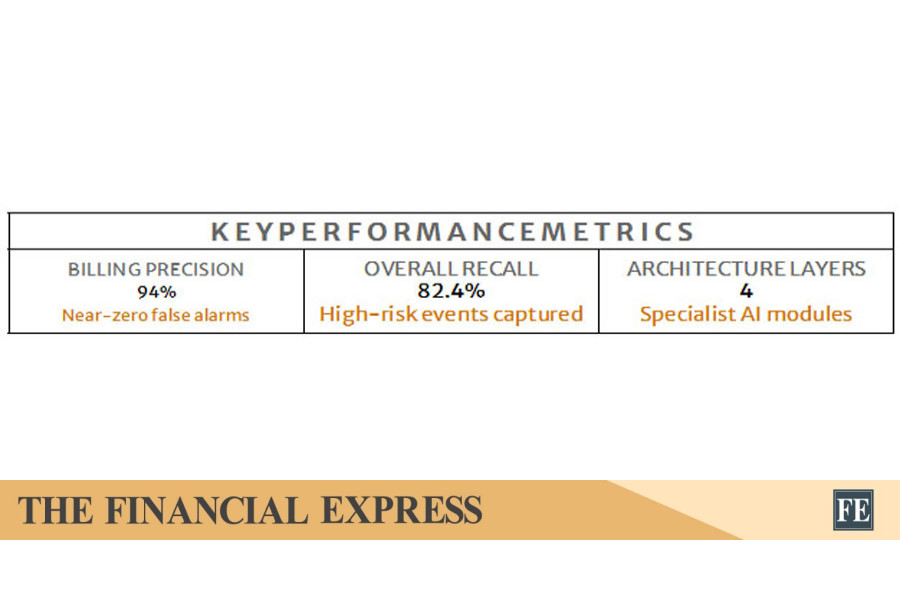
PERFORMANCE AND OPERATIONAL IMPACT: The performance metrics of this synergistic architecture clearly demonstrates the immense value of specialised, multi-layered AI. By utilising advanced hyper parameter tuning to manage severe class imbalances, the dedicated billing anomaly layer achieved an exceptional 94 per cent precision rate. In practical terms, this means that when the system flags a billing error, the alert is incredibly reliable, generating almost zero false alarms. When all layers are synthesised by the meta-learner, the complete system achieves an impressive overall recall rate, capturing 82.4 per cent of all high-risk events across the entire platform.

The operational impact of implementing this hierarchical blueprint across the financial sector would be profound. For traditional banks, mobile financial services, and major payment gateways, managing customer disputes is highly resource-intensive, requiring manual human investigation that increases overhead costs. By deploying an automated framework capable of instantly distinguishing between malicious fraud and operational billing errors, financial institutions can immediately triage issues, reserving expensive manual reviews only for highly ambiguous cases.

Furthermore, the high precision rate ensures that legitimate transactions flow without friction, safeguarding consumer relationships from unnecessary account freezes. Embracing this modular, highly interpretable artificial intelligence paradigm is not just a technical upgrade; it is an essential strategic investment for building a resilient, cost-effective, and deeply trusted financial ecosystem for the future.

Dr. Shuvashish Roy, Senior Researcher, Research & Innovation Division, Prime Bank PLC. Md Tuhin Rana, Student, Department of Statistics, University of Dhaka​
 

The OpenAI–Musk dispute: Who controls the future of AI?

Faridul Alam

1779684062274.webp

Elon Musk seen during the trial over the future direction and governance of OpenAI PHOTO: REUTERS

The ongoing dispute between OpenAI and Elon Musk has been framed, at least superficially, as a legal and personal confrontation—a founder challenging the trajectory of an institution he helped to create. The superficiality lies in the tendency to treat proceedings before a US federal court—and any potential jury verdict—as dispositive in the narrow legal sense of conclusively settling a matter. Such outcomes, however, are better understood within what Michel Foucault would call a dispositif: a broader apparatus of power and knowledge in which legal judgments function not as endpoints but as moments within an evolving field of institutional and discursive forces. In other words, a different sequencing before the court, or a variation in how the case was constructed, could just as plausibly have yielded an antithetical result. Headlines that cast the episode as a win or loss for either side therefore risk mistaking procedural resolution for substantive closure, obscuring the more consequential reality: this is not simply a conflict over contracts or corporate governance, but a struggle over the meaning of “openness” in an era in which it is both under assault and structurally difficult to sustain.

At stake is the evolution of artificial intelligence from an aspirational public good into a capital-intensive strategic infrastructure. Musk’s critique rests on the claim that OpenAI has departed from its original nonprofit, open ethos. OpenAI, for its part, has implicitly argued that the scale, cost, and risks associated with developing frontier AI systems require new institutional forms—hybrid models that combine mission with market discipline, and openness with controlled deployment. The disagreement, then, is less about whether OpenAI has changed than about how that change should be interpreted.

A useful contrast can be found in the Human Genome Project, often cited as a model of large-scale scientific openness. Completed in 2003, the project made a deliberate commitment to keeping genomic data in the public domain, resisting efforts to privatise genetic sequences. Yet even there, openness was not uncontested. The publicly funded initiative operated alongside private ventures, most notably Celera Genomics, which sought to commercialise genomic data through proprietary databases. The eventual outcome—a largely open genomic commons—was not the natural state of scientific progress but the product of political decisions, institutional coordination, and sustained public investment.

The comparison is instructive precisely because it reveals what has changed. The Human Genome Project unfolded in a context in which governments could mobilise resources at scale and in which the benefits of openness could be institutionalised through public funding. By contrast, contemporary AI development is driven by computational demands and competitive dynamics that far exceed the capacity of any single public institution. The infrastructure required to train advanced models—massive data centres, specialised chips, and continuous iteration—has shifted the centre of gravity towards private actors. Under such conditions, openness is no longer a default aspiration but a contested and often costly choice.

This transformation can also be parsed through what Fredric Jameson famously described as postmodernism, or the cultural logic of late capitalism, in which concepts that once functioned as ethical or intellectual commitments are progressively absorbed into the circuitry of capital. In this sense, “openness” no longer operates as a stable normative principle but as a flexible signifier, rearticulated according to institutional position and market strategy. What appears as a disagreement over fidelity to founding ideals is thus also a symptom of a broader condition in which even the language of the commons is recoded within competitive economic structures.

This shift signals a broader reconfiguration of the political economy of knowledge production. In earlier eras, the state functioned as the primary underwriter of large-scale scientific endeavours, enabling forms of openness that were insulated, at least partially, from market imperatives. Today, however, the locus of innovation has migrated towards corporate ecosystems in which intellectual property, platform control, and first-mover advantage shape the trajectory of research. The result is a hybrid regime in which public rhetoric continues to invoke the language of the commons, even as the underlying structures increasingly resemble those of proprietary capitalism.

The legal dispute between Elon Musk and OpenAI thus operates as a proxy for a deeper structural tension. Musk’s position gestures towards a more decentralised and transparent trajectory for AI development, even as his own venture, xAI, competes within the same high-stakes ecosystem. OpenAI’s alignment with partners such as Microsoft reflects the opposite pull: towards consolidation, managed deployment, and integration into existing technological and economic hierarchies. Neither position stands outside the system it critiques. Both are embedded in a competitive landscape in which scale and control increasingly determine viability.

1779684106896.webp

OpenAI CEO Sam Altman seen during the trial over the future direction and governance of OpenAI PHOTO: REUTERS

The future of AI governance will not be determined by technical capability alone, nor secured through regulatory design in any straightforward sense. It will instead be shaped by how a small set of foundational terms—“open,” “safe,” and “aligned”—are continuously defined, contested, and operationalised by the institutions that now govern computation at scale.

What makes the conflict particularly instructive is that it cannot be resolved at the level of legal judgment alone. Courts may adjudicate specific claims—about contractual obligations, fiduciary duties, or representations of intent—but they cannot definitively settle what “openness” was meant to signify at the project’s inception. That question is not purely legal; it is historical, philosophical, and strategic. Each side reconstructs the past in order to legitimise its present position.

To understand the stakes more fully, one must situate this dispute within the emerging architecture of AI as infrastructure. Unlike earlier digital technologies, advanced AI systems do not merely enable applications; they function as foundational layers upon which entire economic sectors are being reorganised. From finance and logistics to healthcare and education, AI models are becoming embedded in decision-making processes at scale. Control over these models therefore confers not just market advantage but structural power—an ability to shape the conditions under which knowledge is produced, accessed, and applied.

This infrastructural turn introduces new forms of dependency and asymmetry. Firms and governments alike increasingly rely on a small number of providers for access to advanced AI capabilities, raising concerns about concentration and systemic risk. The analogy to energy markets is not entirely misplaced: just as control over oil and gas once defined geopolitical leverage, control over computational resources and model architectures is beginning to define the contours of technological sovereignty. In this environment, openness is constrained not only by economic incentives but also by strategic considerations, including national security and geopolitical competition.

1779684140770.webp

Elon Musk’s lawyer Marc Toberoff addresses the media outside the Oakland federal courthouse during the trial over OpenAI’s conversion to a for-profit organisation on May 18, 2026. Photo: Reuters

The labour dimension of this transformation is equally significant. The development and deployment of AI systems rely on vast, often invisible networks of human labour—from data labelling and content moderation to engineering and infrastructure maintenance. Much of this labour is geographically dispersed and unevenly compensated, reflecting broader patterns of global inequality. The political economy of AI thus extends beyond questions of ownership and control to encompass the conditions under which value is extracted and distributed. Openness, in this context, cannot be disentangled from questions of labour, exploitation, and the global division of technological work.

At the same time, the data that fuels AI systems raises its own set of political-economic questions. Large language models are trained on vast corpora of text, much of it produced without explicit consent or compensation. This has sparked growing debate over data rights, intellectual property, and the boundaries of fair use. If data is the raw material of AI, then the governance of data becomes central to the governance of AI itself. Here again, the language of openness collides with competing claims over ownership, privacy, and value.

Regulation enters this landscape as both a constraint and an enabler. Governments are increasingly seeking to shape the development of AI through rules on safety, transparency, and competition. Yet regulatory frameworks often lag behind technological change, and they are themselves shaped by the lobbying power of major firms. The risk is that regulation may entrench existing advantages rather than democratise access, thereby reinforcing the very concentrations of power it seeks to mitigate. The political economy of AI is therefore not simply a matter of market dynamics but also of institutional design and political contestation.

In this sense, the dispute between Elon Musk and OpenAI illustrates a recurring pattern in technological transformation. Founding ideals, articulated under conditions of relative uncertainty and low capital intensity, are reinterpreted as systems scale and the stakes rise. What appears as betrayal to some becomes adaptation to others. The shift from openness to controlled access is not unique to AI; it echoes earlier transitions in the history of the internet and platform economies. In the case of AI, however, the stakes are considerably higher, given the technology’s potential to reshape economic structures, information ecosystems, and political power.

The future of AI governance will not be determined by technical capability alone, nor secured through regulatory design in any straightforward sense. It will instead be shaped by how a small set of foundational terms—“open,” “safe,” and “aligned”—are continuously defined, contested, and operationalised by the institutions that now govern computation at scale. These are not neutral descriptors but instruments of alignment and legitimation, whose meanings shift as they move between corporate strategy, regulatory discourse, and geopolitical competition.

The dispute between OpenAI and Elon Musk is therefore less a legal episode than a diagnostic of this broader condition. It reveals a political economy in which meaning itself has become unstable: no longer anchored in shared normative reference points, but continually reconstituted through shifting institutional positions and infrastructural constraints. What emerges is a regime of free-floating semantics, in which the key vocabulary of AI governance no longer stabilises practice but instead travels with it—recast, reweighted, and redeployed as strategic circumstances demand. In this sense, the struggle over artificial intelligence is also a struggle over language: a contest in which even the language of the commons is drawn into systems of competitive differentiation and control.

Whether or not any actor prevails in court, the deeper dynamic will persist. “Openness”, once treated as an originating ideal of the field, has become an object of ongoing negotiation—its content contingent, its boundaries elastic, and its function increasingly embedded within a wider architecture of power and computation. The question, then, is no longer who wins this dispute. It is whether any vocabulary remains capable of anchoring collective judgment at all—or whether the language through which AI is governed is itself already the terrain on which capture is complete.

Dr. Faridul Alam, a former academic, writes from New York City.​
 

Artificial intelligence is misnamed

FOR centuries, the growth of civilisation has depended on tools that extended the reach of the human mind. The telescope enabled astronomers to peer into distant galaxies. The microscope revealed invisible organisms. The computer transformed complex calculations into routine operations. None of these inventions replaced human intelligence. Each amplified it.

What we call artificial intelligence belongs to this same lineage, yet the phrase itself may be misleading. In common language, the word ‘artificial’ often carries an unintended implication of imitation or inferiority. Artificial flowers are not real flowers. Artificial sweeteners mimic sugar. Artificial limbs substitute for natural ones. The adjective can suggest something synthetic rather than authentic. That connotation does not accurately describe the most meaningful uses of AI.

When a writer uses AI to draft an article, the system does not independently create a finished intellectual product. The algorithm searches and synthesises information from humanity’s vast digital archive, but the human author defines the purpose, frames the question, chooses the analytical framework, evaluates evidence, verifies facts, revises the prose and accepts responsibility for every conclusion. The resulting work is not purely artificial. It is participatory.

For this reason, a more precise term may be participatory intelligence (PI). This concept captures a fundamental reality: the machine does not possess independent intelligence in the human sense. Rather, it participates in an intellectual process directed by a human being who supplies the purpose, questions, conceptual framework, ethical judgement and final interpretation. The word ‘participatory’ emphasises collaboration rather than autonomy and correctly identifies the machine as an instrument that extends, rather than replaces, human reasoning.

The machine contributes computational speed, vast memory, pattern recognition and rapid synthesis. The human contributor provides intention, context, creativity, scepticism and responsibility. The resulting output is a joint product, but genuine understanding remains rooted in human consciousness. Purpose, judgement and accountability continue to reside in the human mind, which alone bears responsibility for the meaning and consequences of the final work.

This relationship mirrors the way machines have always functioned in economic production. A tractor participates in agriculture but does not understand farming. A lathe participates in manufacturing but does not comprehend engineering. A calculator participates in mathematics but does not grasp mathematical truth. Likewise, large language models participate in the creation of narratives but do not understand truth, morality or meaning as human beings do.

The same principle applies in medicine. Physicians routinely use magnetic resonance imaging, computed tomography, and ultrasound to visualise internal organs, tumours, fractures and blood flow. These machines generate extraordinarily useful images, but they do not diagnose disease. The physician interprets the images, combines them with symptoms, laboratory results and medical history and makes the final diagnosis. No one calls this an ‘artificial diagnosis.’ The machine participates in diagnosis; it does not diagnose.

The pharmaceutical industry offers another example. Modern factories manufacture antibiotics, insulin, vaccines and countless life-saving drugs. Yet no one argues that these factories produce ‘artificial cures.’ The factories participate in the production of medicine, but scientific knowledge, clinical judgement and therapeutic decisions remain fundamentally human.

Public discussion of AI often swings between two extremes. One camp portrays it as a miraculous substitute for human intelligence. Another depicts it as a dangerous force that will erode originality and destroy thinking. Both views miss the central point: the quality of the output depends on the quality of human participation. The human mind remains the pilot; the machine is the engine.

From an economic perspective, AI represents a major technological advance. It sharply reduces the marginal cost of producing text, images, audio and video. Just as industrial machinery lowered the cost of manufacturing and computers lowered the cost of information processing, AI lowers the cost of producing narratives and analyses. When costs fall, supply expands. The world is already experiencing a flood of AI-generated essays, reports, graphics and presentations. This democratises access to intellectual tools and can substantially increase productivity.

But increased output does not guarantee increased truth. Because AI predicts statistically plausible sequences rather than understanding reality, it can fabricate facts, invent references and present errors in polished language. If users accept those outputs without scrutiny, they transfer the risk of misinformation to readers, students, clients and citizens. The economic lesson is clear: information is becoming abundant, but trustworthy judgement remains scarce.

This scarcity is particularly important in journalism. Credibility is a form of institutional capital built slowly and lost quickly. Responsible journalists can use AI to summarise documents, explore data and improve clarity. Irresponsible use can contaminate reporting and erode public trust. In an age of information abundance, trust becomes one of the most valuable forms of social capital.

Education presents a similar challenge. Students who use AI to compare ideas, test arguments and refine drafts may deepen understanding. Students who use it to bypass thought may sacrifice the very learning they seek. Scientific research also depends on participatory intelligence. AI can assist in organising literature, generating hypotheses and analysing data, but discovery still requires human scepticism, methodological rigor and ethical responsibility.

History suggests that powerful tools increase rather than diminish the value of expert judgement. Calculators did not eliminate mathematics. Computers did not end engineering. Medical imaging did not replace physicians. Artificial intelligence is likely to follow the same pattern, enhancing human capabilities while making sound judgement more important than ever.

The real question is, therefore, not whether society should use AI. That question has already been answered. The technology is here and will become increasingly capable. The important question is whether human beings will remain intellectually engaged and morally responsible for what these systems produce.

If they do, AI can become one of the greatest tools ever created for expanding knowledge, creativity and human welfare. If they do not, society may produce more information while generating less wisdom.

Artificial intelligence is more accurately understood as participatory intelligence: a collaborative process in which machines extend human analytical capacity, while purpose, judgement and meaning remain firmly in human hands. Artificial intelligence or, more precisely, participatory intelligence — is transforming the production of narratives.

MRI participates in diagnosis; it does not diagnose. A pharmaceutical factory participates in treatment; it does not heal. AI participates in thinking; it does not understand.

The danger lies not in artificial intelligence itself, but in natural intelligence that chooses to disengage. AI should augment human intelligence, not anesthetise it.

Dr Abdullah A Dewan, former physicist and nuclear engineer at Bangladesh Atomic Energy Commission, is professor emeritus of economics, Eastern Michigan University (USA).​
 

The AI gold rush: Can Bangladesh cash in before the window closes?

Reyad Hasnain

Published :
May 24, 2026 22:28
Updated :
May 24, 2026 22:28

1779839045501.webp


Walk into any tech hub in Dhaka these days and you will hear the same conversation repeated in different accents: artificial intelligence is changing everything, and those who move fast will eat the lunch of those who hesitate. From the cramped freelancer co-working spaces of Dhanmondi to the gleaming floors of Kaliakoir Hi-Tech Park, there is a palpable sense that Bangladesh stands at a crossroads. The global market for AI-enabled IT services is ballooning toward an estimated seven hundred billion dollars by 2030, and the question on everyone's lips is simple: will Bangladesh grab its share, or watch the opportunity slip through its fingers?

The honest answer is that nobody knows yet. But there are reasons for both optimism and anxiety. On the one hand, this country has built something real over the past decade. Official figures put IT exports at around seven hundred and twenty-five million dollars in the last fiscal year, with some industry insiders suggesting the actual number could exceed one billion if you count freelancer earnings that bypass official channels. Over three hundred and fifty companies now export software and services to more than eighty countries, and half a million people work in some capacity in the ICT sector. That is not nothing.

On the other hand, when you stack those numbers against the competition, the picture gets uncomfortable. India's IT-BPM industry now earns over one hundred and ninety billion dollars annually in exports, while even neighbouring Pakistan has surged to nearly four billion dollars in IT revenues and is growing at eighteen per cent year on year. Vietnam has built an export machine worth tens of billions by focusing ruthlessly on quality and compliance. Bangladesh, for all its progress, remains a minnow swimming with whales.

The shape of the opportunity

What makes this moment different from earlier waves of IT outsourcing is the nature of demand. When companies outsourced call centres and back-office operations in the early 2000s, they wanted cheap labour and not much else. The AI wave is fundamentally different. Today's buyers want partners who can help them build intelligent chatbots, automate fraud detection, analyse mountains of customer data, integrate machine learning into legacy systems, and deploy AI-augmented software that actually works. They want collaborators, not just code monkeys.

This shift creates openings for newcomers. The established giants in India and Eastern Europe are saturated with work and struggling to find enough AI engineers. Western companies are actively scouting what analysts call 'next-wave' destinations: places with technical talent, competitive costs, and fewer of the bottlenecks that plague mature outsourcing hubs. Bangladesh, at least on paper, fits the profile.

The cost advantage is real and significant. An AI engineer in Dhaka costs roughly one-third of a counterpart in Bangalore and one-fifth of one in San Francisco. For labour-intensive work such as data annotation and model validation, the savings are even more pronounced. And the time zone, often overlooked, is actually an asset: GMT plus six allows Bangladeshi teams to work while their American and European clients sleep, enabling genuine round-the-clock development cycles.

The talent question

But here is where things get complicated. Bangladesh produces around seventy to eighty thousand engineering and computer science graduates every year. That sounds like a healthy pipeline until you look at what those graduates actually know. Most university curricula remain stuck in the past, heavy on theory and light on the hands-on skills that AI work demands: proficiency in frameworks like TensorFlow and PyTorch, familiarity with cloud platforms, experience working with messy real-world datasets, and the communication skills needed to manage complex client relationships across continents.

Industry executives I spoke with described a painful reality: many fresh graduates require six months to a year of training before they become productive. The shortage is most acute at the mid-level and senior tiers, where engineers with both technical depth and project management experience are needed to lead AI initiatives. And just as Bangladesh is building this capability, its best engineers are being poached by multinationals in Singapore, the Gulf, and Europe, where salaries run double or triple the local rate.

The good news is that there is real movement on skills development. Platforms like MuktoPaath now provide certified online training to over four hundred and fifty thousand young Bangladeshis. The government's Smart Bangladesh 2041 roadmap includes ambitious plans for AI bootcamps, specialised university labs, and public-private partnerships to align training with industry needs. But translating policy into outcomes will require sustained investment and disciplined execution, neither of which has been Bangladesh's strong suit historically.

Trust as the real currency

If there is one message that local IT companies need to hear, it is this: AI buyers are paranoid about compliance. Unlike generic web development, AI projects often involve sensitive training data, whether customer records, medical images, financial transactions, or proprietary business logic. A single data leak or misuse can destroy a vendor's reputation permanently.

International clients now demand proof of security certifications such as ISO 27001, GDPR compliance, and SOC 2 reports before they even consider a proposal. They want robust contracts with clear intellectual property clauses, reviewed by international legal counsel. Too many Bangladeshi firms still treat compliance as a box to tick rather than a core capability. That mindset has to change.

The industry association BASIS and the Hi-Tech Park Authority can help by subsidising security audits and offering group certification programmes. A dedicated 'trustmark' for Bangladesh's IT exporters, similar to the green factory accreditation that transformed the garments sector's image, could signal quality to sceptical global buyers. But ultimately, individual companies must own this. Compliance is not a cost centre; it is the price of admission to the high-value end of the market.

The payment problem that nobody wants to talk about

Ask any freelancer in Bangladesh what their biggest operational headache is, and the answer comes back instantly: getting paid. The country has over one million active freelancers earning foreign currency, yet the infrastructure for receiving international payments remains frustratingly primitive. PayPal, the global standard used by clients everywhere, still does not offer full services in Bangladesh. Stripe, essential for anyone building a software-as-a-service business, is completely unavailable. Even Wise, which was working until recently, has started restricting inbound transfers.

This is not a trivial inconvenience. It drives business away. Clients in America and Europe find it bizarre that a Bangladeshi developer cannot simply invoice them and receive payment within days like a contractor anywhere else in the world. Some have cancelled work orders rather than navigate the convoluted workarounds required. The regulatory barriers, mostly related to foreign exchange controls and anti-money-laundering rules, are understandable in principle. But Bangladesh Bank needs to find solutions that protect the financial system without strangling the country's most promising export sector.

There are signs of movement. The central bank governor confirmed late last year that discussions with PayPal have resumed, with a focus on building a freelancer-friendly remittance gateway. But no official launch date has been announced. Every month of delay is another month where contracts go to Manila, Hanoi, or Nairobi instead.

From freelancers to firms

For too long, Bangladesh's IT exports have been dominated by small freelancing gigs: five hundred dollar website tweaks, basic app development, data entry. Freelancers will always be part of the ecosystem, and many have built impressive global reputations. But capturing high-value AI contracts requires something more: organised companies that can assemble teams of fifty to a hundred engineers, maintain project management discipline, ensure quality assurance, and deliver consistently over multi-year engagements.

A few local pioneers have shown what is possible. Companies like BJIT, SELISE, Brain Station 23, and Cefalo have won long-term contracts from European and Japanese clients by emphasising process maturity, security, and transparent reporting. They prove that Bangladeshi firms can compete on quality, not just price. But these remain exceptions. The average local IT company lacks the bench strength and delivery infrastructure to bid for contracts worth five million dollars or more.

Building that capability will require investment in project management frameworks, automated testing pipelines, and dedicated account management. It may also require industry consolidation, merging small firms into larger entities that can compete at scale. The government could accelerate this through soft loans for acquisitions or by creating consortium arrangements to bid on major international tenders.

The road ahead

Turning the AI wave into dollars is not going to happen by accident. It requires a coordinated effort across government, industry, and academia, the same formula that transformed the ready-made garments sector from nothing into an eighty-billion-dollar export engine over three decades. The ICT Division has set a target of five billion dollars in IT exports by 2031. Reaching that will require annual growth rates of over thirty per cent, ambitious but not impossible if the right pieces fall into place.

The priorities are clear. First, fix the payments infrastructure so that earning foreign currency is not an obstacle course. Second, clarify the tax regime so that exporters can plan with confidence. Third, invest seriously in skills development, not more programmes but better ones, designed in genuine partnership with industry and evaluated ruthlessly on employment outcomes. Fourth, strengthen compliance capabilities so that Bangladeshi firms can compete for high-value contracts in regulated industries. Fifth, build the institutional capacity of local companies to deliver at scale.

None of this is revolutionary. These are the same lessons that India learned in the nineteen nineties, that Vietnam learned in the two thousands, that every successful IT exporting nation has figured out one way or another. The question is whether Bangladesh will act with the urgency the moment demands.

The window of opportunity is open. New AI buyers are entering the market faster than established vendors can serve them. Cost structures favour countries like Bangladesh. The global talent shortage means that capable engineers here can command premium work if they can demonstrate quality. But this window will not stay open forever. Countries across Asia and Africa are racing to capture the same opportunity. Every month of hesitation is a month where competitors build relationships and reputations that become harder to dislodge.

Bangladesh has something to prove. It has spent two decades building an IT sector from almost nothing, defying sceptics who said a garments-dependent economy could never compete in knowledge work. The foundation is there. The talent exists. What is needed now is execution: clear policy, serious investment, and an industry willing to hold itself to global standards. The AI gold rush is underway. The only question is whether Bangladesh will be a participant or a spectator.

- The writer is a policy analyst specializing in digital governance and public-sector reform​
 

Latest Posts

Back