[🇧🇩] Corruption Watch

[🇧🇩] Corruption Watch
387
15K
More threads by Saif

G Bangladesh Defense

Bangladesh-linked money in Swiss banks swells
Latest deposits amount to Tk 126.79 billion

Asjadul Kibria

Published :
Jun 19, 2026 00:16
Updated :
Jun 19, 2026 00:16
1781825673228.webp


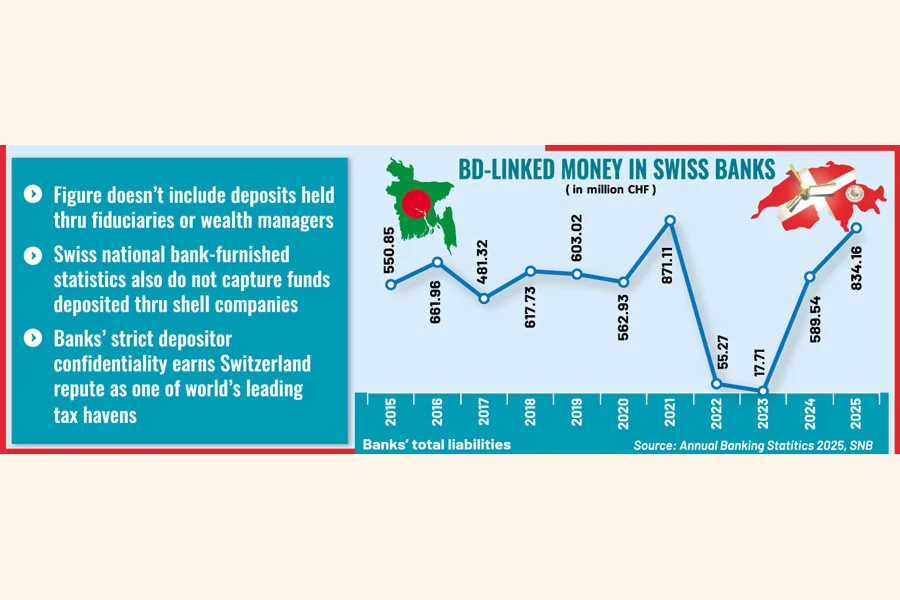
Bangladesh-linked money in Swiss banks ballooned further in 2025 by 41 per cent from the amount recorded in 2024 when there was a quantum leap of 232 per cent following previous two years' sharp decline.

The picture of much-talked-about 'Swiss bank balance' emerges from the Annual Banking Statistics 2025 released by the Swiss National Bank (SNB) in Zurich on Thursday.

According to the latest SNB data, total such deposits in Swiss banks -- including trade finances, investments, and funds held by Bangladeshi individuals and entities -- stood at CHF (Swiss Franc) 834.16 million last year.

Based on the current average exchange rate of Tk 152 per CHF, the amount is equivalent to approximately Tk 126.79 billion.

In 2024, the corresponding amount was CHF 589.54 million, or Tk 89.61 billion. The figures do not include deposits held through fiduciaries or wealth managers.

As the Bangladeshi taka (BDT) has depreciated against major foreign currencies over the past few years, figures converted to local currency using current exchange rates differ from those published previously by the FE.

Although Swiss bank deposits are often associated with stashed wealth, black money or illegally transferred assets from various countries, the SNB report does not provide any information on the nature or source of the funds.

Its statistics show Bangladesh-linked deposits had fallen to CHF 17.71 million (Tk 2.69 billion) in 2023 and CHF 55.27 million (Tk 8.40 billion) in 2022.

Deposits held by Bangladeshi and other non-Swiss individuals and entities are recorded under the "liabilities" section of Swiss banks' balance sheets.

These liabilities are mainly divided into two categories. The larger component, "amounts due to banks", accounted for CHF 822.71 million (Tk 125.06 billion) of Bangladesh-linked money in 2025.

The remaining CHF 11.45 million (Tk 1.74 billion) was classified as "amounts due in respect of customers' deposits".

The above-mentioned figures exclude deposits routed through fiduciaries or wealth managers. Bangladesh-linked deposits held through such channels amounted to CHF 8.31 million, or Tk 1.26 billion, last year.

A few years ago, Bangladesh Bank prepared an explanatory note on Bangladesh-linked deposits in Swiss banks.

The central bank argued that only around 10-15 per cent of such deposits belonged to individual clients, while the bulk of the money represented funds placed by banks for trade-related transactions.

According to Bangladesh Bank, therefore, only a small portion of the deposits may represent money transferred from Bangladesh and stashed abroad.

The SNB statistics also do not capture funds that Bangladesh-linked clients may have deposited through shadow entities or shell companies.

Meanwhile, total funds held by all foreign clients in Swiss banks declined further in 2025 to CHF 896.38 billion from CHF 977.12 billion in 2024 and CHF 983.45 billion in 2023.

The figure represents total liabilities of Swiss banks, excluding fiduciary liabilities.

The SNB data also show Indian deposits in Swiss banks declined by 7.78 per cent to CHF 3.23 billion in 2025 from CHF 3.50 billion in 2024.

Pakistani deposits also fell by around 13 per cent to CHF 236.35 million from CHF 271.67 million over the same period. These figures likewise exclude deposits held through fiduciaries.

Switzerland's banking system is known for maintaining strict depositor confidentiality -- a feature that has long contributed to the country's reputation as one of the world's leading tax havens.​
 

A chronicle of kleptocracy and plunder of banks
There are very few examples of one-third of a country’s banking-sector funds being lost through theft or robbery. Had the government performed its assigned role properly, and had Bangladesh Bank fulfilled its regulatory responsibilities effectively, such theft or robbery should not have occurred.

Mohiuddin Ahmad
Writer and Researcher
Published: 19 Jun 2026, 16: 11

1781913996850.webp


This region has seen many dictators in recent history, like Ayub Khan of Pakistan, Park Chung-hee of South Korea, Lee Kuan Yew of Singapore, Suharto of Indonesia, and Ferdinand Marcos of the Philippines. Ayub, Suharto, and Park came to power through military coups. Lee and Marcos became heads of government after winning elections. All of them were dictators. Yet there was one major difference among them.

The extraordinary development achieved by South Korea and Singapore over the past several decades owes much to the contributions of Park Chung-hee of South Korea, Lee Kuan Yew of Singapore. In the eyes of their citizens, they are known as “developmental dictators.” Within a remarkably short period, they elevated their countries to the level of Europe.

On the other hand, Pakistan, Indonesia, and the Philippines were unable to come close to achieving the same. The reason is that their rulers were not only dictators; they were also corrupt. They established kleptocracies in their respective countries. They themselves amassed enormous wealth.

The irony of history is that today it is difficult to find any landmark in Pakistan named after Ayub. He died in relative neglect and isolation.

Suharto and Marcos were overthrown by popular uprisings and fled their countries. They remained in exile for the rest of their lives.

Even after them, we have seen many dictators. In our own country, the most recent example was Sheikh Hasina. In her determination to remain in power, there was scarcely any misdemeanour she did not commit. She was joined by a group of plunderers and loyalist followers. Together, they sucked the country dry, squeezing it until little was left. Nearly all of the country’s institutions are now struggling with deep, festering wounds. The banking sector is one of the hardest hit.

At a post-budget press conference on 12 June, the Governor of Bangladesh Bank made what could be described as a “confessional” statement, saying that “one-third of the money in the banking sector has been stolen.”

The money that was stolen from the banks belonged to lower- and middle-income depositors. Wealthier individuals do not leave their money sitting idle in banks. What was stolen was the depositors’ money. Ordinary people had entrusted their savings to banks based on the belief that they would be able to withdraw their funds whenever they wished. The state and the government, through Bangladesh Bank, are responsible for safeguarding the interests of depositors.

From the statement of the Governor of Bangladesh Bank, it appears that the institution primarily responsible for fulfilling this duty has confined itself to merely describing the crime after it occurred. The Governor declared that theft had taken place, but he did not disclose whether any theft cases had been filed against those responsible.

Among the banks from which money was allegedly stolen, readers have learned through newspaper reports about various incidents involving the loss of depositors’ funds at Islami Bank Bangladesh PLC. Based on the details presented in those reports, the offence related to the change in ownership of the bank does not fall within the legal definition of “theft” under Sections 378 and 379 of the Penal Code. Rather, the elements described appear to correspond more closely to the legal definition of “robbery” under Sections 391 and 395 of the Penal Code.

Whether the crime is called theft or robbery, I have not heard that any of those who were entrusted with depositors’ funds, and from whose custody that money disappeared, have filed a theft or robbery case in connection with the offence. Should we then assume that bank officials or owners were unaware that when depositors’ money is stolen, a criminal complaint for theft must be filed against the perpetrators?

Some may argue that cases concerning the misappropriation of funds have already been filed and that, in at least one instance, a court has even imposed punishment. What I am saying is that no case was filed specifically on charges of theft or robbery. The cases that were filed concerned other types of offences.

I am discussing two serious crimes that are familiar to everyone: theft and robbery. There is no need to explain what theft and robbery are. Everyone understands these concepts very well.

If the dramatic accounts published in newspapers regarding the replacement of the chairman of Islami Bank Bangladesh PLC during the tenure of Sheikh Hasina are accurate, then I see no reason why a robbery case should not have been filed over that incident. The then-chairman, who would have been the victim of that event, does not appear to have filed any robbery case from that time until now. Likewise, there is no indication that any subsequent governors filed theft or robbery cases either.

Nor have I heard that any of the officials or board members of the banks from which money was stolen or looted fulfilled their legal responsibilities by filing theft or robbery cases.

Under existing law, anyone who was aware that a theft or robbery had occurred but failed to report it may have committed an offence punishable by imprisonment or a fine under Section 176 of the Penal Code. Readers should remember that, under criminal law, there is generally no statute of limitations barring the allegation, investigation, or prosecution of criminal offences.

The supreme law of the country is the Constitution. Article 21 of our Constitution identifies the protection of national property as a civic duty of every citizen. Scholars may continue to debate whether the private deposits held by bank customers should be regarded as national property. However, the money lost through theft or robbery constitutes evidence of a crime.

The governor has said that the money lost by depositors through bank thefts or robberies will be repaid. But this money ultimately comes from the taxes paid by the country’s 180 million people. In this country, even the poor contribute through VAT and other taxes. How ethical, then, is this decision?

Under our country’s Evidence Act, the statement made by the Governor of Bangladesh Bank would be admissible as strong and highly valuable evidence for identifying the culprits and conducting an investigation or trial. The Governor and the officials of Bangladesh Bank working under his supervision have presumably already identified both the theft and those responsible for it. All that remains is to file a case in court and provide testimony; once that is done, the perpetrators can be brought within the reach of punishment.

Judges of our criminal courts could, if they chose, bring such a case under expedited trial on their own initiative. If an enterprising judge were to arrange for the swift prosecution of the offenders, there would be no need to use money earned through the labor and sweat of our farmers and workers to reimburse depositors.

There are very few examples of one-third of a country’s banking-sector funds being lost through theft or robbery. Had the government performed its assigned role properly, and had Bangladesh Bank fulfilled its regulatory responsibilities effectively, such theft or robbery should not have occurred.

For that reason, the possible involvement of influential figures in the government of the time warrants scrutiny. If theft or robbery cases were filed, that issue would naturally come before the courts on its own.

The judicial system currently in force in the country was originally introduced by a foreign trading company. The military commander who led that company’s conquest of Bengal received such an enormous sum of money from what was then the country’s most powerful businessman, often described as the “Banker of the World”, that, after returning home, Robert Clive became one of the wealthiest men in Europe.

India was regarded as the “Jewel in the Crown” of the British Empire. After Clive conquered that jewel, the British ruler who later expanded and consolidated imperial rule was Warren Hastings. Both Clive and Warren Hastings were subjected to impeachment proceedings by their own country. They were publicly tried. Among the allegations against them was that they had plundered the wealth of Bengal and India.

Meanwhile, we have confined ourselves merely to declaring that theft has occurred. More regrettably, even the theft of Bangladesh Bank reserves has not been brought to justice. Will kleptocracy continue unabated?

* Mohiuddin Ahmad, writer and researcher​
 

Ensure ACC remains nonpartisan

A flawed search committee risks undermining it

1782278090305.webp

VISUAL: STAR

The formation of a search committee to appoint a new chairman and commissioners of the Anti-Corruption Commission (ACC), after leaving this vital institution effectively crippled for almost four months, raises critical questions about the government's intentions. It remains to be seen whether the appointment of the ACC chairman and commissioners is carried out transparently and free from partisan influence. This is because the ACC, since its inception, has repeatedly been embroiled in controversy over allegations of partisan and selective actions favouring the ruling party.

Since the newly elected BNP government has allowed the Anti-Corruption Commission (Amendment) Ordinance, 2025 to lapse, the legal framework governing the commission remains the Anti-Corruption Commission Act, 2004, which was enacted by the BNP two decades ago. Yet, in constituting the search committee, the government appears to have stretched the provisions of a law it itself enacted while in power.

According to Section 7(e) of the 2004 act, the five-member selection committee shall comprise, in addition to one judge each from the Appellate Division and the High Court Division, the comptroller and auditor general, the chairman of the Public Service Commission, and "the last retired Cabinet Secretary amongst the retired Cabinet Secretaries." The law further stipulates that if such a retired cabinet secretary is unavailable or unwilling to serve on the committee, “the next before retired Cabinet Secretary of the last retired Cabinet Secretary” shall be selected. The serving cabinet secretary may only be nominated if no retired cabinet secretary is available or willing to hold membership of the selection committee. Since it is hard to believe that no previous cabinet secretary was available for the position, the presence of a serving cabinet secretary on the committee inevitably raises concerns about whether the appointment process can remain free from government influence. A flawed selection process risks undermining both ACC’s credibility and public confidence in its ability to act independently and impartially.

With the government allowing the 2025 ordinance to lapse, scepticism has grown regarding the BNP's commitment to introducing stronger legislation to ensure the ACC's independence. Although the government has yet to publish a draft of any new law, ACC officials have already put forward a draft proposal. Rather than alleviating concerns, the ACC's draft appears to deepen them. It proposes empowering the commission's secretary—a civil servant serving on deputation—to make decisions in the event that all commissioner positions become vacant. The government's silence on this proposal, instead of publicly distancing itself from it, is particularly concerning.

The government must prioritise both the reconstitution of ACC and enactment of a new law that guarantees its genuine independence. Reports of thousands of accumulated complaints and pending investigations should serve as a warning that any further delay in reforming and reconstituting the commission will only weaken and overburden this critical institution and also undermine the BNP's stated commitment to combating corruption in governance. We, therefore, call on the government to ensure that the selection committee is free from government influence by rectifying the current composition and strictly adhering to both the letter and spirit of the law.​
 

Who will rein in the defaulted loans?

MM Mahbub Hasan

1782604627884.webp

Loan default Representational image

For many years, one fundamental question has repeatedly surfaced in discussions about Bangladesh's economy: Will the country ever be able to rein in non-performing loans?

An examination of the trajectory of this crisis makes it clear that the problem extends far beyond economic calculations. It is, above all, the cumulative outcome of a political culture, administrative failures, and prolonged policy leniency.

The deep scars inflicted on the financial sector over the past decade and a half have remained the greatest weakness of Bangladesh's macroeconomy, even after the recent political transition and the assumption of office by the newly elected government.

When the Awami League government took office in early 2009, the country's stock of non-performing loans stood at approximately Tk 22,481 crore (Tk 224.81 billion). In the years that followed, Bangladesh witnessed a wave of development, with the completion of major infrastructure projects such as the Padma Bridge, the Dhaka Elevated Expressway, and the Dhaka Metro Rail. During the same period, the national budget expanded to nearly Tk 797,000 crore (Tk 7.97 trillion).

Against the global backdrop, several of Bangladesh's macroeconomic indicators remained positive during this period. Even in the year of the COVID-19 pandemic, the economy grew by 3.45 per cent, with growth accelerating to 7.1 per cent in 2022. Moreover, between 2014 and 2024, Bangladesh recorded an average annual growth rate of 6.2 per cent, outperforming many of its emerging-market peers.

Yet, beneath this development story, deep structural weaknesses were steadily taking root in the financial sector. Politically backed lending that circumvented banking regulations, preferential treatment for selected corporate groups, and excessive leniency through repeated loan rescheduling gradually undermined the resilience of the banking system.
At the end of 2013, the ratio of non-performing loans stood at 8.9 per cent.

Despite a series of regulatory concessions designed to make banks' loan portfolios appear healthier than they actually were, the stock of non-performing loans climbed to Tk 145,633 crore (Tk 1.46 trillion) by the end of 2023.

By June 2024, that figure had risen further to Tk 211,391 crore (Tk 2.11 trillion), equivalent to 12.56 per cent of total outstanding loans.

Following the mass uprising in August 2024, the interim government led by Muhammad Yunus assumed office. The political transition confronted an economy burdened by challenges on multiple fronts. As part of its efforts to restore good governance, the interim administration decided to gradually reduce the overdue period for classifying loans as non-performing to 90 days, in line with International Monetary Fund guidelines.

Although economists viewed the move positively, loan recovery deteriorated sharply during the transitional period as production was disrupted and many business owners withdrew from economic activity. This, in turn, had adverse effects on employment and the broader economy.

At the same time, many loans that had previously been rescheduled were formally reclassified as non-performing. Following the dissolution of the boards of several banks, audit reports began to reveal the true extent of loan fraud involving a number of controversial corporate groups. As a result, the volume of non-performing loans surged to Tk 530,428 crore (Tk 5.30 trillion) by June 2025 and rose further to Tk 557,217 crore (Tk 5.57 trillion) by December.

While the interim government's willingness to disclose the true scale of non-performing loans was commendable, its lack of policy coordination placed additional strain on the macroeconomy. Neither the task force nor the commission established to reform the banking sector delivered meaningful results. The hasty merger of stronger and weaker banks, together with the rapid appointment of administrators to troubled institutions, triggered a severe crisis of confidence among depositors. That, in turn, worsened the liquidity crunch and contributed to a slowdown in private investment.

During the same period, the authorities sought to curb inflation through a tight monetary policy, but persistent supply-chain disruptions remained evident. Consequently, inflation reached 10.2 per cent in 2024, while GDP growth slowed to just 3.49 per cent in the 2024–25 fiscal year—well below Bangladesh's historical average growth rate.

At the beginning of 2026, the newly elected government, which came to power through the Thirteenth Parliamentary Election, inherited a fragile economy characterized by sluggish growth. By March 2026, non-performing loans had increased by another Tk 31,487 crore (Tk 314.87 billion), surpassing Tk 588,704 crore (Tk 5.89 trillion), equivalent to 32.26 per cent of total loans disbursed. At the same time, the banking sector''s provision shortfall had reached Tk 205,665 crore (Tk 2.06 trillion), placing the entire banking system under significant strain.

Meanwhile, within its first six weeks in office, the new government borrowed nearly Tk 41,000 crore (Tk 410 billion) from the banking system. Overall, during the first nine months of the current fiscal year, total bank borrowing by both the interim administration and the present government amounted to approximately Tk 109,000 crore (Tk 1.09 trillion).

Over the one-and-a-half decades of Awami League rule, Bangladesh''s total outstanding public debt, both domestic and external, rose from Tk 276,000 crore (Tk 2.76 trillion) to Tk 1,835,000 crore (Tk 18.35 trillion). A substantial share of this borrowing was used to finance the country''s major infrastructure projects.

During the interim government's 18-month tenure, the stock of both domestic and external public debt increased unexpectedly, pushing total government debt to approximately Tk 23 trillion. The present government began its term carrying this enormous debt burden. If the current trajectory continues, total government debt could reach nearly Tk 34 trillion by the 2028-29 fiscal year. In that case, the government would have to pay about Tk 162.7 billion annually in debt-servicing costs (interest alone), a prospect that poses a serious fiscal concern.

Meanwhile, under the budget for fiscal year 2026–27, the government plans to finance most of its Tk 243,000 crore (Tk 2.43 trillion) budget deficit through borrowing from the banking sector.

According to available data, as of March 2026, more than 85 per cent of the country''s total non-performing loans, amounting to Tk 499,000 crore (Tk 4.99 trillion), were concentrated in just 15 of Bangladesh's 61 banks.

Among the state-owned banks, Janata Bank is in the most precarious position, with nearly 70 per cent of its total loan portfolio, about Tk 72,539 crore (Tk 725.39 billion), classified as non-performing.

In both regional and global comparisons, Bangladesh''s position is deeply concerning. The average non-performing loan ratio across Asia is just 1.6 per cent, while the average for South Asia stands at 3.5 per cent. In India, the ratio ranges between 2.3 and 2.8 per cent; in Nepal, between 4.4 and 5.6 per cent; and even in crisis-stricken Pakistan, it is only 7.4 per cent. By contrast, nearly one-third of all loans disbursed in Bangladesh are now non-performing, several times the regional average.

Bangladesh's legal framework also differs significantly from those of many other countries. The concept of a "willful defaulter" is applied primarily in India and Pakistan. In most developed and emerging economies, however, the law is applied uniformly: failure to repay a loan within the stipulated period triggers the same legal consequences for all borrowers. In the United Arab Emirates, for example, the assets of loan defaulters can be seized immediately.

In China and Vietnam, corruption and large-scale embezzlement may carry the death penalty. China also imposes restrictions on willful defaulters, including bans on obtaining credit cards and purchasing airline or high-speed rail tickets. Following the 1998 financial crisis, South Korea restructured its banking sector by establishing the Korea Asset Management Corporation (KAMCO), which resolved non-performing loans by converting them into equity and other recoverable assets.

If every change of government also brings a change in the culture of banking and the philosophy of financial policymaking, the goal of bringing non-performing loans under control will remain perpetually out of reach.
The non-performing loan crisis cannot be resolved overnight through a single policy or by any one government.

Nevertheless, without fundamental structural reforms, there is no viable path to improvement.

First, the central bank's genuine independence and supervisory capacity must be strengthened, and single-borrower exposure limits for large corporate groups must be enforced rigorously.

Second, the nearly 75,000 cases pending before the loan courts should be resolved expeditiously through the establishment of special tribunals, while strict legal action against willful defaulters must be implemented in practice rather than remaining merely a matter of legislation.

Third, lending decisions must be based on modern risk-based assessment and risk management, replacing the longstanding practice of granting credit on the basis of political influence or personal connections.

Fourth, unwarranted political interference in bank boards must come to an end. In state-owned banks, the practice of appointing directors and senior executives on political grounds should be replaced by a merit-based system that prioritises professional competence.

The deep wounds inflicted on Bangladesh's banking sector by years of irregularities and institutional weakness will take time to heal. Full recovery may require five to ten years. Economic history, however, offers an important lesson: countries that have successfully overcome banking crises have done so through a combination of sustained political commitment and comprehensive institutional reform. South Korea, Malaysia, Thailand, and Sri Lanka all rebuilt their banking systems through rigorous reforms and stronger accountability.

Bangladesh has the economic potential to do the same. The country's economy has already surpassed half a trillion US dollars in GDP. Remittance inflows remain robust, exports continue to offer significant growth potential, and Bangladesh possesses a large and youthful workforce. What is lacking is sustained political will and an unwavering commitment by policymakers to long-term structural reform.

If every change of government also brings a change in the culture of banking and the philosophy of financial policymaking, the goal of bringing non-performing loans under control will remain perpetually out of reach.

The non-performing loan crisis is not merely a banking-sector problem, it affects every citizen. Ultimately, the burden of bad loans is passed on to the public through higher interest rates, persistent inflation, and slower economic growth. Reining in this crisis is therefore a historic responsibility, and one for which both current and future policymakers must be held accountable.

* MM Mahbub Hasan is a banker and development researcher.​
 

Latest Posts

Back