[🇧🇩] Artificial Intelligence-----It's challenges and Prospects in Bangladesh

Afghanistan Albania Algeria Andorra Angola Antigua Austria Azerbaijan Bahamas Bahrain Bangladesh Barbados Canada China Egypt Finland Germany India Iran Israel Japan Lebanon North Macedonia Pakistan Palestine Qatar Russia Syria Turkey Ukraine United Kingdom United States Yemen
[🇧🇩] Artificial Intelligence-----It's challenges and Prospects in Bangladesh
111
5K
More threads by Saif

G Bangladesh Defense

EWU hosts discussion on AI in industry, education
Staff Correspondent 28 June, 2026, 01:15

1782607122347.webp

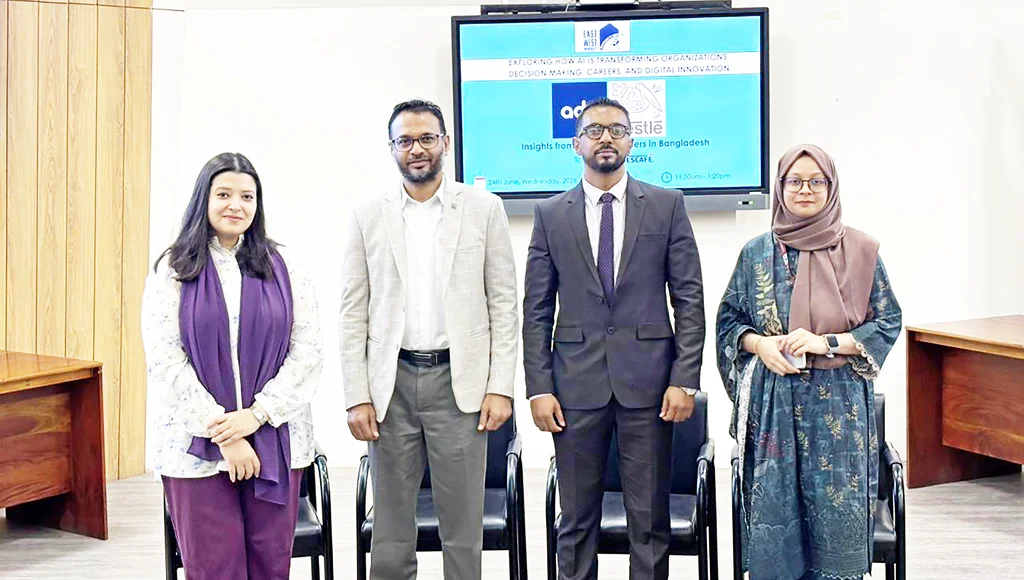
The management information systems department of East West University organises a discussion titled Artificial Intelligence in Industry: Transforming Education and the Future Workplace at the Nousher Ali Lecture Gallery of the university in Dhaka recently. | Press release photo

The management information systems department at East West University has organised a discussion titled Artificial Intelligence in Industry: Transforming Education and the Future Workplace at the Nousher Ali Lecture Gallery of the university in Dhaka recently.

The event aimed to enhance students’ understanding of the growing significance of artificial intelligence in modern industries, business operations and professional environments, said a press release on Saturday.

Through discussions led by industry experts, students gained valuable insights into how AI is reshaping organisations, creating new career opportunities and transforming workplace practices across Bangladesh and beyond.

Reaz Uddin Khan, head of Bangladesh, ADA Data AI Solutions Limited, and Md Tajdiqul Islam, manager, business excellence and project supply chain, Nestlé Professional Bangladesh, attended the discussion as guest speakers.

The speakers shared their experiences and perspectives on the practical applications of AI, emerging industry trends, data-driven decision-making, workforce transformation and the skills required for success in an AI-powered economy.

Speaking about the event, the organisers — EWU senior lecturer Bushra Humyra Esha and lecturer Munira Parvin — emphasised the importance of preparing students for a future in which artificial intelligence would play an increasingly central role in business, education, and society.​
 

Govt to introduce AI-based market monitoring system for agriculture, trade: Commerce Minister

UNB
Published :
Jul 03, 2026 22:24
Updated :
Jul 03, 2026 22:24

1783131393278.webp


The government is set to introduce an artificial intelligence (AI)-based market monitoring system to make agricultural production and market management more data-driven and effective, Commerce, Industries, Textiles and Jute Minister Khandaker Abdul Muktadir said on Friday.

The proposed system will analyse production data, weather forecasts, international market trends, import requirements and supply conditions to facilitate timely policy decisions, he told reporters after a prize-giving ceremony marking National Education Week 2026 at Sylhet Sadar Upazila Auditorium.

The event was organized by the Sylhet Sadar Upazila administration and the Upazila Secondary Education Office.

Muktadir said the AI-based platform would be developed in coordination with the ministries concerned, including agriculture, fisheries and livestock.

"Once operational, the system will make market monitoring more institutionalised, data-driven and effective. It will enable the government to respond more quickly to artificial shortages, abnormal price hikes and market volatility," he said.

The minister also announced that the government is implementing an integrated plan to develop Sylhet into one of Bangladesh's leading vegetable export hubs.

As part of the initiative, a modern packaging centre will be established in Sylhet, while farmers will receive training on international production standards, and a traceability system will be introduced to meet export market requirements.

Although Sylhet produces large quantities of vegetables, export potential remains underutilised due to inadequate packaging and logistical facilities, he said.

"Removing these constraints will help transform Sylhet into one of the country's major vegetable exporting regions," he added.

Responding to a question on commodity prices, Muktadir said prices of most products in Bangladesh are determined by market forces. However, the government is working to formulate an effective pricing framework for essential commodities to maintain market stability.

The framework will be finalised following consultations with relevant stakeholders, he said.

Asked whether exports would increase this year, the minister said ongoing global conflicts and geopolitical instability have affected international trade and exports.

He expressed optimism that Bangladesh's exports would expand once the global situation stabilises, adding that the government is also taking steps to ensure uninterrupted energy supply to the industrial sector.

The programme was chaired by Sylhet Sadar Upazila Nirbahi Officer Khoshnur Rubaiyat.

Among others, Sylhet City Corporation Administrator Abdul Qayyum Chowdhury, Sylhet Development Authority Chairman Rezaul Hasan Qayes Lodhi, Sylhet Zila Parishad Administrator Abul Kaher Chowdhury Shamim, Sylhet Metropolitan BNP General Secretary Emdad Hossain Chowdhury, Deputy Director of the Department of Agricultural Extension in Sylhet Md Shamsuzzaman and Sylhet Sadar Upazila BNP President Abul Kashem attended the event.

Earlier in the day, Muktadir distributed financial assistance from his discretionary fund, handed over wheelchairs to persons with disabilities, distributed goat feed among members of disadvantaged small ethnic communities, participated in a tree plantation programme in Sylhet Sadar and attended a Partner Congress organised by the Sadar Agriculture Office as the chief guest.​
 

AI-based customs clearance set to begin next month
Container dwell time at Ctg port expected to drop nearly 50pc
Doulot Akter Mala

Published :
Jul 08, 2026 08:50
Updated :
Jul 08, 2026 08:50

1783490092845.webp


The customs authority is set to introduce an Automated Risk Management System (ARMS) next month in a bid to address the long-standing allegations of unnecessary harassment in the selection of import consignments for physical inspection at ports.

The AI-powered ARMS, scheduled to be launched under the National Single Window (NSW), is expected to be a game-changer for customs clearance at the Chattogram Port by reducing human intervention in cargo inspection.

The World Bank-supported NSW project, launched in 2017, is scheduled to end in December 2026 after an eight-year journey to automate customs procedures and streamline trade facilitation.

Jewel Ahmed, Project Director at the NSW, said the system has already proven successful by enabling businesses to obtain certificates, licences and permits (CLPs) in less than a day-a process that was previously lengthy and cumbersome.

With the introduction of ARMS, container dwell time is expected to be cut by nearly half, significantly improving the ease of doing business and facilitating international trade, he said.

According to the 2023 Container Port Performance Index, Chattogram Port ranked 348th position among 405 ports worldwide.

A 2022 Customs Time Release Study found that customs clearance in Bangladesh required an average of 11 days.

Although container dwell time has since declined to around six to eight days, it still lags behind regional competitors such as Colombo and Ho Chi Minh City, where cargo clearance generally takes only two to three days.

Abdur Razzaque, Chairman of the Research and Policy Integration for Development (RAPID), said in a recent paper on Bangladesh's export competitiveness that logistics delays are not merely an infrastructure issue but it is a major competitive disadvantage for exporters.

"Every extra day at the port raises uncertainty, weakens buyers' confidence and reduces Bangladesh's ability to respond quickly to export orders," he said.

Manual processes and fragmented data systems prolong customs clearance and increase transaction costs, he noted.

Despite the introduction of the Bangladesh Single Window and the Authorised Economic Operator (AEO) scheme, trade facilitation reforms have yet to deliver sufficient improvements, he added.

He also pointed out that longer container dwell time and slower customs clearance undermine the reliability of Bangladesh's time-sensitive exports.

At present, customs officials select import consignments for physical examination largely on a random basis. Under ARMS, however, an AI-driven machine learning system will determine which containers require inspection based on traders' compliance history, risk profiles and other parameters.

The machine learning system was originally scheduled to be launched on May 11. However, its implementation was delayed due to technical upgrades required by the World Bank and other stakeholders, Mr Ahmed said.

Once the ARMS is operational, customs officials will no longer manually select containers for inspection, which will reduce discretionary intervention and lessen unnecessary harassment of compliant traders, he added.

The government signed the financing agreement with the World Bank in 2017. Upon completion of the project later this year, the government will take over its operation and management.

As of Tuesday, around 1.3 million certificates, licences and permits (CLPs) had been issued through the NSW platform. Of them, about 85 per cent were issued within one hour, while 95 per cent were processed in less than one day.

Businesses no longer need to visit agencies such as Bangladesh Standards and Testing Institution (BSTI), Bangladesh Investment Development Authority (BIDA) or Directorate General of Drug Administration (DGDA) to obtain clearance documents for customs purposes, Mr Ahmed said.

"Businesses can now apply online, make payments electronically and obtain the required permits from anywhere in the world," he added.

Nusrat Nahid Babi, a Senior Transport Specialist at the World Bank (WB) said Bangladesh has set a target to facilitate 60 percent clearance through green channels. Automated Risk Management System (ARMS) is the key to achieving this target.

ARMS is a business intelligence tool, the more information it gets, the more accurate analysis it can produce to assess risky consignments, it was learnt.

For effective functioning of ARMS, it needs full integration with Asycuda and other related back-office digital solutions.

ARMS is the first step to coordinated border management. It will work hand-in-hand with Bangladesh Single Window and it would be important for all border clearance agencies to share data with ARMS to produce robust risk assessment reports and facilitate trade.​
 

Govt giving the highest priority to developing AI-skilled workforce: Faqir Mahbub Anam
1783813719589.webp


Minister for Posts, Telecommunications and Information Technology and Science and Technology Faqir Mahbub Anam on Saturday said the government is giving the highest priority to developing an AI-skilled workforce, describing artificial intelligence as a key driver of the country's future economy, innovation and competitiveness.

He made the remarks while inaugurating the Artificial Intelligence Research Laboratory and AI Project Competition 2026 at Daffodil International University (DIU) in Birulia, Savar.

Speaking at the event, the minister said AI is no longer just an emerging technology but has become a transformative force shaping education, healthcare, agriculture, industry, business and public administration.

"Building a new Bangladesh requires sustained investment in research, innovation and the development of a highly skilled workforce," he said.

He said university-based AI research laboratories can serve as centres of excellence by equipping students with advanced knowledge and practical skills, enabling them to conduct research, develop innovative prototypes and create industry-focused solutions.

Highlighting the government's digital transformation agenda, the minister said continued investment in the ICT sector has laid a strong foundation for developing future-ready human resources through a range of initiatives.

Referring to the government's long-term vision, Anam said Prime Minister Tareq Rahman considers young people the driving force behind tomorrow's Bangladesh.

"Our goal is to create one million new jobs in the ICT sector over the next five years," he said, adding that AI will play a central role in achieving that target by driving economic growth, employment and innovation.

The minister also announced that the government and the Ministry of Posts, Telecommunications and Information Technology would support the most promising AI projects developed by DIU students through the ministry's Startup Fund and other relevant platforms.

He said the government is also working to establish AI training centres across the country while expanding satellite-based internet connectivity to the grassroots to ensure wider access to digital services.

The newly inaugurated AI Research Laboratory includes 25 NVIDIA DGX Spark workstations, along with five high-performance computers powered by RTX 3060 and RTX 4090 graphics processing units (GPUs).

According to the university, the laboratory has appointed five full-time researchers who are working on AI-driven solutions to real-world challenges, including AI agents and product development. The research team has already developed platforms such as AI Professor, AI Proctor and AI Registrar, and is currently developing a Smart Classroom system.

The minister later distributed prizes to 12 winning teams across six categories in the AI Project Competition 2026, where 145 student-developed AI projects were showcased.

Dr Md Sabur Khan, chairman of the Board of Trustees of Daffodil International University chaired the session.

Among those present were Vice-Chancellor Prof Dr S M R Kabir, Pro-Vice Chancellor Prof Dr Md Shams Iqbal, Head of the Department of Computing and Information Systems Prof Dr Md Sarwar Hossain Mollah, faculty members, students and invited guests.​
 

‘Build AI capability, not just digital access’

Speakers call for national AI ecosystem centred on people, skills, innovation at roundtable by Grameenphone, Star

Staff Correspondent

1784245780709.webp

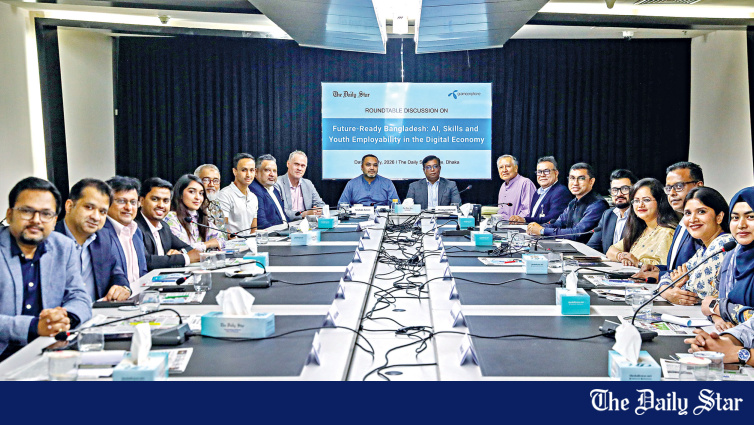
Speakers at a roundtable, titled “Future-Ready Bangladesh: AI, Skills & Youth Employability in the Digital Economy”, jointly organised by Grameenphone and The Daily Star at The Daily Star Centre yesterday. Photo: Star

Speakers at a roundtable yesterday urged experts to move beyond digitalisation and build a national ecosystem centred on people, skills, and innovation to enhance and foster artificial intelligence (AI) capability.

Building AI capability is a must to reshape the economy, labour markets and global competitiveness, they said.

Grameenphone and The Daily Star jointly organised the roundtable titled “Future-Ready Bangladesh: AI, Skills & Youth Employability in the Digital Economy”, at The Daily Star Centre.

Bangladesh’s success in the AI era would depend less on adopting technology and more on developing human capability, strengthening institutions and introducing coordinated national policies, the speakers said.

Delivering the keynote address, Zulkarin Jahangir, research affiliate at MIT and assistant professor at North South University, said AI has already become mainstream globally, with 78 percent of organisations using AI and nearly half automating complete workstreams through AI agents.

“The question is not whether Bangladesh will adopt AI, but whether Bangladesh can build capability faster than others,” he said.

He cautioned that digital readiness alone would not make the country competitive in the AI era.

“Bangladesh now needs to transform digital access into AI capability,” he said.

Drawing on findings from Unesco’s AI Readiness Assessment, the Stanford AI Index and other global studies, Jahangir said the country’s greatest investment must now be its people.

He urged universities to redesign education and ensure that students develop critical thinking, reasoning, creativity and ethical judgement alongside introducing AI governance frameworks, disclosure requirements for AI-assisted academic work, faculty training and discipline-specific AI literacy.

“AI should accelerate learning -- it should never replace learning,” he said.

The government is preparing a national AI policy to improve public service delivery and governance through integrating AI into government programmes. We want to ensure transparency and accountability, and AI can help us achieve both---------Mahdi Amin, adviser to the prime minister.

He also called on Bangladesh to build its own AI ecosystem instead of remaining a consumer of imported technologies by investing in Bangla datasets, AI-enabled freelancing, model evaluation, data annotation and applied AI research.

Jahangir further proposed a National AI Skills Compact, bringing together government, universities, industry and development partners.

Mahdi Amin, adviser to the prime minister for ministries of education and labour and employment, said the government is preparing a national AI policy to improve public service delivery and governance through integrating AI into government programmes ranging from social safety nets and policymaking to project monitoring and public service delivery.

He added that AI could significantly strengthen monitoring and supervision of public projects while reducing bureaucratic delays.

“The government wants to ensure transparency and accountability, and AI can help us achieve both,” he added.

Amin also stressed that the government sees itself as a policy facilitator, with the private sector leading economic growth through stronger public-private partnerships.

He announced plans to gradually make technical and vocational education compulsory from sixth-grade, establish TVET laboratories across schools, and strengthen university-industry collaboration to bridge the country’s skills gap.

Prof Dr Mamun Ahmed, chairman of University Grants Commission, said Bangladesh’s higher education sector is facing a strange paradox where the number of university graduates and graduate unemployment both remain high due to the absence of a linkage between academia and industry.

He said the UGC is working on creating a digital platform connecting students, universities, industry, faculty members and the Bangladeshi diaspora to improve collaboration and employability.

ASM Amanullah, vice-chancellor of National University, said the country’s university system needs a major transformation to prepare nearly four million students for the AI era with a competent curriculum.

Skill-based education and a complete paradigm shift in curriculum are essential to prepare graduates for future jobs, he added.

Grameenphone Chief Financial Officer Otto Magne Risbakk described today’s youth as digital natives capable of transforming organisations, but warned that rapid AI innovation must be matched by long-term investments in digital infrastructure.

Farhana Islam, head of Environment, Social and Governance at Grameenphone, said Bangladesh faces a widening skills gap as 2.2 million young people enter the job market annually while graduate unemployment remains at 28 percent.

She noted that Bangladesh ranks 75th among 195 countries on the Oxford Insights Government AI Readiness Index, and that nearly 90 percent of young people currently use AI mainly for social media and entertainment rather than career development, while two-thirds of global employers now prefer candidates with AI skills.

She highlighted Grameenphone Academy’s role in addressing the gap through reaching more than 3,24,000 youths and awarding over 1,31,000 certifications.

Mahfuz Anam, editor and publisher of The Daily Star, said skills have become the defining factor between dependency and productivity in the AI era.

“We are beggars if we are not skillful, and if we are skillful, then we produce for the country,” he said.

He warned that AI could eliminate a large number of routine jobs and widen inequality unless countries invest aggressively in upskilling youths.

Shahir Chowdhury, chief executive officer of Shikho, said, “While technical AI skills like machine learning and data science remain important, the bigger opportunity is enabling millions of people to use AI effectively. Our education system must therefore prepare people not just for today’s jobs but for tomorrow’s opportunities.”

Maruf Azam, project manager at UNDP Bangladesh; Munir Hasan, president of the Bangladesh Open Source Network; and Kazi Faisal Bin Seraj, country representative of The Asia Foundation, as well as youth representatives Md Aman Ullah Aman and Maria Nawar, also spoke.

Tanjim Ferdous, head of Strategic Partnerships at The Daily Star, moderated the event.​
 

Bangladesh drafting human-centric AI policy: ICT minister


1784416274239.webp


Bangladesh is formulating a human-centric National Artificial Intelligence (AI) Policy aimed at ensuring the ethical, safe and inclusive use of AI under the leadership of Prime Minister Tarique Rahman, Posts, Telecommunications and Information Technology Adviser Faqir Mahbub Anam has said.

Speaking at the High-Level Meeting on Global AI Governance on the sidelines of the World Artificial Intelligence Conference (WAIC) 2026 in Shanghai on Saturday, the minister said the government was overhauling the country's digital policy and legal framework to harness AI for economic and social development while safeguarding citizens' rights and addressing emerging risks, according to a press statement sent by the ministry.

He said Bangladesh was preparing an integrated and inclusive AI policy based on human rights, ethics and responsible innovation, alongside a series of complementary initiatives to strengthen AI governance.

These include reinforcing personal data protection and cybersecurity, preparing guidelines for the use of AI in the public sector, introducing responsible data management standards, expanding AI education and curricula, and establishing decentralised AI Centres of Excellence across the country.

Addressing the international gathering, Faqir Mahbub Anam outlined four priorities for global AI governance — safety, equity, adaptability and international cooperation.

He called for stronger international collaboration to facilitate technology transfer, build institutional capacity, protect data sovereignty and ensure equitable access to AI technologies for developing countries.

"The future of artificial intelligence should not be defined solely by technological advancement but by human values, justice and inclusivity," he said.

Held under the theme "AI Partnership for a Brighter Future", the high-level meeting focused on the role of AI in accelerating sustainable development, promoting inclusive economic growth, strengthening global security and improving international governance of emerging technologies.

The event brought together heads of government, ministers, representatives from more than 100 countries, international organisations, technology companies and academic institutions to discuss the future of AI, its ethical governance and opportunities for global cooperation.

The four-day World Artificial Intelligence Conference (WAIC) 2026 is being held in Shanghai from July 17 to July 20.​
 

Bangladesh's AI policy must factor in the environmental costs

Naziba Basher

1784419252181.webp

A drone view shows the xAI Colossus 2 'Macrohard' data centre in Southaven, Mississippi, US on May 30, 2026. FILE PHOTO: REUTERS

While the world rushes to learn how to use Artificial Intelligence (AI) in every sphere of life—from classrooms and hospitals to offices and newsrooms—remarkably little attention is paid to an uncomfortable question: what is the environmental cost of this technological revolution?

AI is often portrayed as something intangible. We interact with it through a simple prompt on a screen, receiving answers in seconds. It feels detached from the physical world. But behind every AI-generated response lies a vast physical infrastructure of data centres, high-performance processors, cooling systems and power grids that consume enormous amounts of electricity and water. The irony is difficult to ignore. At a time when the world is racing to reduce greenhouse gas emissions, AI is becoming one of the fastest-growing energy consumers.

According to a report by the Massachusetts Institute of Technology (MIT), the rapid expansion of generative AI has significantly increased electricity demand, not only for training large language models but also for running them every time users submit prompts. Unlike conventional software, generative AI requires enormous computational power throughout its lifecycle. The report also notes that AI infrastructure consumes substantial amounts of water to cool the servers that keep these systems running, while the manufacturing and transportation of specialised hardware carry additional environmental costs. This raises an uncomfortable question: are we becoming so fascinated by what AI can produce that we have forgotten to ask what it consumes?

The environmental footprint extends far beyond electricity.

According to a report by the United Nations University Institute for Water, Environment and Health (UNU-INWEH), by 2030, global AI-related data centres could consume around 945 terawatt-hours of electricity annually. Their water footprint could equal the basic domestic water needs of 1.3 billion people in sub-Saharan Africa, while the land required to support AI infrastructure could exceed 14,500 square kilometres.

These figures should concern every country, but perhaps none more than Bangladesh. Ours is among the nations that have contributed the least to global climate change while suffering some of its harshest consequences. Rising temperatures, erratic rainfall, river erosion, cyclones, floods and salinity intrusion are already placing immense pressure on our economy and natural resources. At the same time, the country is embracing digital transformation with remarkable speed.

Government services, banking, education, journalism and businesses are increasingly integrating AI into their operations. There is nothing inherently wrong with that. AI has extraordinary potential; it can improve disaster forecasting, optimise crop management, enhance healthcare, strengthen scientific research and even help monitor environmental degradation. According to the United Nations Environment Programme (UNEP), AI is already being used to detect methane emissions, monitor biodiversity and map environmentally destructive activities.

The problem is adopting AI without accounting for its environmental costs. For Bangladesh, this conversation is particularly urgent because our energy resources remain constrained, electricity demand continues to rise, and water security is becoming increasingly fragile. If AI usage expands without investment in cleaner energy, efficient infrastructure and transparent environmental standards, the technology could quietly increase pressure on systems that are already under strain.

The environmental cost of AI is also becoming an issue of global equity. Wealthier countries and technology companies are driving much of the demand for AI computing, yet the environmental consequences—from emissions to water stress—are shared across borders. Countries already vulnerable to climate change could end up paying for a digital transformation that primarily benefits others.

The UN has therefore urged governments to develop standards for measuring AI’s environmental impacts, require greater transparency from technology companies, improve the efficiency of AI systems and power data centres with renewable energy wherever possible. And Bangladesh must take note. As the country develops its own AI strategies, environmental sustainability must become part of the conversation from the outset.

Policymakers should encourage the use of energy-efficient AI models, require greater transparency regarding the environmental footprint of digital infrastructure, and ensure that future investments in data centres align with the country’s renewable energy ambitions. Universities and researchers should also examine how AI can be deployed responsibly in Bangladesh’s unique environmental context rather than simply adopting models developed elsewhere.

Technology has always promised progress, and AI is no exception. But progress should not be measured solely by how quickly we can automate tasks or generate content. It should also be measured by whether innovation strengthens the world we live in or silently depletes the resources that sustain it.

Bangladesh has little choice but to embrace AI. The greater challenge is ensuring that, in doing so, we do not unknowingly deepen the very environmental crisis we are already struggling to survive.

Naziba Basher is a journalist at The Daily Star.​
 

Is Bangladesh ready for AI in business?

Mamun Rashid

1784419424523.webp


Artificial intelligence (AI) continues to generate curiosity, fear and hype. Some believe it will replace millions of jobs overnight. Others dismiss it as little more than chatbots or image generators. Both views miss the larger economic point. AI is reducing the cost of decision-making. Throughout economic history, whenever the cost of an important capability has fallen sharply, production systems have changed. The Industrial Revolution reduced the cost of physical labour. The internet reduced the cost of information exchange. AI is now reducing the cost of prediction, analysis, customer engagement, risk assessment, marketing, accounting and operational decisions. This is why AI matters for Bangladesh. Our economy has long benefited from low-cost labour, entrepreneurial resilience and execution at scale. These strengths helped build a globally competitive garments industry, expand financial inclusion and create a vibrant SME base.

But the next decade will be different. Global buyers now demand speed, traceability, quality assurance, compliance and data-backed visibility. Banks need better credit decisions. Farmers need better market information. Government agencies need to deliver services with fewer leakages. AI can help Bangladesh respond, but only if we treat it as an economic capability, not a technology slogan. The greatest opportunity lies with SMEs. They form the backbone of the economy, yet most lack analytics teams, structured customer databases, advanced inventory systems or marketing capabilities. Many still rely on intuition, fragmented records and manual follow-up.

AI can change that. A retailer can identify repeat customers, predict demand and manage inventory. A manufacturer can improve planning and reduce waste. A logistics company can optimise routes. A lender can assess credit more responsibly using alternative data. This is not about replacing entrepreneurs; it is about giving them better decision tools. The relevance extends across sectors. In garments, agriculture, banking, healthcare, education and public services, AI can support forecasting, quality control, disease detection, fraud detection, documentation, personalised learning and grievance management. However, AI is not a magic solution. Poor data will produce poor decisions. Weak governance will create new risks. Inefficient processes will remain inefficient if automated. A chatbot on a broken system does not create transformation; it only makes the system look modern. This is where Bangladesh must be careful. Many organisations may rush to adopt AI because it sounds fashionable. But real value will come from clean data, integrated systems, process redesign, employee training and responsible governance. AI adoption should begin with business problems, not software purchases.

Bangladesh should focus on three priorities: practical support for SMEs through adoption vouchers, tax incentives and low-cost advisory services; regulation that enables innovation through sandboxes while strengthening data protection, cyber security and accountability; and urgent human capital development so managers, bankers, teachers, doctors, agricultural officers, logistics planners, accountants and public officials can use AI productively. Employment will change. Some routine jobs will decline, many will evolve, and new categories of work will emerge. The right response is reskilling and moving workers from repetitive tasks to higher-value roles. Bangladesh also has an opportunity to build AI-enabled business services as an export industry. Our young workforce, startup ecosystem and global client experience can create solutions in customer experience, accounting, logistics, automation, compliance and SME productivity.

The question is whether we will remain passive consumers of imported AI products or become active builders of AI-enabled capabilities. We have entrepreneurial energy, a young population, strong SMEs and a growing technology base. What we now need is clearer public policy, bolder business leadership, better data governance and faster investment in human capability. AI should be viewed as Bangladesh’s next productivity challenge. It deserves an urgent answer.

The writer is an economic analyst​
 

Latest Posts

Back