Home Watch Videos Wars Movies Login

[🇧🇩] Agriculture in Bangladesh

Latest Posts Countries Wars Q&A

[🇧🇩] Agriculture in Bangladesh
242
10K
More threads by Saif

G Bangladesh Defense

Saif

Senior Member
Joined
Jan 24, 2024
Messages
17,219
Likes
8,332
Nation

Residence

Axis Group

Agriculture Sectors
Last published date:
2022-07-20

Overview​

A rising middle class (estimated at over 30 million) has fueled demand for high-quality agricultural products. According to the Bangladesh Bureau of Statistics for FY 2020-21, crops, livestock, fisheries, and forest products accounted for about 12.5 percent of Bangladesh’s total GDP and employed approximately 40 percent of the total population. Most agricultural production in Bangladesh is characterized as traditional subsistence farming. Bangladesh produces a variety of agricultural products such as rice, wheat, corn, legumes, fruits, vegetables, meat, fish, seafood, and dairy products. Rice is the main staple in the Bangladeshi diet. Lack of arable land and limited natural resources increase the importance of developing new agricultural technologies, such as salt tolerant or submergence tolerant seed varieties, to help increase productivity and meet future demand. Floods, cyclones, and biotic-abiotic stress can also affect agricultural productivity levels and incomes.

Although Bangladesh imports bulk commodities such as wheat, soybeans, and pulses, there are niche segment opportunities for high-value agricultural product imports, particularly in more affluent urban centers such as Dhaka and Chittagong. Strong consumer demand exists for imported fresh fruits, tree nuts, and dairy products, as well as processed food products.
Total Market Size for Agricultural Products: 2016-2021

201620172018201920202021
Total Local Production$30,424$33,374$35,882$38,095$37,568$38,801
Total Exports$1,488$1,625$1,418$1,600$1,343$1,586
Total Imports$5,991$9,470$5,952$8,000$8,442$10,334
Imports from the U.S.$496$889$1,087$1,300$966$1,031
Total Market Size$34,927$41,219$40,417$44,495$44,667$47,549
Exchange Rates798182848585

total market size = (total local production + imports) - exports)
Units: $ millions

Leading Sub-Sectors​

The processed food industry accounts for approximately 13 percent of all manufacturing production value and employs 6.5 percent of the manufacturing labor force. The industry employs 1.4 percent of the country’s total labor force, and the sector is dominated by small- and medium-sized enterprises strongly linked to local production. There are nearly 292 medium-sized food manufacturing enterprises in the country processing baked goods, confectionery items, fruits and vegetables, cereals, dairy goods, fruit juices, and other foods and beverages.

Opportunities​

Agricultural equipment and technology; agriculture inputs, including feed, seeds, pesticides, and fertilizer; dairy processing equipment; fish processing equipment; packaging and canning equipment and technology; agriculture infrastructure consulting services and solutions, including silos and cold chain/cold storage facilities.

Resources​

  • Ministry of Agriculture
  • Bangladesh Agricultural Research Council
  • Food and Agriculture Organization
  • Ministry of Food
  • Ministry of Livestock and Fisheries
  • Ministry of Textile and Jute
  • Ministry of Commerce
 
Analyze

Analyze Post

Add your ideas here:
Highlight Cite Respond
  • Like (+1)
Reactions: Bilal9

More attention needed for the agriculture sector​

1707036249301.webp


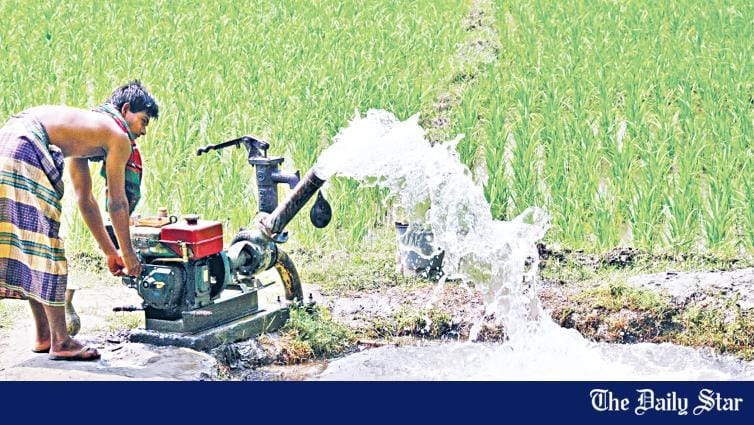
More emphasis should be given on agricultural mechanisation and the use of ICT in farming. PHOTO: STAR

The agriculture sector is one of the key economic pillars of Bangladesh. Just after liberation in 1971, its contribution to GDP was around 60 percent. It is the most important sector in Bangladesh that helps with peoples' livelihoods, employment, and contributes to GDP, we all know that. But its share of GDP has decreased over the last decade, going from 17 percent in 2010 to 12.6 percent in 2020.

Countries around the world are now facing serious inflationary challenges mainly due to the Russia-Ukraine war, which is greatly harming the global economy. The global commodity market is facing considerable instability due to supply chain disruptions. Bangladesh has also been affected by all these, and is struggling to cope with the situation. The country was already experiencing significant inflationary pressure, and the added price hike has made the situation almost unbearable for the general people.

On the other hand, its foreign currency reserves have been going down. The impact of the three Cs – climate change, Covid-19, and conflict (Russia-Ukraine war) – has given birth to another "C" which is quite evidently, the cost. However, these could be tackled with three As – agriculture, austerity and assistance – which could save all of us.

Over the years, Bangladesh has written a remarkable story of poverty reduction and development, especially during the past decade. After its independence in 1971, it was one of the poorest countries in the world. But Bangladesh successfully reached the lower-middle-income status in 2015 and is now on track to graduate from the UN's Least Developed Countries (LDC) category by 2026.

However, compared to many other countries of the world, we are still lagging behind in terms of technology, education, economy, farming, and in numerous other sectors. Bangladesh is now an important part of the global village. And it will not always be easy for Bangladesh to overcome different global shocks. It is because we currently have so many issues to cope with that the government announced a measured budget for the fiscal year 2022-2023.

In his budget speech for the fiscal year 2022-2023, Finance Minister AHM Mustafa Kamal emphasised on boosting food production to ensure food security amid the Russia-Ukraine war and global food price hike. He proposed an allocation of Tk 33,698 crore for food, fisheries, and agriculture for the coming fiscal year, which is only 6.2 percent of the total budget. He talked about increasing fertiliser subsidies from Tk 12,000 crore (2021-2022) to Tk 16,000 crore.

The significance of farming as a whole, including the sub-sectors, service and industry sectors, has increased manifold. The cultivation of high-value fruit orchards and vegetables also played a significant role in boosting the economy. Not only the farms, but the value addition of these agricultural products provided a much-needed boost for the agricultural service sector. Bangladesh Rice Research Institute (BRRI) must be credited for the grain production and they have been quite remarkable, I must say. Alongside the production, the research didn't stop for a day and with responsibility, it moved ahead with the support of Bangladeshi Agricultural Research Institute (BARI). Bangladesh Institute of Nuclear Agriculture (BINA) also deserves credit for their advanced techniques in boosting agricultural production and for developing technologies that are environmentally friendly and sustainable.

The farming sector has individually employed more than 40.6 percent people, either directly or indirectly. Previously, farmers in our country were really poor, but today, they have changed their fates with their persistent labour and certainly with quality seed support. And that has also led to farmers' buying capacity increasing. They can now feed themselves and their family and also send their children to school.
1707036383890.webp

Over the years, Bangladesh has written a remarkable story of poverty reduction and development. PHOTO: HABIBUR RAHMAN

If we look at the three main driving forces of our economy – i.e., farming, RMG, and remittances – we will see the sons and the daughters of farmers working in all three sectors. Oftentimes, they send their earnings back to their parents in their villages. And this money is used to invest in farming – both in small- and large-scale initiatives. This has not only strengthened our economy, but has empowered the youth, especially women, and has also helped raise the voice of the impoverished. Moreover, agricultural tourism has opened a new door for us. I have seen in many European countries and in the US the concept of the family farm. Many young entrepreneurs in Bangladesh have started a number of wonderful eco-resorts across the country and people from around Bangladesh are visiting these beautiful places to get close to nature and farming.

Climate change is a big challenge, which we are facing and will have to face with the use of new agricultural technologies and adaptability. We must closely follow global adaptation technologies and concentrate more on new examples of climate adaptability which is best suited for us. More emphasis should be given on agricultural mechanisation and the use of ICT in farming, as this will help us greatly in fighting back against climate change. In the same way, we should also focus on the weather-based index and crop insurance which will ensure real empowerment of farmers and will make them more resilient. Artificial intelligence will play a key role and I don't think family farms will remain, but the pattern of farming will change entirely. Overall, the system will change and we will go through a global paradigm shift. Ultimately, we will have to face the challenge of hidden carbon emission and we will need technologies to overcome it. After 50 years, farming will become more expensive, but there will be a global export market where Bangladesh will hopefully be at the forefront.

Despite the high population, decreasing arable land, and frequent natural disasters, Bangladesh has made significant progress in achieving self-sufficiency in producing cereal crops and reducing poverty. Almost half of the population is now employed in the farming sector. Therefore, our state policies must be aligned with the interest of this sector, especially at a time when we are facing numerous challenges as a nation. I believe that, if we could safeguard the marginal farmers, bring in modern technologies, properly execute the Delta Plan, and strengthen inter-ministerial coordination, the country will keep moving forward and the farming sector will continue to flourish.
 

Analyze Post

Add your ideas here:
Highlight Cite Respond
  • Like (+1)
Reactions: Bilal9

Cultivation of colorful cauliflower is increasing in Bangladesh - price is double and is rich in Beta-Carotene, tastes better too.​


Analyze

Analyze Post

Add your ideas here:
Highlight Cite Respond

Nahar Agro seeks to lead egg market with Tk150 crore new investment​

It aims to sell 10 lakh eggs per day for the consumers by 2025​


Nahar Agro seeks to lead egg market with Tk150 crore new investment


Nahar Agro, a Chattogram-based agro farm, plans to make a Tk150 crore new investment to expand its poultry business to enter the egg market with around 10 lakh daily supply by 2025.

The new investment plan is expected to transform the farm, which is heavily concentrated on hatching egg production, into a major player in the egg market in the Chattogram region, company officials say.

"There is a daily demand for 50 lakh eggs in the Chattogram region, but there are not enough poultry farms in the area to meet the demand. We are planning to fill the gap in production to ease the crisis in the market while also reducing the price," Rakibur Rahman, managing director of the company, told The Business Standard.

Currently, the company produces nearly 2.5 lakh hatching eggs a day, apart from some consumable ones with double yolks. It also has businesses in areas ranging from poultry and fish feed to dairy and horticulture products.

The move comes at a time when Bangladesh is grappling with price volatility in the egg market, forcing it to allow imports from neighbouring India as a tool for stabilising the situation.

Initially, Nahar Agro aims to supply two lakh eggs per day by this year, which will eventually increase to 10 lakh by the next year, according to company officials.

With the massive business expansion plan, it hopes to create around 1,000 new jobs alongside producing 50-60 tonnes of environmentally friendly bio-fertiliser per day.

The company says it has already taken initiatives to import modern machinery and establish new farms in different parts of the district in phases.

In the first phase, the company plans to set up a shed to produce two lakh eggs per day by 2024. By the end of 2025, the company will set up all seven sheds containing 1.2 million hens to produce one million eggs.

"We hope to set up all the sheds in phases to produce 10 lakh eggs by 2025 and then we have plans to double the production in the next two years," Rakibur said.

The company aims to incorporate modern technologies in its egg production, such as an automatic system for brooding, egg collection, drinking, and feeding facilities, alongside installing an automatic ventilation system and automatic heating and cooling equipment in the new layer industry.

"There will also be an automatic litter collection system to turn the litter into biofertiliser. We are working on that, particularly to make our new industry more effective," Rakibur told TBS, adding that the industry will produce 50-60 tonnes of biofertiliser every day.

In a span of 37 years since starting business as a livestock venture in 1989, Nahar Agro has become one of the country's largest and most successful agro-business entities with an annual turnover of around Tk1,000 crore. It employs more than 2,500 people directly and another 10,000 indirectly.

The company has maintained a sustainable growth with top-quality day-old chicks, poultry and fish feed, along with dairy and horticulture products.

It has 12 lakh parent-stock (broiler and layer) chickens in its poultry farms. From the eggs laid by the parent-stock chickens, 22 lakh to 24 lakh chicks are produced every week in its hatcheries.

Besides, its dairy farm has 1,700 breeding and milking cows, producing about 5,500 to 6,000 litres of milk daily.
Nahar Agro operates four poultry and fish feed mills in Mirsharai, Sirajganj, and Jashore, with a production capacity of 60,000 tonnes per month. Currently, these mills produce 30,000 tonnes of feed a month, with 20% used by the company's own farms and the remaining 80% marketed.

Additionally, the agro company provides chicks, feed, and other technical support to around 10,000 poultry farmers across approximately 5,000 poultry farms nationwide.
 
Analyze

Analyze Post

Add your ideas here:
Highlight Cite Respond
Growing Roselle buds in Bangladesh which is consumed (after drying) as a tea (and is an organic superfood). One KG sells for Tk. 4000 and many times that amount overseas.


Analyze

Analyze Post

Add your ideas here:
Highlight Cite Respond

Agricultural Mechanization Landscape of Bangladesh: Access to Finance a Significant Barrier​

Profile

LightCastle Analytics Wing​

May 30, 2023

Agricultural Mechanization Landscape of Bangladesh: Access to Finance a Significant Barrier


Agriculture has contributed 11.66% to the country’s total GDP in 2021-22; with 5.64% coming from crops and horticulture. According to the latest provision labor force survey 2022, the proportion of the population employed in Agriculture (of total employed) is 45.3%, up by 4.7% from that of 2017. On top of that, most farmers in Bangladesh come from lower-income segments, which makes strengthening the agricultural value chain a crucial step for fostering inclusive growth.

Current State of Agricultural Mechanization in Bangladesh​

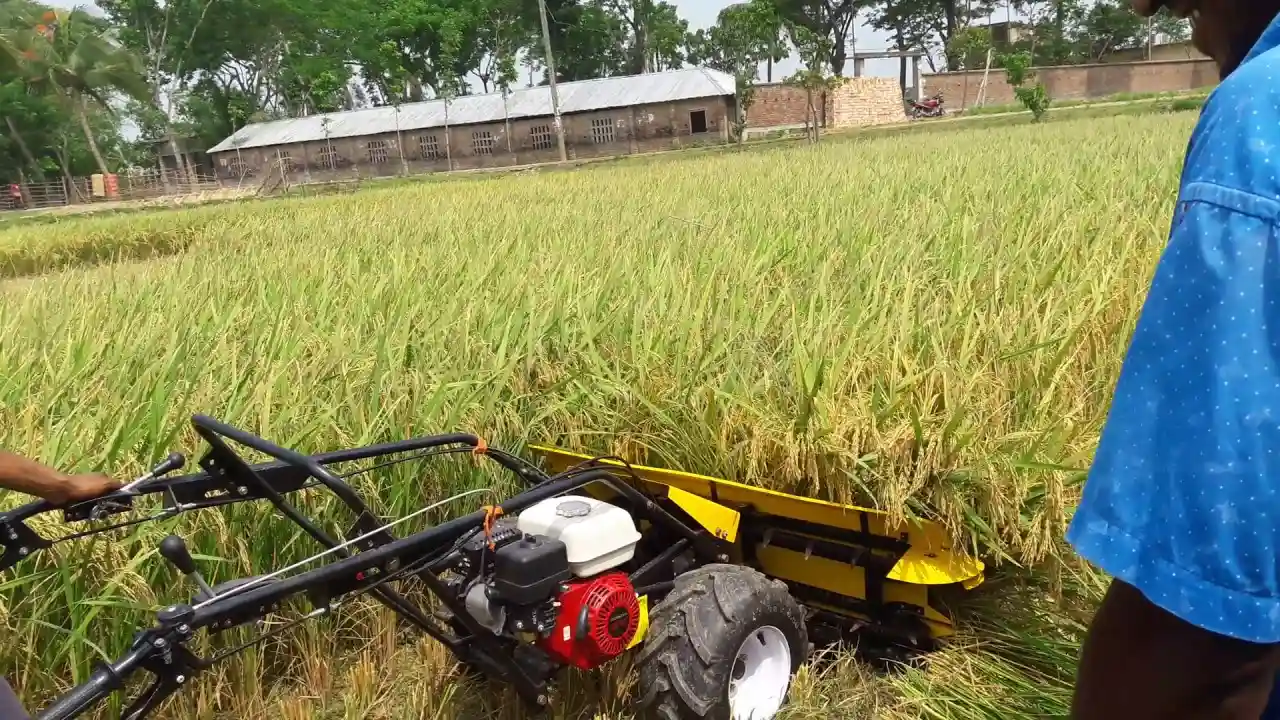
Agri-mechanization is the process of integrating modern machines and equipment in farming to increase productivity and reduce farmers’ vulnerability to labor shortages and natural calamities. Bangladesh has gone through phases in terms of mechanization. Per a study in 2019, operations that are most heavily mechanized (over 90%) are Land Preparation, Irrigation, Threshing and Pesticide application [4]. The rates of mechanization during Planting and Harvesting are below 2%; that of Fertilizer application and Weeding are higher, but still below 10%.

image001-1.webp


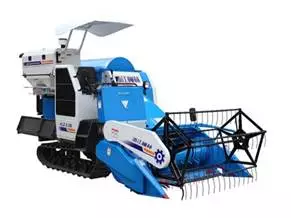
Combine Harvester
Agri-machineries of the Domestic Market: Reaper


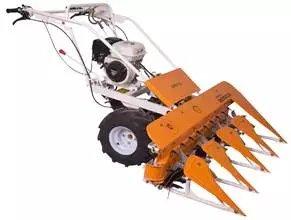
Reaper
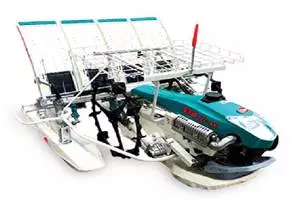
Agri-machineries of the Domestic Market: Rice Transplanter


Rice Transplanter
Figure 1: Agri-machineries of the Domestic Market


Urgency of Agricultural Mechanization in Bangladesh​


Changes in Labor Force Composition​


Although the 2022 labor force data shows a recent increase in the proportion employed in the agriculture sector, in the past three decades, rural labor has been migrating to the cities of Bangladesh as a significant portion of unskilled agricultural laborers has switched to working in the service sector, as well as in the RMG sector, catering to the high demand for cheap labor.

As a consequence, there has been a shortage of agricultural laborers in the rural areas, particularly in times of manpower-intensive work like planting and harvesting. The labor crisis and high prices of labor have increased the cost of production. Since these operations are very time-sensitive in nature, the unavailability of laborers often leads to late planting or harvesting, exposing farmers to further risks of natural calamities or low yield.

Two-fold Benefits of Mechanization​


Agricultural mechanization generates higher productivity, efficiency and prevents the loss of crops. Manual planting in Bangladesh requires around 123-150 man-hour/hectare while mechanical transplanting with a four-row walking transplanter would take 9-11 man-hour/hectare. A delay of one month in transplanting can reduce yield by 25%; that of 2 months can reduce 70% of the total crop yield. A study titled “On- and Off-Farm Mechanization in Bangladesh: A Sustainable Approach to Ensure Food Security” conducted by the Bangladesh Agricultural University on rice cultivation has shown that using seed planters, transplanters and harvesting machines, the cost of each operation could be brought down by at least 50%.
.

Challenges to Agricultural Mechanization in Bangladesh​


Lack of Modern Machinery in the Market​


The annual market size for agricultural machinery in the country is Tk3,000 crore, according to industry experts. However, the market for small machinery manufactured by local entrepreneurs is only 10-12% of the total agri-machinery market size[9]. Ready to use, agricultural machinery of competitive quality is not being produced domestically. The product portfolio of local foundries and agricultural machinery manufacturing industries majorly consists of spare parts and small machines like rice milling machines, sprayer machines, threshers, and vertical pumps.

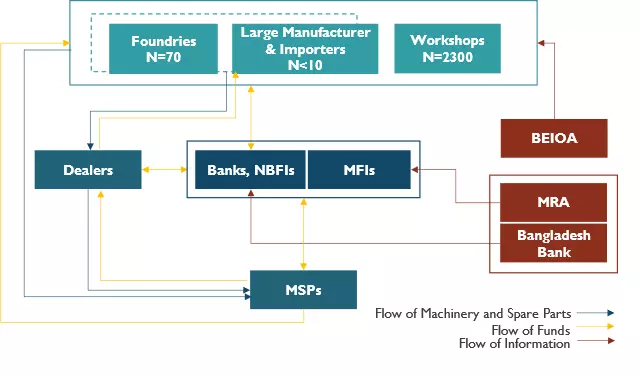
Supply-side Actors in the agricultural mechanization Landscape
Figure 2: Supply-side Actors in the Agri-machinery Landscape

Agricultural mechanization Value Chain in Bangladesh


Figure 3: Agri-machinery Value Chain in Bangladesh

At present, domestic manufacturers lack the technology to fully manufacture larger machines like threshers, planters, combine harvesters, etc. Qualified manpower with knowledge and skills related to designing, drawing, reverse engineering, and maintaining quality control is also one of the reasons for this. Other factors include the absence of modern machine manufacturing machinery, high price, and dependency on imported raw materials.

The impact of COVID-19 and the ongoing Ukraine-Russia war has increased raw material prices and utility overheads for these foundries and workshops, affecting their profitability even more.

Access to Finance from Formal Financial Institutions​


Both supply and demand side players currently face certain barriers to accessing finance. The GoB has provided 70% and 50% subsidies on selected machinery but even after the assistance, farmers struggle to bear the rest of the cost. A major machinery manufacturer opined that Banks need to grant farmers better-suited loan schemes in order for them to purchase the machinery.

Lack of access to finance from traditional financial institutions in the agriculture machinery market and the agricultural sector in general also leads to many farmers borrowing from informal money lenders or loan sharks, who typically provide faster disbursement but at a much higher cost of funds, making it harder for farmers to save money for adopting mechanization in the future.

Most agri-loan products in the formal financing sector in Bangladesh do not consider the cultivation period of crops. Many farmers take additional loans at higher rates to pay off-season financial condition of farmers, hindering further mechanization efforts. Lack of working capital financing for manufacturers leads to limited supply during peak demand. Banks and NBFIs require certain documentation like sales ledgers, audited financial statements, environmental and health certifications to give out loans. Small machinery manufacturers often don’t have these documents prepared and therefore do not get approved for loans.

From the Financial Institutions’ side, the policy-dictated interest rate for agricultural loans (8%) does not justify the credit risk of lending to small-scale machinery manufacturers or farmers. As a consequence, most institutions are averse to approving loans from these applicants. Ultimately, the gap in access to finance persists.

Agriculture Machinery Loan Landscape​


There are a total of 61 scheduled and 5 non-scheduled commercial banks in Bangladesh, 34 NBFIs, of which 3 are Government owned. More than 1000 MFIs operate in the domestic landscape, although 87% of the market is captured by the top 10 institutions.

Despite the large number of players in the financing landscape, the formal MSME finance gap is 67.3 percent. In Bangladesh, Foundries access formal finance through banks (public and private), NBFIs, and MFIs. Agricultural credit disbursement targets are set by the Central Bank to encourage banks to venture into this sector. They also provide refinancing facilities to the participating banks. The agricultural credit disbursement target has been set at Tk 30,911 crore for FY23, which is 8.88 percent higher than Tk 28,391 crore targeted in FY22.

Banks in Bangladesh provide specialized agricultural loans to farmers at an average interest rate of 4-8%. Krishi Bank, the only government-owned bank specialized for farmers, offers a credit program for farm and irrigation equipment[16]. Non-Banking Financial Institutions (NBFIs) also offer agricultural financing products, at an average interest rate of 5-7%. However, the loan approval process is reportedly more stringent in the case of NBFIs. Institutions like IPDC and Midas have their own lease financing program specialized for equipment purchase with tenures ranging from 1 to 5 years.

Microfinance Institutions (MFIs) in Bangladesh provide agricultural loans, though the interest rate is often 3 times as high as that of banks. On average, it has been estimated that farmers pay nearly 25% in interest to MFIs for loans that they would not have received from any other institution. BRAC offers a dedicated loan scheme for smallholder farmers to adapt to farming technologies called “Borga Chashi Unayyon Project (BCUP)”.

Large machinery companies provide credit facilities to small service providers and farmers, but they require a down payment of around 40% of the remaining amount after subsidy coverage. This means that the machinery companies are taking on the burden of recovery for the remaining 60%, which hurts their cash inflow. On the other hand, this loan is usually to be repaid in a year with monthly installments which affects farmers or machine service providers due to the seasonality impact on their business, making monthly repayment impractical.

Efforts of the Government of Bangladesh to Promote Agricultural Mechanization​


To promote mechanization in the agriculture sector, the Government of Bangladesh has provided subsidies starting from 50% (70% in coastal regions) on the purchase of specific machines. The machines under this scheme include power tillers, reapers, rice transplanters, and combine harvesters.
According to finance minister A H M Mustafa Kamal, the Government has taken up a project at a cost of Tk 30.2 billion titled ‘Mechanisation of Agriculture Work through Integrated Management’, targeted to distribute 51,300 units of agro-machinery from 12 categories between 2020-2025,”.

In FY21, the government distributed 2,300 different agri-machinery, including 1,762 combine harvesters, 379 reapers, and 34 rice transplanters at a cost of Tk 208 crore among farmers under the agricultural mechanization project. In FY 2021-22, there was an allocation of Tk 680 crore in this regard.
In FY 2021-22, Bangladesh Bank set a monetary policy to reduce the interest rate cap on agriculture from 9% to 8% and started providing loans at 4% interest rate for crops and the harvest sector. Most Foundries and Workshops fall under cottage, micro and small enterprises, to whom Banks and NBFIs have been instructed to provide 50% of SME loans by 2024. These initiatives have been taken with the aim of increasing agricultural production and consequentially, the income of rural people. Improved access to finance for cottage, micro, small and medium enterprises (CMSMEs) will also lead to farmers gaining access to tools that will enhance agricultural productivity.

The government also plans to withdraw the advance tax (AT) levied on the import of rice transplanters, agricultural drier machines, all types of sprayers, and potato planters in the upcoming national budget aiming to modernize the agriculture sector.

Conclusion​

The cost of larger agri-machineries is often too high for farmers or small machine manufacturers to pay upfront. Hence, they seek financial assistance. Adoption of machines would increase profitability but both end users and manufacturers will typically need multiple seasons to earn back the capital expenditure from their revenues.

Loan provisions for agricultural machinery purchase by commercial banks, NGOs, NBFIs should have a specialized low interest, long repayment periods and alternative risk mitigation schemes in order to improve the mechanization status of the country. Given the rising pressure on imports, and supply chain disruptions affecting industries across the board, mechanization of the agricultural sector, to raise productivity and reduce import dependency, is of paramount importance.

Author​

Priyo Pranto, Business Consultant at LightCastle Partners, has prepared the write-up. For further clarifications, contact here: info@lightcastlebd.com.
 
Analyze

Analyze Post

Add your ideas here:
Highlight Cite Respond
  • Like (+1)
Reactions: Bilal9

Bangladesh Institute of Nuclear Agriculture (BINA)

Introduction​

Started in a small radiotracer laboratory (RAGENE) in 1961 under the Atomic Energy Commission (erstwhile PAEC) at Dhaka, a centre named "Institute of Nuclear Agriculture (INA)" was established in July 1972 with a more organized group under BAEC (Bangladesh Atomic Energy Commission) at Dhaka, and shifted to the campus of Bangladesh Agricultural University, Mymensingh in 1975. In 1982, INA was given “the status of an independent national agricultural research institute” like BARI and BRRI, and was placed under the administrative control of Ministry of Agriculture. In 1984, it was declared as a national institute and renamed as Bangladesh Institute of Nuclear Agriculture (BINA) through promulgation of Ordinance No. II of 1984. BINA Ordinance was amended and enacted by Bangladesh Parliament vide Act No. IV of 1996.

The headquarters of Bangladesh Institute of Nuclear Agriculture (BINA) is located in the campus of the Bangladesh Agricultural University (BAU), Mymensingh. It is about 5 km south from the Mymensingh Railway Station, and about 125 km north from Dhaka City. Its infrastructure and related facilities cover an area of 33 acres within the BAU campus. In addition to its office campus, BINA has another residential campus at Mymensingh town covering an area of 8.2 acres.

Director General is the Chief Executive of the institute assisted by Director (Research), Director (Administration and Support Service) and Director (Training and Planning). The general direction, administration and supervision of the affairs of the Institute is vested in the Management Board, which in discharging its function on policy issues is guided by such instructions as may be given to it by the Government from time to time. As the chief executive of the institute, the Director General is the ex-officio Chairman of the Management Board.

Total manpower of the Institute in its Headquarter, Regional office and sub-stations are 578 comprising the DG, 3 Directors, 170 scientists, 36 class-I officers, 40 class-II officers, 211 class-III employees and 117 class-IV employees. However, out of 170 scientists, 50 are with PhD degrees.

It has got 11 full-fledged research divisions viz. Plant Breeding, Soil Science, Crop Physiology, Entomology, Plant Pathology, Agronomy, Agricultural Engineering, Training, Communications & Publications, Biotechnology, Horticulture, and Agricultural Economics. At present, BINA has got 1 regional office at Sreepur,Gazipur and 13 substations located in various parts of the country namely Rangpur, Ishurdi, Magura, Satkhira, Comilla, Jamalpur, Khagrachari, Sunamganj, Sherpur, Barisal, Gopalganj, Noakhali and Chapainawabganj. BINA has also developed a rich soil museum with collections of various soil samples of Bangladesh.

BINA has well equipped laboratories in almost all research divisions along with 3 glasshouses, field research facilities in its Headquarters at Mymensingh, one regional office and thirteen sub-stations. The major equipment items are Gamma (Co-60) Source, N-15 Analyzer, Liquid Scientillion Counter, Fluorescent and Phase Contrast Microscopes, Biolog, Gas Chromatograph, HPLC, PCR, Gel Electrophoresis, Gel Doc, Atomic Absorption Spectrophotometer, Gamma Spectrophotometer, -80°C Freezer, Portable Photosynthesis System, UV Spectrophotometer, Fermented, Neutron Moisture Meter, Isotope Ratio Mass Spectrometer etc.

BINA conducts its research activities in ten different areas. These are: i. Crop improvement through induced mutation, ii. Biotechnology, iii. Soil management and biofertilizer, iv. Irrigation and water management, v. Pest management, vi. Physiological aspects of crop productivity, vii. Crop management, viii. Improvement of horticultural crops, ix. Technology transfer & impact assessment, and x. Socio-economic research.

BINA has so far succeeded in developing and releasing 125 modern varieties of 19 important crops by using nuclear techniques and these varieties are now making significant contributing to raise the agricultural productivity of Bangladesh. It has also been able to identify nine rhizobial inocula for fixing higher biological nitrogen in soils of increase the seed yield of bean, pulses and oil crops
 
Analyze

Analyze Post

Add your ideas here:
Highlight Cite Respond
  • Like (+1)
Reactions: Bilal9

Attachments

Analyze

Analyze Post

Add your ideas here:
Highlight Cite Respond
  • Like (+1)
Reactions: Bilal9

Members Online

No members online now.
Back
 
G
O
 
H
O
M
E