New Tweets

[🇧🇩] BDR Mutiny---An Irreparable Damage to Bangladesh's First Line of Defense

G Bangladesh Defense
[🇧🇩] BDR Mutiny---An Irreparable Damage to Bangladesh's First Line of Defense
119
5K
More threads by Saif

Commission uncovers evidence suggesting ‘Indian involvement’ in the planning of Pilkhana killings​

The chief of the commission says General Moeen had warned that any action could provoke Indian intervention​

Probe finds ‘India links’ in Pilkhana conspiracy

Senior Correspondent
bdnews24.com
Published : 01 Dec 2025, 01:20 AM
Updated : 01 Dec 2025, 01:20 AM


The head of the National Independent Inquiry Commission, retired major general ALM Fazlur Rahman has said evidence points to “Indian involvement” in the conspiracy behind the 2009 Pilkhana killings.


Speaking at a press conference after submitting the 16-year-old case’s report to Chief Advisor Muhammad Yunus on Sunday, Fazlur highlighted that the Border Guard Bangladesh (BGB, formerly BDR) had been “deliberately weakened”, contributing to the bloodshed.

Fazlur, who also served as BDR director general, said: “The conspiracy aimed to weaken this force and destabilise Bangladesh. At that time, India sought to create instability while the then government sought to extend its rule.”


Asked at the media briefing who the main Pilkhana massacre plotters were, the head of the commission formed last December, said: "Former prime minister Sheikh Hasina, barrister Fazle Noor Taposh, Sheikh Selim, Jahangir Kabir Nanak, Mirza Azam, Sahara Khatun, General Tarique Siddique, ex-Army chief General Moeen U Ahmed, and the former DGFI chief maj gen Akbar (Hossain).


"After the BDR carnage took place, the government wanted to prolong its power, and the neighbouring country wanted to destabilise Bangladesh," he added.

When asked who he meant by the neighbouring country, Fazlur replied: "We meant India, where our former prime minister, along with her party members, took shelter."


In response to another question, the former army official said: "General Moeen stated in his remarks that if he had taken 'action' here, India would have 'intervened' here."

Seventy-four people, including the 57 army officers, were killed in the mutiny at the erstwhile Bangladesh Rifles, or BDR, Headquarters in Dhaka’s Pilkhana on Feb 25 and 26, 2009.

Citing evidence of the involvement of Indians in the incident, Fazlur said: "Around 921 Indians came to the country during that time. The whereabouts of 67 of those Indians are unknown."


The case and judicial proceedings concerning this massacre, which caused national and international interest, were carried out during the Awami League government's tenure.

Following a change in power and the interim administration taking charge, demands arose for a re-investigation of the incident. The inquiry commission was formed on Dec 24, with a 90-day deadline to submit its findings.
 
Analyze

Analyze Post

Add your ideas here:
Highlight Cite Respond

Families of martyred officers demand full disclosure of BDR Carnage Report​


The families alleged that they faced various kinds of social and online harassment for providing testimony during the inquiry
https://www.dhakatribune.com/397770

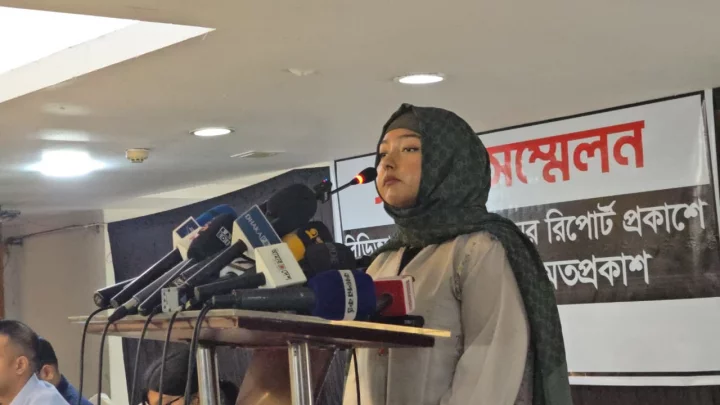
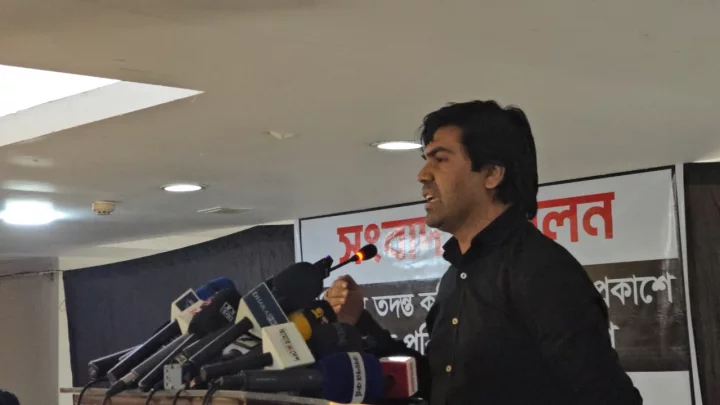
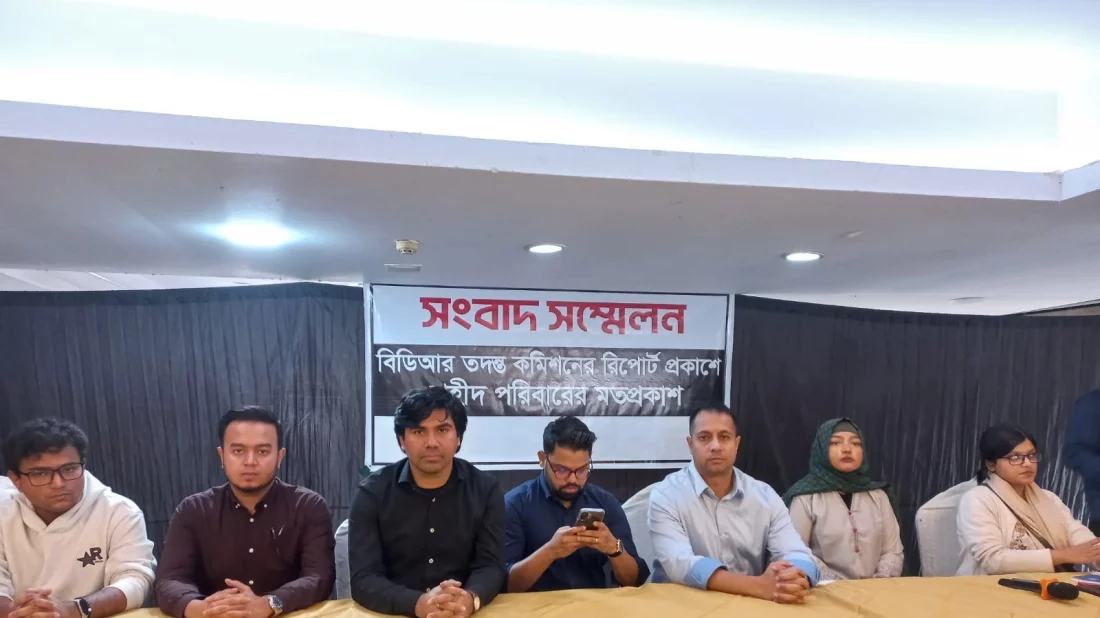
A press conference titled “Opinions of the Families of the Martyrs on the Publication of the BDR Inquiry Commission Report” was held on Monday, December 1, 2025, at the RAOWA Club in the capital where family members demanded the full disclosure of the report and called for legal action regarding the BDR carnage. Photo: Dhaka Tribune
Tribune ReportTribune Report
Publish : 01 Dec 2025, 07:33 PM
Update : 01 Dec 2025, 07:43 PM

Family members of the army officers killed in the Pilkhana BDR carnage have voiced frustration that the names of all individuals involved have yet to be made public.

They demanded that, along with releasing the full report, the government immediately initiate legal action against the perpetrators.

At a press conference titled Opinions of the Families of the Martyrs on the Publication of the BDR Inquiry Commission Report, held Monday at the RAOWA Club in the capital, relatives of the slain army officers made the remarks. They also expressed satisfaction that the national independent inquiry commission, formed by the interim government, has submitted its report to the chief adviser.

BDR Carnage

The families alleged that they faced various forms of social and online harassment for providing testimony during the inquiry and said they continue to live in insecurity.

The national independent inquiry commission—tasked by the interim government with investigating the brutal killings at Pilkhana—submitted its report to Chief Adviser Professor Muhammad Yunus on November 30 at the state guesthouse Jamuna.

The commission prepared the report following an 11-month investigation into the carnage that unfolded on February 25–26, 2009, at the headquarters of the then Bangladesh Rifles (BDR), now Border Guard Bangladesh (BGB).

Speaking at the event, Dr. Fableeha Bushra, daughter of Lt. Colonel Lutfor Rahman Khan, said Commission Chief General Fazlur Rahman stated on Sunday that the report is not classified and will be made public. “The call of the martyrs’ families is that the process should not be delayed—urgent steps must be taken to send the report to the judiciary, impose legal measures such as travel bans on potential accused individuals, and publish the investigation report,” she said.

She added, “The loss of 74 lives, including 57 army officers, is not just a tragedy for one group of families—it is a national catastrophe. A conspiracy was carried out using a state security force funded by taxpayers’ money to undermine the country’s sovereignty. Every citizen has the right to know the truth.”

BDR CarnageA press conference titled “Opinions of the Families of the Martyrs on the Publication of the BDR Inquiry Commission Report” was held on Monday, December 1, 2025, at the RAOWA Club in the capital where family members demanded the full disclosure of the report and called for legal action regarding the BDR carnage. Photo: Dhaka Tribune.

Saquib Rahman, son of Colonel Kudrat-E-Elahi, said: “The commission has clearly stated that there are some names they cannot reveal at this moment. We understand the reasoning to some extent. But we will not accept this being used as an excuse for indefinite delay. That is unacceptable to us.”

He added: "As soon as possible, arrest warrants must be issued against all individuals—military and civilian alike—and they must be apprehended. If the report is not made public, we fear that those named may slip beyond the reach of law.”

Rakin Ahmed Bhuiyan, son of Major General Shakil Ahmed, director general of BDR during the carnage, warned, “If the traitors are not prosecuted, then the opportunity for another Pilkhana carnage will remain.”

Ashraful Alam Hannan, son of Subedar Major Nurul Islam, along with another victim’s family member, said: “After this report, not only the families of the martyrs—the entire nation will now be able to speak.”
 
Analyze

Analyze Post

Add your ideas here:
Highlight Cite Respond
  • Like (+1)
Reactions: Saif

Tenure of independent investigation commission on BDR carnage extended

UNB
Published :
Dec 03, 2025 19:48
Updated :
Dec 03, 2025 19:48

1764810882633.webp

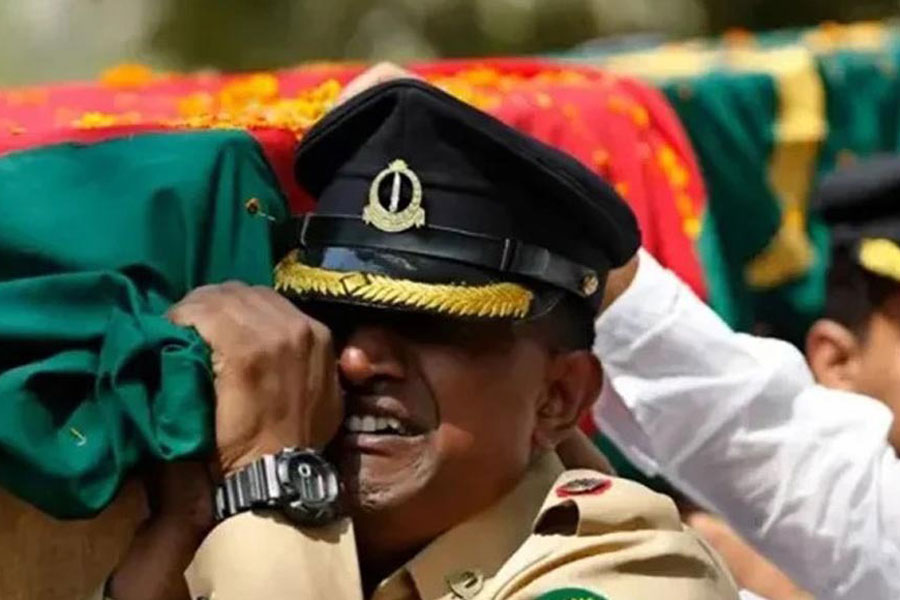
File photo shows an army offer breaks down as he carries coffin of a colleague killed in BDR carnage. Photo : BSS/Files

The government has extended the tenure of the National Independent Investigation Commission formed to reinvestigate the BDR carnage till December 7.

Cabinet Division issued a notification in this regard on Wednesday.

The interim government formed the independent commission on December 24 last year with retired Major General ALM Fazlur Rahman as its chairman.

Initially, the commission was given three months to submit its report.

The tenure was later extended twice, each time by three months, followed by an additional two-month extension.

The latest extension expired on November 30.

According to the new notification, the seven-day extension will take effect from December 1.

The commission has been tasked with unearth the nature and full extent of the events that took place on February 25–26, 2009 at the then BDR headquarters in Pilkhana.

The commission has been asked to identify those involved including perpetrators, accomplices, conspirators, evidence destroyers, instigators and any domestic or foreign individuals, groups, organisations, agencies, or institutions linked to the killings.

The commission submitted its report to Chief Adviser Prof Muhammad Yunus on November 30.​
 
Analyze

Analyze Post

Add your ideas here:
Highlight Cite Respond

BDR carnage plot to weaken army
Mustafizur Rahman 27 January, 2026, 00:21

1769477643077.webp

ALM Fazlur Rahman

The National Independent Investigation Commission on the 2009 BDR carnage has found that conspirators inside and outside were involved in the grisly killing at the Pilkhana BDR headquarters.

Former director general of the erstwhile Bangladesh Rifles Major General ALM Fazlur Rahman, who headed the investigation commission, revealed the information in an interview with New Age at his residence recently in the city. Bangladesh travel guides

‘In this inquiry, we have found out the inside and outside conspirators were involved. It was not any munity out of grievances within,’ said Fazlur Rahaman, a freedom fighter.

It is true that soldiers had dissatisfaction due to work pressure as in any force and there was a shortage of manpower, which also helps improve their skills, he further said.

Although people said that the Dal Bhat Karmasuchi (rice and lentil programme) was one of the factors the soldiers were very disturbed about, Fazlur also said, it was not the genuine cause behind the deadly incident that saw 74 people, including 57 army officers, killed.

‘We don’t say that this was the cause, because the BDR director general, who was the man to fulfill their demand, was killed. They had to have their grievances addressed by the DG — isn’t it so? But we have seen that he was the first man to be killed along with few companions,’ the retired military bureaucrat said.Daily newspaper subscription

He said that their investigation had found a link between the Padua-Rowmari border conflict of 2001 and the Pilkhana tragedy in February, 2009 as more than 400 Indian Border Security soldiers were killed in that clash during his tenure as DG of the then BDR for invading Bangladesh territory in Kurigram.

He said that they had found that BDR soldiers were exploited during the mutiny that spread to other places outside the Pilkhana headquarters in Dhaka.

‘It’s a kind of incident that happened at Palashi in 1757 — leading to the fall of Bengal to the British. A Palashi incident happened here in a small place of Pilkhana,’ he mentioned.

He added that all forces, including the army and the Rapid Action Battalion, remained standby near Pilkhana without going for actions although the military officers were being killed on February 25 in 2009 and it continued on the following day.

‘The RAB was standing and they didn’t take any action so far. But in the army law of 1952, Section 31 is absolutely clear. Wherever there is a mutiny, undertaken by a soldier, it must be subdued as soon as possible before it spreads to others,’ he said.

He disclosed that they had found that the then ruling Awami League and a foreign power were directly involved in the BDR carnage.

Fazlur said that they had evidence showing neighbouring country India was involved in the conspiracy to weaken the Bangladesh Army.

The national investigation commission formed on December 24, 2024 by the interim government to reinvestigate the BDR carnage after the ouster of the authoritarian Sheikh Hasina regime in a student-led mass uprising on August 5, 2024, submitted its report on November 30, 2025.​
 
Analyze

Analyze Post

Add your ideas here:
Highlight Cite Respond

Govt to form another commission to investigate 2009 BDR carnage
Staff Correspondent 24 February, 2026, 00:11

1771895171476.webp

File photo

Home minister Salahuddin Ahmed on Monday said that the government would form a commission to reinvestigate the 2009 carnage at Pilkhana, the headquarters of the erstwhile Bangladesh Rifles now known as Border Guard Bangladesh, in Dhaka.

His statement came at a press briefing after an exchange-of-views meeting with heads of various departments at the Bangladesh Secretariat on Monday.

‘A new commission will be formed for a thorough investigation into the BDR carnage. We will work according to the recommendations of the commission to ensure justice,’ Salauddin said replying to a query during the briefing.

Earlier on December 24, 2024, shortly after the ouster of the Awami League regime, the interim government formed the National Independent Investigation Commission headed by retired Major General ALM Fazlur Rahman to reinvestigate the BDR carnage.

The report submitted by the commission revealed that then ruling Awami League and foreign power were directly involved in the 2009 carnage.

According to the report, then prime minister Sheikh Hasina had a green signal behind the carnage that saw at least 74 people, including 57 army officers, killed and lawmaker Sheikh Fazle Noor Taposh acted as the chief coordinator in the massacre.

On December 22, 2024, families of 22 victims of the BDR carnage filed a complaint with the International Crimes Tribunal chief prosecutor, accusing deposed prime minister Sheikh Hasina, her defence adviser Tarique Ahmed Siddique, former army chief Moyeen U Ahmed and 55 others of crimes against humanity and genocide.

The BDR carnage was committed in February 25–26, 2009, less than two months after the December 29, 2008 national election that saw Sheikh Hasina-led Awami League rise to power.​
 
Analyze

Analyze Post

Add your ideas here:
Highlight Cite Respond

In a fascism-free Bangladesh, causes behind Pilkhana killings are now understood: PM

National Martyred Army Day to be observed on Wednesday


BSS

1771981313878.webp

Image: BSS

National Martyred Army Day will be observed on Wednesday by paying tribute to the martyrs of the 2009 Pilkhana massacre.

On the eve of National Martyred Army Day, Prime Minister Tarique Rahman issued a message praying for the eternal peace of the souls of the martyrs of the Pilkhana massacre and expressed his deepest sympathy and solidarity with their bereaved family members.

He said that on February 25, 2009, a brutal massacre took place at the then BDR (now BGB) headquarters in Pilkhana.

The premier said that 74 people were martyred, including 57 army officers, in the carnage at the Pilkhana BDR headquarters.

After 2009, the day was not observed with due importance, he said, adding that since 2024, following the country’s liberation from fascism, the day has been observed as “Martyred Army Day”.

“The trial over the killings at Pilkhana is ongoing. As the matter is sub judice, there is no scope for detailed comments. However, as a citizen, I believe it is important for us to understand that activities against the country’s independence and sovereignty were involved in this massacre.

“After the incident, there were attempts to mislead the public through various falsehoods and misinformation,” said the premier.

“But in a fascism-free Bangladesh, the underlying causes behind the Pilkhana killings are now understood by the people,” said Tarique Rahman.

He said the armed forces are a symbol of the honour, bravery, and pride of an independent nation.

“Today, we must renew our pledge so that no one can ever again conspire against the armed forces. Let this be our commitment on Martyred Army Day - that we will stand united against any conspiracy that goes against the interests of the country and its people,” he said.​
 
Analyze

Analyze Post

Add your ideas here:
Highlight Cite Respond

2009 BDR carnage: 2024 enquiry commission finds evidence against top military officials, politicians
25 February 2026, 02:27 AM
Zyma Islam

1772068730080.webp

Officers cry while carrying bodies of Pilkhana massacre victims. File photo

For 17 years, the killing of 74 people, including 57 of the nation’s top military officers, during a mutiny at the then BDR headquarters in Pilkhana has remained an open wound, clouded by state-led investigations dismissed by critics as a facade of justice.

In 2024, the Ministry of Home Affairs set up a seven-member body to re-examine the findings of the 2009 BDR mutiny commission, following widespread criticism of the 2013 mass trial. The inquiry was tasked with uncovering evidence that the previous report may have overlooked due to political interference.

The previous official investigation into the mutiny blamed years of pent-up anger among ordinary soldiers, who felt their appeals for pay raises and better treatment were ignored. Rampaging troops from the then Bangladesh Rifles (now Border Guard Bangladesh) murdered some of the brightest military officers during the two-day revolt that began in Dhaka’s Pilkhana on February 25, 2009 and spread across the country.

However, the new body, the National Independent Investigation Commission, which submitted its final report in November 2025, contradicts the findings and said the massacre had direct involvement of the then-ruling Awami League leadership. It specifically named lawmaker Sheikh Fazle Noor Taposh, former defence and security adviser to the prime minister Tarique Ahmed Siddique, and former army chief General Moeen U Ahmed, among others.

The report, submitted to former chief adviser Prof Muhammad Yunus, has not been made public, and details of the evidence against the accused have not been disclosed.

The Daily Star has seen the report, which gathered evidence against some of the top civil and military officials as well as politicians.

Meanwhile, on February 23, the newly formed BNP government announced that it would constitute another commission to reinvestigate the incident to ensure justice.

EVIDENCE AGAINST TARIQUE SIDDIQUE, MOEEN U AHMED

In the latest report, the most substantial evidence against Tarique Ahmed Siddique and General Moeen U Ahmed comes from the testimony of Chief of Army Staff General Waker-Uz-Zaman, who was present at the scene on the day of the mutiny.

Waker, then a major and second-in-command of the 17th East Bengal Regiment, arrived at the scene around 10:30am. He positioned troops from the 46th Independent Infantry Brigade near Gate 4 of the BDR headquarters and was prepared to intervene.

According to Lt Gen (retd) Abdul Mubeen, then the principal staff officer of the Armed Forces Division, he instructed Waker to take position on the rooftop of a building in Dhanmondi near the Pilkhana gate and fire several rocket shells targeting the gate.

Mubeen said Tarique later ordered him not to intervene. Tarique subsequently confronted Mubeen and questioned whether he had the authority to order such a move. Mubeen later became the Chief of army staff.

According to the report, Waker, unable to reach the commander of the 46th Brigade for orders, contacted Major General Tarique Siddique. The report says Tarique bypassed the chain of command and explicitly instructed him not to launch an attack, citing the government’s decision to pursue a political resolution.

According to the report, Tarique was alerted to the massacre as early as 9:37am, when Major Md Zaedi Ahsan Habib, who was trapped in the Darbar Hall as the killings unfolded, called him seeking help. Tarique had previously been Zaedi’s commanding officer. Zaedi survived and later testified before the Commission.

In his testimony, Maj Gen Rezanur Rahman Khan, additional director general (operations) of RAB, then a colonel, told the Commission that he received news of the mutiny around 9:30am from BDR officers and set out for Pilkhana with his forces.

He said he had already ordered RAB-2, RAB-3 and RAB-10 to proceed to Pilkhana and had authorised them to open fire if necessary.

On the way, Tarique called and instructed him to go instead to the state guest house Jamuna. Upon arrival, the then director general of RAB told him to cancel the order to fire and advised him to contact the appropriate authorities regarding army deployment.

Rezanur said he was also instructed by the then DG of the Special Security Force, Brig Gen Joynal Abedin, and by Tarique not to intervene. He relayed those instructions to his forces on the ground.

According to his statement, he repeatedly sought permission to enter Pilkhana with RAB personnel but was not approved.

The report further said that on the morning of 27 February, when Brig Gen Abdul Hakim Aziz, then the director of Military Operations (DMO) at the Army Headquarters, entered Pilkhana in an armoured personnel carrier, Tarique allegedly verbally reprimanded him for bringing the vehicle inside.

It also says that on the evening of 25 February 2009, Major General Sultanuzzaman Saleh -- then brigadier general at the Directorate General of Forces Intelligence (DGFI) -- went to the National Monitoring Centre (NMC) to conduct mobile phone monitoring under Tarique’s instruction, bypassing the chain of command.

The Commission noted that because Sultanuzzaman monitored networks for an extended period without valid authorisation and outside his regular duties, the possibility that he was identifying officers’ locations and relaying the information to the mutineers could not be ruled out.

National Monitoring Cell (NMC) chief Brig Gen Md Khorshed Alam told the Commission that Saleh barged into the NMC and took over. NMC was the predecessor of the NTMC and was located inside the DGFI premises.

In his interview with the Commission, General Moeen U Ahmed, then the army chief, said he attended an emergency cabinet meeting at the prime minister’s residence, Jamuna, and was tasked with overseeing the military response.

The Commission found that the army chief failed in his duty to protect his officers by not issuing specific operational orders to the 46th Independent Infantry Brigade and instead spending critical hours at Jamuna.

Despite reports of officer fatalities by noon, the report says he supported political negotiations and ordered troops to withdraw to a position two miles away, a move that allegedly allowed the attackers to continue the killings and later escape.

EVIDENCE AGAINST TAPOSH AND SHEIKH SELIM

The Commission called Barrister Sheikh Fazle Noor Taposh a key coordinator of the massacre.

One premise of this accusation is that Taposh had a close acquaintance with some of the sepoys and jawans convicted as primary conspirators of the BDR mutiny.

Sepoy Selim Reza, currently incarcerated, told the Commission that ahead of the 2008 general election, Taposh met several BDR personnel to discuss their grievances. The group was brought to him by Torab Ali, a ward-level Awami League leader in Dhaka.

Torab Ali later died in jail after being accused and convicted in the 2009 BDR carnage case, though he was subsequently acquitted of conspiracy charges.

Another incarcerated BDR member, Nayek Sheikh Shahidur Rahman, who was close to Torab, told the Commission that Torab had described a secret planning meeting at Taposh’s residence. He claimed those present included former lawmakers Sheikh Selim, Jahangir Kabir Nanak and Mirza Azam, Torab Ali, along with mutiny leaders likeSepoy Milon.

Rahman said Torab objected to a plan to kill officers but was overruled by Sheikh Selim. Shahidur Rahman is the sole source for this alleged meeting.

According to the report, a sweeper, Abdul Hakim, also witnessed Taposh holding meetings with jawaans and BDR’s deputy assistant director Syed Tauhidul Islam on three occasions.

DAD Tauhid, who was sentenced to death in the BDR carnage, was named in the report as a key coordinator.

On February 25, 2009, DAD Tawhid led a 14-member rebel delegation to the then prime minister’s residence (Jamuna) to negotiate a surrender and seek a general amnesty for the mutineers. The report also notes that during the two-day massacre, Tawhid maintained command over the rebel factions.

Sepoy Selim Reza (now incarcerated), who was present at the meeting, said that Hasina had promised to make DAD Tawhid the director-general of BDR.

Major Sumon Ahmed of the 4th East Bengal Regiment told the Commission that during the mutiny, he saw Taposh, former police inspector general Nur Mohammed, Nanak, and Mirza Azam enter and exit the BDR HQ several times without hindrance, while others, including the army, were barred. He also said that around 11:30am, he saw Taposh distributing leaflets to the jawaans.

Around midnight of the day of the mutiny, Taposh, former home minister Sahara Khatun, and the then IGP held a meeting with the mutinous jawaans. Subedar Major Gofran, an eyewitness, said Sahara asked the jawans whether they wanted Taposh or Nur Mohammed as director-general.

The events following the mutiny brought further scrutiny to Taposh.

Five military officers who had been on duty during the mutiny, took action against the rebels, or were involved in post-event investigations, were forcibly disappeared, tortured in a joint interrogation cell, and imprisoned for five years through a court-martial.

They were accused of attempting to assassinate Taposh with a remotely controlled bomb on 21 October 2009, outside his law office in Motijheel. The officers named in the case were Major Helal, Capt Rezaul Karim, Capt Khondokar Rajib Hossain, Capt Md Fuad Khan, and Capt Subayel Ibne Rafique.

The Commission noted that all five were at their respective stations on the day of the attack and could not have been involved.

According to the report, Capt Rezaul had fired at rebels during the mutiny and later received a stand-down release for disobeying the army chief’s order. Fuad and Rajib had defied orders to keep the army out, seized weapons from the armoury, and launched a rescue operation into Pilkhana on 26 February to save surviving officers. Subayel had acted similarly, taking arms from the 14th Engineering Brigade to aid the rescue.

Capt Rezaul told the Commission that they were forcibly disappeared and framed to remove them from the investigation and destroy the evidence they had gathered. All five said they were tortured in the “Aynaghar”-famed Joint Interrogation Cell (JIC). Brigadier General Imamul Huda, who headed the court-martial, admitted that the officers appeared physically abused during their hearings.

The initial investigation could not prove the allegations. Yet, after the court-martial, the officers were taken to the AIC, tortured again, and forced to give confessional statements under duress. They told the Commission that Brig Gen Huda threatened them with prolonged torture if they did not sign a blank paper.

The Commission’s review of the court-martial proceedings found gross discrepancies, indicating the officers had been deliberately framed.​
 
Analyze

Analyze Post

Add your ideas here:
Highlight Cite Respond

Victim families for publishing perpetrators’ names

Nat’l Martyred Army Day observed


Staff Correspondent 26 February, 2026, 00:15

1772069587929.webp

Armed forces personnel raise their hands in salute as president Mohammed Shahabuddin and prime minister Tarique Rahman go to the Banani Military Graveyard in Dhaka to pay tribute to army officers martyred in the 2009 BDR carnage on Wednesday. | Star Mail photo

The families of the victims of the 2009 Bangladesh Rifles mutiny at the erstwhile BDR headquarters in the capital’s Pilkhana area on Wednesday urged the government to publish the names of the perpetrators and conspirators mentioned in the National Independent Investigation Commission report.

They also demanded trial of the conspirators and perpetrators involved in the killings of 74 people, including 57 army officers, during the mutiny, held in February 25-26, 2009.

Wednesday was observed as the National Martyred Army Day.

The Muhammad Yunus-led interim government in the past year declared the day as National Martyred Army Day amid demands from the victims’ families.

Addressing a ceremony organised by the Retired Armed Forces Officers’ Welfare Association in Dhaka to mark the day, Nehrin Ferdousi, widow of slain Colonel Mujibul Haque, said, ‘We urge the government to publish the names found involved directly or indirectly in the commission’s report. We want justice through a fair trial.’

Nehrin also urged the government to upgrade the Jatiya Shaheed Sena Dibash to category ‘A’ from category ‘C’ of the list of different national days.

After the mutiny, the BDR was renamed the Border Guard Bangladesh.

The National Independent Investigation Commission, formed on December 24, 2024 during the interim government to re-investigate the BDR carnage after the ouster of the Sheikh Hasina regime on August 5, 2024, revealed that the then-ruling Awami League and foreign powers were directly involved in the carnage at Pilkhana.

It also found that the then prime minister Sheikh Hasina, now in India, had given a green signal to the incident and that the then lawmaker Sheikh Fazle Noor Taposh acted as the chief coordinator of the perpetrators during the massacre.

Earlier, the commission chief, retired Major General Fazlur Rahman, who is also a former BDR director general, said that they urged the interim government to make the report public, but the then government did not do so.

On Wednesday morning, president Mohammad Shahabuddin and prime minister Tarique Rahman paid tributes to the army officers killed in the 2009 Pilkhana mutiny by placing wreaths at their graves at the Banani Military Graveyard to mark the National Martyred Army Day.

A one-minute silence was observed after the wreath-laying, and members of the armed forces offered a formal salute.

The president and the prime minister later joined in prayers for their departed souls.

Home minister Salahuddin Ahmed, chief of army staff Waker-Uz-Zaman, chief of naval staff Mohammad Nazmul Hassan and chief of air staff Hasan Mahmood Khan and senior officials from the army, navy and air force also attended the ceremony.

Talking to reporters after paying tributes to the graveyard, home minister Salahuddin Ahmed said that they would not form any new commission but implement the recommendations of the commission formed during the interim government.

The home minister’s remarks on the issue came two days after his earlier comment at the secretariat, where he said that they would form a commission to re-investigate the BDR carnage.

Speaking at the event at RAOWA Club, slain BDR chief Major General Shakil Ahmed’s son Rakin Ahmed said, ‘We want nothing but justice.’

RAOWA chairman, retired Colonel Mohammad Abdul Hoque, in his welcome speech, said that several hundred brilliant officers became victims of enforced disappearance, were sacked from service and faced early retirement for protesting against the killings during the mutiny and demanding justice.

He alleged that the mutiny was a part of the neigbhouring country’s conspiracy.

Surviving victim Lieutenant Colonel Riazul Karim also addressed the event.

Special prayers session, video presentation and commemoration of the victims’ families and survivors were also held at the RAOWA Club.

In the evening, an iftar party and a view-exchange programme was held at the Bangladesh Army Multipurpose Complex at Dhaka Cantonment where prime minister Tarique Rahman and chief of army staff Waker-Uz-Zaman were present, according to a press release issued by the Inter Services Public Relation Directorate.​
 
Analyze

Analyze Post

Add your ideas here:
Highlight Cite Respond

Members Online

Latest Posts

Back
PKDefense - Recommended Toggle