যে ভাবে সংঘঠিত হয় বিডিআর হত্যাকাণ্ড। (The following video illustrates how the BDR carnage took place in Pilkhana in 2009. Though the video is long, please watch the video until the end.)
Children of three slain army officers talk about their experience regarding BDR carnage
www.thedailystar.net
Memories, trials and tribulations
VISUAL: ANWAR SOHEL
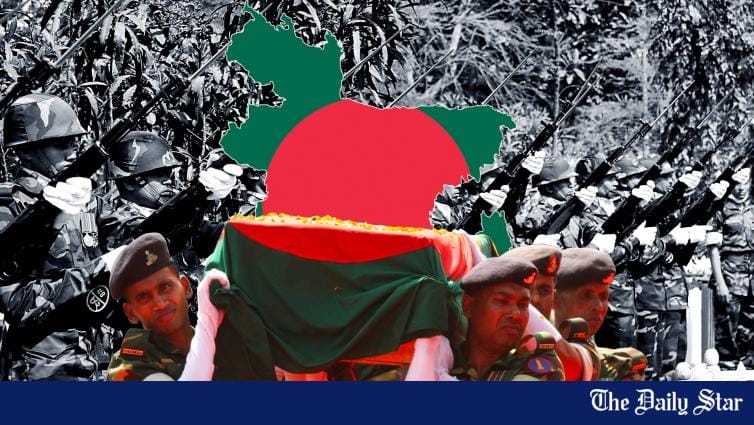
Children of three slain army officials speak to The Daily Star about their experience during the BDR carnage on February 25-26, 2009, the false narratives surrounding the incident, and their hope for a fair investigation.
'The horrors of BDR carnage still haunt me'
Fabliha Bushra
As I write this, 16 years after February 25, 2009, I am filled with a complex mix of emotions, something akin to relief and even astonishment at being alive and a profound grief of losing my beloved father to mindless violence. I, along with my family, was held hostage while my father was slain, along with many others not too far away from us. The day still feels like a vivid nightmare that I don't have the luxury to wake up from. For 16 years, I have been in the survival mode. That incident has robbed me and many others like me of a childhood, a chance at normal life.
Before we could even make sense of what was happening amid the sound of blaring gunfire and cars burning in front of our house, intruders barged into our home and dragged us out at gunpoint that morning. To our utter horror, they were men in uniform—BDR jawans, whom we looked at for protection and entrusted with our security. I, a 14-year-old then, and my six-year-old brother held on to my mother tightly, as we ran for our lives as bullets were being fired at us too. When our phones were taken away, my mother pleaded with the jawans to let her speak to my father at least once. She thought we were being taken to safety and it was important to inform my father or he would worry about us. Not once did we think that these men intended to harm us or that my father would meet a fate much worse than us. In my mother's last conversation with my father, he asked her to take care of herself and keep us safe.
Instead of taking us to a safe place, they took us to a place called "Quarter Guard," where we were held hostage with at least a hundred other families for 36 hours. We were thrown into a small cell that was already filled with injured, bleeding people. While they shoved us in, some of us were kicked in the back, and I was hit in the back of my head with a rifle butt. Many hostages including women and children were beaten brutally. They had also captured several officers who were beaten to a pulp right in front of us. We were all screaming and praying for the Almighty's mercy as they threatened to torture and kill us.
Most of the time, we were ducking to avoid being shot. We begged for forgiveness and consoled the hostages right next to us who were our neighbours, friends, and playmates. As a teenage girl, my fear of death was layered with a very real possibility of being raped. My mother covered me with a large orna as that was the most she could do, in hopes of protecting me from those barbarians.
All the time we were in captivity, I foolishly thought that my father, being a doctor, would be spared from the atrocities. I was proven wrong in the worst way possible when my father's body was found in a mass grave with 32 others. The feeling of getting a new chance at life, after being released from that hell, disappeared when I learnt of my father's killing.
There have been, and there will be, many political autopsies of BDR carnage, and the deaths will probably become just another statistic. Meanwhile, I am forced to make peace with the fact that I will never get closure and will probably have to spend the rest of my life trying to heal from something I had no part to play in. None of us did.
Dr Fabliha Bushra is the daughter of slain Lt Col Lutfur Rahman Khan.
'Reject the flawed narrative on BDR carnage'
Saquib Rahman
It was hurtful for the victims' families to see how some media outlets sympathetically portrayed the agonies of dismissed BDR rank and file who recently took to the streets. These riflemen and their families staged protests on January 8-9, claiming that the carnage was the result of Sheikh Hasina's conspiracy and that the riflemen were systematically framed and subjected to farcical trials as part of the plot. Undoubtedly, they were playing the victim card.
Since the recent court hearings on explosive cases, some media outlets began to highlight the miseries of the accused riflemen who received bail. They portrayed the struggle of the riflemen's families to make ends meet. While any prudent human being would have sympathy for the families, it must be noted that the trial of the BDR jawans is still in progress and their chances of conviction remain.
On January 29, at a press conference, we, the victims' families, strongly condemned the media's role in twisting stories and changing the narrative on the mastermind behind the killings and atrocities inside Pilkhana. Though we filed a complaint against Hasina and others in the International Crimes Tribunal, acknowledging that there was a conspiracy, that does not mean the first line of perpetrators, the riflemen, charged with murder, can be freed!
Meanwhile, the protesting riflemen and their families later changed their demands and no longer asked for the unconditional release of those convicted of assassinations.
On February 6, we, the victims' families, through the official Facebook page of our organisation, Shaheed Shena Association, put out a statement that we believe is reasonable.
We clarified that the protesting riflemen who were punished as per the erstwhile BDR service law for upto seven years, are within their rights to place their demand before the government for reinstatement (and compensation) in the force. We have no opinion regarding that. The government might review their applications and do as they deem fit.
Moreover, in the explosive cases where the riflemen are receiving bail, we, the victims' families, cannot certainly comment on the decisions made by the judiciary.
Lastly, we, the victims' families, acknowledge that the murder cases are with the Supreme Court's Appellate Division at the moment. Reinvestigation is not allowed once a court has taken cognisance of a matter. If the new BDR Investigation Commission reinvestigates the murder cases, it would be an interference in the criminal trial. However, we stated that provided there is any scope within the law to reinvestigate the murders, such a step may be taken.
Advocate Saquib Rahman is senior lecturer of law at North South University. He is the son of slain Col Quadrat Elahi Rahman Shafique.
'I am cautiously optimistic of the new investigation'
Muhtasim Ittisaf
I was in my room when the BDR Jawans came and took us hostage on the fateful day of February 25, 2009. They took my entire family—my mother, my brother— and held us captive inside the Quarter Guard jail for two days, crammed into a small cell. They were firing their guns right in front of us and I was frightened for my family's safety.
We thought we were going to be freed when Sahara Khatun (the then home minister) arrived. Some weapons were surrendered to her, which was clearly just for show as we saw people picking the weapons back up once she left. It was a complete mockery.
We heard that the army tried to send a RAB unit inside, but the top brass allegedly did not allow it.
After our release, we were taken to Mirpur Cantonment. Then to my uncle's house in Dhanmondi. That was when we started getting the list of those who had been killed. I found out my father, Lieutenant Colonel Sazzadur Rahman, was among the martyrs.
It was deeply traumatic. I did not go to school for four months. Later, I got admitted to Adamjee and finished my studies there.
After the incident, we were terrified as everyone warned us not to speak of the then government's alleged involvement. They said "You have already lost so much. Do not risk your life further."
But growing up in a military family, I heard things that made the government's involvement in the incident quite obvious. It was not possible for such a massive event to occur with just low-level political figures involved. There had to be higher-ups.
What confuses me even more is the appointment of the current home adviser. He headed the 20-member army probe committee on the BDR carnage mutiny in 2009 and allegedly amended the report thrice before presenting it to the media. And I believe political involvement in the carnage was covered up.
Some people claim that political and possibly foreign influence was involved. Yet, no one points fingers directly because a certain quarter does not allow it.
For 15 years, nothing happened. The Awami League was in power, and many believe that there was clear involvement from people within their ranks. Some people even mention the names of Jahangir Kabir Nanak and Sheikh Fazle Noor Taposh. There was a systematic effort to delay and bury the investigation.
While the families of the slain officers were subtly told not to point fingers at the Awami League, they tried to pacify us with offers of plots of land, one-time payments—things we did not ask for.
Thankfully, a new committee has been formed under Lieutenant General Fazlur Karim Chowdhury to probe the incident and Saquib Rahman, of slain officer Col Quadrat Elahi Rahman Shafique, is involved in it, representing the families of the martyrs.
I am cautiously optimistic that as long as this government stays in power, we might finally see real progress. That is why I hope the committee can release a preliminary report before the next election, clearly stating the involvement of not just BDR soldiers or army personnel, but of higher-ups, political figures, and possible foreign influences.
All we want is for the truth to come out, no matter who was involved. That is all.
(This comment was taken by Monorom Polok of The Daily Star.)
Muhtasim Ittisaf is lecturer at the Department of Chemical Engineering at Bangladesh University of Engineering and Technology. He is the son of slain officer Lt Col Mohammad Sazzadur Rahman.
The families of the martyred army officers have called on the National Independent Investigation Commission to identify both the direct and behind-the-scene perpetrators of the 2009 Pilkhana BDR massacre.
www.thedailystar.net
Identify direct and behind-the-scene perpetrators
Demand families; National Martyred Army Day observed
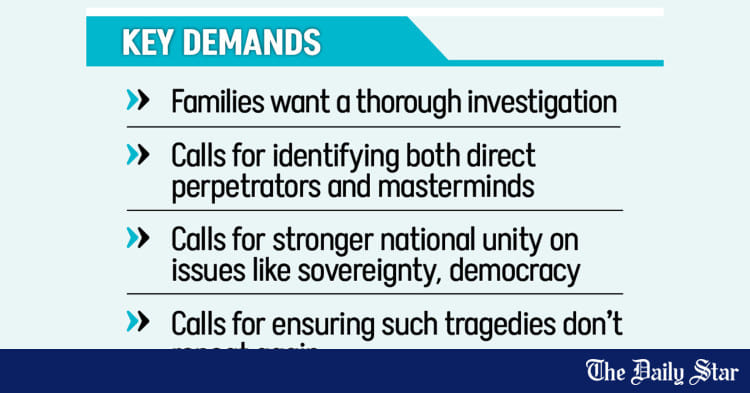
The families of the martyred army officers have called on the National Independent Investigation Commission to identify both the direct and behind-the-scene perpetrators of the 2009 Pilkhana BDR massacre.
At a memorial event at the Retired Armed Forces Officers Welfare Association (RAOWA) auditorium in Mohakhali yesterday, they said that the current environment is conducive to such an investigation and that the nation is awaiting justice.
They said those responsible for the murders of 57 army officers must be held accountable.
The event was attended by Chief of Army Staff General Waker-Uz-Zaman, Chief of Naval Staff Admiral Mohammad Nazmul Hassan, Principal Staff Officer (PSO) of the Armed Forces Division Lieutenant General Kamrul Islam, and Border Guard Bangladesh Director General Major General Mohammad Ashrafuzzaman Siddiqui, who also addressed the gathering.
Meanwhile, Shaheed Sena Dibosh (National Martyred Army Day) was observed in the Armed Forces with due honour, according to an ISPR press release.
The flags of the Army, Navy, and Air Force were flown at half-mast. In the morning, the chiefs of army, navy, and air force paid tribute and laid wreaths at the Banani Military Graveyard, where the Pilkhana-martyred officers are buried. Following them, the families of the martyrs also laid wreaths, observed a moment of silence, and offered special prayers for their souls, the release said.
NEVER AGAIN
Admiral Nazmul Hassan expressed hope that such a massacre would never occur again. "As citizens, we must work for our country's betterment. We sincerely pray that such a brutal loss of life never happens again and that innocent people are never subjected to oppression," he said.
Lt Gen Kamrul Islam described the official recognition of February 25 as Shaheed Sena Dibosh as a historic milestone, crediting General Waker-Uz-Zaman for the initiative.
"February 25 was not just an ordinary event. It could have been a conspiracy, a planned attack, or a failure to control the situation. Whatever it was, it left a deep wound that cannot be forgotten. There is much to learn from this, and the armed forces are on the right path. Immediate measures must be taken to prevent such incidents in the future," he added.
Maj Gen Ashrafuzzaman Siddiqui reassured the victims' families of BGB's continued support. He announced that the "Border Conference Centre" at BGB Darbar Hall has been renamed in honour of the late BDR Director General Major General Shakil Ahmed, who was among those killed.
IDENTIFY THE MASTERMINDS
Retired Maj Gen Jamil D Hassan urged the authorities to expose the individuals behind the massacre. "The time has come for justice. Yet instead of punishing the culprits, some are being shielded. This must stop," he said.
Major General (retd) Azizur Rahman Bir Uttam, recalling his tenure as BDR (Bangladesh Rifles, now BGB) director general, cited a letter from a former foreign secretary concerning border security.
He suggested that there had been a deliberate effort by a neighbouring country to weaken Bangladesh's defence system. "We now better understand who was involved in the massacre and who orchestrated it," he said.
FOREIGN INVOLVEMENT ALLEGED
BNP standing committee member Major (retd) Hafiz Uddin Ahmed Bir Bikram criticised the former army chief and the lack of military preparedness at the time.
"I strongly believe a foreign state was involved in this massacre. At the same time, the former army chief, General Moeen U Ahmed, bears responsibility for this failure," he said.
CALL FOR NATIONAL UNITY
Jamaat-e-Islami's Nayeb-e-Ameer Syed Abdullah Mohammad Taher stressed the need for unity on key national issues.
"The army chief has mentioned national unity. This is crucial. We need unity on key matters -- independence, sovereignty, sustainable democracy, free and fair elections, a moral framework, and a just society. If we unite on these, we will achieve our national goals," he said.
A SYMBOLIC BLOW TO CONSPIRATORS
ALM Fazlur Rahman, head of the Independent National Inquiry Commission, said failure of the commission would raise concerns about national security.
Regarding the recognition of Shaheed Sena Dibosh, he said, "Cowards kill from behind. By establishing this day as Martyrs' Day, we have delivered a symbolic blow to the conspirators."
The memorial meeting was chaired by RAOWA Chairman Colonel (retd) Mohammad Abdul Haque and moderated by Vice Chairman Brigadier General (retd) Shams Alauddin Ahmed.
Among the speakers were Lt Col (retd) Riaz, Sharmin Nishat Siraji (wife of Lt Col Sajjadur Rahman), Nasrin Ahmed (wife of Major Mohammad Saleh), Fabliha Bushra (daughter of Shaheed Kazi Mosaddek Hossain), and Kazi Nazir.
The victims' families expressed gratitude to the government for recognising February 25 as Shaheed Sena Dibosh, saying that it provided some solace. However, they reiterated their demand for justice against those responsible for the massacre.
Renowned artist Haider Hossain, who composed a song dedicated to the victims, was honoured by RAOWA. Reflecting on his work, he said, "I do not consider it just a song -- it is my heartfelt expression and emotion."
Jatiya Shaheed Sena Dibas was observed on Tuesday, marking the Pilkhana carnage in which 74 people, including 57 army officers, were killed at the then Bangladesh Rifles headquarters in the capital Dhaka in February 25-26, 2009.
Armed forces personnel raise their hands in salute, as they pays tribute to their fellows killed in 2009 BDR carnage, at the Banani military graveyard in Dhaka on Tuesday. | Md Saurav
Jatiya Shaheed Sena Dibas was observed on Tuesday, marking the Pilkhana carnage in which 74 people, including 57 army officers, were killed at the then Bangladesh Rifles headquarters in the capital Dhaka in February 25-26, 2009.
The day was observed nationally this year as the interim government on February 23, two days before BDR mutiny day, declared February 25 Jatiya Shaheed Sena Dibas.
In the morning on Tuesday, home affairs adviser retired Lieutenant General Md Jahangir Alam Chowdhury paid homage to the killed officials by placing wreaths at the Military Graveyard at Banani in the capital.
Chiefs of Bangladesh Army, Bangladesh Navy and Bangladesh Air Force also paid homage to the victims.
Tribute to the BDR carnage victims were also paid by the president, the chief adviser, the Border Guard Bangladesh and the Rapid Action Battalion.
While talking to reporters at the Banani graveyard, the home adviser said that they had implemented the day as Jatiya Shaheed Sena Dibas.
‘We have also formed the National Independent Investigation Commission following a demand of the victim families. The commission was formed on December 24, 2024 and would submit the report within three months,’ said Jahangir while responding to a question.
He said that if the commission found involvement of the other accused in the carnage, they would also be brought to justice.
A team of Bangladesh Nationalist Party leaders led by BNP secretary general Mirza Fakhrul Islam Alamgir and standing committee member retired Major Hafiz Uddin Ahmed paid tribute by placing wreaths at the graveyard.
Fakhrul told reporters that brutal killings of army officers at Pilkhana were carried out under the leadership of Sheikh Hasina.
‘We have united after many years. A huge political change has come in the country. Students and people have created a golden opportunity for us by overthrowing the fascist forces to build a new Bangladesh,’ said Fakhrul referring to the July mass uprising that toppled Hasina from power on August 5. 2024.
Victim families also paid tribute to slain members of their families and expressed satisfaction over the government announcing the day officially.
Rakin Ahmed, son of slain former BDR director general Major General Shakil Ahmed and Naznin Ahmed, both of whom were murdered during the carnage, told New Age that they were observing the day on a large scale after the Sheikh Hasina’s fall as no members of intelligence agencies were disturbing them.
‘We expected that the government would declare the day in grade A but it declared it as grade C. We hope that the government would upgrade it,’ said Rakin.
Saquib Rahman, son of slain Colonel Quadrat Elahi Rahman Shafique, said that actual perpetrators must not be released.
Chief of army staff General Waker-Uz-Zaman on Tuesday said that the then Border Guard Bangladesh members had committed murders in the February 25-26, 2009 Pilkhana carnage as no army officers committed those killings.
‘Full stop, there are no ifs and buts here. If you bring ifs and buts, the judicial process of 16 years about those who were in jail and convicted would be hampered. We have to keep in mind clearly and not to hamper judicial process,’ said Waker while addressing at a photography exhibition on the BDR carnage, marking its 16th anniversary held at the Retired Armed Forces Officers’ Welfare Association, Bangladesh in Dhaka city.
The programme was organised by the RAOWA Club where Border Guard Bangladesh director general Major General Mohammad Ashrafuzzaman Siddiqui and chief of naval staff Admiral M Nazmul Hassan also addressed.
A prayer session was also held at the Mirpur DOHS central mosque after maghrib prayers.
The BGB in a press release said that it arranged doa mahfil in all mosques, including in the headquarters from Fajr to Zuhr, seeking prayers for the slain people.
On December 19, 2024, the families of 22 slain army officers filed a complaint with the International Crimes Tribunal chief prosecutor, accusing deposed prime minister Sheikh Hasina, her defence adviser Tarique Ahmed Siddique, former army chief Moeen U Ahmed and 55 others of crimes against humanity and genocide for their suspected involvement in the mutiny.
Newly formed National Independent Investigation Commission on February 20 said that the commission had recorded statements of 37 people, mostly former army officers, in its 41 working days.
WHILE the 2009 carnage in the Bangladesh Rifles, later renamed as Border Guard Bangladesh, remains a shocking incident, leaving an indelible scar, the failure to establish the motive and the plotters of the incident and to bring them to justice is unsettling. The rebellion, which began in the...
www.newagebd.net
Govt should deliver justice for BDR carnage
26 February, 2025, 00:00
WHILE the 2009 carnage in the Bangladesh Rifles, later renamed as Border Guard Bangladesh, remains a shocking incident, leaving an indelible scar, the failure to establish the motive and the plotters of the incident and to bring them to justice is unsettling. The rebellion, which began in the border guard headquarters on February 25 and spilled over to some other sector headquarters that day and the day after, left 74 people, including 57 officers deputed to the force from the army, dead. After the incident, which happened less than two months after the Awami League government had assumed office, two investigation committees were formed, one by the government, headed by a former secretary, and the other by the army, but none of them could establish the motive of the rebellion and identify the plotters. Both the reports, yet to be made fully public, which failed to get to the reasons and the plotters, however, suggested further investigation to establish who, if any, hatched the plot and why. Further and thorough investigation, the demand for which has only become louder after the fall of the Awami League government on August 5, 2024, is important for strategic planning and stopping such events.
In the aftermath of the rebellion, which exposed weaknesses in Bangladesh’s security framework, various theories emerged to explain the underlying causes of the incident. While the official explanation attributed the incident to dissatisfaction about salaries, benefits and working conditions among the soldiers, many security experts found this explanation inadequate and misleading as it is highly unlikely that such an extreme level of violence could erupt solely because of grievances. Survivors, sacked border force personnel and families of the slain officers also allege that the official explanation coming from unpublished investigation reports — a few of the findings and recommendations of the government committee were made public in May 2009 though — is an attempt to hide the motives and plotters of the massacre. A number of survivors and security experts have, meanwhile, also alleged that there is an external, specifically Indian, involvement in the massacre and that the external forces, aided by the political leadership of the day, exploited the existing grievances among the soldiers. This allegation of the involvement of external forces is a serious one and needs to be investigated properly. If such an involvement is there, the implication of the massacre is far-reaching and severely impacts national security, bilateral relations and regional stability.
This is heartening that the government has declared February 25 National Martyred Army Day, assured its commitment to ensuring justice and formed the national independent investigation commission to investigate the rebellion. The government should now deliver on its assurances.
The chief of army staff, General Waker-Uz-Zaman, has urged all to refrain from disrupting the trial of the Pilkhana killings, emphasising that the incident was committed entirely by members of the then Bangladesh Rifles (BDR).
en.prothomalo.com
BDR carnage entirely done by BDR men, no ifs or buts: Army chief
Staff Correspondent
Dhaka
Published: 25 Feb 2025, 16: 39
The chief of army staff, General Waker-Uz-Zaman, has urged all to refrain from disrupting the trial of the Pilkhana killings, emphasising that the incident was committed entirely by members of the then Bangladesh Rifles (BDR).
The army chief made the statement while addressing a commemoration ceremony at Helmet Hall of the RAOWA Club in Dhaka on Tuesday. He paid tribute to the 57 army officers killed in the 2009 carnage, along with several of their family members.
“Today is a painful day. On 25 February, 2009, we lost 57 brave army officers and some of their family members. I was looking at these pictures while travelling here. You have watched these in pictures, but I have witnessed all these in person. I am a witness of all these brutality,” he said.
He clarified that no army personnel were involved in the killings. “Always, we have to keep in mind that no army personnel carried out this brutality. It was entirely carried out by the then BDR members. Full stop. There are no ‘ifs’ or ‘buts’ here.”
The army chief warned that questioning the established trial process, which has been ongoing for 16-17 years, could undermine justice. “If you drag in ifs and buts, the trial process that continues for 16 years and the convicted who have been in jail for 17 years will be disrupted. We have to keep it in mind very clearly. Do not spoil the trial. Those who have been sentenced are bound to face it.”
Regarding suspected external involvement, General Waker-Uz-Zaman noted that the authorities have formed a commission to find out if any political leadership or foreign forces were involved in the carnage. “The commission chairman is present here. He will find out and inform you.”
He also warned against misinterpretations and attempts to deviate the narrative. “The bottom line is that our fallen soldiers lost their lives in the firing of the BDR men. Some of us have different views and are trying to channel it towards a different direction. It will not be beneficial for us.”
The National Independent Investigation Commission on the 2009 BDR carnage has issued a public notice urging 15 individuals, including former prime minister Sheikh Hasina, to testify as part of its ongoing inquiry. It made the call in a special notice issued today, saying that due to time...
en.prothomalo.com
BDR carnage probe commission asks Hasina, 14 others to appear, testify
BSS
Published: 08 Mar 2025, 21: 37
Sheikh HasinaFile Photo
The National Independent Investigation Commission on the 2009 BDR carnage has issued a public notice urging 15 individuals, including former prime minister Sheikh Hasina, to testify as part of its ongoing inquiry.
It made the call in a special notice issued today, saying that due to time constraint, the commission hopes to complete the process of taking the testimony of the 15 individuals by 31 March of this year.
Apart from Sheikh Hasina, the other individuals are former army chiefs General Moeen U Ahmed and Aziz Ahmed, Maj Gen (Retd) Tarique Ahmed Siddique, former prime minister's security adviser, Fazle Noor Taposh, former mayor of Dhaka South City Corporation, Sheikh Fazlul Karim Selim, former member of parliament from Gopalganj-2, Jahangir Kabir Nanak, former member of parliament from Dhaka-13, Mirza Azam, former member of parliament from Jamalpur-3 and AFM Bahauddin Nasim, former member of parliament from Dhaka-8, Brig Gen (Retd) Muhammad Shamsul Alam, former commander, 44th Rifle Battalion, Lt Gen (Retd) Molla Fazle Akbar, former directorate general of Forces Intelligence, Hasan Mahmud Khandaker, former directorate general, RAB, Abdul Kahar Akond, former police officer, Nur Mohammad, former inspector general of police and Monirul Islam, former additional IGP.
The witnesses are requested to inform the commission in writing of their proposed schedule within 7 days of the publication of the notice, either by phone or e-mail or by letter, as per their convenience.
Online testimony can also be arranged through video conference, the notice said.
BRD carnage mystery must be revealed, CA tells probe commission
BSS
Published :
Apr 16, 2025 19:57
Updated :
Apr 16, 2025 19:57
Chief Adviser Professor Muhammad Yunus on Wednesday said the mystery behind the 2009 BRD carnage must be revealed.
“We all are looking for the answers. The commission must be successful in probing this incident. This mystery should be unveiled,” he said when the members of the National Independent Investigation Commission on BDR carnage called on him at the State Guest House Jamuna.
The Commission members met the Chief Adviser to inform him about the progress of its investigation into the barbaric incident, Chief Adviser’s Deputy Press Secretary Abul Kalam Azad Majumder told BSS.
Speaking on the occasion, Prof Yunus said the interim government will provide all-out cooperation to the probe commission, saying, “They brutally killed their own officers. This carnage was carried out smoothly.”
He noted that the entire nation is looking at the investigation commission and that is why it must reveal the mystery behind this incident.
During the meeting, the commission expressed the hope that its probe report would be finalised by June as its investigation is progressing at full speed.
Commission chief Major General (Retd) ALM Fazlur Rahman said the Commission is contacting various parties.
As the BRD carnage took place 16 years ago, it is being delayed a little bit to contact many of those who had connections with the incident, he said.
Rahman informed the Chief Adviser that many of the accused are staying abroad. “We continue to inquire about their information in coordination with the Ministry of Foreign Affairs,” he added.
He said the Commission has already interviewed some people who are in jail now. “There are 23 people abroad who need to be contacted for the investigation. Of them, eight have contacted for their interviews,” he said.
The commission chief further said: “We are investigating the pattern of killings and torture. After the killing of the DG, the rest (of the officers) were killed. This was a planned carnage. Such a carnage cannot happen without a plan”.
Mentioning that it was like the recurrence of Plassey tragedy, he said the Commission has to find out its roots.
Commission member Major General (Retd) Jahangir Kabir Talukder said: “Not a single officer/official was removed in the incident of such a heinous carnage. None has been held accountable. This was a failure of the intelligence agencies, the military and politics.”
Other members of the Commission Brigadier General Md Saidur Rahman, Munshi Alauddin Al Azad, Dr M Akbar Ali, Md Shariful Islam, Shahnewaz Khan Chandan and ATKM Iqbal were present at the meeting.
On December 24, 2024, the government formed the seven-member commission to reinvestigate the tragic 2009 BDR massacre and it was asked to complete its probe by 90 working days.

 Bangladesh Defense