Bangladesh Defense
Saif
Senior Member
- Jan 24, 2024
- 21,435
- 9,743
- Nation

- Residence
- Axis Group


A budget built on recovery and reform, but can it deliver?
The proposed national budget for FY2026-27 comes at a time when the economy is seeking not only growth but also stability, confidence and direction.
A budget built on recovery and reform, but can it deliver?
12 June 2026, 08:00 AM
Fahmida Khatun
VISUAL: ANWAR SOHEL
The finance minister presented the proposed national budget for FY2026-27 in parliament yesterday, at a time when the economy is seeking not only growth but also stability, confidence and direction. The new budget attempts to balance two objectives that are often difficult to reconcile: restoring macroeconomic stability while reviving growth, investment, and employment. Its central philosophy appears to be economic stabilisation, institutional rebuilding, and investment-led recovery. In many ways, this approach reflects the broad themes of the BNP’s election manifesto, which emphasised economic democratisation, employment generation, institutional reform, private-sector-led growth, and governance improvement.
Are the budget priorities right?
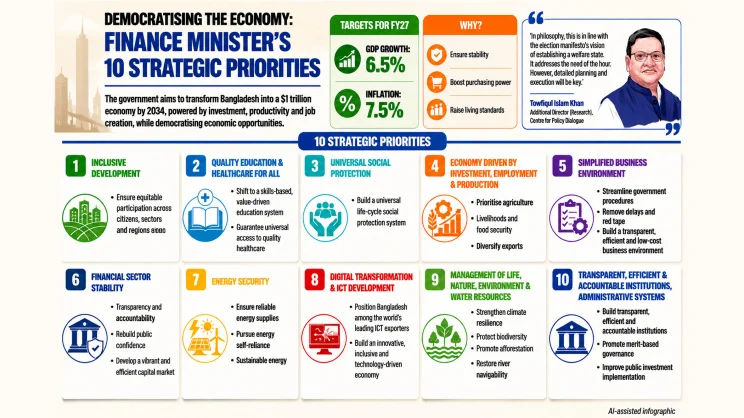
The budget rightly prioritises macroeconomic stability, investment, employment, health, education, social protection, energy security, and financial sector reform. Given the current challenges, inflation control should remain the foremost objective to protect household welfare and restore economic confidence. Reviving private investment and creating jobs is essential for sustainable growth, while restoring stability in the banking sector is critical for financing economic activities. Reliable energy supply is necessary to support industrial expansion and competitiveness. Strengthening social protection is equally important, as poverty and vulnerability have increased amid prolonged inflationary pressures.
Assessing the macroeconomic framework
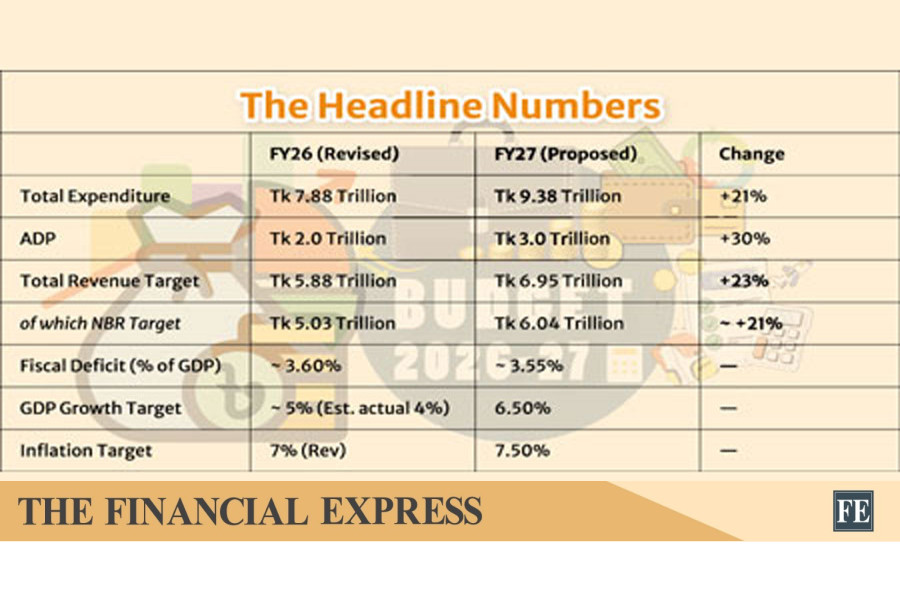
The budget targets a GDP growth of 6.5 percent and inflation of 7.5 percent in the upcoming fiscal year. The growth target is ambitious, but not impossible. Achieving that will require a substantial acceleration in private investment, industrial production, and exports. Considering the current investment trends, weaknesses in the banking sector, and energy constraints, achieving this target will be challenging.
The inflation target represents an improvement from the current levels but is still relatively high. For inflation to shrink meaningfully, several conditions must be met. For example, stable exchange rates, improved food supply chains, adequate energy supply, prudent monetary policy, productive use of fiscal allocation, and favourable international commodity prices are critical for reducing inflation. In fact, any external shock, such as a spike in global energy prices, could jeopardise this target.
The budget projects a total revenue collection of Tk 6,95,000 crore, including Tk 6,04,000 crore from the National Board of Revenue (NBR). This represents a substantial increase compared with the current collections. Historically, revenue mobilisation has been one of the country’s weakest policy areas. Bangladesh’s tax-GDP ratio also remains among the lowest in Asia. Therefore, while the revenue targets are desirable, their feasibility remains uncertain unless major improvement in tax administration, compliance, and enforcement is achieved. The proposed budget of Tk 9,38,000 crore represents a significant expansion compared to the revised budget of the outgoing year. Given the huge need of a growing economy with a large population, increased public expenditure is necessary. However, how much of this allocation will be implemented and the quality of that expenditure remain critical issues.
The fiscal deficit is projected at 3.55 percent of GDP, which remains broadly manageable by international standards. Financing the budget deficit remains a significant challenge for FY2027. Although the government plans a slight reduction in bank borrowing relative to the revised FY2026 budget, it still aims to borrow Tk 1,12,000 crore from banks. Since it also aims to enhance private investment by creating an agreeable environment, excessive dependency on bank borrowing can crowd out private credit, raise borrowing costs, and hamper investment and job creation. To reduce reliance on the banks, the government should focus on increasing revenue through tax reforms, broadening the tax base, reducing exemptions, improving project execution to minimise waste, and securing more concessional external funding. Developing a more mature bond market and exploring other long-term financing options are essential for sustainable deficit management.
Tax reductions and increases
The government has proposed a number of tax and customs reforms aimed at reducing the cost of doing business and encouraging investment. Several measures are intended to facilitate exports, improve customs procedures, and reduce compliance burdens. The budget proposes expanding duty-free import facilities for export-oriented industries, reducing procedural complexities, streamlining VAT compliance, and improving digital tax administration.
These measures are broadly justified. Exporters in Bangladesh face increasingly competitive pressure from peer countries. Reducing compliance costs and improving trade facilitation can enhance competitiveness without significantly reducing government revenue.
However, some tax increases have also been proposed to strengthen revenue mobilisation and reduce fiscal pressures. The rationale behind these measures is understandable given the government’s ambitious expenditure commitment and the need to maintain fiscal discipline. Whether these measures will reduce the cost of living is less certain. Most of the reforms appear more focused on improving the business environment than directly lowering consumer prices. Indirect benefits may emerge over time through increased investment and employment, but immediate relief for households may be limited.
Investment and job creation
A major focus of the budget is investment-led growth. The government aims to increase the total investment and eventually raise it to 40 percent of GDP by FY2030-31. The budget also highlights export diversification, industrial expansion, and support for entrepreneurship. The challenge is keeping investment targets consistent with employment objectives. Bangladesh needs to create millions of jobs in the coming decade to absorb new entrants to the labour market. Investment alone does not automatically generate employment. The composition and quality of investment matter, too.
The budget places considerable emphasis on manufacturing, SMEs, agriculture, information technology, and skills development. These sectors have greater employment-generating potential than capital-intensive industries. Nevertheless, a more explicit employment strategy with measurable job creation targets and monitoring mechanisms would have strengthened the budget.
Health, education, and social protection
One of the most notable features of the proposed budget is the significant increase in allocations for education and health. Education allocation has been increased to 1.79 percent of GDP, which was 1.41 percent of GDP in the revised FY2026 budget. Health allocation has doubled as a share of GDP. Given the weaknesses exposed by the pandemic, as well as ongoing concerns regarding access, quality, and affordability of healthcare, this increase is justified.
The budget also raises social protection spending, acknowledging growing poverty and vulnerability in the country. The social security budget accounts for 2.11 percent of GDP, up from 1.98 percent of the revised outgoing budget. Family Card accounts for 10.05 percent of the social safety net allocation in FY2027. The key challenge is effective use of these allocations. Persistent targeting errors, leakages and administrative inefficiencies often limit impact. While the budget emphasises inclusive and universal social protection, its success will depend on strengthening beneficiary databases, expanding digital delivery systems, integrating social registries, and improving monitoring to ensure that benefits reach the intended recipients efficiently and transparently.
Another issue we should note is that higher allocations alone cannot guarantee better outcomes. Weak implementation, governance failures, procurement inefficiencies, and corruption can undermine the effectiveness of public spending. Therefore, improving the quality of expenditure is as important as increasing allocations. The government’s emphasis on value for money, accountability, and returns on investment is welcome, but success will ultimately depend on effective implementation.
Reform agenda and governance
The proposed budget correctly recognises that governance reform is essential for economic recovery. Several reform initiatives have been proposed, including separation of tax policy from tax administration, digitalisation of revenue systems, banking sector restructuring, strengthening financial sector governance, regulatory simplification, improved public investment management, and greater institutional accountability. These reforms are positive steps forward, but the main challenge is their implementation. Reshaping institutions is far harder than proposing reform measures. Success depends on political will, administrative capacity, and sustained effort over the coming years.
The budget acknowledges the necessity of export diversification, competitiveness enhancement, skills development, and trade facilitation. These are all relevant for the post-LDC environment. However, the budget could have set out a more explicit LDC graduation strategy. Key issues like the erosion of trade preferences, compliance with emerging environmental standards, productivity enhancement, logistics reform, and export market diversification deserve greater attention.
Dr Fahmida Khatun is an economist and executive director at the Centre for Policy Dialogue (CPD).
12 June 2026, 08:00 AM
Fahmida Khatun
VISUAL: ANWAR SOHEL
The finance minister presented the proposed national budget for FY2026-27 in parliament yesterday, at a time when the economy is seeking not only growth but also stability, confidence and direction. The new budget attempts to balance two objectives that are often difficult to reconcile: restoring macroeconomic stability while reviving growth, investment, and employment. Its central philosophy appears to be economic stabilisation, institutional rebuilding, and investment-led recovery. In many ways, this approach reflects the broad themes of the BNP’s election manifesto, which emphasised economic democratisation, employment generation, institutional reform, private-sector-led growth, and governance improvement.
Are the budget priorities right?
The budget rightly prioritises macroeconomic stability, investment, employment, health, education, social protection, energy security, and financial sector reform. Given the current challenges, inflation control should remain the foremost objective to protect household welfare and restore economic confidence. Reviving private investment and creating jobs is essential for sustainable growth, while restoring stability in the banking sector is critical for financing economic activities. Reliable energy supply is necessary to support industrial expansion and competitiveness. Strengthening social protection is equally important, as poverty and vulnerability have increased amid prolonged inflationary pressures.
Assessing the macroeconomic framework
The budget targets a GDP growth of 6.5 percent and inflation of 7.5 percent in the upcoming fiscal year. The growth target is ambitious, but not impossible. Achieving that will require a substantial acceleration in private investment, industrial production, and exports. Considering the current investment trends, weaknesses in the banking sector, and energy constraints, achieving this target will be challenging.
The inflation target represents an improvement from the current levels but is still relatively high. For inflation to shrink meaningfully, several conditions must be met. For example, stable exchange rates, improved food supply chains, adequate energy supply, prudent monetary policy, productive use of fiscal allocation, and favourable international commodity prices are critical for reducing inflation. In fact, any external shock, such as a spike in global energy prices, could jeopardise this target.
The budget projects a total revenue collection of Tk 6,95,000 crore, including Tk 6,04,000 crore from the National Board of Revenue (NBR). This represents a substantial increase compared with the current collections. Historically, revenue mobilisation has been one of the country’s weakest policy areas. Bangladesh’s tax-GDP ratio also remains among the lowest in Asia. Therefore, while the revenue targets are desirable, their feasibility remains uncertain unless major improvement in tax administration, compliance, and enforcement is achieved. The proposed budget of Tk 9,38,000 crore represents a significant expansion compared to the revised budget of the outgoing year. Given the huge need of a growing economy with a large population, increased public expenditure is necessary. However, how much of this allocation will be implemented and the quality of that expenditure remain critical issues.
The fiscal deficit is projected at 3.55 percent of GDP, which remains broadly manageable by international standards. Financing the budget deficit remains a significant challenge for FY2027. Although the government plans a slight reduction in bank borrowing relative to the revised FY2026 budget, it still aims to borrow Tk 1,12,000 crore from banks. Since it also aims to enhance private investment by creating an agreeable environment, excessive dependency on bank borrowing can crowd out private credit, raise borrowing costs, and hamper investment and job creation. To reduce reliance on the banks, the government should focus on increasing revenue through tax reforms, broadening the tax base, reducing exemptions, improving project execution to minimise waste, and securing more concessional external funding. Developing a more mature bond market and exploring other long-term financing options are essential for sustainable deficit management.
Tax reductions and increases
The government has proposed a number of tax and customs reforms aimed at reducing the cost of doing business and encouraging investment. Several measures are intended to facilitate exports, improve customs procedures, and reduce compliance burdens. The budget proposes expanding duty-free import facilities for export-oriented industries, reducing procedural complexities, streamlining VAT compliance, and improving digital tax administration.
These measures are broadly justified. Exporters in Bangladesh face increasingly competitive pressure from peer countries. Reducing compliance costs and improving trade facilitation can enhance competitiveness without significantly reducing government revenue.
However, some tax increases have also been proposed to strengthen revenue mobilisation and reduce fiscal pressures. The rationale behind these measures is understandable given the government’s ambitious expenditure commitment and the need to maintain fiscal discipline. Whether these measures will reduce the cost of living is less certain. Most of the reforms appear more focused on improving the business environment than directly lowering consumer prices. Indirect benefits may emerge over time through increased investment and employment, but immediate relief for households may be limited.
Investment and job creation
A major focus of the budget is investment-led growth. The government aims to increase the total investment and eventually raise it to 40 percent of GDP by FY2030-31. The budget also highlights export diversification, industrial expansion, and support for entrepreneurship. The challenge is keeping investment targets consistent with employment objectives. Bangladesh needs to create millions of jobs in the coming decade to absorb new entrants to the labour market. Investment alone does not automatically generate employment. The composition and quality of investment matter, too.
The budget places considerable emphasis on manufacturing, SMEs, agriculture, information technology, and skills development. These sectors have greater employment-generating potential than capital-intensive industries. Nevertheless, a more explicit employment strategy with measurable job creation targets and monitoring mechanisms would have strengthened the budget.
Health, education, and social protection
One of the most notable features of the proposed budget is the significant increase in allocations for education and health. Education allocation has been increased to 1.79 percent of GDP, which was 1.41 percent of GDP in the revised FY2026 budget. Health allocation has doubled as a share of GDP. Given the weaknesses exposed by the pandemic, as well as ongoing concerns regarding access, quality, and affordability of healthcare, this increase is justified.
The budget also raises social protection spending, acknowledging growing poverty and vulnerability in the country. The social security budget accounts for 2.11 percent of GDP, up from 1.98 percent of the revised outgoing budget. Family Card accounts for 10.05 percent of the social safety net allocation in FY2027. The key challenge is effective use of these allocations. Persistent targeting errors, leakages and administrative inefficiencies often limit impact. While the budget emphasises inclusive and universal social protection, its success will depend on strengthening beneficiary databases, expanding digital delivery systems, integrating social registries, and improving monitoring to ensure that benefits reach the intended recipients efficiently and transparently.
Another issue we should note is that higher allocations alone cannot guarantee better outcomes. Weak implementation, governance failures, procurement inefficiencies, and corruption can undermine the effectiveness of public spending. Therefore, improving the quality of expenditure is as important as increasing allocations. The government’s emphasis on value for money, accountability, and returns on investment is welcome, but success will ultimately depend on effective implementation.
Reform agenda and governance
The proposed budget correctly recognises that governance reform is essential for economic recovery. Several reform initiatives have been proposed, including separation of tax policy from tax administration, digitalisation of revenue systems, banking sector restructuring, strengthening financial sector governance, regulatory simplification, improved public investment management, and greater institutional accountability. These reforms are positive steps forward, but the main challenge is their implementation. Reshaping institutions is far harder than proposing reform measures. Success depends on political will, administrative capacity, and sustained effort over the coming years.
The budget acknowledges the necessity of export diversification, competitiveness enhancement, skills development, and trade facilitation. These are all relevant for the post-LDC environment. However, the budget could have set out a more explicit LDC graduation strategy. Key issues like the erosion of trade preferences, compliance with emerging environmental standards, productivity enhancement, logistics reform, and export market diversification deserve greater attention.
Dr Fahmida Khatun is an economist and executive director at the Centre for Policy Dialogue (CPD).