Expressway Authority and Dhaka Metropolitan Police collaborate on using AI and Video technology to catch and fine speeders on Dhaka Elevated Expressway. After warning notices sent to license plate holders, speeding infractions reduced 90% from the previous 200 KMH speeding activity.
A baseline study carried out recently finds that Tk 3.0 trillion was spent on railways, roads and bridges to develop the country's communications system in the past 15 years without achieving the desired results. According to a report published in this newspaper on Tuesday last under the National I
thefinancialexpress.com.bd
Developing a multimodal communications system
Published :
Dec 31, 2025 23:19
Updated :
Dec 31, 2025 23:19
Photo: morksensei.com
A baseline study carried out recently finds that Tk 3.0 trillion was spent on railways, roads and bridges to develop the country's communications system in the past 15 years without achieving the desired results. According to a report published in this newspaper on Tuesday last under the National Integrated Multimodal Transport Master Plan, a lack of integration is to blame for such an underachievement. The other major fault with the development of communication infrastructure is an overemphasis on road transports instead of a coordinated development of roads, railways and waterways. Megaprojects do not always deliver the goods especially when they are not interlinked to take over one system's good work by another. For example, imported goods when unloaded at sea ports need to be speedily disposed of by an efficient railway system without the last-mile bottlenecks. Similarly, exportable goods should be transported in real time to the sea ports.
However, the modes of transportation are not all about goods, the mobility of people depends on how expeditiously passengers can take advantage of commute from one system to another. At the end point of one system, facilities are needed to be commensurate with the rush of people. If the end points of the metro or railways are not spacious enough and interlinked with public bus services or other modes of transportation, chaos reign supreme there. Similarly, road journeys or transportation of inland freights are costlier than those of waterways and railways. The need, therefore, was to invest the lion's share in railways for both people's commute and goods transportation instead of long-route road travel. Because Dhaka is both the single-most important centre of origin and destination of passenger and freight traffic, putting a greater emphasis on developing the railway system is even more compelling. A major portion of the Tk 3.0 trillion could be better used in order to make the existing railway networks more efficient by replacing the meter gauge tracks with double gauge lines and also expanding the system by introducing it to regions like Barishal where railways are yet to be introduced.
Building an efficient multimodal communications system is the call of the day. When bridges are built in paddy fields or without link roads on one side or both sides, it gives a clear idea of how capriciously the projects under the ministry concerned were approved. A good portion of the large fund was misappropriated. When the need was to develop a comprehensive multimodal communication system with roads, waterways, railways and even airlines receiving a reasonable share of the fund, the policymakers of the past regime either made a blunder or just minded their commissions instead of allocating a fare share to all stake-holders.
Thus there developed a disparate system of communication without ensuring an integrated affair. It is exactly why different bus companies imported luxurious vehicles for long routes to compete with each other. But the capital city's buses cut a sorry figure and the transport workers and owners can defy the government to press for their vested interests. A few expressways cannot cure the malaise. The metro rail has shown the way of dealing with the defiant transport operators. Then the number of car and bus trips on short and long routes is a witness to the anarchic system in existence. Expansion of railways can address the problem.
The relevant investigation committee has submitted its report into the incident in which a pedestrian, Abul Kalam, was killed after a bearing pad fell from the metro rail structure.
en.prothomalo.com
Metro rail accident caused from substandard bearing pads, design flaws
Special Correspondent Dhaka
Published: 01 Jan 2026, 19: 55
The bearing pad of a metro rail pillar fell in front of a tea stall on the footpath in the capital’s Farmgate area today, Sunday, damaging the stall. Sazid Hossain
The relevant investigation committee has submitted its report into the incident in which a pedestrian, Abul Kalam, was killed after a bearing pad fell from the metro rail structure.
The report states that tests conducted at a BUET laboratory found that the two bearing pads that fell did not meet the required quality standards. Similarly, the design of the viaduct from which the bearing pad fell off was also found to be flawed.
The investigation report was formally handed over today, Thursday, to adviser of the Ministry of Road Transport and Bridges, Muhammad Fouzul Kabir Khan, by head of the investigation committee and secretary of the Bridges Division, Mohammad Abdur Rouf.
Head of the investigation committee and secretary of the Bridges Division, Mohammad Abdur Rouf hands over the investigation report to adviser of the Ministry of Road Transport and Bridges, Muhammad Fouzul Kabir Khan on 1 January 2026. Anwar Hossain
Although substandard bearing pads and design flaws were identified, members of the committee believe that train operations on this metro rail line can continue. In this regard, they have recommended that the bearing pads be kept under close and regular monitoring.
Around 12:20 pm on 26 October, a bearing pad became dislodged from pillar number 433 of the metro rail in the Farmgate area and fell onto the road below. Pedestrian Abul Kalam Azad, 35, was struck on the head and died at the scene. A high-level committee was formed the same day to investigate the incident.
Earlier, on 18 September 2024, another bearing pad had become dislodged from pillar number 430 of the metro rail in the same area and fallen onto the road. Although there were no fatalities on that occasion, metro rail services were suspended for nearly 11 hours.
Bearing pads are installed at the junction between metro rail pillars and the elevated viaduct. They are made of a combination of rubber and steel, each weighing approximately 50 to 80 kilograms. There are a total of 2,480 such bearing pads along the Uttara-Motijheel metro rail route.
To facilitate commute for visitors to the 30th Dhaka International Trade Fair, taking place at the Bangladesh-China Friendship Exhibition Centre in Purbachal, the Bangladesh Road Transport Corporation (BRTC) has pressed into service shuttle buses. The shuttle buses will operate daily from multiple
thefinancialexpress.com.bd
Dhaka needs public shuttle bus service
Tanim Asjad
Published :
Jan 10, 2026 00:55
Updated :
Jan 10, 2026 00:55
To facilitate commute for visitors to the 30th Dhaka International Trade Fair, taking place at the Bangladesh-China Friendship Exhibition Centre in Purbachal, the Bangladesh Road Transport Corporation (BRTC) has pressed into service shuttle buses. The shuttle buses will operate daily from multiple locations in Dhaka and surrounding districts to the fair venue. The trade fair-bound shuttle service is not new; the state-owned transport corporation has been operating it for the past few years. Though the service is still not efficient, it suggests that a dedicated shuttle service could make commuters' daily journeys easier to some extent.
Shuttle service is a transportation service meant for vehicles' frequent travel between two locations. Generally, there is no drop-off or pickup point in between the two end destinations to make the journey smoother and safer. In Dhaka City, where public transport is chaotic and public buses are a nightmare, a well-designed shuttle service is necessary at key destinations such as the airport, rail stations, metro stations, and inter-city bus terminals.
Shuttle service from different metro stations to nearby key junctions can easily reduce traffic congestion caused by the proliferation of battery-run rickshaws. For instance, shuttle buses can easily transport large numbers of commuters from Farmgate metro station to Asadgate intersection, or from Agargaon station to Shamoly intersection. Airport shuttle service can pick up airport-bound passengers from several dedicated points in the city and transfer them to both domestic and international terminals. In a similar vein, passengers who arrive at the airport can board shuttle buses to key points in the city for onward transfer. In a city where commuting is a daily test of patience and stamina, an extensive shuttle service can be a relief.
Students at schools and colleges also need a shuttle bus service to help reduce congestion. Only a few educational institutions provide transport services for their students and teachers. For the others, BRTC can offer shuttle buses with dedicated boarding and departure stops.
Many office-goers, who mostly depend on chaotic public buses, may also opt for shuttle services if they are provided on time. Busy commercial areas like Motijheel need to be free of rickshaws during the morning and evening when offices start and end, respectively, to ensure free movement of shuttle buses. For instance, shuttle buses will stop at a certain point in Motijheel to drop off and pick up passengers. Those who avail of the service will walk up to the boarding point.
As shuttle services for offices and educational institutions are time- and area-bound, they will not operate during off-peak hours. In that case, the authorities need to allow the operators to run buses on dedicated, short routes to earn some money. The authorities also need to ensure that the shuttle service does not become a competitor to the regular public bus services.
Both the BRTC and private operators can run the services. At present, a few private shuttle bus services are available for limited destinations at high fares. These are quite inadequate for the thousands of commuters in Dhaka, where the daily travel is not just about time and distance, but about day-to-day survival.
A number of barriers, however, exist to make a shuttle service effective and efficient. Setting the routes is the biggest challenge due to the many overlapping and mixed public bus routes. To avoid conflicts with unruly bus services, shuttle routes need to be designed to focus on offices, educational institutions, and key public services. Again, commuters in Dhaka are largely undisciplined and unwilling to follow strict rules. Since shuttle service usually does not offer drop-off or pick-up between the dedicated departure and arrival points, it is necessary to ensure there are no stops along the route. The buses have to run in gate-lock mode, with the gates open at arrival and departure points.
As the public transport sector is heavily criminalised by the prevalence of rent-seekers, it is a major challenge to contain them through strict regulations. Otherwise, shuttle services will not deliver optimal outcomes, and commuters will continue to suffer despite paying more.
The new corridors would work as bus priority corridors in the next two decades
Munima Sultana
Published :
Jan 11, 2026 12:08
Updated :
Jan 11, 2026 12:08
Development of three more metro rail corridors has been proposed in the Revised Strategic Transport Plan (RSTP), of which updating is now at the final stage.
However, officials said the new corridors would be working as the bus priority corridors in the next two decades.
The RTSP proposed total six Mass Rapid Transit (MRT) corridors and two Bus Rapid Transit (BRT) lines supposed to be built by 2035.
Except the MRT line 6, none of the metro rail works could be implemented in accordance with the deadlines.
MRT line 1, MRT 5 North and MRT 5 South have remained stagnant at the procurement stage while MRT 2 and 4 are still at the planning stage.
Dhaka Transport Coordination Authority (DTCA) is conducting midterm review of RSTP to update all the 20 years of transport options due to change of scenario.
The URSTP proposed to develop four transport networks focusing on substantial investment in the MRT, BR and BRT for public transport and expressways for road network development.
Officials said the URSTP has proposed MRT 3, 7 and 8 on three more corridors which would, however, be used as the bus corridors in the next 20 years.
"Consultants may propose phasing out of the BRT corridors to MRT amid ridership increase," said Project Director Mohammad Rabiul Alam.
He said as the URSTP proposed bus network development like previous STP and RSTP, 11 bus net corridors have been proposed to be made functional in the city in the next 20 years till 2045.
The MRT 8 has been proposed to be built from Nimtoli to Gulshan 2, via Ghatachar, Mohammadpur, Bijoy Sarani, Tejgaon link road and Gulshan 1.
It will have interconnections with MRT 6, MRT 5 North and South at different points.
The MRT 7 is proposed to be set up from Chasara to Titakul through Signboard, Demra, Dasherkandi and Beraid.
Sources said during the stakeholder meetings, proposals were placed to convert BRT lines into MRTs particularly when the government has closed down the BRT 3 from Gazipur to Airport due to cost and time of the project.
But they said BRT corridor development is much lower investment than the MRTs in the city and the government should give priority on low cost projects to ease traffic congestion.
"Development of a BRT corridor costs Tk40 billion and above whereas to develop an MRT corridor the cost reaches Tk 600 billion and even more," said one of them.
He said the previous government's focus on mega projects and political economy have been blamed for inability to develop a successful bus network in the city.
According to the DTCA officials, the consultants did not recommend new MRTs during the next 20 years but proposed extension of the MRTs undertaken in the RTSP in 2015.
The MRT 1 extension up to Jhilmil from Kamalapur, MRT 6 extension up to Tongi from Uttara Diabari, MRT 2 upgrading towards Demra through Mohammadpur and Babu Bazar from Gabtoli etc. are likely to be proposed in the URSTP.
Amirul Haque, MD of Premier Cement raised the question of how travel between Dhaka and Chattogram can be reduced to two and a half hours.
en.prothomalo.com
A dedicated expressway will cut distance between Dhaka and Chattogram to two and a half hrs: Amirul Haque
Staff CorrespondentChattogram
Updated: 11 Jan 2026, 15: 28
Premier Cement managing director Amirul Haque speaking at the roundtable on 'When will Chattogram be the commercial capital?' The roundtable was organised by Prothom Alo. Sunday morning, Radisson Blu Chattogram Bay View, Chattogram City.
Premier Cement managing director Amirul Haque speaking at the roundtable on 'When will Chattogram be the commercial capital?' The roundtable was organised by Prothom Alo. Sunday morning, Radisson Blu Chattogram Bay View, Chattogram City.
Raising the question of how travel between Dhaka and Chattogram can be reduced to two and a half hours, Amirul Haque, Managing Director of Premier Cement, said, “If a dedicated expressway can be built, this distance can be covered in two and a half hours. Why should it take five to six hours by train? If direct rail connectivity is established bypassing Bhairab, it could also be covered in two and a half hours. And as long as we cannot make full use of the river ports, this environment will not be preserved.”
The roundtable discussion titled “When Will Chattogram Be the Commercial Capital?” was held today, Sunday, at the Meghla Hall of Radisson Blu Chattogram Bay View. The event was organised by Prothom Alo with support from GPH Ispat Limited, Abul Khair Group, and TK Group.
Amirul Haque said, “Goods can be transported via waterways at one-tenth the cost. That means, if transporting by road causes ten parts of pollution, doing it by river reduces it to one part.” He added, “The Investment Board office used to be in Chattogram. That has been taken away as well. Why should the DG Shipping office be in Dhaka? Look at Mumbai or New York, these cities are commercial capitals. We did not need to declare the name. To make a city a commercial capital, the transport and connectivity system must be given priority.”
During the Awami League government’s tenure, metro rail was added to Dhaka’s public transport system. If the BNP comes to power, party chairman Tarique Rahman has said a monorail system would be introduced alongside the metro rail.
en.prothomalo.com
Metro rail or monorail: Which is more practical?
Anowar HossainDhaka
Updated: 27 Jan 2026, 12: 37
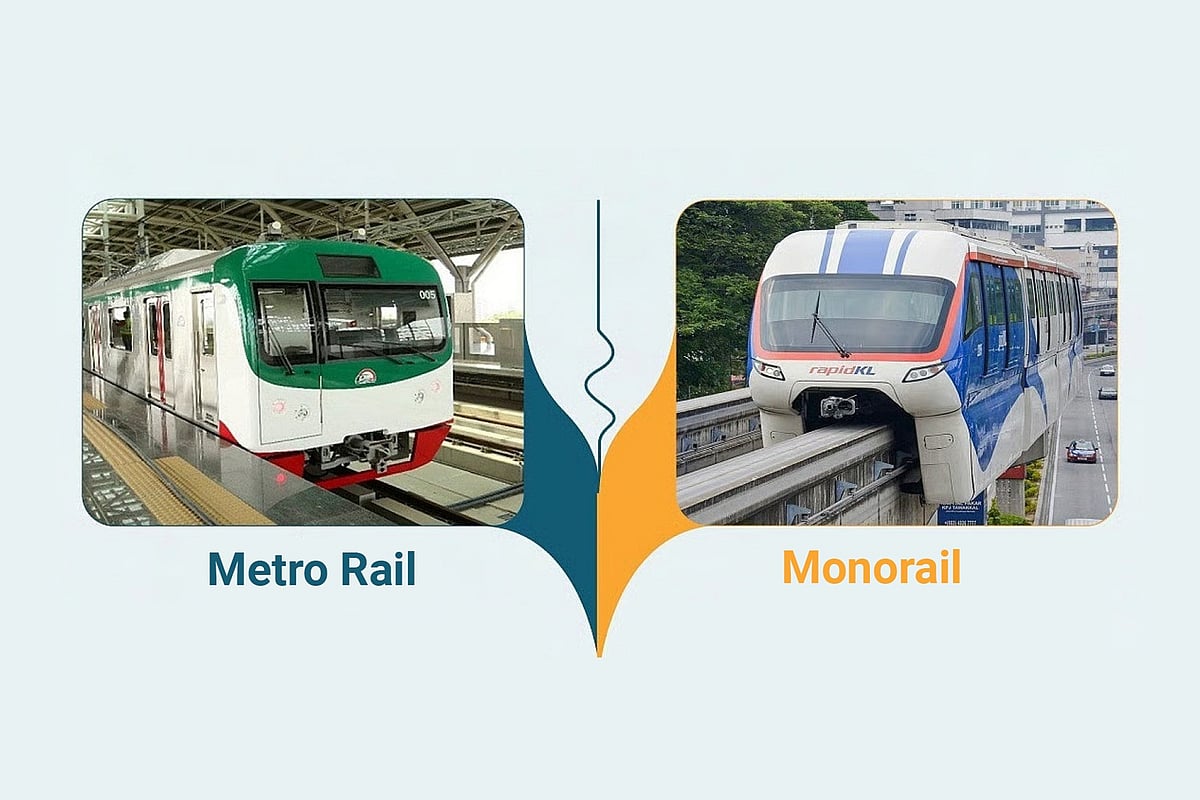
Comparison between metro rail and mono railProtom Alo infographic
During the Bangladesh Awami League government’s tenure, metro rail was added to Dhaka’s public transport system. If the Bangladesh Nationalist Party (BNP) comes to power, party chairman Tarique Rahman has said a monorail system would be introduced alongside the metro rail.
Earlier, in June, the Chattogram City Corporation also announced plans to introduce a monorail in Chattogram. Discussions are also underway about the possibility of building a monorail in Narayanganj.
With World Bank assistance, the government formulated a 20-year Strategic Transport Plan (STP) for Dhaka in 2005. Later, with Japanese funding, the STP was revised in 2014 and turned into the Revised Strategic Transport Plan (RSTP).
Based on this plan, the previous Awami League government undertook various projects to improve Dhaka’s public transport system.
Even during the formulation of the STP, some experts had suggested introducing a monorail in Dhaka. However, the STP ultimately recommended elevated expressways, metro rail, and dedicated bus lanes (BRT).
Based on these recommendations, plans were made to construct six metro rail lines in Dhaka, one of which, stretching from Uttara to Motijheel, is already operational.
What is a monorail?
In a monorail system, trains run on a single beam, meaning two separate tracks are not required. In conventional rail or metro systems, trains operate on two tracks. Metro rail requires overhead electrical wires supported by large poles, whereas in a monorail system, the power supply mechanism is integrated into the beam itself. As a result, no additional structures such as poles or overhead wires are needed.
Monorails can be built more easily in narrow roads and densely populated urban areas. Construction costs are also comparatively lower than those of metro rail. In addition, monorails can navigate curved routes more easily. In contrast, metro rail must reduce speed on curved tracks, and accommodating such curves increases construction complexity and cost.
Metro rail is a popular mode of transport in major cities around the world. In Europe and the United States, metro systems are mostly underground. Countries such as China, India, Malaysia, Thailand, South Korea, the United States, Brazil, and the United Arab Emirates operate monorails alongside metro rail systems. However, monorails have a lower passenger-carrying capacity compared to metro rail.
A complement to metro rail
Both metro rail and monorail are forms of mass transit. The key question is: what advantages does monorail offer for Dhaka city? Dhaka is densely populated and has grown in an unplanned manner. As a result, metro rail cannot be constructed on all routes. For example, in many areas of Old Dhaka, even buses cannot operate due to narrow roads.
Experts say that building metro rail in such areas would require underground construction, which is extremely expensive and risky. In contrast, monorail systems can be built relatively easily in these areas.
Monorail may not be suitable for every city. For example, Jakarta in Indonesia had to abandon its monorail project because it could not handle passenger demand. However, monorail systems are operating successfully in many cities around the world. In India’s Mumbai, monorail operates alongside metro rail.
Public transport expert and BUET civil engineering professor Shamsul Haque told Prothom Alo that the Uttara–Motijheel corridor is the most straightforward and suitable route for metro rail in Dhaka due to high passenger demand. Even so, fares had to be set higher than in neighbouring countries because of high construction costs.
Most sections of the upcoming metro rail lines will be underground, further increasing costs. “Will fares be raised even more then?” he asked. “If so, can it still be considered public transport?”
Professor Shamsul Haque further said monorail should be considered as an alternative alongside metro rail, particularly to connect narrow and densely populated areas.
He cited an example: the existing metro rail makes a wide turn between Bijoy Sarani and Khamarbari stations, requiring entry into the parliament area. A monorail could have followed the main road with a curved alignment, reducing costs.
Cost: the biggest question for metro and monorail
The construction cost of Dhaka’s first metro line was around Tk 15 billion per kilometre, and the entire line is elevated. Currently, projects are underway for metro lines from Kamalapur to the airport and from Norda to Purbachal.
Another line is planned from Hemayetpur in Savar through Mirpur and Gulshan to Bhatara. Portions of these lines will be elevated, while others will be underground. The per-kilometre cost of these two metro lines is expected to exceed Tk 30 billion.
In Mumbai, India, a 20-kilometer monorail was built at a cost of Tk 32.83 billion, or Tk 1.64 billion per kilometre. By comparison, metro rail construction in India typically costs Tk 4–5 billion per kilometre.
Mumbai’s monorail can carry 150,000 to 200,000 passengers daily, while Dhaka’s metro rail carries an average of around 400,000 passengers per day. Dhaka’s metro rail project cost Tk 334.72 billion.
Egypt’s 96-kilometer monorail project has an estimated cost of USD 4.5 billion, or nearly USD 50 million per kilometre, which is roughly equivalent to Tk 6 billion per kilometre in Bangladeshi currency.

 Bangladesh Defense