[🇧🇩] Cottage Industry/SME in Bangladesh

[🇧🇩] Cottage Industry/SME in Bangladesh
50
4K
More threads by Saif

G Bangladesh Defense

Aarong unveils the world’s largest craft store in Dhanmondi
Business Desk 08 March, 2025, 22:35

1741673265486.webp

Aarong executives unveil the world’s largest craft store in Dhanmondi recently. | Press release photo

Bangladesh’s leading fashion and lifestyle brand Aarong has unveiled its flagship outlet in Dhanmondi with 60,000 square feet eight spacious floors.

According to a press release, it is the world’s largest craft store which will treat the visitors with a series of monumental art installations, including a 4-storey nakshi kantha, clay pottery wall, and alchemy.

The press statement also said that every corner of this flagship outlet has been thoughtfully curated to delight shoppers, from the widest selection of handcrafted textiles to exclusive artisanal decor.

The outlet also has a restaurant named ‘Orange Parrot’ on the 7th floor of the building to serve Bangladeshi fusion cuisine.

Tamara Abed, managing director of Brac Enterprise, said that this groundbreaking destination store is a proud testament of Bangladesh moving boldly into the future.

She also said that it embodies their mission to preserve and celebrate Bangladesh’s rich artisanal heritage while delivering a world-class shopping experience.​
 

Low export earnings for poor patronage, skills, innovation
SAIF UDDIN
Published :
Mar 15, 2025 01:00
Updated :
Mar 15, 2025 01:00

1741999605307.webp


The country's handicraft sector faces multiple challenges like inadequate finance for entrepreneurs and lack of innovation in designs, compounded by skill gaps, resulting in lower-than-expected export earnings.

Besides, unorganised supply chain, limited competitiveness and weak country branding are also contributory factors for this sluggish state of the promising sector, according to industry insiders.

However, they said the sector holds huge potential on the back of buyers' focus shifted from major exporting countries like China and Vietnam due to higher cost to countries like Bangladesh.

Besides, Bangladesh is abundant in natural resources for handcrafted items and affordable labour that indicates prospects of better earnings from the sector if provided with necessary policy support.

Bangladesh's handicraft exporters' earnings have fluctuated in the past five fiscal years (FY) between FY 2020-21 and FY 2023-24, according to data available with the Export Promotion Bureau.

They got export receipts of $42.83 million in FY 2021-22 as global buyers showed special interest in eco-friendly and natural artefacts during the trying times of the Covid-19 pandemic.

However, the figures witnessed ups and downs in the next two fiscals.

Sources said during Covid pandemic global buyers reduced their spending on apparel and other items and showed increased interest in eco-friendly goods.

They said the local handicraft sector is mainly driven by jute, bamboo and cane, followed by pottery, puppetry and crafts like embroidery and tapestry.

A Bangladesh Bureau of Statistics survey shows about 44-per cent handicraft establishments are bamboo and cane-based.

As many as 73,542 handicraft establishments are in operation across the country and 97.6 per cent of them are household-based.

The industry is dominated by female entrepreneurs who own 51.2 per cent of the establishments.

Entrepreneur and former FBCCI director Rashedul Karim Munna believes the sector can fetch more foreign currencies if existing challenges are well-addressed.

Mr Munna, managing director of Creation Private Ltd, says his company exports mostly export jute diversified products as well as coconut fibre, recycled garment offcut and palm-tree straw.

Sharing an experience of a recent visit to a major global expo-Ambiente Fair-in Germany, he said international buyers are currently looking for potential countries as alternatives to China due to higher tax imposed by the Trump administration.

"All global buyers are now keeping that taxation issue in their mind. For example, a US buyer has to pay 50-per cent higher tax on average while buying from China," he said, adding that this trend paves the way for more focus on other countries like Bangladesh.

"Besides, Bangladeshi handicraft export is growing fast to EU countries, the UK and Japan, thanks to GSP facilities," mentioned Mr Munna.

One of the positive aspects of Bangladesh is comparatively lower labour cost than China as monthly average salary there has almost doubled from $300 to $600 in recent years.

"However, their productivity is much higher-almost four times-than a Bangladeshi worker," cited the entrepreneur as he explained that Chinese use modern machinery for making.

He identified Bangladesh's limitation in large-scale production and complexities related to compliance management as some challenges.

He underscored the need for country branding, establishment of large-scale production facilities, design innovation and capacity enhancement.

Sources said Bangladesh exports handicraft merchandises-the list includes handmade attires and various household items made of natural ingredients like clay, jute, cane and seaweed-to more than 50 countries.

According to a study by the global think tank Credence Research, the global demand for handicrafts was valued at $1005.49 billion in 2022 and is expected to double around $2317 billion in 2030.

The market is expected to grow at the compound annual growth rate (CAGR) of 11 per cent between 2023 and 2030.​
 

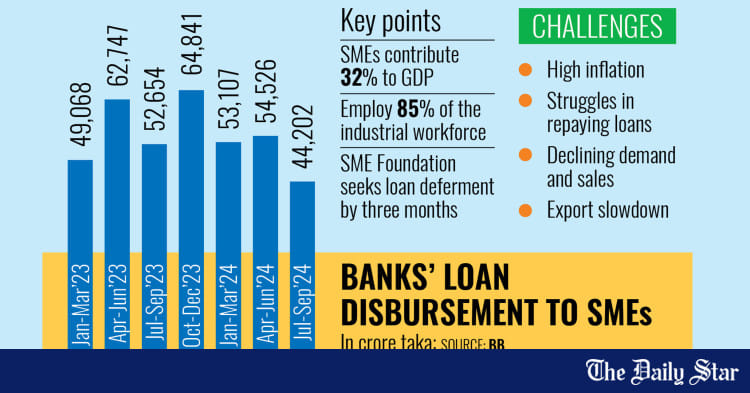
Falling SME sales shake economic backbone

1742083357788.webp


When the Bangladesh Bank raises interest rates on bank borrowing in its battle against stubbornly high inflation, the ripple effects reach small and medium businesses run by Faridpur's Paritosh Kumar Malo or Chuadanga's Md Oli Ullah.

Already squeezed by slumping sales in response to an upward inflationary curve over the past three years, Malo and Ullah promptly shelved their business expansion plans that depend on bank loans.

If that is not enough to survive, they now go for cutting their workforce just to keep their businesses afloat.

But even desperation has its limits.

If the macroeconomic stress does not ease soon, these small ventures, which contribute 32 percent of the country's GDP and employ 85 percent of the industrial workforce, face closure.

According to the Small and Medium Enterprise (SME) Foundation, there are around 79 lakh SMEs in the country. These ventures are considered as the economic backbone of the country. But most of the businesses are struggling due to inflation and macroeconomic headwinds.

Amid the economic turmoil, the political changeover through a mass uprising last year has led to slower spending on development projects, adding another layer to the SME crisis.

Take the case of Paritosh Kumar Malo, who runs RK Metal in Faridpur. His workshop, which once employed 25 workers, produces farming machinery.

Malo said government projects were his steady clients, but as work has been halted in the past six months, he has not received any new orders.

To make matters worse, he supplied equipment worth Tk 20 lakh to a USAID-funded project. The payment is now uncertain after the new US administration announced cuts in foreign aid.

Just six to eight months ago, Malo said, his factory generated Tk 30 lakh in revenue, but that has now fallen to Tk 3 lakh.

Of that, he must repay around Tk 80,000 per month in bank loans.

Demand for small agricultural machines, once the backbone of his sales, has dropped by nearly 70 percent.

Dealers hesitate to place orders, while farmers struggle to afford new equipment. "If they don't have money, how will they buy it?" he asked.

Unable to sustain his full workforce, Malo had to lay off 15 employees. "Letting them go was painful. They have families to feed."

DEPLETING CAPITAL, LOOMING LAYOFFS

Md Oli Ullah, owner of Janata Engineering in Chuadanga, manufactures agricultural machinery such as corn threshers and mustard oil extraction machines.

Like Malo, he said demand has plummeted as farmers and small entrepreneurs are delaying purchases.

He employs more than 100 workers but fears layoffs.

"I took a Tk 5 crore loan from Agrani Bank in 2020, when the interest rate was 9 percent. Now it has risen to 17 percent, significantly increasing my quarterly repayments."

Ullah said his capital is depleting, and after Eid, he may have to lay-off some workers just to keep the business running.

Despite efforts to sustain operations, he fears that businesses like his will be forced to shut down if conditions do not improve.

Loan disbursement data from Bangladesh Bank also reflects the financial struggles of small ventures.

Loan disbursement to small enterprises dropped by 16.05 percent year-on-year in the July-September period of fiscal year 2024-25, compared with a 1.89 percent increase in the same period of FY24, according to central bank data.

Meanwhile, the cost of financing for SMEs surged to 12.12 percent in December 2024 from just 6.17 percent in June 2023, further straining businesses.

UNEXPOSED TO LOANS, YET STRUGGLING

In contrast to Malo and Ullah, Rubina Akter Munni, owner of Design By Rubina, does not have any bank loans.

She manufactures leather goods such as travel bags and jackets.

She said online, corporate, and export orders have almost disappeared over the past three months.

"Consumers are probably not spending on luxury products," she added.

"Earlier, I received export orders from expatriates and local leather exporters, but they are delaying payments due to their own business downturns," she said.

With revenue sharply down, she is struggling to pay her 71 employees. "This tough situation affects not just me but many small entrepreneurs," she added.

Some businesses have already postponed orders.

Although she finds relief in having no bank loans, running day-to-day operations is becoming increasingly difficult.

A SILVER LINING IN GOLDEN FIBRE

Ajit Kumar Das, owner of Creative Jute Textile in Narsingdi, has managed to sustain his business thanks to the steady demand for eco-friendly bags made of jute -- dubbed the "golden fibre" of Bangladesh.

While other businesses struggle, his company supplies various shops in tourist areas, and some of his bags are indirectly exported abroad.

"Basic Bank has supported me financially, and even private banks have shown interest in providing loans. As long as I maintain quality and attractive designs, there will always be demand," Das said.

His company currently employs more than 100 workers and remains one of the few thriving SMEs.

SME FOUNDATION FOR LOAN DEFERMENT

M Masrur Reaz, chairman and CEO of Policy Exchange Bangladesh, cited the Purchasing Managers' Index (PMI), which signalled a downturn in the SME sector.

He identified three main challenges: high production costs driven by inflation, disruptions to raw material imports due to the US dollar crisis, and declining consumer demand as the cost of living rises.

Anwar Hossain Chowdhury, managing director of the SME Foundation, acknowledged these challenges and emphasised that SMEs often operate with limited capital, making them vulnerable.

The foundation has urged Bangladesh Bank to grant a three-month loan deferment for SMEs.

"We are also working to create collaboration among stakeholders through fairs and conferences," he said.

"Our goal is to ease access to bank loans by connecting the banking sector, corporates, and entrepreneurs, ensuring their progress."​
 

Exigency of loans for CMSMEs
FE
Published :
Mar 19, 2025 23:28
Updated :
Mar 19, 2025 23:47

1742433311796.webp


The sanctioning of loans for any sector of economy should ideally be decided by factors spurring economic growth. The disbursement of a sizeable percentage of the total disposable loans of banks runs the risk of distorting the natural mechanism of investment. But when it comes to patronising a fledgling sector neglected long on account of faulty or unresponsive policies, the risk is worth taking. Cottage, Micro, Small, and Medium Enterprises (CMSMEs) with a share of 90 per cent industrial units and 80 per cent industrial employment constitute a sector that unfortunately has received a step-brotherly treatment compared to large industries. So the Bangladesh Bank (BB) has felt the urgency of righting the wrong not only in the interest of the sector but also in the interest of the country's overall economy.

As a first decisive step, the BB has made it mandatory for banks to disburse loans to CMSMEs at least 25 per cent by this calendar year with the provision of 0.5 per cent annual increase to 27 per cent by 2029. Small enterprises often cannot avail of such government supports because of their lack of collateral. Even many of such small units failed to receive incentive packages the government generously distributed in the post-Covid period as part of bringing about an economic turnaround. To circumvent this constraint the BB has withdrawn the conditions of mandatory Tax Identification Number (TIN) and collateral for enterprises to claim a loan amounting to Tk500,000. Entrepreneurs can obtain this amount on the strength of their business identification number. This is a clear case of easing the process of receiving loan for the small enterprises. Now the banks need to have a sound mechanism for assessing the small ventures' potential for sustainability and expansion of business and even marketing of products either at home or abroad. Fresh exigencies and risks should also be meticulously analysed so that the loanees cannot misuse the fund borrowed.

This country has witnessed massive loan default on account of sanctioning loans to business sharks with an ulterior motive on the part of both parties---the loan sanctioning authorities and the loan receivers. Evidence has it that the rate of defaulters among small borrowers is very low compared to their large counterparts. However, misuse of government or public funds in the name of entrepreneurship or business at no level is desirable. Let there be several monitoring and vigilant teams expert in business and industrial issues including marketing prospects which will make on-the-spot and off-the-spot assessment before recommending loans for units in the sector.

In this respect, Chinese model of CMSMEs can be helpful for emulating with some minor adjustment to the local conditions here. Specialised village-based small enterprises have been the backbone of the industrial might developed in China later on. From the smallest item such as needle, pin, gem clip to calculator to electric car---the range of industrial outputs in China puts every manufacturing country on the planet to shame. China's economy grew in leaps and bounds because of this as well as the low prices of such essential tools and goods. Somewhat regimented, the method of production hardly allows entrepreneurial failure as those are closely monitored and patronised. A congenial entrepreneurial environment can meet the dual challenge of developing a strong economic base and creation of employment for a huge army of unemployed youths in Bangladesh.​
 

Empowering MSME sector
With strategic incentives in FY 26 Budget
Md. Abdul Latif
Published :
Mar 22, 2025 00:01
Updated :
Mar 22, 2025 00:01

1742603765047.webp


The labour-intensive MSME sector (Micro, Small and Medium Enterprises) plays a vital role in Bangladesh's economic development by fostering entrepreneurship, driving sustainable technology innovation, and contributing to economic growth, employment generation, poverty alleviation, and social stability. According to the 2019 manufacturing survey by the Bangladesh Bureau of Statistics (BBS), MSMEs represent 93.81 per cent of industrial output and employ over 32.85 per cent of the workforce. In the fiscal year 2022-23, the sector contributed 38.51 per cent to value addition and 24.45 per cent to GDP. However, the sector has faced significant challenges due to the Covid-19 pandemic, with many small businesses shutting down due to lack of capital. The expansion of MSMEs is hindered by inadequate infrastructure, limited financial support, technological lag, market entry barriers, and a shortage of skilled labour, threatening the sector's viability. Increasing financial incentives in the 2025-26 budget, such as MSME-friendly tax policies, credit facilities, VAT concessions, interest reductions, and tax exemptions, could be crucial in creating jobs and encouraging investment by boosting productivity and competitiveness. This article explores the necessity and significance of these financial incentive strategies and their potential impact.

COMPARATIVE ANALYSIS OF MSME SECTOR CONTRIBUTIONS IN BANGLADESH AND OTHER COUNTRIES: According to the SME Policy 2019, there are approximately 7.8 million MSME industries in Bangladesh, providing direct and indirect employment to around 21 million people. The SME Foundation reports that in the fiscal year 2022-23, investment in the MSME sector was merely 27,560.27 crore taka (2.75 billion dollars), representing only 0.61 per cent of the GDP, which totaled about 4,490,842 crore taka (451.53 billion dollars). In contrast, the MSME sectors in India, China, and Japan contribute 80 per cent, 60 per cent , and 69.5 per cent to their respective GDPs, significantly surpassing Bangladesh's figures. In Germany, small and medium enterprises constitute the majority, accounting for 82 per cent of employment and contributing 17 per cent to value added. Additionally, in the Asia-Pacific region, MSMEs in China and India contribute over 40 per cent of total exports, compared to 26 per cent in Thailand, 19 per cent in South Korea, and 16 per cent in Indonesia. This comparison underscores the critical role of the MSME sector in both developed and developing economies, highlighting the need for special initiatives and policy support in Bangladesh to enhance the sector's contribution and improve overall economic and export capacity.

FINANCIAL INCENTIVE STRATEGIES FOR MSME SECTOR: In a market economy, small businesses often struggle against larger competitors that can monopolise the market, utilising information advantages to stifle MSME entry. To protect and sustain small businesses, special measures are essential. According to the structural transformation theory and the inclusive growth model in development economics, the MSME sector plays a crucial role in economic development by decreasing income inequality, creating opportunities for mobility, and broadly distributing economic benefits. To bolster the MSME sector's competitiveness, a variety of financial incentive strategies should be implemented at both public and private levels. These strategies aim to enhance MSME productivity and facilitate growth by lowering financial and administrative barriers.

LOW-INTEREST LOANS AND CONSULTING SERVICES FOR NEW ENTREPRENEURS IN EXPORT-ORIENTED MSMES: The government and Bangladesh Bank can collaborate to establish a refinancing fund, offering partial credit guarantees to commercial banks for loans to export-oriented SMEs under favourable terms. This can include direct low-interest loans through specialised institutions that assist in adopting eco-friendly technologies and modern equipment. Additionally, providing consultancy services can help new MSME entrepreneurs improve product quality, create market connections, and enhance international marketing capabilities. With low-interest financing, export-oriented SMEs can elevate product quality while adhering to global standards and invest more in marketing. Such loans enable new entrepreneurs to expand their operations cost-effectively and invest in innovative technologies, leading to product diversification and improved quality. Ultimately, this development will generate new employment opportunities, alleviating unemployment in both rural and urban settings.

TAX LIABILITY REDUCTION : The MSME sector primarily faces income tax and VAT obligations. Given their lower annual turnover, reducing tax liabilities for these businesses can ease the financial burden on MSME entrepreneurs, helping them compete with larger firms and expand. Tax assistance can enhance the investment climate, promoting new ventures and projects. By offering tax breaks for research and development (R&D), employee training, and environmentally friendly technologies, the tax liability for MSMEs can be reduced. Studies indicate that tax incentives in the U.S. and Canada significantly alleviate MSME tax burdens. Supporting R&D will foster innovation and competitiveness, while tax incentives for employee training will cultivate a skilled workforce, boosting productivity and performance. Investments in eco-friendly technologies will encourage sustainability within the sector, contributing to long-term environmental protection. Overall, tax relief for MSMEs will stimulate sector growth, job creation, and economic development.

CLUSTER-BASED REGIONAL INCENTIVES: Recognising MSMEs as priority sectors, specific clusters (e.g., light engineering, foundry-based MSMEs) may be eligible for reduced corporate tax rates or tax holidays. These clusters produce agricultural machinery parts, vehicle spare parts, and metal components for local and international markets, such as the light engineering clusters in Bogra or plastic manufacturing in Dholakhal (Dhaka). Criteria like environmentally friendly practices, minimum local value addition, and cluster association membership may be established for qualifying MSMEs. The National Board of Revenue (NBR) could approve tax holidays or reduced rates for compliant MSMEs. Such incentives will enable clusters to upgrade machinery, expand production, and remain competitive against imports, while enhancing the overall size and effectiveness of the cluster. Linking incentives to MSME clusters will further lower operating costs, improve resource sharing, increase productivity, ensure quality control, and enhance worker skills.

PREFERENTIAL TAX REGIME (PRT) BENEFITS FOR LABOR-INTENSIVE MSMES: The government's Preferential Tax Regime (PRT) for labour-intensive micro, small and medium enterprises is a special tax benefit that provides tax reduction, tax exemption or easier tax treatment to labour-intensive or employee-dependent enterprises. In this case, handicraft and cottage industries that employ a relatively large number of workers can get a minimum tax rate or some tax exemption. For example, if an investment is made in labour-intensive industries in the handicraft and cottage industries sector or if the activities or production capacity of the MSME is increased and the employment target is met within a certain period, the government can provide tax exemption as an expansion benefit. For example, if the enterprise starts on a small scale and gradually increases the number of employees and invests in new production lines, the enterprise can come under the scope of tax exemption related to increased production facilities. The Preferential Tax Regime benefit can play a very positive role for MSMEs. Because it reduces production costs somewhat, increases investment interest, and significantly increases local employment opportunities. This will increase the government's total revenue collection from MSMEs, as well as the contribution of MSMEs to GDP.

In conclusion, ensuring transparency and proper verification in selecting MSME beneficiaries for financial incentives is crucial. Strong policies and monitoring frameworks must be established. Regular evaluations using modern technology should maximize the use of incentive funds. During the 2025-26 fiscal year, effective distribution of credit facilities, tax exemptions, and incentives to new and export-oriented enterprises will support MSME sector expansion, job creation, and economic growth.

To make these steps fruitful, it is important for the National Board of Revenue, MSME Foundation, banks and financial institutions to play a responsible role, prevent corruption and use new technologies, provide training and consultancy services to entrepreneurs. Overall, such planned support to the MSME sector will accelerate sustainable growth and social development in the national economy.

Dr. Md. Abdul Latif, (PhD in Development Policy) Global Ambassador & ADB-JSP Scholar, Additional Director, Bangladesh Institute of Governance and Management (BIGM).​
 

IFRS to help SMEs have access to easy investment: Taskeen
Bangladesh Sangbad Sangstha . Dhaka 22 March, 2025, 23:22

The International Financial Reporting Standards will strengthen access to finance and investment, boost global competitiveness and reduce the risks of financial misreporting.

Taskeen Ahmed, president of Dhaka Chamber of Commerce and Industry, said this at a focus group discussion on ‘Implementation of IFRS for SMEs’ held at DCCI in the capital on Saturday.

He said SMEs are the lifeline of Bangladesh’s economy contributing over 25 percent to the GDP. He also said the adoption of ‘International Financial Reporting Standard’ (IFRS) for SMEs provides a structured framework that enhances financial transparency, said a press release.

The DCCI president said IFRS would significantly impact tax revenue collection by improving compliance, minimizing tax evasion and bringing more businesses into the tax net.

He also termed that limited financial capacity, shortages of skilled manpower and compliance cost creates barriers in adopting IFRS for SMEs. Taskeen stressed on the need for more investment in training and regulatory alignments.

Mohammad Abu Yusuf, chairman (Acting) of Financial Reporting Council, said IFRS is very important for SMEs to comply with the international standards, but its implementation is still challenging for the SMEs due to lack of knowledge, skilled workforce, easy procedures and awareness.

There is no alternative to enhancing the capacity of SMEs to make them interested in implementing IFRS, he opined. ‘SMEs need to be more focused on IFRS implementation to increase tax compliance, access to capital from the capital market, and signing international trade agreements,’ Yusuf added.

Md Amir Uddin, executive director of Bangladesh Bank (BB), said the implementation of IFRS should be focused on improving the image of local SME entrepreneurs in the global arena, but it is necessary to provide training to improve their skills. They should be well aware of the benefits of implementing IFRS as well, he added.

Nawshad Mustafa, director of SME and Special Programmes Department of Bangladesh Bank, said they have a lack of trained and skilled accounting professionals in the country especially for SMEs.

‘To implement IFRS in a practical manner, an enabling environment is necessary for this,’ he said adding that IFRS is implemented in 80 countries in the world and it is also required to implement but that should be without affecting the business activities of the SME sector.

Nawshad again stressed for a friendly environment for its implementation.

Mohammad Jahangir Hossain, general manager of SME Foundation, said from SME Foundation accounting software were provided to few SME entrepreneurs, but it was not implemented in many cases due to lack of skills and interest.

He then proposed sector-based customized accounting software for the SME sector to make it easy. Later, he emphasized on providing facilitation and training for further implementation of IFRS.

Sk Md Tarikul Islam, partner of Hoda Vasi Chowdhury and Co Chartered Accountants, presented the keynote paper. ‘Capacity building, training for accountants and auditors and initial transition costs are some of the challenges for implementation of IFRS,’ he said.

Regulatory bodies, professional organisations, and financial institutions can play a vital role in facilitating a smooth transition, he added.

He also highlighted key benefits of IFRS for SMEs such as simplified reporting, cost-effective compliance, enhanced credibility and facilitating growth.

Tarikul, however, urged for easy access to finance, lower tax and vat rate, reduced tax rate for green business, tax incentive for SME startups and simplification of tax payment process for the SME sector.

Speaking at the open discussion, DCCI convener Lutful Hadee said there are about 2,200 chartered accountants in the country, out of them about 600 are in practice.

Moreover, about 40,000 part-qualified accounting professionals are also in the market after completing various pertinent courses.

DCCI’s joint convener Md Shafiqul Alam urged for uniformity in the definition of SME in different policies and regulations of different institutions.

DCCI’s senior vice-president Razeev H Chowdhury and Vice-president Md. Salem Sulaiman were also present at the meeting.​
 

Strategic growth for thriving cottage industry
Wasi Ahmed
Published :
Mar 26, 2025 00:16
Updated :
Mar 26, 2025 00:16

1742973667738.webp


The country's cottage industry, recognised as the backbone of small entrepreneurs and rural employment, has long suffered due to various challenges, primarily stemming from a lack of structured data. Until recently, there was no comprehensive database detailing the sector, which hindered effective planning at both the macro and micro levels. The absence of a structured database has long impeded the planned growth of this sector.

Recognising this gap, the Bangladesh Bureau of Statistics (BBS) conducted an extensive field survey some time ago to compile a detailed database on the cottage industry. The survey captures crucial aspects such as the overall characteristics of different sub-sectors, regional variations, and specific challenges facing cottage industries across the country.

According to the survey, Bangladesh has a total of 830,000 cottage industry units, employing over 29 million workers. An encouraging aspect is that nearly 97 per cent of these units operate throughout the year, indicating the resilience and sustainability of the industry. The survey also highlights that the sector contributes significantly to the economy, producing goods worth approximately Tk 395.38 billion annually, with a value addition of about Tk 314.86 billion.

A striking feature of the survey findings is the geographical distribution of cottage industry units. Around 56.3 per cent of these units are located in rural areas, with 20 per cent situated at the homesteads of their owners. This underscores the sector's role in supporting rural livelihoods and sustaining employment opportunities outside urban centres.

However, there are also some concerning findings. The survey reveals that approximately 16 per cent of the workforce employed in the cottage industry does not receive any wages, as they consist of family members engaged in the production process. The lack of wage recognition renders their labour unproductive in terms of economic measurement since it is not accounted for in the manufacturing cost structure. This issue needs to be addressed to ensure that family labour is appropriately valued and contributes to the financial stability of cottage industry workers.

The highest concentration of cottage industry units-around 30 per cent-is found in the Dhaka division, while the lowest is in the Sylhet division. Despite their diverse manufacturing processes, these industries commonly face fundamental challenges that limit their growth potential. One of the key issues is the definition of cottage industries in the government's industrial policy, which many believe is outdated and restrictive.

Under the current definition, a cottage industry is characterised as a unit employing no more than ten workers and operating with a capital of less than Tk 500,000. This definition fails to capture the evolving nature of cottage industries, particularly in the age of technological advancements. By setting strict limitations on workforce size and capital investment, the definition inadvertently discourages growth and scalability. As a result, a large proportion of cottage industry units remain unregistered with relevant government agencies such as the Bangladesh Small and Cottage Industries Corporation (BSCIC) or local government bodies, reflecting the industry's lack of reliance on state support mechanisms. This lack of registration limits their access to financial assistance, technology transfer, training programmes, and other essential resources that could enhance productivity and competitiveness.

The overall scenario of the cottage industry remains chaotic due to these structural and operational challenges. However, there are opportunities to organise and strengthen the sector through systematic interventions. A key strategy could be the establishment of support programmes focused on product development, diversification, and adaptation for both domestic and export markets.

Technology transfer is another crucial area for improvement. Many cottage industry units still rely on outdated tools and traditional production methods, limiting their efficiency and quality standards. Introducing modern equipment and innovative techniques can significantly boost productivity and enhance the market appeal of cottage industry products. Additionally, the use of improved raw materials and production inputs can lead to better product quality and higher profit margins.

Access to credit remains a major constraint for cottage industry entrepreneurs. Government policies should facilitate credit access tailored to the specific needs of small-scale producers. If the authorities, particularly the BSCIC, actively monitor and support the activities of this vast yet disorganized sector, credit facilities can be structured to provide meaningful assistance. Many cottage industry entrepreneurs struggle with securing loans due to the lack of collateral or formal business registration. Addressing these issues through financial inclusion initiatives can empower small entrepreneurs to expand their businesses and improve their livelihoods.

A holistic approach is necessary to transform the cottage industry into a well-organised and thriving sector. Policymakers should revise the existing definition of cottage industries to reflect the changing dynamics of small-scale production and entrepreneurship. Encouraging formal registration through incentives, rather than mandates, can help integrate cottage industry units into mainstream economic activities while allowing them to retain their operational flexibility.

Marketing support is another critical area that requires attention. Many cottage industry products have strong potential in both domestic and international markets, but limited market exposure prevents them from achieving higher profitability. Establishing dedicated platforms for cottage industry products, such as trade fairs, online marketplaces, and branding initiatives, can help entrepreneurs reach a broader customer base.

Furthermore, skill development and training programmes tailored to the needs of cottage industry workers can enhance productivity and innovation. Training in areas such as business management, financial literacy, and modern production techniques can equip entrepreneurs with the knowledge and skills needed to scale their businesses sustainably.​
 

Developing roadmap for MSMEs' digital transformation
Sanjoy Pal
Published :
Apr 27, 2025 22:43
Updated :
Apr 27, 2025 22:43

1745803109284.webp


Digital transformation is the transition of process-flow from manual to digital intervention in enterprise management. The world economy is moving towards embracing the digital transformation in every sphere of business practices. The majority of business entities in the global market are Cottage, Micro, Small and Medium Enterprises (CMSMEs) and the ASEAN region accounts for most of them. ASEAN Investment Report in 2022 revealed that, more than 97 per cent of enterprises in the region are MSMEs. They account for 67 per cent of employment in the region, an average of about 28 per cent of gross value added, about 20 per cent of export revenues and about 45 per cent of GDP. It has also been exposed that, three member states (Singapore, Indonesia and Malaysia, in that order) account for 83 per cent of start-ups that have raised more than $1 million in funding in the region.

The pursuit of process reengineering from product innovation to procurement and sales is increasing their arena through utilisation of digital means day by day. As part of process automation for accounting, inventory management, invoicing etc. different technologies such as digital devices, business management software are also being integrated. But, there are some barriers noticed to accept the process automation by MSMEs, where the limited skills and knowledge to use the software, human resource constraints, the cost of procurement of digital tools, cost of software set up, cost of operations of the automation are common. Sometimes, the income they earn from their business does not commensurate the transformation cost incurred. As a result they are getting rid of embracing the digital transformation in easiest way.

Bangladesh Bank, the central bank of Bangladesh, has taken a timely initiative by reviewing the Master Policy on CMSME financing, which includes the trading sector under the medium enterprises category and recognizes marginal enterprises possessing UBID (Unique Business Identification) or DBID (Digital Business Identification) as per the Digital Commerce Operation Guidelines 2021. They have also encouraged the use of Digital Financial Services (DFS) and Mobile Financial Services (MFS) in CMSME financing, along with the development of QR code and chatbot services for CMSMEs. These initiatives help to establish a digital footprint for CMSMEs in Bangladesh. However, they are not yet sufficient for the full development of MSME sector participants.

The integration of digital technology and engagement of MSMEs will get pace if a specific roadmap for the digital transformation can be developed. Some prolific recommendations to sketch the roadmap for digital transformation of MSMEs are pointed out below.

Comprehensive policy on Digital Transformation for MSME. A comprehensive policy on Digital Transformation for MSME must be adopted, where the process, technological investment, employment of skilled manpower, service propositions etc. are to be mentioned. Additionally, the government must develop a Digital Trade Policy and embrace digital trade in international trade services to streamline the trade process in a shorter frame.

Development of Digital Infrastructure. Optimal level infrastructure development such as reliable internet connectivity, easily accessible software management tools for MSMEs must be ensured. Market competitors for software development and management (Automation Company) will be increased to minimise the automated software and tolls installation and management. Notable presence of consultancy firms for MSMEs in the marketplace should be confirmed. Nano loan for procuring digital devices for marginal MSMEs should be launched by the banks that may be repaid by monthly instalments.

Digital Education. An awareness building programme on digital financial literacy for MSMEs should be undertaken. The Technical Training Institute must provide training on Digital Transformation for MSMEs to youths either free of charge or at an affordable cost.

Digital Marketing Techniques for MSMEs. MSMEs solidifying their business footprint through digital platforms like Facebook, Instagram, Tiktok and different sites for e-commerce should be encouraged with tax benefits. Organisations supporting MSMEs should develop training programmes for them in line with international standards.

Incentive for MSMEs and Fintech Developers. The central bank should launch an incentive package to support the financing of MSME transformation. Additionally, an incentive package for financing fintech developers who innovate MSME processes should be implemented. Digitally transformative MSMEs that export their products abroad should be encouraged through concessional duty benefits provided by the government. These measures will motivate MSMEs to contribute more significantly to increasing the country’s foreign reserves.

Investments and Rewards. The Chamber of Commerce and Industries, along with other member organisations, must embrace digital transformation and invest in it to develop marginal MSMEs. They should annually highlight and award the top 10 transforming MSMEs in the category of successful digitally transformative enterprises to encourage visible impacts of digital transformation.

Bangladesh is a country where eagerness to harness technology, openness to innovation, strong growth prospects, and expanding employment opportunities create a favourable environment for economic success. To ensure inclusive benefits, the Fourth Industrial Revolution (4IR or Industry 4.0) also presents numerous prospects for MSMEs, such as boosting efficiency in business processes, accessing global markets, and diversifying customer engagement — all of which can be a strong fit for Bangladesh. By adopting emerging technologies like AI, data analytics, and others, MSMEs can drive innovation and make data-driven strategic decisions more rapidly. Therefore, digital transformation for MSMEs is a blessing for the digital future, not a hazard.

The writer is a banker and certified Financial Modelling & Valuation Analyst (FMVA).​
 

Latest Posts

Back