[🇧🇩] Eid ul Azha

[🇧🇩] Eid ul Azha
7
23
More threads by Saif

G Bangladesh Defense

Saif

Senior Member
Joined
Jan 24, 2024
Messages
19,336
Likes
8,997
Nation

Residence

Axis Group

Inculcating the spirit of Eid-ul-Azha

FE

Published :
May 26, 2026 21:52
Updated :
May 26, 2026 21:52

1779838288152.webp


Called the festival of sacrifice, Eid-ul-Azha is one of the two great festivals of Islamic tenet. It commemorates the total obeisance of Prophet Ibrahim to the Almighty Allah through his willingness to sacrifice his son Ismail. In fact, it was the supreme test a father is put to and both Prophet Ibrahim and Prophet Ismail passed it successfully. It was a recurring dream in which Prophet Ibrahim was commanded by Allah to sacrifice his beloved son. When Prophet Ibrahim told his son about the dream, the son had no hesitation to cooperate for the intended sacrifice. God was pleased to see the readiness of both father and son and right at the moment Hazrat Ibrahim was about to slit his son's throat, there was a divine intervention to spare the life of the son. Instead, a ram was presented for completion of the ritual of sacrifice.
FE

This event coincides with the annual Hajj Pilgrimage and becomes a mandatory performance of Hajj, one of the world's largest religious congregations. Now what are the lessons of the sacrificial event involving Prophet Ibrahim and Prophet Ismail? First of all, it is total submission to Allah the benevolent. Compliance to God's wishes is fulfilled by the spirit as demonstrated by the two prophets who rebuilt Makka Sharif. Thus Eid-ul-Azha originating from the two prophets' unreserved submission to the Almighty symbolises the quintessence of sacrifice humans can make. The sacrifice of animals combines both spiritual and mundane aspects of Islamic tradition and culture. If the slaughter of an animal in the name God symbolises obeisance to Him, the special mass prayer offered by the Muslims on the morning of Eid-ul-Azha complements the process of seeking divine blessings. An obligation, this prayer is an expression of gratitude for the divine mercy Allah has bestowed upon his followers.

The religious edict here is clear. It is a meeting point between the divine and the mundane. Prayer and sacrifice are religious obligations but the mandatory distribution of two thirds of meat from the sacrificial animal among relatives and the poor---one-third to each--- who cannot afford sacrifice of animals is a pragmatic attempt to share with and care for everyone in society. Here is an attempt to develop an outlook for an inclusive society. No one, not even the poorest of the poor, will be left out so far as the feasts of the day is concerned. If only the doctrine of sharing and caring could be extended to livelihoods and economy throughout the year! The need for reaching out to the needy is overwhelming at a time when the world is drifting towards selfishness and shameless profit-mongering.

The distribution of meat and hides of slaughtered animals has now become an established tradition. But it is yet to be organised in a systematic way. If it were done so, the poor would benefit from it and at the same time, the country's economy would receive a shot in the arm. Once again, the spiritual and the everyday life find here a meeting point. This is quite a positive aspect that makes celebration of Eid-ul-Azha special. It is a strong point of Islam validated by scriptural verses. So these lessons can be recalibrated in the modern context of banking and finance. This could ensure well-beings of the people bypassed by modern economic systems. Eid Mubarak to all.​
 

Rain likely across Bangladesh as heavy showers forecast in several divisions on Eid day

bdnews24.com

Published :
May 26, 2026 23:46
Updated :
May 26, 2026 23:46

1779838613533.webp


Downpours have been causing significant distress to commuters since the beginning of the Eid rush, and the Bangladesh Meteorological Department warns that this rainy trend is likely to persist until next Saturday.

As the country prepares to celebrate Eid-ul-Azha on Thursday, the Met Office has indicated a strong possibility of rain or thundershowers across many parts of five divisions, including the capital city of Dhaka.

Moreover, heavy to very heavy falls are expected in some areas across four divisions.

Meteorologist Tariful Newaz Kabir said on Tuesday: “On Eid day, rain or thundershowers are likely at many places over Rajshahi, Khulna, Dhaka, Mymensingh, and Sylhet divisions and at one or two places over Rangpur, Barishal, and Chattogram divisions.”

“Among these, heavy to very heavy rainfall may occur at some places in Mymensingh, Sylhet, Dhaka, and Rajshahi divisions,” he said.

He added that the tendency for rainfall would be relatively higher in the central regions of the country, while northern and southern areas—specifically Rangpur, Barishal, and Chattogram divisions—face a lower likelihood of rain.

When asked about the specific weather conditions for the capital on Eid day, Tariful said: “There is a possibility of light to moderate rain in Dhaka during the morning and afternoon on Eid day. The day temperature may remain unchanged on that day, but the night temperature may drop slightly.”

During the 24 hours leading up to 6pm on Tuesday, Sreemangal in Moulvibazar district recorded the country’s highest rainfall at 90mm, while Dhaka recorded 68mm.

Morning showers on Eid day could trigger severe complications for citizens heading out for the main Eid congregations.

The rain is also bound to complicate the slaughtering of sacrificial animals and the subsequent processing of meat.

Rainwater will inevitably wash animal blood and waste from the roadsides directly into the city’s drainage systems.

A few years ago, torrential downpours on Eid-ul-Azha caused severe waterlogging in Dhaka’s Shantinagar.

The stagnant water mixed with animal blood, turning the streets into a striking visual described by many as “rivers of blood”.

However, rainfall in the afternoon could help clean roads and ease the workload of sanitation workers, while also reducing odour.

The five-day outlook from the Meteorological Department indicates varying degrees of rainfall across different regions every day.

In the 24 hours from 6pm on Tuesday, light to moderate rain or thundershowers are expected at many places over Rangpur, Rajshahi, Mymensingh, and Sylhet divisions; at a few places over Dhaka and Chattogram divisions; and at one or two places over Khulna and Barishal divisions.

Moderately heavy to heavy falls are also possible at places over Rangpur, Rajshahi, Dhaka, Mymensingh, Chattogram, and Sylhet divisions.

Day temperatures may fall slightly, while night temperatures could rise a little across the country.

From Wednesday at 6pm for the next 24 hours, rain or thunderstorms with temporary gusty or squally winds and lightning flashes may occur at many places in Rajshahi, Khulna, Dhaka, Mymensingh and Sylhet divisions, and at some places in Rangpur, Barishal and Chattogram divisions. Moderate to heavy rainfall may occur at some places.

From 6pm on Thursday, the weather forecast indicates temporary gusty or squally winds alongside light to moderate rain or thundershowers at many places over Rangpur, Rajshahi, Khulna, and Mymensingh divisions, and at a few places over Dhaka, Barishal, Chattogram, and Sylhet divisions.

Moderately heavy to heavy rainfall may continue at places, with day temperatures dropping slightly nationwide.

From Friday 6pm for the next 24 hours, some places in Dhaka, Mymensingh and Sylhet divisions and a few places in other divisions may experience light gusty winds and lightning flashes with light to moderate rain or thunderstorms.

From Saturday 6pm for the next 24 hours, some places in Chattogram division and a few places in Rangpur, Rajshahi, Dhaka, Mymensingh, Khulna, Barishal and Sylhet divisions may experience temporary gusty winds, lightning flashes and light to moderate rain or thunderstorms.

Moderate heavy rainfall may occur at some places in Chattogram division.​
 

Pilgrims pray on Mount Arafat as hajj reaches peak

AFP

Mount Arafat, Saudi Arabia

1779840557582.webp


Muslim pilgrims pray on Saudi Arabia's Mount Arafat, also known as Jabal al-Rahma or Mount of Mercy, during the climax of the Hajj pilgrimage early on May 26, 2026. AFP

Huge numbers of Muslims prayed on Mount Arafat on Tuesday at the climax of the hajj pilgrimage, as a punishing desert sun sent temperatures soaring towards 40C.

From daybreak, thousands of white-robed worshippers recited Quranic verses on the 70-metre (230 feet) rocky hill near Mecca, where the Prophet Mohammed is believed to have delivered his last sermon.

Volunteers handed out bottles of water, parasols and food packages to the tens of thousands of pilgrims as they made their way toward Mount Arafat.


"It is an indescribable feeling," said Ahmoud Abou Elezz, a 35-year-old Egyptian engineer, as he approached Mount Arafat for the first time.

More than 1.5 million people have joined the hajj this year despite the shadow of war across the Middle East from the US and Israeli war with Iran.

During the fighting, Tehran retaliated with waves of drone and ballistic missile strikes, hitting major infrastructure and energy installations across the Gulf, including in Saudi Arabia.

More than 30,000 Iranians have made the journey, about a third of the 86,000 originally expected. Iran's IRNA state news agency said the "wartime situation" explained the drop.

Despite the war, Saudi officials said over the weekend that more pilgrims had travelled from abroad this year than in 2025.

The hajj, one of the five pillars of Islam, must be performed at least once by all Muslims with the means to do so.

With temperatures hitting 44 degrees in Mecca in recent days, Saudi authorities have urged pilgrims to drink plenty of water and protect themselves from the sun during the mostly outdoor rituals, which can take five days or more to complete.

Since men are prohibited from wearing hats, many carry umbrellas to try to keep the blistering sun at bay.

After Mount Arafat, pilgrims will spend the night in Muzdalifah, where they will collect pebbles for the symbolic "stoning of the devil" ritual in Mina, starting on Wednesday.

The hajj is said to follow the path of the Prophet Mohammed's final pilgrimage, about 1,400 years ago.

It has long been an important source of legitimacy for the Al Saud dynasty, whose monarch has the title "Custodian of the Two Holy Mosques", in Mecca and Medina.​
 

Faith, Sacrifice, and Unity: The essence of Hajj and Eid al-Azha

UNB

Published :
May 27, 2026 18:33
Updated :
May 27, 2026 21:02

1779932209932.webp


Every year, millions of Muslims travel to Mecca in Saudi Arabia to perform the Hajj, one of the holiest acts of worship in Islam. The pilgrimage brings together believers from different countries and cultures in a shared spiritual journey marked by prayer, devotion and religious rituals.

This year’s Hajj comes amid regional uncertainty linked to the fragile ceasefire surrounding the Iran conflict and wider tensions in the Middle East. Earlier this year, some Muslims performing Umrah — often called the minor pilgrimage — faced travel disruptions caused by the conflict, leaving several stranded in Saudi Arabia.

The Hajj is one of Islam’s five pillars

Hajj is the annual Islamic pilgrimage to Mecca and is considered a religious duty for every Muslim who is financially and physically capable of undertaking the journey at least once in their lifetime. Many believers, however, aspire to perform it multiple times.

The pilgrimage is one of the Five Pillars of Islam, alongside the declaration of faith, daily prayers, charity and fasting.

The pilgrimage follows the Islamic lunar calendar

Hajj takes place during Dhul-Hijja, the final month of the Islamic lunar calendar, and officially begins this year on Monday.

Because the Islamic calendar shifts each year, the pilgrimage rotates through different seasons. When Hajj falls during summer, pilgrims often endure extreme temperatures. In 2024, Saudi authorities reported that more than 1,300 people died during the pilgrimage amid severe heat, with most victims identified as unauthorized pilgrims exposed to long hours under the sun.

A journey of faith and spiritual renewal

For Muslims, Hajj is not only a religious obligation but also a profound spiritual experience. Pilgrims view the journey as an opportunity to seek forgiveness from God, strengthen their faith and follow the path of prophets.

The pilgrimage also symbolizes unity among Muslims regardless of nationality, race, language or social background. Many pilgrims carry personal prayers and requests from relatives and friends, hoping their supplications will be accepted during the sacred journey.

For some, preparing for Hajj takes years of saving money, waiting for travel permits and studying the rituals through lectures, books and guidance from experienced pilgrims.

Pilgrims perform a series of sacred rituals

Pilgrims begin by entering a spiritual state known as “ihram,” during which they follow specific rules and avoid certain activities. Men wear simple white garments intended to promote humility and equality by removing signs of wealth or social status.

One of the most significant moments of Hajj is the gathering at the plain of Arafat, where pilgrims pray, seek forgiveness and make heartfelt supplications.

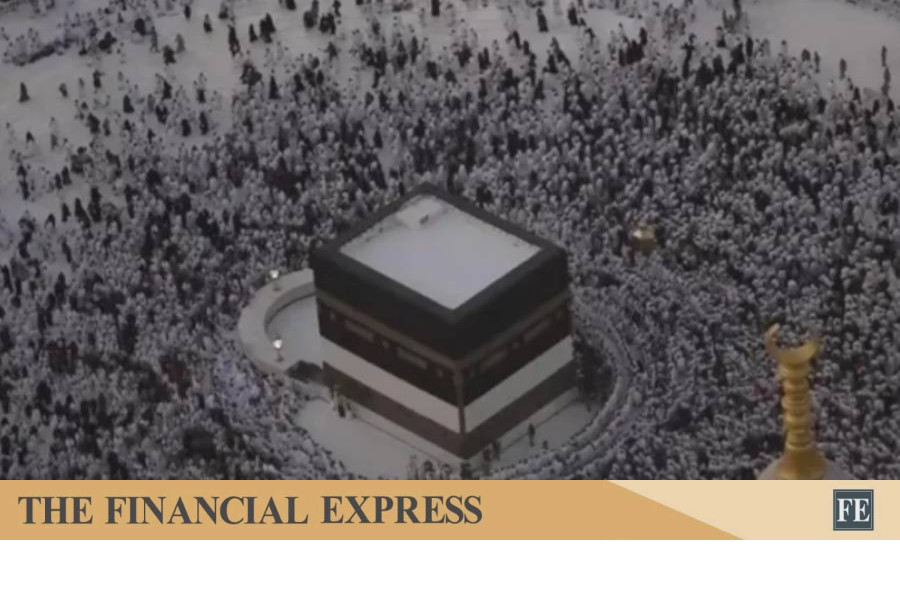
Another major ritual is “tawaf,” the act of circling the Kaaba seven times in a counterclockwise direction. The Kaaba is the sacred structure toward which Muslims around the world face during daily prayers.

Pilgrims also reenact the journey of Hagar, the wife of Prophet Ibrahim, who according to Islamic tradition ran seven times between two hills searching for water for her son.

Eid al-Azha and its religious importance

Eid al-Azha, known as the “Feast of Sacrifice,” begins during Hajj on the 10th day of Dhul-Hijja.

The festival commemorates Prophet Ibrahim’s willingness to sacrifice his son in obedience to God’s command. Muslims around the world observe the occasion through prayers, family gatherings and the sacrifice of animals such as sheep or cattle, with part of the meat distributed among the poor and needy.​
 

‘Donald Trump’ buffalo not to be sacrificed, says police

UNB

Published :
May 27, 2026 21:51
Updated :
May 27, 2026 23:12

1779932586601.webp


Police on Wednesday took into custody a pink-coloured albino buffalo named “Donald Trump” on Wednesday afternoon, day before Eid-ul-Azha.

Ruhul Quddus, officer-in-charge of Keraniganj Model Police Station, said the buffalo was taken into custody citing security concerns.

“With the intervention of the Home Ministry, the buffalo was brought from the Rasulpur area around 5pm,” he said. “The US Embassy does not want the buffalo to be sacrificed.”

As a result, the animal’s owner, Sharfa Raj, will no longer be able to sacrifice it, the OC said, adding that a decision regarding the buffalo will be taken later.

The buffalo, weighing around 700kg, had become a major attraction ahead of Eid-ul-Azha in Narayanganj. It was being raised at Rabeya Agro Farm in the Paikpara area, where visitors gathered daily to see the animal.

Farm owners said the buffalo was named “Donald Trump” because its hairstyle resembles that of the US president. Its unusual appearance and calm nature further increased its popularity among visitors.

According to the farm authorities, the albino buffalo was bought from a cattle market in Rajshahi shortly after last year’s Eid-ul-Azha and has since been raised with special care.

The animal had reportedly been sold to a buyer in Dhaka at a rate of Tk 550 per kg of live weight.

Farm owner Zia Uddin Mridha said the buffalo is naturally calm and does not become aggressive unless provoked.
Its rare appearance and unusual name turned it into a local attraction, drawing curious visitors of all ages every day.​
 

Muslims celebrate Eid-ul-Azha across country on Thursday

BSS
Dhaka

1779933394976.webp


The holy Eid-ul-Azha, one of the biggest religious festivals of Muslims, will be celebrated across the country on Thursday with due religious solemnity and festivity.

People from all walks of life are set to celebrate the festival, also known as the “Qurbani er Eid,” in the spirit of devotion, sacrifice and submission to the will of the Almighty Allah.

On this occasion, Muslim devotees will offer Eid prayers at Eidgahs and mosques across the country in the morning.

Religious scholars and khateebs will deliver sermons highlighting the significance of Qurbani and the teachings of sacrifice in Islam.

After the prayers, people will exchange Eid greetings, strengthening the bonds of fraternity and harmony.

President Mohammed Shahabuddin and Prime Minister Tarique Rahman, in separate messages, extended greetings to the countrymen on the occasion of Eid-ul-Azha.

Leaders of different political parties, including BNP and Jamaat-e-Islami, also conveyed Eid greetings.

The main Eid congregation in the capital will be held at the National Eidgah adjacent to the High Court premises. The venue has already been prepared for the prayers where the President, the Prime Minister, judges, diplomats, political leaders and people from different professions are expected to join.

Authorities have taken special security measures centering the congregation.

Government, semi-government and autonomous institution buildings have been illuminated marking the festival.

Bangladesh Television, Bangladesh Betar and private television channels are airing special programmes on the occasion.

Special meals will also be served at hospitals, orphanages, prisons and child care centres.

After offering Eid prayers, Muslims will sacrifice animals seeking the blessings of the Almighty Allah.

The practice of Qurbani commemorates the supreme devotion of Hazrat Ibrahim (AS), who was prepared to sacrifice his beloved son Hazrat Ismail (AS) in obedience to Allah's command.

The Almighty Allah later replaced Ismail (AS) with a sacrificial animal, symbolising the spirit of faith and sacrifice.

Eid-ul-Azha is also deeply linked with the holy Hajj. Eid is being observed in Saudi Arabia today as Hajj pilgrims have already performed major rituals at Arafat, Muzdalifah and Mina.

Many countries around the world are celebrating Eid in line with Saudi Arabia.

Meanwhile, a long holiday began on 25 May marking the Eid festival.

According to a notification issued by the Ministry of Public Administration, government, semi-government, autonomous and private offices will remain closed from 25 May to 31 May.

However, emergency services, including hospitals, healthcare, fire service, electricity, water, gas, internet and postal services, will remain operational during the holidays.

Officials and employees engaged in those sectors will continue their duties as usual.

Media organisations have also announced a five-day Eid holiday, resulting in no newspaper publication from 27 May to 31 May.

To ensure smooth Eid journeys, the government has taken various measures, including keeping all CNG and filling stations open.

Authorities also warned of immediate action against passenger harassment and travel-related sufferings.​
 

Eid is where home is

War, financial stress overshadow celebrations for Bangladeshi migrants in Middle East

1779934809622.webp

FILE PHOTO

For millions of Bangladeshi migrant workers across the Gulf and wider Middle East, Eid-ul-Azha arrives with a symphony of mixed emotions.

It’s the time of the year when the distance between a dormitory in Kuwait or Lebanon and a family home in Bangladesh feels most profound.

Whether we eat well or earn more, it means little without those who we cherish the most in life. So, when Eid comes around, we miss our families back home dearly.

Jiyabur Rahman Expatriate in Lebanon

“Whether we eat well or earn more, it means little without those who we cherish the most in life. So, when Eid comes around, we miss our families back home dearly,” said Jiyabur Rahman, who lives in a satellite town on the outskirts of Lebanese capital Beirut.

An estimated 15 million Bangladeshis work abroad, most in Saudi Arabia, the UAE, Qatar, Oman, Kuwait, and Bahrain. They send home nearly $30 billion annually -- a lifeline for the national economy. Yet their personal struggles and sacrifices often remain unseen.

The US-Israel war on Iran, Tehran’s retaliatory strikes on Gulf states, and Israel’s bombardment of southern Lebanon since March have left hundreds of thousands of Bangladeshi migrants in fear.

Many report job losses, wage cuts, and soaring prices of essential commodities that erode their savings.

In the quiet corners of worker dormitories in these countries, Eid festivities are often unrecognisable.

For Dulal Sarker, a 45-year-old migrant in Kuwait, Eid morning yesterday began with prayer, followed by a simple breakfast, and ended almost immediately with going to bed.

“What else can we do?” he told this correspondent via WhatsApp. “It’s a holiday and we have nothing to do.”

The vibrancy of the local marketplaces, where compatriots usually gather to share news from home, was out of question for migrants like Dulal this year.

With the month drawing to a close and many yet to receive their salaries, the lack of money in their pockets kept them confined to their rooms.

For these workers, the sacrifice of Eid is literal: they send gifts and money home to ensure their families are happy, while buying nothing for themselves.

“There is no Eid away from home,” Dulal said.

Before the conflict, freelance migrants could secure 20 days of work a month. Now, that has dwindled to 10–12 days.

In Sharjah, UAE, a Bangladeshi entrepreneur who opened a car garage in February said business collapsed after the war broke out.

“I used to do a job, which was not bad. But I wanted to do better and started the business. But there are rarely any clients now as many people have fled,” he said, preferring anonymity.

“This is all because of the war and I’m not sure when the situation will get better,” he added.

Jiyabur Rahman, who is mentioned earlier in the report, describes a bittersweet celebration in Beirut.

On Eid-day yesterday, he joined 300 compatriots for prayer and a communal meal. “It was even better than what we have at home,” he said. Yet the atmosphere was heavy with tension.

He dreams of returning to his village in Narail but is bound by financial obligations. “I’m paying for a two-storey building for my family and cannot afford a trip home now.”

Israeli airstrikes in May displaced thousands of Bangladeshi workers in southern Lebanon. Some were also killed. Though the strikes have paused, fear of their resumption looms.

For those displaced, survival has come to depend on food support from charities and the embassy.

Mohammad Zakaria, founder of Jagrata Humanity Foundation, said they are supporting the displaced migrants by connecting them to employers.

“The fear of war, however, is difficult to shake off,” he said.​
 

Latest Posts

Back