New Tweets

[๐Ÿ‡ง๐Ÿ‡ฉ] Energy Security of Bangladesh

G Bangladesh Defense
[๐Ÿ‡ง๐Ÿ‡ฉ] Energy Security of Bangladesh
532
18K
More threads by Saif


Cleaning up the power sector mess

FE
Published :
Feb 28, 2026 00:56
Updated :
Feb 28, 2026 00:56

1772238694852.webp


A lack of long-term power and energy policy, penchant for quick fix and governance issues are responsible for leaving the country's power forever crisis-prone. So, when Power, Energy and Mineral Resources Minister Iqbal Hassan Mahmood observes that power deals signed during the previous Awami League government pose a threat to national sovereignty, he actually states the obvious. Energy and power are strategic assets, and any lopsided binding agreement that makes a country dependent on a single foreign supplier is bound to have serious geopolitical and economic repercussions. The experience of European countries following the Russia-Ukraine war is a stark reminder of this fact. Excessive dependence on Russian gas exposed them to severe energy shortages, unprecedented price hikes, soaring inflation and industrial disruptions. Governments were compelled to spend hundreds of billions of euros on energy subsidies and emergency support measures to shield households and businesses from escalating costs.

Similarly, the deposed Awami League government left Bangladesh in a precarious situation by signing a host of long-term power purchase agreements with both local and foreign entities. Among these, the deal with Adani Power Ltd of India stands out as one done in utter disregard for national interest. According to the findings of a National Review Committee formed by the interim government, the pricing mechanism of the deal is so unfair against Bangladesh that Adani is extracting an additional $400-500 million annually. Over the 25-year contract period, this excess payment could amount to nearly $10 billion. It is outrageous that the regime gave the country such a raw deal while taking credit for expanding power generation capacity. In reality, the country was made dependent on Adani for a significant portion of its energy consumption. In 2025, Adani supplied roughly 15 per cent of Bangladesh's total electricity demand. Whenever Adani reduces supply, it triggers significant power shortages in the country. This dependence gives Adani an undue leverage to pressure Bangladesh into settling electricity bills at much higher rates by reducing or threatening to suspend supply. It clearly raises concerns about a threat to national sovereignty. Finding a way to get out of this unfair deal will be one of the biggest challenges in the power sector for the new government.

However, the damage done to the power sector extends far beyond the Adani deal. Nearly a hundred private power plants - independent power producers (IPPs) and rental power plants - were awarded power purchase contracts at inflated rates under political considerations, while public-sector stations were left idle. By fast-tracking private power plants, power generation capacity has been increased to around 28,166 MW against a peak demand of around 18,000 MW, resulting in over 38-40 per cent excess capacity. Worse still, under these agreements, private power plants are entitled to receive capacity charges even when they remain idle. This massive overcapacity, without ensuring fuel and transmission line, costs the government billions in "capacity payments" for unused plants.

To correct the course, the government must conduct a comprehensive review of all existing power purchase agreements (PPAs) and assess their fairness and economic viability, and gradually phase out the unsustainable practice of capacity payments. It is crucial to examine why such excessive power generation capacity was created and who has been benefiting from it. Above all, a long-term energy planning is needed, grounded in a reliable fuel supply chain and backed up by investment in transmission infrastructure. With a clear strategy and firm political will, Bangladesh can still develop a power sector that efficiently meets the country's needs, safeguards national sovereignty and serves the people rather than private interests.​
 
Analyze

Analyze Post

Add your ideas here:
Highlight Cite Respond

Load-shedding fears amid arrears and fuel crisis

Outstanding dues to power plants have reached Tk 460 billion. Gas bill arrears stand at Tk 165.16 billion.


Mohiuddin
Dhaka
Updated: 28 Feb 2026, 13: 12

1772326005909.webp


Dues owed to public and private power plants have accumulated to nearly Tk 460 billion (46,000 crore). Of this, around Tk 140 billion (14,000 crore) is owed to private sector oil-fired plants.

After Adani, owners of private power plants are also pressing for payment of arrears now. They say that without receiving their dues, they will not be able to purchase fuel to generate electricity. As a result, there may be load-shedding hassle during this summer season.

People associated with the power sector say that electricity demand exceeded 12,000 megawatts in February, even before the end of winter. In summer, demand could surpass 18,500 megawatts. The country has a generation capacity of 28,000 megawatts. However, due to shortages of fuel (gas, coal, furnace oil), there is uncertainty about meeting demand.

According to agreements, the Power Development Board (PDB) purchases electricity from all public and private plants. It sells electricity at a loss of five taka per unit, which is offset by government subsidies.

Electricity demand exceeded 12,000 megawatts in February. In summer, demand could surpass 18,500 megawatts. The country has a generation capacity of 28,000 megawatts. However, due to shortages of fuel (gas, coal, furnace oil), there is uncertainty about meeting demand.

However, the ministry of finance does not provide subsidies for jointly owned plants with other countries or for Indian power plants. As a result, the PDBโ€™s deficit increases each year, leaving it unable to pay outstanding dues to the power plants.

Two reliable PDB officials said that the interim government did not raise electricity tariffs, and the new government also does not wish to increase prices at present. Therefore, the government must decide how to cover the PDBโ€™s deficit. Otherwise, ensuring uninterrupted power supply during summer will be difficult.

The new minister for power, energy and mineral resources, Iqbal Hassan Mahmood Tuku, acknowledges that maintaining uninterrupted supply will be a major challenge. He told Prothom Alo that there is a shortage of gas, a deficit of fuel, and outstanding dues, creating a complex situation altogether.

People want electricity and will not consider that the previous government left arrears behind. The current government has only just taken office. Meanwhile, business owners have become restless over the recovery of past dues. He said discussions are ongoing and expressed hope that if fuel can be arranged, load-shedding will not be excessive.

Coal-based power under arrears pressure

Including Adaniโ€™s plant in India, coal-based generation capacity now exceeds 7,500 megawatts. The PDB aims to generate 7,100 megawatts in April. However, uncertainty remains regarding the supply of coal.

Compared to the previous year power generation increased by about 5.5 per cent in the last fiscal year. It is the least costly to generate electricity from gas.

Last year, 44 per cent of electricity was produced from gas, down from 48 per cent the year before. Production from high-cost oil-based plants (furnace and diesel) has been reduced, while coal-based generation has increased.

Of coal-based supply, the largest share of 1,436 megawatts is accounted for by Adaniโ€™s plant. However, there is a dispute over revising the contract with Adani, and the company is pressurising for payment due to mounting arrears. There are concerns that Adaniโ€™s supply could be disrupted, which would increase load-shedding even further.

The Payra Thermal Power Plant in Patuakhali supplies the largest amount of coal-based electricity domestically. The 1,320-megawatt plant is jointly owned by China and Bangladesh. It has arrears exceeding Tk 80 billion (8,000 crore), which may disrupt coal imports.

The Rampal 1,320-megawatt plant in Bagerhat (jointly owned by India and Bangladesh), the 307-megawatt plant in Barishal, and the 1,244-megawatt plant in Chattogramโ€™s Banshkhali are also under pressure from unpaid dues.

People want electricity and will not consider that the previous government left arrears behind. The current government has only just taken office. Meanwhile, business owners have become restless over the recovery of past dues--------Iqbal Hassan Mahmood, minister for for power, energy and mineral resources.

Dispute over penalties at furnace oil-based plants

Furnace oil-based plants have a generation capacity of 5,634 megawatts. The PDB plans to generate about 3,500 megawatts from these plants. If gas supply declines further, output from oil-fired plants will need to increase. However, the PDB is facing disputes over unpaid bills with these plants as well.

According to the PDB, contracts allow plants to remain shut (outage) for 10 per cent of the year. Beyond that, they are not entitled to capacity payments and must pay penalties.

Due to mounting arrears, outage calculations were suspended from July 2022. The PDB later decided to calculate two and a half yearsโ€™ worth of outages and recover penalties.

Plant owners have since exerted pressure, arguing that it is unreasonable to impose penalties while keeping bills unpaid. They have filed a complaint with the Bangladesh Energy Regulatory Commission (BERC) following legal advice. In an order on 24 February, BERC suspended penalty recovery until 3 March.

Former president of the Bangladesh Independent Power Producersโ€™ Association (BIPPA), Imran Karim, told Prothom Alo that without payment of arrears, it will be difficult to purchase fuel and continue generating electricity.

If daily gas supply is 1.1 billion cubic feet, 534 megawatts of load-shedding will be required, at 1.0 billion cubic feet 1,104 megawatts, at 0.9 billion cubic feet 1,674 megawatts, and at 0.8 billion cubic feet 2,244 megawatts. This could mean up to three hours of load-shedding.

Gas shortages may worsen the situation

The PDB says that to ensure load-shedding-free electricity supply during the irrigation and summer season (March to May), 1.2 billion cubic feet of gas must be supplied daily. At the same time, adequate funds must be arranged to purchase coal and liquid fuel.

If daily gas supply is 1.1 billion cubic feet, 534 megawatts of load-shedding will be required, at 1.0 billion cubic feet 1,104 megawatts, at 0.9 billion cubic feet 1,674 megawatts, and at 0.8 billion cubic feet 2,244 megawatts. This could mean up to three hours of load-shedding.

Petrobangla has said that domestic gas production is steadily declining, and it does not have the capacity to import more than 1.1 billion cubic feet per day. Petrobangla has liabilities of Tk 228.38 billion (22,838 crore), owed to the National Board of Revenue, BPC and ITFC.

It is also under pressure because power plants are not regularly paying gas bills. Gas bill arrears owed by power plants total Tk 165.16 billion (16,516 crore).

M Tamim, former special assistant to the chief adviser of the caretaker government on energy, told Prothom Alo that dependence on gas must be reduced and preparations made to maximise generation from oil and coal.

Even then, the situation will depend on temperatures. If this summer is as mild as last yearโ€™s, there may be some relief; otherwise, load-shedding is likely during the summer, added he.​
 
Analyze

Analyze Post

Add your ideas here:
Highlight Cite Respond
newagebd.net/post/country/292611/bpc-dismisses-immediate-impact

BPC dismisses immediate impact

Supply from ME countries may be hit if war lingers


Staff Correspondent 01 March, 2026, 00:31

1772327965985.webp


The Bangladesh Petroleum Corporation is monitoring the coordinated strikes across Iran by the United States and Israel on Saturday, triggering tensions among fuel oil traders.

Iran fired back at four US military bases โ€” Al Udeid in Qatar, Al Dhafra in the United Arab Emirates, Al Salem in Kuwait, and the Fifth Fleet headquarters in Bahrain.

BPC chairman Md Rezanur Rahman, however, dismissed any immediate impact on the countryโ€™s fuel oil import because of the joint strikes on Iran.

The state-owned BPC is the only importer of fuel oils for the country.

Immediate past interim government energy adviser Muhammad Fouzul Kabir Khan said that everything depended on the duration war.

Giving example of the US strikes on Iran in past June, he said that there would no worries if the current tension ended soon.

Around 56 lakh tonnes of fuel oil out of the 67.2 lakh tonnes of overall import come from China, Indonesia, Malaysia, and Thai Land, said the BPC chief, adding that they had already signed deals with the countries for an uninterrupted supply of refined oils until next June.

The remaining 10 lakh tonnes of fuel oils in the form of crude oils are imported from the Middle-East counties through the Strait of Hormuz.

Iran is the primary littoral state of the Strait of Hormuz transiting 20 million barrels per day, accounting for 20 per cent of the global oil consumption.

Not only Bangladesh, but other countries will also face problems if the transportation through the Strait of Hormuz is affected, said the BPC chair.

The escalation of war may cause price hikes of fuel oils, another disadvantage for Bangladesh which relied on fuel oils to run small power plants in peak hours of the summer.

International analysts have already expected a significant volatility and a sharp premium to be priced into crude oils.

A significant amount of liquefied natural gas also passes through the strait, with Bangladesh importing LNG from Qatar and Oman to meet its natural gas deficit.

The country also imports LNG from spot market, but that had remained suspended from July 2022 to early 2023 due to price hike of the item because the Russia-Ukraine war.​
 
Analyze

Analyze Post

Add your ideas here:
Highlight Cite Respond

LPG prices remain steady in March as BERC maintains Feb rates

bdnews24.com
Published :
Mar 02, 2026 17:41
Updated :
Mar 02, 2026 17:41

1772497396140.webp


The Bangladesh Energy Regulatory Commission (BERC) has decided to keep the price of 12kg liquefied petroleum gas (LPG) cylinders unchanged at Tk 1,341 for the month of March.

The new rates will be effective from 6pm Monday, according to a notice issued by the commission.

The price remains at the same level set in February, which was adjusted on Feb 23 following changes in the duty structure.

The energy regulator adjusted the local rates based on the Saudi contract price (CP) for March, as announced by Saudi Aramco.

For this month, the CP for propane is fixed at $545 per metric tonne, while butane is at $540.

With a 35:65 mixing ratio, the average Saudi CP stands at $541.75 per tonne.

Considering an average exchange rate of Tk 122.47 per USD, the retail price for private LPG has been set at Tk 111.74 per kg.

The commission also announced revised prices for various cylinder sizes, setting the price at Tk 615 for a 5.5 kg cylinder, Tk 1,341 for a 12 kg cylinder, Tk 1,397 for a 12.5 kg cylinder, Tk 1,676 for a 15 kg cylinder, Tk 2,794 for a 25 kg cylinder, and Tk 5,028 for a 45 kg cylinder.

For private LPG supplied through the reticulated system, the price is set at Tk 107.99 per kg in liquid form and Tk 239.90 per cubic metre in gaseous form.

The price of autogas remains at 61.83 per litre.

The price of the state-owned companyโ€™s 12.5kg LPG cylinder will remain unchanged at 776.93.​
 
Analyze

Analyze Post

Add your ideas here:
Highlight Cite Respond

No immediate risk of fuel shortage even if Strait of Hormuz closes

Masud Milad & Sujoy Chowdhury
Chattogram
Published: 02 Mar 2026, 15: 03

1772499400924.webp

An aerial view of the Iranian shores and the island of Qeshm in the strait of Hormuz, 10 December, 2023. Reuters

After the United States and Israel carried out strikes, a warning was broadcast over maritime radio on Saturday night advising vessels to stop sailing through the Strait of Hormuz.

The announcement has created uncertainty in import-export trade that relies heavily on the Middle East. However, Iranโ€™s Foreign Minister Abbas Araghchi told Al Jazeera on Sunday that currently there is no plan to close the Strait of Hormuz.

Businesspeople and energy sector insiders say that even if the strait were closed, there would be no immediate fuel shortage. However, if the situation continues for a prolonged period, pressure could mount on supply chains.

Bangladesh conducts trade with seven countries through the Strait of Hormuz: Iraq, Iran, Qatar, Kuwait, Bahrain, the United Arab Emirates and Saudi Arabia. Because of the ongoing conflict, transport risks have also increased through the Gulf of Oman, which lies beside the strait.

Ships travelling from the Persian Gulf pass through the Strait of Hormuz and then the Gulf of Oman, the Arabian Sea, the Indian Ocean and the Bay of Bengal before reaching Bangladesh.

Although the radio message warned of a closure, Iran has not officially announced such a move. Data from ship-tracking organisation MarineTraffic on Sunday showed that while some vessels had changed course, limited shipping through the strait was still continuing. Concern increased further the same day after an attack on an oil tanker named Skylight.

According to Bangladesh Bank, imports from countries dependent on this route amounted to nearly 6 billion US dollars in the 2024-25 fiscal year. Data from the National Board of Revenue shows that exports to those countries during the same period were worth 750 million dollars. Although exports are comparatively smaller, a large portion of essential imports such as fuel oil, gas and LPG comes from this region.

Risk of delays in oil supply

Sources at the Bangladesh Petroleum Corporation (BPC) said that a vessel carrying 100,000 tonnes of crude oil is scheduled to be loaded at Saudi Arabiaโ€™s Ras Tanura port between 1 and 3 March. The ship is expected to reach Chattogram after passing through the Strait of Hormuz. However, uncertainty has arisen over whether the voyage will begin on time. About half of BPCโ€™s crude oil imports come through this route.

BPC officials say there is no fuel shortage in the country at present. But if the situation in the strait persists, it could disrupt supply planning. Bangladesh currently has 201,610 tonnes of diesel in stock, which can meet demand for about 14 days. Daily demand is around 14,000 tonnes. Another 380,000 tonnes of diesel are expected to arrive this month. Petrol stocks are sufficient for about 20 days, octane for 30 days and furnace oil for 93 days.

BPC director (commercial) AKM Azadur Rahman said crude oil is imported through the Strait of Hormuz, but refined oil does not usually arrive directly through that route. Discussions have already been held with companies in the United Arab Emirates, Singapore, Indonesia and several other countries, and none has indicated any negative developments regarding supply.

Possible LNG risk in two weeks

Bangladesh is heavily dependent on Qatar for liquefied natural gas (LNG) imports. According to National Board of Revenue data, customs clearance for 2.337 million tonnes of LNG imports was completed by February of the current fiscal year. About 65 per cent of this came from Qatar through the Strait of Hormuz.

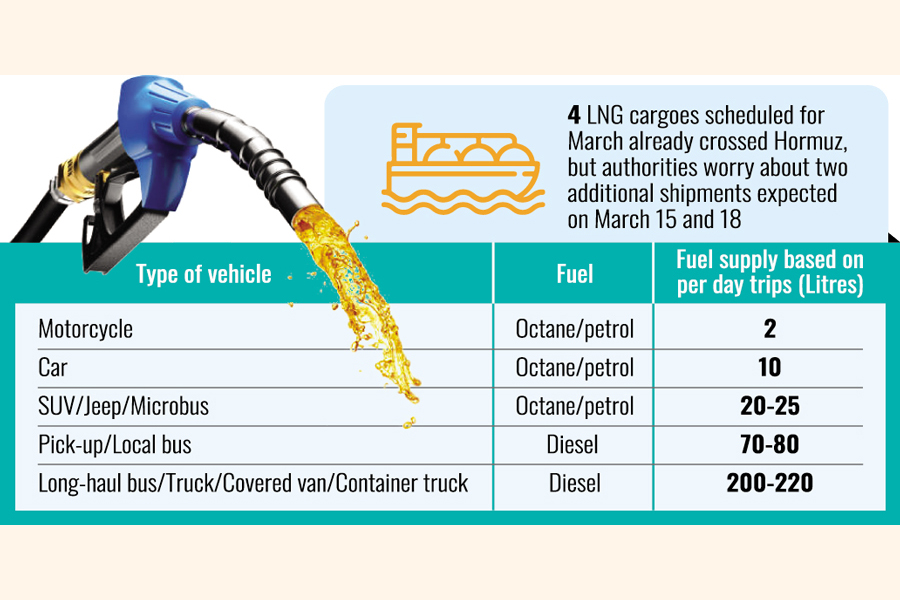
Petrobangla Chairman Md Erfanul Haque told Prothom Alo that four LNG-carrying vessels had already passed through the strait before the conflict began. As a result, there is no major concern until 12 March. However, two vessels scheduled to arrive on 15 and 18 March are expected to travel through the same route. If they are delayed, some supply pressure may arise. Alternative sources for LNG imports, such as Australia and Malaysia, are also available.

LPG supply stable for now

There is also no immediate shortage of LPG, although businesspeople in the sector say there could be risks in the long term. Amirul Haque, president of LPG Operators of Bangladesh, said three ships waiting to enter the Hormuz region had changed course. However, the country is not expected to face LPG problems immediately.

According to the National Board of Revenue, 171,000 tonnes of LPG were imported through Chattogram and Mongla ports and the Sitakunda jetty in February, about 30 per cent higher than that in January.

In addition, LPG carriers scheduled to arrive during the first two weeks of March are already on their way to Chattogram and Mongla ports. Of the nearly 57,000 tonnes of LPG imported by Meghna Group of Industries (MGI), a large portion has already reached port and the rest is on its way.

When asked, MGI Chairman Mostafa Kamal said the LPG carriers heading towards Chattogram port are continuing their journey. Even if the Strait of Hormuz were closed, there would be no immediate problem. However, deliveries of future shipments could be delayed.

In the previous fiscal year, about 75 per cent of LPG imports came through the Strait of Hormuz. However, during the first two months of this year, the share dropped to 21 per cent. A large portion, about 67 per cent, came from the US, reducing overall dependence on the route.

Alternative plans under consideration

Experts associated with the energy sector say Bangladeshโ€™s capacity for long-term fuel storage is limited. Therefore, if the Strait of Hormuz remains effectively closed for more than two weeks, pressure could arise on supplies of oil, gas and LPG alike. While there is no immediate crisis, a prolonged disruption could put Bangladeshโ€™s energy security to a serious test.

State minister for Power, Energy and Mineral Resources Anindya Islam Amit told Prothom Alo, โ€œThere is no immediate concern regarding energy imports and supply. Plans have been prepared to address any potential crisis resulting from disruption in the Strait of Hormuz or conflict in the Middle East. We are working on all possible sources for importing fuel oil and LNG.โ€​
 
Analyze

Analyze Post

Add your ideas here:
Highlight Cite Respond

Members Online

Latest Posts

Back
PKDefense - Recommended Toggle