Donate ☕
201 Military Defense Forums
[🇧🇩] - Energy Security of Bangladesh | Page 101 | PKDefense
Home Post Alerts Inbox Watch Videos

[🇧🇩] Energy Security of Bangladesh

Reply (Scroll)
Press space to scroll through posts
G Bangladesh Defense
[🇧🇩] Energy Security of Bangladesh
504
16K
More threads by Saif

LPG crisis exposes regulatory gaps

Atiqul Kabir Tuhin
Published :
Jan 11, 2026 00:07
Updated :
Jan 11, 2026 00:07

1768113637748.webp

Liquefied petroleum gas (LPG) is no longer a luxury; it has become an essential cooking fuel for millions of households across the country. As domestic natural gas reserves dwindle, authorities have for years encouraged domestic use of LPG as an alternative. New residential gas connection has remained suspended for years, and is unlikely to be resumed in the foreseeable future. Even many households that still have pipeline connections are forced to keep LPG cylinders on standby, as stoves connected to the grid remain dry for the better part of the day. As a result, cylinder gas has become a fact of daily life from rural areas to major cities. However, the sudden volatility in the LPG market over the past two weeks has exposed how people have been made dependent on a commodity over which the government exercises almost no effective control.

The country is almost entirely dependent on imports to meet the growing demand for cylinder gas. At the same time, the market is overwhelmingly dominated by private companies. Unlike pipeline gas, there is no state buffer stock. As a result, even when the government wants to intervene, its ability to suddenly increase supply and bring prices under control is limited.

The state-run Bangladesh Petroleum Corporation (BPC) produces and sells LPG at a much lower price than private companies. However, BPC's share of the LPG market is so negligible that consumers rarely find its cylinders available, forcing them to rely on the more expensive products of private operators.

The Bangladesh Energy Regulatory Commission (BERC) fixes LPG cylinder prices every month in line with international rates. Yet private suppliers and distributors have routinely sold LPG at several hundred taka above the government-set prices. The problem came to a head in recent weeks when the price of a 12kg cylinder rose to between Tk 1,700 and Tk 2,500, even as the official price was fixed at Tk 1,306.

Prices were raised on the pretext of lower imports, even though official data show steady import volumes and adequate stock levels. The Energy affairs Advisor of the government has himself acknowledged that prices were increased by creating an artificial shortage.

When the government began taking action, private suppliers stopped selling LPG from Thursday. Although the strike was withdrawn, at both wholesale and retail levels, suppliers are still selling 12kg cylinders at Tk 350 to Tk 900 above the government-fixed rate. Many wonder, what is the point of fixing the price if the government cannot enforce it?

Bangladesh is all too familiar with this cycle of price manipulation where importers blame wholesalers and the wholesalers blame the retailers. In this blame-shifting game, it is ordinary people who bear the cost. The social impact of the LPG crisis is quiet but far-reaching. Low-income families are cutting back on food consumption. Middle-class households are cutting back on their spending for their children's education or healthcare to cope with higher cooking costs. Small food businesses who are struggling to survive and raising prices are putting further pressure on consumers. In this way, the LPG crisis gradually seeps into the wider economy and fuels inflation.

Beyond pricing, serious concerns have also been raised about product quality and public safety. To maximise profits, some companies are allegedly marketing substandard cylinders, a malpractice believed to contribute to frequent cylinder blasts.

In a sector so inextricably linked to day-to-day life, the government must enforce stricter monitoring over supply chains, pricing structures and technical specifications. At the same, the state should strengthen the BPC and expand its market share in the LPG market. This is the only way to prevent private sector dominance from holding consumers hostage over such an essential commodity.​
 
Analyze

Analyze Post

Add your ideas here:
Highlight Cite Fact Check Respond
How modern wind turbine technology can reshape Bangladesh’s energy future


By Sudeepto Roy and Israt Hossain

1768116058297.webp

‘Currently, there are 15 wind energy projects either in operation or in the planning stages, with a total capacity of 777.902 MWp.’ FILE PHOTO: MOKAMMEL SHUVO

Bangladesh, a developing economy heavily reliant on fossil fuels, is entering a critical phase of its energy journey amid rising energy demand and environmental challenges. The power sector, being the largest consumer of natural gas in the country, not only contributes to greenhouse gas emissions but also incurs high energy import costs, as evident in the 13.86 percent surge in LNG imports in FY2024-25. Thus, wind power is becoming a more practical choice as Bangladesh moves towards renewable energy sources.


Bangladesh has considerable potential for wind energy resources. However, the development of the wind energy sector is experiencing slow growth due to a challenging regulatory situation and investment uncertainty. Currently, there are 15 wind energy projects either in operation or in the planning stages, with a total capacity of 777.902 MWp, according to the SREDA. Bangladesh’s first commercial wind power plant began its full-scale operation in March 2024. This marked a significant milestone for Bangladesh in its transition towards renewable energy. Other projects are underway, including the 100 MW Anwara Wind Power in Chittagong, which is currently in the planning stages. This is expected to make to a significant contribution to the country’s renewable energy capacity by 2035. In addition, the 100 MW Wind Power Plant in Matarbari is set to be completed in 2026. Plans are also underway for wind power plants with lower capacity in Chandpur and Feni.

The wind energy sector is undergoing a major transformation due to recent revolutionary innovations in the way wind is harnessed for electricity generation, which also reduces costs. The recent developments are not only translating into higher efficiencies, but they are also bringing wind power closer to accessibility and affordability than ever. Optimisation of turbines for aerodynamic performance is highlighted as a key research theme in wind technology today. An increase in turbine efficiency is achieved via improved blade design and materials used. New blade designs provide an optimal aerodynamic profile that captures more wind energy over a wider range of wind speeds.

Notable advancements such as variable pitch and twist technologies enable blades to continuously vary to changing wind conditions over their entire span, optimising performance, minimising mechanical loads, and increasing their longevity. At present, the shift towards advanced materials is crucial. Today, most turbine blades are made of composite materials such as fibreglass and carbon fibre with good strength-to-weight ratios. This progress enables building larger blades that can capture more wind energy whilst also extending operational lifetime and reducing maintenance costs. Modern wind turbine towers now exceed heights of 160 metres, enabling the deployment of large rotors with diameters of up to 150 metres that can access stronger and more consistent winds at higher altitudes. Meanwhile, the use of segmented blades, which can be converted into long blades to improve the energy capture per turbine, reduces the cost of transportation, a key factor in lowering installation costs.


One way to overcome limitations associated with regions with lower wind resources, such as Bangladesh, is a concept called “Low Wind”, which uses special turbines for low wind speeds. The goal of this design is to produce power when traditional windfarms are not doing so, and eliminate the “cannibalisation effect” responsible for making electricity less expensive when suddenly all farms produce renewable energy at the same time, thus driving down prices. Low Wind turbines are identified by their very-long blades to optimise power at the lowest wind speed, and low cut-out speed around 12–13 metres per second.

Bangladesh can take advantage of the state-of-the-art technologies in wind turbines to enhance its renewable energy capacity. According to a detailed study conducted in 2018 by the US Department of Energy’s National Renewable Energy Laboratory, Bangladesh has wind energy potential of at least 30,000MW. The coastline is 710 km, and in the southwest lies the Sundarbans mangrove and in the southeast the Saint Martin’s coral island. Since fixed wind turbines cannot be installed in the Bay of Bengal, floating wind farms can be positioned further out from shore. If we build seaside windfarms, for instance, using 153-metre blades, we could supply energy to a lot of homes simultaneously. Residential areas are best suited for bladeless turbines. They are easily manageable because they are small, quiet, and less demanding.

The adoption of wind power is expected to speed up the development trajectory for Bangladesh, as it will not only be a green energy source for households but also a powerhouse for the national economy. The growing wind power industry is also expected to nurture a new generation of trained workers, from engineers and maintenance staff to power managers, another factor contributing to the country’s development. Also, the environmental benefits of wind power go far beyond simply reducing carbon emissions. With an increasing demand and production of wind farms, the country will rely less on imported fossil fuels. This shift promises much cleaner air because burning coal releases toxic pollutants such as sulphur dioxide and nitrogen oxides, which conventional power plants continuously spew into the atmosphere daily.


Although there may still be some reliance on traditional sources in the short term, every step forward is crucial. The wind energy sector’s coming-of-age can mean a solid green footing for a cleaner future and a better way of life in Bangladesh. In fact, we can lead the way in the deployment of advanced wind technologies with floating offshore farms and low-wind turbines, thus creating energy independence, new industries, and sustainable economic development, while ensuring a large reduction in national emissions.

Sudeepto Roy is research associate at the South Asian Network on Economic Modeling (SANEM).​
 
Analyze

Analyze Post

Add your ideas here:
Highlight Cite Fact Check Respond
Process ongoing for LNG deal with truant firm Socar

Proposed contract reopens trauma over Azeri firm's past dereliction of drilling commitments, litigation


M Azizur Rahman
Published :
Jan 14, 2026 00:28
Updated :
Jan 14, 2026 00:28

1768351608629.webp

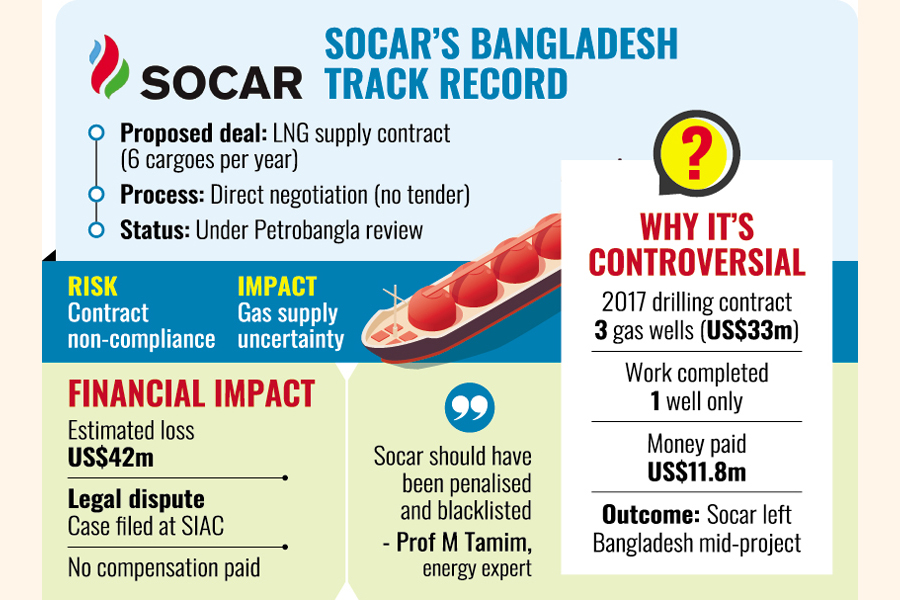
Preparation is on stream to award a liquefied natural gas (LNG)-supply contract to a truant foreign firm that had previously left Bangladesh without completing a contracted drilling job, sources say, stoking fresh concerns.

Energy-industry insiders say the move towards deal-making with Socar, an Azerbaijani company, has triggered unease, given the firm's controversial track record in the country's oil and gas industry.

State-run Petrobangla is currently negotiating with Socar to select it, without a competitive tender, for LNG supply to Bangladesh for the first time, a senior Petrobangla official told The Financial Express on Tuesday.

Critics fear the decision could expose the country to renewed contractual and supply risks amid an already-strained gas market.

Socar earlier won a three-well drilling contract from Petrobangla's subsidiary, Bangladesh Petroleum Exploration Company (BAPEX), but allegedly completed only one-third of the works before leaving the country.

Industry insiders describe it as the first instance in Bangladesh's oil and gas sector where an international oil company abandoned an assigned drilling job midway.

In 2017, BAPEX awarded Socar a contract worth around US$33 million to drill three onshore gas wells -- Semutang South-1, Begumganj-4 and Madarganj-1.

However, the company drilled only the Semutang South-1 well and left Bangladesh after receiving about US$11.8 million, officials said.

The Azerbaijani firm did not proceed with drilling the Begumganj-4 well in Noakhali or the Madarganj-1 well in Jamalpur district.

Instead of compensating BAPEX for failing to fulfil its contractual obligations, Socar reportedly filed a lawsuit against the state-run explorer at the Singapore International Arbitration Centre (SIAC), allegedly exploiting loopholes in the contract.


As a result, Bangladesh could incur losses of around US$42 million, according to a senior Petrobangla official.

He alleges that Socar, in connivance with its local partner, is set to gain windfall profits without completing the agreed drilling works.

"If Socar is awarded an LNG supply deal, Petrobangla may again face a situation where contractual obligations are not honoured, further aggravating the already-strained gas supply across the country," the official warns.

If selected, Socar would be required to supply around half a dozen LNG cargoes annually.

And Bangladesh will have to pay around US$240 million to the supplier to buy the gas cargoes, if the deal is finally awarded, said the Petrobangla official


At present, Bangladesh imports the liquefied gas under long-term contracts from QatarEnergy LNG (formerly Qatargas), OQ Trading International and US-based Excelerate Energy. The country also imports LNG from OQ Trading International under a short-term arrangement.

Energy-expert Prof M Tamim says Socar should have been penalised for leaving Bangladesh without completing its drilling commitments.

"The company should have been blacklisted from undertaking any work in Bangladesh for such misconduct," he adds.

Professor Tamim, who is currently Vice-chancellor of the International University, Bangladesh (IUB), alleges that Socar is now attempting to secure the LNG contract posing as a Switzerland-registered entity.


This company is using unfair means to obtain the contract, he claims.​
 
Analyze

Analyze Post

Add your ideas here:
Highlight Cite Fact Check Respond
Energy advisor signals approval as BPC seeks permission to import LPG

bdnews24.com
Published :
Jan 14, 2026 20:40
Updated :
Jan 14, 2026 20:40

1768436841928.webp

The Bangladesh Petroleum Corporation (BPC) has formally requested permission from the Energy and Mineral Resources Division to import liquefied petroleum gas (LPG) directly, aiming to tackle a domestic supply crisis and price volatility.

In a letter addressed to the division’s secretary on Jan 10, BPC Chairman (Secretary) Amin Ul Ahsan sought authorisation for the imports.

The letter highlighted recent shortages and “abnormal” price hikes in the domestic market, noting reports by national dailies where consumers have been forced to pay significantly above the regulated rates.

On the matter, Power and Energy Advisor Muhammad Fouzul Kabir Khan told bdnews24.com: “We will grant BPC approval if necessary. We are currently exploring the feasibility of importing LPG through government-to-government (G2G) arrangements.”

Such a move could help restore balance to the market, he added. The BPC said the country’s LPG import and supply chain is currently entirely dependent on the private sector.

“Without a state-level mechanism for direct imports via the BPC, the government’s ability to intervene and stabilise the market during artificial shortages or supply disruptions remains limited.

It said the LPG produced as a by-product at Eastern Refinery Ltd through crude oil refining accounts for a mere 1.33 percent of the nation’s total demand.

The state-run corporation admitted, however, that it currently lacks the necessary infrastructure for unloading and storing LPG. “At present, the BPC does not possess its own infrastructure, such as jetty-based pipelines, flow metres, or storage tanks, for the storage and discharge of LPG,” the letter stated.

To bypass these hurdles, the BPC proposed adopting the “lightening” method currently used by private operators in the Kutubdia deep-sea area. This would involve using the lighterage vessels of interested private operators to discharge and distribute the gas.

The BPC suggested that a list of participating firms, import volumes, payment methods, and distribution protocols could be finalised in consultation with the LPG Operators Association of Bangladesh (LOAB).

Citing past precedents, the BPC said that during sudden surges in fuel oil demand or supply crises, additional supplies have been secured through quotations from G2G-listed suppliers. A similar approach could be applied to LPG.

“Since the BPC’s listed G2G suppliers are large-scale refiners capable of producing and supplying petroleum fuels, including LPG, the feasibility of importing through them should be explored,” the letter argued.

The corporation also proposed evaluating other potential international sources to ensure the best possible terms.

The letter concluded by seeking “policy approval” from the Energy and Mineral Resources Division to protect consumer interests and ensure a competitive, stable environment in the LPG market.

The domestic market has been gripped by an LPG cylinder crisis for over a month due to dwindling supplies. Depending on the volume, prices have surged by Tk 350 to over Tk 1,000 per cylinder.

While the government has introduced measures such as tax waivers, credit-based imports, and increased quotas to ease the pressure, there are few signs of an immediate resolution.

Despite government-mandated price caps, cylinders are rarely available at the official rate. The scarcity has left ordinary citizens struggling, while restaurants and small eateries reliant on LPG face severe operational challenges.

The supply crisis, which began a month ago, has intensified in recent days.

The situation was further exacerbated in early January when a leak in the Titas Gas pipeline forced a major shutdown of piped gas across large sections of the capital.​
 
Analyze

Analyze Post

Add your ideas here:
Highlight Cite Fact Check Respond

Interim govt urged to halt energy master plan before polls

FE REPORT

Published :
Jan 16, 2026 09:06
Updated :
Jan 16, 2026 09:06

1768610497277.webp


The Centre for Policy Dialogue (CPD) has come down heavily on the draft Energy and Power Sector Master Plan (EPSMP) 2026-2050, describing it as 'fundamentally flawed, non-participatory and backward-looking'

The private think tank also urged the interim government not to finalise it before the ensuing national election.

It also warned that approving the master plan in its present form would lock Bangladesh into costly and carbon-intensive fossil fuel infrastructure, deepen excess power capacity and delay the country's energy transition by years.

The CPD's concerns and warnings came on Thursday at a media briefing titled "Interim Government's Energy & Power Sector Master Plan (EPSMP): 2026-2050" in the city.

The press conference was moderated by CPD Research Director Khondaker Golam Moazzem while the keynote paper was presented by CPD Senior Research Associate Helen Mashiyat Preoty. Researchers and programme associates from CPD were also present there.

The CPD said the draft EPSMP largely echoes the previous Integrated Energy and Power Master Plan, prepared by the ousted Awami League government, and fails to address the criticisms, concerns and questions that have long surrounded Bangladesh's power and energy planning.

Instead of correcting the past mistakes, the new draft, CPD argued, carries them forward and in some cases intensifies the existing debates.

The draft proposes adding new coal-fired power plants to the grid and revives discussion on exploiting domestic coal resources under the banner of "resource optimisation", according to the CPD.

At the same time, it outlines an expansion of LNG infrastructure, including a new floating storage and regasification unit and a land-based terminal, raising questions about how the interim government intends to escape the sector's growing debt burden while claiming to move away from fossil fuels.

The CPD highlighted faulty power demand forecasting as another key area of concerns. The draft EPSMP projects electricity demand of more than 40,000 megawatts by 2040, while CPD's own analysis suggests that demand is unlikely to exceed 30,000 megawatts by that time.

Mr. Moazzem warned that overestimating the demand would only perpetuate excess capacity, inflate capacity payments and exacerbate the sector's financial stress, as Bangladesh's future economic growth is expected to be more service-oriented and less energy-intensive.

The draft also introduces zone-wise peak demand projections and generation planning, a technically sophisticated exercise that could have been beneficial, CPD acknowledged,

The CPD, however, said inconsistencies between zonal demand estimates, and renewable energy potential and generation plans risk creating additional and unnecessary generation burdens.

Although the EPSMP sets headline targets of 20 per cent renewable energy by 2030, 30 per cent by 2040 and 50 per cent by 2050, CPD questioned the credibility of such goals.

The master plan's definition of renewable energy includes large utility-scale and rooftop solar, onshore and offshore wind, waste-to-energy, geothermal, as well as hydrogen and ammonia co-firing.

The CPD argued that it remains unclear how much of the projected renewable share would come from proven sources such as solar and wind, and warned against "camouflaging" unproven or fossil-linked technologies as renewable solutions.

More critically, the plan places major renewable energy expansion and smart grid development in the post-2040 period, even though the renewable target for 2040 is 30 per cent, according to the CPD.

Mentioning that the existing grid can accommodate not more than about 20 per cent of variable renewable energy, it stressed the need for early investment in grid modernisation.

Delaying smart grid implementation until 2040, it said, is incompatible with the plan's own targets.

Grid upgradation emerged as one of the most overlooked aspects of the draft EPSMP. CPD noted the draft lacks detailed regional power mapping and also the urgency in preparing the grid to integrate higher shares of renewable energy.

It also highlighted weak provisions for institutional reform, including the need to strengthen the autonomy and enforcement powers of sector regulators and to reform the Power Grid Company of Bangladesh to ensure independent and efficient system planning.

The financial strategy outlined in the draft drew sharp criticism, according to the CPD.

It said the plan proposes investment allocations of tens of billions of dollars for electricity generation and LNG infrastructure, alongside billions for hydrogen and ammonia, while allocating negligible resources for renewable energy expansion, domestic gas exploration and transmission and distribution modernisation.

Such priorities, CPD argued, contradict the stated goals of energy security and transition.

Mr. Moazzem also questioned the timing and process of the plan's formulation, noting that it was presented to the advisory council just weeks before national elections.

He alleged excessive bureaucratic dominance in drafting the plan and raised concerns about pressure from vested domestic interests and foreign partners, particularly in relation to LNG expansion and potential commitments linked to international trade and economic agreements.

In response to questions from journalists on LNG costs, renewable integration, institutional reforms and the repetition of past planning mistakes, the CPD researchers reiterated the need for a fresh, inclusive and research-based planning process.

The CPD strongly recommended that the interim government suspend the proposed EPSMP and leave the task to an elected government.

It also called for scrapping plans for new coal-fired power plants, initiating a time-bound phase-out of existing coal capacity, halting new LNG terminal projects, accelerating smart grid development from the earliest phase, redefining renewable energy around proven sources such as solar and wind, and integrating regional renewable energy trade, including cross-border imports from Nepal and Bhutan.​
 
Analyze

Analyze Post

Add your ideas here:
Highlight Cite Fact Check Respond

Members Online

⤵︎

Latest Posts

Latest Posts