[🇧🇩] Energy Security of Bangladesh

[🇧🇩] Energy Security of Bangladesh
583
20K
More threads by Saif

G Bangladesh Defense

Govt decision to scrap prepaid meter monthly fee hailed by CAB

UNB
Published :
Mar 29, 2026 23:04
Updated :
Mar 29, 2026 23:04

1774830641535.webp


The Consumers Association of Bangladesh (CAB) on Sunday night welcomed the government’s decision to withdraw the monthly charge on prepaid electricity meters, describing it as a pro-consumer move.

In a statement, CAB Vice-President SM Nazer Hossain congratulated the government for taking the decision in response to long-standing demands from electricity consumers across the country.

He said the monthly meter charge had been a source of discomfort and dissatisfaction among consumers for years, and the decision reflects the government’s responsiveness to public demand. “The move indicates that the current government remains committed to addressing public concerns and will continue to formulate policies and regulations in favour of consumers.”

Nazer also stressed the need for more consumer-friendly policies to ensure better electricity services, adding that scrapping the meter charge is a commendable step in that direction.

At present, prepaid electricity users have to pay a fixed amount every month as ‘meter rent’, which, according to CAB, imposed an additional financial burden despite regular payment of electricity bills.

CAB noted that various civic groups and consumers had long been demanding the withdrawal of what they termed an “unjustified and unreasonable” charge.

CAB expressed hope that the decision would ease monthly electricity expenses to some extent and help reduce public dissatisfaction.

Earlier in the day, Power, Energy and Mineral Resources Minister Iqbal Hassan Mahmood Tuku announced the decision to abolish the prepaid meter monthly fee following widespread criticism and consumer demands.

The minister said dissatisfaction had persisted among users over additional deductions in prepaid systems. After reviewing the issue upon assuming office, the government decided to withdraw the charge as part of a consumer-friendly initiative.

The minister added that steps are being taken to make electricity services more public-oriented and to reduce the financial burden on consumers, and the decision will be implemented soon.​
 

Adverse impacts of energy crisis on commodity prices

FE
Published :
Mar 29, 2026 23:56
Updated :
Mar 29, 2026 23:56

1774830893664.webp


The war in the Middle East has entered 2nd month, and there is no end in sight. All sides are claiming that they are winning, but only one outcome that is certain is global economic recession and suffering of ordinary people both in the conflict-affected zones and beyond. While people in Iran are facing widespread death and destruction due to relentless bombing by the USA and Israel, the rest of the world is grappling with rising prices and even shortages of energy and food. Oil prices have surged above $120 a barrel, up from $73 a barrel before the conflict. Some analysts warn that if the Strait of Hormuz, which is already closed for nearly a month, remains blocked for another month or two, oil prices could jump to as high as $150 and even $200 a barrel.

The repercussion of global oil price volatility is weighing heavily on Bangladesh's economy, as the country meets 95 per cent of its energy needs through imports. Bangladesh has not increased domestic fuel prices yet, whereas about 100 countries have increased energy prices since the US and Israel launched attacks on Iran on February 28. The state minister for power, energy and mineral resources recently said the government is providing a daily subsidy of Tk1.67 billion on fuel to ease public hardship and that it does not plan to raise prices now. This decision appears aimed at shielding people from further inflationary pressure, as consumers have already been grappling with high inflation for the past three years.

However, this crucial pro-people move is being undermined by the hoarding and selling of fuel oil in the open market at prices far above official rates. Many are purchasing fuel at exorbitant prices from black market either because filling stations in their vicinities are out of stock or to avoid long queues. As a result, fuel prices have effectively risen sharply despite no official adjustment. At the same time, traders are increasing the prices of other goods - sometimes justifiably, sometimes opportunistically - citing higher fuel costs. Fuel prices are never an isolated economic phenomenon. The unofficial rise in fuel prices is rapidly cascading through the broader economy, intensifying an already difficult economic environment and tightening the squeeze on low- and middle-income households. The most immediate impact was visible in transport fares, particularly during the Eid travel season. The ripple effects do not stop there. Higher transportation costs are feeding into food inflation, pushing up the prices of vegetables, fish, chicken and other essential kitchen items. This comes at a time when general inflation rose to 9.13 per cent in February, up from 8.58 per cent in January. Given the ongoing Middle East conflict, oil price volatility and a rising dollar, inflation could climb even higher in the coming months.

Against this backdrop, with no immediate end in sight to the ongoing war, the urgency of a coordinated response cannot be overstated. A number of countries have declared a national energy emergency and begun adopting energy conservation measures. For instance, the Philippines has officially declared a national energy emergency, while countries such as Pakistan and Egypt have introduced austerity measures, including reduced fuel use, remote work and cuts in energy-intensive activities. Prime Minister Tarique Rahman has recently convened a high-level meeting to confront the fuel crisis and global energy volatility. The government should also immediately sit with leading economists to assess the overall economic situation and devise a pragmatic course of action to shield the people from the full inflationary impact of fuel price volatility and broader economic instability.​
 

Surviving unexpected energy storms

SYED FATTAHUL ALIM
Published :
Mar 29, 2026 23:55
Updated :
Mar 29, 2026 23:55

1774831003632.webp


Prime Minister Tarique Rahman has instructed the home minister to adopt stern measures against oil smuggling as well as creation of any artificial energy crisis. For a country critically dependent on imported fossil fuel, such strict directive from the government's highest level is a welcome step. And that is particularly so when, according to the prime minister himself, there is already sufficient stock of oil in the country. Therefore, there should be no reason to be worried about oil shortage. Such pronouncements from the government to reassure the public about the stock and supply situation of fossil-based oil, a vital source of energy, is obviously prudent and well-timed. This should dissuade the people from panic buying of fuel oil. Though the public may be made to see the reason, the traders may not be. So, it is believed, the government would not confine its directive to words only. For hoarding of the fuel oils started as soon as both genuine and fake pundits started to make forecasts about the impending war in the Gulf and its immediate fallout --- scarcity of energy and a sharp rise in its price in the global market. The media, the mainstream as well as the social, were and still are abuzz with the rumours, speculation and also some reports that were not fake. Under the circumstances, an unscrupulous and greedy section of traders cannot be expected to miss such a once-in-a-lifetime opportunity to make windfall gains out of public misery!

And so, stockpiling of oils began to take place not only at the secret corners of oil pumps, shops, houses or below the ground. Hoarders, according to some reports, even hid now-scarce flammable substance in the odd places like cowsheds. No doubt, it was to the utter amazement of the innocent graminivorous, hooved quadrupeds! The state-owned news agency 'Bangladesh Sangbad Sangstha (BSS)' was the source of the report that was carried by one of the English dailies on the 14th of this month (March). It went like this: 'The Directorate of National Consumers' Right Protection (DNCRP) has seized 1,500 litres of petrol and octane illegally stored in a cowshed in the Chinakhara area under Sujanagar upazila of Pabna'. Needless to say, the said act of hoarding took place amid the government-run drive against illegal stockpiling of fuel oils. So, one should not be surprised if the hoarders return to their illegal activities as soon as the drive is over. This is a never-ending cat and mouse game in which the culprits always win. So, to get around this predicament, the punishment for hoarding should be harsh and the raid should not be on-again, off-again, but a relentless one. Also, those in charge of the raids need to be above board.

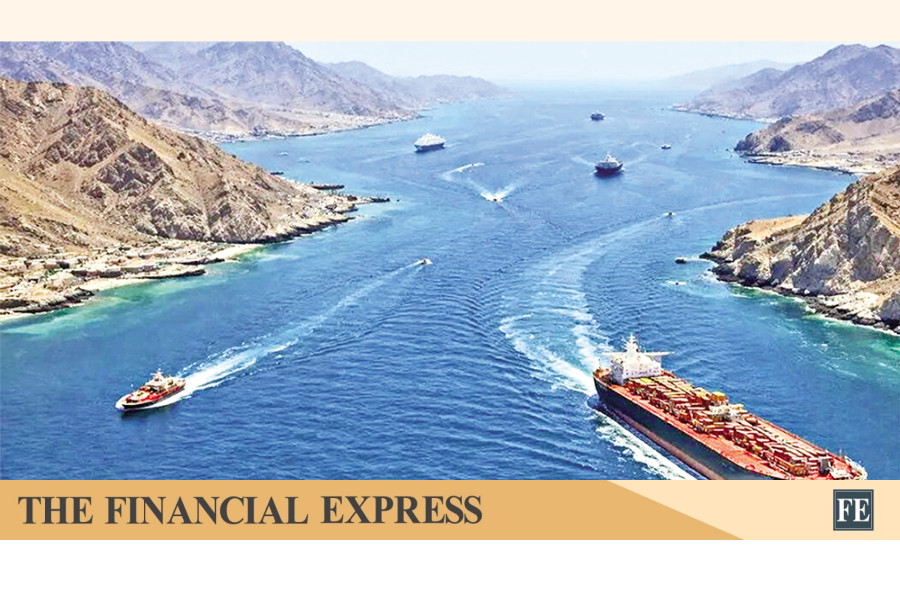
In fact, crisis of energy or for that matter fuel oil including Liquefied Natural Gas (LNG), at the moment, is not a local, but a global concern. In the global market, oil is now the most volatile commodity. As of March 29, Brent crude oil was trading at approximately US$112.57 per barrel. Fuel oil (heating oil) prices were recorded around US$4.50 per US gallon. Notably, one barrel is equivalent to 42 US gallons. This obviously marks a significant rise in the prices of fuel oils in the market. The reason, as everybody knows, is the unjust war that the USA and Israel have imposed on Iran and, as a result, the de facto closure of one of the world's key oil route, the Strait of Hormuz, by Iran in retaliation. Notably, the Strait is the only passage for any vessel that in peace time in the past would use to load cargoes like oil, LNG or fertilizers from the ports of the Persian Gulf countries and pass through the Strait of Hormuz and then out into the open sea. But the passage through both the Persian Gulf and the Strait is now under the strict control of the Iranian forces.

Countries that Iran considers friendly to it can now use the Gulf and the Strait for the passage of their ships. Fortunately, Iranian authorities consider Bangladesh a friend. Now as there is no end in sight of the war and the US has been issuing one ultimatum after another demanding that Iran open the Strait of Hormuz or face more devastating consequences like fresh assaults on its vital infrastructures and Iran countering those threats with promise of inflicting equal damage to US assets and those of its allies in the Gulf states, it cannot be said the Gulf, at the moment, is safe for use especially by a peaceful country like Bangladesh. That is true, even if, Iran might allow any Bangladesh-owned vessel to pass through the critical oil route. That is because the vessel might inadvertently be caught in crossfire as the entire Gul region is now a war zone. As it happens in any war, the ports and the fuel terminals either get damaged or are shut down to avoid any damage or dislocation. As reports go, a number of oil and gas facilities owned both by Iran and some Gulf countries have suffered considerable damage. In that case, it would be wise for Bangladesh to avoid the Strait of Hormuz for sourcing its energy like oil and LNG until the situation stabilizes in the Middle East. Meanwhile, Bangladesh might look to the East, especially the southeast Asian countries like Malaysia, Brunei, Indonesia and Vietnam which produce and refine significant amount of oil. Countries like Malaysia, Brunei, Indonesia and Thailand also produce natural gas.

However, when it is about energy, the country needs to have a long-term strategy. As we are basically an importer of energy, especially of fossil oil, the policy should be one of building enough stock so the nation can go without importing the vital commodity for at least six months. China, for instance, has an estimated 1.2 to 1.3 billion barrels of crude oil in combined strategic and commercial storage. Consider that China is not entirely dependent on imported oil to run its economy. In fact, renewable energy accounts for more than 60 per cent of China's total installed power generation capacity. In that case, Bangladesh should be more serious about building its energy storage capacity to survive unforeseen storms like the present one in the global energy market.​
 

No scarcity, hoarding and panic buying causing problems: Energy Minister

UNB
Published :
Mar 30, 2026 20:08
Updated :
Mar 30, 2026 20:08

1774915494807.webp


Power, Energy and Mineral Resources Minister Iqbal Hassan Mahmood on Monday told Parliament that currently there is no energy shortage rather fuel hoarding and excessive purchase are creating problems in the country.

“I want to make it clear that there is no shortage of fuel in Bangladesh so far. In fact, we have increased the supply more than last year,” he said.

The Minister made this remark while delivering a statement under Section 300 of the Rules of Procedure in the House to raise the energy supply situation in the country amid panic buying triggered by the Middle East war.

He said the government has been able to ensure higher fuel supply this year compared to the volume sold at this time last year.

Iqbal Hassan Mahmood said definitely the actual consumption of people suddenly could not have doubled within a year. “This unusual change makes it clear to us that the mentality of fuel hoarding is now a bigger problem than fuel shortage,” he said.

“Despite our adequate supplies and preparations, if people buy more than they need or hoard illegally in villages and towns, normal supplies will inevitably be disrupted,” he added.

The Energy Minister stressed the need for creating trust and awareness among the people to address the present energy problem.

Noting that cooperation from the people is very essential here, he urged the people to avoid additional purchase, refrain from hoarding and reserve, stop energy and power wastage and raise voice against hoarding and illegal connections.​
 

Experts for reducing dependence on imported fuel, boosting renewable energy
The country’s 60 per cent of energy depends on imports, study finds

FE ONLINE REPORT
Published :
Mar 30, 2026 14:20
Updated :
Mar 30, 2026 14:20

1774916067511.webp


A study has highlighted the need for Bangladesh to reduce its dependence on imported fuel and move toward energy self-reliance.

The findings were presented at a roundtable held at the Centre on Integrated Rural Development for Asia and the Pacific (CIRDAP) in Dhaka, organised by Change Initiative.

The study said over 60 per cent of the country’s energy depends on imports, exposing the economy to global price shocks and putting pressure on foreign exchange reserves.

It noted that shifting investment from liquefied natural gas (LNG) to renewable energy could bring major economic benefits. For every $1 redirected, the system could generate up to $17 in long-term gains.

The study proposed a “zero-arable land” strategy and a $32.82 billion investment plan to ensure long-term energy security.

The event was moderated by M. Zakir Hossain Khan, Co-Founder and Chief Executive of Change Initiative.

Guests of honour included Dr AK Enamul Haque, Director General of Bangladesh Institute of Development Studies (BIDS), Mr Owais Parray, Country Economic Advisor at UNDP, and Dr Md. Didarul Alam, Director (Joint Secretary) of Bangladesh Energy Regulatory Commission.

M Azizur Rahman, chairman of Forum for Energy Reporters Bangladesh (FERB), and Mostafa Kamal Majumder, President of the Bangladesh Environmental Journalists Forum, also spoke on the occasion, among others.​
 

Bangladesh increasing fuel imports from multiple countries: Shama Obaed

bdnews24.com
Published :
Mar 31, 2026 20:44
Updated :
Mar 31, 2026 20:44

1775002462480.webp


Bangladesh is increasing fuel imports from multiple countries to avoid any supply disruption despite mounting pressure from Middle East tensions, State Minister for Foreign Affairs Shama Obaed Islam has said.

Speaking to reporters at the foreign ministry on Tuesday, she said fuel shipments are expected from Saudi Arabia, India, Malaysia and Indonesia.

“I understand more oil will arrive in April. Supplies are coming from Saudi Arabia, will come from India, and are expected from Malaysia and Indonesia. These are all being processed,” she said.

Her remarks came on a day when the Energy and Mineral Resources Division said there was no fuel crisis in the country.

Amid the ongoing conflict in the Middle East, long queues have been seen at petrol pumps in recent days, raising concerns over supply.

However, Joint Secretary Monir Hossain Chowdhury said Bangladesh currently has around 192,000 tonnes of fuel in stock and ruled out any shortage.

The government is also considering extending weekly holidays at educational institutions and offices to save energy.

Against this backdrop, the state minister said her ministry is working closely with the energy ministry to secure imports from alternative sources.

She said Bangladesh has held “productive discussions” with Malaysia and Indonesia and already has a memorandum of understanding with Malaysia signed last year.

“We are making every effort to diversify our energy sources,” she said.

The minister said efforts are under way to secure fuel from alternative suppliers as imports from some sources have been affected by the war.

“As far as I know, there is still no fuel crisis,” she said.

Referring to remarks by State Minister for Power, Energy and Mineral Resources Iqbal Hassan Mahmood Tuku in parliament, she said authorities suspect some traders are stockpiling fuel to create an artificial shortage.

“There is no real shortage. We must be cautious in consumption and ensure future supplies so that the economy does not come under pressure,” she said.

Replying to a question on imports from the United States, she said Bangladesh is exploring all possible sources, including the US, Russia, India, Indonesia and Malaysia.

“Wherever we can secure supplies easily, we are making arrangements, keeping the economy and people in mind,” she said.​
 

No rise in fuel oil prices

Staff Correspondent
Dhaka
Published: 31 Mar 2026, 17: 50

1775003134816.webp

Fuel droplets fall from a nozzle at a gasoline station in Dhaka, Bangladesh on 6 August 2022Reuters file photo

The government has not increased fuel oil prices despite global energy markets turning volatile due to the spread of war across the Middle East and prices rising to more than double, keeping rates unchanged for a second consecutive month, with petrol, octane, diesel and kerosene to be sold at existing prices in April.

This decision was announced today, Tuesday, in an official order issued by the Ministry of Power, Energy and Mineral Resources.

According to the order, the consumer-level price of diesel in April has been set at Tk 100 per liter. The price of kerosene is Tk 112 per litre, petrol Tk 116, and octane Tk 120 per litre. These were also the prices in February and March.

Earlier, fuel prices were reduced by Tk 2 per liter in January and by another Tk 2 per liter in February.

Since March 2024, the government has introduced an automatic pricing system for fuel in line with the global market. Under this system, prices are adjusted each month based on the cost of imported fuel in the previous month. Guidelines outlining the formula for automatic fuel pricing were issued on 29 February 2024.

According to the guidelines, octane and petrol—mainly used in private vehicles—are considered luxury items, and therefore their prices are always kept higher than diesel.

Among fuel types, the prices of jet fuel used in aircraft and furnace oil used in power plants are determined by the Bangladesh Energy Regulatory Commission (BERC).

Meanwhile, the prices of diesel, kerosene, petrol, and octane are set by the Energy and Mineral Resources Division through executive orders.

According to Bangladesh Petroleum Corporation (BPC) sources, diesel is currently being sold at Tk 100 per liter.

If adjusted with the current import price, diesel would cost around Tk 200 per liter. Due to not increasing prices, the government will have to provide a subsidy of Tk 50 billion in just one month.

State Minister for Power, Energy and Mineral Resources, Iqbal Hasan Mahmud (Tuku), said in parliament yesterday, Monday, that diesel prices in the global market have risen by 98 per cent in a month. The current import cost of diesel is Tk 198 per litre. Although octane is being sold at Tk 120 per litre, the government’s cost is Tk 150.72 per litre.​
 

Energy decisions critical for macroeconomic management

Says Debapriya Bhattacharya as next budget must address fuel, debt, and fiscal pressures

Star Business Report

1775005575717.webp


Energy-related decisions will be critical for the country’s macroeconomic management, according to economist Debapriya Bhattacharya, who called for careful assessment of policy options and coordination with the finance ministry.

Without such coordination, any decision taken solely by the energy ministry could put the economy at risk, he said.

Speaking at a media briefing organised by the Centre for Policy Dialogue (CPD) in Dhaka yesterday, Bhattacharya, convener of the Citizen’s Platform for SDGs, Bangladesh, talked about the challenges facing the first budget of the new government.

“If the government wants to take any decision regarding fuel and energy, it should not take it without analysing the impact on the macroeconomy,” he said.

“You will have to first understand the fiscal space of the country within the existing macroeconomic situation,” said the economist.

The government must also consider the balance of payments. “How much you can import by spending foreign currency, and how much you can borrow to import high-priced fuel, needs to be analysed.”

Without this assessment, any unilateral decision by the energy ministry could jeopardise the economy. “So, coordination is necessary, but I don’t see any such coordination at this moment.”

Bhattacharya said the government needs to evaluate fuel taxes and excise duties carefully, and where the rates could be reduced.

“How much am I concerned about the diesel price hike? I have no such concern regarding the price hike of octane,” he said, adding that fuel price adjustments should vary across types and that the government must focus on sourcing fuel at lower costs.

He also noted that international diplomacy could affect fuel supply, but said, “An elected government will make a proper trade relation in the global arena, and it is normal. We cannot run the country’s trade relations by taking heed of other countries.”

However, the fuel issue remains closely linked to geopolitical tensions. “It will depend on how long the war continues.”

Bhattacharya said that the government faces a major challenge in the next national budget due to limited fiscal space, which could shrink further amid rising global fuel prices and the ongoing US-Israel war on Iran.

“Already, the fiscal space of the country is very limited and the debt burden is also high. The higher fuel price may dampen the debt burden and squeeze fiscal space further.”

He said that mitigating the energy problem will require greater import dependence, including purchasing liquefied natural gas (LNG) from the spot market at higher prices.

“If the government cannot bring fuel through the Strait of Hormuz, it will have to bring it from anywhere else. So, the costs for fuel import will rise in the coming days, which will raise pressure on the balance of payment and fiscal space of the country.”

This may force the government to take tough decisions, such as reducing taxes and duties on fuel imports, which would again strain fiscal space. “If you don’t have enough fiscal space, how will you manage the spending demands? The government will have to keep more focus on this issue.”

Bhattacharya also linked energy challenges to broader economic concerns.

“The country’s investment and job creation remain weak,” he said. “If the availability of fuel becomes more challenging, if the banking sector remains inefficient, investment and job creation may remain challenging. Food security is also vulnerable to disruptions in fuel and fertiliser supply. If food prices rise, it will directly affect food security.”

On budgeting, he advocated against setting unrealistic targets.

“Whether the next budget will be surreal will be apparent from some of its measures, such as the revenue target. If the government sets an unachievable target, it will make the budget surreal.”

He said that it is one type of “cheating system” of making a budget, realising that it will not be implemented.

“At least 20 percent of the budget is not implemented. So, the target of the NBR’s tax collection and real collection is widening year after year. This is surreal budgeting,” he explained.

He added that unrealistic budgeting also affects public spending and development plans. “We will see whether this government will make a non-achievable revenue target, and make the budget surreal like the previous government.”

Bhattacharya stressed the importance of a prudent budget under hard constraints. “A short-term roadmap is necessary for the ongoing fiscal year, considering the global concern and inheritance of a weak macroeconomic situation.”

He recommended phasing out tax exemptions, broadening the tax net, increasing revenue from state-owned firms, and recovering stolen funds. On spending, he suggested adjusting subsidies, phasing out cash subsidies, limiting loans, offloading state-owned shares, and privatising inactive firms.

“The government should increase tax compliance but reduce the tax rate so that the tax net expands and fiscal space improves. By imposing tax only on income, the situation will not improve in reducing disparity. Wealth and inheritance taxes also need to be imposed.”

He also said that offloading government shares could face bureaucratic resistance. “It is a litmus test for the government.”

On debt, Bhattacharya underscored rising liabilities and the limits of foreign borrowing. “We could have borrowed from the foreign sector to mitigate the fuel situation; however, now the scope is limited as the debt burden has already mounted.”

He advised against printing money. “Even if the upcoming budget is not surreal, loans will remain constrained. If you print money, the market will realise it, forcing inflation to rise.”

Bhattacharya also talked about reviewing the recommended pay scale for public employees. The previous interim government finalised a new pay scale at the last moment but left many liabilities unresolved.

The economist recommended that the new government form its own commission to reassess pay scales, considering previous reports only as input. “There is no scope to accept the proposed pay structure unquestioningly; rather, it should be reviewed carefully and adjusted to a reasonable level.”​
 

Latest Posts

Back