[🇧🇩] Monitoring Bangladesh's Economy

[🇧🇩] Monitoring Bangladesh's Economy
1K
31K
More threads by Saif

G Bangladesh Defense

Investment, savings slide as growth slows
BBS data signals deepening economic strain amid inflation, weak demand

FHM Humayan Kabir

Published :
Mar 29, 2026 09:17
Updated :
Mar 29, 2026 11:35

1774831272318.webp


Bangladesh's investment and savings ratios declined sharply in FY2024–25, reflecting a broader economic slowdown that has pushed GDP growth to its lowest level since the pandemic.

The latest official data point to weakening domestic demand and a more cautious investment climate. Economists warn that the twin decline in investment and savings could have far-reaching consequences for employment, income growth and poverty reduction, raising fresh concerns over the country's macroeconomic stability.

According to the recently released final estimates of the Bangladesh Bureau of Statistics (BBS), the investment-to-GDP ratio fell to 28.54 per cent in FY25, down from 30.70 per cent in the previous FY24.

Domestic savings dropped by nearly two percentage points to 21.98 per cent, while national savings followed a similar downward trajectory, settling at 27.67 per cent in FY2025.

Domestic savings declined to 21.98 per cent of GDP in FY2025 from 23.96 per cent in FY2024, the official data showed. Similarly, national savings fell to 27.67 per cent of GDP in FY2025 from 28.42 per cent in FY2024, according to the BBS final estimates.

Analysts say this contraction underscores a cautious environment for both public and private capital, with private investment dropping to 22.03 per cent of GDP in FY2025 from 23.96 per cent in FY2024. Public sector investment also declined slightly to 5.80 per cent of GDP in FY2025, from 5.91 per cent in the previous fiscal year, the data showed.

Economists attribute the decline to a combination of persistently high inflation and weak domestic demand, which has forced many households to prioritise immediate consumption over long-term savings.

Furthermore, high interest rates and exchange rate volatility, with the average dollar rate used for BBS calculations rising to Tk 120.82, have significantly eroded real purchasing power and surplus income.

The drop in these key indicators aligns with a revised GDP growth rate of 3.49 per cent for FY2025, down from the provisional estimate of 3.97 per cent. This marks the third consecutive year of deceleration for the Bangladesh economy.

While the industrial sector posted modest growth of 3.71 per cent, both the services and agriculture sectors slowed, expanding by 4.35 per cent and 2.42 per cent respectively.

In a rare positive development, per capita income rose to Tk 334,511 (US$2,769) in FY2025, up from Tk 304,102 (US$2,738) in FY2024, according to BBS data. However, analysts caution that the increase in dollar terms partly reflects exchange rate adjustments and nominal growth, rather than a broad-based improvement in living standards.

The current economic landscape suggests that, without a significant boost in investment and savings, growth recovery may remain uncertain.​
 

The next phase of digital payments in Bangladesh

Sabbir Ahmed
Published :
Mar 29, 2026 23:51
Updated :
Mar 29, 2026 23:51

1774831472026.webp


When I look at how payments were traditionally made in Bangladesh till about a decade ago, I am reminded how our financial system relied on physical presence. Paying utility bills, settling supplier payments, or processing salaries meant paperwork, signatures, and visits to banks or service centers. The system was familiar and dependable, but it was also slow and paper-heavy and not designed for scale. As the economy expanded and commerce accelerated, the cost of manual processes became increasingly visible in time lost, operational inefficiencies, and delays in opportunities.

By the late 2010s, mobile phones had become a key channel for financial transactions. Mobile Financial Services such as bKash and Nagad expanded rapidly, enabling millions to send, receive, and manage money while bringing formal financial services closer to people with limited access to banking.

A key turning point came in 2012 with the launch of the National Payment Switch Bangladesh (NPSB). By allowing banks to connect with one another and enabling smoother ATM, POS, and online fund transfers, it laid the groundwork for an extremely efficient and integrated system. Over time, it also strengthened the links between banks and Mobile Financial Services. In many ways, this was the beginning of a more connected, real-time payments ecosystem in Bangladesh.

According to Bangladesh Bank data, digital transactions including mobile wallets, internet banking, and other electronic channels increased from 366.7 million in 2023 to 403.1 million in 2024, with total transaction value exceeding Tk 763.40 billion.

Although cash continues to play an important role in daily life, this steady growth shows that more people are choosing digital payment methods. To me, this reflects not just usage, but growing trust.

Mobile Financial Services (MFS) have transformed how money moves in our system. Peer-to-peer transfers, merchant payments, and everyday transactions can now happen digitally at scale. Interoperable QR codes and mobile platforms have made digital payments more accessible, bringing greater convenience and financial inclusion.

Visa has been present in Bangladesh for more than three decades, supporting the evolution of the country's digital payments ecosystem through innovation-led solutions. Small and medium enterprises (SMEs) have emerged as a key pillar of the economy, enabling inclusive growth and new economic opportunities.

For small and medium enterprises (SMEs), the growth of digital and contactless payments has created meaningful opportunities. Digital payments allow businesses to receive funds faster, maintain clearer transaction records, and reduce reliance on cash handling. QR payments, contactless cards, and mobile wallets also make it easier for merchants to accept payments from customers instantly. Over time, these digital transaction histories can help businesses build financial credibility and potentially improve their access to formal credit. In this way, digital and contactless payments are helping strengthen the SME sector, which remains a key driver of Bangladesh's economy.

During the COVID-19 pandemic, digital platforms further demonstrated the resilience of the payment ecosystem. Government wage payments, particularly in sectors such as ready-made garments, moved largely to digital channels. What began as a necessary response during a difficult period has since become a lasting behavioral shift. For many businesses and consumers, digital payments are no longer an alternative, they have becoming part of the regular routine.

The momentum we see today is supported by an evolving policy environment, as the newly formed government reaffirms its focus on strengthening Bangladesh's digital financial ecosystem. Through regulatory support and engagement with industry stakeholders, these efforts are helping accelerate the adoption of secure and efficient digital payment systems across the country.

As digital payments expanded, we have seen firsthand how important security becomes in building long-term confidence. Convenience alone is not enough though. One of the most important advancements in recent years has been tokenisation. Instead of transmitting a customer's actual card number during a transaction, tokenisation replaces it with a secure digital code. This significantly reduces the risk of fraud while ensuring that transactions remain fast and seamless. Through Visa's Token Service, we work with banks, digital wallets, and merchants to enable secure payments across mobile apps, contactless taps, and online platforms. From my experience, innovation in security is not optional, it is essential. Trust is the foundation on which any digital ecosystem must be built.

Cash remains important in Bangladesh, and challenges such as digital literacy and system integration require continued attention; but the direction is clear. Digital payments are reducing friction across the economy shortening settlement times, lowering transaction costs, improving transparency, and expanding access to formal finance.

As digital payments reach new and first-time users, ensuring robust and seamless authentication becomes critical. To address this need, Visa is introducing Payment Passkey to further strengthen authentication in digital commerce. Designed to move beyond traditional one-time passwords, Payment Passkey is built on FIDO® standards and allows consumers to authenticate transactions using their device's native unlock methods such as fingerprint, facial recognition, or PIN. With a simple one-time setup, consumers can experience consistent authentication across participating merchants, improving both security and user experience.

Visa continues to be a global leader in digital payments, with a presence across more than 200 countries and territories, connecting consumers, businesses, and governments worldwide with its innovative solutions. Last year, we also introduced innovations around Visa Direct Account (VDA), which expands the way money can move through the Visa network. Visa Direct enables fast and secure transfers directly to bank accounts, supporting use cases such as remittances, business payments, and person-to-person transfers. By enabling funds to move quickly and reliably between accounts, these solutions help improve efficiency for businesses and provide greater convenience for consumers.

We are actively collaborating with leading issuing banks in Bangladesh to bring these innovations into the domestic e-commerce ecosystem. The objective is clear: reduce friction, improve transaction approval rates, strengthen security, and create a safer environment for digital commerce. For me, this partnership between global technology and local institutions is what enables progress that is both secure and sustainable.

The real change lies in how Bangladesh's payments ecosystem is evolving through stronger connectivity between institutions, improved security standards, and collaboration across the financial sector. While the purpose of transactions remains the same paying bills, buying groceries, or sending money to family, the speed and convenience have transformed. Today, a QR scan or a simple mobile tap can complete payments in seconds, often without any paperwork.

The process is the same: value exchanged for value. What has changed is the distance between intent and completion. And in reducing that distance, we are not simply making payments easier, we are helping position Bangladesh's economy in a favourable position to operate with greater efficiency, resilience, and global connectivity in the years ahead. At Visa, we are proud to play our part in enabling that progress alongside our partners across the ecosystem in our continued commitment to Bangladesh's progress.

Sabbir Ahmed is Country Manager, Visa - Bangladesh, Nepal, and Bhutan.​
 

Hollowing out the economy by illicit fund outflow

Mir Mostafizur Rahaman
Published :
Mar 31, 2026 00:41
Updated :
Mar 31, 2026 00:41

1774915935562.webp


Few statistics capture the scale of Bangladesh's economic vulnerability as starkly as this: $68.3bn illicitly transferred abroad in less than a decade. The figure, estimated by Global Financial Integrity, is not merely an accounting anomaly or a technical irregularity in trade data. It is a systemic haemorrhage -- one that has quietly but profoundly undermined the foundations of the country's economic stability.

For a developing economy like Bangladesh, such losses are not abstract. They represent foregone infrastructure, underfunded hospitals, fragile banks and missed opportunities for millions. At current exchange rates, the outflow of Tk 8.33tn over 10 years is equivalent to several annual national budgets. It is money that should have built roads, strengthened the education system, or cushioned the country's ultra poor against inflation and economic shocks.

Instead, it has vanished -- often invisibly -- through the opaque channels of global trade.

The primary vehicle for this outflow is not suitcases of cash or clandestine bank transfers. It is something far more mundane and therefore more dangerous: trade misinvoicing.

By overpricing imports and underpricing exports, businesses can legally move money across borders while disguising it as legitimate trade. A shipment worth $1m may be declared as $2m on paper, allowing an extra $1m to be transferred abroad. Conversely, exporters may understate earnings, retaining profits offshore. These practices exploit gaps in oversight and asymmetries in international trade reporting.

Such manipulation thrives in a global system where customs authorities in one country rarely have the capacity -- or sometimes the incentive -- to verify the accuracy of invoices against their counterparts abroad. The "value gap" identified by GFI is not just a statistical discrepancy; it is a symptom of weak governance.

But the deeper problem is not technical -- it is political.

The scale of the outflows suggests that this is not the work of isolated business people. It points instead to entrenched networks involving elements of the political class, sections of the bureaucracy, and segments of the financial system.

A white paper by the interim government led by Muhammad Yunus estimated that as much as $234 billion was siphoned out of the country during the Awami League government. Whether or not one accepts the precise figure, the broader conclusion is difficult to dispute: illicit financial flows have been facilitated by institutional failures and, at times, active complicity.

This collusion corrodes more than just public finances. It erodes trust in the state. When citizens see vast sums leaving the country while they struggle with rising prices, stagnant wages and declining public services, the social contract begins to fray. The consequences of this long term capital flight are now visible across Bangladesh's economy.

First, it has intensified pressure on foreign exchange reserves. Every dollar illicitly transferred abroad is a dollar not available to stabilise the currency or pay for essential imports such as fuel, food and industrial raw materials. The recurring balance-of-payments stress that what Bangladesh faced in recent years cannot be understood without accounting for these hidden outflows.

Second, it has weakened the banking sector. When funds are siphoned off through trade channels, domestic liquidity tightens. Banks face increased pressure and are often resort to high lending rates, and their dependency on the central bank increases. This, in turn, constrains private sector investment and slows economic growth.

Third, it distorts competition. Honest businesses that comply with rules find themselves at a disadvantage compared to those that can shift profits abroad and evade taxes. Over time, this creates a perverse incentive structure where success depends less on efficiency and innovation and more on access to illicit networks.

Finally, it exacerbates inequality. The benefits of capital flight accrue to a narrow elite, while the costs are borne by the wider population through reduced public spending and economic instability. This is not just an economic issue; it is a question of fairness.

Despite repeated warnings from economists and international organisations, efforts to curb illicit flows have yielded limited results. The reasons are multilayered.

Regulatory oversight remains fragmented. While institutions such as Bangladesh Bank, the National Board of Revenue, and customs authorities all have roles to play, coordination between them is often weak. Information sharing is limited, and enforcement actions are sporadic.

There is also a capacity gap. Detecting trade misinvoicing requires sophisticated data analysis and access to international trade databases -- resources that are not always readily available.

More fundamentally, there is a deficit of political will. Tackling illicit financial flows inevitably means confronting powerful interests. Without sustained commitment at the highest levels of government, reforms risk being diluted or delayed.

Reversing this longstanding trend will require more than incremental adjustments. It demands a comprehensive strategy that combines domestic reform with international cooperation.

First of all the country needs to strengthen trade transparency.

Bangladesh must invest in real-time trade data verification systems, enabling customs authorities to compare declared values with international benchmarks. Partnerships with organisations like Global Financial Integrity can help build technical capacity.

Enhancing institutional coordination is a must. A dedicated inter-agency task force -- bringing together the finance ministry, central bank, customs and intelligence agencies -- should be empowered to investigate and prosecute cases of trade-based money laundering. Information sharing must become the norm, not the exception.

Existing laws often fail to deter big perpetrators. So heavier fines, asset seizures and criminal prosecution should be ensured for those involved in illicit flows by amending the rules and regulations.

Illicit funds do not disappear; they are parked in foreign bank accounts, real estate and financial instruments. Bangladesh must actively engage with international partners -- particularly in the United States and Europe -- to trace and recover stolen assets. Mutual legal assistance treaties and participation in global anti-money laundering frameworks are essential.

Investigative journalism and insider disclosures are often the first line of defence against financial crimes. Legal protections for whistleblowers and a free press can play a critical role in exposing corruption.

Ultimately, no reform will succeed without confronting the political economy of corruption. Transparency in political financing, asset declarations by public officials, and independent oversight institutions are crucial.

Recovering laundered money is notoriously difficult. It involves complex legal processes, cross-border cooperation, and long time. Yet even partial recovery can send a powerful signal.

Countries such as Nigeria and Malaysia have demonstrated that asset recovery, while challenging, is not impossible. For Bangladesh, success will depend on persistence, smart diplomacy, and the willingness to pursue cases even when they implicate influential figures.

Bangladesh stands at a crossroads. The exposure of large-scale illicit financial flows has created a rare moment of public awareness and political urgency. The interim government has signalled its intent to act, but intent must translate into results.

If these outflows continue unchecked, the consequences will be profound: a weakened currency, a contracted economy, and a growing sense of injustice among citizens.

But the reverse is also true. If Bangladesh can stem the tide of illicit finance -- if it can ensure that wealth generated within its borders is reinvested for the benefit of its people -- it could unlock a new phase of inclusive growth.

The stakes could hardly be higher. This is not just about money. It is about the kind of state Bangladesh aspires to be: one where rules are enforced, opportunities are shared, and the fruits of development are not quietly siphoned away, but visibly and equitably distributed.​
 

Foreign loan commitments rise, but disbursal slows

Md Asaduz Zaman

1774917659720.webp


Bangladesh secured higher foreign loan commitments in the first eight months of the current fiscal year, yet actual disbursement fell by 26 percent compared with the same period last year, raising concerns about the country’s ability to use external funds effectively.

Between the July-February period, foreign loan disbursement dropped to $3.05 billion, down from $4.13 billion a year earlier, according to data released by the Economic Relations Division (ERD) today.

The decline was driven largely by slower project aid, the primary channel for financing infrastructure and development projects.

Disbursement under project assistance fell to just above $3 billion in the first eight months of this fiscal year, compared with over $4.1 billion during the same period last year.

This slowdown comes despite nearly $40 billion in financing commitments from foreign lenders.

Analysts say the widening gap between pledged funds and actual disbursement reflects Bangladesh’s limited capacity to use external resources on time.

Foreign aid is crucial for roads, power plants, and social sector projects, but delays can reduce project benefits and increase costs.

The trend is particularly concerning as Bangladesh’s external debt servicing rises. During the July-February period, the country paid $2.9 billion in principal and interest, up from $2.63 billion a year earlier.

Deen Islam, professor of economics at Dhaka University, said the figures indicate a gradual shift from development financing to debt rollover.

“When a large portion of new external borrowing is used to service existing debt rather than finance productive investment, the net inflow of resources into the economy declines,” he said.

“Infrastructure and development spending may slow, while rising debt servicing puts additional pressure on foreign exchange reserves and the exchange rate,” Islam said.

He added that the situation could also fuel imported inflation. While not yet a crisis, he described it as a “warning sign”.

“If this trend persists, policymakers will face difficult trade-offs between taking on more debt and reallocating domestic resources away from development spending,” he said.

Meanwhile, Monzur Hossain, member (secretary) of the General Economics Division (GED) under the Planning Commission, said, “Loan disbursement is directly tied to project progress. When implementation slows, disbursement inevitably falls.”

He pointed to structural bottlenecks, particularly in investment projects.

“Many projects involve complex conditions, and meeting those requirements takes time. Land acquisition remains a major challenge in many cases,” Hossain said.

He also noted weaknesses in the execution of the Annual Development Programme (ADP) as a key factor. “Since most of these loans are linked to ADP projects, delays in overall project execution translate into slower disbursement,” he added.

During the period of the interim government, many projects were almost stagnant. However, Hossain expressed optimism about improvement in the coming months.

“Now, with a political government in place, monitoring has increased, projects are being prioritised, and delays are being scrutinised more closely,” he said.

“I expect the situation to improve soon, particularly in the final months of the fiscal year as measures taken by the Planning Commission begin to take effect,” he added.​
 

Remittance inflows hit record $3.62 billion in March

UNB
Published :
Mar 31, 2026 21:00
Updated :
Mar 31, 2026 21:00

1775002123490.webp


Bangladesh’s remittance inflows have reached a historic high, recording US $3.62 billion in the first 30 days of March 2026.

This surge, fueled by expatriates’ increasing transfers ahead of the Eid-ul-Fitr celebrations, has pushed the foreign exchange reserves to a robust $34.05 billion.

The March figure marks a significant 10.7 percent growth compared to the $3.27 billion received during the same period in 2025. This record-breaking performance in March 2026 contributes to an exceptional trajectory for the current fiscal year (FY 2025-26).

Cumulative remittance from July 2025 to March 28, 2026, has reached $26.07 billion, a staggering 19.8 percent increase over the $21.76 billion recorded during the corresponding period of FY 2024-25. Central bank officials attribute this record-breaking trend to the government’s 2.5 percent cash incentive on formal banking channels, which has effectively discouraged the informal “hundi” system.

Bolstered by the influx of foreign currency, Bangladesh’s gross foreign exchange reserves rose to $34.05 billion as of March 30, 2026. Under the IMF’s BPM6 manual, the reserves stood at $29.35 billion. This is a slight adjustment from mid-month figures, where gross reserves peaked at $34.22 billion on March 16.

The surge was most concentrated in the first half of the month, with expatriates sending home $2.20 billion in just the first 14 days—a 35.7 percent jump compared to the previous year. Industry insiders noted that Non-resident Bangladeshis (NRBs) traditionally ramp up transfers during Ramadan to support family festival expenses, providing a vital seasonal boost to the national economy.

Economists suggest that if this momentum continues, total remittance for FY 2025-26 will likely surpass all previous annual records. Such a milestone would further stabilize the exchange rate of the Taka and ease pressure on the country’s balance of payments amidst ongoing global economic volatility.​
 

Diagnosing Bangladesh's inflation
Monetary policy or market distortion?
Abdullah A Dewan
Published :
Apr 01, 2026 00:27
Updated :
Apr 01, 2026 00:27

1775002767971.webp


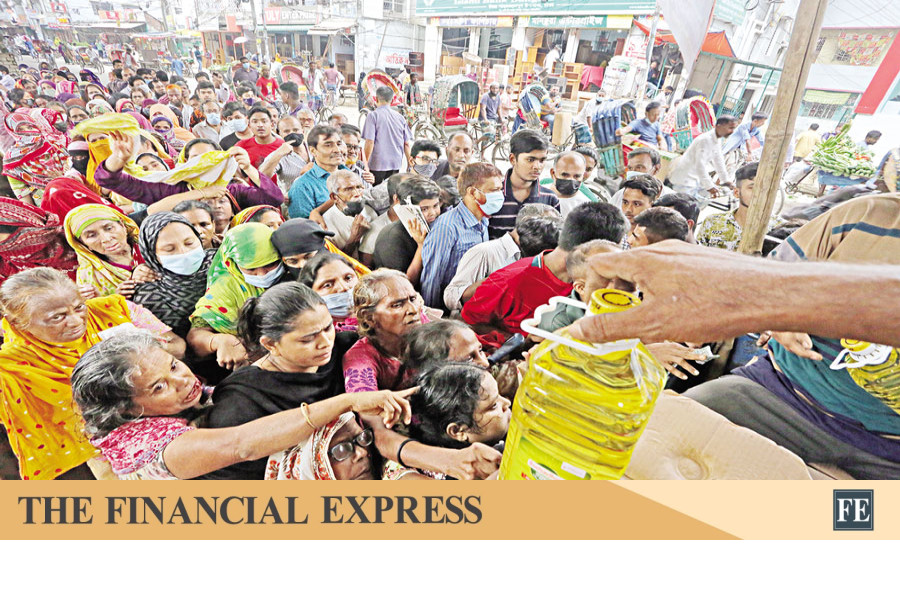
Rush for essentials at subsidised prices reflect how inflation erodes real purchasing power of low income people in Bangladesh —FE File Photo

Public debate often reveals insights that formal policy discussions overlook. Occasionally a thoughtful reader’s question captures the essence of a national economic problem more sharply than lengthy technical policy reports. Such was the case when I received the following email in response to my recent article, “Central Bank and Monetary Policy.” [FE, P-4 March 2, 2026] The message raises a question that goes directly to the heart of Bangladesh’s current inflation dilemma. I reproduce the email below exactly as it was written:

“This email is to express my appreciation for your article on ‘Central Bank and Monetary Policy’. I completely agree with you that an effective monetary policy will require a thorough understanding of the transmission mechanisms and the ability to fathom early signals for impending macroeconomic troubles. Certainly, having the prudence and capacity to take appropriate measures to stem the risks is way more important than high academic accomplishments.

I take this opportunity to know your views about the stubborn inflation in Bangladesh. Do you think reigning in the supply side constraints (which, in my opinion, is more of a rent-seeking behaviour and logistical hurdles, rather than a shortfall in supply) could have yielded better outcomes than following a sustained contractionary monetary policy? The concerned authorities do not seem to pay much heed to this argument. They opine that the market, especially the market for essential foods, is very competitive.

I look forward to hearing your views on this and how you think the Bank can play a more constructive role in tackling inflation.”

The email was sent by Professor Ferdousi Naher (Chairman, Economics Department, University of Dhaka), and it raises an analytical question that deserves careful reflection. Her observation touches a crucial issue in Bangladesh’s ongoing inflation debate—whether the problem is fundamentally monetary or whether it originates in deeper structural distortions within the country’s supply chains and market institutions.

Inflation, as economics textbooks explain, can arise from two broad sources: demand pressures or supply constraints. When excessive demand pushes prices upward, central banks normally respond by tightening monetary policy—raising interest rates, reducing liquidity, and restraining credit growth. This contractionary approach works because it cools aggregate demand and reduces the pressure that excessive spending places on prices.

Inflation becomes far more complicated when it originates not from excessive demand but from distortions within the supply chain itself. In such situations prices rise even when overall demand in the economy is not expanding dramatically, because the mechanisms through which goods move from producers to consumers become inefficient or strategically distorted. Bangladesh’s current inflation exhibits many characteristics of this second type. Prices of essential commodities—rice, edible oil, onions, and other staples—often rise not because the country faces a genuine shortage of goods but because the channels through which these goods travel from farms, import points, or factories to retail markets are frequently inefficient or manipulated.

In theory, markets for essential food commodities should be highly competitive. A competitive market contains many buyers and sellers, allows free entry and exit, provides transparent pricing, and adjusts rapidly to changing supply and demand conditions. Under such circumstances, abnormal profits quickly disappear because new suppliers enter the market and arbitrage eliminates price disparities. Yet the actual structure of many commodity markets in Bangladesh often diverges significantly from this textbook description. Import channels, wholesale distribution networks, and storage facilities are frequently dominated by a limited number of traders. This concentration creates conditions conducive to oligopolistic behaviour, allowing market participants to coordinate supply decisions or exert influence over price formation. In everyday language, such arrangements are commonly described as syndicates.

Under these circumstances prices can rise even when aggregate supply is not genuinely scarce. Professor Naher’s observation that the problem may reflect “rent-seeking behaviour and logistical hurdles rather than a shortfall in supply” therefore deserves serious consideration. Her comment highlights an institutional dimension of inflation that often receives insufficient attention in conventional macroeconomic discussions.

Rent-seeking occurs when economic actors generate income not through productive activity but by controlling access to markets. When intermediaries restrict distribution channels, manipulate inventory flows, or exploit regulatory loopholes, they can create artificial scarcity. Prices increase not because goods are unavailable but because access to those goods is strategically constrained.

If inflation is driven by such structural distortions, the effectiveness of contractionary monetary policy becomes inherently limited. Higher interest rates may suppress investment and slow credit growth, but they do little to dismantle bottlenecks supply or disrupt collusive behaviour among dominant market participants. Excessive reliance on monetary tightening may even produce unintended consequences. When borrowing costs rise, transportation, storage, and distribution expenses increase as well. These higher operating costs may be passed on to consumers, ironically reinforcing the very inflation policymakers are attempting to suppress.

This issue also intersects with a broader analytical debate in macroeconomics concerning the limits of conventional frameworks such as the Phillips Curve. The Phillips Curve assumes that inflation is largely driven by demand conditions and therefore linked to employment and output fluctuations. Yet in economies where inflation emerges from supply-chain distortions, rent-seeking behavior, or distributional inefficiencies, this relationship weakens considerably. Inflation can persist even when economic growth slows because the forces pushing prices upward lie outside the traditional demand-driven mechanism.

Bangladesh’s recent experience may well illustrate such a structural phenomenon. Persistent food inflation despite slower economic momentum suggests that price dynamics are being shaped by institutional and market-structure factors rather than purely by macroeconomic demand conditions.

The central challenge therefore lies in correctly diagnosing the origins of price increases. If inflation stems primarily from demand expansion, contractionary monetary policy remains the appropriate response. But if inflation arises from supply-chain distortions, administrative bottlenecks, or rent extraction within distribution networks, policy responses must extend beyond the central bank’s conventional tools.

Addressing such inflation requires improvements in market monitoring, stronger competition policy, better logistics infrastructure, and more effective regulatory oversight. The objective is not simply to reduce liquidity in the financial system but to ensure that goods move smoothly and efficiently from producers to consumers. This does not imply that the central bank lacks a constructive role. Even when inflation has structural roots, monetary authorities can contribute by improving economic surveillance, strengthening price data analysis, and identifying early signals of supply disruptions. Close coordination with fiscal authorities and regulatory agencies can help ensure that policy responses target the underlying causes of inflation rather than merely its symptoms.

Professor Naher’s email highlights an important feature of healthy economic discourse. Sound policy debates do not emerge exclusively from official institutions or academic circles. They also evolve through thoughtful engagement between analysts, policymakers, and informed citizens who examine economic developments critically. Her question reminds us that inflation is rarely a simple monetary phenomenon. Prices rise within an institutional environment shaped by incentives, market structures, and regulatory frameworks. When those structures are distorted, monetary policy alone cannot restore stability.

Understanding inflation therefore requires looking beneath the surface of price statistics and identifying the deeper forces shaping market behaviour. Without such diagnosis, even well-intentioned policy measures may fail to address the real problem. The debate on inflation in Bangladesh must therefore continue—not only about how tight monetary policy should be, but also about whether the true sources of inflation are being correctly identified.

In that sense, thoughtful questions from engaged readers are not merely comments on published articles. They often illuminate the path toward better economic understanding and better policy.

Dr Abdullah A. Dewan, Professor Emeritus of Economics, Eastern Michigan University (USA); Former physicist and nuclear engineer, Bangladesh Atomic Energy Commission.​
 

NBR considering raising tax for high earners
Staff Correspondent 01 April, 2026, 02:32

1775007528216.webp


National Board of Revenue chairman Abdur Rahman Khan holds a pre-budget discussion with the Economic Reporters Forum members at NBR headquarters in Dhaka on Tuesday. | Press release

The National Board of Revenue is considering increasing the top income tax rate to 35 per cent for individuals earning over Tk 1 crore annually, as part of efforts to reduce income inequality from the 2027-28 financial year.

Under the existing structure, the tax-free income threshold has been set at Tk 375,000. Income beyond is taxed progressively, with the highest current rate at 30 per cent on income of Tk 20,00,000 and above.

NBR chairman Abdur Rahman Khan revealed this on Tuesday at a pre-budget discussion regarding the upcoming budget of the financial year 2026-27 with the Economic Reporters Forum, the apex platform of the country’s economic, financial, and business journalists.

However, he clarified that in the current fiscal budget, income tax rates for the following fiscal year have also been pre-announced.

‘So, there is no scope to revise tax rates for the 2025–26 or 2026–27 fiscal years, as these have already been fixed in advance to ensure predictability for taxpayers,’ he added.

Any potential changes might come in the 2027–28 fiscal year, where the government might consider an adjustment to signal that those with higher incomes should contribute more,’ he added.

Abdur Rahman Khan also said that the authority was considering introducing a ‘wealth tax’ and an ‘inheritance tax’ as alternatives to the existing surcharge system.

‘If we can bring back a wealth tax act, we would be able to collect taxes from very wealthy people outside the existing income tax framework,’ he added.

On inheritance tax, he said that many individuals inherit substantial assets from their predecessors and that such taxation is in place in many countries.

‘We are considering imposing inheritance tax, particularly on high-value properties before ownership is transferred to the next generation through mutation,’ he added.

He said that boosting income tax collection remains the most effective tool to address disparity.

‘Many countries impose significantly higher marginal tax rates, ranging from 45 to 55 per cent, on high-income individuals, while Bangladesh had rates as high as 60 per cent during the 1980s,’ he added.Bangladesh travel guide

He also said that the country has gradually reduced rates.

ERF president Doulot Akter Mala proposed increasing the tax-free income limit for an individual to Tk 5 lakh, in line with inflation, in the upcoming FY27 budget.​
 

Latest Posts

Back