[🇧🇩] Energy Security of Bangladesh

[🇧🇩] Energy Security of Bangladesh
749
28K
More threads by Saif

G Bangladesh Defense

What is the path to overcoming crisis and achieving energy security?

Fahmida Khatun
1787786509600.webp


Due to the war in the Middle East, major disruptions in the global energy supply have occurred. Energy is now not only crucial for the economy but also a significant geopolitical issue. As a result, various countries around the world are at risk of energy crises. However, the current energy crisis did not appear suddenly. In 2021, as the global economy started to recover post-COVID-19 pandemic, the demand for energy rapidly increased, but the supply did not rise correspondingly. The situation became even more difficult when the Ukraine war began in 2022. After the war in the Middle East started on 28 February this year, the situation worsened further.

The global situation has impacted Bangladesh's current energy crisis. However, blaming external factors alone does not provide the complete picture; instead, the global crisis has exposed the longstanding weaknesses in our energy sector more clearly.

Sufficient investment has not been made in gas exploration in the country. Production from existing gas fields is declining, and dependency on imported energy has increased. There has not been enough diversification in energy sources. There are weaknesses in the transmission and distribution of gas and electricity as well. The use of renewable energy has not increased significantly. Although electricity generation capacity has increased, adequate fuel arrangements have not been made to run power plants. As a result, Bangladesh faces not only a fuel shortage but also energy security issues.

At one time, Bangladesh's economy benefited from cheap domestic natural gas. Large portions of electricity, fertilizer, industries, and household needs were met by domestic gas. However, gas production has been declining for several years. Now LNG (Liquefied Natural Gas) has to be imported to fill this gap. Imported LNG is expensive, and its supply is uncertain. If international market prices rise or there are supply chain issues, Bangladesh is directly affected.

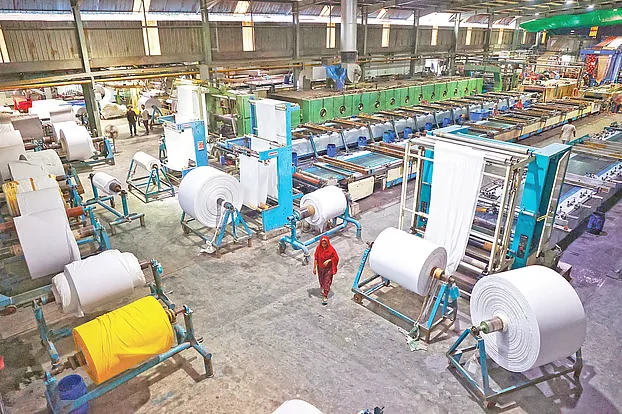
The economic costs are also significant. Industries cannot produce efficiently when gas pressure is low or supply is uncertain. Production is disrupted in various industries like textiles, spinning, ceramics, steel, and fertilizers. Many factories have to reduce production or use alternative, more expensive fuels.

Energy uncertainty also affects investments. A businessman will hesitate to make new investments if he is not sure whether the necessary gas or electricity will be available next month. In this way, the energy crisis can eventually turn into an investment crisis. If investment does not increase, the creation of new employment, export diversification, and economic growth will all be hindered.

The issue will become even more important for Bangladesh after graduating from the LDC (Least Developed Countries) status. Then, to compete in the international market, productivity, technology, and energy efficiency must be increased. It will not be possible to rely solely on the advantage of low wages for competition. Therefore, the high cost of energy could become a significant obstacle to Bangladesh's competitive ability.

The impact of rising energy prices ultimately affects the general public. If the prices of diesel, gas, and electricity increase, the cost of transportation, irrigation, industrial production, and food transportation rises. Ultimately, consumers have to bear these additional costs through increased product prices. Due to high inflation for several years, people's purchasing power is already under pressure; therefore, when setting energy prices, the economic realities and the needs of low-income people must be considered.

What needs to be done now? In the short term, the first task is to stabilise the energy supply as much as possible. More planned approaches should be taken in LNG import. A balance must be maintained between long-term contracts and purchasing from the spot market. Relying solely on the spot market could cause major issues for Bangladesh if international market prices suddenly rise. On the other hand, hasty long-term contracts without proper negotiation could lead to additional costs.

During energy shortages, it is also necessary to clarify which sectors will receive gas first. Regular supply must be ensured for export-oriented industries that create the most employment, power plants, fertilizer production, and other essential sectors. Simultaneously, measures should be taken for energy savings in government offices, commercial buildings, shopping centres, and large institutions.

Energy price reform is also needed. However, it’s not right to increase prices equally for everyone. Targeted assistance should be provided to low-income people. Those who can afford it should pay prices closer to the market rate. Because the government cannot provide substantial subsidies for everyone for an extended period.

One of the most important tasks is to increase domestic gas exploration. Gas exploration needs to be expedited both on land and at sea. The financial and technical capacity of BAPEX (Bangladesh Petroleum Exploration & Production Company Limited) must be increased. If necessary, experienced international companies can also be involved through a transparent and competitive process. If new gas is found, dependence on LNG imports will decrease, and the impact of international market price increases will be mitigated to some extent.

Improvement in gas and electricity transmission and distribution systems is also urgent. Simply purchasing more energy won't solve the problem; if that energy cannot be delivered to users effectively, the advantages of increased supply won't materialise. Simultaneously, energy efficiency must be increased. Advanced boilers, motors, and captive power plants can be used in industries. In buildings and households, the use of electricity-saving appliances needs to be increased. In many cases, reducing energy waste can be cheaper and more effective than increasing new energy supply.

More emphasis should also be placed on renewable energy. Bangladesh has land limitations, but there are opportunities to increase solar power on rooftops, government buildings, irrigation systems, and other suitable locations. This will reduce the pressure on imported fuel and save foreign exchange.

Bangladesh should not remain confined to merely calculating how much megawatt power generation capacity exists. Energy security is not ensured just by having power plants. There must be fuel to run those plants, adequate arrangements for electricity transmission, and reasonable prices for people and industries. Therefore, our aim should be to establish an energy system where energy is readily available, prices are reasonable, supply is reliable, and energy sources are diverse.

Opportunities for regional electricity trade should also be utilised. Especially, the prospects of using hydropower from Nepal and Bhutan should be viewed with greater importance. Alongside, coordination among various institutions in the energy sector must be increased, transparency and accountability in procurement must be ensured, and policy consistency must be maintained. This will increase the confidence of domestic and foreign investors.


Global conflicts may exacerbate Bangladesh's energy issues. However, the extent to which external crises will turn into major crises in our country largely depends on our decisions. Therefore, the goal should be to ensure that energy does not become a long-term obstacle to Bangladesh's investment, industrialisation, and economic development.

#Fahmida Khatun is economist and executive director, Center for Policy Dialogue (CPD)​
 

SOME CURE FOR FUEL CRUNCH SOON
Gas supply getting a boost with LNG resurgence
Both FSRUs in full steam, minimum 8 LNG cargoes coming in Sept
1788044168563.webp


Overall gas supply across Bangladesh is expected to increase substantially in September amid re-gasification of increased volumes of imported liquefied natural gas (LNG) with both the floating terminals in full-steam operation.

"At least eight LNG cargoes will be imported in September, mostly from spot LNG suppliers and short-term contracted companies," a senior official of state-run Petrobangla told The Financial Express on Saturday.

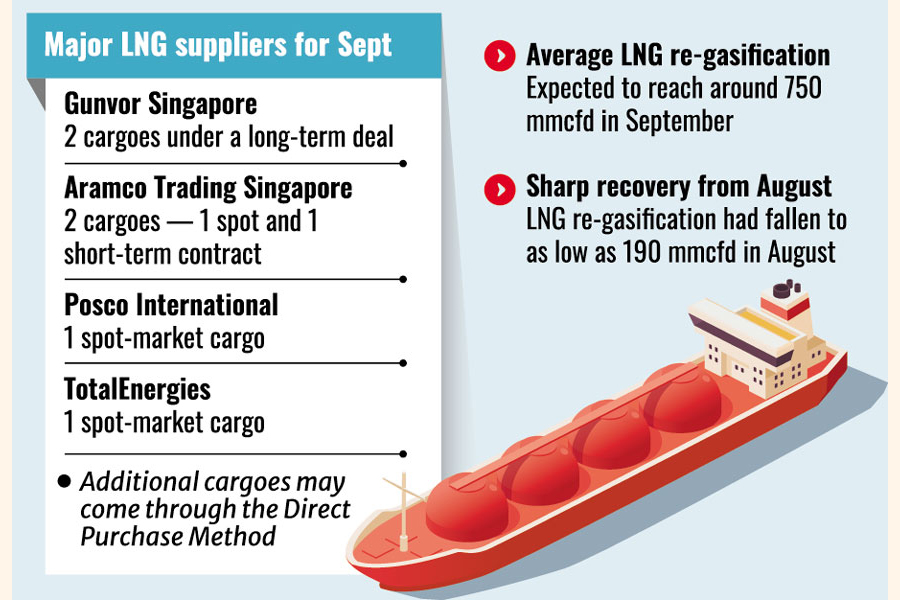
Average LNG re-gasification in the country's two operational floating storage and regasification units (FSRUs) is expected to be around 750 million cubic feet per day (mmcfd) with the daily re-gasification ranging from 700mmcfd to 800 mmcfd, he said about the good news amid prolonged fuel outcry.

Of the eight LNG cargoes confirmed for delivery in September, Gunvor Singapore Pte Ltd will deliver two cargoes under its long-term deal with Petrobangla, Aramco Trading Singapore Pte Ltd will supply another two -- one from spot market and another under a short-term supply deal.

Posco International Corporation and TotalEnergies Gas & Power Ltd will deliver two LNG cargoes from spot market.

If the contracted firms under direct-purchase method (DPM) supplies LNG in line with their commitments, overall LNG re-gasification will increase further, he said.

The official said overall LNG re-gasification would be much higher in September compared to August when the LNG re-gasification fell as low as to around 190mmcfd.

An abrupt accident in US Excelerate Energy's FSRU on the Bay of Bengal left the floating LNG terminal idle at least for 15 days from late July to mid-August, dragging down the country's overall gas supply.

Delivery of at least two spot LNG cargoes was affected due to abrupt shutdown of the FSRU at deep sea in Moheshkhali.

The cargoes of Gunvor Singapore Pte Ltd and TotalEnergies Gas & Power Ltd could not be delivered to the accident-ridden FSRU and had to remain stranded in the Bay of Bengal for a couple of weeks.

Rough seas, dearth in LNG supply along with the influx of a faulty LNG cargo also contributed to the squeezing of the country's overall LNG re-gasification during August.

Although the accident-ridden FSRU, owned by Excelerate, resumed partial operation on August 6, the rough weather over the Bay of Bengal had forced the LNG cargoes away from floating LNG terminals on safety grounds after the first week of August.

Excelerate Energy's FSRU -- Excellence -- also had run out of LNG following the refusal to receive LNG via ship- to-ship transfer from a moss-type LNG cargo -- Al Haamra -- supplied by Aramco Trading Singapore Ltd on safety issue during middle of August.

1788044198300.webp


The significant decline in LNG re-gasification had pushed the government to divert some gas to power plants from industries as part of rationing.

The disruptions had cut gas supply to the national grid significantly, reducing gas pressure in many areas, disrupting industrial production, squeezing generation in gas-fired power plants.

Long queues of vehicles in front of CNG (compressed natural gas) filling stations across the country had been a regular scene.

The disruptions had intensified gas shortages in Dhaka and other parts of Bangladesh, where many households have been left with little or no gas for cooking for much of the day.

In some areas, supplies have stopped altogether, while factories in key industrial zones have reportedly been forced to scale down production because of low gas pressure.

Sources said the government was grappling to arrange LNG cargoes due to restricted contractual supplies because of the Middle East war and Strait-of- Hormuz supply disruptions before the abrupt operational closure of one of its two FSRUs on July 21.

Non-delivery of several scheduled LNG cargoes awarded under the DPM method also contributed to the abrupt shortage of LNG for regasification, prompting the government to buy spot LNG cargoes within a very short span of time in late August to meet exigencies.

"We are now well-prepared to keep the country's overall LNG re-gasification to around 750 mmcfd on average in September after having experiences of unforeseen accident, 'incapable' DPM contractors and 'faulty' LNG cargo," said a senior official of state-run Rupantarita Prakritik Gas Company Ltd (RPGCL).

High cost of LNG on the spot market, however, has emerged as a major challenge, he said.

"Comparatively cool temperature in September might ease the country's overall energy demand in the coming month," he hopes.

RPGCL is a part of state-owned Bangladesh Oil, Gas and Mineral Corporation, also known as Petrobangla, and is responsible for LNG trading in the country.

Bangladesh's overall natural gas supply as of August 28 was around 2,360mmcfd against a known demand for around 4,000mmcfd, according to official Petrobangla data.​
 

RENEWABLES ONLY CURE FOR CURRENT POWER CRISIS
Govt orders diverting funds from dev budget for clean power generation
Finance div receives directive, as govt draws up massive prog for solar power, green energy
1788045320553.webp


The government has asked the finance division to divert necessary funds from the development budget to support the initiative for higher generation of clean energy, officials say.

The firman comes as the finance division submitted a possible way-out plan on the energy crisis to the Prime Minister earlier this week. The plan comprises short,- mid,-and long-term solution to the nagging crisis.

Sources have said Prime Minister Tarique Rahman may submit the plan before parliament during the ongoing session.

According to finance division officials, the government in the current budget allocated some Tk 20 billion to provide funds to some state-run umbrella bodies associated with microcredit and poverty alleviation. Preparing rules is underway to channel the funds to them.

However, sources said, amid the ongoing power crisis, government high-ups now asked the finance division to divert Tk 10 billion from that allocation and use the money for installation of rooftop-solar power systems in particular.

Contacted, finance division secretary Dr Md Khairuzzaman Mozumder told The Financial Express that using the funds for solar-power generation will be finalised in a meeting to be held next week.

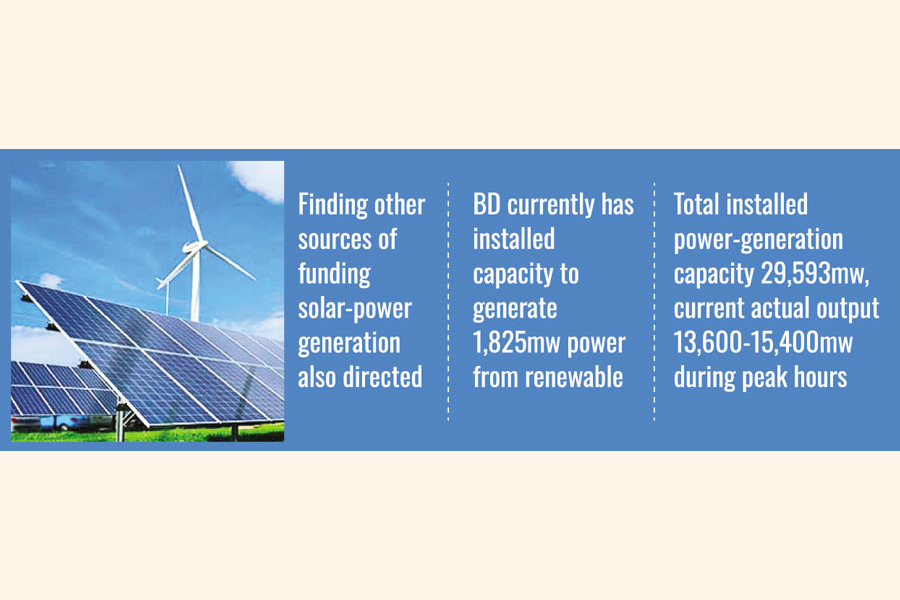
"We have been asked to find out other sources as well to finance solar power generation," he said.

According to officials concerned, the finance division in its paper submitted to the Prime Minister has suggested that as part of short-term solution, if necessary funds and policy supports can be provided now to both government-and private-sector entities, solar-power generation will increase manifold before the next summer.

This may significantly help avert electricity shortage next year, the paper mentions.

"We could not find out any other short-term solution to the power crisis," said a senior finance official.

After being instructed by the Prime Minister, sources have said, the power division officials this week had a meeting with private-sector renewable energy-based electricity producers seeking their help enhance generation.

At the meeting, the power officials sought their cooperation in generating at least 5,000 megawatts of electricity from renewables, particularly from solar energy.

The meeting participants have sought financial support and incentives for setting up of increased number of rooftop solar systems and removal of some barriers, including the high duty on equipment at import stage, sources said.

The power division officials agreed on quick solution to these problems and arrange fund as soon as possible.

President of Bangladesh Sustainable and Renewable Energy Association (BSREA) Mostafa Al Mahmud told the FE that the government is probably creating a Tk 20-billion fund to finance the effort to enhance green-power generation.

He said at the meeting the participants presented specific proposals to the government if it really wanted to get rid of the persisting power crisis that has hit homes and businesses most.

"The main barrier to increasing renewable-power generation is 40-to 50-percent duty at import stage that applies almost across the board. That is a major hurdle," he said, adding that even though the government claims the duties are withdrawn, various technicalities and SROs (Statutory Regulatory Orders) stand the way.

"We urged them to remove duties for all so that whoever wants to install solar systems-whether at home or in factories-can get them at low costs," says Mr Mahmud.

He feels that since the government is facing a major crisis, an incentive programme needs to be introduced to motivate people to adopt green power quickly. "Without an incentive programme, why would people switch? People can't afford the current costs."

Regarding financing, they "clearly stated that no matter what is discussed, without financial backup, this won't move forward".

Presently, the country has the installed capacity to generate 1,825 megawatts of electricity from renewable sources.

Its total installed power-generation capacity is 29,593 megawatts while current actual output hovers around 13,600 MW to 15,400 MW during peak hours-far below the demand.​
 

Govt to buy 4 more spot LNG cargoes by mid-Oct


1788218017624.webp


Bangladesh has re-issued one tender and floated three fresh tenders to purchase four spot LNG cargoes for delivery over September and October as both of the country’s floating, storage and re-gasification units (FSRUs) are operational.

The country has reissued a tender for a September 8-9 delivery window cargo and fresh tenders for September 25-26, October 1-2 and October 5-6 delivery windows, a senior Petrobangla official told The Financial Express on Monday.

The cargoes are to be delivered to Moheshkhali Island, with an option to discharge at either of the country’s two FSRUs located on the island.

The volume of each spot LNG cargo is about 3.36 million British thermal units (MMBtu).

Bangladesh has reissued a tender to buy one spot LNG cargo for a September 8-9 delivery window as its previous bid was cancelled after getting higher-than-expected price quotes from the selected limited suppliers.

Bangladesh awarded its latest one spot LNG cargo for delivery over September 13-14 and September 23-24 windows to Posco International Co. at US$24.625 per MMBtu and TotalEnergies Gas Power Ltd. at US$ 24.25 per MMBtu.

The country has so far purchased 47 LNG cargoes from the spot market this year, of which 45 were procured after the commencement of the Middle East war.

Bangladesh imported a total of 49 LNG cargoes from the spot market in 2025, he noted.

The South Asian country could purchase only a couple of LNG cargoes from the spot market for August delivery windows amid abrupt operations closure at one of its two FSRUs and suppliers’ quotation of higher-than-expected prices in tenders.

Bangladesh is currently struggling to meet its gas demand amid elevated LNG prices, and as contracted long-term LNG suppliers continue to restrict scheduled cargo deliveries, the RPGCL official said.

The country’s overall natural gas supply was about 2,307 million cubic feet per day (mmcfd) on August 30, with 682 mmcfd regasified LNG, according to official Petrobangla data.

Bangladesh’s natural gas demand is about 4,000 mmcfd.

State-run Petrobangla has been rationing gas supplies to industries, power plants and other consumers to cope with the short supply of natural gas.​
 

Making the most out of clean power option


1788218257984.webp


The government's reported move to divert a portion of the development budget to finance clean-power generation is a welcome departure from treating renewable energy as a secondary concern. According to reports, the finance division has been asked to redirect Tk10 billion from allocations for some state-run bodies to support rooftop solar systems. The Power Division has also sought cooperation from private renewable-energy producers to add at least 5,000 megawatts (MW), particularly from solar sources. Given the severe power shortage now disrupting homes, industries and businesses, relocating development funds for an urgent programme of clean-power generation is undoubtedly a prudent move.

In fact, the present energy crisis has once again exposed the inherent weakness of a power generation regime that is built overwhelmingly on fossil fuels, a lion's share of which has to be imported. Bangladesh's domestic natural gas production has been falling for years. So, Liquefied Natural Gas (LNG), coal, furnace oil and diesel have increasingly become necessary to keep power plants running. But imported fuel is subject to uncertainties in the international market/geopolitics over which Bangladesh has little or no control. A war in the Middle East, disruption at an LNG terminal or an unusual rise in international fuel prices can suddenly turn into prolonged load-shedding at home. The ongoing crisis has shown precisely how vulnerable this arrangement is.

Consider the gas situation alone. Following repeated disruption at the Moheshkhali LNG terminal, national gas supply recently fell far short of demand and the power sector became an immediate casualty. At one stage, dozens of generating units faced fuel shortage while electricity shortfall widened. So, installed capacity on paper is of little comfort if the fuel required to operate the plants cannot be secured. One wonders, then, what is the use of adding more fossil-fuel-based generation capacity if the country cannot guarantee the fuel required to run those plants?

One might recall that successive governments were never short of promises about increasing the share of renewable energy. The Renewable Energy Policy of 2008 set the target of meeting 5.0 per cent of the country's power demand from renewables by 2015 and 10 per cent by 2020. Neither target was achieved. Years later, renewable energy still remains a marginal contributor while public investment continued to flow overwhelmingly towards fossil-fuel projects. So, the failure was not exactly due to lack of policy declarations. It was rather the absence of matching investment and implementation. Governments came and went, targets were announced and revised, but the basic energy structure remained about the same.

Now the BNP government has come up with its own promises. The Renewable Energy Policy 2025 envisages 20 per cent of electricity from renewable sources by 2030 and 30 per cent by 2040. The government has also spoken of creating 10,000MW solar-generation capacity by 2030. No doubt, these are ambitious targets. But considering that present renewable capacity is still a small fraction of the country's total installed generation capacity, the distance to be covered is enormous. Will the latest targets, then, meet the same fate as those announced in the past? That will depend on whether the incumbent government is ready to treat renewable energy as an essential component of national energy security rather than as just another climate-related promise.

In this connection, the decision to abandon the proposed second 1,320MW coal-fired unit at Rampal and use the already-developed land for a 442MW grid-connected solar power plant is well taken. The existing Rampal plant beside the Sundarbans has remained controversial due to environmental concerns. The land earmarked for its second thermal unit can now be put to better use. More importantly, the decision signals that the government is willing to review the old fossil-fuel-based development plan.

But a few large solar projects here and some rooftop panels there will not by themselves resolve the structural energy crisis. Solar power has its limitations. It is intermittent and cannot produce at night without storage facilities. Land is also scarce in this densely populated country. So, the answer should lie in combining utility-scale solar with rooftop solar on factories, warehouses, government offices, schools and other buildings, floating solar on suitable water bodies, wind generation in the coastal belt and improved storage and grid management. At the same time, duties and regulatory barriers that make solar panels, inverters, batteries and other equipment unnecessarily expensive have to be removed. Notably, renewable-energy entrepreneurs themselves have identified the high import-stage duties on equipment as a major hurdle to faster expansion.

There is also the issue of financing. Investors will not put money into renewable-energy projects merely because the government says clean energy is a priority. They require predictable tariffs, affordable credit, stable policies, quick approval procedures and, above all, an electricity grid capable of absorbing intermittent renewable power. If the present move to divert development funds is to have any lasting meaning, it should lead to a permanent financing mechanism rather than remain an emergency measure taken only during a power crisis.

To be fair, the incumbent government has inherited an energy system whose weaknesses developed over decades. There is therefore no magic solution to the present crisis. For now, the government has little option but to manage imports, ration gas prudently and keep critical plants running. But if it assumes that the crisis will disappear once fuel supplies improve or geopolitical tensions ease, it would be repeating the same mistake committed by its predecessors. For Bangladesh's dependence on imported energy and the depletion of its domestic gas reserves will remain.

The government should therefore make good on its promise of substantially increasing the share of renewables before another, perhaps far worse, external energy shock strikes the country. To continue responding to every crisis by buying increasingly expensive LNG, coal or oil from abroad would be to treat the symptoms while leaving the disease untouched. Worse yet, each fresh shock would expose industries, businesses and ordinary consumers to another round of uncertainty.

The time has come to adopt a long-term strategy under which renewable energy would gradually become the mainstay of the country's energy source rather than an appendage to fossil fuel. The present crisis should be seen as an opportunity to begin that transition in earnest. Otherwise, once the immediate shortages disappear, renewables may again be pushed to the background until the next crisis arrives. By then the price of such procrastination may be still higher.​
 

For a sustainable future, we must take energy efficiency seriously

Mohammad Alauddin

1788220283084.webp

VISUAL: STAR

If we were to stick to simple terms, energy transition denotes systematically moving away from a fossil-based energy structure to a low-carbon energy system, and this has posed a challenge to many countries around the world. This is especially because energy demand has been steadily on the rise globally due to rapid industrialisation, urbanisation, and rising living standards, driving countries to go on a quest for additional sources of energy. Bangladesh, too, has been on a similar journey, although so far, it has mainly focused on increasing generation while a lot of readily available sources of energy remain largely untapped. This is where energy efficiency, the use of less energy to do the same task or provide the same service by increasing energy productivity, comes in.

Approaches to improving such efficiency include supply-side energy efficiency (SSEE) and demand-side energy efficiency (DSEE). SSEE can improve efficiency by reducing losses along the energy supply chain, and DSEE enables consumers to use less energy to provide the same level of service. Realising the growing importance of energy efficiency, the Sustainable and Renewable Energy Development Authority (SREDA) launched the Energy Efficiency and Conservation Master Plan (EECMP) up to 2030 in May, 2016 with an implementation roadmap. The plan aimed to reduce primary energy consumption per unit of GDP (energy intensity) by 15 percent in 2021 and by 20 percent in 2030 relative to 2013 levels.

The EECMP introduced a pioneering framework for energy efficiency in Bangladesh, but it gave less attention to the transport sector, efficiency on the utility side, and energy pricing reforms. This weakened the plan’s potential to reduce energy consumption across the economy, especially as transport has become one of the fastest-growing energy-consuming sectors in Bangladesh. The EECMP implementation roadmap proposed several specific programmes. However, many of these programmes, particularly mandatory energy management, appliance labelling, and energy audits, have not progressed as rapidly as envisioned due to limited institutional capacity within implementing agencies and lack of effective inter-agency coordination.

According to the International Energy Agency (IEA), governments—particularly in emerging and developing economies—spent approximately $620 billion on fossil-fuel consumption subsidies in 2023. The International Monetary Fund estimated Bangladesh’s energy-related budget subsidies at 0.9 percent of GDP in FY2022-23. Since then, the fiscal burden has remained substantial. In the revised FY2024-25 budget, subsidies for power and fertiliser alone rose to Tk 90,000 crore, partly because the government had to clear large arrears accumulated in the power sector. In FY2025-26, the government faced further pressure from soaring international fuel and LNG prices, with the finance minister estimating that the oil, gas, electricity and fertiliser sectors could require an additional Tk 42,600 crore in subsidies.

While the government argues that lower energy prices are beneficial for economic growth and can make products and services more affordable, prolonged energy subsidies can have unintended consequences. For instance, subsidies can be deemed as an irrational use of taxpayer money. Energy costs directly drive efficiency by making waste more expensive. When electricity or fuel prices spike, the financial incentive for both households and businesses to switch to high-efficiency technologies. By keeping energy prices artificially low, subsidies weaken the price signals that would otherwise encourage households and businesses to conserve energy and invest in more efficient technologies.

However, it’s also true that energy efficiency needs an ecosystem of standards, incentives, labelling, enforcement, and public awareness to support it. The government should strengthen and enforce minimum energy performance standards for appliances such as motors, boilers, air conditioners, refrigerators, fans, and lighting products. Additionally, fiscal incentives, such as reduced import duties, tax rebates, concessional financing or utility-sponsored rebate programmes, can make efficient appliances more affordable. Equally important is sustained public awareness to highlight the benefits of saving energy. After all, every unit of energy saved is, in effect, as good as making a new unit of energy.

Perhaps the greatest misconception surrounding energy transition is the assumption that renewable energy alone can solve Bangladesh’s energy challenges. However, renewable generation must be complemented by demand-side management. Without energy efficiency, rising demand may continue to outpace the growth of clean energy, requiring additional investments in generation capacity and grid infrastructure. As Bangladesh charts its path toward a resilient and sustainable energy future, concerned authorities must recognise that energy efficiency is not the missing piece of the puzzle, but the foundation upon which a successful energy transition must be built.

Mohammad Alauddin is former rector at Bangladesh Power Management Institute.​
 

Latest Posts

Back