โ˜• Support Us โ˜•
[๐Ÿ‡ง๐Ÿ‡ฉ] - Everything about Hasina's misrule/Laundered Money etc. | Page 12 | PKDefense

[๐Ÿ‡ง๐Ÿ‡ฉ] Everything about Hasina's misrule/Laundered Money etc.

Reply (Scroll)
Press space to scroll through posts
G Bangladesh Defense
[๐Ÿ‡ง๐Ÿ‡ฉ] Everything about Hasina's misrule/Laundered Money etc.
259
7K
More threads by Saif


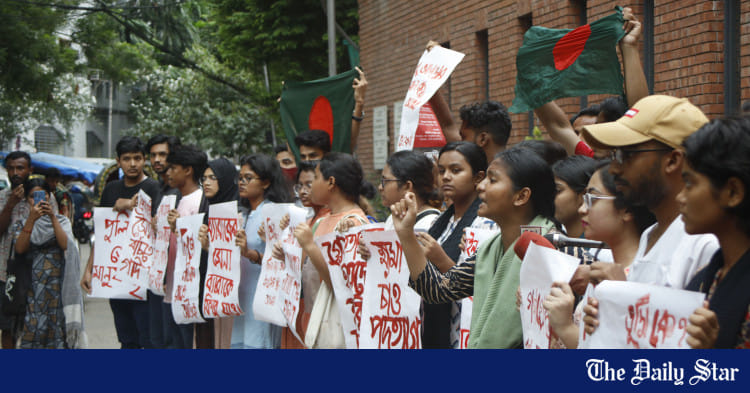
Recover stolen funds as a top priority
$234 billion siphoned out of Bangladesh between 2009 and 2023 when Awami League was in power

1733208457924.png

Visual: Star

According to a government-commissioned white paper on the economy, presented to Chief Adviser Prof Muhammad Yunus on Sunday, an estimated $234 billion was siphoned out of Bangladesh between 2009 and 2023 while Awami League was in power. The report reveals that these laundered funds were primarily routed through or to countries such as the UAE, UK, Canada, US, Hong Kong, Malaysia, Singapore, and India, as well as various tax havens. These findings highlight the unprecedented economic damage inflicted on Bangladesh's economy under the Sheikh Hasina-led government.

The white paper emphasises that illicit financial outflows created a complex shadow economy that "thrived on criminal activities of diverse nature, and drew sustenance from an unholy alliance involving corrupt politicians, businessmen, financial players, middlemen, government officials, influence peddlers, and wheeler-dealers." Through rampant corruption and looting, the ousted AL government severely undermined the nation's institutions, rendering many completely dysfunctional. Regulatory bodies often remained silent or were complicit in the face of such corruption.

The report also outlines how individuals in this network plundered vast sums from the public treasury through fraudulent schemes before laundering them abroad, causing immense economic degradation. This massive outflow of wealth has drained the country's capital, hindering efforts to revive the economy and restore vital institutions such as the banking sector. Much of the laundered money was used to purchase real estate abroad or funnelled under the guise of business operations. The paper identifies 532 individuals of Bangladeshi origin owning real estate worth $375 million in Dubai, with 972 residential properties in the UAE valued at approximately $315 million. In Canada, between $47 billion and $100 billion was reportedly laundered, with similarly large sums transferred to other countries.

Recently, a joint investigation by the British newspaper The Observer and the Berlin-based anti-corruption organisation Transparency International revealed that close associates of Hasina, including former ministers and business owners, hold properties worth over ยฃ400 million (approximately Tk 6,000 crore) in the UK. Allegations suggest that these assets were purchased with laundered funds siphoned out of Bangladesh.

Further investigations will likely uncover additional instances of corruption and wealth laundering under the AL. It is, therefore, imperative for the interim government to thoroughly investigate these cases and begin recovering the stolen wealth as a top priority, given that financial crimes of this nature become harder to trace and recover over time.

The white paper committee has recommended establishing an independent prosecution body to pursue follow-up actions and recover these funds. The government must act promptly to implement this recommendation as well as other proposals outlined in the report. Our diplomatic channels and international connections should also be leveraged to freeze illicit funds and facilitate their return to Bangladesh. Holding accountable those responsible for plundering the nation's wealth is essential to prevent such crimes in the future.​
 

AL turned Bangladesh into kleptocratic state: Debapriya
Staff Correspondent 03 December, 2024, 00:22

1733209076361.png

Debapriya Bhattacharya | File photo

Economist Debapriya Bhattacharya on Monday said that a kleptocracy was established from crony capitalism in the past 15 years under the Awami League regime ousted by a student-people uprising on August 5.

Politicians, businesspeople and civil and military bureaucrats established the kleptocracy, he said, highlighting the findings of the โ€˜White Paper on State of the Bangladesh Economy โ€” Dissection of Development Narrativeโ€™ at a briefing at the planning commission in the capital.

Debapriya, who headed the 12โ€“member white paper committee, blamed the successive general elections since 2014 for the origin of the kleptocracy.

To him, members of kleptocracy influenced and manipulated key facets of the economy to serve their vested interests, concealed by an illusory development narrative sustained by inflated and misleading data.

The briefing was arranged a day after submission of the โ€˜White Paper on State of the Bangladesh Economyโ€™ to chief adviser Muhammad Yunus on Sunday.

Describing efforts by the members and support teams over the past three months, Debapriya, also a distinguished fellow of Centre for Policy Dialogue, said that the report would be made public in printed form in a month.

The paper stated that the country lost $16 billion annually on an average between 2009 and 2023 because of the illicit fund flow amid systemic tax evasion, misuse of exemptions, and poorly managed public finances under the AL regime.

The white paper also highlighted that $14โ€“24 billion was lost to political extortion, bribery, and inflated budgets with the annual development programme projects worth $60 billion in the past 15 years.

Exploring the overall economy left behind by the AL regime, in 23 chapters, the 385-page white paper revealed that the banking sector was plagued by distressed assets of Tk 6.75 lakh crore as of June 2024, equivalent to the cost of constructing 14 Dhaka metro rail systems or 24 Padma Bridges.

Despite the fragile economic situation identified as the middle income country trap by committee member and economist Zahid Hussain, Debapriya said that they opposed the deferral of graduation from the least developed countriesโ€™ block from 2026.

He feared that such a decision might provide a political weapon to the ousted regime.

Indicating Sheikh Hasina who fled to India on August 5, Debapriya said that statements might be issued that the interim government ruined the LDC graduation platform laid by the AL regime.

Zahid Hussain narrated how the overstatement of the countryโ€™s gross domestic product by the AL regime had already put the country into a middle income country trap.

Besides, the loan trap due to foreign loans on high interest rates for implementing non-viable projects will cause sufferings for the next generations, said Mustafizur Rahmnan, a member of the committee.

Other committee members were also present at the briefing.

Debapriya made five recommendations, including formulation of a two-year policy by the interim government, the next six-month outlook and meetings with development and lenders.​
 

Economists estimate $30 billion looted during Hasinaโ€™s tenure: NYT
FE ONLINE DESK
Published :
Dec 04, 2024 21:55
Updated :
Dec 05, 2024 01:23

1733364556712.png


The New York Times on Wednesday published a report titled 'How a countryโ€™s economy was siphoned dry', in which Bangladesh's central bank governor, Ahsan Mansur, calculates that about $17 billion was siphoned out of the countryโ€™s financial system in the 15 years before the Sheikh Hasina-led government fell in August this year.

However, the true value looted during Ms Hasinaโ€™s rule, before she left the country, might exceed $30 billion, the report said, citing other economists.

According to the report, Mr Mansur said that the money was taken using a network of financial schemes. He explained that what the perpetrators in the government and at some of the countryโ€™s biggest companies committed was effectively the largest bank heist in the history of money and it inflicted incalculable damage to the countryโ€™s economy.

โ€œThe highest level of political authority realized that the banks are the best place to rob,โ€ said Mr. Mansur, an appointee of an interim government in Bangladesh. Afterwards, the perpetrators took control of the central bank and the ownership of several private banks and their boards of directors. The banks subsequently lent billions of US dollars to companies, some of which were fictional, and much of that money was illegally taken out of the country, the report added.

Mr Mansur, who worked at the International Monetary Fund for 27 years, said that while working for the IMF, he never witnessed โ€œany country where the highest level of the government, with the help of some goons,โ€ managed โ€œthe systematic robbing of the banks.โ€

Citing AKM Ehsan of the central bankโ€™s investigation wing, the Bangladesh Financial Intelligence Unit, the New York Times mentioned that former Awami League lawmaker Saifuzzaman Chowdhury is now being investigated by the interim government. He was quoted as telling Al Jazeera that he was the subject of a โ€œwitch huntโ€ against members of Ms. Hasinaโ€™s government.

Efforts to reach Mr Chowdhury, as well as Ms Hasina, for comment were unsuccessful, the report added.

The NYT report also described how Mohammad Abdul Mannan, managing director of Islami Bank Bangladesh, was forced to resign, with inputs from him. Citing both Mr Mannan and Mr Mansur, it said that S Alam Group took control of Islami Bank and other banks.

Some banks in Bangladesh have been on life support. Even the healthy ones are unable to extend much credit and can only sporadically honor depositorsโ€™ withdrawals, Mr Mansur reportedly said.

The report said that even the central bank governor wonders which of the banks are worth saving.

Mr Mansur, who took over the central bank in August, recalled what he witnessed when first looking into the economy.

โ€œEverything was a disaster,โ€ he said.

However, now he exudes โ€œcautious optimism," even though he believes things are coming back to a stable level.

Economic growth is unlikely this year, as the central bank governor indicates.

This โ€œis not the year for economic growth,โ€ Mr Mansur acknowledged but pointed to positive signs such as declining inflation and growing remittances. โ€œWe have to be satisfied with that,โ€ he added.​
 

Awami Leagueโ€™s legacy of corruption should serve as a cautionary tale
TIB reveals how citizens were held hostage to bribery for everyday services

1733445266756.png

VISUAL: STAR

The fact that an estimated Tk 1.46 lakh crore was paid in bribes for services during the 15 years of Awami League rule is truly mindboggling. This estimate was derived by Transparency International Bangladesh (TIB) from an analysis of six household surveys conducted between 2010 and 2023. The most recent survey, which assessed the extent of corruption between May 2023 and April 2024, revealed that 70.9 percent of respondents encountered corruption while seeking services, collectively paying a total of Tk 10,902 crore in bribes.

Among the sectors analysed, passport services were identified as the most corrupt (86 percent of respondents), followed by the Bangladesh Road Transport Authority (85.2 percent), law enforcement agencies (74.5 percent), judicial services (62.3 percent), and land services (51 percent). Overall, 50.8 percent of surveyed households reported paying bribes or being forced to pay extra for services. These findings underscore how the former regime normalised corruption, compelling citizens to engage in unethical practices to access basic services.

Shockingly, the highest average bribe amount was recorded in the judicial services sector, at Tk 30,972 per household. The fact that individuals were forced to resort to unlawful measures even for legal assistance underscores the extent to which the regime undermined law and order. This not only points to the institutional decay during its tenure but also reveals that, far from maintaining a "zero-tolerance" stance on corruption as claimed, Awami League turned the country into a mafia state. Citizens were left at the mercy of systemic corruption, while mechanisms for accountability completely collapsed. Given this, rebuilding a system of checks and balances to steer the country away from this cesspool of corruption will understandably require substantial time and effort.

The consequences of such widespread corruption were catastrophic, disproportionately affecting low-income and marginalised groups. The survey also found that corruption rates were higher when individuals sought services in person compared to when using online or mixed methods, even though the latter approaches were not without flaws.

Following the ouster of the corrupt and fascist AL regime, the nation has placed high expectations on the interim government. Chief among these is the hope for substantial measures to dismantle institutionalised corruption that spread like cancer. To this end, the current government must strictly implement TIB's recommendationsโ€”such as full digitisation of services, introduction of one-stop service systems, and strong legal action against those involved in corruption. Additionally, it must comprehensively reform institutions tasked with combating corruption, such as the Anti-Corruption Commission.​
 

Probe into high-profile corruption cases stalled
Solamain Salman 07 December, 2024, 00:17

1733553883788.png

File photo

The Anti-Corruption Commission has failed to file any case against four high-profile corruption suspects, including former inspector general of police Benazir Ahmed and former revenue board official Matiur Rahman, as it has yet to complete its probe into allegations against them.

The two other corruption suspects are former army chief general Aziz Ahmed, and former Dhaka metropolitan police commissioner Asaduzzaman Mia.

All the four former government high officials face allegations of amassing massive illegal wealth at home and abroad and laundering money.

All the four inquiries have by now gone past the 75-day time allowed by the ACC rules to complete an inquiry.

The commission, on completion of a probe into allegations against a corruption suspect, files a case against the person on finding adequate evidence.

Officials said that the ongoing inquiries had already found information on a huge amount of moveable and immovable assets owned by all the four corruption suspects.

Besides the sluggish pace of these much-talked-about probes, allegations of negligence are also there against its officials tasked with these inquiries.

Experts say that failure to complete the inquiries in due time would let the corruption suspects find ways out of the ACC net, limiting the commissionโ€™s scope to lay claim on the wealth they have gained allegedly through illegal means.

The commission during its inquiry found a vast amount of illegal movable and immovable assets of former police chief Benazir and former president of the NBRโ€™s Customs, Excise, and VAT Appellate Tribunal, Matiur Rahman and their family members, but as of December 5 it has not filed any case.

Besides, there is also no visible progress in the ACC inquiries against former army chief Aziz Ahmed and former DMP chief Asaduzzaman over allegations of corruption.

Refusing allegations of negligence, anti-corruption commission director general (prevention) Md Aktar Hossain told New Age, โ€˜We are conducting sincere probes against them and are hopeful to complete the inquiries soon.โ€™

โ€˜We would file case action against them based on the inquiry reports and after the approval of the commission,โ€™ he added.

โ€˜Delays in inquiry, investigation and trial might benefit corruption suspects,โ€™ said Transparency International Bangladesh executive director Iftekharuzzaman.

โ€˜Failure to complete inquiry, and investigation in due time creates many scopes for corruption suspects to find ways out of the ACC net,โ€™ he said.

Amid massive allegations of corruption, the commission on April 18 decided to run an inquiry into the assets of Benazir and his family members, but Benazir left the country 15 days after the probe had been launched.

Before his departure, the former police chief withdrew Tk 13 crore from his bank accounts and is now staying abroad along with his family.

More than seven months have elapsed now since the inquiry had begun, but the ACC inquiry team, led by its deputy director, Hafizul Islam, has yet to complete the inquiry or file a case against him despite available information about his illegal wealth, said commission officials.

According to the commissionโ€™s findings, Benazir and his family members amassed illegal wealth of around Tk 44 crore.

Of the assets, Benazir amassed illegal wealth worth around Tk 9.25 crore, and his wife Jissan Mirza owned Tk 21.34 crore.

The coupleโ€™s elder daughter, Farheen Rishta has amassed illegal wealth worth Tk 8.10 crore, and another daughter, Tahseen Raisa has become owner and wealth worth Tk 4.76 crore.

Apart from this, the inquiry also found that 25 acres of land at Bandarban Sadar was taken on lease in Benazirโ€™s name, two plots in the names of Benazir and his wife Jissan Mirza in Munshiganj, Jissan Mirza also owned a seven-storey building at the capitalโ€™s Uttara, and six flats in Dhakaโ€™s Adabar area.

The value of these assets was not mentioned anywhere, and the value of these assets has not been determined in the inquiry, according to the findings.

Matiur Rahman was first exposed to public scrutiny after video footage had gone viral on social media showing his second wifeโ€™s son, Mushfiqur Rahman Ifat, buying a goat for Tk 12 lakh ahead of Eid-ul-Azha this year.

The goat scandal involving his son brought his assets under the anti-corruption agencyโ€™s scrutiny on June 4 of this year for the fifth time in the past two decades.

In 2004, the commission launched the first inquiry against Matiur, while it conducted three more inquiries in 2008, 2013 and 2021 without any breakthrough.

The ACC officials allegedly gave Matiur clean chits in each of the four inquiries due to his influence.

During the ongoing inquiry, the commission found evidence of 3,523 decimals of land, and shares of 19 companies, and Tk 13.44 crore in 116 bank accounts and 23 beneficiary ownerโ€™s accounts owned by Matiur and his family members.

The commission also found his eight apartments in Dhaka, a multi-storey building in the capitalโ€™s Bashundhara residential area.

The anti-corruption commission, on August 18, decided to conduct an inquiry against former Dhaka Metropolitan Police chief Asaduzzaman Mia over allegations of amassing illegal wealth.

More than three months have elapsed, but the commissionโ€™s inquiry team is yet to complete the inquiry against Asaduzzaman.

According to the allegations, Asaduzzamanโ€™s family took advantage of legalising undisclosed money by investing in the real estate sector and hid information to get a Rajdhani Unnayan Kartripakkha plot.

His daughter, Ayesha Siddika, legalised Tk 1.72 crore by purchasing a flat in 2020, while his wife, Afroza Zaman, got a 7-katha plot under a special provision by violating the rule.

Media reports said that Asaduzzaman and his family members own a huge amount of wealth, including flats, plots, and houses.

In Dhaka, his wife owns a house and two flats and his daughter owns a flat.

Moreover, 233 decimals of land have been found in the names of Asaduzzamanโ€™s wife and children in Gazipur and Narayanganj districts.

The commission, on September 4, decided to carry out an inquiry against former army chief retired General Aziz Ahmed over allegations of amassing massive illegal wealth.

No visible progress has been made so far in the probe against the retired general.

According to the allegations, Aziz has several houses, including in DOHS at Mirpur and Nikunja in Dhaka.

He also allegedly purchased houses and several hundred bigha of land in the names of his younger brothers, including Tofayel Ahmed in Dhaka.

Aziz also laundered money through hundi and banking channels for business purposes and purchasing property in Malaysia, Singapore, and Dubai, according to commission officials.

Corruption allegations against Aziz came to the fore after the United States imposed sanctions on him and his immediate family members on May 21, citing his alleged involvement in serious corruption.​
 

Over 16,000 killed in last 5 years of Awami League government
Staff Correspondent
Dhaka
Updated: 07 Dec 2024, 10: 05

1733556223371.png

Murder Prothom Alo illustration

More than 16,000 people were killed across the country during the last five years under the Awami League government, says the police headquarters.

The information comes from crime statistics published on the police headquarters' website on Thursday. With this, the police authorities resumed publication of the crime data after a disruption of more than five years.

According to the police headquarters, a total of 16,555 murder incidents took place in the country between 2019 and December 2023, based on the number of cases filed. As a single case sometimes involves multiple murders, the number might be even higher.

During the period, an average of 3,311 murders took place per year. There was no respite even during the coronavirus outbreak in 2020 as some 3,500 murders were recorded in the year.

Besides, a total of 9,955 cases of mugging and 1,685 cases of robbery were recorded throughout the period.

According to sources, the actual figures of mugging and robbery should be much higher as most of the victims do not file lawsuits to evade extra hassle. Also, the police sometimes refuse to record cases over incidents of robbery and, in many instances, register robbery cases as incidents of burglary.

The Awami League government filed numerous 'fictitious cases' against opposition political leaders and activists, alleging attacks on the police and explosion of cocktails, despite no actual incidents taking place. Later, the police stopped publishing crime data.
During the five years, a total of 2,452 kidnapping cases were registered, while the number of burglary cases is around 55,000.

It was a regular practice for the police force to disclose crime data on its website until 2018. However, the practice was stopped before the 11th parliamentary elections in the face of a huge public outcry over a large number of fictitious cases.

The Awami League government then filed numerous 'fictitious cases' against opposition political leaders and activists, alleging attacks on the police and explosion of cocktails, despite no actual incidents taking place.

Against the backdrop, Prothom Alo published a report under the title โ€œA deadly September in Dhaka!โ€ on 20 December, 2018.

According to the report, the police filed some 578 sabotage cases in Dhaka alone in September. The police claimed to have encountered 90 violent attacks in the capital throughout the month, but the city dwellers were completely unaware of the violence.

In the face of a huge public outcry over the fictitious cases, the police headquarters stopped publishing the crime data on its website and also removed the previously available data.​
 

Why bringing the laundered money back may not be easy
Bringing back laundered money

1733790542558.png

VISUAL: ANWAR SOHEL

December 9 is observed worldwide as the annual International Anti-Corruption Day (IACD). No country is free from corruption; it is as much a national problem as international. Corrupt practices and failure to prevent and control it in one country facilitates corruption in another, especially high-level corruption including money laundering.

What often fails to draw sufficient attention are the systemic loopholes that drive high-level corruption and illicit international financial transfers on both supply and demand sides. Ironically, the suppliers are most of the worst ranked countries in global corruption indices, while some of the "best performers" are the beneficiaries. The latter group is also regarded as the global leaders of the fight against corruption, financial crime and money laundering. For every dollar received by developing countries as ODA, at least 10 dollars are lost through money laundering.

IACD is a reminder that nearly all countries in both categories who have ratified the United Nations Convention against Corruption (UNCAC), have pledged to take concrete and collective action against corruption at both national and international levels. This year's theme for IACD is "Uniting with Youth Against Corruption: Shaping Tomorrow's Integrity." The idea is to amplify voices of the young integrity leaders to express their concerns and aspirations, with the hope that their call will be heard and acted upon.

IACD is being observed this year in Bangladesh against a backdrop scripted in golden letters about the youth's invincible courage and power that led to the fall of one of the world's worst kleptocratic-authoritarian regimes, at an extremely high cost of deaths, injuries and multi-dimensional and multi-level violation of human rights. The youth's vision of a new Bangladesh is anchored in the total rejection of long years of state capture that facilitated and provided impunity to corruption, especially at high level, creating floodgates of money laundering.

The humiliating defeat of the authoritarian regime opened unprecedented opportunities for transition towards a "new Bangladesh" that's free from abuse of power, institutionalised corruption, kleptocracy and unbridled money laundering. Mandated by people power, the interim government has rightly attached top priority to the state reform agenda with specific emphasis on corruption control as well as repatriation of stolen assets.

Public expectation is high that the bulk of the billions of dollars laundered out of the country over the years may be brought back. The governments and relevant agencies of the leading host countries of Bangladesh's laundered assets appear willing to provide legal and technical support in a spirit of goodwill to the transition opportunity led by the interim government and solidarity with the youth-led people's uprising.

However, the outcome of this goodwill and solidarity in the form of actual return of stolen assets is easier to be expected than realised. There is no denying that our laws and policies were not enforced, relevant institutions like the Anti-Corruption Commission (ACC), Bangladesh Financial Intelligence Unit (BFIU), Criminal Investigation Department (CID) and Attorney General's Office were captured, rendered dysfunctional and professionally bankrupt. The good news is that, unlike its predecessors, the interim government has the will to act and appear on course to fast-track reforms and practical action towards mobilising the necessary capacity to proceed with the due process consistent with national and international legal standards and practices.

However, the process of repatriation of laundered assets is long and complex, requiring multi-stage collaboration and cooperation between our relevant institutions and those of the countries who have let our laundered money and assets to land there. As illicit as these are, laundered money from Bangladesh has been invested in host economies. Although such transfers and investments are de jure illegal in every such country, syndicates of consultants including law firms, trust experts, offshore specialists, real estate agents, accountants, regulators and banking and financial services counsels facilitate deals in a manner that the dirty money is welcomed quite conveniently and becomes "clean" until proven otherwise in a complex and long-drawn process.

Before every laundered penny is returned, it must be proven in the host country in the due process that it has entered there illegally and actually belongs to Bangladesh. This is why, as per credible assessments, the global experience of the rate of repatriation is no more than only one percent of trillions of dollars stolen a year. The only instance of Bangladesh's success of bringing back stolen money from Singapore took six yearsโ€”from 2007 to 2013. Nevertheless, given the interest of the host countries to be helpful, there is nothing wrong to expect that in "new Bangladesh," it may not necessarily take that long.

While it is our responsibility, host countries also have the burden not only to assist the repatriation process, but also ensure due diligence and accountability of the syndicates of enablers to prevent further flow of funds. Unfortunately, the track record in most cases is far from encouraging. There is much to be desired about their compliance with the standards set by the Paris-based global money laundering watchdog, the Financial Action Task Force (FATF).

FATF reports that most of the host countries of Bangladesh's laundered money have a well-developed regime to control money laundering. But almost all are also reported to be short or inconsistent of supervision and accountability across various relevant sectors. There are weaknesses in reporting and investigation of suspicious transactions. Some are even found to have less than desired levels of understanding of money laundering risks. Lack of effective mitigation measures against vulnerabilities of the high-end real estate agents, lawyers, accountants, trustees and investment advisers also persist.

This is not to underestimate the importance of stronger legal, institutional and policy reforms and actions at our end. However, of equal if not more importance, is greater control and compliance at the demand side. No real progress in prevention of money laundering can be expected without more concrete actions against welcoming the flow of illicit financial transfers in host countries. Concerted and collective action at both ends of money laundering are long overdue not only for repatriation, but more importantly for effective prevention.

Dr Iftekharuzzaman is executive director at Transparency International Bangladesh (TIB).​
 

Taskforce to probe money laundering by 10 major groups
Bringing back laundered money


1734221573303.png

VISUAL: ANWAR SOHEL

A government taskforce has decided to investigate the money laundering and other misdeeds allegedly carried out by 10 major business groups of the country.

Ten separate inter-agency probe teams are going to be formed within this week to investigate into the allegations and the necessary directives has already given to the offices concerned, officials said.

Teams will be comprised of the members of the Anti-Corruption Commission, National Board of Revenue, and Criminal Investigation Department of police.

The move came as the interim government intensified efforts to recover money laundered allegedly by major corporate giants that thrived under the Awami League government.

A total of $234 billion was siphoned off from Bangladesh between 2009 and 2023, according to an estimate of a government-commissioned white paper committee on the economy.

The business groups are: S Alam Group, Beximco Group, Summit Group, Bashundhara Group, Gemcon Group, Orion Group, Nabil Group, Nassa Group, Sikder Group, and Aramit Group.

The interim government last month formed a 11-member taskforce to recover laundered money, which is considered as major reason behind the financial crisis of the country.​
 

Time for many to apologise

1734306881406.png

Our politicians, civil servants, kleptocrats, media, and educators must apologise for their collaboration with Hasinaโ€™s fascist regime. FILE PHOTO: RASHED SUMON

Given the politico-administrative culture of Bangladesh, it was quite refreshingly surprising to watch the Inspector General of Police (IGP) apologising to the citizens for the criminal excesses committed by the police during July-August mass uprising. He promised to bring the deviant police officials to book for their blatant criminal acts to meet the ends of justice. In fact, this is the minimum he must do to assuage the agonies of the near and dear ones of the victims who suffered immeasurably from the deaths and injuries caused by police action. The enormity of the casualties, numbering a thousand, and the injuries of several thousand shall remain an indelible shame on our national consciousness.

While the police force appears to be the visible principal offender in the indiscriminate loss of lives, a question arises as to whether other organs of the state that resorted to disproportionate use of lethal force have similarly apologised to the nation or, at the least, displayed some remorse or repentance. Then there are others at the policy level and at the strategic command position who are no less culpable in the deaths of scores of defenceless civilians during the uprising. Don't they need to apologise, notwithstanding their corporate criminal liability? Specifically, shouldn't our politicians, whose unbridled desire for power and single-minded pursuit of money have landed us in this mess, atone?

It is time for discerning citizens to ponder over the factors and circumstances that have brought us to this precarious condition. During the preceding years, particularly in the last 15, the establishment has subordinated the individual to the government so completely that, with few exceptions, the nation is now made up of one-dimensional human beings. The government has dwarfed its citizens so that they may be docile instruments, without realising that with small men, no great thing can really be accomplished.

We have devalued the judiciary, as we have devalued every other important institution. Instead of defending our judges against political pressures and threats, and instead of insisting upon integrity and impartiality in judicial appointments, we have deliberately allowed the executive to supersede judges of calibre and courage and appoint persons who "subscribe to the philosophy of the ruling party." The underlying disease that has destroyed our democracy is moral, political, and constitutional, and to cure it, we must recognise it as such.

Our politicians need to appreciate that the tone of public life has reached an all-time low. We have been burdened with so-called democracy without meritocracy, wherein ignorance, incompetence, and dishonesty are no disqualifications for high public office. Sadly, persons have been appointed to such offices because they represent a group or belong to a particular region. The ethos of public service has been badly compromised, and many government officials have behaved and acted subserviently.

Our leaders need to apologise because they have not ventured beyond the safe provision of personal gratifications and have strengthened the autocrat by acting as sycophants and time-servers. History will apportion blame and responsibility among a wide spectrum of politicians who betrayed their trust. Their pretensions to infallibility will remain a sad chapter in our political existence.

It is no secret now that some of our prominent businessmen and bankers have fleeced the economy so comprehensively that it is becoming a mind-boggling exercise to put the house in order. Our kleptocrats had a field day while the nation bled. Don't they need to apologise to the nation?

Our educators who are fondly addressed as the builders of the nation have largely failed to act as the moral supervisors. Quite disgracefully, many of them have been willing collaborators in the continuation of undemocratic dispensation, both within and outside academia. A number of senior teachers have jockeyed for key appointments in an unbecoming manner, creating unhealthy precedents. Don't these educators need to apologise for their failings?

A segment of the media, the vital corrective institution aptly called the Fourth Estate, has been sadly and conspicuously biased and polarised in reporting and commenting on the state of public affairs. Some of them have towed official propaganda in the most unprofessional manner. The deviance in the media, no doubt, makes us look petty and small. Don't the conscientious gentlemen and women in the media need to apologise?

It is an unfortunate fact of our public life that the majority of our leaders personify the arrogance of powerโ€”the exact opposite of the unfeigned humility of great souls. One might not be wrong to assume that we now have two sharply divided castesโ€”the rulers and the ruled. The ruling caste too often displays a dangerous blend of unscrupulousness and plain wickedness. It is now time for them to apologise and atone to the ruled.

Muhammad Nurul Huda is former IGP of Bangladesh Police.​
 

'Hasina is more dangerous than Sheikh Mujib': BNP's Dudu
Published :
Dec 16, 2024 23:16
Updated :
Dec 16, 2024 23:16

1734395808972.png


Bangladesh Nationalist Party (BNP) Vice-Chairman Shamsuzzaman Dudu has said that Sheikh Hasina is more dangerous than her father Sheikh Mujib.

โ€œThere is no count of how many thousands of mothers Hasina has emptied their chests in the last 16 years. She has made 2000 leaders and activists, including BNP's former Organising Secretary M Ilias Ali, disappear or end their lives by sending them to mirror rooms (Ayna Ghar),โ€ he claimed.

Dudu said this while addressing as the chief guest at a brief street rally in front of the BNP party office at the Grand Hotel intersection in the Rangpur city on Monday afternoon, BSS reports.

Dudu said that Sheikh Hasina used to say with pride that Mujib's daughter does not run away. But, she has run such a race that no one else in the country has been able to run like this. Or is she thinking of returning?

โ€œI want you (Hasina) to come to the country. You will have to answer for how many people you have killed and how many lakhs or crores of Taka you have laundered. You have killed democracy and endangered freedoms,โ€ he said.

Dudu said, โ€œYou (Hasina) must also answer why you turned the people of Bangladesh into slaves of India.โ€

โ€œWe want to build Bangladesh, for which the war of independence was fought. Just as Shaheed Zia made food self-sufficient, gave work to workers, and ensured employment to the unemployed, Tarique Rahman and Begum Khaleda Zia want to build Bangladesh,โ€ he said.

Dudu said, โ€œWe know how to give blood, we know how to protest, we know how to make sacrifices. BNP does not bow down to anyone except Allah.โ€

The BNP Vice-chairman said, in 1971, Shaheed Ziaur Rahman declared independence of the country from Kalurghat Betar Kendra, โ€˜I, Major Ziaur Rahman, declare the independence of Bangladesh.โ€™

โ€œThere was no declaration beyond this declaration. Some of the country's deceivers have told various lies to belittle Shaheed Zia,โ€ he said.

Shamsuzzaman Dudu said, after independence, Sheikh Mujibur Rahman single-handedly seized power and killed 40,000 opposition party members with his โ€˜Rakshi Bahiniโ€™ in three and a half years.

โ€œHe (Sheikh Mujib) caused famine and pushed millions of people to death. At that time, Basanti of the North wore fishing net to cover her body since she had no clothes to wear,โ€ Dudu mentioned.

With Rangpur Metropolitan BNP convener Shamsuzzaman Samu in the chair, BNP's Rangpur Divisional Assistant Secretary Abdul Khaleque addressed the street rally.

Metropolitan BNP Member-secretary Advocate Mahfuz-un-Nabi Don, district BNP convener Md Saiful Islam, district BNP leader Emdadul Haque Bharsha, metropolitan BNP Joint Convener Shahidul Islam Mizu, BNP leader Abdus Salam and others were present.

Later, a huge Victory Rally was brought out on the streets with the participation of thousands of leaders and workers of district and metropolitan BNP, Chhatra Dal, Jubo Dal, Swechchasebak Dal, Zia Mancha, Krishak Dal, Sramik Dal, Mohila Dal and JASAS.​
 

Latest Posts

Latest Posts