[🇧🇩] Evolving partnership between Bangladesh and Malaysia

[🇧🇩] Evolving partnership between Bangladesh and Malaysia
67
3K
More threads by Saif

G Bangladesh Defense

Don’t let old ghosts haunt Malaysia reopening

Concerns over potential irregularities in Malaysia bid must be addressed
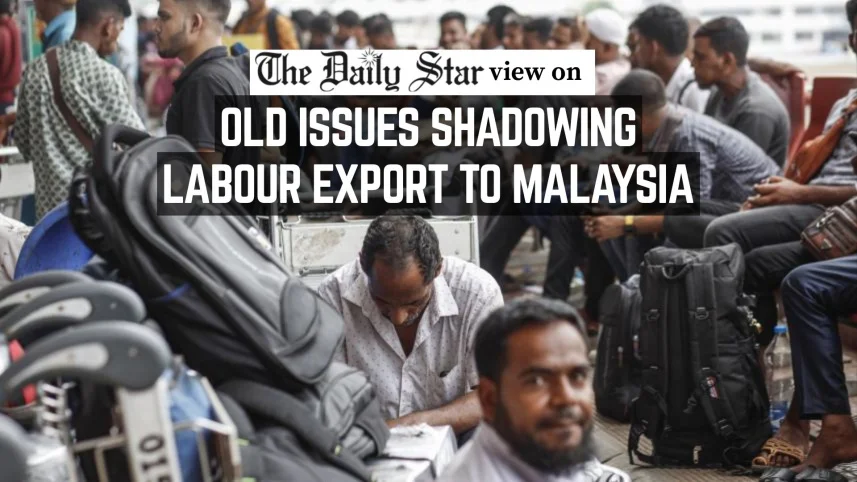
1783816571521.webp

VISUAL: STAR

It is understandable to have cautious optimism about the prospect of the Malaysian labour market reopening to Bangladeshi migrants given the past controversies that often marred the recruitment process. One would, therefore, expect that the over-two-year recruitment freeze has given the authorities the necessary impetus to address all underlying issues before the market does reopen, which seems imminent following an announcement on Tuesday by the expatriates’ welfare and overseas employment minister. But this may not be smooth sailing, as a report by this daily suggests, amid renewed concerns over a lack of transparency and potential irregularities.

The concerns are not without basis. Even before Bangladesh and Malaysia have revised their labour migration framework through a Joint Working Group—as agreed during Prime Minister Tarique Rahman’s visit to Malaysia—questions have emerged over whether recruitment may resume under essentially the same system that previously enabled manipulation. Malaysia's recent decision to continue processing quota applications through the Foreign Workers Centralised Management System (FWCMS), a platform long associated with allegations of opaque practices, has revived fears that politically connected business interests remain entrenched. Conflicting messages from the Bangladesh government have only added to the uncertainty. While the expatriates’ welfare minister publicly announced the reopening of the labour market, the ministry subsequently instructed recruiting agencies not to begin any recruitment activities until formal procedures are announced. Such mixed signals risk creating precisely the kind of confusion that unscrupulous brokers have long exploited.

The history of Bangladesh-Malaysia labour migration offers ample reason for caution. Recruitment was last suspended in June 2024 following widespread allegations that workers often had to pay exorbitant fees only to arrive in Malaysia without the promised jobs or under exploitative conditions. The system itself proved quite flawed. For instance, only a select group of recruiting agencies was allowed to process workers, effectively creating an exclusive channel vulnerable to syndicate control. At the same time, questions were raised about the approval of inflated worker quotas by some Malaysian employers and the inadequate verification of actual labour demand, leaving many migrants stranded without work after borrowing heavily to get there. Such irregularities hurt not only workers but also the credibility of labour migration governance in both countries.

So while we welcome the ongoing reopening bid, it must not mean a return to business as usual. Any revised agreement between Bangladesh and Malaysia, likely after the expected visit of a Malaysian delegation later this month, should clearly define the accountability of both governments, as well as employers, recruiting agencies, and other stakeholders. Recruitment should remain open to all duly licensed agencies under transparent and competitive rules. Job orders and employer quotas must be properly verified before recruitment begins, and migration costs must be strictly monitored. Equally importantly, the government must ensure proper communication so that prospective migrants are not exploited by brokers. The regularisation of workers who found themselves deprived of the promised jobs in Malaysia also deserves serious consideration. These measures are vital both for restoring integrity to the recruitment process and for protecting our workers from exploitation.​
 

Trade Union–Civil Society Action Alliance
Malaysia labour market: Rights activists call for ensuring transparency

Prothom Alo English Desk
Dhaka
Published: 15 Jul 2026, 19: 07

1784170361222.webp


The Trade Union–Civil Society Action Alliance (TUCSAA) in a statement on Tuesday expresses deep concern over recent developments surrounding Bangladesh's efforts to reopen the Malaysian labour market, says a press release.

While restoring employment opportunities for Bangladeshi workers is an urgent national priority, recent media reports raise important questions about whether the governance failures that led to the previous market closure have truly been addressed.

Malaysia remains one of the most important overseas employment destinations for Bangladeshi workers.

Yet the previous recruitment system was plagued by allegations of syndication, limited market access, excessive migration costs, and unequal opportunities for recruiting agencies.

The suspension of recruitment left thousands of aspiring migrants in uncertainty and exposed serious weaknesses in Bangladesh's migration governance.

Many Bangladeshi workers also faced unpaid wages, passport confiscation, contract substitution, poor accommodation, and limited access to justice.

These experiences highlight the urgent need for a recruitment system that protects workers not only before departure but throughout the migration cycle.

The recent diplomatic engagement between Bangladesh and Malaysia presents an important opportunity to rebuild this labour migration partnership.

However, reopening the market should not simply mean resuming worker deployment. It must mark a shift towards a recruitment system that is transparent, accountable, and trusted by workers.

TUCSAA urges the Government of Bangladesh to move beyond broad Memoranda of Understanding (MoUs) and pursue clear, enforceable bilateral labour agreements with defined commitments on recruitment procedures, workers' rights, wages, occupational safety, grievance redress, dispute resolution, and joint monitoring.

Such agreements are essential to protecting migrant workers throughout the migration cycle.

Reopening the Malaysian labour market must also be accompanied by broader reforms.

Stronger oversight, transparent recruitment, better coordination among government institutions, modernised skills development, and meaningful participation of trade unions, civil society organisations, and migrant representatives are essential to building a fair and sustainable migration system.

The decisions taken today will shape more than Bangladesh's relationship with Malaysia.

They will influence the country's credibility as a labour-sending nation, affect future negotiations with other destination countries, and determine whether migrant workers continue to bear high migration costs and exploitation or benefit from a system that protects their rights and dignity.

Bangladesh now has an opportunity to show that it has learned from past experience.

TUCSAA calls on the Government to ensure that the reopening of the Malaysian labour market is guided by transparency, accountability, stakeholder participation, and the best interests of migrant workers.

The success of this process should not be measured only by the number of workers deployed, but by the fairness, protection, and dignity they receive.​
 

PM seeks Malaysian cooperation to tackle gas crisis
Staff Correspondent 28 July, 2026, 20:44

1785281889635.webp

From left: Tarique Rahman, Anwar Ibrahim. | BSS Photo

Prime minister Tarique Rahman on Tuesday sought cooperation from Malaysian prime minister Anwar Ibrahim over the phone to address Bangladesh’s ongoing gas crisis, as the government moves to resolve supply disruptions caused by a major technical fault at a floating LNG terminal. SouthAsians & Diaspora

State Minister for Power, Energy and Mineral Resources Anindya Islam Amit disclosed this at a briefing at the Secretariat on Tuesday, expressing regret on behalf of the government over the public suffering caused by the crisis.

The state minister said the Malaysian prime minister assured all possible support at the earliest opportunity to help Bangladesh overcome the energy crisis.

Amit said, ‘We sought their cooperation, and the prime minister and his side will let us know if there is scope for an immediate solution. If they can, that will be good, and if not, they will inform us in what form they can cooperate.’

The state minister said the Energy and Mineral Resources Division held detailed talks on Tuesday with senior officials of Excelerate Energy, the company operating the terminal, to expedite a solution.

He said supply of 280-300 million cubic feet of gas per day was expected to resume early next week, with the FSRU expected to become fully functional by the end of the following week.

On long-term solutions, Amit said the government had begun exploring alternative sources, noting that detailed discussions on energy cooperation were also held Tuesday with a Japanese delegation led by an adviser to Japan’s prime minister.

The state minister said the Energy Division and Petrobangla were working continuously to ease public hardship, and that the government is closely monitoring the gas supply situation.​
 

Bangladesh and Malaysia must break the recruitment syndicate’s grip

Shariful Hasan


1788220444216.webp

Over the past five decades, the Malaysian labour market has opened many times, allegations of high costs and irregularities surfaced, migrants suffered, and recruitment has been suspended repeatedly, with little change in the recruitment process. PHOTO COURTESY: SHARIFUL HASAN

“Is the syndicate more powerful than the state?”

With that question to both Malaysia and Bangladesh, I ended my article, “Labour recruitment to Malaysia: Time to break the never-ending cycle,” published in The Daily Star on July 25, 2022.

At the time, Bangladesh was preparing to reopen the Malaysian labour market after more than three years of suspension. My warning was simple: reopening should not reproduce a syndicate-driven model in which migrant workers bear the costs and the risks.

The consequences soon became clear.

Around 4,50,000 migrant workers from Bangladesh went to Malaysia between 2022 and 2024. But under the controversial recruitment system, the average migration cost reportedly reached Tk 5.44 lakh or more, against an officially fixed cost of Tk 78,990. Besides, when Malaysia set May 31 as the deadline for Bangladeshi workers to enter the country in 2024, at least 16,970 workers who had obtained clearance from the Bureau of Manpower Employment and Training (BMET), as well as valid visas and tickets, could not reach the Southeast Asian state because of mismanagement by government authorities and local recruiting agents.

My article “Labour recruitment to Malaysia: Syndicate wins, migrants suffer, country loses,” published in The Daily Star on June 8, 2024, mentioned how the 2022 warning had become reality.

Two years later and after three changes in government, the same Foreign Workers Centralised Management System (FWCMS)-based limited-recruitment architecture—and the related concerns about the syndicate—have returned. On August 21, 2026, Malaysia’s FWCMS published a list of 25 Bangladeshi recruiting agencies, raising concerns about a limited-agency recruitment model.

Amid the criticism, on August 28, FWCMS expanded the arrangement to 338 Bangladeshi agencies. Of these, 25 were directly selected agencies, 250 were associate agencies under them and another 62 would work under the state-owned Bangladesh Overseas Employment and Services Limited (BOESL).

However, several fundamental questions remain unanswered. For instance, based on what criteria were the agencies selected? Who controls access to employers, job orders and the digital recruitment chain? Is it still the same FWCMS system? And if recruitment is suspended once again, who will be held accountable?

Reopening, exploitation, suspension: The old cycle

Bangladesh-Malaysia labour migration has followed a familiar pattern over the past five decades: the market opens, allegations of excessive costs and irregularities arise, migrants suffer, recruitment is suspended and attempts are made at reform.

According to BMET, 23 Bangladeshis first went to Malaysia in 1978, while regular migration began in 1992. The market was almost frozen between 1997 and 2005. After Malaysia introduced the calling visa system in 2006, around 4,00,000 Bangladeshis went there in 2007 and 2008. Although the official migration cost was Tk 84,000, workers reportedly paid Tk 2 to Tk 3 lakh or more. Many struggled to find jobs, while a significant number of workers became undocumented.

Then in 2009, Malaysia again stopped recruiting Bangladeshi workers. Three years later, in November 2012, Bangladesh and Malaysia signed a government-to-government (G2G) agreement, bypassing private recruiting agencies. But the system did not generate sufficient recruitment.

Meanwhile, the maritime trafficking crisis between 2012 and 2015 exposed a devastating side of irregular migration, with thousands of people attempting dangerous journeys by boat and trafficking camps and mass graves discovered along the Thailand-Malaysia border.

A decade of syndication and control

Private recruiting agencies returned under the G2G Plus arrangement in 2016. But instead of opening the market to all eligible agencies, Malaysia selected a syndicate of just 10 agencies, leading to allegations of monopoly, excessive costs and irregularities in the recruitment network and its associated digital system. FWCMS remained at the centre of the recruitment process.

In September 2018, after Mahathir Mohamad returned to power, Malaysia suspended the system, describing the recruitment process as a form of human trafficking and a money-making scheme. Yet in 2022, the same recruitment model resurfaced despite protests from civil society and recruiting agencies. And this time, 25 Bangladeshi recruiting agencies were initially selected, and later expanded. But once again, FWCMS sits at the centre of the recruitment process.

FWCMS is developed and operated by Bestinet, a Malaysian private company associated with Aminul Islam Bin Abdul Nor. A Malaysian citizen of Bangladeshi origin, Aminul has been identified in media reports as a central figure in Malaysia’s migrant recruitment system for the past decade, alongside influential actors within powerful circles in both countries.

According to media reports, under the syndicate system in 2023 and 2024, the registration fee per worker was set at 100 Malaysian ringgit, equivalent to around Tk 2,700 at the time. Instead, workers were charged Tk 1,07,000, of which Tk 1,00,000 allegedly had to be sent to Bestinet in Malaysia.

Recruiting agencies allege that around Tk 5,000 crore was siphoned out of the country through a “syndicate fee” of Tk 1,00,000 per worker. Another Tk 3,750 crore was allegedly siphoned off in the name of the “visa trade”. Altogether, the amount allegedly siphoned out of the country could be at least Tk 8,750 crore. The actual scale of corruption and irregularities, however, may have been even higher.

Between July 2024 and 2026, several cases were filed, several people were arrested, and investigations are still ongoing. Yet the fundamental recruitment architecture has not changed. Instead, concerns about the same model have resurfaced around FWCMS and the proposed list of recruiting agencies.

This raises a fundamental question: how can a private recruitment architecture become so influential in a system involving two sovereign governments? Are the actors behind it more powerful than the governments of Bangladesh and Malaysia? And if they are not, why has the system repeatedly been allowed to operate despite such serious allegations and irregularities?

The concern is regional

Nepal has raised serious concerns about the limited-agency model. After FWCMS published a list of 25 recruiting agencies, Nepal’s Ministry of Youth, Labour and Employment expressed concern and held an emergency meeting with Malaysia’s ambassador to Nepal to seek clarification. Nepal Association of Foreign Employment Agencies also strongly objected, arguing that restricting recruitment to just 25 agencies would create a de facto monopoly, undermine healthy competition and ultimately open the door to the economic exploitation of migrant workers.

The concern has since become regional. On August 27, representatives of foreign recruitment agencies from Bangladesh, Nepal, Myanmar and Pakistan issued a joint statement calling for equal access, transparency and fair competition. They warned that no digital platform should become a vehicle for syndication, monopoly or exclusive control over migrant recruitment.

Disclose the entire mechanism

For a recruiting agency, a government office or a digital system, a migrant worker may be a number, but for a family, that worker is often its only hope. Migrants often sell land, borrow from relatives, mortgage property or take high-interest loans to finance the journey for a foreign job. If the job materialises, the family gradually recovers its investment. However, if the worker pays Tk 5 to 6 lakh and cannot travel, the debt does not disappear. Migrants and their families have to bear the burden of that sunk cost.

That is why the goal should not simply be how to reopen the market. It should be: how can it be reopened safely, transparently and affordably with the migrant worker at the centre?

Before recruitment begins this time, both governments should disclose the entire mechanism—a step that has been missing in previous recruitment cycles. Workers, recruiting agencies and the public deserve to know exactly how the process will work, who will control each stage, what each party in the process will be paid and what safeguards are in place. If a worker pays but cannot travel, who will refund the money? If the promised job does not exist, who will be held responsible? If a digital platform controls access to recruitment, who will oversee it and ensure that it cannot be used to create a monopoly?

These questions must be answered before recruitment begins. If there are limitations in the current Memorandum of Understanding, both governments should work to amend those as the agreement expires later this year. But transparency cannot wait. It must come before the first worker pays a single taka, accompanied by a clear commitment that anyone who violates the rules—however powerful—will face consequences.

The state must answer

Bangladesh-Malaysia labour migration has repeatedly been plagued by problems. For almost a decade, different versions of limited-agency recruitment have been accompanied by allegations of irregularities, controversy and migrant suffering. Yet those allegedly responsible for previous irregularities have not been held accountable, while the same network appears to have resurfaced in the next recruitment process under a different name. This cycle must be stopped. Both governments have a responsibility to ensure that migrant workers are protected from exploitation and that recruitment is transparent, fair and accountable.

Otherwise, the question “Is the syndicate more powerful than the state?” will remain unanswered.

This time, Bangladesh and Malaysia must prove that the state is more powerful than the syndicate.

Shariful Hasan is a labour migration expert and former journalist.​
 

Latest Posts

Back