Bangladesh Defense
Saif
Senior Member
- Jan 24, 2024
- 21,561
- 9,760
- Nation

- Residence
- Axis Group


Haor farmers sink into debt, misery
Untimely rains, floods, and upstream water inflow have left thousands of Boro farmers in the haor belt reeling from crop losses and plunging paddy prices.
Haor farmers sink into debt, misery
Sukanta Halder , Jaydul Islam , and Dwoha Chowdhury
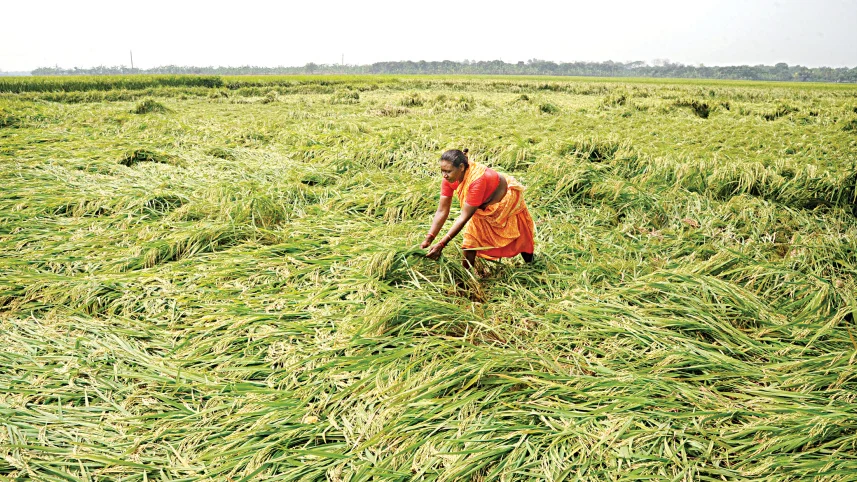
Rain and storm on Wednesday afternoon flattened ripe Boro paddy in several villages of Poba upazila, Rajshahi, leaving farmers unable to harvest amid a labour shortage. They said the crops were due to be harvested within days, but the weather halted work. Yesterday, a woman in Darusha showed how the paddy lay damaged in the field. Photo: Azahar Uddin
Untimely rains, floods, and upstream water inflow have left thousands of Boro farmers in the haor belt reeling from crop losses and plunging paddy prices.
Many have been pushed into a cycle of debt they fear they cannot escape, compounded by worries over how to feed their families through the year.
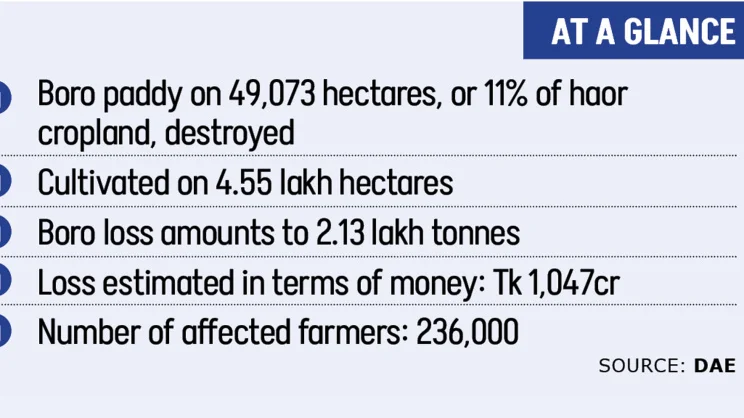
According to the agriculture ministry, over 2.36 lakh farmers across seven haor districts have been affected. The districts are Sylhet, Sunamganj, Brahmanbaria, Habiganj, Moulvibazar, Netrokona, and Kishoreganj.
Boro, the dry-season irrigated rice crop planted from December to February and harvested from April to June, contributes almost 55 percent of Bangladesh’s annual rice output.
“Harvest is completed by the end of season every year. But this time, the damage occurred due to embankment failures and unusually heavy rainfall in April,” Md Salim Khan, additional secretary of the ministry’s extension wing, told The Daily Star.
Boro paddy on 49,073 hectares, or 11 percent of haor cropland, were destroyed, while 17.5 percent of the fields remains at risk, he said.
In the seven haor districts, Boro was cultivated on 4.55 lakh hectares, with 80 percent harvested so far, according to Department of Agricultural Extension (DAE) data.
Officials said unofficial estimates suggest that in terms of money, the damage is Tk 1,047 crore.
Government officials said lists of affected farmers are being prepared, with emergency support expected to begin within days and continue for three months.
Nationally, acreage rose 3.29 percent year-on-year to 50.50 lakh hectares in FY2025-26, with production targeted at 2.24 crore tonnes. Production increased from 2.01 crore tonnes in FY22 to 2.13 crore tonnes in the last season of FY25.
DEBT AND DESPAIR
For this report, The Daily Star interviewed over 40 farmers in the seven haor districts. More than 25 of them revealed that the ongoing situation has trapped them in a cycle of debt.
Bidhan Sarkar of Muladair Haor in Khaliajuri upazila, Netrokona, said his five acres of ripe paddy were submerged.
“In our haor area, we get only one crop a year. We depend on selling that paddy to cover all yearly family expenses, including children’s education and medical treatment,” he said.
Standing waist-deep in water, he managed to harvest part of the crop and hired labourers for the rest, but was forced to sell wet paddy at Tk 600 per maund (37.3kg), far below production cost, just to pay them.
He had borrowed Tk 40,000 for cultivation. “Now the paddy is not even enough for food. The moneylender is pressuring me to sell my land. I see no option but to sell it,” he said.
Fulu Mia of Madan upazila borrowed Tk 2 lakh, with repayment due at Tk 2.60 lakh. “Now I cannot repay that debt by selling the paddy. Even if I return the principal amount, the remaining Tk 60,000 will still remain as debt,” he said.
Shamim Mia of Barhatta upazila leased two acres, borrowing Tk 50,000 with interest, promising to repay Tk 70,000 after harvest.
But 40 percent of his paddy field has gone underwater.
“I am struggling to harvest the remaining crop. The paddy was very good, and I thought I would get around 100 maunds of rice as my share. Even after repaying the lender, I could have supported my family for four to five months,” he said.
“Now, even if I sell the remaining paddy, I won’t be able to repay the loan. I will have to borrow again,” he added.
Amirul Islam, deputy director of DAE in Netrokona, said heavy rainfall affected nearly 80,000 farmers in the district.
Syed Ahmed of Dekhar Haor in Sunamganj cultivated 1.2 hectares by leasing half of the land. He expected over 100 maunds of paddy but salvaged only 50.
Half of the crops from the leased land must go to the landowner.
“I need at least 70 maunds of paddy to feed my family for a year. Moreover, I must repay Tk 36,000 for a Tk 30,000 loan.
“With one daughter’s marriage due this year, the crisis has become unbearable. Selling the paddy at Tk 700 per maund, I cannot even repay the loan and interest. I will have to take another loan next season,” he said.
Akkas Mia of Mithamoin upazila, Kishoreganj, cultivated six hectares with Tk 6 lakh in loans, due to repay Tk 9 lakh including interest.
“So far, I have not been able to bring even a single kilogram of paddy home. My nights are sleepless now because of the stress of debt,” he said.
In Kishoreganj, 13,479 hectares of paddy fields have gone under water, affecting 52,500 farmers.
Crop losses in the district are estimated at Tk 300 crore, said Md Sadiqur Rahman, deputy director of the Kishoreganj DAE.
Suman Namshudra of Kawadighi Haor in Rajnagar upazila, Moulvibazar, took Tk 2 lakh in loans expecting 600 maunds of rice.
After the damage, he fears he may salvage only 50 maunds.
“I have not seen such a disaster in the last 15 years,” he said. “Under pressure from moneylenders, it has now become difficult for me to stay at home.”
3-MONTH SUPPORT
Prime Minister Tarique Rahman yesterday directed authorities to take urgent measures to assist the affected haor farmers.
During a meeting at the Secretariat, he instructed officials to prepare an accurate and transparent list by identifying those actually affected, the Prime Minister’s Press Wing said in a statement.
Disaster Management and Relief Minister Asadul Habib Dulu had earlier announced that the aid would be provided as food assistance for three months through a special card system.
Economist Abdul Bayes, former vice-chancellor of Jahangirnagar University, cautioned that food aid alone would not resolve the crisis.
“The main concern is how farmers will repay cultivation-related loans after suffering crop losses,” he said, stressing that debt relief must accompany food support.
He suggested measures such as rescheduling loans, installment-based repayment, or waiving interest to ease the burden.
[Mintu Deshwara and Tafsilul Aziz contributed to this report]
Sukanta Halder , Jaydul Islam , and Dwoha Chowdhury
Rain and storm on Wednesday afternoon flattened ripe Boro paddy in several villages of Poba upazila, Rajshahi, leaving farmers unable to harvest amid a labour shortage. They said the crops were due to be harvested within days, but the weather halted work. Yesterday, a woman in Darusha showed how the paddy lay damaged in the field. Photo: Azahar Uddin
Untimely rains, floods, and upstream water inflow have left thousands of Boro farmers in the haor belt reeling from crop losses and plunging paddy prices.
Many have been pushed into a cycle of debt they fear they cannot escape, compounded by worries over how to feed their families through the year.
According to the agriculture ministry, over 2.36 lakh farmers across seven haor districts have been affected. The districts are Sylhet, Sunamganj, Brahmanbaria, Habiganj, Moulvibazar, Netrokona, and Kishoreganj.
Boro, the dry-season irrigated rice crop planted from December to February and harvested from April to June, contributes almost 55 percent of Bangladesh’s annual rice output.
“Harvest is completed by the end of season every year. But this time, the damage occurred due to embankment failures and unusually heavy rainfall in April,” Md Salim Khan, additional secretary of the ministry’s extension wing, told The Daily Star.
Boro paddy on 49,073 hectares, or 11 percent of haor cropland, were destroyed, while 17.5 percent of the fields remains at risk, he said.
In the seven haor districts, Boro was cultivated on 4.55 lakh hectares, with 80 percent harvested so far, according to Department of Agricultural Extension (DAE) data.
Officials said unofficial estimates suggest that in terms of money, the damage is Tk 1,047 crore.
Government officials said lists of affected farmers are being prepared, with emergency support expected to begin within days and continue for three months.
Nationally, acreage rose 3.29 percent year-on-year to 50.50 lakh hectares in FY2025-26, with production targeted at 2.24 crore tonnes. Production increased from 2.01 crore tonnes in FY22 to 2.13 crore tonnes in the last season of FY25.
DEBT AND DESPAIR
For this report, The Daily Star interviewed over 40 farmers in the seven haor districts. More than 25 of them revealed that the ongoing situation has trapped them in a cycle of debt.
Bidhan Sarkar of Muladair Haor in Khaliajuri upazila, Netrokona, said his five acres of ripe paddy were submerged.
“In our haor area, we get only one crop a year. We depend on selling that paddy to cover all yearly family expenses, including children’s education and medical treatment,” he said.
Standing waist-deep in water, he managed to harvest part of the crop and hired labourers for the rest, but was forced to sell wet paddy at Tk 600 per maund (37.3kg), far below production cost, just to pay them.
He had borrowed Tk 40,000 for cultivation. “Now the paddy is not even enough for food. The moneylender is pressuring me to sell my land. I see no option but to sell it,” he said.
Fulu Mia of Madan upazila borrowed Tk 2 lakh, with repayment due at Tk 2.60 lakh. “Now I cannot repay that debt by selling the paddy. Even if I return the principal amount, the remaining Tk 60,000 will still remain as debt,” he said.
Shamim Mia of Barhatta upazila leased two acres, borrowing Tk 50,000 with interest, promising to repay Tk 70,000 after harvest.
But 40 percent of his paddy field has gone underwater.
“I am struggling to harvest the remaining crop. The paddy was very good, and I thought I would get around 100 maunds of rice as my share. Even after repaying the lender, I could have supported my family for four to five months,” he said.
“Now, even if I sell the remaining paddy, I won’t be able to repay the loan. I will have to borrow again,” he added.
Amirul Islam, deputy director of DAE in Netrokona, said heavy rainfall affected nearly 80,000 farmers in the district.
Syed Ahmed of Dekhar Haor in Sunamganj cultivated 1.2 hectares by leasing half of the land. He expected over 100 maunds of paddy but salvaged only 50.
Half of the crops from the leased land must go to the landowner.
“I need at least 70 maunds of paddy to feed my family for a year. Moreover, I must repay Tk 36,000 for a Tk 30,000 loan.
“With one daughter’s marriage due this year, the crisis has become unbearable. Selling the paddy at Tk 700 per maund, I cannot even repay the loan and interest. I will have to take another loan next season,” he said.
Akkas Mia of Mithamoin upazila, Kishoreganj, cultivated six hectares with Tk 6 lakh in loans, due to repay Tk 9 lakh including interest.
“So far, I have not been able to bring even a single kilogram of paddy home. My nights are sleepless now because of the stress of debt,” he said.
In Kishoreganj, 13,479 hectares of paddy fields have gone under water, affecting 52,500 farmers.
Crop losses in the district are estimated at Tk 300 crore, said Md Sadiqur Rahman, deputy director of the Kishoreganj DAE.
Suman Namshudra of Kawadighi Haor in Rajnagar upazila, Moulvibazar, took Tk 2 lakh in loans expecting 600 maunds of rice.
After the damage, he fears he may salvage only 50 maunds.
“I have not seen such a disaster in the last 15 years,” he said. “Under pressure from moneylenders, it has now become difficult for me to stay at home.”
3-MONTH SUPPORT
Prime Minister Tarique Rahman yesterday directed authorities to take urgent measures to assist the affected haor farmers.
During a meeting at the Secretariat, he instructed officials to prepare an accurate and transparent list by identifying those actually affected, the Prime Minister’s Press Wing said in a statement.
Disaster Management and Relief Minister Asadul Habib Dulu had earlier announced that the aid would be provided as food assistance for three months through a special card system.
Economist Abdul Bayes, former vice-chancellor of Jahangirnagar University, cautioned that food aid alone would not resolve the crisis.
“The main concern is how farmers will repay cultivation-related loans after suffering crop losses,” he said, stressing that debt relief must accompany food support.
He suggested measures such as rescheduling loans, installment-based repayment, or waiving interest to ease the burden.
[Mintu Deshwara and Tafsilul Aziz contributed to this report]