[🇧🇩] City Buses, Metro Rail, Urban Transport & City Road Infra

[🇧🇩] City Buses, Metro Rail, Urban Transport & City Road Infra
163
10K
More threads by Bilal9

G Bangladesh Defense

What fate awaits Dhaka-Gazipur BRT?

Published :
May 20, 2026 22:56
Updated :
May 20, 2026 22:56
1779329024297.webp


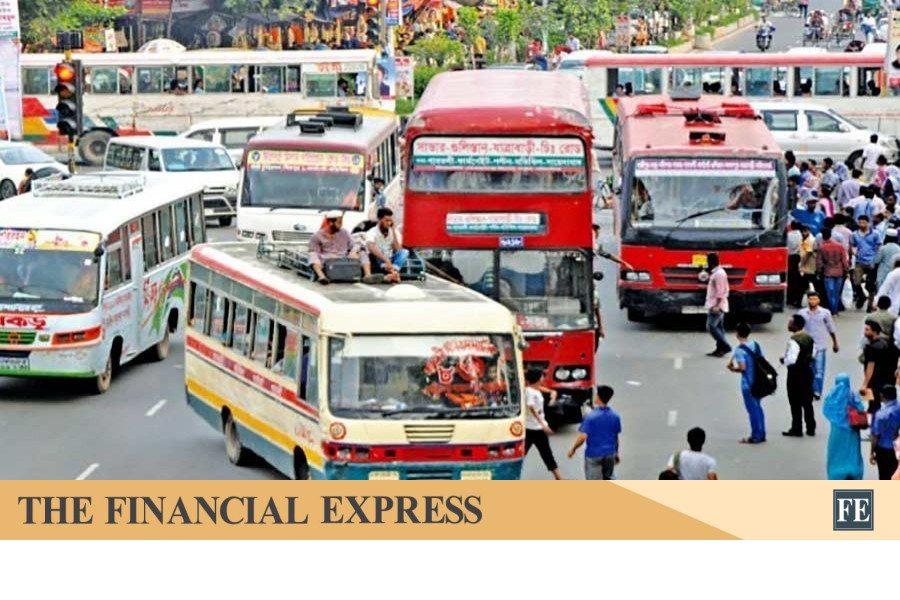
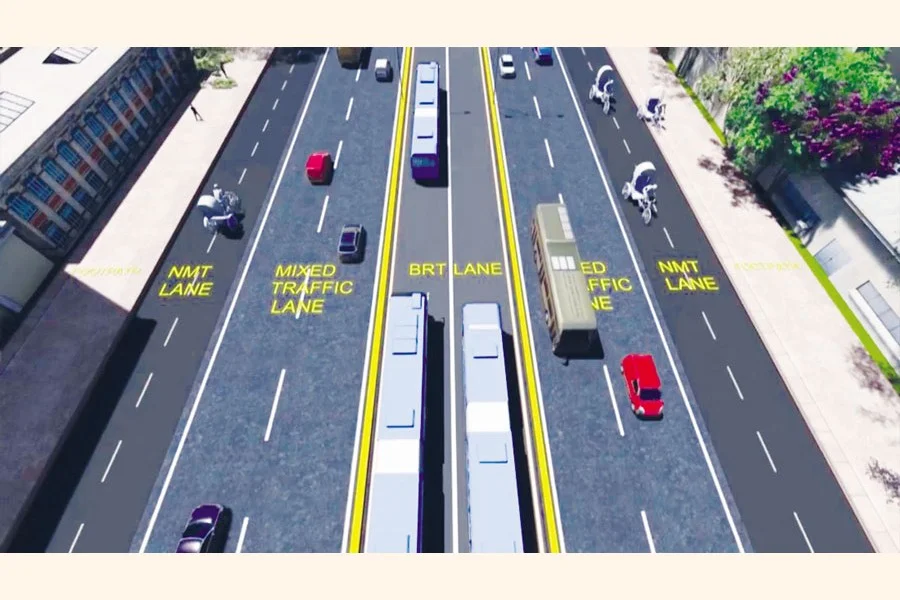
Launched in 2012, the Dhaka-Gazipur Bus Rapid Transit (BRT) project was supposed to be completed in 2016 but the corridor still awaits completion. When another rescheduling and allocation of Tk30 billion was sought lately for its completion, the Planning Commission rejected the request. The Ministry of Road Transport and Bridges instead assigned a high-level team from the Bangladesh University of Engineering and Technology (BUET) with the responsibility of recommending suggestions on the project's future. The BUET team has suggested the project's cancellation or in other words demolition. Interestingly, leading urban planners of the Bangladesh Planners Institute (BPI) opposes the BUET team's recommendations. They claim that demolition cost would be more than the expenditure on the remaining construction works for its completion. So it is better to complete the project instead of scrapping it. They also argue that the unused fund would be enough to do the job.

According to the BPI experts, 97 per cent of the project has been completed. They complain that the BUET team's recommendations were made on a partial study. In this connection they mention that 205 cities operate the Mass Rapid Transit (MRT) systems worldwide but BRT systems have grown at a break-neck pace of approximately 383 per cent since 2000 'due to lower costs, faster implementation and easier expansion'. At the press conference hosted by the BPI, keynote presenter Dr M Mosleh Uddin Hasan further claims that the dedicated lanes can be opened for basic BRT operation within the next six to 12 months. Now this is intriguing as the opinions of BUET team and the claims made by the BPI are diagonally opposite and contradictory. If the long-delayed project is so close to be complete, why did the division of the ministry concerned sought an allocation of Tk30 billion? Again what made the BUET team to suggest outright scrapping of the project that is near completion?

That projects get delayed in this country is nothing new. It should not be the only criterion for cancellation of a project at this stage. If there are serious design flaws or the project was undertaken on imperfect feasibility study, it is a different issue. The reason why the BUET team made such recommendations should be made public. The government will be in a dilemma now that such claims and counter-claims have been made. It would be proper for the administration to bring the two sides together in order to arrive at a consensus about the future of the project.

The merit of BRT cannot be denied. Originally, the outlay on the BRT was Tk 42.68 billion only. This is far less than the Tk 334.72 billion spent on the metro rail from Uttara to Motijheel. On the count of expenditure and the delivery of service, BRT certainly has an edge over metro rail. It is not just enhanced mobility but its impact on urban restructuring, land use transformation and economic opportunities also counts. An earlier study carried out by the BUET's Urban and Regional Planning Department suggested development of 13 BRT corridors for six cities and towns. So, before deciding on demolition of the Dhaka-Gazipur BRT, a comprehensive review of the project should be carried out.​
 

EXPANDING DHAKA'S METRO-RAIL NETWORK
Stalled MRT projects bag big Tk 126.49b funds to restart

FHM Humayan Kabir

Published :
Jun 02, 2026 00:30
Updated :
Jun 02, 2026 00:30

1780358441050.webp


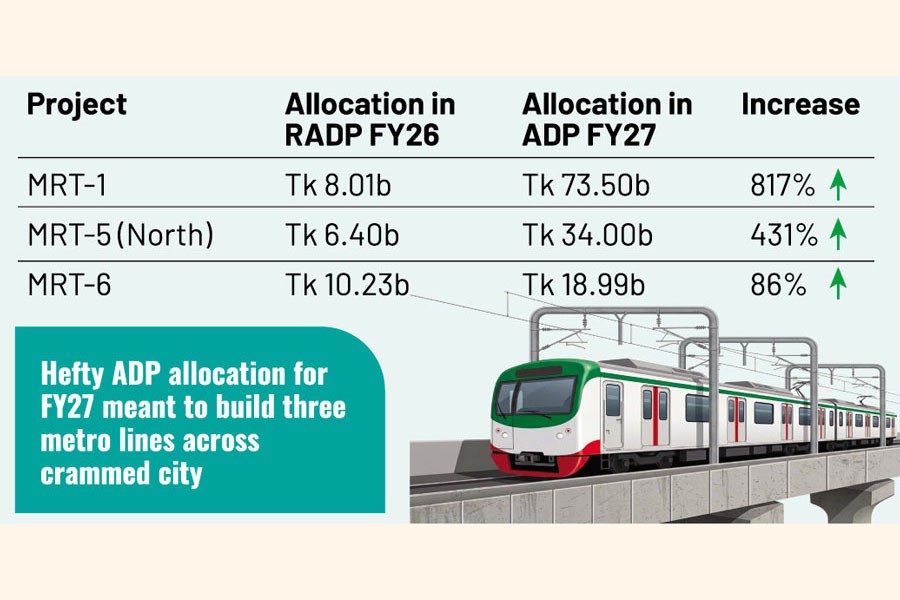
Stalled mass rapid transit (MRT) projects receive a substantial sum of Tk 126.49 billion in ADP allocations for the upcoming fiscal year as the government vows to construct three Dhaka metro-rail lines after prolonged dilemmas, officials say.

The long-stalled MRT-1 and MRT-5 (Northern) lines have got significant allocations in the FY27 Annual Development Programme (ADP).

The ongoing MRT-6 project has also been given a hefty allocation, Planning Commission officials say.

The National Economic Council (NEC) has approved a Tk 3.0-trillion ADP for FY27, where nearly 1,150 development projects, including the MRTs, have got large allocations.

In the new ADP, the MRT-1 line from Dhaka airport to Kamalapur has grabbed Tk 73.50 billion, 817-percent higher than that in the FY26 Revised ADP (RADP).

MRT-5 (Northern route) from Hemayetpur to Vatara secures Tk 34 billion, which is 431-percent higher.

Besides, MRT-6 from Uttara to Kamalapur, which is near completion, gets Tk 18.99 billion, in an 86-percent increase.

The Executive Committee of the National Economic Council (ECNEC) approved both the MRT-1 and MRT-5 (northern) projects in October 2019 with a combined estimated cost of Tk 937.9998 billion.

The estimated project cost for MRT-1 was Tk 525.61 billion and that for MRT-5 was Tk 412.39 billion.

Japan International Cooperation Agency (JICA) is financing all three MRTs.


A senior Roads and Highways Division official told The Financial Express they had sought higher funds for the three projects.

"We are trying to restart the construction of MRT-1 and MRT-5 stalled for long. We recently held a meeting with all the parties, including the fund provider, for expediting work," he added.

Another official of the division says since the bidding prices of some of the packages of MRT-1 and MRT-5 are much higher than official estimations, they are working to renegotiate with the bidders to reduce prices.

"We are hopeful of settling the issues within a short period of time and restarting construction," he adds.

A senior Planning Commission official says they have allocated higher funds for the stalled MRT projects in response to the demand of the Roads and Highways Division.

"Since they've vowed to restart construction, we have allocated higher funds," he adds.​
 

MRT Line-1 metro rail bidding hits snags
Japan's Kajima backs out citing time lag, global volatility

Munima Sultana

Published :
Jun 05, 2026 00:22
Updated :
Jun 05, 2026 00:22

1780627228000.webp


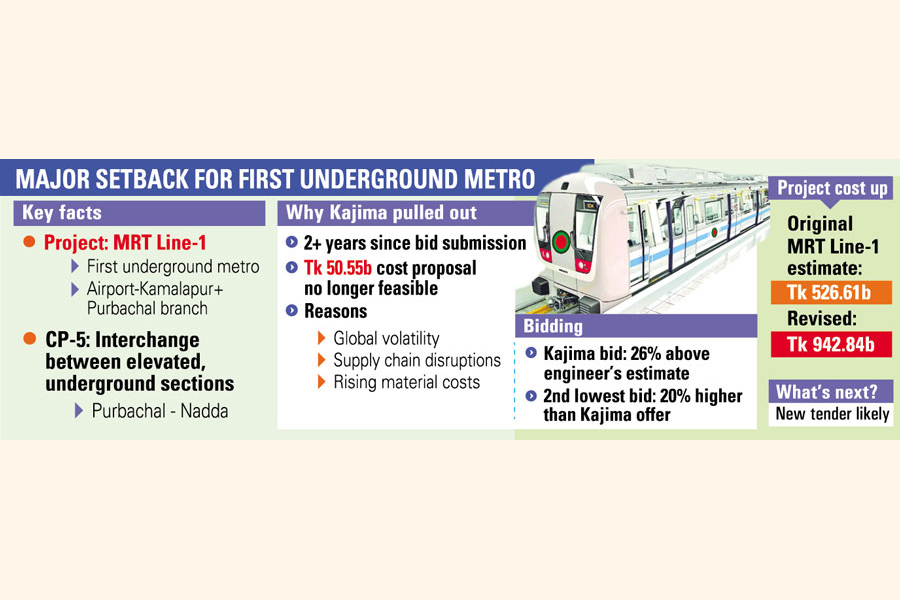
A Japanese company has withdrawn from the bidding for one of the most controversial contract packages (CP) on MRT Line-1 despite being the lowest bidder, citing prolonged delays in implementing Bangladesh's first underground metro-rail project.

Sources say Kajima Corporation, whose bid was based on cost estimates prepared nearly two years ago, has informed the government that carrying out the works under current conditions would be difficult due to the volatile global situation and the impact of conflicts in the Middle East.

"The company said executing the work at its proposed cost of Tk 50.55 billion was no longer feasible because more than two years had passed since the bid was submitted," says an official familiar with the matter.

According to sources, Kajima also cited disruptions in global supply chains and rising material costs, which made its original financial proposal for CP-5 unworkable.

The company submitted a letter to the Dhaka Mass Transit Company Limited (DMTCL) managing director on June 1 seeking withdrawal from CP-5, and also met the secretary of the Road Transport and Highways Division on Wednesday.

The withdrawal may pave the way for a fresh tender.

DMTCL had earlier proposed to Japan International Cooperation Agency (JICA), the project's financier, to cancel some bids of MRT-1, including CP-5, on grounds of proposing an exorbitant rate than the package's revised cost and seek permission for an open tender.

Kajima's bid itself was around 26-percent higher than the engineer-estimated cost, while the second-lowest bid was about 20 per cent higher than the lowest offer.

However, JICA rejected the proposal.

DMTCL has been facing difficulties with several contract packages of MRT Line-1 and MRT Line-5 North as only a few Japanese companies participated in those biddings and some lowest bidders' proposals were two to three times higher than the revised cost estimates in the development project proposals (DPPs).

Based on evaluated bids, the authorities estimated the cost of MRT Line-1 alone at Tk 942.84 billion, compared with the original estimate of Tk 526.61 billion.

Sources say Kajima became lowest bidder among only three participating Japanese companies.

CP-5 involves the construction of the interchange section linking the elevated and underground portions of the 31.24-kilometre MRT Line-1 metro rail between Purbachal's 300-Foot Road and the underground station at Nadda.

Following a review during the interim government's tenure, DMTCL found limited participation in most contract packages of MRT Line-1 and MRT Line-5 North.

It also estimated the combined cost of the two projects at around Tk 1.84 trillion, effectively delaying their implementation.

The MRT Line-1, Bangladesh's first subway, is planned to run from Dhaka Airport to Kamalapur, with a branch line connecting Purbachal.​
 

Metro dreams, pricey reality—Affording Dhaka’s mass transit future

Farhad Ahmed

Published :
Jun 04, 2026 18:21
Updated :
Jun 04, 2026 18:21

1780627632877.webp


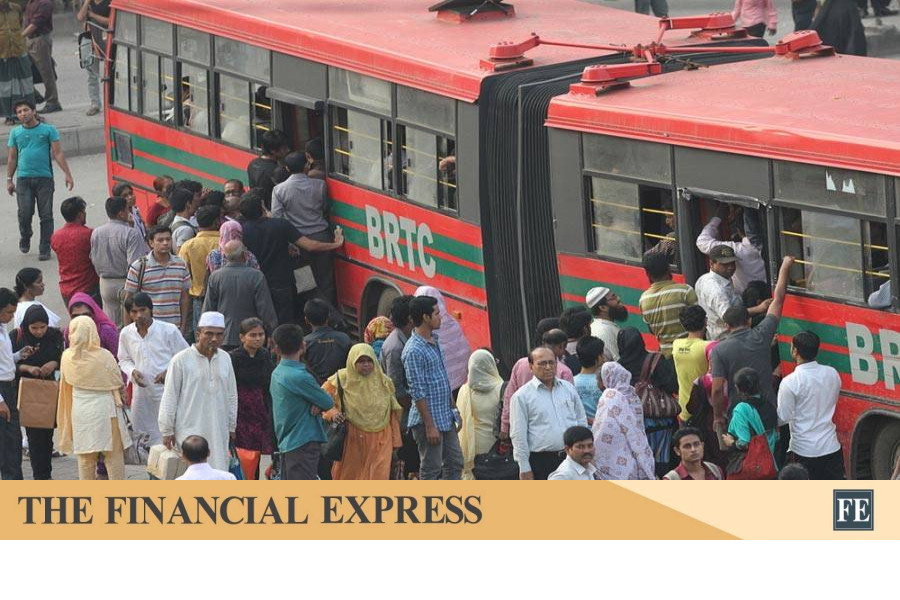
Mr Mohammad Aalvee, who lives near Pallabi Metro Station, says the Dhaka Metro has made his life easier: “Now I can travel to the old part of Dhaka for my business activities quickly and conveniently. The fare is also reasonable.” However, he faces “rush-hour overcrowding, long queues at ticket offices, and the unavailability of services after 10 pm”.

Currently, the metro serves only one corridor but has already improved mobility for many. This early success shows how expanding the network—while managing costs and linking it with other transport modes—can improve physical access and mobility across Dhaka.

Dhaka’s transport issues stem from rapid, unplanned growth; concentrated jobs and housing; fragmented governance; chronic underfunding; weak regulation; and cultural habits such as owning cars for status. These factors cause traffic congestion, unreliable public transport, more road crashes, pollution, and social exclusion. Addressing them requires coordinated governance, stable funding, smarter land use, better demand management, stronger enforcement, safe walking and cycling infrastructure, and faster improvements to public transport so that people shift from private cars and emissions are reduced.

Dhaka’s metro is designed to be a fast and reliable mass-transit backbone for the city. It aims to reduce congestion and pollution, connect homes and jobs, and make travel quicker. The metro can modernise mobility and improve accessibility if it is well connected across the city, guides land use, and is fully integrated with buses and other transport modes.

Dhaka plans a six-line metro network (approximately 130 km by 2030). Line 6 (21 km) is operational, with 16 stations and an extension under way. Other lines are in procurement, design, or land acquisition stages. Challenges include high costs, construction risks, complex urban works, land acquisition and resettlement delays, traffic disruption, and unsatisfactory procurement outcomes. Stronger governance, smarter financing, local capacity, and integrated planning are needed to complete the network and make it work for all.

An analysis shows that Dhaka Metro Line 6 is far more expensive than Indian metro systems. Line 6’s fully elevated alignment costs Tk 1,575 crore (US$126 million) per km in 2024 prices. Delhi and Chennai spent only US$32–44 million per km (in 2024 prices). Dhaka’s cost is approximately three and a half times higher. Even Mumbai’s fully underground Line 3, at US$74 million per km, is cheaper. These differences highlight serious cost challenges for Dhaka.

Experts say Line 6 is costlier because it is the first project, development partners imposed limited bidding and specifications, soil conditions are poor, groundwater levels are high, land acquisition has been slow, systems are imported, and designs are non-standard. Costs can be reduced through standardised designs, competitive bidding, local assembly, utility mapping, and stronger contracts, as global experience shows.

The Metro Rail Act 2015 sets the rules for Dhaka’s metro system but contains key gaps. The Dhaka Transport Coordination Authority (DTCA) oversees the system, while the Dhaka Mass Transit Company Limited (DMTCL) builds and operates it, creating blurred responsibilities over licensing, fares, assets, and enforcement. The law lacks an independent regulator, secure maintenance funding, and integration with buses, walking, cycling, parking, and land use. These gaps slow decision-making and weaken accountability. Cities such as Delhi and Singapore demonstrate the value of clear institutional roles, strong regulation, and performance standards. Dhaka needs similar clarity and integration.

Dhaka’s 130 km metro plan by 2030 is overly ambitious. Line 6, at just 21 km, took more than six years to build. The remaining network is estimated to cost US$24 billion (Tk 288,000 crore)—roughly 6% of Bangladesh’s 2025 GDP. This will be difficult for the country, especially amid global risks arising from ongoing conflicts, including higher energy and food prices, tighter financial conditions, currency pressures, and fiscal stress. This suggests the following policy priorities: (a) setting a realistic, phased timeline; (b) focusing on high-impact corridors and considering cheaper options, such as BRT or light rail, for lower-demand routes; and (c) securing low-cost loans and guarantees from multilateral development partners.

Recent reports by the BBC and The Economist highlight a major challenge faced by Indian metro systems: low ridership. India spent US$26 billion on 1,000 km of metro lines across two dozen cities, yet many carry only 20–50% of their expected passenger numbers. Causes include high fares, poor last-mile connectivity, weak bus integration, poorly located stations, safety concerns—particularly for women—and overestimated forecasts. The lesson is clear: metros alone cannot solve urban transport problems. Other elements of the urban transport ecosystem must function effectively alongside metro systems to deliver the best mobility outcomes.

For Dhaka, this raises several key policy questions: Are ridership forecasts realistic? Are fares affordable? How will last-mile connectivity and bus integration be improved? How will monitoring and accountability be ensured? And to what extent can standardised designs, competitive tenders, and diverse financing instruments reduce costs and accelerate delivery?

It is still too early to judge Dhaka Metro’s long-term ridership performance. Line 6 currently carries between 400,000 and 420,000 passengers daily. DMTCL aims to reach 1.3 million daily riders by 2051, equivalent to a peak passenger-per-hour-per-direction (PPHPD) figure of 61,000. Achieving this target would require annual growth of around 5% over 25 years. This appears feasible because Line 6 serves a densely populated urban corridor characterised by low car ownership and heavy public transport use. In addition, average station spacing of 1.25 km and extensive feeder services improve accessibility. Overall, the existing transport ecosystem is supporting strong ridership growth on Line 6.

An analysis suggests that two planned Dhaka metro corridors may experience lower demand: Line 4 (Kamalapur–Madanpur) and Line 5 North (Hemayetpur–Vatara). Their projected PPHPD figures are only 17,000 (2065) and 36,500 (2058), respectively, which may be insufficient to justify full metro systems. Given the high costs and lengthy delivery periods, DMTCL could consider cheaper and faster alternatives. BRT and light rail can effectively serve medium-demand corridors (PPHPD 10,000–35,000) at significantly lower costs. Cities such as Mexico City use BRT on comparable corridors to deliver rapid and visible mobility improvements without constructing expensive metro lines.

Building on the metro’s early success and integrating it with the wider transport network, the government should adopt clear policies to ensure access to jobs and services, affordable fares, and sustainable mobility. Key priorities include: (a) strengthening DTCA—even if legal reforms are required—to plan, fund, regulate, and monitor transport, while clearly defining the responsibilities of builders, operators, and regulators; (b) prioritising high-impact corridors and phasing investments, while testing BRT or light rail on lower-demand routes to match transport modes to actual needs and save time and money; (c) standardising station and track designs and using open, competitive tenders to reduce costs and accelerate construction; (d) securing low-cost multilateral loans and guarantees without restricting fair procurement, thereby lowering borrowing and construction costs; (e) developing local skills and industries for metro design, construction, maintenance, and operations. A semi-knocked-down (SKD) approach—importing trains and systems for local assembly—could reduce import costs, create jobs, and facilitate technology transfer; and (f) monitoring ridership in real time and adjusting fares based on data to keep services affordable while covering operating costs efficiently.

Dhaka must turn the promise of metro rail into tangible results. Policy priorities include strengthening urban transport governance, phasing projects according to impact, matching transport modes to demand, standardising designs, building local capacity, securing affordable finance, and ensuring effective last-mile connectivity. Metro rail is only one part of the solution, not the entire solution. It must work alongside other transport system elements to provide safe, affordable, reliable, low-emission, and inclusive mobility that eases congestion, protects public health and the environment, and supports economic growth.

Farhad Ahmed is a retired Senior Transport Specialist at the World Bank, Washington, D.C. He is a trustee of the Human Capital Initiative (HCI).​
 

Latest Posts

Back