Home Watch Videos Wars Movies Login

[🇧🇩] Insurgencies in Myanmar. Implications for Bangladesh

Latest Posts Countries Wars Q&A

[🇧🇩] Insurgencies in Myanmar. Implications for Bangladesh
395
15K
More threads by Saif

G Bangladesh Defense

9 Rohingya die after boat capsizes near Teknaf
bdnews24.com
Published :
Aug 06, 2024 22:41
Updated :
Aug 06, 2024 22:41
1722998305647.png


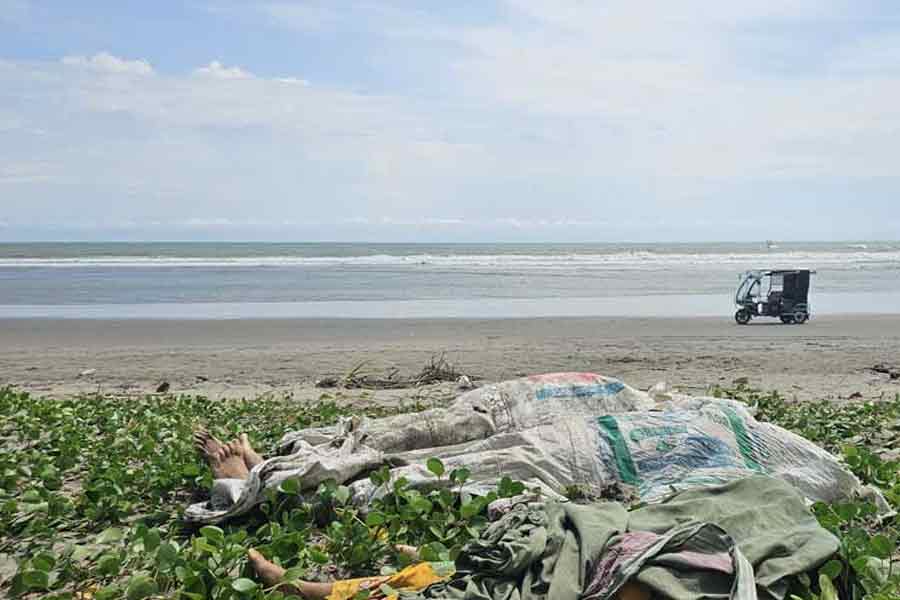
The dead bodies of nine Rohingya, including three children, have been recovered from the coast of Cox's Bazar's Teknaf Upazila. As many as 22 others have been reported missing over the incident.

According to public representatives, the victims were trying to enter Bangladesh territory by sea from Myanmar, according to bdnews24.com.

Md Adnan Chowdhury, the chief executive officer of Teknaf, said that the boat carrying the Rohingya capsized in the sea near Habirchhara and Rajarchhara point areas of Teknaf Sadar Union on Tuesday.

Of the bodies recovered from the coast, three are children, four women and two men. He also said that two people were rescued alive following the incident.

However, the officials have yet to identify the victims.

Abdur Rashid, a member of Ward no 1 of Teknaf Sadar Union, told bdnews24.com that a boat carrying 31 Rohingya capsized while trying to flee Myanmar's Rakhine State. They were on their way to Bangladesh to escape the conflict raging in Myanmar.

Although a few of them managed to swim ashore, several passengers of the boat drowned in the sea. The bodies of nine people were recovered with the help of the locals on Tuesday. At least 22 of them are still missing.

According to Abdur Rashid, preparations are underway to hand over the dead bodies to the families of the victims in various Rohingya shelters located in Teknaf, which are under the Upazila administration.

Adnan Chowdhury said legal action is being taken over the incident.

He also added that a few of the Rohingya men were detained while they tried to infiltrate the borders. They are currently in the custody of the BGB.​
 
Analyze

Analyze Post

Add your ideas here:
Highlight Cite Respond
  • Like (+1)
Reactions: Bilal9

13 more Myanmar citizens take shelter in Bangladesh
UNBCox's Bazar
Published: 15 Aug 2024, 09: 39

1723712598601.webp

13 more members of the country's Border Guard Police (BGP) took shelter in Bangladesh on Wednesday morning UNB

Amid a conflict between the Myanmar military and the armed rebel group in Myanmar’s Rakhine, 13 more members of the country's Border Guard Police (BGP) took shelter in Bangladesh on Wednesday morning.

So far, a total of 123 BGP members have taken refuge in Bangladesh, said Teknaf-2 BGB Commander Lieutenant Colonel Mohiuddin Ahmed.

Colonel Mohiuddin said the BGP members infiltrated through the Sabrang border on Wednesday morning due to internal conflict in Myanmar.

Later, they surrendered to the BGB with a pistol and 25 rounds of ammunition.

The process of repatriation has started and they will be sent back soon, he added​
 
Analyze

Analyze Post

Add your ideas here:
Highlight Cite Respond

UN fears repeat of 2017 atrocities against Rohingyas
Agence France-Presse . Geneva 23 August, 2024, 21:23


1724457245525.webp

Volker Türk. | File photo.

The United Nations said on Friday it fears a repeat of the 2017 atrocities committed against the Rohingya minority in Myanmar, warning a human tragedy was unfolding in Rakhine State.

UN human rights chief Volker Turk voiced grave alarm about the sharply deteriorating situation across Myanmar, particularly in Rakhine where, he said, hundreds of civilians have reportedly been killed while trying to flee fighting.

Clashes have rocked Rakhine since the rebel Arakan Army attacked forces of Myanmar’s ruling junta in November, ending a ceasefire that had largely held since a military coup in 2021.

The AA says it is fighting for more autonomy for the ethnic Rakhine population in the state, which is also home to around 6,00,000 members of the Rohingya Muslim minority.

Hundreds of thousands of Rohingya fled Rakhine in 2017 during a crackdown by the military that is now the subject of a United Nations genocide court case.

‘Thousands of Rohingya have been forced to flee on foot, with the Arakan Army herding them repeatedly into locations that offer scant safe haven,’ Turk said in a statement.

‘As the border crossings to Bangladesh remain closed, members of the Rohingya community are finding themselves trapped between the military and its allies and the Arakan Army, with no path to safety.’

Bangladesh is now home to around one million Rohingya refugees.

‘This month marks seven years since the military operations which drove 7,00,000 across the border into Bangladesh. Despite the world saying ‘never again’, we are once more witnessing killings, destruction and displacement in Rakhine,’ said Turk.

The UN high commissioner for human rights said parties to the armed conflict were denying responsibility for attacks against the Rohingya, which ‘stretches the bounds of credulity’, he said.

The UN Human Rights Office said that according to its information, the military and the Arakan Army have both committed serious human rights violations and abuses against the Rohingya.

These include extrajudicial killings, some involving beheadings, abductions, forced recruitment, indiscriminate bombardments of towns and villages, and arson attacks.

‘Both the military and the Arakan Army bear direct responsibility for the human tragedy that is unfolding in Rakhine,’ said Turk.

‘These atrocities demand an unequivocal response: those responsible must be held accountable, and justice must be pursued relentlessly.

‘Recurrence of the crimes and horrors of the past must be prevented as a moral duty and a legal necessity.’

Turk called on both parties to cease attacks on civilians and urged ASEAN, the Association of Southeast Asian Nations, to take all necessary measures to protect the Rohingya.​
 
Analyze

Analyze Post

Add your ideas here:
Highlight Cite Respond
  • Sad (0)
Reactions: Bilal9

Rohingyas to observe ‘Genocide Remembrance Day’

1724543994829.webp

Reuters file photo

The displaced Rohingyas from Myanmar, who are now sheltered in Bangladesh, will observe "Genocide Remembrance Day" today.

Around a million Rohingya people fled ethnic cleansing by the Myanmar junta troops to take refuge in Bangladesh following military crackdown in Rakhine State on August 25, 2017.

Since then, they have been living in camps of Ukhiya and Teknaf of Cox's Bazar.

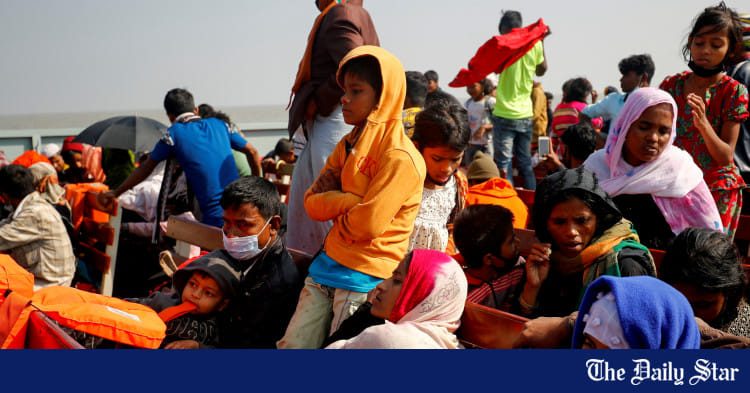
Meanwhile, no less than 20,000 Rohingyas crossed Naf river and entered Bangladesh to take shelter in the refugee camps in Cox's Bazar in a fresh exodus amid violent clashes between Arakan Army and Myanmar troops since August 4-5 this year, said Rohingya leaders at the camps.

Kamal Hossain, chairman of the Forcibly Displaced Myanmar National Representative Committee, termed the recent attacks on the community as the second wave of genocide.

"Over 20,000 Rohingays have come to Bangladesh after the Arakan Army launched brutal attacks on the community recently. They are now living at the camps in Cox's Bazar with their relatives or acquaintances. The previously sheltered Rohingyas are sharing food with the newcomers despite suffering from shortage due to limited rations," he said.

However, government officials have no specific data about the number of new arrivals.

Contacted, Mohammad Mizanur Rahman, Refugee, Relief and Repatriation Commissioner, said they have no specific data on how many new Rohingyas have come to the camps recently when Bangladesh was facing a troubled situation.

At present, Bangladesh's stance is not to allow any more Rohingyas in the country, Mizanur said. However, he said they are contacting their high-ups to arrange food for the new arrivals on humanitarian ground.

Rashida Begum, a Rohingya woman who arrived on August 8, said she and her family members had taken shelter at a relative's house in Rakhine's Maungdaw Township for 15 days before entering Bangladesh.

The Arakan Army had tried to stop them from leaving the country to use them as human shields, she added.

Meanwhile, at least 100 bodies of Rohingyas were recovered from river bank and sea coast in Teknaf and were later buried on different graveyards and other areas on the shore stretching from Lada to Shahporir Dwip between August 4 and August 21.

They were assumed to have died after their boats capsized on the way to Teknaf.

Confirming the matter, Adnan Chowdhury, UNO of Teknaf, said, "As far as I know, over 100 bodies were recovered and buried by locals and Rohingyas on different shores."

Khin Maung Thein, a Rohingya human rights activist, said he along with Rohingya volunteers had arranged for burial of 20 bodies of Rohingya people, including one of a pregnant woman.

"The bodies bore numerous injury marks. Some had amputated legs," he added.​
 
Analyze

Analyze Post

Add your ideas here:
Highlight Cite Respond
  • Like (+1)
Reactions: Bilal9

No fresh move in sight for Rohingya return
Mustafizur Rahman with Tarekur Rahman in Cox’s Bazar 25 August, 2024, 00:06

1724544761654.webp


No fresh initiative has been taken by the interim government for Rohingya repatriation, as Bangladesh could not send back even a single person from the over 12 lakh displaced people in Myanmar to their homeland in the past seven years since the latest influx began in 2017.

The moves initiated by the previous government to repatriate the persecuted Rohingyas to the Rakhine State of Myanmar, facing a civil war situation for around three years, did not bear any outcome, according to officials.

The foreign ministry’s Myanmar wing director general, Ferdousi Shahriar, said that there had been no progress so far in the return of Rohingyas, sheltered in Bangladesh camps as a China-backed project to repatriate some 1,000 Rohingyas on a pilot basis remained stalled for months.

She said that they did not get any fresh instructions on the issue from the interim government, which was formed on August 8 with professor Mohammad Yunus as chief adviser following the August 5 fall of Sheikh Hasina, who fled to India amid a student-led mass uprising, ending her 15-year-long regime.

‘We are expecting fresh directives exclusively to look into the issue of Rohingya repatriation following the changeover in the government,’ Ferdousi told New Age on Saturday.

She said that the joint efforts for the Rohingya repatriation could not make any headway as there was a civil war situation in Myanmar, which made the conditions not favourable for their return to the Rakhine State.

The overthrown government of the Awami League has blamed on several occasions both international communities, including the United Nations Refugee Agency and Myanmar’s military regime, for its failure to return Rohingya people from Bangladesh after the large-scale exodus that began on this day in 2017 amid a military crackdown in Rakhine State.

The United Nations said on Friday it feared a repeat of the 2017 atrocities committed against the Rohingya minority in Myanmar, warning of an unfolding human tragedy in Rakhine State, the Agence France-Presse reported from Geneva.

UN human rights chief Volker Turk voiced grave alarm about the sharply deteriorating situation across Myanmar, particularly in Rakhine, where he said hundreds of civilians had reportedly been killed while trying to flee fighting.

Clashes have rocked Rakhine since the rebel Arakan Army attacked forces of Myanmar’s ruling junta in November, ending a ceasefire that had largely held since a military coup in 2021, according to the AFP report published on Friday.

Although international communities, including UN organisations, assured time and again that they would facilitate the return of the forcibly displaced people by creating a congenial atmosphere in Myanmar, not a single Rohingya could be sent back home since the signing of instruments between Bangladesh and Myanmar in 2018 for repatriation.

Bangladesh has also sought the cooperation of China and Japan, among others, to expedite the repatriation process, as they have leverage over Myanmar.

Officials said that the number of Rohingya people has already crossed 12 lakh following the latest exodus of over seven lakh persecuted Myanmar nationals who fled a military crackdown in Rakhine State to Bangladesh for shelter.

Rohingya community leader Mohammed Syed, who has been residing in a camp at Ukhia in Cox’s Bazar for around seven years, said that they did not like to live the confined life anymore and wanted to return voluntarily to their homeland without further delay on the assurance that their rights as citizens would be fulfilled.

‘We have been living here for a long time, but we cannot forget our motherland. If we even remain unfed in Myanmar, we feel we will have freedom there,’ he told New Age.

Hamid Hossain, another Rohingya leader at Kutupalang in Ukhia, expressed uncertainty about the fate of the move for their return as the population of their community was increasing every year.

‘We don’t know whether such a big Rohingya community would be able to return to their homeland by realising our demands. But we want to return to our country of birth. Our future is uncertain here,’ he added.

At least two attempts to start the repatriation of the displaced Rohingyas from Bangladesh to Myanmar failed, as they refused to return home without a guarantee of their citizenship and security.

Rohingyas observe this day with various programmes including discussion meetings, rallies, and prayer sessions for their relatives killed during the Myanmar military crackdown on this day and later on.​
 
Analyze

Analyze Post

Add your ideas here:
Highlight Cite Respond
  • Like (+1)
Reactions: Bilal9

World should act to stop repeat of 2017 Rohingya atrocities
25 August, 2024, 00:00

UN FEARS for a likely repeat of the 2017 atrocities that Myanmar’s security forces committed against the Rohingyas in Rakhine State against the background of an unfolding tragedy now brings to the fore a couple of issues for the global forum itself and the world community to seriously consider. The UN human rights chief has voiced grave alarm about a sharply deteriorating situation across Myanmar, especially in Rakhine State, which is home to about 600,000 Rohingya people, where hundreds of civilians are reported to have been killed when they tried to flee fighting. The situation has exacerbated into clashes in Rakhine since the Arakan Army attacked forces of Myanmar’s ruling junta in November 2023, ending a ceasefire that had largely been held since a military coup in 2021. Hundreds of thousands of Rohingyas fled Rakhine in 2017 during a military crackdown, now the subject of a UN genocide court case. As the border crossings to Bangladesh remain closed, the Rohingyas find themselves trapped between the Myanmar military and its allies and the Arkan Army with no path to safety. The proposition is bad for the Rohingyas, about 700,000 of whom entered Bangladesh where the Rohingya population in shelters is more than one million.

This is also bad for the world community, which earlier said ‘never again’ but now appears to be failing again as killings, destruction and displacement are witnessed once again in Rakhine. Parties to the armed conflict in Rakhine, as the UN high commissioner for human rights says, are denying responsibility for attacks against the Rohingyas which ‘stretches the bounds of cruelty.’ Such a situation is also bad for Bangladesh, where more than a million of the Rohingyas have lived in shelters and camps, with no past to fall back on and no future to look forward to. And, none of the Rohingyas could be repatriated to Rakhine State since August 2017 despite some efforts that petered out mostly because of Myanmar’s unwillingness and continued efforts that have created a fearful situation there to stop the Rohingyas from willingly returning. The United Nations, which earlier likened Myanmar’s persecution of the Rohingyas to ‘a textbook example of ethnic cleansing,’ has, along with the international community, therefore, a role to play in preventing the deplorable situation that it fears in Rakhine State again especially now that it has already sensed what could be in store. The recurrence of the crimes and horrors that happened to the Rohingyas in the past should be prevented as a moral duty and legal necessity of the world community.

Whilst the world community should act to stop a repeat of the atrocities that Myanmar committed against the Rohingyas in 2017 and step up efforts on international forums for the repatriation of the Rohingyas sheltered in Bangladesh, Bangladesh authorities must redouble its efforts bilaterally, regionally and internationally for a resolution of the deteriorating situation in Rakhine State and the repatriation of the Rohingyas. Bangladesh authorities must also remain alert to any such efforts, perhaps by the adversaries, to create instability in the politically changed context of Bangladesh.​
 
Analyze

Analyze Post

Add your ideas here:
Highlight Cite Respond
  • Like (+1)
Reactions: Bilal9

7th anniv of Rohingya influx: Crisis deepens as funds falling
* Experts suggest opening talks with Arakan Army * We are observing situation, says foreign secy * Fund crisis compromises with life-saving aid

MIR MOSTAFIZUR RAHAMAN
Published :
Aug 24, 2024 21:10
Updated :
Aug 24, 2024 22:44

1724546260960.webp


A drastic fall in humanitarian funds and uncertainty about repatriation mark the seventh anniversary of Rohingya influx into Bangladesh, thereby putting both refugees and host communities at risk, experts said.

Those involved in the humanitarian assistance at grass-roots level have cautioned that thousands at Rohingya camps are in peril as they have to compromise with food rationing and others.

For the last couple of years, only 40 per cent of the humanitarian funds required for the refugees were received, according to officials.

Moreover, as the repatriation of the Rohingya is not in sight in near future, experts suggest Bangladesh start talks with the Arakan Army who are practically in control of Rakhine State, the homeland of over 0.1 million Rohingya now staying here.

“Fund deficit is painful but we are trying hard to encourage the donors to continue their funding,” foreign secretary Masud Bin Momen told the FE.

Usually, donors tend to reduce funding for old refugee situations and funding for the Rohingya is declining with the emergence of new situations in Ukraine, Sudan and the Middle East, he explained.

However, those working at grass-roots level to provide humanitarian aid make it clear that thousands of Rohingya will be under severe threat due to malnutrition if funds continue to decline.

“This declining trend is a matter of grave concern because if the funding is shortened, life-saving assistance will be compromised,” said Manish Kumar Agrawal, country director of the Concern Worldwide.

“And this will be dangerous, not only for the camps, but then also for the Bangladesh host community, because you have a million-plus people, if they are deprived of life-saving assistance, then it’s definitely going to have much larger implications for surrounding areas.”

He said malnutrition has been worsening due to cuts in food rationing and the number of children with clear malnutrition symptoms is rising day by day.

Concern Worldwide is responsible for over 60 per cent of nutrition-related activities at 22 refugee camps in Cox’s Bazar.

Asked about a way out, Mr Manish laid more emphasis on development funding to engage the refugees in income-generating and livelihood activities.

Furthermore, attracting development funding would be a good alternative in the face of declining humanitarian support, he told the FE.

On the other hand, experts suggested the government open up channels for communication with the Arakan Army.

A latest report of the International Crisis Group (ICG) said, “For all the challenges it’s facing domestically, Bangladesh also has a key role to play in Rakhine State. The emergence on its border of a de facto state that aspires to permanent autonomy will require the new interim government in Dhaka to expand the scope of its engagement with the Arakan Army...”

Asked about opening communication with the Arakan Army, Mr Momen told the FE that the government was observing the situation.

“We see reports that the Myanmar military government is losing ground in Rakhine,” said the seasoned diplomat, adding that Myanmar assured Bangladesh that they are committed to taking back the Rohingya.

“If the situation demands, the government can talk to all stakeholders to ensure safe and dignified repatriation of the Rohingya.”

In just a few months, the Arakan Army has created the largest area in Myanmar under the control of a non-state armed group in terms of both size and population and is now on the verge of securing almost all of Rakhine.

According to the ICG, Rakhine remains at a perilous juncture, requiring leaders of both Rakhine and Rohingya communities to rise above their historical animosity and defuse tensions.

It has urged the Arakan Army to incorporate more Rohingya into its administration and commit to supporting an independent investigation into allegations of abuses against civilians.

Narrating the current situation, the Amnesty International said acute funding shortfall led to food insecurity in camps as well as shortcomings in health care and education.

“Bangladesh continues to host nearly 0.1-million Rohingya refugees in camps in poor conditions for the seventh consecutive year. Last year, at least 12,000 refugees in camps were rendered homeless due to devastating fires and the impact of cyclone Mocha.”

“Bangladesh’s new interim government should prioritize the protection of Rohingya refugees’ human rights and their safety in camps, uphold the principle of non-refoulment, and adopt a rights-respecting policy towards the Rohingya,” the Amnesty said in a report.

On 25 August 2017, Myanmar security forces launched a widespread and systematic assault on Rohingya villages after an armed group calling itself the Arakan Rohingya Salvation Army carried out deadly attacks on police posts.

The military response included extrajudicial killings, destruction of properties and sexual assault. As a result of the military’s so-called “clearance operations”, more than 740,000 Rohingya women, men and children fled northern Rakhine to neighbouring Bangladesh.​
 
Analyze

Analyze Post

Add your ideas here:
Highlight Cite Respond

Rohingya's fate remains unchanged even after seven years
Mahbubul Haque
Published :
Aug 24, 2024 22:15
Updated :
Aug 24, 2024 22:15

1724546514328.webp


The Rohingya have faced a continuous process of de-legitimization, systematic persecution, and worsening abuses culminating in genocide. Today is the seventh year of the Myanmar military's genocidal attacks against the Rohingya. The Rohingya diaspora in different countries observe today as "Rohingya Genocide Day''. In this day, Rohingya political groups urged global leaders to end the cycle of impunity and act against the genocides and no perpetrator should go unpunished.

The genocide has consisted of two phases to date: the first was a military crackdown that occurred from October 2016 to January 2017, and the second has been occurring since August 2017. Consequently, more than a million Rohingya have fled the country because of well-founded fears of persecution. It can be stated that from 2012 to 2016 and most dramatically in 2017, wholesale destruction, systematic rape, and mass killings were carried out against Rohingya as a part of the government policy to eradicate them from their ancestors' land. The Rohingya atrocity is now the subject of a genocide investigation by the International Court of Justice.

The ongoing political situation in Myanmar especially after the Military coup witnessed that without accountability and justice, the future generations of Rohingya will face again genocide. The foremost priority of the existing Rohingya people who have become exiles is to return home in safety, dignity, and justice. But the reality is they cannot return where genocide is still ongoing. There must be credible accountability to ensure victims see justice served and the cycle of violence is not repeated. It is very clear if Rohingya do not get full citizenship rights, it will never be safe for them to return to Myanmar. There has been no visible progress regarding the repatriation agreement signed between the governments of Bangladesh and Myanmar on 23 November 2017. Bangladesh called on the United Nations to effectively engage with Myanmar to facilitate the sustainable repatriation of the displaced Rohingya people to their homes in Rakhine State. Nobel laureate Professor Muhammad Yunus, the interim leader of Bangladesh, has delivered his first major government policy to address and promised to support the Rohingya community seeking refuge in the country. Professor Yunus pledged that his government "will continue to support the Rohingya people sheltered in Bangladesh". He also mentioned that "we need the sustained efforts of the international community for Rohingya humanitarian operations and their eventual repatriation to their homeland, Myanmar, with safety, dignity and full rights."

Currently, in Bangladesh, more than a million forced-displaced Rohingya have no right to work and are completely reliant upon international aid for their survival. It is a very common scenario for displaced Rohingyas to have the right to work in Malaysia, Indonesia, and Thailand. In the above-mentioned ASEAN countries, Rohingya are treated as 'illegal migrants. The root cause of forced displacement of Rohingya is connected to the criteria of the 'refugee' according to the 1951 Refugee Convention. The international community has also failed to adequately support the Rohingya in their hour of need. Recently the UN's World Food Programme (WFP), has announced cuts to funding for the refugee camps in Bangladesh. Amidst rising global food costs, an increase in the number of geopolitical crises such as the Russia-Ukraine war, the Gaza war, and overstretched international humanitarian aid budgets, these cuts form part of a broader trend in declining support for protracted humanitarian crises in the global south. Some countries are backing a short-sighted plan to repatriate Rohingya refugees from Bangladesh before their safe return to Myanmar can be ensured. The UN refugee agency, UNHCR has called for more durable solutions from the international community which include increasing the resettlement of Rohingya refugees in third countries. Few countries have stepped up to support resettlement or other durable solutions for Rohingya. It can be mentioned that Australia has contributed to this containment policy despite calls from Bangladeshi authorities and international advocacy groups to increase their resettlement of refugees and to increase support for resettlement in other countries. The total number of third-country resettlement for Rohingyas is very low compared to Ukrainian refugees.

After three years of military coup in Myanmar, the landscape of the country's conflict is changed enormously. The military faces a national uprising that spans the breadth of the country. It is for the first time in its history, that Myanmar's military has lost control over vast areas of territory and strategically significant bases. The Human Rights Watch and various media published that Myanmar Military and the opposition Arakan Army (AA) have committed extrajudicial killings and widespread arson against Rohingya, Rakhine, and other civilians in Myanmar's western Rakhine State since the end of 2023. The offensive has also dramatically overrun two strategically important townships on the border with Bangladesh - Buthidaung in late May, and almost completely, the town of Maungdaw later. The diaspora Rohingya community is concerned that the AA's success could inflame communal tensions between ethnic Buddhist Rakhine and Rohingya Muslims, who make up a majority in both townships. The AA stated that they are fighting for more autonomy for the ethnic Rakhine population in the state, which is also home to around 600,000 Rohingya who remained after the 2017 crackdown. It does not mean that AA recognizes the Rohingyas as indigenous people of the present Rakhine State. The medical charity organization, Doctors without Borders, popularly known as MSF also mentioned that more Rohingya are arriving in Bangladesh from Myanmar with war-inflicted injuries amid escalating conflict between the military and the AA in Rakhine State. It should be mentioned here that the military's unlawful recruitment of Rohingya men and boys has stoked communal tensions between the Rohingya Muslim and Rakhine Buddhist communities. The clashes have since moved west to Maungdaw, where fighting has surged over the past weeks, with reports of killings and other abuses against the Rohingya population, including children, women, and older people. Rights groups urged that all parties to the conflict should stop hate speech, and unlawful attacks and allow aid agencies to conduct humanitarian support to those in need.

Since November 2019, different initiatives have been taken against the genocides in Myanmar including provisional measures by the International Court of Justice (Gambia vs Myanmar case). Despite these measures, community leaders and rights groups witnessed that the Myanmar military has continued to burn the Rohingya villages and burying bodies in mass graves in order to destroy the evidence of atrocities committed. No genocide can be prevented if a culture of impunity exists. In addition, the international community also cannot avoid its responsibility to protect the Rohingya people from further atrocities.

Dr. Mahbubul Haque currently working as a faculty member at the Faculty of Law and International Relations at the University Sultan Zainal Abidin, Malaysia, and one of the founder members of the Initiatives for Human Rights in Asia-IHRA (human rights-related civil society forum).​
 
Analyze

Analyze Post

Add your ideas here:
Highlight Cite Respond

Members Online

No members online now.
Back
 
G
O
 
H
O
M
E