New Tweets

[🇧🇩] Insurgencies in Myanmar. Implications for Bangladesh

G Bangladesh Defense
[🇧🇩] Insurgencies in Myanmar. Implications for Bangladesh
395
15K
More threads by Saif


Rohingyas urge Yunus to facilitate their swift return

1741995829841.webp

Photo: AFP Rohingya refugees gather to listen to United Nations Secretary-General António Guterres during his visit to a refugee camp in Ukhia, Cox' Bazar yesterday.

The Rohingya community has urged Chief Adviser Prof Muhammad Yunus to facilitate their swift return to their homeland.

They made the call during his visit to the Rohingya camp along with UN Secretary-General António Guterres at an iftar event in Cox's Bazar today.

The Rohingyas who met the CA told him, "We have land there. We can make a living. We came here because we were not allowed to stay in our own country. We do not want to be a burden to anyone..."

Expressing their willingness to return home, they requested Yunus to convince Myanmar authorities to take them back as soon as possible.

1741995872803.webp

Photo: CA's press wing

"They [the Rohingyas] want the world to hear their plea," Yunus said.

Addressing the Rohingyas, he said, "Despite so many crises around the world, including wars in different regions, the UN secretary-general [António Guterres] has come here just to listen to you. He has travelled from afar solely to break fast with you so that a solution can be found. For this, we all express our gratitude to him."

He thanked all those involved in organising the event and sought prayers from everyone so that he could work with Guterres to resolve the issue swiftly.​
 
Analyze

Analyze Post

Add your ideas here:
Highlight Cite Respond

UN chief speaks with Rohingya children at learning centre

1741996720468.webp


United Nations Secretary-General Antonio Guterres spoke to Rohingya children at a learning centre in the Rohingya camp in Cox's Bazar today.

Chief Adviser Professor Muhammad Yunus and Antonio Guterres arrived in the coastal town to attend several programmes, including a visit to the refugee camp.

They are being accompanied by UN Under-Secretary-General and High Representative for the Least Developed Countries, Landlocked Developing Countries and Small Island Developing States (UN-OHRLLS) Rabab Fatima, Foreign Affairs Adviser Md Touhid Hossain, SDGs Affairs Principal Coordinator Lamiya Morshed, and Chief Adviser's Press Secretary Shafiqul Alam.​
 
Analyze

Analyze Post

Add your ideas here:
Highlight Cite Respond

Rohingya crisis needs a lasting solution
We hope to see positive outcomes from the UN chief’s visit

1741997090835.webp


At a time when Bangladesh is struggling to deal with the Rohingya crisis amid fund cuts by the US and other international donors, the importance of UN Secretary-General António Guterres's visit to Bangladesh cannot be overstated. This visit is also important for Bangladesh as the country undergoes a major political transition following the July uprising that ousted the fascist Awami League regime in August last year. As the primary focus of the UN chief's visit this time is to observe the Rohingya situation in Bangladesh, we hope it will reignite global attention to this crisis and mobilise international donors to financially support Bangladesh in providing the necessary assistance to the over one million Rohingya living here.

The UN chief is scheduled to visit the Rohingya camps in Cox's Bazar today and attend an iftar party with them, a gesture that reflects Guterres' empathy and support for the refugees. We were also encouraged by the concern he showed about the Rohingya crisis a month ago, when he sent a letter to the chief adviser, reaffirming the UN's solidarity with Bangladesh in its ongoing efforts to manage the humanitarian impact of the crisis. Therefore, we expect him to deliver a strong message to the world that, without global support, Bangladesh cannot continue shouldering this immense responsibility alone.

In the past few years, numerous other global crises have overshadowed the Rohingya issue, and funds for the refugees have declined alarmingly, making it challenging for Bangladesh to provide basic services to this forcibly displaced population. The recent fund cuts by the US have further worsened the crisis, and the impact is already evident in the refugee camps in Cox's Bazar's Ukhiya and Teknaf upazilas. Moreover, the renewed violence in Myanmar has forced around 80,000 more Rohingyas to seek shelter in Bangladesh since August last year, adding to the staggering 1.2 million already living here. A recent Refugee and Migratory Movements Research Unit study painted a grim picture of the living conditions in the camps, highlighting gender-based violence and security concerns. The ongoing violence and instability within Myanmar are also hindering repatriation efforts.

Against this backdrop, we hope Guterres' visit will help push for a swift resolution to the Rohingya crisis—enabling them to return to Myanmar with safety and dignity. We would also request him to use his own and his office's influence to boost the dwindling humanitarian aid for the Rohingya.​
 
Analyze

Analyze Post

Add your ideas here:
Highlight Cite Respond

Rohingya crisis at risk of being forgotten
Warn INGOs, demand bold, decisive actions for sustainable solutions

1741997475816.webp

A Rohingya camp. File photo

International NGOs operating in Bangladesh have made an urgent call for bold and decisive global action to secure a sustainable future for the Rohingya refugees in Bangladesh.

"The world cannot afford to let one of the largest refugee crises of our time fade from global attention. It is time to secure a sustainable future where Rohingya refugees and host communities are not left in limbo, but empowered to reclaim their rights and dignity," they said in a joint statement yesterday.

The international NGOs -- ACF, ActionAid, Cordaid, Concern Worldwide, DRC, Handicap International, International Rescue Committee, Islamic Relief, Oxfam, Plan International, Save the Children, and World Vision -- made the statement.

The Rohingya crisis is not just a resource crisis, but a crisis of political will. The UN and international community must ensure sustained support and invest in long-term solutions.— Hasina Rahman Country director, International Rescue Committee.

The statement comes during UN Secretary-General António Guterres' visit to Bangladesh, hoping to help bring back global attention on the issue.

"With the humanitarian response to the Rohingya crisis facing severe funding shortages and shifting global priorities, the need for renewed and sustained international commitment has never been more urgent," the statement says.

They called for immediate and coordinated action to sustain life-saving assistance, innovative response strategies, and a dedicated mission that ensures stability and dignity for over one million Rohingya refugees and host communities in Cox's Bazar.

Severe funding cuts have slashed rations by over half, which will be operational from April, worsening economic pressures and social tensions in host communities. Essential services -- including food and nutrition, WASH, protection, shelter, and livelihoods -- are critically affected.

"Without urgent reforms and a long-term strategy, this crisis risks becoming unsustainable and deeply entrenched. Now in its eighth year, the Rohingya crisis continues to strain Bangladesh's resources as donor commitments dwindle amid global crises," the statement added.

Signatories of the statement said addressing this crisis requires a high-level and regular dialogue among the UN, Bangladesh government, development partners, INGOs, local NGOs, and key international stakeholders.

"The current model of aid must evolve into a more sustainable, long-term, and resilience-based approach, integrating livelihoods, skills training, and economic opportunities for both Rohingya refugees and host communities," they added.

A Triple Nexus Approach, linking humanitarian relief, development, and peacebuilding, is crucial to reducing dependency and fostering self-reliance, they also said.

"The Rohingya crisis is not just a resource crisis, but a crisis of political will. The UN and international community must ensure sustained support and invest in long-term solutions," said Hasina Rahman, country director of International Rescue Committee.

ActionAid Bangladesh Country Director Farah Kabir said, "Without immediate and decisive action, we risk allowing the Rohingya crisis to become a forgotten tragedy. A people-centred approach, ensuring livelihood, skills, and education opportunities, is the way forward."

Ashish Damle, country director of Oxfam in Bangladesh, said, "Given the prolonged nature of this crisis, we urge global stakeholders to consider a structured and dedicated mission to drive sustainable response."​
 
Analyze

Analyze Post

Add your ideas here:
Highlight Cite Respond

Dr Yunus pledges joint efforts with UN for quick Rohingya repatriation
UNB
Published :
Mar 15, 2025 00:36
Updated :
Mar 15, 2025 00:36

1741998452704.webp


Chief Adviser Prof Muhammad Yunus on Friday pledged to put in their collective efforts together with the United Nations so that the Rohingyas can celebrate their Eid next year by returning to their own homes in Myanmar's Rakhine state.

"Let's pray to Almighty Allah.....so that you can celebrate your Eid at your own homes after your return....this Eid we can't," he said after joining iftar with one lakh Rohingyas at Camp 20 Extension of Ukhiya in presence of UN Secretary-General Antonio Guterres.

The Chief Adviser delivered his speech in Chattogram's regional language for better communication with the Rohingya.

Dr Yunus said he will also try staying in touch with the UN chief to make that (repatriation of Rohingyas) happen quickly.

The Chief Adviser said Guterres has many responsibilities and but his participation in iftar with the Rohingyas demonstrates the importance he attaches to the Rohingyas.

The Rohingya community urged the Chief Adviser Prof Muhammad Yunus to facilitate their swift return to their homeland.

Addressing the Rohingyas, Dr Yunus said despite so many crises around the world, including wars in different regions, the UN Secretary-General has come just to listen to the Rohingyas. "For this, we all express our gratitude to him."

He thanked all those involved in organising the event and sought prayers from everyone so that he could work with Guterres to resolve the issue swiftly.
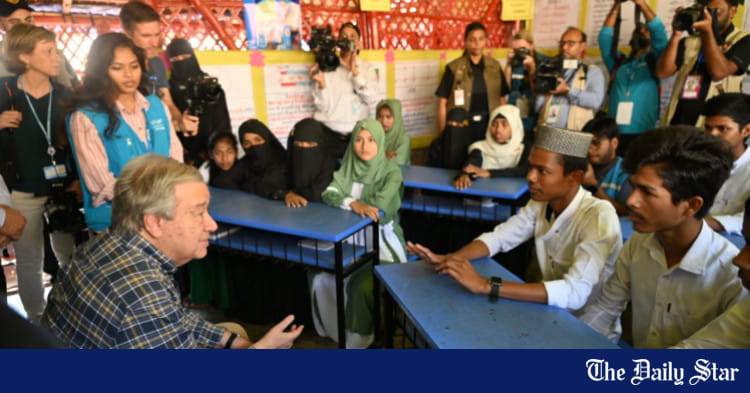
UN Secretary-General Guterres vowed to do everything in his power to prevent further hardship as drastic aid cuts threaten food supplies and other critical relief efforts.

During his visit, he said he had heard two key messages from the refugees: their desire to return safely to Myanmar and their need for better conditions in the camps.

Dr Yunus and the UN chief together returned to Dhaka on Friday night from Cox's Bazar.​
 
Analyze

Analyze Post

Add your ideas here:
Highlight Cite Respond

Rohingyas want to celebrate next year’s Eid in Myanmar: Yunus

1742081996099.webp

File photo

Rohingyas want to celebrate next year's Eid back in their homes in Myanmar, said Chief Adviser Prof Muhammad Yunus today.

While addressing an iftar party arranged in honour of visiting United Nations Secretary-General Antonio Guterres, he also sought UN's assistance to combat "misinformation" targeted at Bangladesh.

Quoting the Rohingyas, Yunus said the refugees even mentioned a date when they want to go back.

"They want to invite you [Guterres] back home next year to celebrate Eid with them in their homes [in Myanmar]," Yunus added.

He said Rohingya refugees want to show the whole world that they are not a burden to anyone.

"We can take care of ourselves, and we want to take care of the rest of the world in our own way because we are not somebody's burden," Yunus quoted Rohingyas as saying.

Yunus also said Rohingyas pleaded with him to help them to go back to their homes and families.

They also told the chief adviser that they left behind the graves of fathers, grandfathers, mothers and so on in Myanmar.

"That's our home. We are supposed to stay in this forest land as a guest of a limited time," Yunus further quoted Rohingyas.

On disinformation propaganda against Bangladesh, Yunus sought UN's help.

"We need your support, particularly to battle misinformation. … All we are saying is protect us from misinformation, and we can do the rest," Yunus added.​
 
Analyze

Analyze Post

Add your ideas here:
Highlight Cite Respond

Will the UN chief’s visit put the focus back on the Rohingya issue?
UN chief visit impact on Rohingya crisis

1742082513704.webp

Photo: REUTERS

UN Secretary-General António Guterres's ongoing visit to Bangladesh has given us an opportunity to explore international dimensions to our national crises. An editorial in this daily shared optimism over finding a lasting solution to the influx of more than 1.1 million Rohingya refugees into our country from Myanmar. Perhaps Friday's iftar with the refugees in the camps in Cox's Bazar would further compel the UN chief to resolve the crisis and reconsider their actions.

The Rohingya refugees in the Cox's Bazar camps are about to face a situation worse than they have been enduring. Funding shortfalls have prompted the UN World Food Programme (WFP) to halve monthly food rations for Rohingya refugees in Bangladesh—from $12.50 per person to just $6—from next month. In real terms, $6 a month is about Tk 24 a day—not even enough for a banana and an egg. Bangladesh's recent economic health card is not promising enough to suggest that the host country can bear the burden of these stateless people for a long time without any international assistance. The funding cut is likely to lead to malnutrition, which carries far more dangerous implications. Rohingya leaders and aid workers have already voiced their concerns that the despair is likely to feed militancy.

We have already seen reports of thousands of refugees who, frustrated by poverty, idleness and insecurity, have become prone to armed struggle. A Reuters investigation last year revealed that the promise of income or purpose has drawn many disillusioned young men, leading to the recruitment of 3,000 to 5,000 Rohingya fighters from the refugee camps. Some even joined factions aligned with their former persecutors to fight ethnic rebels, while others engaged in gang violence within the camps. Officials stationed at the Rohingya camps expressed their helplessness, as they know more than anyone the dire consequences of the fund cuts. It's uncertain whether the impact of hunger will soon transcend beyond health and affect stability and peace.

Any immediate solution to the Rohingya crisis is unlikely because of the slow nature of the judicial process. The Gambia, backed by the Organisation of Islamic Cooperation (OIC), filed the Rohingya genocide case at the International Court of Justice (ICJ) in 2019, holding Myanmar accountable for the 2017 ethnic cleansing. The ICJ has imposed some provisional measures, but the progress has been painstakingly slow due to Myanmar's legal delays. Substantive arguments began in late 2023 when several nations intervened as the idea of genocide concerned them. Bangladesh strategically refrained from any formal involvement, preferring diplomatic solutions through China and the Association of Southeast Asian Nations (ASEAN), for instance. The case is important to keep the global optics on the Rohingya crisis, and we will eventually need all the diplomatic efforts as well as action from the UN Security Council for justice to be delivered. Without sustained international pressure, the Rohingya risk becoming a forgotten crisis, overshadowed by other global events.

The attempts of the Office of the UN High Commissioner for Refugees (UNHCR) for Rohingya repatriation have seen hardly any success. The lack of credibility and fund shortage will further exacerbate the situation on the Bangladesh side. This will only add to the security concerns mentioned earlier. A UK government report shows that many of the refugees have fallen prey to human trafficking as they try to leave the country, often using fake Bangladeshi IDs. The relaxation of police verification for obtaining national IDs has made it easier to abuse the system for the refugees. The identification may either help them assimilate into the mainstream Bangladeshi society or explore overseas travels through criminal syndicates. The lack of bare minimum food funds, if unchecked, can have a ripple effect.

We hope that the UN secretary-general's iftar at the Rohingya camps will help him adopt a balanced role, learning from the experience of fund and food shortages in Gaza and their domino effect. The UN must facilitate not only humanitarian aid but also seek sustainable solutions, ensuring refugee rights, upholding community concerns, and pressuring Myanmar for meaningful refugee repatriation. We expect the UN in a more balanced role to remain a credible actor in resolving one of the most prolonged refugee crises in recent history and their geopolitical atrophies.

Dr Shamsad Mortuza is professor of English at Dhaka University.​
 
Analyze

Analyze Post

Add your ideas here:
Highlight Cite Respond

World must not forget the Rohingya
UN chief’s call to the international community is heartening

1742082643388.webp


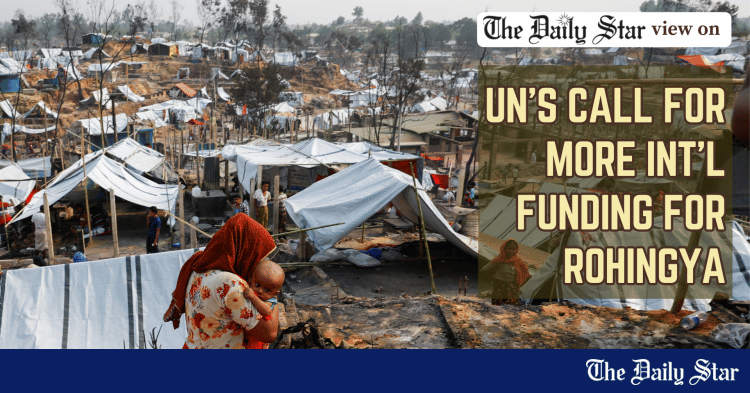
We welcome the UN Secretary-General António Guterres' call to the international community to increase funding for the Rohingya living in refugee camps in Bangladesh. Mentioning that the Rohingya are on the verge of a deep humanitarian crisis caused by global aid cuts, the UN chief rightly emphasised the international community's obligation to support them. As the UN chief and Chief Adviser Prof Muhammad Yunus addressed a large gathering of Rohingya refugees at a camp in Cox's Bazar's Ukhiya on Friday and shared iftar with them, he also expressed hope for the safe and dignified return of over one million Rohingya currently stranded in Bangladesh.

The Rohingya refugees living in camps face growing uncertainty as their food rations are being cut due to global funding shortages. The World Food Programme is reportedly reducing its monthly rations from $12.5 to $6 per person starting in April 2025. In 2024, only $554 million—65 percent of the required funds—was provided for these over one million refugees. With the announced cuts in financial assistance, the situation will become even more dire this year. A previous round of ration cuts in 2023, which reduced food rations to $8 per month, led to a sharp increase in hunger and malnutrition. Hence, if monthly food rations are further reduced to $6—approximately Tk 24 per day—it could push the Rohingya refugees to the brink of starvation and even death. Reportedly, nearly 50 percent of the total humanitarian assistance for the Rohingya comes from the US government. Therefore, cuts in US funding will have disastrous consequences for them.

Bangladesh has generously shared its land, forests, limited water, and scarce resources with the refugees. However, it largely depends on humanitarian aid to meet their basic needs, including food, education, and healthcare. If these fundamental rights for the Rohingya population cannot be guaranteed due to funding shortages, tensions within the camps are likely to escalate, potentially leading to increased violence, criminal activity, drug trafficking, and other issues. Therefore, we hope the UN chief's call to increase funding for the Rohingya will awaken the global conscience.

The Rohingya refugees cannot remain stuck in limbo forever. Bold and decisive global action is needed to secure a sustainable future for them. To ensure this, the UN and the global community must prioritise the Rohingya issue. They must put pressure on Myanmar to create conditions for the voluntary, safe, and sustainable return of the Rohingya. Until that can be ensured, the international community must step forward with financial assistance. Bangladesh, despite facing many challenges, has done everything in its capacity to support the Rohingyas. It's time for the world to do its part.​
 
Analyze

Analyze Post

Add your ideas here:
Highlight Cite Respond

Members Online

No members online now.

Latest Posts

Back
PKDefense - Recommended Toggle