[🇧🇩] Insurgencies in Myanmar. Implications for Bangladesh

[🇧🇩] Insurgencies in Myanmar. Implications for Bangladesh
397
16K
More threads by Saif

G Bangladesh Defense

UK provides fresh $1.4m aid for Rohingyas in Bangladesh

This support will also directly benefit Bangladesh’s economy, says UK deputy high commissioner


By Star Online Report
1769564181789.webp

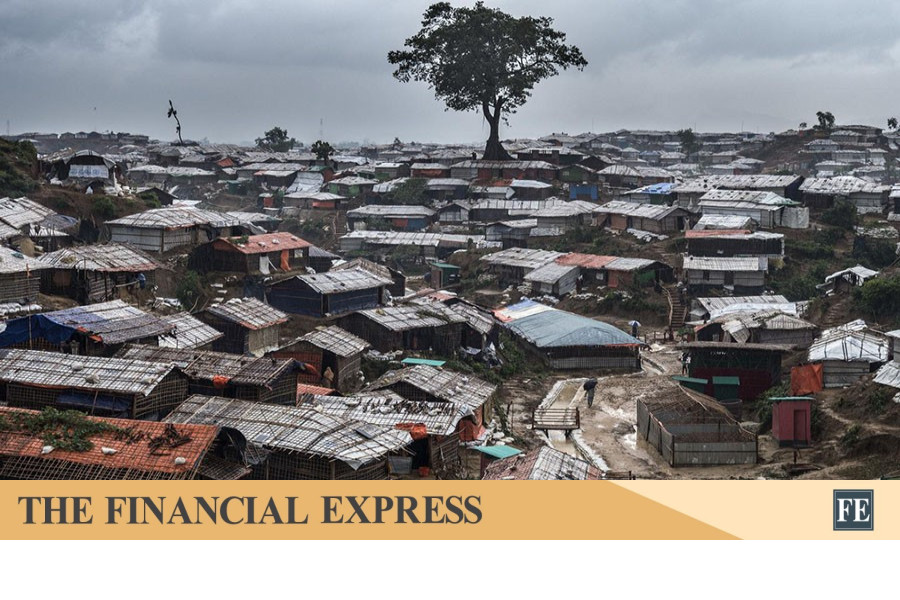
The Kutupalong camp in Cox’s Bazar’s Ukhiya. Star file photo

The UK has provided a new funding of $1.4 million for the Rohingyas in Bangladesh, following earlier allocation of $11.6 million through the World Food Programme in 2025.

"The UK is proud to continue supporting WFP’s vital work for Rohingya refugees, ensuring families have access to nutritious food and essential services," said British Deputy High Commissioner to Bangladesh James Goldman, also the development director at the British High Commission.

“Together, we will keep working to provide the essentials they need and build hope for a better future. This support will also directly benefit Bangladesh’s economy by sourcing goods locally from suppliers within host communities.”

The WFP in a statement today said through an e-voucher system, WFP supports the entire Rohingya community, now nearly 1.2 million people, with lifesaving food assistance.

Families receive an entitlement of $12 per person per month to purchase a variety of staple and fresh food items.

In addition, WFP provides nutrition support to prevent and treat malnutrition for children under 5 and pregnant and breastfeeding women; school feeding for 260,000 Rohingya children aged 3-14; and livelihoods interventions to strengthen resilience for both Rohingya and host community members.

“We are deeply grateful to the UK for continuing to stand with the Rohingya community and supporting WFP’s efforts to meet their essential needs,” said WFP Country Director Simone Parchment.

“At a time when needs are rising and humanitarian funding is declining, the solidarity of the UK and the international community is what vulnerable communities like the Rohingya rely on to survive.”

Now in its ninth year, the Rohingya crisis is confronting severe challenges, including a sharp decline in funding.​
 

Rohingya repatriation only viable solution: Yunus
Bangladesh Sangbad Sangstha . Dhaka 29 January, 2026, 13:14

1769738187543.webp

The new country representative of the UNHCR in Bangladesh Ivo Freijsen, 2nd from left, along with chief adviser Professor Muhammad Yunus and others poses for photo at the state guest house Jamuna in Dhaka on Wednesday. | CA’s press wing photo

Chief adviser Professor Muhammad Yunus said that the repatriation of more than one million Rohingyas to their homeland in Myanmar remained the only viable and sustainable solution to the crisis.

He urged the UN refugee agency to continue its active engagement to facilitate their safe return.

Yunus made the remarks when the newly appointed country representative of the United Nations High Commissioner for Refugees, Ivo Freijsen, paid a courtesy call on him at the state guest house Jamuna in Dhaka on Wednesday, said the chief adviser’s press wing Thursday morning.

During the meeting, the UNHCR representative highlighted the ‘dramatic decline’ in aid for Rohingyas living in camps in Bangladesh’s southeastern district of Cox’s Bazar and stressed the need for greater self-reliance and livelihood opportunities in the settlements.

Professor Yunus said the Rohingya crisis was not receiving the attention it deserved, despite the interim government of Bangladesh organising a series of high-profile events over the past year, including a visit by the UN secretary-general to the camps during Ramadan, which helped draw international focus to the humanitarian issue.

He said prolonged stay of the Rohingyas in the camps could never be a solution, as it had already created tensions with host communities, and called for renewed international efforts to ensure repatriation.

‘The problem began in Myanmar, and the solution must also come from there. A frustrated and angry young generation is growing up in the camps, with access to technology. This is not good news for anyone. Our job is to make sure they return to their homeland in peace and dignity,’ the chief adviser said.

The meeting also covered the Rohingya situation in Bhasan Char, the forthcoming general elections and referendum, and the country’s democratic transition.

Professor Yunus noted that many Rohingyas had fled shelters on Bhasan Char Island and blended into the mainland population, creating new challenges for the country.

Ivo Freijsen said that Barham Salih, the newly appointed UNHCR chief, has expressed keen interest in visiting Bangladesh in the near future and is expected to travel to the Rohingya camps. His predecessor, Filippo Grandi, visited the camps several times since 2017.

Professor Yunus said Bangladesh was fully prepared to hold a free, fair and festive election.

‘We want to set a new standard in conducting elections. All our efforts are focused on ensuring a credible and well-conducted poll. For first-time and new voters, we want the process to be enjoyable and to create a festive and inclusive atmosphere,’ he said.

Lamiya Morshed, SDG coordinator and senior secretary to the government, was also present at the meeting.​
 

Rohingya survivors expect UN's highest court to find Myanmar committed genocide

REUTERS
Published :
Jan 30, 2026 22:50
Updated :
Jan 30, 2026 22:50

1769819347592.webp


Judge Yuji Iwasawa, president of the International Court of Justice (ICJ), presides over the the ICJ, as the court starts two weeks of hearings in a landmark case brought by Gambia, which accuses Myanmar of committing genocide against the Rohingya, a minority Muslim group, in The Hague, Netherlands, Jan 12, 2026. Photo : REUTERS/Piroschka van de Wouw

Rohingya survivors of the 2017 military crackdown in Myanmar expect the International Court of Justice, the United Nations' highest court, to rule the country committed genocide against them, they said on Friday.

A judgment is expected in three-to-six months' time following three weeks of hearings at the court in the Hague that is also known as the World Court.

The outcome of the case will have repercussions beyond Myanmar, including affecting South Africa’s genocide case at the court against Israel over the war in Gaza.

GAMBIA BROUGHT THE CASE

In their final submissions this week, lawyers for Gambia, a mainly Muslim country that brought the case, told the court that the only reasonable conclusion to be drawn from Myanmar's conduct is that it intended to destroy the Rohingya as a group.

Myanmar has denied accusations of genocide and said the 2017 offensive that forced at least 730,000 Rohingya from their homes and into neighbouring Bangladesh was a legitimate counterterrorist operation.

Speaking on Friday on the sidelines of a meeting of survivors of mass atrocities, Yousuf Ali, a 52-year-old Rohingya refugee who says he was tortured by the Myanmar military, said he believed the court would declare a genocide had been committed.

"The world has witnessed us suffering for so many years (... ) how we were deported, how our homes were destroyed and we were killed," he said.

A UN fact-finding mission concluded the offensive had included "genocidal acts" and survivors recounted killings, mass rape and arson.

At the international court, Myanmar's lawyers said the fact-finding mission was biased and that its conclusions did not have the standard of proof needed for a finding of genocide.

Gambia's Justice Minister Dawda Jallow asked the court to reject Myanmar's arguments and said a judgment declaring genocide would help to break Myanmar's "cycle of atrocities and impunities".​
 

Rohingya refugee crisis and global failure of justice

Sayed Mohammad Abu Daud

1770280101787.webp

File Photo: Reuters

Years after the mass exodus of Rohingya people from Myanmar, the crisis stands as one of the clearest examples of the global failure of justice. Although Myanmar is bound by the Geneva Conventions, customary international humanitarian law norms, and the Genocide Convention of 1948, the Rohingya people are still deprived of justice, safety, and a viable path to return home. The problem, therefore, lies not in the absence of legal rules, but in the absence of principled enforcement.

International courts have played a role, although lacking effects. In response to the Gambia’s allegation against Myanmar, the International Court of Justice (ICJ) ordered temporary measures in 2020 to stop the genocide and protect evidence. However, the orders remain largely symbolic as military operations are still ongoing in Rakhine State, humanitarian access is limited, and there is no real accountability in sight. Although the ICJ has moral and legal authority, it has limited enforcement mechanism. Consequently, its decisions could end up being nothing more than formal condemnations.

The International Criminal Court (ICC) suffers from similar limitations. However, in 2018, it was decided that the ICC can deal with crimes that cross borders to a signatory State, like that of the forced deportation of Rohingya people to Bangladesh (although Myanmar is not a signatory to the Rome Statute). While this has allowed an investigation to proceed, it does not address the full scale of atrocities committed within Myanmar. Eventually, arrests remain impossible without cooperation from the very same authorities accused of the crimes. As a result, justice delayed, in this context, increasingly resembles justice denied.

Furthermore, geopolitics has further weakened enforcement. China and Russia have repeatedly protected Myanmar from strong actions by the UN Security Council using their veto powers. On the other hand, ASEAN’s long-standing policy of non-interference has led to careful diplomacy instead of holding the states accountable. As a result, most of ASEAN’s work is still symbolic, with little or no effect to stop the mass atrocities. This paralysis exposes a harsh reality: international humanitarian law depends both on legal obligation and on political will.

The consequences of this failure are borne most heavily (and disproportionately) by Bangladesh. The conditions for more than a million Rohingya refugees in Cox’s Bazar and Bhasan Char are increasingly deteriorating. The scarcity of funds has resulted in reduced food rations, limited educational opportunities, and overburdened health services. Moreover, donor fatigue has made an already fragile humanitarian situation even more vulnerable. On the other hand, the lack of accountability in Myanmar makes safe, voluntary, and dignified return rather impossible.

If the world really cares about justice, it needs to stop responding in bits and pieces and start working together. Bangladesh, willing ASEAN members, and relevant UN bodies could all support a regional system for collecting and documenting evidence. This could help keep the evidence safe and protect the witnesses, even if Myanmar remains unwilling to cooperate. Justice should not rely on the acquiescence of alleged offenders.

At the same time, sanctions need to be clear and impactful as well. While individual national measures have little effect, a unified sanctions regime aimed at military leaders, military-owned businesses, and arms transfers would put real pressure on them. Trade privileges and development cooperation ought to be explicitly contingent upon demonstrable adherence to international court directives. Similarly, ASEAN must also reflect on its actions. The principle of non-intervention should not equate to lack of responsibility. Establishing a regional framework that aligns humanitarian access with accountability will eventually strengthen ASEAN’s credibility.

Indeed, as of 2026, the Rohingya crisis shows a dangerous schism between law and reality. International humanitarian law is well developed, but it fails when political interests trump accountability. Closing this gap is not only a legal imperative but also a moral one. For the Rohingya people, justice delayed is a lived experience in overcrowded camps, through uncertain futures and broken promises. The world must now decide whether international law will remain a statement of principles or finally become a tool that delivers justice.

The writer teaches law at the European University of Bangladesh.​
 

Rohingya population in Cox’s Bazar surges by 179,000 in a year: UNHCR

bdnews24.com
Published :
Mar 16, 2026 22:52
Updated :
Mar 16, 2026 22:52

1773706888206.webp


The number of Rohingya refugees sheltered in Cox’s Bazar has increased by nearly 179,000 over the past year, driven by both fresh influxes from Myanmar and newborns within the camps, according to the latest data from the UN refugee agency.

A report from the United Nations High Commissioner for Refugees (UNHCR) released on Monday shows that the total refugee population in the district reached 1,184,864 as of Feb 28.

This is a significant jump from the 1,006,107 refugees recorded exactly one year ago, marking an increase of 178,757 people.​
 

Rohingya as a test case of global moral failure

Matiur Rahman
Published :
Apr 10, 2026 00:18
Updated :
Apr 10, 2026 00:18

1775953645709.webp

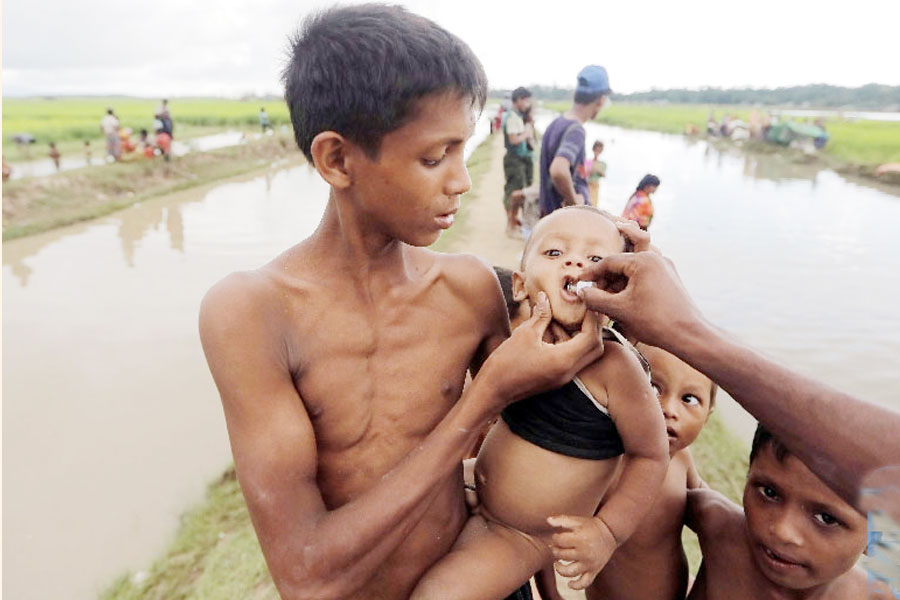
A Rohingya refugee boy who crossed the border from Myanmar, gets an oral cholera vaccine, distributed by UNICEF workers as he waits to receive permission from the Bangladeshi army to continue his way to the refugee camps, in Palang Khali, near Cox's Bazar, Bangladesh Oct. 17, 2017— Agency Photo

There is a concept in political philosophy that the Italian theorist Giorgio Agamben spent decades developing — one that, read in a library or a seminar room, feels like an intellectual exercise, but read against the daily dispatches from Cox’s Bazar in 2026, feels like prophecy. He called it ‘bare life’: the condition of biological existence stripped of political protection, of a human being reduced to a body that can be harmed but cannot seek justice, fed but cannot earn, sheltered but cannot own. Agamben borrowed the idea from Roman law’s figure of ‘homo sacer’ — the person who existed outside every legal category, who could be killed but not sacrificed, who occupied a juridical void where neither the state nor custom extended its protection. The Rohingya of Bangladesh are not a philosophical case study. They are 1.2 million flesh-and-blood human beings, and what is being done to them — and what is being permitted to happen around them — constitutes the most consequential and least examined experiment in the global politics of bare life currently underway.

Eight and a half years after Myanmar’s military carried out what the United States formally designated a genocide, the refugee camps in Cox’s Bazar remain among the largest in the world, housing nearly 1.15 million registered refugees. The word “temporary” has haunted every institutional description of their presence in Bangladesh. But temporariness, when sustained across nearly a decade without a credible resolution, ceases to function as a descriptor and hardens into a social condition of its own. Sociologists have a term for this: permanent temporariness. It describes the condition of a population warehoused indefinitely — systematically denied the legal personality that would allow them to work formally, own property, access domestic courts, or enrol their children in any nationally recognised education system — while remaining fully exposed to every form of violence that their physical surroundings can produce. They are geographically inside Bangladesh. They are legally outside it.

When Agamben describes the refugee camp as the defining political architecture of modernity, he does not mean that camps are aberrations. He means the opposite: that the suspension of rights is not an accident of camp life but its organising principle. The Cox’s Bazar camps illustrate this with uncomfortable precision. The Rohingya face pressure and violence from armed groups and criminal gangs, including sexual violence, abductions, forced recruitment, and extortion. Many victims report a near-total lack of access to protection, legal assistance, and medical care. These are not crimes at the edges of a functioning humanitarian system. They are the predictable and structural output of a designed environment in which a community has no access to legal recourse, no mechanism to hold perpetrators accountable, and no institutional standing to report abuse to any authority with the power to act.

There is no criminal justice system available to refugees in the camps. Security forces have failed to address a culture of impunity surrounding sexual violence, where women, girls, and other vulnerable groups are often targeted. The violence inside is not spontaneous disorder — it is organised, territorial, and escalating. Killings of refugees by militant organisations rose from 22 in 2021 to 90 in 2023, while abductions increased nearly fourfold, with over 700 kidnappings recorded in the first nine months of 2023 alone, compared to approximately 100 in 2021. The Arakan Rohingya Salvation Army is among at least ten armed factions documented as operating inside the camps, each exploiting the institutional vacuum to maintain coercive control over a population with nowhere to turn to. More than 100,000 Rohingya have arrived in Bangladesh since early 2024, fleeing renewed fighting and abuses by both the Myanmar military and the Arakan Army.

Fire has become the most visible symptom of what happens when extreme density meets armed conflict and institutional indifference. Between May 2018 and December 2025, 2,425 documented fires struck the settlement, affecting over 100,000 individuals and destroying more than 20,000 shelters. The February 2026 fire in Camp 11, like dozens before it, was not a natural disaster in any sociologically meaningful sense. The 33 camps in Cox’s Bazar cover just under 24 square kilometres, with an average population density of 47,000 people per square kilometre — more than four times that recommended by international humanitarian standards. In spaces designed for impermanence rather than human habitation, fire is not an accident.

The funding framework constructed to keep this population from the worst outcomes is now in advanced collapse. This is not a gradual deterioration. It is a deliberate withdrawal. Programmes to support the Rohingya were only around half funded in 2025, and as of 2026, stand at a mere 19 per cent of the required levels. The World Food Programme has responded by introducing a tiered rationing system that will reduce already inadequate allowances further. Currently, 1.2 million Rohingya receive twelve dollars per person per month — an amount the community has long warned is barely enough for survivable. Some households will now receive even less than that. The figure of 19 per cent funding is not a statistic in the ordinary sense. It is a declaration by the wealthiest nations on earth that the continued biological survival of the Rohingya is no longer a political priority. It is the international community converting a refugee crisis into a managed disappearance.

The reduction of United States foreign aid in 2025 contributed to a severe funding shortfall; UNICEF reported a 27 per cent loss in its budget, leading to the closure of roughly 2,800 schools in June 2025. The consequences of school closures do not remain contained within the domain of education. The closure of schools has contributed directly to a surge in kidnapping, child marriage, and child labour. When protection infrastructure is systematically dismantled, vulnerability cascades through every dimension of life simultaneously. Each closed school is not merely a lost classroom. It is a removed layer of protection, a widened avenue for armed recruitment, a gateway into trafficking networks.

Understanding this crisis fully requires going beyond Agamben’s framework. The French theorist Michel Foucault’s concept of biopolitics — the modern state’s management of populations through the control of bodies, nutrition, space, and reproduction — finds one of its most literal expressions in the camps of Cox’s Bazar. International agencies determine the number of calories a Rohingya child will consume, the square footage in which a family will sleep, and whether a mother will receive prenatal care. The entire population has been converted into a subject of global biopolitical management rather than a community of rights-bearing persons. Hannah Arendt, writing about statelessness in the aftermath of the Second World War, observed that the fundamental human right is the right to have rights — the prior political condition that makes all other rights meaningful. The Rohingya embody Arendt’s argument with unbearable literalness: without citizenship, without a state willing to claim them, every universal declaration of human rights becomes a document that does not apply.

The question of repatriation — the official answer rehearsed by governments and diplomats — has descended into a form of institutionalised dishonesty. Bangladesh authorities continued to advocate for the repatriation of over one million Rohingya refugees in 2025, even though conditions for safe, voluntary, and dignified returns to Myanmar did not exist. The military establishment that carried out the 2017 atrocities continues to wage war across Myanmar. By 2025, more than 3.5 million people had been internally displaced inside Myanmar as a result of ongoing post-coup violence. Repatriation into that landscape is not a humanitarian solution. It is a rhetorical mechanism that allows international actors to signal concern while avoiding the financial and political commitments that genuine solutions would require.

It would be dishonest, and indeed unjust, to place the entirety of this failure at Bangladesh’s feet. Bangladesh has hosted this population under extraordinary constraints, in a densely populated, resource-limited country that was itself navigating a political crisis. The moral weight of this failure belongs primarily to the international donor community that built the aid architecture, extracted the soft-power returns of humanitarian virtue signalling, and is now withdrawing quietly — and to Myanmar, which produced the crisis and has never been held to adequate account. But specific policy choices within Bangladesh — the complete denial of work rights, the prohibition on higher education outside the camps, the absence of any pathway toward legal status — have measurably deepened vulnerability. These are not natural conditions. They are administrative decisions, and they can be revisited.

If the Rohingya were permitted controlled economic participation — access to small enterprise, regulated labour markets, skills training — the incentive structures that make armed recruitment and drug trafficking attractive would weaken. Self-reliance is not simply a development preference. In conditions like these, it is a security strategy.

On the dusty roads of Cox’s Bazar, barbed wire on both sides, bare life is not a theoretical proposition. It is the daily reality of 1.2 million people whose food assistance has been slashed once more, whose children’s schools have been shut, and who are legally barred from the work that could allow them to feed themselves. The Rohingya crisis in 2026 poses a question not about geopolitics but about something more foundational: whether the international order retains any genuine commitment to the idea that human life, regardless of citizenship, carries inherent value and demands institutional protection. The answer, so far, is being written in funding spreadsheets and campfire statistics. It does not read well.

Dr. Matiur Rahman is a researcher and development professional.​
 

Latest Posts

Back