Home Watch Videos Wars Movies Login

[🇧🇩] July Charter

[🇧🇩] July Charter
39
1K
More threads by Saif

G Bangladesh Defense

July Charter draft disappoints some political parties
Sadiqur Rahman 18 August, 2025, 00:20

1755563164804.webp

AFP file photo

A few political parties, including the National Citizen Party, on Sunday expressed their disappointment with the draft July National Charter 2025 that was shared with political parties concerned by the National Consensus Commission on Saturday.

The draft charter is divided into three parts: a prologue outlining the historical context of the intended reform initiatives, a set of 84 reform issues accepted by the majority of parties, and a covenant.

Representatives of the parties dissatisfied with the draft told New Age that the prologue contains ‘partial’ history while the set of reform issues doesn’t spell out all the disagreements, and the covenant is ‘confusing’.

Parties, including the Bangladesh Nationalist Party, Bangladesh Jamaat-e-Islami, Khelafat Majlis, and Amar Bangladesh Party, said that they would convey their feedbacks by August 20 after discussing the draft on the party forum.

The Ganosamhati Andolan, Revolutionary Workers Party of Bangladesh and Bangladesh Jatiya Samajtantrik Dal-Jasod expressed some concerns about the draft while the Communist Party of Bangladesh and Gano Forum criticised the draft, saying that it undermined the constitution.

NCP joint convener Javed Rasin said that his party was frustrated with the draft charter. His party will express its concern to the consensus commission, he said.

‘There is no timeline. Although the covenant pledges to execute the immediately implementable reforms by the government, there is no guideline on the method of implementation,’ Javed said.

The last section of the eight-point covenant says that the signatories have agreed that any reform measures mentioned in the charter that are deemed immediately implementable shall be executed in full by the interim government and the relevant authorities without delay, prior to the next national elections.

Islami Andolan Bangladesh presidium member Ashraf Ali Akon termed the draft ‘incomplete.’

‘The historical context of the July uprising has only been partially reflected. Moreover, the draft does not mention that our party has strongly demanded a proportional representation system in the lower house,’ he said, adding that a meeting of the party’s highest body would decide its next course of action.

Gano Adhikar Parishad general secretary Rashed Khan strongly opposed the prologue. He complained that the interim government had skipped the ‘Quota Reform Movement of 2018’, which had inspired youths to stand against discrimination and the fascist Awami League regime in the charter.

‘We will express our concerns in the feedback. Our party will take it seriously if our concerns are not addressed,’ he warned.

BNP standing committee member Salahuddin Ahmed, Jamaat assistant general secretary Hamidur Rahman Khan Azad, AB Party president Mojibur Rahman Monju, and Khelafat Maslish secretary general Ahmad Abdul Kader said that their parties would review the draft and give feedback to the commission by August 20.

According to the draft covenant, the signatories will pledge to incorporate all the charter provisions in the constitution and prioritise the document over the existing law of the land.

The charter shall be deemed constitutionally and legally binding and hence its validity, necessity, or authority shall not be questioned in any court. The covenant also says that only the Appellate Division of the Supreme Court is assigned the authority to interpret its clauses.

Terming the provision against questioning the charter in any court as an ‘indemnity’, Communist Party of Bangladesh president Shah Alam said that such indemnity would damage the democratic essence of the constitution.

Bangladesh Jatiya Samajtantrik Dal-Jasod presidium member Mushtuq Husain said that no charter can be implemented by deviating from the democratic norms and principles in practice.

Ganosamhati Andolan executive coordinator Abu Hassan Rubel, however, said, ‘When a charter is prepared in the spirit of the post-uprising masses to change the existing laws and rules, it must be prioritised over the existing laws. Otherwise, the charter has no value or significance.’

He, however, added that the implementation of reforms related to the constitution must be mandated by voters, either through the election of a constitutional reform council or the parliament. The political parties would decide on the process of implementation.

RWPB general secretary Saiful Huq said that matters unrelated to the constitution, on which we have reached consensus, can be implemented immediately.

‘But those related to the constitution must wait for implementation by the next parliament. It will depend on political decisions whether a sovereign parliament legalises this covenant of the charter or not,’ Saiful said.

In the set of 84 ‘agreed’ reform issues, section seven says that the majority of parties have agreed on the inclusion of equality, human dignity, social justice, democracy, and religious freedom, and harmony as the state’s fundamental principles.

Although the CPB, Socialist Party of Bangladesh, SPB (Marxist), Gano Forum, and Bangladesh Jasod have demanded that the consensus commission must not keep the section in the charter, the draft mentions the parties as ‘dissenters’.

The CPB’s Shah Alam, the Bangladesh-Jasod’s Mushtuq Husain, and the Gano Forum’s general secretary Mizanur Rahman, strongly opposed the ‘misleading’ mention.

Mizanur said, ‘The Gano Forum has also dissented from Bangladeshi nationalism [Section 2 of the charter]. But the draft does not mention our party as a dissenter,’ he added.​
 
Analyze

Analyze Post

Add your ideas here:
Highlight Cite Respond

No polls before July charter legitimacy: Jamaat, allies
Staff Correspondent 11 November, 2025, 23:39

Leaders of Bangladesh Jamaat-e-Islami and seven other Islamist parties at a rally on Tuesday said that no general elections would be held before the July National Charter 2025 was given legal legitimacy.

They urged the interim government to take steps for giving a legal basis to the July Charter before the 13th parliamentary elections planned for the first half of February 2026.

The July Charter, an agreement reached through almost a year of negotiations involving various political parties, was signed on October 17. But the political parties remain divided over its implementation method.

Jamaat and the seven other Islamist party organised the rally at the Purana Paltan crossing in the capital Dhaka to press their eight-point demand, including holding a referendum before the national election and holding the next general elections under the proportional representation system.

Islami Andolan Bangladesh amir Syed Muhammad Reazul Karim chaired the rally. Demanding a legal basis for the July Charter, Jamaat amir Shafiqur Rahman at the rally said that those who would not believe in the charter, the 2026 election was not for them.

‘No general elections will be held before giving a legal basis to the July Charter,’ he added.

Mentioning that holding a referendum on the charter before the next general elections was ‘the people’s demand’, he said that why there was a delay in holding the referendum.

‘We want that the next general elections be held before Ramadan, but before that a referendum must be held for giving a legal basis to the July Charter,’ Shafiqur said.

He also said, ‘We will continue our movements until our five-point demand is met.’

Islami Andolan Bangladesh amir Syed Muhammad Reazul Karim said, ‘We will continue their movements so that the fascist Awami League and their partners could not return to power again.’

He called on the Islamic political forces to remain united to resist the fascist political forces.

Bangladesh Khelafat Majlis amir Mamunul Haque said that they would wage tougher movements to compel the interim government to hold a referendum on the charter before the general elections.

A makeshift podium was built at the Purana Paltan crossing for the rally in which a huge number of leaders and activists of the eight political parties took part.

The programme was scheduled to begin at 2:00pm, but activists from Dhaka and nearby districts arrived at the rally venue from the morning in processions, occupying city roads near the rally venue and chanting slogans.

Due to the blocking of some key roads, the traffic movement was disrupted in the areas for several hours, causing sufferings for the city dwellers.

Khelafat Majlis amir Abdul Basit Azad, Nejame Islam Party amir Sarwar Kamal Azizi, Bangladesh Khelafat Andolan amir Habibullah Miajee, Bangladesh Development Party president Anwarul Haque Chand, Jatiya Ganatantrik Party vice-president Rashed Prodhan and Jamaat secretary general Mia Golam Parwar, among others, also spoke at the rally.

On November 6, Jamaat and the seven other parties submitted a five-point memorandum to chief adviser Muhammad Yunus, seeking the implementation of the July Charter and calling for a national referendum ahead of the national election.​
 
Analyze

Analyze Post

Add your ideas here:
Highlight Cite Respond

July Charter implementation order: How much of each party's demands accommodated
Rajib AhmedDhaka
Updated: 14 Nov 2025, 19: 03

1763170027437.webp


The government finally issued the July National Charter (Constitutional Reform) Implementation Order yesterday, Thursday.

Before issuing this order, there were differences of opinion among various parties—including BNP, Jamaat-e-Islami, and the National Citizen Party (NCP)—regarding the implementation of the charter.

The government had given the political parties seven days to resolve their differences and submit a coordinated proposal; however, it is reported that no formal discussions took place among the parties.

The question now is: to what extent did the government consider each party’s objections regarding the July National Charter (Constitutional Reform) Implementation Order and the referendum?

First, let’s understand what the July Charter is.

In the July mass uprising, the Awami League government was overthrown on 5 August last year. After that, calls for reforms grew stronger.

An interim government led by Professor Muhammad Yunus formed 11 reform commissions. Among them, a National Consensus Commission was established, consisting of the heads of the Constitution, Election System, Judiciary, Anti-Corruption Commission, Police, and Public Administration Reform Commissions. Professor Yunus himself served as the chair of this commission.

The National Consensus Commission discussed 166 key proposals and implementation methods from six commissions. Recommendations from the Health Sector Reform Commission, Local Government Reform Commission, Media Reform Commission, Women’s Affairs Reform Commission, and Labour Reform Commission were not included.
However, the government has implemented some proposals from these commissions. Still, stakeholders believe the overall situation is 'not satisfactory'.

The National Consensus Commission held meetings with political party leaders regarding reform proposals in various sectors for nearly eight months.

The National Consensus Commission spent nearly 9 months discussing the recommendations of 6 reform commissions with 30 political parties and alliances.

During these discussions, consensus and decisions were reached on 84 proposals. These proposals formed the basis of the July National Charter, which was signed on 17 October (the NCP and four leftist parties did not sign). Among them, 48 proposals are related to the constitution.

The July National Charter (Constitutional Reform) Implementation Order has been issued to implement these constitution-related proposals, and a referendum will be held on them.

Yes–no referendum

The referendum will be held on the same day as the 13th National Parliament election. Just as voters will receive ballots to vote for candidates, they will also receive ballots for the referendum.

The referendum will have a single question, to which voters must respond with either 'yes' or 'no'. Four proposals will be listed under the question.

The question will be:

"Do you approve the July National Charter (Constitutional Reform) Implementation Order 2025 and the following constitution-related proposals recorded in the July National Charter?"

The four proposals are:

During elections, the caretaker government, the Election Commission, and other constitutional institutions will be formed following the procedures described in the July Charter.

The next parliament will be bicameral. A 100-member upper house will be formed proportionally based on the votes received by the parties in the National Parliament election, and constitutional amendments will require approval by the majority of the upper house members.

The winning parties in the next parliamentary election will be required to implement the 30 proposals on various issues—such as increasing women’s representation in parliament, electing the Deputy Speaker and parliamentary committee chairs from the opposition, limiting the Prime Minister’s term, expanding the President’s powers, broadening fundamental rights, ensuring judicial independence, and local government reforms—that were agreed upon by political parties in the July Charter.

Other reforms described in the July Charter will be implemented according to the commitments of the political parties.

It is worth noting that some say certain proposals—including limiting the Prime Minister to multiple positions and the freedom to vote against one’s own party in parliament—can be implemented by BNP or other parties according to their own commitments or differing views, although these were not specifically detailed in the order.

All four of these proposals include all 48 constitution-related recommendations of the National Consensus Commission.

Why four proposals under a single referendum question? The answer is that this was done mainly to accommodate the objections of the political parties.

To what extent were the objections of different parties considered?

a) BNP opposed the issuance of the July Charter (Constitutional Reform) Implementation Order. They wanted it to be implemented through a proclamation, arguing that the interim government does not have the authority to issue such an order. However, Jamaat supported the constitutional order.

b) BNP also wanted the referendum and the 13th National Parliament election to be held on the same day. The government had already announced that voting would take place in the first half of next February, so BNP’s demand has been met. However, Jamaat’s demand in this regard was not fulfilled, as they wanted the referendum to be held before the national election.

c) BNP objected to the proportional representation (PR) system for forming the upper house of parliament. They wanted the 100 seats in the upper house to be allocated proportionally based on the seats won in the lower house. For example, if a party wins 150 seats in the lower house, they would receive 50 seats in the upper house. BNP’s differing view on the upper house was not accommodated. In this case, the demands of Jamaat and NCP were met. That is, in the parliamentary election, parties will receive seats in the upper house proportionally to the votes they win. For instance, if a party gets 10 per cent of the vote, it will get 10 seats in the upper house, and the party will decide the names of the members.

d) For constitutional amendments, a majority in the upper house will be required—that is, at least 51 votes out of 100. BNP opposed taking the matter of constitutional amendments to the upper house. Their differing view was not considered.

e) BNP wanted a 'note of dissent' system, allowing them to implement proposals with differing views according to their political commitments if they win the election. BNP’s demand in this regard has been partially met. However, their differing views on major issues were not accommodated, such as the Anti-Corruption Commission (ACC), Public Service Commission (PSC), appointment of the Comptroller and Auditor General, and judicial appointments.

For example, BNP wanted appointments to the Anti-Corruption Commission (ACC) to be made by the government through a law. This was not included in the July Charter Implementation Order. If 'Yes' wins in the referendum, the chairman and commissioners of the ACC will be appointed through a Selection and Review Committee. This committee will be led by the senior-most judge of the Appellate Division (excluding the Chief Justice). The committee will include the senior-most judge of the High Court Division, the Comptroller and Auditor General, the Chairman of the Public Service Commission, one representative each from the leader of the house and the leader of the opposition in parliament, and a citizen representative nominated by the Chief Justice. The committee will propose names, and the President will make the appointments.

f) BNP has no objection to the caretaker government itself. However, they had a differing view on how the caretaker government would be formed, which was not accommodated.

g) NCP wanted a legal basis for the July Charter, which has largely been addressed. However, an alternative recommendation by the Consensus Commission suggested that if parliamentary reform proposals are not approved within a specified period, they would automatically become part of the constitution after 270 days. BNP objected to this, and the government did not adopt the automatic amendment recommendation.

h) NCP wanted the Chief Advisor to issue the July National Charter (Constitutional Reform) Implementation Order, because there was objection to President Md Sahabuddin, although under the Constitution of Bangladesh the President can issue such an order. Ultimately, the order was issued in the name of the President.

i) NCP supported the formation of a People’s Assembly or giving a dual role to the next parliament. Jamaat also supported giving the dual role. The July Charter Implementation Order grants the next parliament this authority, meaning the upcoming parliament will function as a constitutional reform council. BNP, however, opposed giving the parliament the powers of a constitutional reform council.

Has the crisis ended?

The question is whether the conflicts among political parties have been resolved and whether everyone is now ready to move forward with the elections.

First, BNP has thanked the government after the issuance of the July National Charter (Constitutional Reform) Implementation Order. However, there is one notable point.

The party has called on the government and the Election Commission to hold a referendum to obtain the people’s approval for the July National Charter, which was signed on 17 October based on consensus, and to organise the National Parliament elections soon.

On Friday, at an event, BNP Standing Committee member Salahuddin Ahmed said that BNP is committed to implementing the July National Charter as it was signed. He added that any proposals imposed forcibly beyond this will be judged by the people.

At a press conference today, Jamaat’s nayeb-e-ameer Syed Abdullah Muhammad Taher, said that they want the referendum to be held first. He also remarked, “I am surprised to see that many changes have been made in favour of a single party.”

The NCP has not yet issued an official response.​
 
Analyze

Analyze Post

Add your ideas here:
Highlight Cite Respond

July charter, referendum: BNP softens stance, Jamaat still rigid
NCP concerned over implementation uncertainty

1763170587660.webp


Although the BNP is not fully satisfied with the government's decisions on key issues regarding the July charter's implementation, it has chosen a softer stance over the matter, ruling out any stern move for now.

On the other hand, the Jamaat-e-Islami has stuck to its demand for holding a referendum on constitutional reforms in the charter before the national election, warning of indefinite sit-ins if its call was ignored.

Meanwhile, the National Citizen Party expressed frustration over the announcement, saying that there is still uncertainty over full implementation of the July charter.

Chief Adviser Prof Muhammad Yunus unveiled the decisions in a televised address on Thursday after the parties missed a one week deadline set by the government to reach a consensus on the unresolved July charter issues.

As per the announcement, the national election and the July charter referendum will be held on the same day, a decision that matched the BNP's demand.

The government also decided that an upper house of parliament will be formed through a proportional representation system on the basis of total votes received by each party. The PR system was among Jamaat's core demands.

At a Standing Committee meeting on Thursday night, BNP leaders reviewed Yunus' address and voiced dissatisfaction over several elements.

Yet, as part of a strategy to keep the election at the heart of its politics, the party decided against any aggressive response for now. Acting chairman Tarique Rahman virtually presided over the meeting at the party chairperson's Gulshan office.

"The party does not want to start a new dispute over the charter at this stage. The government has placed proper importance on holding the election, a key demand the party has long been pushing for," a Standing Committee member told this newspaper after the meeting.

"We will now closely watch how the government proceeds in the coming days," the member added.

Speaking at an event in Shahbagh yesterday, Standing Committee member Salahuddin Ahmed said the BNP remains committed to upholding the July National Charter exactly as signed.

Welcoming the referendum timing, he added, "If any coercive proposals beyond the signed July charter remains, the people will give their decision on these matters through the referendum on the election day."

DEBATE AT STANDING COMMITTEE

During the three-hour meeting, Salahuddin detailed discrepancies between the signed charter and the July National Charter (Constitution Reform) Implementation Order, 2025 issued by President Mohammed Shahabuddin soon after Yunus' address.

Under the order, the next parliament would also function as a Constitutional Reform Council to implement the charter's reforms.

Salahuddin objected broadly to four points: the referendum question, formation of the Constitutional Reform Council, use of the PR system for the 100-member upper house, and the president's authority to issue such an order.

Several members argued that taking a confrontational stance now would only spark complications and distract from election preparations. One member said Tarique was dissatisfied with Yunus' speech but agreed to adopt a softer line as the majority wanted to keep the polls at the centre of its politics.

"There are some people in the Yunus team who want to make the situation complicated. Ahead of the polls, many complications may arise. That's why we closely watch every action of the government," another member said.

The leaders accepted the same-day referendum but said the process is flawed, with a complicated question containing four sections. They said citizens cannot vote on multiple issues in a single referendum question.

They also questioned the legitimacy and authority of a Constitutional Reform Council whose members would not be directly elected -- an issue that had surfaced during the National Consensus Commission talks.

Salahuddin further criticised the government for choosing the PR system for the upper house despite divergent views in the consensus process.

Some members said the president has the authority to issue ordinances, but the head of the state does not have the constitutional power to issue an order of this kind.

JAMAAT REMAINS RIGID

The eight-party alliance, including Jamaat and Islami Andolan Bangladesh, maintained its uncompromising demand for holding the referendum before the national polls.

The government had "bowed to the demand of BNP" by planning both votes on the same day, Jamaat Nayeb-e-Ameer Syed Abdullah Muhammad Taher said while delivering the alliance's official reaction.

He said they were "surprised" that instead of adopting the consensus commission's recommendations, the chief adviser introduced "many changes by compromising with a particular party," implying the BNP.

"As a result, the people and the nation are disappointed," Taher said at a briefing in Moghbazar, flanked by alliance leaders.

Taher argued that the nation had wanted the referendum on a separate day and claimed that if it were held earlier, "80 percent people would go against the thinking and ideology of a particular party."

He said the BNP had refused to accept any referendum held first, and the government had "bowed to their demand."

Accusing the interim government of losing neutrality, he said it was "aligned with a particular party" and attempting to hold an election "in any manner necessary to bring that party to power".

Without naming anyone, he alleged that three advisers were working for that party and demanded their removal.

Taher warned that the alliance would take a "final decision" at its meeting on Sunday, if its demands were not met, though he expressed gratitude to Yunus for giving constitutional legitimacy to the July charter through an order.

Leaders of Islami Andolan Bangladesh, Bangladesh Khelafat Majlis, Khefat Majlish, Bangladesh Nezame Islam Party, JAGPA, and Bangladesh Development Party were present.

NCP SEES VAGUENESS, RISKS

The NCP said several key aspects, such as the implementation order, referendum question, fate of dissent notes on crucial reform proposals and the Constitution Reform Council's authority, are still unclear.

"What will happen if the council cannot complete its job within the 180-day timeframe?" NCP Member Secretary Akhter Hossen asked while giving the party's official response to the chief adviser's address at a press conference yesterday.

One of the alternative proposals recommended by the consensus commission had stated that the proposed reforms would be automatically incorporated into the constitution in case of the Constitution Reform Council's failure to complete the process within a 270-day timeframe. The final order shortened the deadline, but dropped the proposal on automatic inclusion.

"The language used in the order is subject to interpretation …. As a result, instead of ensuring transparency, the order has created further questions," Akhter said.

He urged the government to promptly provide a clear explanation of the order and remove all ambiguities so that the ongoing crisis surrounding the July charter can be effectively resolved.

He demanded that the referendum result must be made binding so that no one can deviate from the charter.

"All in all, the ambiguities and interpretive flexibility left within the July charter implementation order make it vulnerable to exploitation by those who will come to power. We find it deeply concerning," he said.

Chief Coordinator Nasiruddin Patwary said the party would sign the charter only after receiving clarity on the implementation order, referendum framework, and reform roadmap.

"We wanted to dismantle the authoritarian framework of 1972, but through this order, we are once again walking the path of the 1972 Constitution," he said.​
 
Analyze

Analyze Post

Add your ideas here:
Highlight Cite Respond

July Charter will ensure religious rights of citizens: Ali Riaz

BSS
Published :
Jan 27, 2026 20:42
Updated :
Jan 27, 2026 20:42

1769561281728.webp

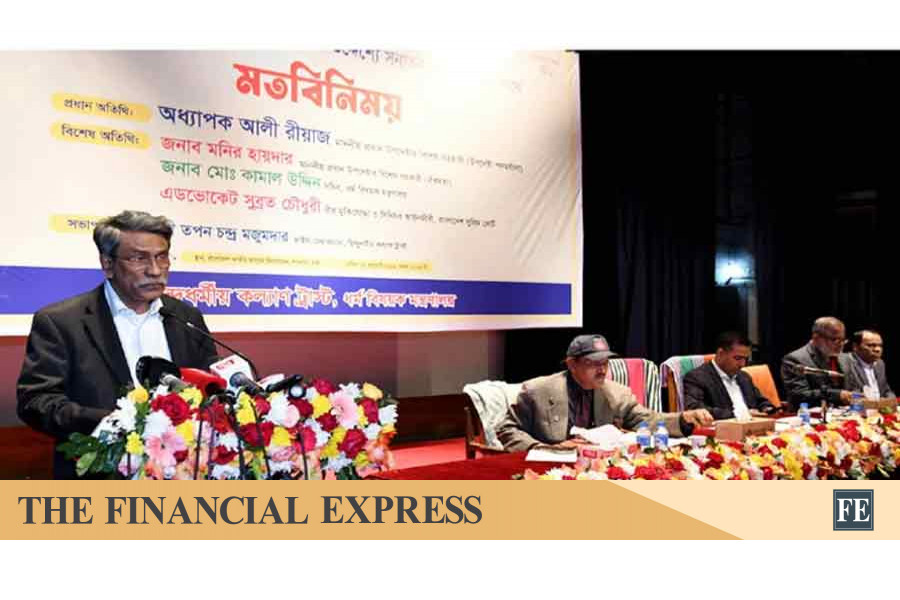
Chief Adviser’s Special Assistant Professor Ali Riaz on Tuesday said the July National Charter will ensure the religious rights of every citizen and establish a society based on equality, human dignity, and social justice.

“July National Charter will establish a society based on equality, human dignity, and social justice, where the state will not discriminate between individuals on the basis of religious belief. The Charter will guarantee equal rights for all as citizens,” he said.

Ali Riaz made these remarks while speaking at a views-exchange meeting with members of Hindu community on referendum campaigning and voter motivation at the auditorium of the National Museum in the capital.

The event was organized by the Hindu Religious Welfare Trust.

He said, “In our dream of creating a democratic and humane homeland, we have had to pass through a bloodstained path. After losing so much, a golden opportunity has come, and we do not want to lose it again.”

Ali Riaz said the existing system must be changed through extensive reforms to rescue the state battered by the oppression of fascism.

He urged the voters to cast ‘Yes’ vote in the referendum to achieve those reforms.

“According to Constitution, all powers of the Republic belong to the people. But the people were kept deprived of it,” he said.

“Participation in the referendum is essential, driven by conscience, so that the future Bangladesh does not resemble the past. Remember, through victory in the referendum, it will be possible to build the state system you desire,” he said.

Regarding the appointment and responsibilities of the President, the chief adviser’s special assistant said in the past everything happened according to the will of the Prime Minister.

Under the Constitution, the President cannot take any decision independently except for appointing the Prime Minister and the Chief Justice, he added.

“Yet it is said that as a constitutional authority, the President appoints bodies such as the Election Commission, the Public Service Commission Secretariat, and judges in the judiciary. In reality, however, these appointments take place according to the wishes of the then head of the government,” he said.

Referring to Article 70 of the Constitution, Ali Riaz said it is like putting Scotch tape over the mouths of MPs of their own parties.

“This provision is a major obstacle to the development of a democratic system. To overcome this, the reform proposal suggests that MPs will remain loyal to their own parties in the case of finance bills and votes of confidence, while on other issues they will be able to express independent opinions,” he said.

As a special guest, another Special Assistant to the Chief Adviser, Monir Haidar, said, “The fundamental objective of our Proclamation of Independence was to ensure the issues such as social justice and human values are supposed to be implemented with dignity.”

He said they want a society where a child’s identity will be determined by merit, acquired knowledge, and effort.

He said false propaganda is being spread that if people vote “Yes” in the referendum, “Bismillah” will be removed from the Constitution and full faith and trust in Allah will not remain. Calling this propaganda as false, he urged everyone not to be misled by it.

Hindu Religious Welfare Trust Vice-Chairman Tapan Chandra Majumder chaired the event while Religious Affairs Secretary Md Kamal Uddin and Hindu Religious Welfare Trust Secretary Devendra Nath Uran also spoke.​
 
Analyze

Analyze Post

Add your ideas here:
Highlight Cite Respond

Yes, no and 'confused': A closer look at the July charter as the referendum nears

30 January 2026, 01:07 AM

By Kallol Mustafa

1769822074192.webp

VISUAL: ANWAR SOHEL

Following prolonged discussions between the National Consensus Commission (NCC) and various political parties on reforms in key state institutions, the July National Charter was signed on October 17, 2025.

After the interim government assumed office in August 2024, six reform commissions were formed initially. Recommendations from five of these commissions—on constitutional reform, the electoral system, public administration, Anti-Corruption Commission, and judiciary—were distilled into 166 reform proposals.

In the first phase, the NCC held discussions with 32 political parties, followed by talks with 30 parties in the second phase. Through this process, the July charter was finalised with 84 reform proposals, many of them accompanied by notes of dissent from political parties. Several parties refrained from signing the charter, citing objections such as proposed changes to the fundamental principles of the constitution, failure to present an accurate historical context, a commitment not to challenge the charter in court, and the absence of clarity regarding the charter’s legal basis and implementation mechanisms.

Areas where consensus was reached

The July charter contains a number of significant reform commitments on which participating political parties reached consensus. If the signatory parties implement these pledges upon assuming power, they could play an important role in Bangladesh’s democratic transition.

As part of the parliamentary reform, the charter proposes amending Article 70 of the constitution to allow members of parliament to vote independently on all matters except budgetary and confidence votes. The BNP supports this reform, albeit with conditions including constitutional amendments and exceptions related to national security or wartime situations. There is also consensus on limiting an individual’s tenure as prime minister to a maximum of 10 years, appointing opposition members as chairs of parliamentary standing committees (including the Public Accounts Committee) in proportion to their seats, and nominating an opposition MP as deputy speaker.

All political parties agreed on appointing the chief adviser of a non-partisan caretaker government through a five-member selection committee comprising the prime minister, leader of the opposition, and others. Similarly, the formation of the Election Commission would no longer depend solely on the prime minister’s preference; instead, election commissioners would be appointed through a five-member selection committee that would include the prime minister, leader of the opposition, and a judge of the Appellate Division.

The president would be granted authority to appoint key constitutional officeholders without the prime minister’s recommendation in certain cases, including appointments to the National Human Rights Commission, Information Commission, Bangladesh Press Council, and Law Commission. At the same time, the president’s discretionary power to grant pardons would be curtailed. Pardons would only be possible under legally defined principles and standards, and with the consent of the victim or the victim’s family.

To effectively separate the judiciary from the executive, the charter proposes establishing a separate secretariat for the Supreme Court and ensuring its financial autonomy. This secretariat would oversee the promotion, transfer, and discipline of subordinate court judges. Instead of appointing the chief justice at the prime minister’s discretion, the president would appoint the chief justice from the senior most judge or from the two most senior judges of the Appellate Division. There is also consensus on forming an independent Judicial Appointment Commission led by the chief justice.

On anti-corruption reforms, consensus includes abolishing the requirement for prior approval before filing cases against government employees, mandating annual public disclosure of income and assets by elected representatives and their family members, enacting beneficial ownership laws to curb corruption and money laundering, and introducing separate legislation to prevent conflicts of interest and abuse of state power.

Regarding police reform, political parties agreed to establish an independent police commission headed by a retired Appellate Division judge, tasked with investigating and resolving complaints against the police.

Consensus was reached—except by Jamaat-e-Islami—on granting financial autonomy to local governments and placing government officials under elected local representatives. All parties except Gano Forum and Nagorik Oikya agreed that local governments should have the authority to raise their own funds.

Areas without consensus

The Constitution Reform Commission had proposed forming a national constitutional council comprising representatives from the executive, judiciary, and legislature to ensure balance of power in key appointments, but it was dropped due to objections from the BNP and several other parties. Later, the National Consensus Commission suggested incorporating provisions in the constitution for appointing members of the Election Commission, Public Service Commission, Anti-Corruption Commission, Comptroller and Auditor General, and Ombudsman through selection committees. While there was consensus on EC appointments, several parties—including the BNP—dissented on applying this method to the other four institutions.

According to the existing constitution, the president is required to act on the advice of the prime minister in all matters except the appointment of the prime minister and the chief justice. Although the NCC initially proposed expanding presidential powers to appoint officials in 12 institutions, discussions ultimately narrowed this scope. The president would make appointments to the NHRC, Information Commission, press council, Law Commission, Bangladesh Bank governorship, and Bangladesh Energy Regulatory Commission (BERC) without the prime minister’s advice. However, the BNP and some other parties dissented on appointments to Bangladesh Bank and the BERC.

While there was agreement on establishing a bicameral parliament, consensus was not reached on the method of selecting members of the upper house. The Constitution Reform Commission proposed proportional representation based on vote share, but the BNP and others favoured allocating seats in proportion to lower house representation. The intended purpose of the upper house—to prevent absolute dominance by a single party in constitutional amendments and approval of major international treaties—would not be achieved if it simply mirrored the lower house. Notably, several parties, including the BNP, have also expressed dissent over the proposal that constitutional amendments and the ratification of international treaties should require approval from both chambers of parliament.

No consensus was reached on changing the fundamental principles of the constitution, with dissent expressed by Gano Forum, JSD, Bangladesh JASAD, CPB, BASAD, and BASAD (Marxist). Jamaat and several others objected to reforms related to local government autonomy, placing local officials under elected representatives, amending the Official Secrets Act, and recruiting teachers and doctors through separate service commissions.

The absence of women and representatives of religious and ethnic minorities in the NCC also shaped the charter’s limitations. Although there was agreement to gradually increase women’s representation in parliament to 100 seats, no decision was finalised—despite demands from the Women’s Affairs Reform Commission—on direct elections to reserved seats. There was partial consensus, with dissent, on requiring political parties to nominate at least five percent women candidates in the next general election and increasing this proportion by five percent in subsequent elections until reaching 33 percent. However, this provision will not be enshrined in the constitution.

What the July charter doesn’t include

Many important recommendations from the first-phase reform commissions were never discussed by the National Consensus Commission, and no effort was made to build political consensus around them. While the charter mentions expanding citizens’ fundamental rights, it does not specify which rights will be expanded or how. Instead, it states that detailed proposals will be outlined in the commission’s report.

Moreover, the NCC did not hold discussions on recommendations made by the second-phase reform commissions on labour, media, local government, women, and health. The heads of these commissions urged Chief Adviser Prof Muhammad Yunus to incorporate their recommendations into the July charter. They said in order to institutionalise democracy and build a new Bangladesh, reform initiatives in line with the recommendations of the second-phase commissions were equally essential. But no visible initiative was taken. Nor did the government clarify how these second-phase recommendations would be implemented, rendering their future uncertain.

The implementation order and referendum

On November 13, 2025, the interim government issued the July National Charter (Constitutional Reform) Implementation Order. Under this order, the parliamentary election and a referendum on the charter will be held on the same day. The referendum will be conducted on four constitutional reform proposals, and voters will be required to cast a single “Yes” or “No” vote on all four collectively.

If the referendum passes, elected representatives will form a Constitutional Reform Council, serving concurrently as MPs. The council must complete constitutional reforms within 180 working days. Within 30 working days of completing the reforms, an upper house will be formed based on proportional representation of votes received in the parliamentary election.

Among the four proposals to be put to the referendum, the first states that the caretaker government, the Election Commission, and other constitutional bodies will be formed in accordance with the procedures described in the July charter. The second proposal states that a 100-member upper house will be formed in proportion to the votes received by political parties in the election. Any amendment to the constitution will require the majority approval of the upper house. The third proposal states that the political parties that win the next election will be bound to implement the 30 proposals on which consensus was reached in the July National Charter. The fourth proposal states that the remaining reforms described in the July charter will be implemented in accordance with the commitments made by the political parties.

It is noteworthy that the way the referendum proposal on the July charter has been framed allows some reforms to be implemented in line with the political parties’ notes of dissent, while other reforms do not allow for implementation based on notes of dissent. If the “Yes” vote prevails in the referendum, the reform proposals for which political parties’ notes of dissent will no longer remain effective include the formation of the caretaker government, EC, appointments to various constitutional offices, and the formation of the upper house through a PR system. This has been ensured through the first and second proposals of the referendum. For the remaining issues, the fourth proposal of the referendum states that political parties will be able to implement reforms in accordance with their respective notes of dissent or differing opinions.

This order for implementing the July National Charter may give rise to various complexities.

First, the referendum question included in the implementation order conflicts with the July charter that was signed. This is because the charter states that political parties would mention their notes of dissent in their election manifestos, seek public consent, and then act accordingly. However, the way the referendum proposal has been framed in the implementation order does not give due importance to political parties’ notes of dissent regarding the formation of the upper house, caretaker government, EC, and other constitutional bodies. If the “Yes” vote prevails in the referendum, an obligation will arise to implement the proposed reforms regarding the formation of the caretaker government, EC, and “other constitutional bodies” exactly as described by the National Consensus Commission in the July charter. Since it has not been clearly specified, complications may also arise regarding which bodies are meant by the term “other constitutional bodies.”

Second, if the outcome of discussions with political parties is disregarded and public opinion is sought directly, then the question arises: why should a referendum be held only on constitutional reform proposals? Why not hold a referendum on all the recommendations given by the 11 reform commissions?

Third, lengthy debates among political parties took place on constitutional reform proposals, yet consensus was not achieved on all issues. How reasonable is it, then, to ask the public to express their opinion with a single “Yes” or “No” on all these matters? Like political parties, ordinary citizens may agree on some issues and disagree on others. In that case, how can they express their views on all constitutional reform proposals with a single word? Moreover, has the public been adequately informed about all the positive and negative aspects of these reform proposals? Generally, referendums are held to seek public opinion on a constitution that has been adopted through majority voting after discussions and debates in a constituent assembly. Here, the exact opposite is being done: first holding a referendum and then asking the constitutional reform council to amend the constitution accordingly.

Fourth, by disregarding the political parties’ differing opinions on proportional representation in the upper house, formation of the caretaker government, and appointments to constitutional offices in the referendum question, the implementation of the entire July charter may be put at risk. This is because if a political party considers safeguarding these dissenting positions to be essential, it may campaign for a “No” vote against the entire referendum package. Since the referendum does not allow separate voting on the four proposals—even though there are four questions, there is only one answer—if any party disagrees strongly with even one proposal, it may be motivated to vote “No” for the entire referendum. By contrast, if the referendum had accommodated dissenting views, those parties would have voted “Yes” and would then have been bound to implement their respective promised reforms upon coming to power. Due to the interim government’s current referendum proposal, not only the dissenting proposals but also the implementation of the agreed-upon reform proposals may now fall into jeopardy. Even if the “Yes” vote prevails, the party or coalition forming the government after the election may refuse to implement certain reforms by citing their notes of dissent in the signed July charter, which could then create a different set of legal, constitutional and political complications.

How certain is implementation?

Even if the July National Charter secures popular approval through a referendum and gains the highest legal standing, its implementation will ultimately depend on the political will of future governments. Past experience offers little reassurance.

In 1990, during the anti-autocracy movement, three major political alliances published a joint roadmap promising free elections, independent state media, judicial independence, and protection of fundamental rights. None of these commitments were fully realised by subsequent governments.

There is no guarantee that the charter will not meet the same fate. Ensuring its implementation will, therefore, require vigilant oversight by political actors and civil society, alongside sustained pressure to enact reform recommendations excluded from the charter. Otherwise, as late Local Government Reform Commission Chair Prof Tofail Ahmed once warned, these reports may add little more than archival value to history.

Kallol Mustafa is an engineer and writer who focuses on power, energy, environment, and development economics.​
 
Analyze

Analyze Post

Add your ideas here:
Highlight Cite Respond

July Charter written in blood: Ali Riaz

DU CORRESPONDENT
Published :
Feb 05, 2026 10:04
Updated :
Feb 05, 2026 10:04

1770277054705.webp


Prof Ali Riaz, special assistant to the Chief Adviser, said although the printed copies appear in black ink, every letter of the July National Charter was written with the blood of the people of Bangladesh.

He made the remarks while speaking at a discussion titled "Public Awareness Campaign on the Referendum for Public and Private Universities" at the Nawab Ali Chowdhury Senate Building auditorium of Dhaka University on Tuesday.

Referring to the sacrifices of the July martyrs, Ali Riaz said they did not aspire to become prime minister or president, but sought a dignified state.​
 
Analyze

Analyze Post

Add your ideas here:
Highlight Cite Respond

DISSENTS IN JULY CHARTER: Most parties mum in polls manifestos
Sadiqur Rahman 10 February, 2026, 00:28


1770686626132.webp


Several political parties that formally recorded dissenting opinions on key provisions of the July Charter for state reforms have largely avoided explaining those positions in their election manifestos ahead of the 13th Jatiya Sangsad elections, despite pledging to do so.

At least 34 political parties participated in the drafting of the July National Charter past year. At least 28 parties submitted notes of dissent regarding different provisions in the charter and made commitments to explain those in their election manifestoes.

But many of their objections were either omitted or selectively reinterpreted in their manifestos for the national elections and the concurrent referendum scheduled for February 12.

Election analysts say that the ‘selective silence’ in manifestos weakens informed public debate.

Shushashoner Jonno Nagorik executive director Badiul Alam Majumdar, also the former member of the National Consensus Commission and the chief of the Electoral Reform Commission, told New Age, ‘The reform proposals outlined in the July Charter have the support of the majority. Even so, those who expressed dissent regarding certain proposals should clarify their logic to the voters.’English language tutoring

On women’s representation, Bangladesh Khelafat Majlis dissented from the charter’s requirement of fielding at least 10 per cent female candidates.

The party’s manifesto neither addressed women’s representation in the Jatiya Sangsad nor explained its objection.

The July Charter includes a provision strengthening the Supreme Judicial Council in line with Article 96 of the constitution, which determines the tenure of judges.

The Bangladesh Jamaat-e-Islami and the Jamiat Ulama-e-Islam dissented from this provision.

However, the Jamaat did not explain its position on this dissent in its election manifesto. The Jamaat unveiled its election manifesto on February 4.

The Jamaat also dissented from the July Charter provisions granting autonomy to local government bodies to manage finances and terms of reference and to place government officials working at the local level under elected representatives.

In its election manifesto, the Jamaat did not mention how it would ensure a balance of power between elected representatives and government officials at the local government level.

On the issue of nationality, the July Charter defines citizens of the country as ‘Bangladeshi’, a point dissented by three political parties, including the Jatiya Samajtantrik Dal-JSD.

However, the JSD’s election manifesto has urged voters to cast their votes for ‘yes’ in the referendum on state reforms, but has not referred to its dissenting position on the issue.Bangladesh cultural tours

The JSD unveiled its election manifesto on February 6.

Regarding constitutional amendments, the charter stipulates that such amendments require a majority in the upper house.

The Bangladesh Nationalist Party dissented from this provision.

Its manifesto, released on February 6, proposed that all bills, except constitutional amendment bills, money bills, votes of confidence and national security matters, be sent to the upper chamber.

The charter empowers the president to appoint top officials of several constitutional and statutory bodies, including the National Human Rights Commission, the Bangladesh Energy Regulatory Commission, and the governor of Bangladesh Bank, without consulting the prime minister.

The BNP, along with seven other like-minded parties and alliances, opposed the president’s particular authority.

Yet presenting no explanation on the issue, the BNP’s manifesto stated that the executive body would appoint BERC officials and the BB governor ‘in accordance with the law’.

The Islami Andolan Bangladesh, which also dissented from the BB governor appointment process, did not mention the issue in its manifesto. The IAB unveiled its election manifesto on February 4.

On the charter suggestion that prime minister would not hold party chief position, the BNP maintained in its manifesto its dissent with the suggestion.

The Nationalist Democratic Movement also dissented from the suggestion. The NDM did not present their election manifesto.

The July Charter stipulates that the proportional representation would be based on vote casted. Opposing the point, the BNP recommended a PR system based on seats secured in the lower house.

The BNP maintained its dissent in its election manifesto.

The July Charter includes a provision increasing the nomination of female candidates by at least five per cent in every Jatiya Sangsad election to eventually ensure 33 per cent women’s representation.

The National Citizen Party dissented from this provision. The party, however, did not sign the charter.

In its election manifesto, the NCP pledged that 100 seats in the lower house would be reserved for women through direct elections, with the number gradually reduced as women’s participation in politics increases.

The party unveiled its election manifesto on January 30.

Criticising the text of the July Charter, the Socialist Party of Bangladesh (Marxist) in its election manifesto, said that the party initially was in favour of incorporating the July Charter into the constitution, but later changed its position as it was unclear how the charter would be incorporated into the constitution along with notes of dissent.

In the charter, it has been noted that any political party or alliance, if includes its respective note of dissent in its election manifesto and secures a mandate from the people, may take action accordingly.

A commission under the interim government that assumed office on August 8, 2024, after the fall of the authoritarian Awami League regime finalised the July charter on October 17 past year.​
 
Analyze

Analyze Post

Add your ideas here:
Highlight Cite Respond

Members Online

Latest Posts

Back
 
G
O
 
H
O
M
E