New Tweets

[๐Ÿ‡ง๐Ÿ‡ฉ] July uprising

G Bangladesh Defense
[๐Ÿ‡ง๐Ÿ‡ฉ] July uprising
71
2K
More threads by Saif


707 cases filed in capital over July uprising, 5,079 held

BSS Dhaka
Published: 08 Aug 2025, 21: 24

1754701855258.webp

July Graffiti BSS

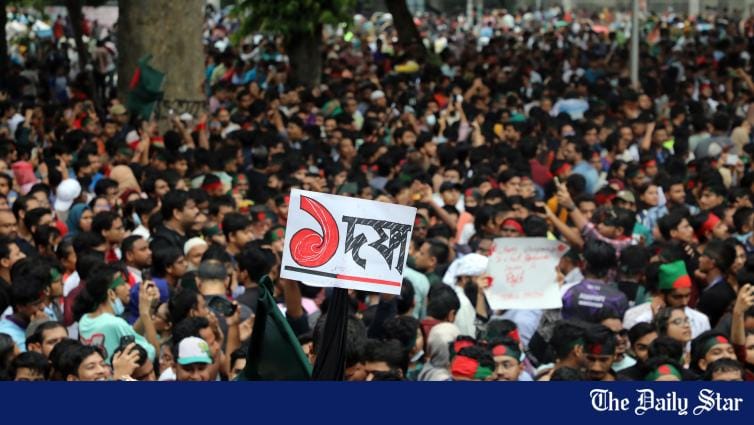
A total of 707 cases have been filed with 50 police stations across the capital till 5 August 2025, in connection with the killing and attempted killing incidents during the July-August Mass Uprising that toppled the Awami League (AL) government.

The uprising forced the then Prime Minister Sheikh Hasina to resign from office and flee the country.

During the movement, around 1,400 were killed and several thousand others injured after being shot by members of law enforcement agencies, cadres of the Awami League, and its affiliated organisations.

According to police, the cases name thousands of top leaders and activists of the Awami League, including its president and ousted prime minister Sheikh Hasina.

Following the cases, police arrested former law minister Anisul Huq, former adviser to the Prime Minister Salman F Rahman, former ministers Amir Hossain Amu and Dr Dipu Moni, Rashed Khan Menon, Hasanul Haq Inu, former state minister for ICT Zunaid Ahmed Palak, former MPs Momtaz Begum, A M Naimur Rahman Durjoy, Kazi Monirul Islam Monu, Abdus Sobhan Golap and AKM Sarwar Jahan Badsha, among others.

In total, 5,079 AL leaders and activists and members of its affiliated bodies have been arrested during the period.

Two former Inspectors General of Police (IGPs) -- Mohammad Shahidul Haque and Chowdhury Abdullah Al-Mamun -- along with 21 other former and serving police officials are among the detainees.

The arrested police officials are former DMP Commissioner Mohammad Asaduzzaman Miah, former DIG Molla Nazrul Islam, former DC Tanvir Salehin Emon, former Sylhet SP Abdul Mannan, former SP Mohammad Asaduzzaman, former DC of DB Lalbagh Division Mashiur Rahman, Additional Deputy Commissioner (ADC) (Dhanmandi Division) Abdullah Hil Kafi, Assistant Commissioner Md Tanzil Ahmed, former ADC Md Shahen Shah, ADC Md Jewel Rana, former Gulshan OC Md Rafiqul Islam, former Additional SP Md Apel Uddin, AC (DB Gulshan Division) Md Iftekhar Mahmud, former OC of Jatrabari Police Station Md Abul Hasan, Inspector Majharul Islam, SI Md Sajjad-uz-Zaman, Nayek Sojib Sarkar, constables Sujon Hossain, Shoaibur Rahman and Md Bayejid Bostami.

Confirming the information, ADC (administration) of DMPโ€™s Prosecution Division Mayeen Uddin Chowdhury told BSS that 707 cases have been lodged, so far, over killings and attempted killings during the uprising.

โ€œA total of 5,079 people -- including ministers, MPs, and senior officials -- have been arrested. Among them, two former IGPs and 23 police officials are included. All cases are currently under investigation,โ€ he added.​
 
Analyze

Analyze Post

Add your ideas here:
Highlight Cite Respond

5,079 arrested in Dhaka till Aug 5 over killings, attacks during July Uprising
707 cases filed with 50 police stations across the capital


A total of 707 cases have been filed with 50 police stations across Dhaka till August 5, 2025, in connection with the killings and attempted killings during the July uprising.

Additional Deputy Commissioner (Administration) of the DMP Prosecution Division Main Uddin Chowdhury told BSS that 707 cases have been lodged, so far, over killings and attempted killings during the uprising.

"A total of 5,079 people -- including ministers, MPs, and senior officials -- have been arrested. Among them, two former IGPs and 23 police officials are included. All cases are currently under investigation," he added.

The uprising forced Sheikh Hasina to resign from office and flee the country and toppled the then Awami League government. During the movement, around 1,400 were killed and several thousand were injured after being shot by members of law enforcement agencies, activists of the Awami League, and its affiliated organisations.

According to police, the cases name thousands of top leaders and activists of the Awami League, including Hasina.

Following the filing of cases, police arrested former law minister Anisul Huq, former private industry and investment adviser Salman F Rahman, former ministers and AL MPs Amir Hossain Amu and Dipu Moni, Rashed Khan Menon, Hasanul Haq Inu, former state minister Zunaid Ahmed Palak, former MPs Momtaz Begum, AM Naimur Rahman Durjoy, Kazi Monirul Islam Monu, Abdus Sobhan Golap, and AKM Sarwar Jahan Badsha, among others.

Two former inspectors general of police (IGPs), Mohammad Shahidul Haque and Chowdhury Abdullah Al-Mamun, along with 21 other former and serving police officials are among the detainees.​
 
Analyze

Analyze Post

Add your ideas here:
Highlight Cite Respond

The anatomy of post-uprising disillusionment

1754965039305.png

'It is time to confront a painful possibility that the July movement was not about systemic transformation, but about renegotiating power.' FILE PHOTO: PALASH KHAN

When Sheikh Hasina's Awami League government finally fell on August 5, 2024, after over 15 years in power, many saw this as the end of not just a regime but also its legacy of nepotism, elite capture, and weaponisation of bureaucracy. In its place, an interim government, strengthened by student leaders and civil society figures, promised a new beginning. But now, on the first anniversary of that momentous transition, we are left to confront a dispiriting paradox: the more things seem to change, the more they seem to remain the same.

To observe this trajectory is not merely to diagnose political stagnation; it is to confront a deeper malaise that grips the postcolonial state. The Bangladeshi polity, like many postcolonial entities, remains haunted by what Partha Chatterjee termed the "derivative nature" of its politics, importing forms of democracy and revolution without addressing their foundational preconditions: ethics, justice, and institutional integrity.

Instead of dismantling the Hasina-era architecture of inequality, the uprising appears to have inherited its scaffolding. The bureaucracy, once subservient to a party machine, remains largely unchanged, save for new masters who often replicate the performative gestures of the old. The passport office is still a Kafkaesque labyrinth; BRTA still delays issuing licences; roads are still cleared for convoys of newly minted VIPsโ€”the list goes on. The "sir" culture persists not because of policy failure, but because it is rooted in a psychology of entitlement and feudal deference cultivated over generations.

What is equally disturbing is the appropriation of the movement's moral capital by those who once fought under its banner. Many students who braved tear gas and rubber bullets in the name of justice now find themselves accused of replicating the very practices they once condemned. Extortion, influence-peddling, and administrative favouritism are no longer exclusive to career politicians; they have found new agents among the revolution's own. This is what Hegel would describe as the "tragedy of history," wherein noble ideas are often corrupted by the dialectic of power.

History offers many such warnings. The Bolshevik Revolution, once heralded as the dawn of proletarian emancipation, ossified into Stalinist terror. The post-Mubarak transition in Egypt collapsed into military authoritarianism. Even the French Revolution, perhaps the most emblematic of all, devoured its own architects in the Reign of Terror. In each case, the moral legitimacy of mass uprising was squandered by the inabilityโ€”or unwillingnessโ€”of its leaders to reimagine governance beyond the idioms of control and domination.

The failure of Bangladesh's post-July regime lies not in its slow pace of reformโ€”radical change is rarely instantโ€”but in its abandonment of ethical seriousness. What was meant to be a foundational rupture has congealed into a cynical continuity. The deeper structures of clientelism, bureaucratic aloofness, or institutional dysfunction remain unmoved. July, a symbol of defiance, is now turning into a brand rather than a beacon. The very mechanisms that animated resistanceโ€”solidarity, courage, and truth-tellingโ€”have been commodified.

Perhaps nowhere is this more visible than in the movement's treatment of women. It was women who reignited the movement on the night of July 14, 2024, when they marched from Rokeya Hall in defiance of curfews and repression. Their audacity shifted the moral centre of the uprising. And yet, a year later, discriminatory rules still bind women within university halls, harassment on the streets remains rampant, and the societal reflex to rehabilitate predators with garlands of social forgiveness is unchanged. Simone de Beauvoir once warned that no revolution is truly revolutionary unless it transforms the condition of women. In this sense, the July uprising has not merely fallen short; it has betrayed its most courageous constituency.

It would, however, be too easy, and too comforting, to lay blame solely at the feet of the new leadership. The deeper problem is cultural and civilisational: our collective fascination with the theatre of change and our reluctance to pursue the rigours of transformation. The Bangladeshi elite, intellectual and political alike, have mastered the aesthetics of protest but remain averse to the ethics of reform. We chant slogans with lyrical passion but balk at the demands of justice when they challenge our privileges. Nor can we ignore the complicity of the populace. When civic memory is short and historical amnesia is encouraged, authoritarian residues thrive. When corruption is normalised as a tool of survival, and influence is celebrated as success, revolutions cannot endure.

It is time, then, to confront a painful possibility: that the July movement was never about systemic transformation, but about renegotiating power; that the anti-discrimination rhetoric was instrumental, not intrinsic; and that the struggle was less about eliminating privilege and more about redistributing it.

Still, all is not lost. The disappointment of the past year may yet serve as a crucible for a more serious reckoning. We must resist the temptation to romanticise revolutions or demonise reform. What is needed is a deep reimagining of the moral foundations of public life in Bangladesh. We must ask: What does it mean to govern ethically? What does it mean to dissent responsibly? What does it mean to rebuild institutions that serve, rather than dominate, the people?

Education, too, must rise to this challenge. Universities must become sites not only of resistance but also of reflection. Students must be taught not only to demand rights but also to practise justice. We must return to the basics of civic education as a collective pursuit of wisdom, integrity, and service.

To the young who marched last July, and dreamed of a Bangladesh without discrimination, let this be a reminder: that revolutions are not eventsโ€”they are obligations. Their legitimacy lies not in what they destroy, but in what they dare to create. The golden Bengal we dreamed of was never going to be inherited; it must be built, word by word, act by act, truth by truth. And that work is not yet done.

H.M. Nazmul Alam is an academic, journalist, and political analyst.​
 
Analyze

Analyze Post

Add your ideas here:
Highlight Cite Respond
 
Analyze

Analyze Post

Add your ideas here:
Highlight Cite Respond
 
Analyze

Analyze Post

Add your ideas here:
Highlight Cite Respond
Bangla version


English version
 
Analyze

Analyze Post

Add your ideas here:
Highlight Cite Respond
  • Love (+3)
Reactions: Saif
Hasina has been sentenced to death for her crimes against humanity. She will rot in hell for killing so many students during July uprising.
 
Analyze

Analyze Post

Add your ideas here:
Highlight Cite Respond

Mass uprising wasnโ€™t to impose religious dominance or any particular ideology: Zonayed Saki
Staff CorrespondentChattogram
Published: 05 Dec 2025, 21: 39

1764982980133.webp

Ganosamhati Andolan chief coordinator Zonayed Saki addresses a pre-procession rally in Chattogram city on 5 December 2025 Prothom Alo

The mass uprising of 5 August (2024) did not take place to impose any form of religious dominance or any particular ideology, Ganosamhati Andolan chief coordinator Zonayed Saki stated on Friday.

He made the remarks during a pre-procession rally in Chattogram city this afternoon.

Zonayed Saki said that the Julyโ€“August uprising occurred to establish democracy. Thousands of youths sacrificed their blood for a new political settlement.

As part of Ganosamhati Andolanโ€™s nationwide series of โ€œmathal marchesโ€, todayโ€™s programme was organised jointly by the organisationโ€™s Chattogram north, south and city units.

Addressing the gathering as the chief guest, Zonayed Saki spoke on the constitution, reforms, elections, fascist politics and several other issues. He also introduced to party activists the Ganosamhati Andolan leaders who are contesting as candidates in the upcoming national election.

The Ganosamhati Andolan chief coordinator said that Sheikh Hasina had tried to suppress the movement through various machinations, conspiracies, attacks, lawsuits, repression and killings. Students took to the streets in Julyโ€“August. Students were shot dead in broad daylight. That was why the people of Bangladesh united.

Pointing out that the students played the leading role in this struggle, uniting people across the country, he further said that the political parties, various professional groups and citizens from all walks of life took to the streets during this period. The uprising took place to establish democracy and build a state free from fascism.

Speaking on the matter of ports, Zonayed Saki said that the interim government survives on the support of political parties and stakeholders. Before taking decisions on any major national issue, it should have consulted political parties and stakeholders from different sectors. Instead, the government signed agreements on ports without any such consultation.

Regarding the upcoming parliamentary election, the Ganosamhati Andolan leader said, โ€œWe want to stand tall with dignity on the world stage. With that goal in mind, we have charted the course of our politics. Let us work together to ensure that Bangladeshโ€™s new democratic journey, through the upcoming election, becomes successful. We need political rights. Without political rights, our freedom of speech, our freedom to raise demands, and each individualโ€™s right to survival will not be secured.โ€

Zonayed Saki further said, โ€œFrom the very beginning, Ganosamhati Andolan has continued its struggle to establish the rights and dignity of workers, peasants, labouring and marginalised people, including the majority in this country. The state established through the Liberation War, built upon the blood of hundreds of thousands of martyrs, had pledged to ensure equality, human dignity and social justice for all citizens. But regrettably, in the past 54 years, we have not seen that equality, dignity or social justice realised.โ€

Drawing on the constitution, Zonayed Saki said, โ€œThe foundation of authoritarianism, fascism and autocracy in Bangladesh lies in the constitutional power structure. The Constitution of 1972 gave the prime minister far greater power than any head of government in the world. With that power, successive governments placed all institutions in their pockets and oppressed the people. That is why we have said clearly: merely changing the ruler or the government will not be enough. The system of governance and the constitutional power structure must be changed, otherwise the democratic rights of the people will not be established.โ€

Zonayed Saki elaborated on various stages of state reform. โ€œWe have presented specific proposals for fundamental reforms to the governance system. Among these are the abolition of Article 70 of the Constitution. This article has turned elected representatives into mere hand-raising MPs.โ€

He continued, โ€œWe have demanded that no individual should be allowed to serve more than two terms as prime minister. We have also called for the formation of a constitutional commission to oversee appointments to all constitutional bodies, including the election commission, Anti-Corruption Commission and Public Service Commission. We have long demanded that the judiciary be made fully independent so that it cannot be influenced, that parliament become bicameral to ensure balance of power through proportional representation, and that power be balanced between the president and the prime minister.โ€

Zonayed Saki said that securing political rights alone does not ensure that people will have food to eat. โ€œIf the countryโ€™s economy is an economy of plunder, there will be exploitation of resources, extreme inequality, and money laundering; but there will be no liberation for the people. That is why we believe that alongside political rights, the fair share of labouring people and the rights of every citizen must be established.โ€

Among the speakers at the pre-procession rally were Ganosamhati Andolanโ€“endorsed candidates, including: Mizanur Rahim Chowdhury (Chattogram-2), Zahidul Alam (Chattogram-4), Koli Akter (Chattogram-5), Nasir Uddin Talukder (Chattogram-6), Hasan Maruf Rumi (Chattogram-9), Apurba Nath (Chattogram-10) and Syed Salauddin Shahid Shimul (Chattogram-11).

After the rally, the procession began at Kazir Dewri in the city and concluded with a brief rally at Andarkilla intersection.​
 
Analyze

Analyze Post

Add your ideas here:
Highlight Cite Respond

Members Online

No members online now.

Latest Posts

Back
PKDefense - Recommended Toggle