New Tweets

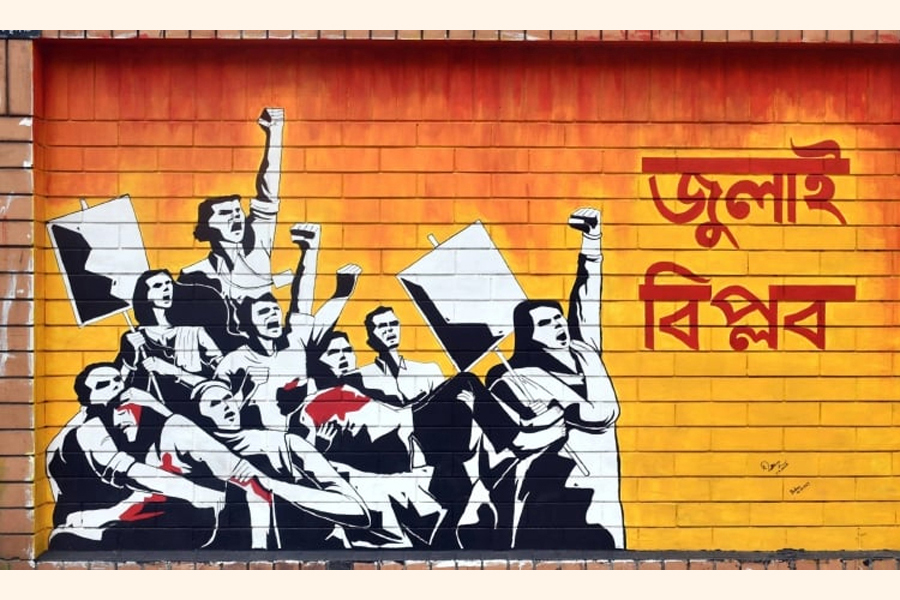
[🇧🇩] July uprising

G Bangladesh Defense
[🇧🇩] July uprising
71
2K
More threads by Saif


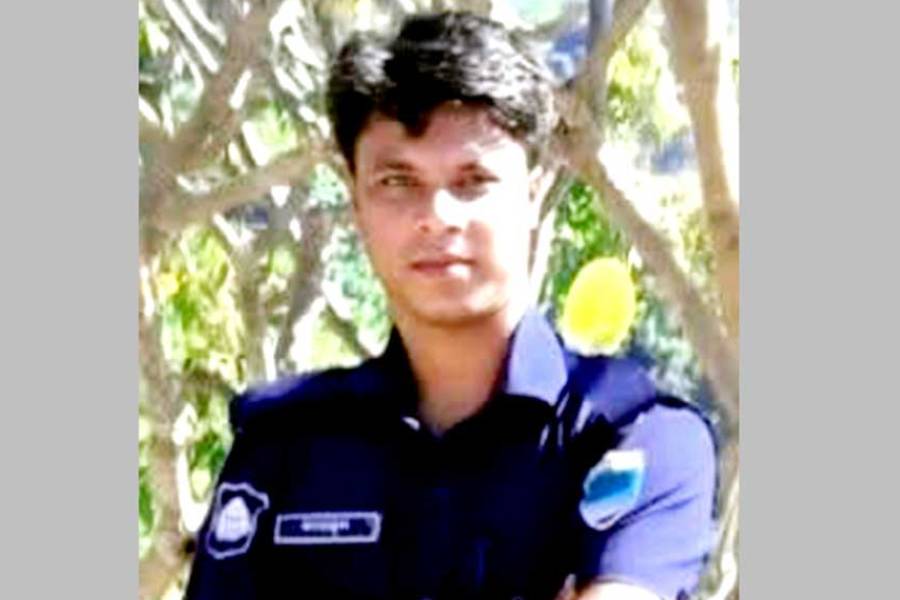
Constable in Kushtia suspended for making ‘derogatory remarks’ about July Uprising

bdnews24.com
Published :
Jul 05, 2025 20:43
Updated :
Jul 05, 2025 20:43

View attachment 19627

A police constable in Kushtia has been suspended for making “derogatory remarks” about the July Uprising on social media.

District Police Superintendent Mizanur Rahman said on Saturday, “As the investigation has found primary evidence, it has been recommended to suspend and dismiss Constable Farzul Islam Rony.”

On Jul 1, Rony made a Facebook post about the student-led mass uprising that toppled the Awami League government, but deleted it shortly afterwards.

He later claimed his account had been hacked. The post, however, had already drawn widespread criticism.

That night, leaders and activists of the Anti-discrimination Student Movement protested in front of the district superintendent of police’s office on the Kushtia-Ishurdi Highway, demanding Rony’s arrest and dismissal.

On Jul 2, a committee was formed to investigate the incident, comprising Additional Superintendent of Police Sikder Mohammad Hasan Imam, Additional Superintendent of Police (Sadar Circle) Pranab Kumar, and Inspector Debashish Roy.

Anti-discrimination Student Movement’s (Kushtia) Member Secretary Mostafizur Rahman said, “There is no opportunity to belittle the July achieved through the sacrifices of the students and the public against the fascist regime. This step taken against Rony will set an example.”

Rony hails from Shailkupa Upazila of Jhenaidah. He had been working in the Kushtia Traffic Department since Jul 13, 2023. A police official said he is currently in hiding.​
These Awami bast*rds are getting bold back again, issuing Facebook posts on behalf of AL.

But little do these fascist scum know that people's memory in Bangladesh has a long life.

Meanwhile - Thanks for sacrificing your own career in law enforcement for good. Good luck getting another job.

Scoot back to where people can't find you.
 
Analyze

Analyze Post

Add your ideas here:
Highlight Cite Respond
These Awami bast*rds are getting bold back again, issuing Facebook posts on behalf of AL.

But little do these fascist scum know that people's memory in Bangladesh has a long life.

Meanwhile - Thanks for sacrificing your own career in law enforcement for good. Good luck getting another job.

Scoot back to where people can't find you.
Ditto:)
 
Analyze

Analyze Post

Add your ideas here:
Highlight Cite Respond

Upholding the spirit of July uprising

FE
Published :
Aug 05, 2025 00:12
Updated :
Aug 05, 2025 00:12

1754351409658.webp


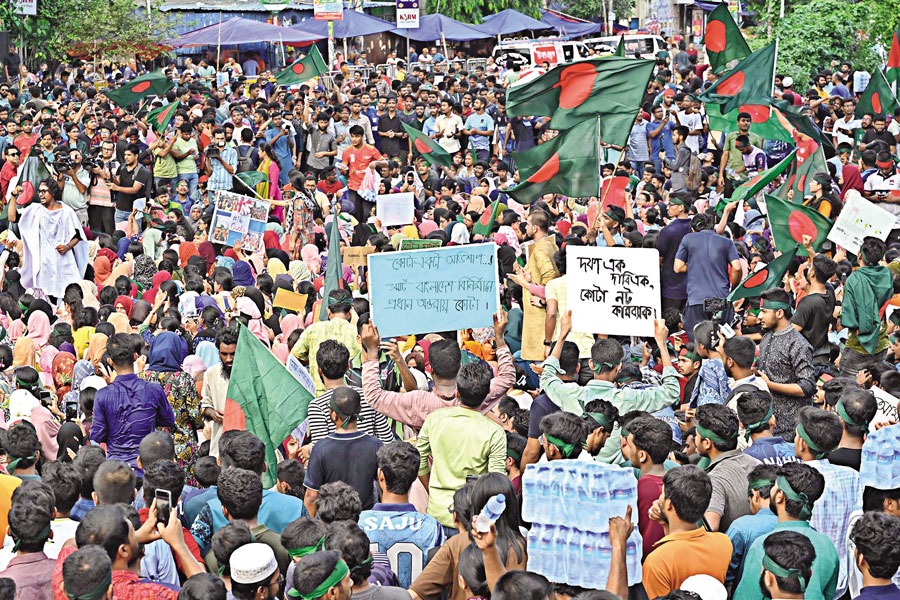
A nation that won independence in 1971 waging a nine-month long bloody war against an occupation army, celebrates the first anniversary of another landmark event called the July mass uprising today (Tuesday). Bangladesh has witnessed many ups and downs since its emergence, but the July uprising, because of its scale and sacrifices made, is considered an unparalleled one. Students and people from all walks of life forced one of the worst authoritarian regimes of the country to fall and its head, Sheikh Hasina, flee to neighbouring India on August 05 last year.

In fact, July mass uprising was the explosion of a series of events marking political, social and economic discontent. These were suppressed by the Hasina regime in most cases brutally terming it anti-liberation conspiracy. Though she came to power in 2009, thanks to popular vote, in the years that followed she grossly undermined the democratic process by making national elections a mockery. She resorted to election engineering to ensure majority seats for her party, Bangladesh Awami League (BAL), in the parliament to stay in power forever. Manipulating the judiciary, her government nullified the constitutional obligation to hold national election under the caretaker government. Bangladesh Nationalist Party (BNP), the main opposition party, faced relentless persecution. Hasina government introduced repressive acts and increased surveillance on the people thereby curbing freedom of speech and marginalising the media.

Though the country witnessed a robust economic growth in the 15 years of Hasina regime, it was unable to attract a significant amount of foreign direct investment (FDI) and diversify export. Over-ambitious mega infrastructure projects became a way of misappropriating pubhlic funds by party loyalists and powerful quarters. The much-hyped development narrative was hollow and unattainable. The Hasina-run administration was basically a kleptocracy, a form of government by individuals who primarily seek personal gain at the expense of those they govern. The tyrant also politicised almost all national institutions and rendered those dysfunctional. She got unconditional support from India and used it to perpetuate her hold on power. Hasina also allowed her party's student wing, Bangladesh Chhatra League (BCL), which has been banned recently, to unleash a reign of terror in all the educational institutions of the country. Torture, intimidation, physical assault and killing by the BCL leaders and activists became a common practice under the shelter of law-enforcing agencies. It was designed to suppress any protest or movement by the ordinary students and youths.

Nevertheless, it is the students and youths who dared to challenge the authoritarian regime. The movement demanding reforms of discriminatory quota system in public jobs in 2013 and 2018 had unnerved the Hasina regime. The law enforcing agencies and the goons of BCL descended on the street protestors with brute force. Also, in 2018, students held street demonstrations demanding road safety across the country which was also brutally suppressed. But the flame of rebellion was alive and street violence erupted again in the form of protest against the resumption of the discriminatory quota system in the public service. Soon the street demonstrations turned into a mass movement demanding that Hasina must step down. Her brutal repressive steps to crush the movement led to the deaths of at least 1,400 people and injuries to more than 20,000 during the final days of July-August.

Thus, Bangladesh witnessed a new morning stained with blood, tears and horrors, but with new hopes for a better future and a society that will be inclusive and free from injustice and discrimination. As the country celebrates the first anniversary of the mass uprising, its key message must be remembered and the spirit must be upheld by all. Now is the time to work together and carry out reforms of key national institutions and begin the onward journey for democracy and a just society.​
 
Analyze

Analyze Post

Add your ideas here:
Highlight Cite Respond

Revolutionary upsurge of the masses

Helal Uddin Ahmed
Published :
Aug 04, 2025 23:45
Updated :
Aug 04, 2025 23:45

1754351718121.webp


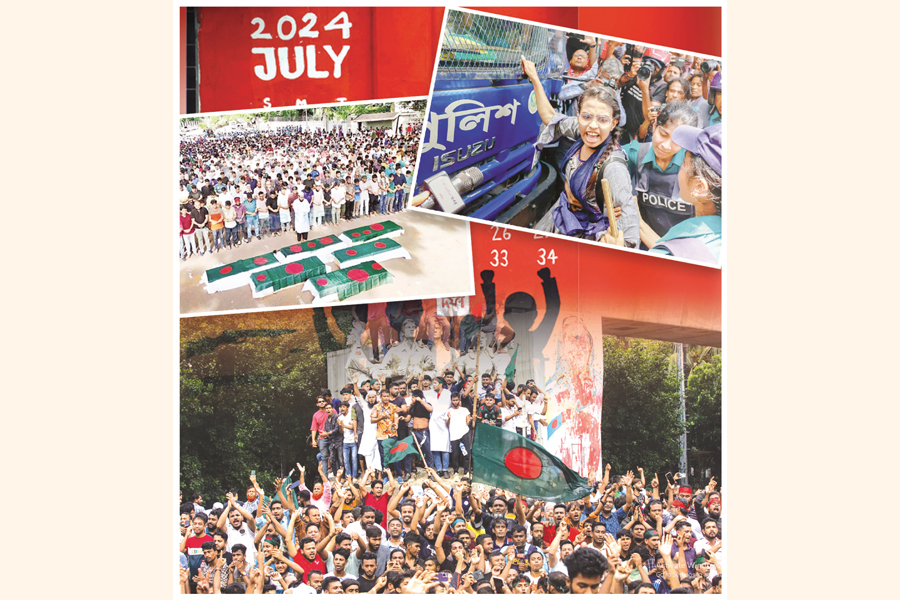
The popular uprising in Bangladesh on July-August last year resulted in the downfall of the autocratic and fascist regime of Sheikh Hasina on August 5, 2024. On the day, her 15-year long vicious and repressive rule came to a sudden end when she was forced to resign and flee the country by air with the help of her Indian masters. Although some people prefer to call it a revolution of the students and masses, most political scientists and analysts generally term the event as a 'mass upsurge' or 'mass uprising' against an autocratic fascist regime that virtually destroyed all democratic institutions of the country during its one and a half decades' rule.

Two months before that epoch-making event, unremitting anger and frustration were generated among the students, youths, and job-seekers across the country when a politicised bench of the High Court Division declared the abolition of quota system for class-1 and class-2 government jobs as illegal on June 5 last year. The abolition of quotas was previously announced by the Hasina regime in order to hang on to power in the face of a popular movement by students in 2018 for reforming the discriminatory system that unjustly favoured the ruling coterie.

This time, the protests gradually intensified, and the students announced a non-stop programme for realising their four-point demand on reforming the quota system on July 1, 2024. In the beginning, the protest programmes were confined to processions, halting of transport movements, blockades, and submission of memorandums to relevant authorities. But the impervious and arrogant ministers of the ruling Awami League (AL) including the prime minister took a hard and intransigent stance on the issue. Their arrogant, irresponsible, and intimidating comments directed against the agitating students further alienated and infuriated the general masses. The protesters subsequently resorted to all-out agitation on the university campuses, expulsion of the Bangladesh Chhatra League (BCL) cadres, and countrywide blockades. Clashes were then taking place on a regular basis between the general students and the police force, who were aided by pro-Awami League goons all over the country. The movement of the students and job-seeking youths continued like this till mid-July.

However, things suddenly heated up when Prime Minister Sheikh Hasina termed the agitating students as offspring of Razakars (collaborators of Pakistan army during liberation war) at a press conference held in Dhaka on July 14. Then while supporting her, the AL general secretary Obaidul Quader boasted to journalists that the Chhatra League (student wing of Awami League) activists were sufficient for suppressing the movement. As a follow-up to these utterances, the BCL cadres viciously attacked the peaceful processions of agitators inside Dhaka University campus on July 15, which received wide coverage in the media and generated further anger and fury among the students. The situation deteriorated even further when the prominent student activist of Rangpur Begum Rokeya University Abu Sayed was fatally shot dead by police on July 16 while leading a procession near the campus. The video of his brave posture - stretching back his open arms while confronting the police before being shot dead - became viral across the country. This valiant martyr became an icon of courage for the agitators overnight, and the spirit of his bravery was transmitted to all those involved in the movement.

Subsequently, the Hasina regime became enraged when the BCL cadres were expelled from the residential halls of Dhaka University on July 17 by the agitating students, and many workers of BCL also voluntarily resigned from their posts. The regime realised that this movement could not be suppressed with the help of Chhatra League goons alone. It therefore sent huge contingents of police and other security forces into the Dhaka University campus and forcibly emptied the residential halls. However, this repressive measure of the government was only a temporary setback for the movement. In reality, the movement became even stronger due to its impact. This was the time when the students of private universities, colleges, and madrasas in Dhaka and elsewhere in the country joined the movement in a concerted manner for keeping it alive. Side by side, the general masses residing in various localities of Dhaka including Uttara, Rampura, Mohakhali, Banani, Dhanmondi, Mirpur and Jatrabari spontaneously came down to the streets in support of the protesters. Even the family-members and teachers of students came forward by expressing support.

The agitating students put forward their 9-point demand on July 19 following innumerable deaths and injuries caused by the Hasina regime during countrywide protests on July 18. At least 31 protesters were killed on the day and over 100 injured. Their demands included an apology from Sheikh Hasina and resignation of some key ministers including the home minister Asaduzzaman Khan Kamal. In this way, the movement graduated into a greater national movement from that of a movement for reforming the quota system in government jobs. The regime responded by enforcing internet blackout from July 18, followed by the deployment of army across the country and imposition of curfew with 'shoot at sight' orders on July 19, when at least 56 protesters were shot dead by the security forces including 44 in capital Dhaka. This was followed by the killing of at least 26 more protesters including 15 in Dhaka on July 20, and the announcement of holidays on July 21 and 22 by the regime.

Meanwhile, the police resorted to mass arrests and block-raids by targeting students at various localities, and even helicopters were flown by RAB for shooting down protesters. The government-orchestrated verdict of the Appellate Division of Supreme Court on the quota system delivered on July 21 did not have any impact whatsoever on the ongoing movement because of the blood already spilled across the country. A popular slogan was then heard at many places: "Take back your quota, give me back my brother". A 'Complete Shutdown' was then observed across the country by the protesters on July 22.

The support of the general masses towards the movement increased manifold during the 16-31 July period. The movement then took a turn towards seeking justice for the victims of repression. As a consequence, it did not remain confined to the students alone, and the participation of the masses including parents and guardians of students became a common feature. Finally, this desire for justice got transformed into the one-point demand for the resignation and ouster of autocrat Hasina.

The people of the country were already very angry and aggrieved due to the continuous misrule, corruption, fraudulent elections, and socio-economic crises perpetrated by the Hasina regime. The lives and livelihoods of the general masses were severely hampered due to the anti-people policies pursued by the regime. In this backdrop, when the students stood up against the autocrat by ignoring all kinds of threats, repression, and intimidation, the grassroots people joined them on the streets spontaneously by identifying with their cause. Therefore, the widespread participation of the masses in this anti-autocracy movement did not originate from a mere spark of the moment; rather it was an explosion of people's cumulative anger and grievances piled up over one and a half decades against unabated discriminations, injustices, deceptions, fraudulences, tortures, and repression let loose by the regime.

The people were fed up with the steep rise in the prices of essentials, rampant corruption in all sectors, gradual rise in socio-economic disparities, and plundering of state-wealth by the ruling coterie - giving rise to complete loss of confidence in the regime. But the false and misleading rhetorics of the regime did no subside a bit over the years, as the ministers and other AL-stalwarts continued to mock and belittle people including the students and media-men whenever they opposed the regime. People were infuriated as the onus of governance was shunned by the rulers, who often blamed others for the problems created by themselves. By killing a defenceless Abu Sayed without any provocation whatsoever, the regime conclusively proved that it did not care a bit about the security, lives, and wellbeing of the people. This anti-people stance generated a new wave of mass discontent, and ignited the final spark that made people belonging to all strata of society revolt against the regime.

To be continued.....................
 
Analyze

Analyze Post

Add your ideas here:
Highlight Cite Respond
Therefore, the anti-discrimination reform movement led by the students and youths resulted in the collective withdrawal of support for the then government. Although this was not evident at the start, the resignations by a large number of disillusioned Chhatra League leaders and activists clearly pointed to that. They were joined by teachers, physicians, lawyers, peasants, and workers, who started to express solidarity with the movement. At a later stage, dissent and division among the armed forces personnel drove a wedge between the military and the Hasina-regime. The officers and soldiers, especially in the lower echelons, expressed their displeasure at the situation and conveyed their unwillingness to shoot at unarmed civilians whom they were supposed to protect.

As the moment of truth arrived for Hasina, some retired officers of the armed forces including former army-chiefs at a press conference held on 4 August at the RAOWA Club of Dhaka urged the military not to attack the common people. This received wide coverage and support among the military and the masses. The retired military officers and their families also brought out defiant processions in support of the movement from some locations including Mirpur DOHS, which was quite unprecedented. Earlier, ignoring all kinds of intimidations, the coordinators of the movement put forward a one-point demand for Hasina's resignation following a huge rally at Central Shaheed Minar in Dhaka on August 3. The military top-brasses then decided not to oppose the movement after internal consultations and discussions. However, the AL was adamant till the end about suppressing the movement by force. Therefore, armed cadres of the Awami League as well as the partisan police personnel attacked the agitators all over the country on August 4 resulting in a huge number of casualties. Even in the face of all these odds, the students and the masses remained resolute and continued to resist the violent assaults.

As the situation reached a boiling point, the coordinators of the movement announced the 'March to Dhaka' programme on August 4, which was initially slated for August 6, but later brought forward by one day due to huge public support across the country. The students then coordinated the entry of people into Dhaka city from various corners of Bangladesh. Lakhs of people started streaming into Dhaka from the morning of August 5; they were headed towards the official residence of the prime minister 'Ganobhaban'. In the face of this huge show of force by the masses, the chiefs of the armed forces told Sheikh Hasina that it was impossible to control the masses by applying force. The final moments of Hasina's reign therefore arrived. It should, however, be pointed out that just as there was huge participation of people in this uprising, the pro-people stance of the armed forces was also critical in deposing Hasina and averting further bloodshed and loss of innocent lives.

Many people previously believed that the armed forces would side with Sheikh Hasina till the last due to the coterie-based government-military alliance built over a long period. However, some also believed that it would have become difficult for the military to continue working with the UN peacekeeping missions if it sided with Hasina by taking a stand against the people; and therefore, this factor may also have played a part in their decision-making. But a majority of observers believed there was an apprehension among the military leadership regarding a break-down in their internal chain of command if the troops were ordered to continue shooting at unarmed civilians. The widespread dissatisfaction within the armed forces on this issue could have caused serious fissure inside, which would have put the military leadership at a disadvantage. Besides, the dominant role and hegemonic interferences by India in the internal affairs of Bangladesh during the AL-rule might also have alienated a sizable segment of the patriotic military personnel against the Hasina regime.

This revolutionary episode in Bangladesh's history enacted during July-August 2024 can rightfully be termed as a mass-upsurge or uprising. Although revolt, uprising, and revolution may have similar connotations, there are some differences as well. For example, revolt entails sudden outburst of cumulative and collective anger against the authorities, but it usually does not bring about ouster of any government, although some reforms may materialise. On the other hand, mass upsurge takes place when the common people unitedly bring about the downfall of an autocratic regime by effecting changes in power-structure through collective expression of solidarity. On the other hand, revolution entails bringing about structural changes in a state through violent uprising in order to radically transform a degenerated socio-economic cum political system. Therefore, many analysts hold the view that the movement for reforming the discriminatory quota system in government jobs was a revolt that ultimately took the shape of a mass-upsurge.

Democracy has been repeatedly jeopardised in Bangladesh in the past due to the presence of fascistic ingredients in the state-structure. In this context, the eminent historian and veteran political commentator Badruddin Umar said in an interview: "The common people may nurture the impression that they have become free and independent, and such a situation will not reappear after the demise of Hasina's fascism. But this is not correct. The people may, however, continue to enjoy freedom in some areas. Those who would come to power after so many incidents would not immediately resort to such repression. But later on, it cannot be said with certainty that repression, torture, imprisonment, and black laws would not be applied, taking into account conditions prevailing in the country. The 70 to 80 percent members in parliament belonging to the business community would not go away. They could not be disposed of through this movement. They would remain, and would try to run the statecraft in future in accordance with their interests. Therefore, it is not true that the country has become completely liberated. There is no reason to believe that the relief the common people felt after ousting a criminal and fascist individual like Sheikh Hasina would last forever."

There are many ingredients for a return to fascism in our constitution, state, and political culture that may aid in its re-emergence. For example, an individual can become prime minister for as many times as he or she likes. If the same person becomes prime minister over and over again, then the tendency to become an autocrat increases. Again, there is no balance between the powers of the prime minister and the president. The prime minister holds absolute power, while the president only plays a nominal role, although the presidential system proved to be quite effective in Bangladesh during the rule of President Ziaur Rahman. Presently, the prime minister can simultaneously be the party-chief, the head of government, and the leader of the house - as was seen during Hasina's rule. A most undemocratic stipulation like Article-70 also exists in the constitution, which facilitates authoritarianism.

In this context, Badruddin Umar further says: "None of the governments since independence took any initiative for structural transformation of the state. Rather, the situation has seriously deteriorated over the past 15 years. Various vested quarters including businessmen have occupied prominent positions in the state and society. Time is needed for cleansing these elements. The objectives of the mass upsurge and the establishment of a discrimination-free society would materialise only if required reforms are implemented. For this to happen, just as changes in law would be required, similarly, the mentality of the people will also have to undergo transformation. Above all, the prevailing undemocratic political culture will have to be rectified."

Therefore, reform of the state-structure is urgently needed for thwarting the reappearance of fascism and obtaining full benefits of a mass-upsurge that emanated from a revolt by the students. A complete democratic transformation is needed for putting the ownership of the state into the hands of the common people. Everything would automatically take a turn for the better if the people are kept at the centre of all state initiatives by doing away with the current domination of vested interests like the business oligarchs, civil and military bureaucracy.

Dr Helal Uddin Ahmed is a retired additional secretary, ex-editorial consultant of The Financial Express, and former editor of Bangladesh Quarterly.​
 
Analyze

Analyze Post

Add your ideas here:
Highlight Cite Respond

A DAY OF RECKONING, DAY OF REJOICING
Nation celebrates Mass Uprising Day today
CA to pronounce July Proclamation at parliament's south-plaza carnival

MIR MOSTAFIZUR RAHAMAN
Published :
Aug 05, 2025 01:07
Updated :
Aug 05, 2025 01:07

1754353106458.webp

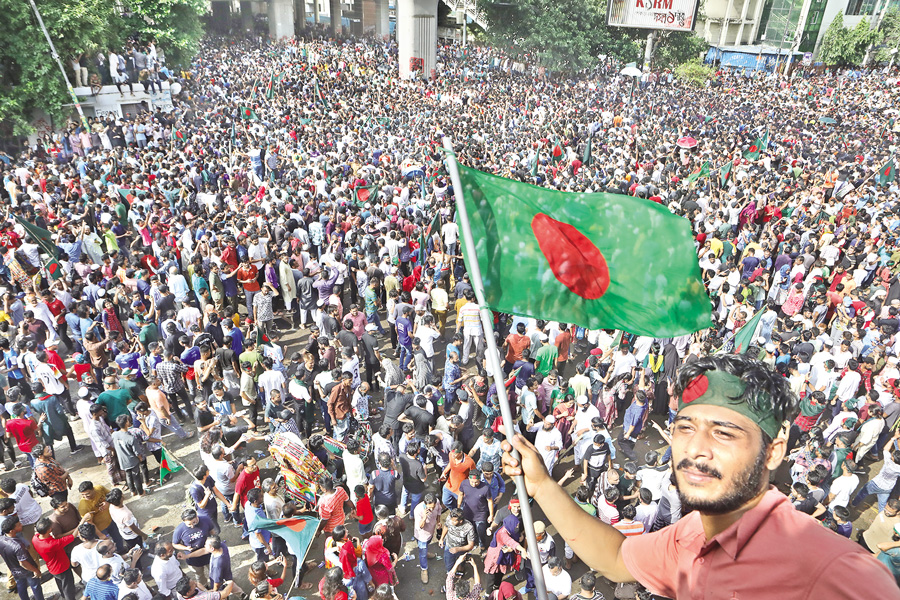
A NEW DAWN IN HISTORY : Tens of millions of people spilled onto the streets across the country on August 5 last year to celebrate the fall of the Sheikh Hasina-led autocratic government. Hasina was forced to flee to India amid a student-led popular uprising. The photo was taken at Shahbagh in Dhaka. — FE Archive

Celebrations are about to set off today as the day marks the first anniversary of a mass uprising that dealt a dramatic collapse of the authoritarian Sheikh Hasina regime--a historic turning point on Bangladesh's political trajectory.

Chief Adviser of the post-uprising government Prof Muhammad Yunus would roll out the 'July Proclamation' in the afternoon at parliament's south-plaza carnival.

The fifth of August, or 'July 36th' in the uprising calendar, is a day of reckoning as of rejoicing in the nation's fresh start with recast statecraft, as aspired by the martyrs and veterans of the mass movement for equal opportunities for all.

This day last year (2024), the long-reigning prime minister, Hasina, was forced to flee the country following a month-long student-led mass upsurge that swept through cities and towns, shaking off the very foundation of her 15-year rule.

The uprising, sparked by mounting grievances over democratic backsliding, rampant corruption, and the erosion of public institutions, ultimately culminated into her abrupt and ignominious exit, political analysts say.

The fall of the Hasina regime, described by many political analysts as the most significant political event in the post-independence Bangladesh, was a watershed moment that rekindled the nation's aspirations for democracy, justice and accountable governance.

Hasina's long and controversial rule had been marked by the centralisation of power, politicisation of the bureaucracy, curtailment of judicial independence, and the rise of an oligarchic economic order. Allegations of state-sponsored corruption, extrajudicial actions, and repression of dissent had reached a boiling point, eventually erupting into a mass movement that would spell her downfall.

As the news of her departure broke this very day last year, spontaneous celebrations erupted across the country. Streets were flooded with jubilant crowds waving flags, lighting candles, and chanting slogans that echoed a sense of long-awaited liberation. For many, it was a symbolic end to what they saw as years of political suffocation.

The price was, however, so dear. Over 1,500 students and civilians lost their lives and thousands more their limbs or eyes in confrontations with security forces during the mass upheaval. Their sacrifices, mourned and honoured today in commemorative events nationwide, were the catalyst for a national awakening.

In the immediate aftermath of the regime's fall, an interim government led by Nobel-laureate economist Professor Muhammad Yunus was sworn in on August 8, 2024. The transitional administration set out an ambitious roadmap for democratic revival and structural reforms. Several high-powered commissions were formed to draft recommendations on judicial reform, law enforcement, local governance, public administration, and media freedom.

These commissions, comprising eminent jurists, academics, and civil-society leaders, worked expeditiously and submitted far-reaching reform proposals. Their work was widely lauded for both vision and depth. However, the slow pace of implementation has become a source of frustration among reformists and civil-society activists, in particular.

Meanwhile, all activities of the Awami League and its affiliated organisations were suspended few months ago.

One year into the transition, cracks have begun to surface within the broad coalition that had united against Hasina's authoritarianism.

The rise of 'mob justice' in certain regions, in the absence of a fully functioning law-enforcement system, has raised serious concerns about the state of public order.

Another notable development in the post-August-5th period is the emergence of a new political party formed by the student leaders who had spearheaded the July uprising. Their entry into the political arena has altered the traditional balance of power.

One of the major debates on the cusp of transition has been over the timing and extent of reforms needed before holding national elections. While some political groups demanded a complete overhaul of state institutions first, others argued for early elections under minimum reforms.

This impasse was largely resolved following a pivotal meeting in London earlier this year between Chief Adviser Yunus and Tarique Rahman, the de facto leader of the Bangladesh Nationalist Party (BNP). The two reportedly reached a consensus on holding national elections by February 2026--a move that has brought some clarity and optimism to an otherwise uncertain political timeline.

The nation now awaits an official announcement of the election date by the head of the post-uprising government of Bangladesh, Chief Adviser Yunus. Public sentiment, as reflected in recent opinion surveys and media commentary, strongly favours the formation of a stable, elected government to steer the country through its recovery phase.

Investors - both domestic and foreign - have largely held back over the past year, citing concerns about political uncertainty and transitional governance. Business leaders have repeatedly warned that prolonged uncertainty could jeopardise economic-recovery efforts.

Despite the challenges, one of the most commendable achievements of the past year has been the finalisation of the July Proclamation. And the July Charter - a political consensus document---being crafted by the National Consensus Commission-albeit with some notes of dissent is in its final stage. Through extensive consultation with political parties, the Commission has put forward reform blueprints for the legislature, judiciary, and local government that, if implemented, could reshape Bangladesh's political architecture for generations to come.

As the country observes this solemn yet hope-raising anniversary of the changeover, the legacy of the uprising stands as a testament to the power of collective action in the face of repression. It is also a reminder of the responsibilities that now lie ahead - to honour the sacrifices made, to protect the gains won, and to build a democratic future rooted in justice and accountability.

While the journey is far from over, the people of Bangladesh have already demonstrated that when the call of history comes, they are capable of rising to meet it.​
 
Analyze

Analyze Post

Add your ideas here:
Highlight Cite Respond

One year since mass uprising: Hasina’s fall must not be the sole achievement

AKM Zakaria
Prothom Alo Deputy Editor
Updated: 06 Aug 2025, 16: 24

1754530115043.webp

People at PMO celebrate the fall of Sheikh Hasina on 5 August 2024 Prothom Alo file photo

The downfall of an autocratic or authoritarian is rarely smooth or peaceful. They must be overthrown — through revolution, mass uprising, or coup. Borrowing from political sociologists like Charles Tilly and Frantz Fanon, one could say: since states are born through violence and conflict, violence tends to persist in state politics as a continuation of that process. This is particularly true for countries that have emerged from colonial rule or through armed liberation struggles — where violence remains as a legacy. In such states, when an autocracy takes hold, the path to removing it is often violent as well.

It was already certain that Hasina would eventually fall. What was uncertain was when and how it would happen. Naturally, there was also the fear that her ouster could be bloody.

The BNP and other opposition political forces had tried to fight against this regime for 10–11 years. Blood was shed then too. Through enforced disappearances, killings, and various forms of repression, Hasina crushed those efforts.

The BNP’s long campaign to topple the government failed because the downfall of a dictatorship or a mass uprising cannot be achieved solely through the efforts of party leaders and activists — it requires public participation.

Although people wanted Hasina gone, the BNP could not make them partners in their movement. Had they succeeded, the BNP would have been the party to lead the uprising.

The anniversary of the mass uprising is not a particularly hopeful moment, especially if we take into account the disunity and conflicts among the political forces of the uprising, along with the interim government’s lack of capacity, absence of necessary initiative, indecision, and, in many cases, indifference.

The public was searching for a way out of authoritarian rule, but they did not feel confident rallying behind the BNP. In 2018, when students took to the streets demanding safe roads, ordinary citizens stood beside them. The spontaneity and intensity of that non-political movement struck fear into the government, making them worry about its own downfall.

They took no risks — alongside the police, they deployed its cadres of the Chhatra League and Jubo League to crush the protests. The school and college students who suffered violence — along with their parents and supporters — eventually returned home, but they were waiting. Six years later, it was again students who created that opening.

In the apolitical, quota-reform movement, students stood face-to-face with the authoritarian with unparalleled courage. This time, people began rallying behind them. The public had been waiting for precisely such a force to join the movement to oust Hasina. Opposition political parties also entered the field. This time, the people were no longer willing to go home without an outcome.

The mass uprising of 5 August was not a revolution under the leadership of any organised political party or guided by any ideology. Its primary objective was the removal of Sheikh Hasina and the end of authoritarian rule. That goal was achieved.

Considering the political uncertainty after 5 August, as well as the infighting and conflicting interests among the forces that supported the uprising, I had already posed a question in the headline of a column published in Prothom Alo on 15 January this year: “Will we have to remain satisfied with just Hasina’s fall?” On the first anniversary of the mass uprising, the answer to that question is perhaps becoming clearer. Since there was no revolution on 5 August, the student leaders, allied political parties, other forces, and the general public involved in the uprising had no vision beyond ousting Hasina. The confusion over government formation and the events that followed 5 August prove this.

1754530175766.webp

People celebrate the fall and fleeing of former Prime Minister Sheikh Hasina on the parliament premises on 5 August 2024 Prothom Alo file photo

Still, since 5 August, many of us have begun talking about the “aspirations of the mass uprising.” But the question is: what are these aspirations, and who has defined them?

Under Sheikh Hasina’s authoritarian rule, the very concept of elections disappeared from Bangladesh; restoring free and fair elections thus became one of the uprising’s central aspirations.

But beyond that, several other demands have emerged as “aspirations of the mass uprising” — many of them taken from graffiti on the walls before and after 5 August.

Over the past 15 years, as we watched institutions being systematically destroyed, a deep-seated desire grew within us to repair them. We also developed the aspiration to ensure that the experiences we endured during this period are never repeated — that no one can ever again establish authoritarian rule in any form. We thought that through reforms, we could fulfil these aspirations.

Now, as the reform process is underway, we are seeing that political parties cannot reach a consensus on how a democratic transition should take place. Parties have different ideologies and there could be disagreements. But what we are observing is that, rather than ideology, it is the calculation of gaining power that has become the central issue. Discussions on reforms are also revolving around these concerns.

As previously noted, violence has become entrenched in our political culture, something we have inherited as part of our state-building process. It is now an integral feature of our politics. At the same time, long periods of authoritarian rule inevitably strengthens reactionary and extremist politics, albeit secretly. We are now witnessing signs of that in the aftermath of Hasina’s fall.

The reform process remains stuck in attempts either to take power or to prevent others from gaining it. There has been no public debate on the reform proposals put forward by the commissions on labour, women, the media, local government, and health.

We see no sign of any internal reform initiatives or even aspirations for reform within the political parties themselves either, although they are going to assume responsibility for running the country in the near future. The older and major political parties, long before actually gaining power or becoming part of the government, have already started scrambling to place their people in various institutions and assert control, engaging in practices such as extortion and patronage.

Old political parties are determined to operate as before, but what about the new ones? Students who led the mass uprising have formed parties, and many more are emerging (148 political parties have reportedly applied for registration). Do we see any fresh direction or promising signs among them? Unfortunately, it’s the same old pattern of extortion, and hiring people to attend rallies.

1754530227372.webp

Graffiti at Dhaka University. The photo was taken on 9 August 2024 Suvra Kanti Das

The anniversary of the mass uprising was celebrated yesterday. If we look at the outcomes of recent uprisings around the world, we see that a mass uprising does not necessarily lead to meaningful reform or successful democratic transition. We too are perhaps walking down that same path. It seems we are being compelled to move forward through a kind of compromise between the fascist regime—which we wish to regard as the 'past'—and the 'present' that followed a mass uprising. This, perhaps, is the reality of our times.

The anniversary of the mass uprising is not a particularly hopeful moment, especially if we take into account the disunity and conflicts among the political forces of the uprising, along with the interim government’s lack of capacity, absence of necessary initiative, indecision, and, in many cases, indifference.

Even so, the prolonged discussions at the National Consensus Commission and whatever limited consensus has emerged among the political parties must be seen as gains of the mass uprising, beyond simply the fall of Hasina. These gains could be carried forward by a free, fair, widely accepted, and inclusive election.

As previously noted, violence has become entrenched in our political culture, something we have inherited as part of our state-building process. It is now an integral feature of our politics. At the same time, long periods of authoritarian rule inevitably strengthens reactionary and extremist politics, albeit secretly. We are now witnessing signs of that in the aftermath of Hasina’s fall.

Thanks to Hasina’s autocracy, the influence of far-right politics has become increasingly apparent in our political landscape. Without placing too much hope in lofty outcomes, perhaps the most urgent task now is to guard against these twin dangers. Electoral politics is the only viable way to check the rise of reactionary forces.

To counter both the legacy of violent politics and the threat of far-right ascendance, the most immediate and effective step could be to resume electoral politics as soon as possible.

Yesterday, Chief Adviser Professor Yunus announced a specific timeline for elections, scheduled for the first half of February, before Ramadan. As we mark the anniversary of the mass uprising, for the time being our demand is this: let its gains extend beyond the fall of Hasina, and pave the way for credible elections.

* AKM Zakaria is the Deputy Editor at Prothom Alo.​
 
Analyze

Analyze Post

Add your ideas here:
Highlight Cite Respond

July uprising, abiding hopes and harsh truths

SYED MUHAMMED SHOWAIB
Published :
Aug 08, 2025 22:31
Updated :
Aug 08, 2025 22:31

1754699512774.webp


When people from all walks of life rose up against the Awami League regime in July last year, their focus remained firmly on toppling an authoritarian government. With the state forces unleashing violence on unarmed protesters on the streets, there wasn't enough time to consider what political system might follow the crisis. It was only after Sheikh Hasina fled to India on August 5 that the people truly sensed her grip on power had broken and felt free to turn their attention to reshaping the country's political future. In the immediate aftermath of the regime's fall, coordinators of the student-led uprising turned to Nobel Peace Prize-winning economist Muhammad Yunus and urged him to lead the government during this critical period. Given his global stature, clean image and track record, they could think of no one more qualified than him to restore stability, rebuild public trust and initiate reforms in the post-uprising atmosphere. True to their hopes, Dr. Yunus's interim government entered office as one of the most popular and widely supported administrations in the country's history.

It is difficult to say for certain how much of that initial popularity still holds as the government completed one year in office and set early February 2026 as the tentative date for national elections. But if public opinion on social media is any indication, dissatisfaction is growing, fuelled by unmet expectations and the slow pace of meaningful reform in a system plagued by inefficiency and corruption. Admittedly, the government's journey over the past year has not been easy. There were multiple attempts to unsettle it and create chaos on the streets, some of which were perhaps inevitable after a mass uprising. However, managing these crises, especially the law and order related ones, was particularly difficult, as the government had to rely on a police force weakened by years of politicisation under the previous regime which left it demoralised and ineffective.

Obviously, the government failed to deliver the fundamental reforms needed in the police, intelligence agencies, security forces and civil service that made up the power structure sustaining the previous autocratic system. While many hoped for a decisive shift from colonial, authoritarian and exploitative governance models of the past, they saw no real commitment or meaningful steps toward such reforms. In fact, the government itself appeared unsure of its ability to drive such transformation. This failure to reform, whether from inability or neglect, has allowed all forms of malpractice to flourish which is the source of public outrage. Today, public conversations revolve around talks of extortion, bribery, corruption, fraud and mob violence because these are the harsh realities people face daily. Many attribute this to the uprising's failure to transform civil service and law enforcement into accountable, citizen-centric institutions. After all, as they understand, rampant extortion and irregularities could not persist in Bangladesh's political reality without the civil administration and law enforcement letting them happen.

It is a sad reality that in some places, members of the student-led National Citizen Party (NCP) have been involved in extortion and lobbying. Students hold a privileged position under this administration because they played a key role in overthrowing the previous regime, and now the same cycle seems to be repeating where privileges lead to excesses, and excesses lead to oppression and violence.

Ever since this new government took office, the BNP has been calling for elections because they believe, in the current climate, they are the main contender with virtually no competition. Their leaders have made the demand for early elections their central talking point, insisting that elections alone can restore representative democracy. However, as the 15 years of misrule under Awami League have shown, without real reforms that make those in power fully accountable to the electorate, even competitive elections may become little more than political theatre. As American writer Walter Mosley once said about his own country, "We have the formal structure of democracy, but not the substance." The same can be said of Bangladesh today. The necessary institutions exist and resources are available, but progress remains obstructed by the entrenched interests of those who come to power and benefit from the status quo. This explains why in the post-uprising era, people continue to dread that a change in leadership might simply replace one ruling elite with another.

So what happens if the BNP wins power in the February elections? Will they be able to truly champion the people's interests or will they pursue their own agenda just like their predecessors and dominate and control? It is true that the BNP's 31-point charter contains some ambitious ideas for the country's future, however it lacks a clear roadmap for implementation. On top of that, many of these points rely heavily on legislative changes. But as history is our witness, expecting political legislation alone to solve the country's problems is fundamentally misguided.

More alarmingly, reports suggest the party is struggling with internal corruption. Media accounts reveal that the BNP has expelled approximately 5,000 leaders and activists since the fall of the autocratic government for disciplinary violations, which often means involvement in extortion or violence. That a party aspiring for power must expel so many of its members suggests that criminal elements are viewing it as their new safe haven. This points to the need for a fundamental shift in both attitude and behaviour. Such changes obviously will not come on its own, because if it were to happen naturally, it would have happened by now. The BNP must take deliberate steps to cleanse itself of corrupt actors and sever the link between money and politics. Otherwise, there is a risk that any electoral victory will just be another chapter in the cycle of hegemony and corruption.

This is why the current mass uprising holds extraordinary potential to reshape the nation's direction and fulfil the people's long-standing aspirations. It has generated a momentum for establishing equality and transforming our political culture. But if this historic opportunity is squandered and the forces rising to power repeat the mistakes of the past, the same injustices will return and the uprising will have all been for nothing.​
 
Analyze

Analyze Post

Add your ideas here:
Highlight Cite Respond

Posts you haven't read yet..

Members Online

Latest Posts

Back
PKDefense - Recommended Toggle