Home Watch Videos Wars

[🇧🇩] Jute Industry in Bangladesh

[🇧🇩] Jute Industry in Bangladesh
63
3K
More threads by Saif

G Bangladesh Defense

Bumper jute yield raises hopes among Magura farmers

OUR CORRESPONDENT
Published :
Aug 10, 2025 08:11
Updated :
Aug 10, 2025 08:11

1754873455475.png

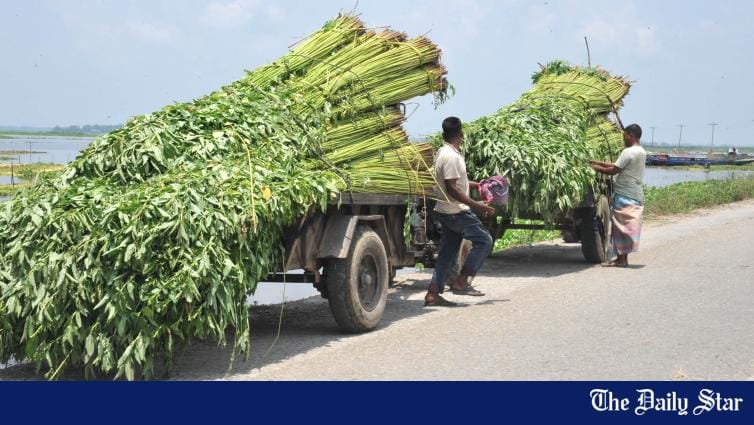
Newly-harvested jute is being traded in Notun Bazar of Magura tow Photo : FE Photo

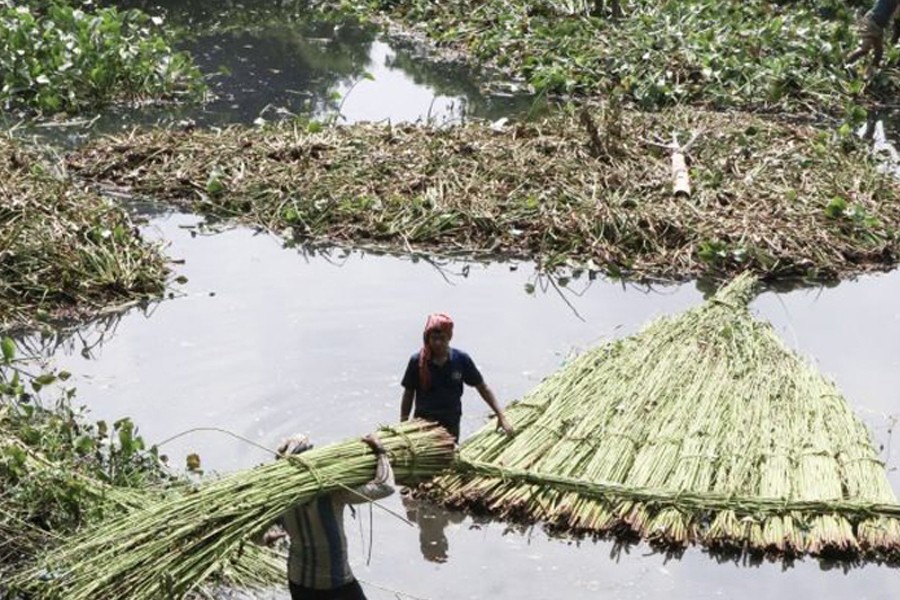
Bumper production of jute as well as its lucrative prices have come as hope raising factors for the farmers of the district this season.

Satisfactory yield of jute has brought smiles to the face of the local growers making them optimistic about the lost glory of the crop, once called golden fibre, coming back rejuvenating agricultural landscape of the region.

There was a time when farmers used to cultivate jute on a large scale in the region finding big returns. But later farmers started losing interest in jute cultivation as switched to other crops for relatively increased profits. Rising production cost and downtrend in prices were the reasons behind their reluctance to cultivate the traditional crop.

Finally closure of the jute mills owned by Bangladesh Jute Mills Corporation disheartened the growers as well as traders.

But this year bumper production and lucrative prices of jute have raised hopes among the growers about its imminent prospects.

Newly harvested jute has already started to appear in the local markets. Bumper production and high prices have sent a wave of joy among the growers in the district.

Sources at the Department of Agricultural Extension (DAE), Magura said they had brought 34,370 hectares of land under jute cultivation in the district this season.

In the meantime, jute harvesting has started. Production may exceed the target which is 463,995 bales of jute.

Moshlemuddin, a farmer of Jagla village under Magura sadar upazila, said, "I brought two bighas of land under jute cultivation this season. I expected to get a yield of 20 maunds of jute. But my production will stand at 24 maunds."

"Moreover, due to adequate rainfall, I did not have to face extra irrigation cost for jute cultivation. For these I am enjoying a superb jute yield."

Another farmer Abu Saleh of Vitashair under Magura sadar upazila told the FE, "This year we are getting jute price at Tk3,500 per maund against Tk2,500 last year. This year I have brought my three bighas of land under jute cultivation. I have sold my produce at Tk120,000 while my production cost was only Tk35,000 that means my profit stands At Tk85,000. I am overwhelmed with such gains."

Farmer Golapdi Mollah of Belnagar village under Magura sadar upazila said, "We have got subsidy from the DAE for jute farming. Moreover, adequate rainfall has boosted our jute cultivation saving irrigation cost. At the same time present jute price is highly satisfactory to us. In this situation, we are optimistic that jute may bring back its glory if government extends subsidy for growers, ensures fair price and supply of quality seeds."

When contacted, DAE additional deputy director Bishnupada Shaha told the FE, "We have provided jute growers in the district with proper subsidy and training. Moreover, the weather was favorable for jute in the district this year. At the same time, farmers are getting high price for the crop . We hope the present situation will create a positive impact on jute cultivation in the coming year."

Agriculturist Khairul Abrar said jute is the country's glorious heritage. Moreover, jute planting has a positive impact on land. When jute is cultivated its leaves enhance fertility of the land falling down on it. Moreover, at present private jute mills hold huge employment in the country.

For several years jute mills are facing crunch of jute. So there is no alternative but to extend jute cultivation.​
 
Analyze

Analyze Post

Add your ideas here:
Highlight Cite Fact Check Respond
India bans jute product imports from Bangladesh via all land routes

FE ONLINE DESK
Published :
Aug 11, 2025 23:51
Updated :
Aug 11, 2025 23:51

1754959017894.webp


India on Monday banned imports of certain jute products and ropes from Bangladesh through all land routes with immediate effect, amid strained relations between the two countries, according to the Press Trust of India.

However, according to a notification of the Directorate General of Foreign Trade (DGFT), these imports are allowed through the Nhava Sheva Seaport, PTI reported.

"Imports from Bangladesh shall not be allowed from any land port on the India-Bangladesh Border," it said, adding, "Import of certain goods from Bangladesh to India is regulated with immediate effect," the news agency said.

The products included in the list are bleached and unbleached woven fabrics of jute or of other textile bast fibre; twine, cordage, rope of jute; and sacks and bags of jute, according to PTI.

Earlier on June 27, India prohibited imports of a number of jute products and woven fabrics from Bangladesh through all land routes. Those imports are, however, allowed only through Nhava Sheva seaport in Maharashtra, the Press Trust of India noted.

The curbs were imposed on items such as jute products, flax tow and waste, jute and other bast fibres, jute, single flax yarn, single yarn of jute, multiple folded, woven fabrics or flex, and unbleached woven fabrics of jute, PTI said.

In April and May also, India had announced similar curbs on imports from Bangladesh, according to the agency.

On May 17, India imposed port restrictions on the import of certain goods like ready-made garments and processed food items from the neighbouring country, PTI reported.

On April 9, India withdrew the transhipment facility it had granted to Bangladesh for exporting various items to the Middle East, Europe and various other countries except Nepal and Bhutan, according to the Press Trust of India.

These measures were announced against the backdrop of the controversial statements made by the head of Bangladesh's interim government Muhammad Yunus in China, PTI said.

The comments did not go down well in New Delhi. It also drew sharp reactions from political leaders in India across party lines, the news agency reported.

India-Bangladesh relations have nosedived dramatically after Yunus failed to contain attacks on minorities, especially Hindus, according to PTI.

Bangladesh is a big competitor of India in the textile sector, the Press Trust of India noted.

The India-Bangladesh trade stood at $12.9 billion in 2023-24. In 2024-25, India's exports stood at $11.46 billion, while imports were $2 billion, according to PTI data.​
 
Analyze

Analyze Post

Add your ideas here:
Highlight Cite Fact Check Respond
Bangladesh exports jute and jute goods to over 100 countries worldwide. Some of the major importing countries include India, Pakistan, China, Turkey, the United Kingdom, Spain, Côte d'Ivoire, Germany, Brazil, the United States, and Vietnam.

Here's a more detailed breakdown:
  • Major Importers:
    According to Textile Today, India, Pakistan, and China are significant buyers of Bangladesh's jute and jute goods.

  • Other Key Markets:
    The United Kingdom, Spain, Côte d'Ivoire, Germany, and Brazil also import raw jute from Bangladesh.

  • Diverse Markets:
    Bangladesh exports to a wide range of countries, including Australia, Belgium, Indonesia, Russia, the United Arab Emirates, and Vietnam.

  • Specific Products:
    Bangladesh is a leading exporter of jute yarn, with Turkey, China, India, Uzbekistan, and Côte d'Ivoire being major destinations for this product.

  • Growing Demand:
    The global demand for sustainable and natural products is driving increased interest in jute from Bangladesh.
 
Analyze

Analyze Post

Add your ideas here:
Highlight Cite Fact Check Respond

The global demand for jute products and Bangladesh's role
March 6, 2024

The world has witnessed an unprecedented shift towards sustainable alternatives, driven by environmental consciousness and economic imperatives. Among these alternatives, jute stands out for its eco-friendly properties and economic viability. But what exactly is jute? A cash crop of Bangladesh widely recognised as 'golden fibre', jute's rise as a viable material in the global market isn't merely a response to current trends; it's a nod to its intrinsic value as a versatile, biodegradable resource.

With its sprawling jute fields, Bangladesh has emerged as a pivotal player in this landscape. As the world's largest producer of jute, accounting for 58% of global jute production, latest figures from the Food and Agriculture Organisation of the United Nations (FAO) indicate, Bangladesh isn’t just catering to rising demands — it's setting the gold standard. A glance at the numbers corroborates this: the country’s exports of raw jute and jute-based products manufactured from it contribute 1% to the country's GDP and account for 3% of the overall export earnings, according to IMARC Group.

Jute in Bangladesh, a deep-rooted legacy

Following the global surge in interest towards jute and its related goods, a deeper dive into its origins and significance in Bangladesh becomes essential. Beyond being the world's largest producer, the country has a profound relationship with this ‘golden fibre’, one that's woven into its cultural and economic tapestry.

Historically, jute has been integral to Bangladesh, not just as a product for trade but as a symbol of its agrarian roots. The country’s landscape is dotted with numerous jute mills, emphasising its role in modern trade. These mills, equipped with advanced techniques, efficiently process raw jute, transforming it into a myriad of products that cater to global market trends.

Beyond its commercial importance, jute is a beacon of employment in Bangladesh, from which livelihoods are offered to countless families. This isn’t just about numbers; it's a testament to the country's dedication to maintaining its legacy while innovating for the future. As the global business ecosystem leans towards sustainability, Bangladesh’s commitment to the production and export of quality items made from jute ensures it remains a pivotal player in the march towards a greener future.

Woman holding jute bag or sack bag on white background. Reusable shopping bag. Natural material. Zero waste. Plastic free. Eco friendly concept.
The Sonali Bag, a sustainable innovation

In 2010, amidst an escalating plastic waste crisis, Bangladesh introduced a transformative solution: the Sonali Bag. This creation by scientist Mubarak Ahmad Khan is derived from jute, and its name 'Sonali', a Bengali term, fittingly translates to 'golden'.

While the Sonali Bag resembles conventional plastic bags, its environment-friendly attributes distinguish it. Crafted from biodegradable jute cellulose sheets, these bags naturally decompose within three months when buried.

The urgency for such an innovation is evident in Dhaka's consumption patterns, where around 14 million polyethylene bags are used daily. Despite Bangladesh's ban on plastic bags more than 20 years ago, the environmental challenge persisted, exemplified by waterways like the Buriganga River accumulating thick layers of discarded plastic.

Globally, plastic pollution remains a pressing concern. As such, 127 nations have all started to enforce plastic bag restrictions. This growing international interest in sustainable alternatives presents a golden opportunity for Bangladeshi businesses specialising in the manufacturing and exporting of jute-based products to expand their market presence and contribute to an eco-friendlier world.

Navigating the challenges of jute logistics

Jute is assessed based on several factors, including its tensile strength, uniformity, and colour. High-quality jute often has a light yellowish to reddish tint. However, shifts towards a brown or green colour can indicate challenges during its processing, potentially due to inadequate water retting or contact with acids.

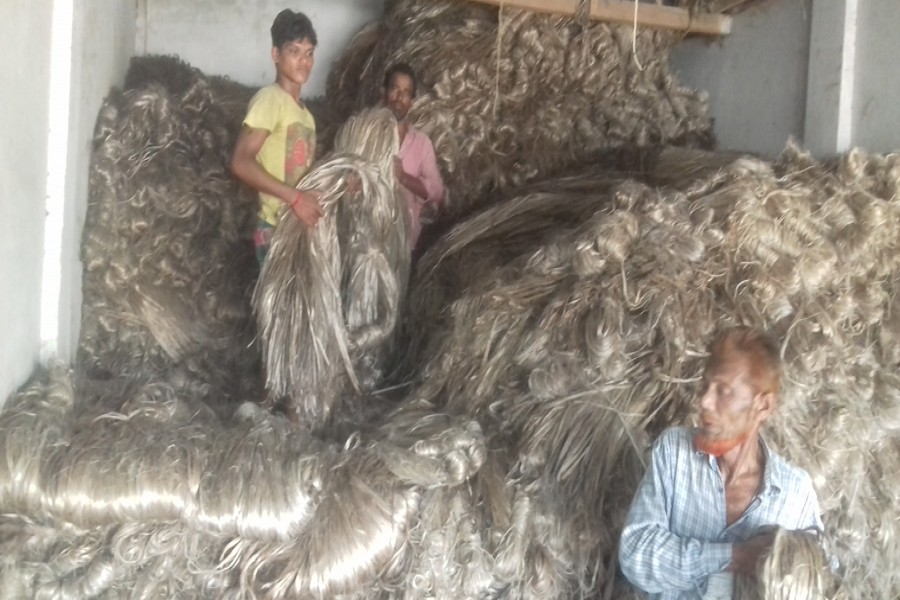
When prepared for export, jute is organised into hanks and then compressed into bales of approximately 181 kilograms. Within Bangladesh, jute is typically transported in less compressed forms, known as kutcha bales.

A significant challenge in handling jute is its susceptibility to moisture. Exposure to high moisture levels can cause rapid deterioration of the fibre. Therefore, it's crucial to store jute in cool and dry conditions. Another aspect to consider is jute's hygroscopic nature, meaning it can draw and hold moisture from its surroundings. This property can be deceptive, as jute may not feel damp to touch even if it has absorbed up to 34% of its weight in water.

When jute becomes damp, it can promote microbial activity, which in turn generates heat. Storing jute in large, tightly packed stacks without adequate ventilation can trap this heat, elevating the temperature within the stack. In scenarios with other contributing factors, such as the presence of oil residues or potential ignition sources, the risk of spontaneous combustion can increase significantly.

It's essential for those involved in jute's global trade to understand and manage these logistical challenges. Doing so ensures the quality and safety of jute products, meeting the increasing global demand effectively.​
 
Analyze

Analyze Post

Add your ideas here:
Highlight Cite Fact Check Respond

The Biggest Jute Exporters and Current Market Trends
tendata blogExport News

In this comprehensive article, Tendata will explore the biggest jute exporters and examine the current market trends. Understanding the key countries that export jute and staying informed about market dynamics is crucial for jute exporters seeking to maximize their business opportunities.

The Significance of Jute:

Jute is a versatile and eco-friendly natural fiber widely used for various applications. Consider the following:

·Sustainability and Biodegradability: Jute is a renewable resource and biodegradable, making it an environmentally friendly choice compared to synthetic materials.

·Versatility and Strength: Jute fibers possess excellent tensile strength and are used to manufacture diverse products such as bags, rugs, textiles, packaging materials, and geotextiles.

Bangladesh: The Largest Jute Exporter:

Bangladesh holds a dominant position in the jute export market. Consider the following:

·Jute Production: Bangladesh is the world's largest producer of jute, accounting for a significant portion of global jute production.

·Export Markets: Bangladesh exports jute and jute goods to various countries, including the United States, the United Kingdom, Germany, France, and Canada.

India: A Major Jute Exporter:

India is another significant player in the jute export industry. Consider the following:

·Jute Industry Development: India has a long history of jute cultivation and jute-based industries, contributing to its position as a major jute exporter.

·Export Markets: India exports jute and jute products to countries such as the United States, the United Kingdom, Germany, Australia, and Japan.

Other Key Jute Exporting Countries:

While Bangladesh and India dominate the jute export market, there are other countries worth mentioning as significant exporters. Consider the following:

·China: China is a notable jute exporter, with a strong presence in the global market. Its large-scale jute production and export contribute to the overall supply of jute fiber and jute products.

·Thailand: Thailand has a thriving jute export industry, with a focus on high-quality jute fibers and jute-based products for various applications.

·Myanmar: Myanmar is an emerging jute exporter, harnessing its jute resources and expanding its presence in the global market.

Current Market Trends:

To stay competitive in the jute export industry, it is crucial to be aware of current market trends. Consider the following:

·Growing Demand for Eco-friendly Materials: Increasing global awareness of environmental sustainability has led to a growing demand for eco-friendly materials like jute. This trend creates opportunities for jute exporters to cater to the needs of environmentally conscious consumers.

·Innovative Product Development: Jute exporters are investing in research and development to introduce innovative jute-based products that meet the evolving demands of various industries. This includes developing jute-blended textiles, eco-friendly packaging solutions, and sustainable home decor items.

·Trade Partnerships and Agreements: Jute exporters should explore trade partnerships and agreements to leverage tariff concessions and preferential access to target markets. Engaging in trade exhibitions and networking events can help foster business relationships and expand market reach.

Conclusion:

Understanding the biggest exporters of jute and staying informed about current market trends is crucial for jute exporters. Bangladesh and India are major players in the jute export industry, but other countries like China, Thailand, and Myanmar also contribute significantly to the global supply. By staying updated on market dynamics, investing in product innovation, and building strong relationships with buyers, jute exporters can seize opportunities and navigate the competitive jute export market successfully.​
 
Analyze

Analyze Post

Add your ideas here:
Highlight Cite Fact Check Respond

Members Online

No members online now.

Latest Posts

Back
 
G
O
 
H
O
M
E