Feed

[🇧🇩] Energy Security of Bangladesh

G Bangladesh Defense
[🇧🇩] Energy Security of Bangladesh
739
27K
More threads by Saif


LNG supply falls again, two fresh cargoes due on Aug 20, 23

1787094106474.webp


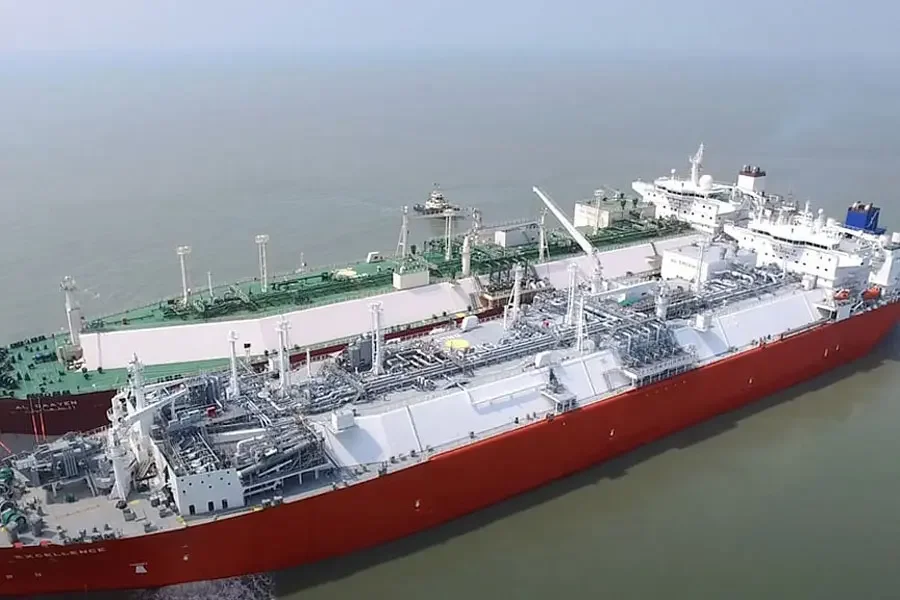
LNG supply to the national grid has fallen as stocks at Excelerate Energy’s floating terminal have declined.

Two new cargoes are likely on Aug 20 and Aug 23, a terminal official said.

At 6pm Tuesday, the two terminals supplied 631million cubic feet per day (mmcfd), down 35mmcfd, or 5.3 percent, from Monday night.

Domestic gas output rose slightly to 1,626mmcfd, but total supply fell to 2,257mmcfd from 2,281mmcfd.

Against daily demand of about 3,800mmcfd, the shortfall was around 1,543mmcfd.

The two terminals have a combined capacity of 1,100mmcfd.

Their supply on Tuesday was 57.4 percent of that capacity.

Petrobangla data show LNG supply at 624.6 mmcfd in the 24 hours to Aug 18, down 179.2mmcfd, or 22.3 percent, from the previous 24-hour period.

Excelerate’s terminal was supplying just over 550mmcfd, while Summit’s was providing about 90mmcfd, the official said.

Summit’s terminal was operating normally.

The official expects supply to return to normal after the new cargoes are unloaded.

Excelerate’s terminal partially resumed operations on Aug 6 after a fire damaged an electrical cable on Jul 21.

Summit’s terminal briefly stopped on Aug 13 because an LNG carrier could not berth but resumed supply the next day.

Power Plants Face Gas Crunch

Power plants received 945.1mmcfd against demand of 2,524.9mmcfd in the 24 hours to Aug 18, meeting 37.4 percent of their requirement.

Power Grid Bangladesh reported gas shortages at 23 plants or units on Aug 17, with two others facing low pressure or gas-control problems.

Thirteen of the 25 affected units produced no electricity that day.

The affected units had a combined current capacity of 3,380.22MW.

The country’s maximum generation on Monday was 15,891.47MW against current practical capacity of 28,793MW.

Other plants were offline due to maintenance, mechanical faults or expired contracts.

Another 28 units faced liquid-fuel shortages, while two reported coal shortages.​
 
Analyze

Analyze Post

Add your ideas here:
Highlight Cite Respond

There is a sustainable solution to the gas and power crisis

Anu Muhammad

An economist and editor of Sarbajankatha

1787095946008.webp

Workers idle away their time as factories shut down due to the gas shortage

Workers idle away their time as factories shut down due to the gas shortageProthom Alo file
The gas crisis across the country has turned dire. Power outages have increased. The situation in Dhaka is severe, and it is even more critical outside of Dhaka. The situation for households and businesses is grim, and many industries have to shut down production. In this situation, everyone was looking to the government for action. However, nothing is happening.

There appear to be at least five problems with the government's role: (1) severe inefficiency in handling the repair of the LNG terminal and the existing technical weaknesses in gas and electricity supply; (2) failure to take swift action regarding the Bhola gas field and renewable energy power; (3) blaming the common people for their own inefficiency and failures; (4) making the most of the crisis to actively fulfill the agendas of some local and foreign business groups; and (5) increasing people's burdens with unjustifiable extra bills.

We must remember that there was a time when limited gas resources in our country were being pressured for export to India by American oil companies. We should also remember who was creating the frenzy for exporting gas abroad for company interests instead of using it domestically. Many of them, at a point, also wanted to export the country's coal resources by destroying northern Bangladesh. The United States and India, the World Bank, ADB, some so-called company lobbyists, and a few minister-bureaucrat-business-media alliances were the main players in this effort. In response to public resistance, the National Committee to Protect Oil, Gas, Mineral Resources, Power, and Ports was formed.

Even the President of the United States (Bill Clinton) came to lobby on behalf of the company. Indeed, the massive movement at that time stopped the gas export. Otherwise, the little gas we are getting today would not have been possible. It is hard even to imagine how terrifying the situation would be in factories, homes, and everywhere else; we would have to import many times more oil and LNG than we do now.

Since its establishment in 1998, the 'National Committee' has emphasised three key points: First, ensuring 100 per cent ownership of Bangladesh's national mineral and natural resources by its people. Second, resources are limited, so exporting them should be prohibited to ensure they can be used entirely for the benefit of the country's people over a long period.

Third, build national capacity for oil-gas exploration-extraction and expand renewable energy. But no government has moved in this direction from then to today and has gone in the opposite direction. Dependency on foreign companies, foreign loans, and imports has increased, and many nature-destroying agreements and policies have been adopted. In the decade and a half of the Hasina government, we have seen the extreme form of this.

Due to the government's position, even though gas export was stopped by popular resistance, the energy and power sector couldn't get out of the grip of multinational and domestic looters. Instead, in 2010, the "Indemnity Act" increased their dominance. To serve their interests, a long-term dangerous master plan was developed for the power sector until 2041 through Japan’s JICA consultants. It’s due to following this path that, despite enormous expenses and environmental destruction, we face today's mega-crisis.

Even if the government changes, this path hasn't changed. Although there has been talk of updates and costly advice at different times, the main features of the 'master plan' remain the same: (1) It is linked with the interests of foreign loans-funds, consultants, and various business organisations. (2) It gives no importance to questions of Bangladesh’s geography, population density, resource availability, environmental risks, and public interest. (3) Priority has been given to foreign company dependency, imports, and loan-dependent, environmentally destructive expensive projects; in this track, various coal-based power plants that destroy lives, dangerous nuclear power plants, and a variety of LNG import projects have been taken. (4) Proposals to regularly increase gas and electricity prices have been made. (5) Although the production of electricity based on renewable energy is increasing at unprecedented rates worldwide, its position here is marginal. (6) It has no importance for national capacity.

Under this path, expensive LNG imports have been established under the guise of the gas crisis, and coal and nuclear power plants have been established. Meanwhile, there has been repeated effort to sign contracts with foreign companies by keeping provisions for gas exports, thereby increasing the advantage for those parties. No attempt has been made to develop their own capacity.

In contrast to this, on 22 July 2017, we published the 'Energy and Power Master Plan of Bangladesh (2017–2041): National Committee Proposed Draft Outline,' prepared on a voluntary basis by independent experts from home and abroad.

We have shown that both coal and nuclear means are very dangerous for Bangladesh and are major burdens financially and socioeconomically. Import-oriented dependency and reliance on foreign companies are very risky.

Our best way is to develop national capacity for gas resource extraction and actively implement strong policy and institutional measures to realise the vast potential of renewable energy. Emphasising this path would not have created the mega-crisis situation in the energy and power sector today. There wouldn’t be a need to repeatedly hike gas-electricity prices, but instead, it would be possible to ensure an uninterrupted supply and even reduce prices.

The government, the World Bank, large company groups, and their preferred bureaucratic-consultants are not willing to go any way other than imports and foreign companies. The question of national capacity is very unwelcome to them. That's why for 20 years, foreign companies have been brought in for gas exploration and extraction at sea, but no work is done.

Again, efforts continue to bring them, benefits are repeatedly increased under company pressure, one LNG import agreement after another is made. But neither the current government nor previous ones has been seen taking holistic plans and initiatives for developing a national base of capability. Not even now. The large amount of money spent on LNG import and capacity charge could have built a strong independent base in the country if a portion of it had been used to take necessary institutional initiatives, and we would not have ended up in such a predicament.

Whenever we talk about national capacity, it is said, ''It's not possible for us. We can't do it.'' Yet, if it’s said that it’s not possible despite having so many science, technology, and engineering universities in the country, then what's the use of these universities? In reality, neither our institutions nor teacher-students are being given that opportunity. Domestic and foreign corporate lobbyists have fostered a sense of ‘national inferiority,’ obstructing the country’s path towards strong, self-reliant development.

In fact, breaking down the wall of this national incompetence is the prime duty of any people's government. The solution to the current gas-electricity crisis is certainly possible. But for this, immediate changes in the problems of the current government’s role as I've mentioned before are essential to overcoming the situation in the short term.

In the medium and long term, for a sustainable and affordable system in the energy and power sector, the government's main task should be to advance with a new roadmap based on 100 per cent ownership of the people and national capacity. However, if instead, the current government remains tied to the old rope, only a few domestic and foreign groups' pockets will become fatter, but the country’s crisis will continue to grow.

#Anu Muhammad is a teacher, writer, and editor of the quarterly journal Sarbajanakotha​
 
Analyze

Analyze Post

Add your ideas here:
Highlight Cite Respond

Nearly 43pc of annual LNG subsidy spent in just 1.5 months


1787179915103.webp


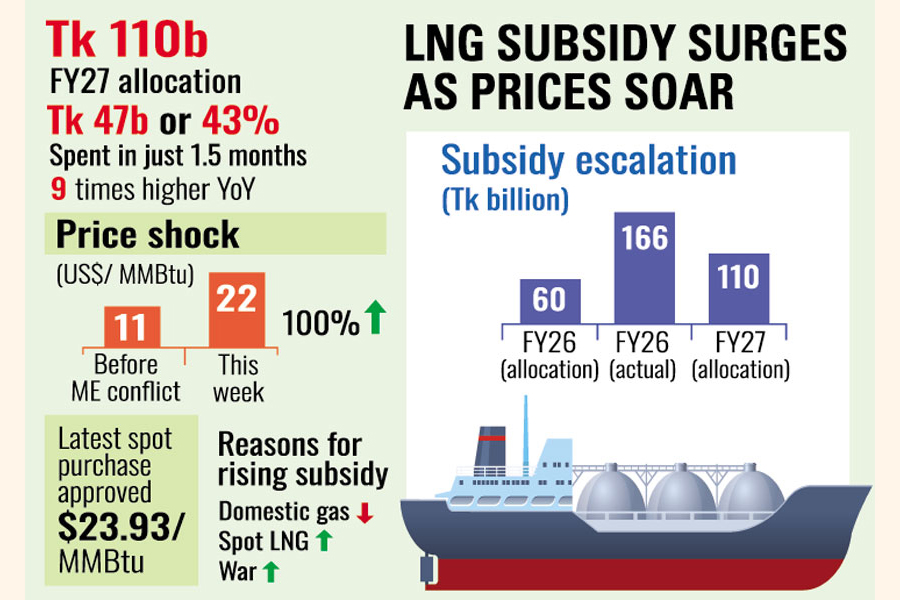
Nearly 43 per cent of the subsidy allocated for liquefied natural gas (LNG) import in the budget has already been disbursed within one and a half months of this fiscal year as the fuel price spikes amid global unrest.

Until mid-August, sources have said, the Finance Division had disbursed Tk 47 billion (42.73 per cent of FY27 allocation of Tk 110 billion) in favour of Energy Division-over nine times higher than the amount of Tk 5.0 billion disbursed in same period in the last fiscal year.

However, disbursement of subsidy for the power sector remained almost same during the one-and-a-half-month period of this fiscal year compared to same period in the last fiscal year, sources say.

Government spending in the form of subsidy, for energy and power sectors, soared in the recent months after war broke out in the Middle East in particular as gas-and fuel-oil prices mounted due to supply-chain disruptions.

The spot LNG prices this week reached nearly $22 per MMBtu, almost double the price before the United States and Israel began pounding bomb on Iran blocking key Middle-East routes of LNG transportation and forcing suspension of gas production.

On Wednesday, the cabinet committee on government purchase in a meeting with finance minister Amir Khosru Mahmud Chowdhury in the chair approved a proposal for buying one cargo of LNG from spot market at $23.93 per MMBtu amid severe supply shortage.

Finance Division officials say in the recent months the government gave approval for buying scores of LNG cargoes from the global spot market as supply from long-time contactors dried up.

This procurement involves huge extra spending due to higher prices of the fuel, causing huge burden to the public exchequer.

They say there is no sign that conflicts in the Middle East will end soon and so LNG-and fuel -oil prices continue climbing.

A senior energy division official said for LNG subsidy, the government earmarked some Tk 110 billion in the current budget for the entire fiscal year. Due to LNG-price escalation, the government was forced to disburse Tk 47 billion within one and a half months from the budgetary allocation to import the item for keeping factories and wheels running.

In the fiscal budget for 2025-26, the government kept aside Tk 60 billion as subsidy for the import of liquefied natural gas. However, at the end of the year, the subsidy had multiplied to Tk166 billion.

"The trend shows that this year's LNG subsidy will surpass significantly last year's spending for the same," he said.

Professor M Shamsul Alam, Energy Adviser at the Consumers Association of Bangladesh (CAB), says that, currently, the economy is under immense pressure while the energy security is on its "deathbed".

"Right now, to survive during a wartime period-or rather, during a crisis period-what the government does to maintain food supply and ensure survival is beyond criticism," he told The Financial Express.

Regarding energy security, he said the question is what strategies the government can adopt alongside this to reach a sustainable stage. "If this issue is not resolved quickly, we cannot survive depending on LNG. The LNG is not a supportive energy source for long-term energy security in a country like Bangladesh," said Mr Alam.

He said importing LNG while experiencing stagnation in domestic gas extraction over the past years was a "terrifying and self-destructive move".

Mr Alam has suggested going for extraction of domestic coal and gas to ensure energy security in the future.​
 
Analyze

Analyze Post

Add your ideas here:
Highlight Cite Respond

Bangladesh's green energy dilemma: Bold targets, slow grid

Suborna Akther Laboni

1787356179290.webp


Worldwide, the rush to adopt renewable energy to reduce carbon emissions is hurting rural and indigenous communities disproportionately, with their lands taken for solar, wind, bioenergy and hydropower projects, human rights groups say. File photo

Bangladesh has never lacked ambition when it comes to renewable energy. What it has lacked, for nearly two decades now, is delivery. The country's first renewable energy policy in 2008 promised a transformed grid; seventeen years later, renewables still make up barely five per cent of installed capacity. We missed the 5 per cent target by 2015. We missed the 10 per cent target by 2020. And now, with a new Renewable Energy Policy 2025 setting a fresh goal of 20 per cent by 2030, the honest question is not whether the target is admirable; it is whether this time will be any different.

The numbers explain the scepticism. As of early this year, Bangladesh's installed renewable capacity stood at roughly 1,690 megawatts, against a total generation base pushing past 28,000 megawatts. To hit the 2030 target, the Institute for Energy Economics and Financial Analysis calculates that the country needs to add about 760 megawatts of renewable capacity every single year between now and then, reaching nearly 5,850 megawatts of installed renewable power. Bangladesh has never come close to that pace. At current rates of deployment, we are on track to fall short again.

Solar carries almost the entire weight of this transition, accounting for roughly 80 per cent of renewable generation, with Kaptai's ageing hydropower plant and a still-nascent wind sector making up the rest.

That concentration is not necessarily a flaw; Bangladesh's solar potential is estimated at more than 50,000 megawatts, enough, in theory, to meet 80 per cent of the country's projected 2041 energy demand. The resource is not the constraint. The constraint is everything around it: land, financing, grid capacity, and a tariff structure that still quietly favours fossil fuels.

Consider the government's own flagship rooftop solar programme, launched last year with a target of 3,000 megawatts of new capacity by December 2025. It was, by any reasonable measure, wildly unrealistic. Bangladesh had installed only 245 megawatts of rooftop solar in the seventeen years between 2008 and mid-2025. Hitting 3,000 megawatts in six months would have required scaling installation rates more than twelvefold, on rooftops, government offices, hospitals, schools, whose combined sanctioned electrical load did not even reach the target capacity in the first place. The programme was well-intentioned. It was also designed without asking whether the physical infrastructure could carry it. That gap between announcement and engineering reality has repeated itself often enough in Bangladesh's energy sector that it now amounts to a pattern.

There are, to be fair, genuine signs of a policy shift that goes beyond rhetoric. The FY27 budget waived import duties, regulatory duties, and advance taxes on solar panels, inverters, and related components through 2031, and extended tariff relief to battery storage systems, the first real dismantling of a tax structure that had, perversely, made clean energy imports more expensive than fossil fuel infrastructure.

A policy change now permits private firms to sell renewable power directly to consumers, opening a market that state utilities alone were never going to electrify fast enough. And momentum is visibly building among industry voices: at a Dhaka press briefing this May, energy experts and civil society leaders pressed the government to streamline investor services and cut duties further, in pursuit of a 10,000-megawatt solar target by 2030.

But fiscal incentives on the supply side only work if the demand side responds, and here Bangladesh's own tariff policy is undercutting itself. Solar electricity can now be generated at roughly Tk 8 to Tk 9 per unit, a genuinely competitive price. Yet retail electricity tariffs remain artificially suppressed, which means the ordinary consumer or factory owner sees little financial incentive to switch. A country cannot simultaneously subsidise fossil-fuel-based grid electricity and expect households and industry to rush toward solar on cost grounds alone. Until that contradiction is resolved, tax waivers on panels and inverters will boost the balance sheets of importers more than they will boost actual adoption.

The urgency here is not abstract. Bangladesh's energy crunch this year has been severe: gas constraints alone produced a generation shortfall of nearly 3,900 megawatts in a single month, compounded by another 1,668 megawatts lost to plant shutdowns and maintenance. Gas-fired plants still account for 43 per cent of installed capacity, coal for another 27 per cent, a fossil fuel dependence that leaves the country exposed every time global energy prices spike, or regional conflict disrupts supply chains, as tensions in West Asia have already begun to demonstrate. Renewable energy, in this light, is not an environmental nicety. It is the most direct route available to energy security and price stability, since sun and wind, unlike LNG and coal, do not arrive on a cargo ship subject to geopolitics.

Land scarcity is the next serious constraint, and it deserves more creative policy attention than it has received. Utility-scale solar needs space that a densely populated delta nation simply does not have in abundance. Industry figures have proposed floating solar installations and the use of riverine char lands, the seasonally exposed sandbars that dot Bangladesh's rivers, as a way around this. These are not fringe ideas; they are the kind of practical adaptation that a land-constrained, river-rich country should be piloting at scale rather than discussing at conferences.

What the sector most needs now, though, is institutional capacity rather than another headline target. SREDA, the government authority tasked with managing this transition, has consistently faced staffing and resource constraints that leave it under-equipped for the scale of coordination that a 20-per cent-by-2030 mandate demands, spanning land allocation, grid interconnection, tariff design, and investor facilitation simultaneously. Ambitious policy without an empowered implementing agency behind it is how Bangladesh ended up here in the first place, missing two targets in a row.

None of this argues against the new targets, 20 per cent renewable by 2030, 30 per cent by 2041, is roughly the right level of ambition for a country this exposed to fossil fuel import costs. It argues for treating the target as the easy part. The hard part- rationalising tariffs so that solar's cost advantage actually reaches consumers, giving SREDA the staff and authority to move at the pace the policy demands, and building the grid and land-use innovations that a dense, low-lying country requires- is where the next four years will actually be won or lost. Bangladesh does not need a bolder promise. It has one. It needs, for the first time in nearly twenty years, to keep it.

#Suborna Akther Laboni is a researcher, Dacca Institute of Research and Analytics (daira)​
 
Analyze

Analyze Post

Add your ideas here:
Highlight Cite Respond

Latest Posts

Back
PKDefense - Recommended Toggle