Feed

[🇧🇩] Monitoring Bangladesh's Economy

G Bangladesh Defense
[🇧🇩] Monitoring Bangladesh's Economy
1K
43K
More threads by Saif


Dollar and reserves offer relief, investment remains sluggish

1787181350225.webp
 
Analyze

Analyze Post

Add your ideas here:
Highlight Cite Respond

Govt targets lofty 34.5pc investment-GDP ratio for FY27


1787353646038.webp


Bangladesh wants to expand its investment-to-GDP ratio by 6.57 percentage points within a year as it has set the aspiration in the newly approved five-year development strategy and framework, analysts say.

Economists have termed this "over-ambitious", saying the target is almost impossible to achieve.

Prime Minister Tarique Rahman formally unveiled the cover of the "Five-Year Strategic Framework for Reform and Development-FYSFRD (July 2026 to June 2031)" alongside its complementary Strategic Action Matrix on Wednesday.

Several economic targets, including the investment-to-GDP ratio increase goal, were set there.

Moving decisively away from traditional and rigid bureaucratic planning models, the General Economics Division (GED) under the Planning Commission prepared the dynamic economic blueprint, designed to guide the nation "from fragility to prosperity".

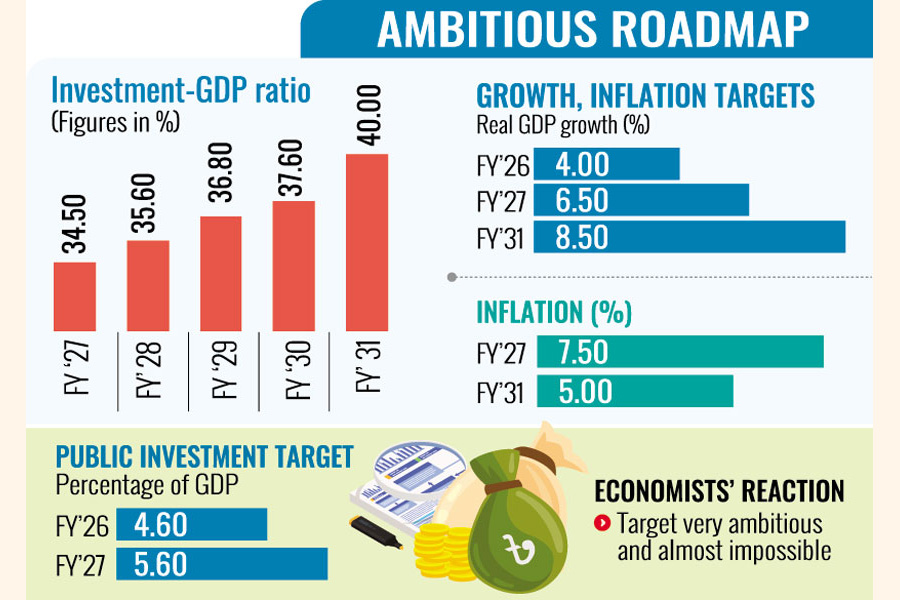
According to the framework's indicator, the government wants to raise the investment-to-GDP ratio to 34.5 per cent within the current fiscal year.

The Bangladesh Bureau of Statistics (BBS) data shows the ratio reduced to 27.93 per cent in FY26 from 28.54 per cent in FY25.

In addition, the government wants to grow the ratio to 40 per cent in FY31.

According to the target, the ratio would reach 35.6 per cent in FY28, 36.8 per cent in FY29, and 37.6 per cent in FY30.

Amid the ongoing austerity and low expenditure capacity of the government, the strategy paper has set a target to increase public investment by one percentage point to 5.6 per cent of GDP within this year from 4.6 per cent estimated in FY26.

It says, "Prudent macroeconomic policies, appropriate supply side measures, and political stability are expected to stabilise the macroeconomic imbalances and reduce vulnerabilities in the near term."

Consequently, real GDP growth is expected to rise from the recent 4.0 per cent to 6.5 per cent in FY27, while CPI inflation is expected to ease to 7.5 per cent, it also says.

Economic growth is projected to accelerate thereafter, reaching 8.5 per cent by the beginning of the next decade, while inflation is projected to decline to 5.0 per cent by FY31, adds the paper.

The GED claims the macroeconomic and sectoral growth projections are made using the dynamic CGE model.

The industry sector's contribution to growth has been steadily declining in recent years owing to the shocks and mismanagement described above, the paper says.

"This is projected to reverse in the acceleration phase of the strategy. Further, a stylised production function estimate finds that capital's contribution to economic growth has also become negative as private investment has ground to a halt because of economic disruptions."

As the economy stabilises and then accelerates, growth is projected to rely more on employment and total factor productivity than had been the case in the past, it adds.

Professor Mustafizur Rahman, a distinguished fellow of the Centre for Policy Dialogue (CPD), tells the FE that he thinks the target is very ambitious and impossible to achieve.

"Bangladesh's business climate is traditionally very poor. Besides, the energy crisis has been added in recent months. So it is really difficult to achieve the target within a year."

Policy Exchange Bangladesh Chairman Dr Masrur Reaz says since the Bangladesh investment climate has not improved and lots of changes have been added in recent times, it is almost impossible to push the investment-to-GDP ratio up to 34.5 per cent.

The government should be realistic in its target and take immediate action to improve the business climate as well as tap more local and foreign investments, he adds.

According to the GED's five-year development strategy, the economic roadmap will be deployed across three strict, sequential operational phases.

The first two years will be treated as "Economic Recovery", where immediate policy prioritisation is directed at stabilising macroeconomic indicators, curbing inflationary pressures, resolving acute banking sector liquidity issues, and aggressively rebuilding depleted foreign exchange reserves.

In the third year, "Restoration & Transition" will be conducted, accelerating institutional banking reforms, modernising trade logistics, and jumpstarting private sector investments.

In the fourth and fifth years, the government would go for "Reconstruction & Acceleration", which will be the final phase and aimed at high-velocity, tech-led growth, absolute poverty reduction, and massive FDI penetration.​
 
Analyze

Analyze Post

Add your ideas here:
Highlight Cite Respond

Latest Posts

Back
PKDefense - Recommended Toggle