[🇧🇩] Monitoring Bangladesh's Economy

Afghanistan Albania Algeria Andorra Angola Antigua Austria Azerbaijan Bahamas Bahrain Bangladesh Barbados Canada China Egypt Finland Germany India Iran Israel Japan Lebanon North Macedonia Pakistan Palestine Qatar Russia Syria Turkey Ukraine United Kingdom United States Yemen
[🇧🇩] Monitoring Bangladesh's Economy
1K
39K
More threads by Saif

G Bangladesh Defense

Exploring alternative sources of remittance

MIR MOSTAFIZUR RAHAMAN
Published :
Jul 14, 2025 23:13
Updated :
Jul 14, 2025 23:13

1752535021548.webp


Remittance has long been a cornerstone of Bangladesh's economic stability and growth. The billions of dollars sent home by expatriates have served as lifelines for families, bolstered our foreign currency reserves, fueled rural economies, and underpinned banking liquidity. In the fiscal year 2023-24, remittance inflows reached an impressive USD 24 billion -- a figure that demonstrates the immense contribution of migrant workers to the national economy. However, a closer look reveals a looming threat: nearly 80 per cent of this remittance came from the Middle East -- a region now engulfed in deepening instability.

The Middle East, once seen as a dependable and generous host to Bangladeshi migrant workers, is today mired in relentless political and military turmoil. From the drawn-out war in Yemen and clashes in Lebanon to the ongoing crises in Syria and Iraq, the genocidal violence in Gaza, and the recent escalation in the Iran-Israel conflict -- the region is quickly becoming a tinderbox of global conflict. These developments are not isolated or distant; they strike at the very core of our economic security. With millions of Bangladeshis working in the Gulf states and beyond, any prolonged disruption in the region could result in mass job losses, forced returns, and a sharp decline in remittance inflows.

This is not a warning we can afford to ignore. It is imperative that Bangladesh begins exploring and developing alternative sources of remittance and foreign income without delay. The old adage "Don't put all your eggs in one basket" rings especially true for us now. We cannot continue to rely so heavily on one region for our economic lifeline -- especially a region so riddled with uncertainty.

The first and most immediate step is labour market diversification. Bangladesh must aggressively pursue new labor destinations across Southeast Asia, Eastern Europe, Latin America, and Africa. Countries such as Malaysia, Japan, South Korea, Romania, Belarus, Croatia, Poland, Brazil, and Chile are grappling with a shortage of skilled and semi-skilled workers. These are opportunities waiting to be tapped.

To access these markets, Bangladesh will need to deploy proactive diplomacy. This means forging bilateral labour agreements, offering mutual training recognition, ensuring worker protection, and building trust with host nations. It also requires private sector collaboration and streamlined government processes to facilitate quicker deployment of trained labor.

Many Bangladeshi workers currently employed abroad -- particularly in the Middle East -- are low-skilled or unskilled. But the demand in emerging labour markets is shifting toward skilled and semi-skilled categories. This mismatch presents both a challenge and an opportunity.

To bridge the gap, the government must prioritise skills development programmes tailored to international demand. Training in electrical work, plumbing, welding, nursing, caregiving, hotel and restaurant management, IT, digital marketing, and even niche areas like hairdressing can transform the earning potential of outbound workers. For example, hairdressing, often dismissed as a low-income trade, commands substantial income in European cities.

By investing in internationally accredited training programmes through technical schools, polytechnics, and public-private initiatives, Bangladesh can unlock a new generation of skilled migrants ready to meet global demand -- and send home greater remittances in the process.

Still, relying solely on exporting labour -- regardless of the market -- keeps Bangladesh vulnerable to external shocks. The more we depend on foreign economies, the more we expose ourselves to global volatility. Therefore, long-term resilience demands the creation of robust employment opportunities within our own borders.

Bangladesh has the potential to stimulate large-scale employment through the development of agriculture-based industries, SMEs, export-oriented manufacturing, freelancing, and entrepreneurship. These are not only avenues for reducing unemployment, but also for increasing domestic income and internal economic circulation.

Freelancing, in particular, has emerged as a major global trend, and Bangladesh is already on the map. After India, we are the second-largest pool of IT freelancers globally. Yet, in the absence of proper infrastructure, payment gateways, tax incentives, and policy support, our freelancers have not been able to translate their potential into substantial export earnings. By removing these bottlenecks, Bangladesh can turn freelancing and digital services into a billion-dollar export industry.

While remittances remain vital, export diversification must go hand in hand with labour market reforms. The ready-made garment (RMG) industry currently accounts for the bulk of our export earnings, but over-reliance on any one sector -- as with any one region -- is dangerous.

There are promising sectors just waiting for the right push: pharmaceuticals, agro-processing, leather, ceramics, frozen fish, light engineering, and handicrafts. With modern infrastructure, smart subsidies, and global market connectivity, these industries can generate substantial foreign exchange -- reducing our dependence on overseas labor altogether.

The IT sector again stands out as a game-changer. With a young, tech-savvy population and a growing digital ecosystem, Bangladesh can become a major hub for outsourcing, software development, and digital services. Countries like India, Vietnam, and the Philippines have already shown the path. All we need is the vision and commitment to follow it.

Should the Middle East crisis escalate, a large number of Bangladeshi migrants may be forced to return home. This influx, if not managed well, could overwhelm the labour market and increase social pressures. But if handled with foresight, it can become a turning point.

Returnee workers bring skills, discipline, and capital -- all of which can be channeled into domestic productivity and investment. The government must create an investment-friendly environment tailored to the needs of the returnees: access to land, bank loans, simplified regulatory procedures, and tax incentives. Such measures can encourage them to become entrepreneurs and employers. This not only ensures them an avenue for soft landing but also turns them into engines of economic growth.

Finally, awareness at the family and community level is essential. Many Bangladeshi households are entirely dependent on remittance, which makes them financially vulnerable. These families must be guided to explore alternative income sources, develop financial literacy, and think beyond remittance dependency.

This can be achieved through joint efforts by local government bodies, NGOs, and the media. Awareness campaigns, community-based entrepreneurship training, and microcredit access can prepare families to adapt and thrive -- even in a post-remittance scenario.

The political crises of the Middle East are not just geopolitical developments playing out on foreign soil -- they are directly connected to the fate of millions of Bangladeshis and the economic lifeline of our nation. We may not be able to stop wars in Yemen, Gaza, or Iran, but we can -- and must -- prepare for their economic fallout.

Now is the time for visionary leadership, not reactive firefighting. Now is the time for bold policies that prioritise human capital, innovation, and diversification. The choices we make today will determine whether we survive future crises or fall victim to them.

Bangladesh stands at a crossroads. It must move beyond the comfort of known markets and traditional remittance channels. A new era demands new thinking -- and exploring alternative sources of remittance is no longer an option; it is an urgent necessity. If we act wisely and decisively now, we can turn today's threats into tomorrow's opportunities. If not, we risk letting uncertainty dictate our destiny.​
 

How global economic governance entrenches dependence for countries like Bangladesh

1752540020037.webp

File visual: SALMAN SAKIB SHAHRIYAR

In the first half of 2025, Bangladesh's economic headlines have swung between cautious optimism and deepening alarm: an IMF bailout, renewed negotiations with the World Bank, calls for foreign direct investment (FDI), and an unrelenting cost-of-living crisis. Beneath these surface-level developments lies a deeper structural entrapment—an architecture of global economic governance that continues to bind Bangladesh's future to externally scripted imperatives.

At the core of this system are the Bretton Woods institutions—the International Monetary Fund (IMF) and the World Bank—established in 1944 to help stabilise the post–Second World War economic order. Add to them the World Trade Organization (WTO), created in 1995. Together, these institutions are now acting as enforcers of the Washington Consensus: policy prescriptions promoting austerity, liberalisation, and privatisation, often at the expense of national sovereignty and social equity. Today, this "Unholy Trinity" operates in concert with powerful actors such as the G7, World Economic Forum (WEF), and transnational corporations (TNCs), colluding closely with domestic enablers from Bangladesh's political, business, and bureaucratic elites.

This ensemble—let's call them the Unholy Trinity Plus—sustains a neo-colonial economic order couched in the language of development, reform, and global integration, essentially reproducing dependence in the Global South. Despite Bangladesh's impressive socio-economic resilience, it remains ensnared in this ill-conceived global architecture, its sovereignty gradually mortgaged for short-term liquidity and long-term indebtedness.

The mirage of development

From Latin America to sub-Saharan Africa, IMF stabilisation packages in the 1980s and 1990s ushered in waves of austerity, liberalisation, and deregulation. These policies decimated public services, weakened state capacity, and widened inequality. Bangladesh now treads a similar path.

In June 2025, the IMF disbursed an additional SDR 567 million (equivalent to around $884 million under the extended credit facility and extended fund facility) and $453 million via the rapid financing instrument, totalling $4.1 billion in support—a sum that, ironically, is dwarfed by the record $30 billion remitted by Bangladeshi migrant workers in FY24-25. These remittances have long sustained the economy without conditionalities, yet those who send them remain voiceless in shaping the very policies that govern their families' lives.

In contrast, a staff-level agreement between the IMF and Bangladesh in May 2025 unlocked $1.3 billion, contingent on tax reform and adopting a crawling-peg exchange rate—a mechanism that allows the taka to gradually depreciate against the dollar, making imports more expensive and fuelling inflation. These reforms aim to reassure global investors and stabilise macroeconomic indicators, but they do so at the cost of household budgets and domestic economic autonomy. For ordinary Bangladeshis, these abstractions translate into VAT hikes, fuel price deregulation, and a weakening taka—a recipe for inflation, wage stagnation, and daily hardship. Although the IMF's tone has softened, its approach still draws from the structural adjustment playbook, prioritising macroeconomic targets over social well-being.

The World Bank continues to couch its interventions in the lofty rhetoric of poverty alleviation and capacity building. But its lending in Bangladesh prioritises infrastructure and energy sectors, areas historically prone to elite capture. The Padma Bridge controversy exemplifies this dynamic: the bank withdrew support over corruption allegations, delaying the project amid further opacity. Despite renewed support, such as the $850 million package signed in April 2025 for port modernisation and social safety nets, the risk of reinforcing elite-controlled development circuits remains high.

Meanwhile, the WTO, though less visible in public discourse, plays a crucial role in entrenching Bangladesh's position in global value chains. Its trade rules and intellectual property regimes favour developed countries. In the ready-made garments (RMG) sector, billions in export earnings are siphoned off by Western brands. Bangladesh provides cheap labour, tax holidays, and lax regulation; buyers reap the lion's share of the margins. The 2013 Rana Plaza collapse exposed the human cost of this bargain. Reforms since then have been piecemeal and largely cosmetic.

Local enablers: The complicit elite

Bangladesh is not alone in this predicament. Across the Global South, the postcolonial dream of economic self-determination has given way to regimes of permanent indebtedness. As anthropologist David Graeber argued in Debt: The First 5,000 Years, debt is not just economic—it is moral and political. Debt historically functions as a tool of domination and social control, enforcing hierarchies and subjugation. It creates obligations: the debtor must comply; the creditor retains control.

Today, this power dynamic is institutionalised through global financial governance where policies are shaped not by democratic consensus but by imperatives of debt repayment. The IMF is not merely a lender of last resort but a de facto policymaker and enforcer. The World Bank is an ideological enforcer, and the WTO is a gatekeeper for global capital.

Bangladeshi policymakers often claim they have "no alternative." But this is less a material inevitability than a lack of political will. Alternatives do exist: regional currency swaps, South-South cooperation, wealth taxes, capital controls, and investment in domestic food and energy security. What is missing is the courage to challenge the global orthodoxy.

Sovereignty for sale

Bangladesh is not alone in this predicament. Across the Global South, the postcolonial dream of economic self-determination has given way to regimes of permanent indebtedness. As anthropologist David Graeber argued in Debt: The First 5,000 Years, debt is not just economic—it is moral and political. Debt historically functions as a tool of domination and social control, enforcing hierarchies and subjugation. It creates obligations: the debtor must comply; the creditor retains control.

Today, this power dynamic is institutionalised through global financial governance, where policies are shaped not by democratic consensus but by imperatives of debt repayment. The IMF is not merely a lender of last resort but a de facto policymaker and enforcer. The World Bank is an ideological enforcer, and the WTO is a gatekeeper for global capital.

Bangladeshi policymakers often claim they have "no alternative." But this is less a material inevitability than a lack of political will. Alternatives exist: regional currency swaps, South–South cooperation, wealth taxes, capital controls, and investment in domestic food and energy security. What is missing is the courage to defy global orthodoxy.

The FY2025–26 budget: Dependency continued

The FY25-26 budget, totalling Tk 7.90 trillion, offers little relief from this vicious cycle. Over Tk 1 trillion will be financed through foreign borrowing—an enormous sum, yet the composition, conditionalities, and repayment timelines remain largely undisclosed. Whether through multilateral lenders, bilateral partners, or private bond markets, the lack of transparency raises urgent questions about accountability and debt sustainability.

The budget closely follows donor prescriptions: tax and duty changes aligned with Least Developed Countries (LDC) graduation requirements, emphasis on attracting FDI, and liberalised trade regimes.

Although framed as pragmatic, these priorities entrench the influence of the Unholy Trinity Plus. The budget downplays redistribution, slashes real spending on health and education, and reinforces a growth model reliant on foreign capital and policy tutelage.

Beyond reform: Towards structural change

This is not a call for isolationism or narrow economic nationalism. Bangladesh is embedded in global trade and cannot extricate itself overnight. But it must challenge the false binary of compliance versus collapse.

A shift is needed—from technocratic management to democratic sovereignty. This means reclaiming policy space to prioritise redistribution over GDP growth, public investment over elite enrichment, and livelihoods over loan conditionalities. It requires confronting elite impunity and demanding transparency in how public debt is negotiated, disbursed, and repaid.

Critics will call this utopian. But history suggests otherwise. Malaysia imposed capital controls during the 1998 Asian financial crisis. Ecuador audited and repudiated illegitimate debt under Rafael Correa. A new generation of economists and activists across the Global South calls for debt cancellation, reparations, and post-neoliberal development models.

Bangladesh should not remain a passive recipient of aid. It must become an agent of its own economic future.

The Unholy Trinity Plus—global lenders and their domestic collaborators—will not dismantle themselves. Too deeply entrenched in profit and power, they will continue reinforcing the status quo unless challenged from below. Citizens, civil society, independent intellectuals, and dissenting state voices must demand a different trajectory, one that reclaims democratic choice and prioritises the well-being of the many over the few.

In the long run, development cannot be outsourced or indefinitely borrowed. It must be wrested back—layer by layer, institution by institution—from those who have turned collective need into market opportunity. True sovereignty requires not just rejecting bad deals but reimagining development beyond debt and donor conditionalities.

Ironically, Bangladesh, more than most Global South countries, must pivot on the very regime of global finance it is pitted against, designed to benefit the Global North. This paradox—building national development on foundations that undercut national autonomy—is not only unsustainable; it is structurally unjust.

This vicious cycle must be replaced by a virtuous cycle grounded in self-reliance, equitable redistribution, and democratic accountability. Until then, each new loan is another link in the chain. Each promised reform, a rehearsal of a tired script. It would be overly optimistic to expect this paradigm shift without struggle, particularly when it brooks no delay. But if not now, when? If not us, who?

Dr Faridul Alam, a retired academic, writes from New York City, US.​
 

WB appreciates reforms, reaffirms dev funding

FE REPORT
Published :
Jul 16, 2025 10:31
Updated :
Jul 16, 2025 10:31

1752709617328.webp

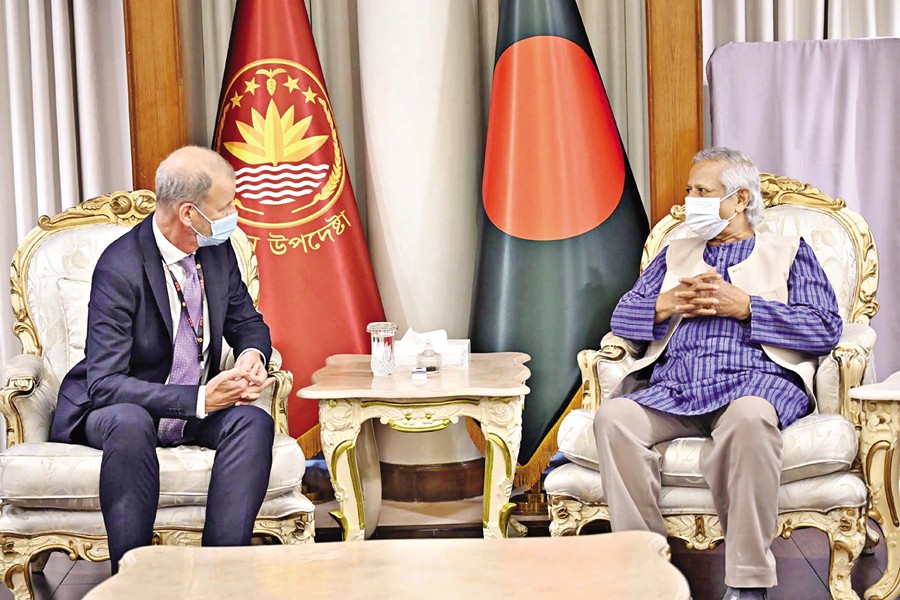
World Bank Vice President for South Asia Johannes Zutt called on Chief Adviser Professor Muhammad Yunus at the State Guesthouse Jamuna in the capital on Monday. — PID

Newly appointed World Bank Vice President for South Asia Johannes Zutt extended Bank's strong support for Bangladesh's inclusive growth and appreciated Chief Adviser Professor Muhammad Yunus-led interim government's reform agenda in the economic sector, officials said.

A spokesperson for the CA Office said Tuesday that Zutt, accompanied by World Bank's new Division Director for Bangladesh and Bhutan, Jean Pesme, called on the Chief Adviser at the State Guesthouse Jamuna in Dhaka late Monday.

During their discussion, Zutt shared his deep affection for Bangladesh, recalling his previous tenure as the World Bank's country director for Bangladesh, Bhutan and Nepal from 2013 to 2015.

"Kudos to you and your fantastic team for doing a good job," he said in acknowledging the post-uprising government's efforts under Professor Yunus's leadership, particularly in addressing "some very challenging issues in the financial sector".

He added, "We are very much prepared to continue our journey and share the ambition of the people of Bangladesh."

He paid tribute to the students who lost their lives in the July Uprising last year, calling it "a very moving moment for everyone who is connected with Bangladesh."

The head of interim government of Bangladesh thanked him for his support and appreciation-explaining how a new journey started in the country after the changeover and what prospects are unfolding.

"When we assumed office, it was like a catastrophic zone, like a place after an earthquake. We didn't have any experience. Yet, all the development partners supported us. And it helped us a lot; it made us confident," he told the WB delegation.

Professor Yunus highlighted the role of the youth in the July Uprising and said, "They showed this nation a dream of building a new Bangladesh."

He termed historic what young people did last July, especially girls and women played a significant role. "We are observing July Women's Day today. Their sacrifices must not go in vain. Young people are the focal point of our country. We need to concentrate on young people and match their ambition."

Professor Yunus urged the World Bank not to view Bangladesh merely as a "geographical boundary", insisting that the Bangladeshi economy is much bigger than that.

"If Bangladesh prospers, the whole South Asian region will prosper. If we separate ourselves, we are not progressing. We need to develop our international trade facilities and transport. We have an ocean. It is an important part of our economy."

The Nobel-laureate economist notes that most countries are short on young people and "so we told them to bring their factories here. We will provide the essentials for industries to make a production hub."

The World Bank Vice President commended Professor Yunus's work in empowering women, offered support on this score. "We will continue supporting you. With the World Bank support, Bangladesh had a pioneering girl's education stipend program that had been replicated in other countries," Zutt mentioned, adding: "The World Bank will help Bangladesh create opportunities for the youth."

He notes that the global lender financed over $3.0 billion in Bangladesh last financial year and pledged to continue similar support in the next three years.

Lutfey Siddiqi, special envoy for international affairs to the Chief Adviser, was also present at the meeting and provided an update on the New Mooring Container Terminal (NCT) of Chattogram seaport.

He noted that container handling at the New Mooring Container Terminal (NCT) of Chattogram Port increased with the new operational management.

"Our plan is to make it more effective. We also saw a significant surge in net foreign direct investment (FDI) in the January-March quarter of 2025, driven by a sharp rise in intra-company loans and strong equity investments," Siddiqi said.​
 

Can Bangladesh afford servicing its debts?

SYED MUHAMMED SHOWAIB
Published :
Jul 18, 2025 23:29
Updated :
Jul 18, 2025 23:29

1752883762381.webp


The burden of public debt in Bangladesh is rising, both in absolute terms and relative to the size of the economy. By the end of the 2025-26 fiscal year, the government's total domestic and external debt is expected to reach Tk 23.42 trillion and it could go beyond Tk 28.93 trillion by 2027-28. This mounting debt is one of the most serious challenges inherited by the interim government from its predecessor. When the previous Awami League government left office in August 2024, it had Tk 18.36 trillion in public debt accumulated through reckless borrowing in the name of development. The responsibility for repaying principals of these loans and servicing the interest now rests squarely on the current government. This unchecked accumulation of debt is creating intense economic pressure which could easily escalate into a full-blown crisis unless public finances are managed with utmost caution.

One of the most commonly used indicators in discussions of government debt is the debt-to-GDP ratio. Many consider the IMF's threshold for this ratio as a definitive benchmark for determining when debt crosses the danger line. For Bangladesh, the debt-to-GDP ratio stood at 37.62 per cent in the 2023-24 fiscal year, later revised down to 37.41 per cent in the latest budget. Projections suggest this ratio will gradually rise, reaching 37.72 per cent by the 2027-28 fiscal year. According to the IMF's fiscal monitoring report, a debt-to-GDP ratio of 55 per cent or higher would raise concerns for Bangladesh, meaning the current level does not immediately set off alarm bells. However, the upward trend warrants close attention. Ideally, if Bangladesh's borrowing had been subject to rigorous scrutiny and directed towards productive investments that boosted GDP growth, the rising debt would not have been seen as harmful. Unfortunately, much of the external borrowing over the past 15 years occurred without adequate scrutiny or negotiation, making the debt burden more severe than it needed to be. Moreover, many of the large-scale infrastructure projects financed by these loans were plagued by corruption. This often took the form of inflated costs, with unnecessary components added to justify budget escalations. Groups with vested interests reportedly exploited these loan-based mega projects by inflating costs multiple times. As a result, the country is now facing mounting pressure to pay back both interest and principal on a debt that it can no longer manage easily.

In theory, there is nothing inherently wrong about a country carrying debt. If the borrowed funds generate returns that exceed the cost of borrowing, such debt can be considered productive and sustainable. This is, in fact, a common feature of modern economies. But in practice, what happened in Bangladesh is that a growing share of public borrowing had gone towards covering routine expenses, propping up loss-making state-owned enterprises and subsidising sectors without credible reform plans. Entities such as the Bangladesh Power Development Board (BPDB), Bangladesh Petroleum Corporation (BPC) and Bangladesh Jute Mills Corporation (BJMC) continue to receive fiscal support despite persistent inefficiencies and structural weaknesses. Even within the ambit of the Annual Development Programme, capital spending is often hampered by poor project selection and implementation delays. Such uses of borrowed funds produce limited long-term economic returns, making the debt less justifiable and harder to service over time.

The ratio of interest paid to revenue is another critical indicator for assessing whether a nation's debt is becoming unmanageable. This matters because the cost of debt is closely tied to interest rates, and as those rates rise, the difficulty of servicing debt increases. Not all countries generate revenue at the same rate relative to GDP, nor do they borrow at the same cost. Countries that can borrow cheaply have more room to manage higher debt levels than those facing higher borrowing costs. Unlike advanced economies, Bangladesh cannot raise taxes or borrow at low interest rates with the same ease. In the fiscal year 2025-26, a staggering Tk 1.13 trillion has been allocated just for interest payments. This alone accounts for nearly one-seventh of the entire national budget. These interest expenses are expected to rise further in the coming years, placing increasing pressure on public finances. Bangladesh's upcoming graduation from the United Nations' Least Developed Country (LDC) status in 2026 will only add to this challenge. Once the country transitions out of the LDC category, it will no longer qualify for concessional financing which typically features low interest rates and long repayment periods. As a result, future borrowing will take place on more commercial terms, involving higher interest rates and shorter maturities. Consequently, debt servicing would consume growing portions of both foreign exchange reserves and fiscal revenues.

Had the country achieved stronger domestic revenue mobilisation in line with its expenditures, the debt burden would not have escalated to its current level. However, the National Board of Revenue (NBR) has consistently fallen short of its tax collection targets year after year, forcing the government to increasingly depend on borrowing, even to cover routine expenditures.

The government's own Medium-Term Debt Management Strategy reportedly acknowledges that Bangladesh has moved from a "low" to a "nearly high" risk category due to the growing volume of public debt. Notably, the country's external debt-to-export ratio has now reached 140 per cent, a level that the Finance Division itself considers alarming. This indicates that Bangladesh is earning significantly less from exports than it owes in foreign currency. If this trend persists, any combination of global events, be it a rise in oil prices, a slowdown in remittances or another pandemic, could trigger a balance of payments crisis.

All of this suggests that while Bangladesh may not currently face an imminent debt crisis, it has been heading in a risky direction for some time. The national budget for FY 2025-26 hints at a more cautious approach to spending, but greater discipline in project selection and debt management remains essential. Bangladesh still has the time and opportunity to place its public debt on a sustainable path, but that time is running out fast.​
 

FDI and external debt management

Asjadul Kibria
Published :
Jul 20, 2025 00:01
Updated :
Jul 20, 2025 00:01

1752971372381.webp


Are the foreign investors sensing a gradual improvement in the country's business climate? Did the much-hyped four-day investment summit in April instil some confidence in foreign businesses to invest in Bangladesh now? These two questions seem pertinent in light of the data released by the central bank'for the third quarter of the past fiscal year (FY25) regarding foreign direct investment (FDI). It showed that the net inflow of FDI jumped significantly in the third quarter (January-March) of FY25.

The big jump is presented in the newspapers with various attractive headlines, as if something significant has happened. One daily writes: ''FDI hits 2-year high in Jan-Mar''; another heading goes like this: ''FDI surges despite economic headwinds.'' Central bank statistics showed that the net inflow of FDI stood at around $864.63 million in Q3 of FY25, which was 114.31 per cent higher than the net FDI in the same period of FY24 and also 76.31 per cent more than the amount in the immediately preceding quarter, Q2 of FY25. The latest quarterly net FDI is the highest amount of quarterly FDI in the last five years. It also indicates an improvement in the foreign investment situation, although some caution is necessary regarding interpretation of the jump.

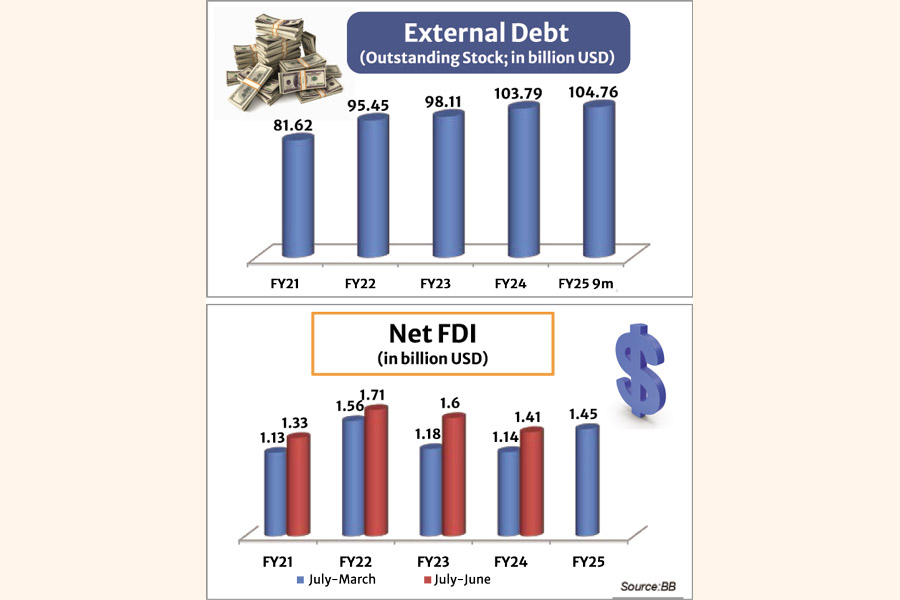
As the full-year FDI data is not available for FY25, one needs to review the data for the first three quarters or first nine months of the fiscal year and compare it with the previous fiscal years to get a broader picture. Bangladesh Bank statistics showed that net FDI in the first nine months (July-March) of the past fiscal year stood at $1459.36 million (or $1.46 billion). It is approximately 26 per cent higher than the same period of FY24, mainly due to a surge in FDI in the third quarter of FY25.

Central bank data further showed that FDI surged after a decline in two consecutive fiscal years (FY23 and FY24). Although FDI data for the last quarter of FY25 is yet to be available, it is clear that the full-year FDI will be significantly higher than the previous year, as the nine-month FDI in FY25 has already surpassed the yearly FDI in FY24. Bangladesh Bank statistics also showed that net FDI in FY23 declined by 6 per cent to $1.60 billion from $1.71 billion in FY22 and further dropped by 11.80 per cent in FY24 to $1.41 billion.

The latest surge in FDI is unrelated to the investment summit or the various activities of the Bangladesh Investment Development Authority (BIDA). Speaking to the media, the BIDA chairman made it clear that the investment promotion agency played a limited role in the recent rise in FDI inflows, as most of the decisions had been made earlier. His acknowledgement is admirable, as people got used to a culture of taking all the credit by politicians and bureaucrats without doing any real work.

The Q3 of the last fiscal was a comparatively stable period after the post-July disruptions. The first quarter of FY25 passed through the most unstable period in recent Bangladesh history. In this quarter, a student-led mass uprising in the country compelled Sheikh Hasina to step down and flee on August 5 last year. In the three weeks of mass movement, which had erupted on July 15, witnessed a brutal suppression by the Hasina regime. Law enforcers and security forces killed around 1,400 people, injured more than 20,000 people. Lots of property were damaged. After the fall of the regime, the country descended into anarchy for some time, and the interim government struggled to restore normalcy.

In the third quarter of FY25 a relative stability returned. The business climate also started to improve, although not enough to attract new investment. This is also reflected in the inflows of FDI, as around 47 per cent of the total investment came from intra-company loans, 22 per cent from reinvested earnings, and 31 per cent through equity capital. Nevertheless, the increase in FDI helped support the balance of payments (BoP), providing a sense of reassurance about the country's economic situation.

It is worth noting here that the inflow of FDI dropped significantly in the last two fiscal years under the ousted Hasina regime, indicating country's limited capacity to attract FDI despite some policy support and considerable rhetoric of development aired by the ruling party leaders. Now, the course is reversing slowly, which is a positive development.

Meanwhile, the foreign debt situation in Bangladesh has also improved modestly in the first nine months of the past fiscal year. The stock of the national external debt increased by approximately 6 per cent at the end of the third quarter of FY25 compared to the same period in FY24. However, compared with the end of FY24, the stock of external debt increased by around 1.31 per cent at the end of March this year.

Over the years, the country's debt-to-GDP ratio has increased gradually. The ratio was 15.60 per cent in FY17, which increased to 22.60 per cent in FY24. The figure for FY25 is still not available. Although the ratio is considered safe, the burden has been growing over the years, and it is not possible to reduce it all at once. It is worth noting that at the end of FY24, total public debt stood at 37.62 per cent of GDP, comprising 21.52 per cent from domestic sources and 16.10 per cent from external sources.

Currently, around 80 per cent of the country's external debt is public debt, which was approximately 75 per cent a decade ago. The rise in public external debt is mainly due to the past government's excessive borrowing from external sources to finance various development and mega projects, mostly at inflated costs. Thus, long-term debt servicing liabilities have also increased. The country's per capita external debt crossed $600 in FY24, up from $258 in FY16.

The finance ministry projected that public sector external debt-to-GDP ratios would remain steady at around 15.74 per cent in FY28. The Medium-Term Macroeconomic Policy Statement: FY2025-26 to FY2027- 28, however, cautioned that though the country's debt-to-GDP ratio is currently within the IMF's safe threshold, the upward trend "necessitates careful monitoring and proactive measures to ensure long-term fiscal sustainability and to safeguard socioeconomic development. Addressing the challenges of low revenue Mobilisation and rising debt servicing costs will be crucial for maintaining a stable and growing economy."

The UN Trade and Development (UNCTAD) has developed a dashboard that helps make insightful comparisons across countries, regions, and special country groups, including those based on development status and public debt. It showed that in many key debt-related indicators, Bangladesh is behind the average status of Least Developed Countries (LDCs).

The latest slowdown in external debt is a temporary phenomenon. Debt management in the coming days will be more challenging. In that case, attracting more FDI is necessary to reduce the burden of external debt in the long-term.​
 

PAYING PENALTY FOR NEGLECTING DIGITAL FINANCE
Bangladesh spends Tk 200b yearly on cash management

Robust cashless infrastructure, policy framework, digital literacy can help out: Experts

Doulot Akter Mala
Published :
Jul 20, 2025 00:57
Updated :
Jul 20, 2025 00:57

1752971518718.webp


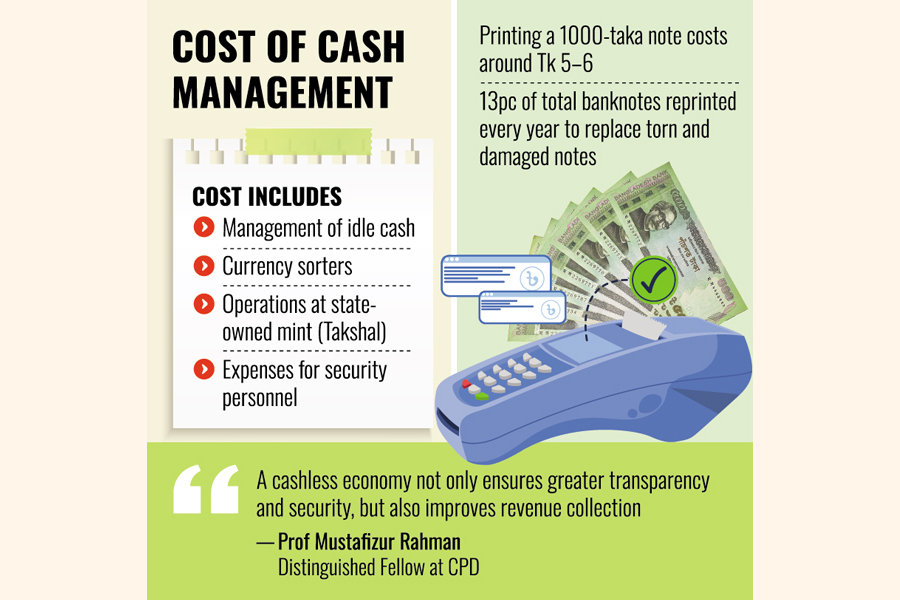
Bangladesh has to pay a penalty for overlooking digital finance as it spends approximately Tk 200 billion annually on cash management for a lack of a robust cashless infrastructure, policy framework, digital literacy and adoption.

The costs include management of idle cash, currency sorters, operations at the state-owned mint (Takshal), and expenses for security personnel.

Bangladesh Bank Governor Dr Ahsan Mansur disclosed the staggering figure of avoidable costs at a recent monetary -policy discussion with economists, bankers and major stakeholders at a hotel in Dhaka.

He stressed the urgency for the country to transition toward a cashless economy to help curb the informal sector--an oft-reported underground or unaccounted-for economy deemed bigger than the country's economy proper.

"We must escalate the credit -card limit to make its use comfortable to encourage digital-payment systems," the economist-turned chief of the central bank said.

He also notes that the National Board of Revenue (NBR) has withdrawn the mandatory tax-return -submission requirement for credit-card-holders with the aim of easing digital-financial inclusion.

Dr Mansur emphasized expanding the coverage of Mobile Financial Services (MFS) to support a cashless transition, lamenting that most of the services are not vibrant and active to encourage clients.

A senior official from the central bank reveals that printing a 1000-taka note costs around Tk 5-6.

Additionally, about 13 per cent of the country's total banknotes are reprinted every year to replace torn and damaged ones.

However, the official acknowledges that a completely cashless economy is currently unrealistic due to the prevailing economic structure.

"It may not be entirely 'cashless'-but we must aim for a 'less-cash' society," he says about the doable for now.

Talking to The Financial Express Saturday, Professor Mustafizur Rahman, Distinguished Fellow at the Centre for Policy Dialogue (CPD), focused on the critical need to enhance cybersecurity and digital protections alongside the push for a cashless society.

"A cashless economy not only ensures greater transparency and security, but also improves revenue collection by addressing the informal economy-one of the key reasons behind our poor tax-to-GDP ratio," he said.

Dr Masrur Reaz, the founder of Policy Exchange Bangladesh, argues for introducing regulatory incentives to discourage excessive cash usage in specific transactions.

"We are far behind countries like India and Thailand in terms of digital transactions," he says.

"This transition must be gradual. We need the right policies, enabling regulations, payment-based digital products, strong infrastructure, financial literacy, and regulatory incentives to ensure a smooth shift."

Naser Ezaz Bijoy, CEO of Standard Chartered Bank Bangladesh, mentions that the SCB is fully aligned with Bangladesh Bank's initiative to reduce cash usage in the financial system, recognizing the substantial inefficiencies and avoidable costs associated with cash management.

“Beyond the direct costs of note printing, transportation, security, insurance, storage, teller services, and sorting infrastructure-borne by both the central bank and the 61 commercial banks-the broader economic cost is even more significant,” he added.

With approximately BDT 3 trillion of cash in circulation, a portion of these large balances are sitting idle across 35,000 branches, sub-branches, and agent banking outlets, he said.

When factoring in the opportunity cost-estimated at 8-10% annually-the cumulative cost to the economy becomes staggering.

Moreover, excessive reliance on cash hampers transparency and traceability, often facilitating tax evasion, corruption, and even funding of illicit activities. At Standard Chartered, “we have proactively implemented measures to discourage high-value cash transactions, requiring supporting documentation for any cash deposits or withdrawals exceeding BDT 500,000.” “Additionally, we have incentivised the adoption of digital channels, including our mobile app, which has led to a significant reduction in transaction monitoring alerts-demonstrating both improved compliance and client behaviour.”

Banking-sector insiders have said cash management remains expensive due to widespread ATM networks, cash-centric transactions, and a large informal sector.

The cost includes cash-in-transit security, ATM replenishment, and fraud prevention.

However, recent measures, such as reducing ATM points, placing thresholds on large withdrawals, and increasing transaction monitoring, are helping bankers to cut expenses and reduce risk.​
 

Bangladesh receives $1.70 billion in remittances in 21 days of July

Published :
Jul 22, 2025 22:36
Updated :
Jul 22, 2025 22:36

1753228290341.webp


Bangladeshi expatriates have sent inward US$1.7 billion in remittances in the first 21 days of July, the first month of the new fiscal 2025-26.

Arif Hossain Khan, Executive Director and Spokesperson for the Bangladesh Bank, confirmed these figures on Tuesday night, UNB reports.

According to central bank data, the expatriates sent $1.43 billion in the same period of the previous fiscal year (FY2024-25). It means inward remittance flow has increased by 18.6 percent in 21 days of July, having sent $266 million more remittance in July of FY2025-26, compared to the previous FY2024-25.

The expatriates sent $30.32 billion remittance in FY 2024-25, which is the highest ever.​
 

The Tax-GDP ratio: what BD's real problem is

M G Quibria
Published :
Jul 23, 2025 00:09
Updated :
Jul 23, 2025 00:09

1753229296775.webp


It has become a standard refrain in the lexicon of international development institutions and local protagonists: Bangladesh suffers from an abysmally low tax-to-GDP ratio. At barely 7.5 per cent, it trails not only global averages but also regional peers such as Nepal, whose ratio hovers around 18 per cent. The International Monetary Fund (IMF), World Bank, and many in the Bangladeshi policy community often argue that this deficiency undermines the country’s ability to mobilise resources for infrastructure, health, education, and other developmental priorities. The prescription offered is almost always the same: broaden the tax net, if not raise the tax rate.

While the argument has surface appeal, it is ultimately mechanical and narrow. It assumes that a low tax-to-GDP (Gross Domestic Product) ratio is inherently problematic and that simply raising it will unlock a development dividend. However, this perspective overlooks the deeper structural and moral dimensions of taxation, particularly in a country where corruption, inequality, and a lack of public trust in state institutions have eroded the social contract.

Corruption and the Moral Basis of Taxation: A crucial omission in the mainstream tax discourse is the role of corruption. Bangladesh routinely ranks near the bottom of Transparency International’s Corruption Perceptions Index (CPI), scoring 23 out of 100 in 2024, placing it 151st out of 180 countries. This level of systemic corruption erodes not only the efficiency of tax collection but also the moral foundation of taxation itself.

Why should citizens comply with taxation if they perceive their contributions as financing the high-living of government officials or disappearing into off-the-books accounts? The moral legitimacy of taxation rests on the belief that revenues will be used to fund public goods and social justice. In a country perceived to be a significant player in the global corruption league, this belief collapses.

Consider the recent revelations that a former Land Minister owned 360 luxury properties in the United Kingdom (UK) alone and around 100 additional properties globally, a staggering accumulation for someone with a modest official salary. This case, while extreme, reflects a broader pattern of similar ownership among senior officials, politicians, and their associates. Such illicit capital outflows not only deprive the state of needed resources but also set a damaging precedent. If the wealthy and powerful can offshore their incomes and assets with impunity, why should the ordinary taxpayer play by the rules?

Moreover, Bangladesh allows “voluntary disclosure” schemes, where individuals can repatriate illicit wealth with minimal tax penalties. These amnesties, while expedient for revenue, undermine long-term compliance and reinforce the perception that tax evasion is both low-risk and reversible. Additionally, there is no evidence that such tax forgiveness has yielded any significant revenue in the past.

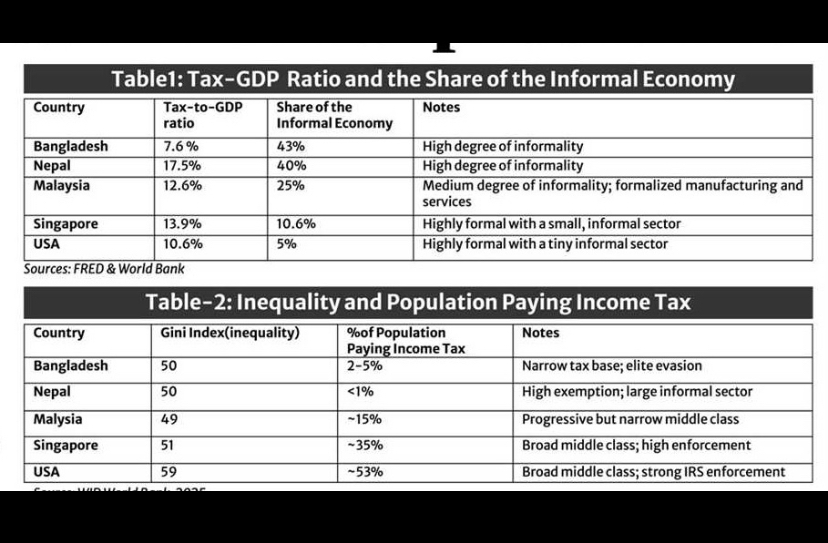
Structural Features of the Economy: Tax performance is not merely a function of administrative efficiency or enforcement capacity; it is deeply linked to the structure of the economy, particularly the size of the formal economy. Let us consider a few illustrative comparisons based on the latest available data. See Table-1, where the Tax-GDP data column in the table is drawn from FRED and the World Bank, while the column on the share of the informal economy is derived from the World Bank’s Informal Economy Database.

Other things remaining the same, the table suggests that informality is negatively correlated with the tax-GDP ratio. Consider Bangladesh, whose economy remains largely informal, with agriculture, microenterprises, and cash-based transactions dominating a vast segment of national output. In terms of informality, Bangladesh is somewhat comparable to Nepal, which, paradoxically, has a much higher tax-to-GDP ratio. We will try to explain the paradox later.

Income Distribution and Tax Compliance: Consider Table-2 below. Column 1 here presents the Gini data compiled from the World Bank’s World Inequality Database (WID) for 2025, while the data on the percentage of the population paying income taxes are sourced from various country reports. The latter data are more indicative than definitive. As the table shows, Bangladesh’s income tax base is exceptionally narrow. Out of a population exceeding 170 million, fewer than 2.5 million people filed income tax returns in FY 2021–22, which is less than 1.50 per cent of the population, and likely only 2–5 per cent of those with taxable incomes. This stark gap reflects both limited administrative reach and widespread evasion among high-income earners. Nepal fares no better: it has fewer than 1 per cent of its population paying personal income tax, due to agricultural exemptions and a vast informal economy.

Even in high-income countries, income distribution plays a critical role in shaping tax outcomes. For instance, in the United States—where the GDP per capita exceeds $80,000—around 47 per cent of households pay no federal income tax. This is not necessarily due to tax evasion but rather reflects the extent of inequality in society: a large portion of the population falls below the income threshold required to owe federal income tax (Tax Policy Center). In fact, many of these households receive an average of approximately $5,000 in income transfers from the federal government through programs such as the Earned Income Tax Credit, Child Tax Credit, and food assistance. This fact highlights the salience of examining tax participation in conjunction with income levels and the state’s redistributive role.

Notwithstanding their egregious inequality, high-income societies such as Singapore and the US have, however, a broader tax base anchored in a wider middle class. Income tax compliance is higher in the middle class not only because enforcement is stricter, but also because they have a vested interest in public services funded through taxes.

Although official data may understate the extent of this inequality, Bangladesh is a highly unequal society: Much of the nation’s wealth is concentrated in a narrow elite that enjoys numerous exemptions, incentives, and often, de facto immunity from enforcement. A large portion of the working population falls below the income tax threshold. Those who do qualify frequently find ways to underreport or obscure their income. The result is a system where the tax-paying middle class bears a disproportionate share, while the wealthy and powerful either evade taxes or shift their capital abroad.

These cross-country comparisons suggest that inequality and informality are closely linked to weak tax performance. Without reforms to make the system more equitable and inclusive, simply raising tax rates or expanding the tax base will likely be both ineffective and regressive.

The Nepal-Bangladesh paradox explained: A closer look at Nepal offers instructive insights. Despite having a smaller and less diversified economy, Nepal consistently outperforms Bangladesh in tax collection. Several factors contribute to this outcome. First, Nepal relies heavily on indirect taxes such as VAT, customs duties, and excise taxes—especially at border points—where compliance is easier to enforce. Bangladesh, in contrast, struggles with widespread underreporting and non-compliance with VAT.

Second, Nepal has benefited from greater reform momentum, driven in part by stronger donor oversight. Its 2015 shift to fiscal federalism also empowered local governments to collect property and service taxes, thereby broadening the tax base. In contrast, Bangladesh’s tax administration remains highly centralised under the National Board of Revenue, which limits local capacity and accountability.

Third, public trust in tax institutions is marginally stronger in Nepal, as reflected in its higher CPI score of 34 (100th globally) compared to Bangladesh’s 23 (151st). While corruption remains an issue in both countries, the perception that tax revenue is more likely to fund public services than private luxuries is more prevalent in Nepal.

Finally, Nepal’s excise tax regime is more effectively enforced. Taxes on fuel, alcohol, and telecommunications make a significant contribution to the country’s revenue. In contrast, excise taxes in Bangladesh are underutilised and often undermined by smuggling and under-invoicing.

In sum, Nepal’s relatively higher tax-to-GDP ratio is not simply the result of better administration but of systemic efforts to expand the base, decentralise collection, and build public trust—lessons that Bangladesh would do well to heed.

Lessons and the Way Forward: The incentive to pay taxes is closely tied to the quality and transparency of government expenditures. When citizens perceive that their tax money is used prudently—for infrastructure, education, or health—they are more inclined to comply. Conversely, ostentatious and wasteful public spending undermines tax morale. In Bangladesh, the spectacle of long motorcades for ministers and high-ranking officials, as well as the use of luxury government vehicles and overseas medical treatments at public expense, stands in sharp contrast to the lives of ordinary citizens. Having had the opportunity to live in capital cities such as Washington, DC, Tokyo, Singapore, and Manila for an extended period, I have never witnessed the kind of official extravagance that is so commonplace in Dhaka. This disparity not only erodes public trust but sends a message that governance serves privilege, not the public good.

Another critical area of reform lies in addressing the skewed distribution of income and the lavish, often unaccountable, expenditure of the state’s upper echelons. The government must take visible steps to curb excessive spending by public officials, parliament members, and military elites. When state representatives live in stark contrast to the people they govern, enjoying perks, vehicles, and foreign medical care at taxpayers’ expense, it breeds resentment and weakens the moral contract that underpins tax compliance. Instituting strict budgetary discipline, transparent audits, and caps on official privileges can help restore a sense of fairness and legitimacy to public finance.

The lesson from these comparisons is clear: raising the tax-to-GDP ratio is not just a matter of better administration or wider nets. It requires building a tax system that is legitimate, equitable, and rooted in social trust.

To be continued...........
 

Latest Posts

Back