[🇧🇩] Monitoring Bangladesh's Economy

[🇧🇩] Monitoring Bangladesh's Economy
1K
34K
More threads by Saif

G Bangladesh Defense

Six valuable minerals found in Brahmaputra river​


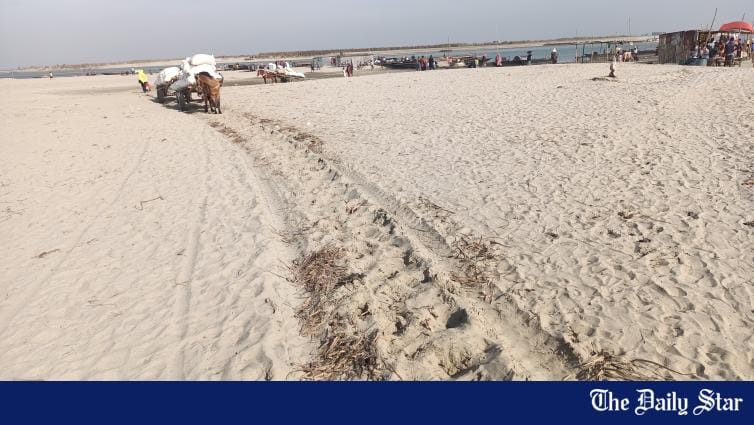
The sands of the Brahmaputra river has been found to contain six types of mineral resources, according to scientists of the Institute of Mining, Mineralogy and Metallurgy (IMMM) in Joypurhat.

1710455089360.webp


The sands of the Brahmaputra river has been found to contain six types of mineral resources, according to scientists of the Institute of Mining, Mineralogy and Metallurgy (IMMM) in Joypurhat.

Their discovery comes nearly five years after the collection of 2,500 tonnes of sand from different chars in Kurigram and Gaibandha to ascertain the presence of mineral resources that can be used in research and development projects.

The IMMM estimates that about Tk 3,630 crore worth of mineral resources, namely rutile, magnetite, garnet ilmenite, quartz and zircon, can be found in each square kilometre of the Brahmaputra river.

This estimation is based on how each tonne of sand yielded 200 grams of rutile, 400 grams of zircon, 2 kilogrammes (kgs) of ilmenite, 12 kgs of garnet, 50 kgs of quartz and 3.8 kgs of magnetite.

Rutile, which is used in making medicine, steel rods, paint, plastic, ink, cosmetics and welding, is mainly exported by India, Italy, Australia, Sri Lanka, Thailand, South Africa and the US.

Magnetite has uses in cleaning mined coal, producing magnets and steel as well as drilling deep wells for oil and gas exploration, with the two exporting countries being South Africa and Australia.

Meanwhile, India and Australia are the main exporters of garnet, which is used for cleaning iron pipes, producing serrated paper and sand blasting.

Zircon is used in refactories, molding sand and to manufacture ceramics. Australia, South Africa, India, China, Brazil, and the US are the biggest exporters of this mineral.
Ilmenite is the most important ore of titanium and is the main source of titanium dioxide, which is used in paints, inks, fabrics, plastics, paper, sunscreen, food and cosmetics.

It also has high magnetic properties, making it useful for some industrial applications.

Lastly, quartz is a hard, crystalline mineral composed of silica and is the main ingredient for making glass. It also has uses in the refectory, petroleum and jewellery industries.

Dr Mohammad Nazim Jaman, former director of the IMMM, said they conducted a geophysical survey on the chars of the Brahmaputra river in Kurigram and Gaibandha to find whether there are mineral resources in the sand.

"A mineral research institute was established in Joypurhat in 2017 and in 2018, sand collected from the Brahmaputra river were researched and valuable minerals were found," he added.

Jaman informed that the market value of minerals excavated from the sand collected at a depth of 10 metres from each square kilometre is Tk 3,630 crore.
"At present, the sand is extracted and used for construction works," he said.

Abdullah Al Mamun, executive engineer of the Water Development Board in Kurigram, said the Brahmaputra river originates from Manas lake near the Kailas peak of the Himalayas.

The river then flows through Tibet and Assam in India before entering Bangladesh through Kurigram.

During monsoon season, the flow of water is high but later decreases during the dry season, when vast chars emerge from the river.

There are about 400 chars along the Brahmaputra river in Kurigram, Mamun added.

Majnu Mandal, a sand trader at Ashtamir Char in Chilmari upazila of Kurigram, said they extract sand from the Brahmaputra river and sell it for use in construction.

He added that they did not know the river sand contained such valuable minerals until IMMM scientists came to study it a few years ago.

Nahid Hasan, former president of the Rail-River, Communications and Environment Development People's Committee in Chilmari upazila, demanded that the government take quick steps to excavate the mineral resources.​
 

IMF suggests raising tax-free income limit to Tk 5 lakh​

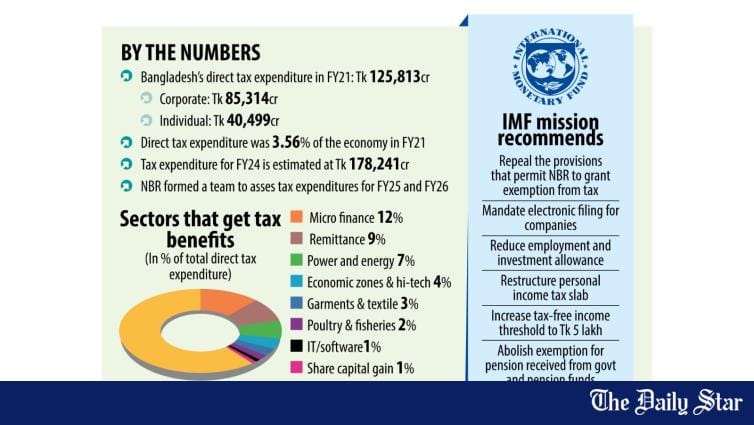
The International Monetary Fund has suggested the National Board of Revenue (NBR) restructure the personal income tax slabs and increase the tax-free income limit to Tk 5 lakh from the existing Tk 3.5 lakh

1710455311378.webp


The International Monetary Fund has suggested the National Board of Revenue (NBR) restructure the personal income tax slabs and increase the tax-free income limit to Tk 5 lakh from the existing Tk 3.5 lakh.

The visiting tax policy mission of the Washington-based lender recommended abolishing the lower slab of 5 percent, saying the marginal tax rate should be 10 percent on income between Tk 5 lakh and Tk 8 lakh.

It also called for repealing the provisions that permit the NBR to grant tax exemptions and urged the tax authority not to extend the concessions after the expiry of the existing benefits.

In order to improve collections, the team said the NBR should make it mandatory the electronic filing for companies from the next fiscal year beginning in July.

The advice comes as Bangladesh's tax-to-GDP ratio continues to be one of the lowest in the world despite rising per capita income.

The lender recommended the government initiate measures that yield an additional tax receipts worth 0.5 percent of the GDP in the current fiscal year ending on June 30.

The team, comprising David Baar, Arbind Modi, and David Wentworth, made the observations during a presentation to the NBR chairman and income tax officials at the revenue authority's headquarters in Dhaka yesterday.

The delegation shared the observations after training taxmen to assess tax expenditures so that the government can eliminate less effective exemptions, broaden the tax base and increase revenue collection, a condition of the IMF's $4.7 billion loan programme for Bangladesh.

According to the NBR, the total estimated amount of direct tax expenditure, which includes exemptions and rebates, was Tk 125,813 crore in 2020-21. Of the sum, tax subsidies given to corporates amounted to Tk 85,314 crore while Tk 40,499 crore was given at the individual level.

Tax expenditures are estimates of tax revenue that government forgoes as a result of legislative provisions that deviate from standard tax treatment. This includes deductions, exemptions and rebates.

The NBR said the total amount of projected direct tax expenditure for 2023-24 will be Tk 178,241 crore.

In its presentation, the IMF team said a tax expenditure should be the most effective policy response to a clearly defined policy need that is aligned with the roles, responsibilities and current priorities of the government.

It described preferential treatment of domestic businesses as incompatible with World Trade Organization rules.

"International best practices will increase the competitiveness of both import-substituting and export-oriented businesses and help attract foreign direct investments."

In the short-term, the IMF said, bad measures should be repealed and a complete evaluation for relevance, effectiveness, economic efficiency and equity should be undertaken.

The team, citing the tax holiday part of the Income Tax Act 2023, favoured cancellation of the provision in the law so that the tax administration can't provide exemptions to businesses through regulatory changes.

"Preferential treatment for mineral and petroleum extraction should be scrapped."

In order to improve tax reporting, the IMF suggested the NBR quickly extend the e-return framework to cover corporate tax.

The tax administration has computer hardware and software and the IMF can help develop the corporate income tax e-return, it said.

The team, however, suggested an evaluation of the depreciation allowance rates and allowances for corporate income tax. It said losses of businesses can be allowed to carry forward for at least 10 years.

The mission called for an evaluation of tax reliefs and the introduction of legislative amendments to implement those that remain relevant, effective, economically efficient and equitable.

It said pension and provident fund contributions, provident fund investment incomes and pension benefits should be taxed once.

The best practice is not to tax contributions or pension fund investment incomes and is to subject pension benefits to the standard personal income tax rates and slabs, said the team.

The IMF's team proposed a review and revision of tax returns to ensure comprehensive data is collected and urged the NBR to go for electronic return filing and payments in phases.​
 

Revamping the financial sector
FE
Published :
Mar 02, 2024 22:02
Updated :
Mar 03, 2024 21:49

1710544725478.webp


The country's financial sector, dominated by banks, has not been in good shape for many years. Economists and financial analysts could not but withhold their negative comments on the poor performance of the sector. They have been particularly critical of the unpalatable developments in the banking industry. Some leading economists, however, consciously distanced themselves from any severe criticism. They have preferred making a few soft observations that would not hurt anybody. Of late, the situation in the financial sector has deteriorated so much that these people could not hide their deep frustration over the goings-on in the banking sector in particular.
FE

Thus, the country's senior-most and venerated economist Prof. Rehman Sobhan, while speaking at a recent SANEM event, said the default culture has progressively become a part of the business model to stay competitive. He explained how a politically privileged class has gone on multiplying their fortunes by 'rescheduling and defaulting' loans. Another noted economist Dr Wahiduddin Mahmud at another event held recently lamented how efforts made some years back to streamline the operations of boards and overall management of banks have lately been diluted much to the benefit of sponsor directors and errant clients of banks.

The negative developments in the financial sector, according to a report published in this paper in the last week of February, have been taking a toll on the country's overall economy. The financial sector reportedly experienced stunted growth in the last fiscal year---FY2022-23---with its two key constituents, banking and insurance, performing poorly. The financial sector growth tumbled to 2.55 per cent in the last FY, compared to 5.87 per cent in the previous fiscal. Factors such as loan scams, soaring non-performing loans, problems with lending rates and subdued demand for funds from the private sector are listed as reasons for the poor performance of the financial sector. The central bank with the government being instrumental in the background is out to amend its past mistakes involving the composition of boards of banks and non-bank financial institutions and other compliance issues. The change in regulatory approach, however, has not come spontaneously. All those are included in the list of dos and don'ts that the International Monetary Fund (IMF) tagged with its US$ 4.7 billion loan.

It is no secret that the Bangladesh Bank is finding it truly difficult to push through even soft reforms in the financial sector at least for a couple of reasons. Firstly, the regulator has yet to discard the soft approach towards the errant bank sponsors and delinquent large borrowers. Secondly, the people who are largely responsible for ongoing crisis in the country's financial sector are still active in the banking industry, using their strong political links. The central bank has been issuing circulars one after another in recent weeks in an attempt to make changes suiting the IMF recipe. These measures would certainly encourage the multilateral lender to make available the remaining tranches of its loan, but the outcome of putting the banking sector on a strong footing remains in doubt. The current state of affairs in this vital sector of the economy demands deep-seated reforms that are unlikely to happen anytime soon.​
 

Growing income inequality hints at uneven development
Published: 00:00, Mar 17,2024

A GROWING income inequality amidst an economic crisis and inflationary pressure is a sign of uneven development. Central bank data show that the number of bank accounts with more than Tk 10 million in deposits has increased by 3,322 to reach 1,16,908 in December 2023, up from 1,13,586 in September 2023 and 1,09,946 in December 2022. Deposits in high-value accounts increased to Tk 9.54 lakh crore in December from Tk 9.44 lakh crore in September 2023. The accounts holding more than Tk 10 million in deposits represent only 0.075 per cent of the total bank accounts; yet, they account for 42.4 per cent of aggregate deposits. Meanwhile, out of the total of 15.35 crore bank accounts, 11.16 crore accounts hold less than Tk 5,000 each. This growth has been consistent for five years, with Bangladesh being viewed having the quickest growth in the number of ultra-wealthy people in recent years. The World Ultra Wealth Report 2018 showed that the number of ultra-high net-worth individuals in Bangladesh increased by 17.3 per cent in 2012–2017.

Such unequal wealth accumulation, especially during an economic crisis, suggests that the government has failed to ensure economic security for the poor while the rich could enjoy policy benefits. Income inequality has been a persistent feature of the economic development. Bankers tend to justify the ‘abnormal’ wealth accumulation by saying that soaring inflation, mounting external debts, a dollar shortage, falling foreign reserves and energy shortage have limited investment opportunities for affluent individuals, leading to the increase in bank deposits. The economists critical of the government’s development policy insist that the inflationary pressure has widened the income gap. The unprecedented food and non-food inflation has affected people’s purchasing power and profits have ended up in accounts of the business elite. The affluent people maintaining links with the ruling party grabbed the larger pie of the economic growth over the past decade and took undue advantage of government facilities which is reflected in their increased asset accumulation. A Global Financial Integrity report showed that Bangladesh loses $8.27 billion annually to trade misinvoicing and by 2030, this could exceed $14 billion a year. The economic development model that the Awami League promised has not delivered.


The government must, therefore, recognise that Bangladesh cannot call itself a developing nation, leaving a huge number of people unemployed and adding to the rich-poor divide. It must work towards an inclusive development by creating an investment-friendly environment for a stable growth in the job market, improving governance and, at least, narrowing income inequality. It should address the corruption that plagues the economy, involve the Anti-Corruption Commission in looking into abnormal wealth accumulation and take action if there is any illegal income. The much-talked-about graduation to developing nations would, otherwise, be a rhetorical move with no real impact on people.​
 

Govt must address inflation, banking sector irregularities
Published: 00:00, Mar 19,2024

A CONSISTENT upward trend in the volume of currency held outside the banks over the past few months brings forth a number of issues that warrant attention. The amount of cash held outside the country’s banks increased in January to reach Tk 2,57,295 crore from Tk 2,54,860 crore in December, Tk 2,48,441 crore in November and Tk 2,45,943 crore in October. The figure was Tk 2,05,895 crore in October 2021. The increase in the volume of cash held outside the banks is blamed on consistent high inflation, people’s declining purchasing power, an erosion of trust in banks and a rise in informal economic activity. The overall inflation rate reached 9.67 per cent in February, while the rate, according to even the conservative estimate of the Bangladesh Bureau of Statistics, remained over 9 per cent for the past 12 consecutive months. Food inflation, meanwhile, has remained higher than non-food inflation. The high inflationary pressure have devalued the taka and negatively impacted people’s purchasing power. Depositors have, as a result, continued to withdraw their deposits to meet the rising costs of living. Widespread irregularities in the banking sector have, moreover, caused an erosion of trust in banks, causing declining deposits in the banks. What is worrying is that the government and the central bank have failed to address both the issues.

When most countries that experienced inflationary pressures since early 2022 in the wake of the Russia-Ukraine war have largely succeeded to contain inflation with effective monetary and fiscal policies, Bangladesh appears to have lamentably failed to address the issue. The mismatch between the expansionary fiscal policy of the government and the contractionary monetary policy of the central bank has rendered all initiatives aiming at containing inflation ineffective. And, with a rise in cash outside the banks the central bank is hardly at a position to control money supply, which is crucial to managing inflation and ensuring economic stability. The authorities have also failed to address the irregularities in the banking sector that has caused a trust deficit, resulting in a decline in deposit. Two-thirds of the banks are, according to the Bangladesh Bank, in a bad shape. In the recent Banks’ Health Index and HEAT Map, the central bank has categorised banks into three zones: green, yellow, and red. The index finds the health of only eight local banks in a good shape and finds 12 banks in a critical condition, among which nine are put in the red zone. Twenty-nine banks are in the yellow zone, suggesting weak and fragile condition and requiring special supervisory attention. The banking sector has for long been plagued by a sharp rise in defaulted loans, scams, irregularities, mismanagement and a lack of good governance. Such a sorry state of the banking sector has not only caused a decline in deposit but also encouraged significant economic activity outside the banks.

The consistent increase in cash held outside the banks has implications for monetary policy, liquidity management and overall economic stability. The authorities must, therefore, devise potential policy interventions to address the underlying issues and to achieve economic stability.​
 

Bangladesh’s exports to keep boosting economic growth: BMI​


1710888430837.webp


Bangladesh's exports will continue to contribute to its economic growth in the short term although high inflation, a weaker taka, and restrictions on imports will weigh down consumption and private investment, according to a new report.

The report, prepared by BMI, a provider of insights, data and analytics owned by Fitch Solutions, said a weak macroeconomic environment and lower purchasing power had caused consumers to shift spending away from mid-priced clothing towards low-priced items, benefitting low-wage producers such as Bangladesh. The report was released last week.​

"We expect that Bangladesh's exports will be bolstered by the growth of low-priced clothing sales across key destinations."

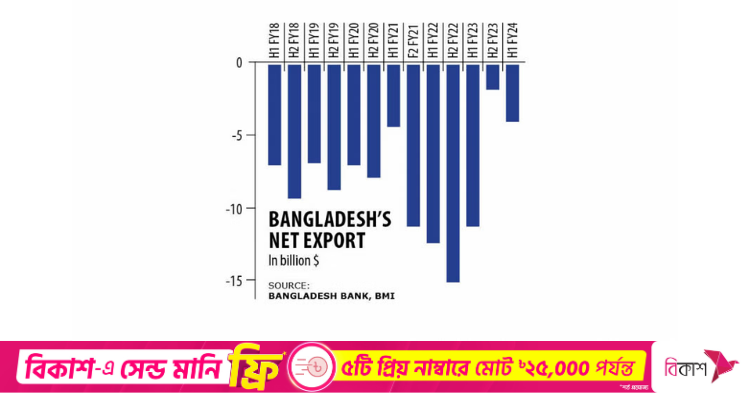
According to BMI, Bangladesh's net exports, which have historically been in the negative, improved to $3.9 billion in the negative, significantly higher than the average net exports of negative $8.1 billion since FY2017-18.

"Net exports are a bright spot as Bangladesh's trade deficit has decreased over recent months and stands at a low, even compared to pre-pandemic levels."

Net exports bottomed out at negative $15.1 billion in the second half of 2021-22, it said.

"The devaluation of the Bangladeshi taka will sustain the country's export competitiveness and keep net export growth elevated."

BMI said Bangladesh's economy is projected to grow 5.4 percent year on year in 2023-24, which is lower than the Bangladesh Bureau of Statistics (BBS) estimate of 5.78 percent.

BMI's prediction is also lower than the forecasts made by the World Bank and the International Monetary Fund.

In January, the World Bank projected that Bangladesh's gross domestic product would slow to 5.6 percent in FY24. The IMF forecast a GDP growth of 6 percent.

This ranges below the robust pre-Covid growth rates, which averaged 6.6 percent in the decade to the pandemic, BMI added.

According to the data service provider, higher inflation and interest rates, capital goods import restrictions, a weaker taka and the ongoing shortage of foreign currency will weigh heavily on private sector investment.

"Although we do not currently forecast the taka to undergo significant further depreciation in the short term, the strong devaluation of the currency in 2022 will continue to weigh on household purchasing power."

Inflation is forecast to average 9.4 percent in FY24, up from 8.9 percent the previous year and considerably above the historical five-year average of 6.3 percent from 2018-19 to 2022-23.

"We forecast private consumption to continue under-performing as high inflation undermines household purchasing power."

It also forecast that private consumption would expand by 6 percent year on year in FY24. But the growth is lower than the stronger growth rates of 8 percent and 7.5 percent recorded in 2020-21 and 2021-22, respectively.

However, it said, robust remittance inflows will provide some upside pressure to consumption.

Remittances inflows, which amount to roughly 5 percent of Bangladesh's GDP, have grown at an average of 22.8 percent per month since October 2023, it said.

"We expect inflows to remain strong, supported by a positive economic outlook for the Gulf Cooperation Council economies," said BMI, forecasting the bloc's economic growth would accelerate from 0.7 percent in 2023 to 2.6 percent in 2024.

An increase in energy prices due to a regionalisation of the Israel-Hamas war poses a key downside risk to the outlook, it said.

BMI added that although energy prices have declined since their rise in response to Russia's invasion of Ukraine, they are expected to remain comparatively high.​
 

Taming Inflation: Let the orthodox monetary policy work​


1710973293608.webp


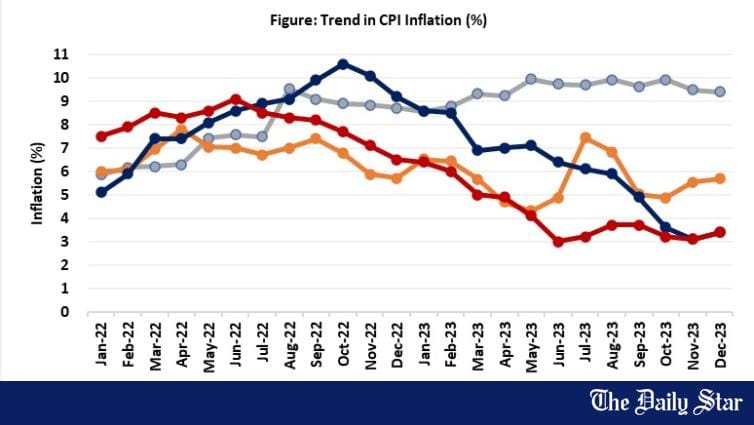
Bangladesh has been experiencing rising inflationary pressure for at least 18 months. In fact, monthly inflation reached as high as 9.94 percent in May 2023 and still remains stubbornly high at 9.67 percent in February 2024. Uncontrolled inflationary pressure is one of the most problematic phenomena in the country. Lessons from economic history vividly demonstrate that high inflation can hinder macroeconomic stability, erode competitiveness of local entrepreneurs, demotivate investment decisions, and accentuate income inequality by substantially reducing the purchasing power of fixed-income and financially weak households.

Thus, it is not surprising that mature monetary regimes across advanced economies commit to an inflation targeting framework where the primary agenda is to keep inflation at about two percent annually. This also explains why, recently, central banks across advanced economies have responded aggressively to tighten money supply and raise interest rates, which translated into lowering inflationary pressure in their respective economies. Interestingly, this also creates a useful context for evaluating the effectiveness of our monetary policy, which has largely been ineffective in controlling inflation.

More simply, given that global inflation has been coming down over the last 18 months, why has inflation in Bangladesh maintained an upward trend since mid-2022? In other words, why is inflation in countries like India and Sri Lanka less than six percent while it remains above 9.6 percent in Bangladesh? What explains this divergence?

To decode this heterogeneity in monetary performance, this analysis will offer insights on three core issues: (i) the set of factors that has driven the global inflationary pressure and how it has been addressed by central banks across the world. In particular, we try to distil the broad lessons that emerge from the international experience; (ii) the set of factors that has driven the inflationary pressure in Bangladesh, and why Bangladesh Bank has failed to tame the inflationary pressure; and (iii) the exact policy decisions that might help bring the current inflationary pressure under control.

Drivers of global inflation and lessons for monetary policy


There is now a consensus among experts that excessive fiscal and monetary stimulus in response to Covid, along with the supply chain disruptions stemming from the aftershocks of the pandemic and Russia-Ukraine war, fuelled this spike in inflation across countries. The initial expectation that the inflationary spike is a transient phenomenon did not come true, and advanced economies started preparing for the worst-case scenario—stagflation—where it was expected that inflation and unemployment rate would rise and remain high simultaneously. This prompted central banks in advanced countries to raise their respective interest rates and commit to contractionary monetary policies, given from the standpoint of macroeconomic management; inflation is seen as a more dangerous problem than unemployment.

For instance, inflation in the United States reached as high as 9.1 percent in June 2022—the highest in 40 years. Responding to this growing crisis, the Fed increased its policy rate eleven times to a range of 5.25 to 5.5 percent—the highest policy rate in 23 years. Consequently, inflation since then decreased substantially, coming down to 3.1 percent in January 2024. Even in India, over the same time span, inflation came down from 7.7 percent to 5.1 percent—responding to the Reserve Bank of India's (RBI) decision to increase the policy rate to 6.5 percent. A similar phenomenon was also observed for the European Union where a contractionary monetary policy brought down inflation from 11.50 percent in October 2022 to 3.1 percent in January 2024.

It is also interesting to underscore that in the US, EU and India, inflation management through contractionary monetary policies did not result in any serious spike in unemployment or nosedive in economic growth. The noted regions have achieved an economic "soft landing," a phenomenon that has pleasantly surprised policymakers who expected costly growth implications of a sustained contractionary monetary policy stance.

Of course, not every nation-state crafted a similar response for inflation management. Türkiye boldly and quite foolishly did what no one expected: its central bank, under pressure from President Tayyip Erdogan, decided to lower interest rates despite an inflation rate of 20 percent, arguing that such measures would help increase investments and smoothen supply-side constraints. But this unorthodox monetary policy experiment did not work and inflation increased to 80 percent in 2022. Subsequently, Türkiye has corrected its earlier devastating monetary policy blunder by increasing its interest rate to 40 percent, which has triggered a downward trend in its inflation rate (standing currently at 65 percent).

On the whole, the global downward trend in inflation validated the effectiveness of an orthodox monetary policy, which views inflation as a largely monetary phenomenon and supports inflation management through contractionary monetary policy stance.

Drivers of inflation in Bangladesh and BB response


As the inflationary pressure in Bangladesh remains sturdy, it is essential to pinpoint its possible drivers. According to the latest monetary policy statement published by the Bangladesh Bank, our inflationary pressure is fuelled by three key factors: (i) supply chain disruptions stemming from post-Covid demand spike and Ukraine-Russian war; (ii) exchange rate depreciation due to higher import bills in FY2022 (which could have been due to money laundering through over-invoicing of imports); and (iii) a sharp energy prices adjustments after the Ukraine-Russia war.

This we believe is an accurate but an incomplete assessment as it ignores a number of key additional issues that have seriously compromised the authorities' efforts to contain inflation. These are: (i) keeping the interest rate structure administratively fixed in the range of six to nine percent for a long time, ignoring the global developments and the post-Covid surge in domestic inflation; (ii) keeping the exchange rate virtually fixed against the US dollar for almost 12 years, contributing to a massive balance-of-payment imbalance and a sharp depreciation of the taka; (iii) injection of substantial monetary stimulus to navigate the economic effects of Covid, which was necessary at that time but was not sterilised subsequently; (iv) printing of high-powered money by the Bangladesh Bank for lending to the government to compensate for revenue shortfall in FY2023; and (v) injection of emergency funds through promissory notes into troubled Islamic banks in December 2022 and December 2023, partially offsetting the efficacy of the central bank's contractionary monetary policy stance. Collectively, these issues need serious recognition in policy formulation.

It is also essential to underscore that the Bangladesh Bank's initial narrative that the inflation was transitory due to external supply shocks and would unwind with supply situation improving was wrong. Thus, its earlier reluctance to remove the six to nine percent interest rate band undermined its fight against inflation. The unchanged interest rate policy also widened the interest rate differential in favour of the US dollar, thereby undermining the authorities' efforts to limit the depreciation of taka by making the taka less attractive against the dollar. The unfavourable return on taka assets coupled with the exchange rate depreciation turned the financial account of the balance of payments significantly negative for the first time in many decades, accentuating pressure on foreign exchange reserves and the exchange rate as short-term capital inflows dried up. Since up to 40 percent of inflation could be attributed to the 30-35 percent depreciation of the taka, an aggressive interest rate policy could have a dampening impact on the inflationary pressure.

Going forward, it is encouraging to note that Bangladesh Bank has moved away from its earlier narrative and has announced the adoption of a tighter monetary stance in its latest Monetary Policy Statement. The authorities have already abandoned the six to nine percent interest policy band, have announced that there would be no recourse to central bank borrowing for budget financing, and the resulting bank financing of the budget deficit has contributed to a significant increase in the interest rates on treasury bills and bonds.

The green shoots of macroeconomic stabilisation is already visible in the form of: (i) external current account being in surplus due to import compression; (ii) stabilisation of the official foreign exchange reserves at around $18-20 billion level; (iii) an apparent stabilisation of the exchange rate around Tk 120-124 per dollar for the last three months; and (iv) an upgradation of the outlook for the banking sector by Moody's due to increased profitability, some recovery in bank deposits and improved liquidity situation, all resulting from the abandoning of the fixed interest rate band.

Given the gains already visible, the Bangladesh Bank needs to go further to consolidate the gains. The post-election hike in the policy rate by 25 basis points was too little too late. The policy rate should be increased in steps of 50 basis points per month for the next four months before considering a pause in the policy rate increase. The basic principle should be to "continue increasing the interest rate until the inflation rate comes down close to the target range." We are still very far from that.

The agenda for restoring macroeconomic stability including price stability—in addition to interest rate hikes—will require (i) unification of the exchange rate in the interbank market; (ii) a sizable cut in non-essential fiscal spending (which we believe is underway); and (iii) refraining from central bank financing of the budget deficit despite the expected pickup in budgetary spending in the final quarter of FY2024. Notwithstanding the initial hesitations and delays, the authorities' current policies are in the right direction and working. What is needed is to strengthen the orthodox policy measures further along the lines described above, and allow for six to nine months of time for the policies to deliver the desired results.​

Dr Ahsan H Mansur and Dr Ashikur Rahman are executive director and senior economist, respectively, at the Policy Research Institute (PRI).
 

External debt crosses $100b for first time​


1711059551119.webp


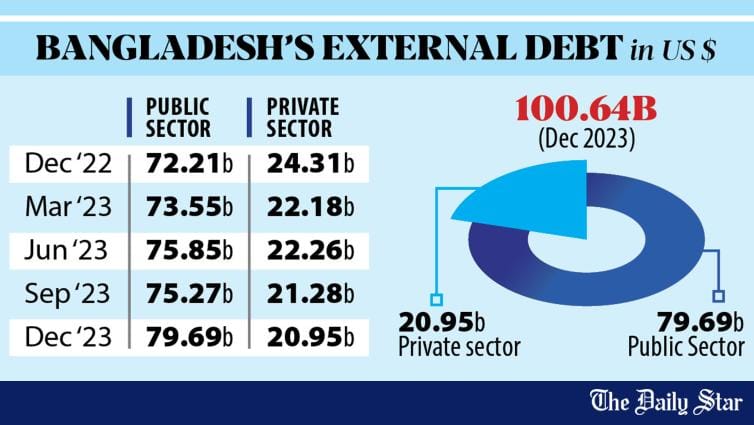
Bangladesh's external debt has crossed the $100 billion mark for the first time, indicating a challenging future amid foreign exchange shortage.

At the end of 2023, the overall external debt stood at $100.6 billion, up from $96.5 billion a year earlier, as per the latest data from the Bangladesh Bank.

Of the external debt, $79.69 billion was taken by the public sector and the rest by the private sector. About 85 percent of the loans are long-term and the rest are short-term.

The debt buildup, which is still within the threshold recommended by the International Monetary Fund (IMF), is becoming a headache for the country given the unfavorable developments on various economic fronts.

"This is concerning that the external debt is increasing," said Ahsan H Mansur, executive director of the Policy Research Institute of Bangladesh.

To tackle the situation, the supplier credit that is being taken from China and Russia must be stopped now, he said.

Supplier credit is an agreement in a commercial contract under which an exporter will supply goods or services to a foreign buyer on credit terms.

If external debt continues to rise, with it the repayment challenges will mount as the country's earning capacity is slowing, both in terms of revenue and foreign exchange, said Mansur, a former economist of the IMF.

Both external debt and debt servicing are growing, said Mustafizur Rahman, a distinguished fellow of the Centre for Policy Dialogue.

In the first five months of the fiscal year, the government's spending on interest payments for foreign debt surged 136.7 percent year-on-year to $562 million.

"The latest batch of external debt is costly, so we have to be alert that there is no problem in debt servicing," Rahman said.

The returns against the foreign loans are coming in local currency and because of the devaluation of the local currency against the dollar, the cost of foreign debt will increase, he said.

The foreign loans that are piled up in the pipeline for projects will have to be used soon to avoid increasing the servicing costs, he added.

Meanwhile, the private sector's foreign loans have dropped about 14 percent to $20.95 billion.

Previously, the interest rate for foreign loans was 1 percent to 2 percent but it has now jumped to 8 percent to 9 percent, said a top official of the central bank.

"This is the main reason for the declining trend of private sector foreign loans," he added.​
 

Latest Posts

Back
Top Bottom