[🇧🇩] Monitoring Bangladesh's Economy

[🇧🇩] Monitoring Bangladesh's Economy
1K
35K
More threads by Saif

G Bangladesh Defense

Non-interference in financial governance

Published :
May 14, 2026 23:45
Updated :
May 14, 2026 23:45

1778801635826.webp


The remarks made by the finance minister at the inauguration of the Bangladesh Start-up Investment Company (BSIC) have resonated widely across policy and business circles, largely because they carried a message that has long been awaited in the country's financial landscape: a commitment to reducing political interference in financial governance. At a time when confidence in the banking and financial sectors remains fragile, the minister's acknowledgment of the "painful" state of the current investment climate appeared both candid and necessary. Speaking at the launch event, the minister pointed to the prolonged weaknesses within the financial sector and warned that such vulnerabilities are often deepened by political interventions. "We will not have any kind of political interference in the economic sector, including the financial one," he declared, while reaffirming the government's commitment to reforming the capital market and strengthening the broader financial system through greater transparency, improved regulation and renewed investor confidence.

The statement carries particular weight in Bangladesh's present economic context. Over the years, concerns about governance failures, loan irregularities and institutional weaknesses have eroded trust in the financial sector. Against that backdrop, the promise of non-interference is more than a political assurance. Whether such promise can ultimately reshape the culture of financial governance remains to be seen, yet the articulation of the principle itself marks a significant departure from practices that many believe contributed to the sector's distress.

Established by 39 commercial banks, BSIC with an initial fund of approximately Tk 4.25 billion and expected to rise to Tk7.0 billion through annual contributions from participating banks, seeks to support seed, late-seed, and Series A-stage startups through the Onkur Bangladesh Fund-1. Noting that the initiative aligns with the government's broader "creative economy" agenda aimed at generating employment opportunities for millions, the finance minister also referred to ongoing collaboration with international institutions to stabilise the banking sector and improve the overall investment climate. Such partnerships suggest an awareness that restoring confidence requires not only domestic reform but also adherence to international standards of accountability and governance. Echoing the minister's sentiments, the governor of Bangladesh Bank emphasised that the country's next phase of financial development would depend on institutions capable of ensuring innovation, discipline, transparency and accountability. His call for BSIC to prioritise projects benefiting rural economies and marginalised communities reflected an important reminder that financial progress must remain inclusive if it is to be meaningful and sustainable.

In a market economy, politically motivated state interference seldom produces healthy outcomes. Bangladesh's recent experience offers ample evidence of how such practices can weaken institutions and undermine public trust. The success of BSIC, therefore, will depend not only on the availability of funds but also on whether it can function under transparent and professional management. If the government remains steadfast in its stated policy and institutions are allowed to operate independently, initiatives like BSIC may help open new avenues for broader economic and social welfare.​
 

What new in budget under new government
Deregulation of economy, liberalising trade figure Prominently
Handover of losing public entities to private management suggested

Syful Islam

Published :
May 15, 2026 23:51
Updated :
May 15, 2026 23:51

1778888894046.webp


A roadmap on deregulation of the economy and liberalisation of trade and investment forms focal policy features in the national budget the new government prepares to present in parliament, sources say.

Deregulation and liberalisation both are election pledges of the government of the Bangladesh Nationalists Party (BNP) that came to power through an election in February.

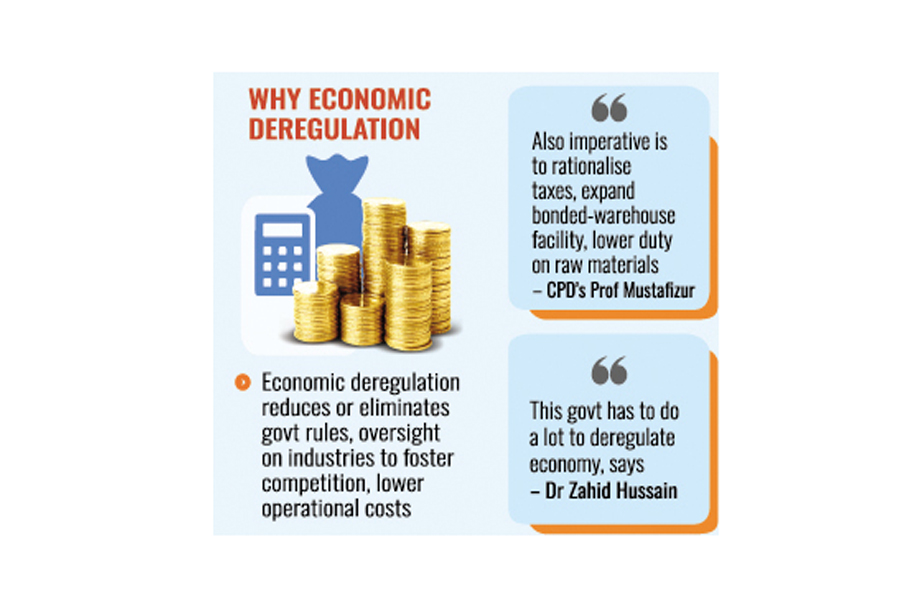
Deregulation of the economy leads to reduction in or elimination of government rules and oversight on industries, aimed at fostering competition, lowering operational costs, and boosting economic growth.

This unclasping of controls means lifting barriers to entry, allowing firms to operate more freely, theoretically lowering consumer prices, and promoting innovation.

Trade liberalisation means the removal of or reduction in trade restrictions or barriers, like tariffs, on the free exchange of goods between nations, according to investopedia.com.

Finance Division officials are now busy formulating fiscal budget for 2026-27, scheduled for rollout on June 11, and on Wednesday, they had meeting with the Prime Minister to apprise him of the budget updates.

At the meeting, sources have said, Prime Minister Tarique Rahman asked the Finance Minister and his team to incorporate as much election pledges as possible in the next budget measures to help reinvigorate the economy and multiply people's welfare.

According to officials concerned, the Finance Division last month asked the ministries and departments concerned to let it know what deregulation-and liberalisation-related measures they have taken so far and what plans they have for the days ahead.

Sources say most of the ministries informed the finance division about the deregulation and liberalisation measures taken in the past.

Only a few ministries proposed what measures they plan to pursue in the future for reduction or elimination of government rules and oversight on industries or removal of or reduction in trade restrictions or barriers.

Finance officials now are preparing a roadmap on deregulation and liberalisation measures to be pursued during the next five years of the present government.

"We are preparing a roadmap based on the election manifesto of the BNP-led+ government," a senior finance division official told The Financial Express.

He said attracting foreign investment by removing various existing barriers and opening up the domestic market as much as possible for all will be at the core of the deregulation and liberalisation measures in the days to come.

Experts also underscore the need for removal of barriers to attracting foreign investments, allowing firms to operate more freely, and lessening cost of doing business to help boost economic growth.

Professor Mustafizur Rahman, a Distinguished Fellow at the Centre for Policy Dialogue (CPD), says rates of duty and taxes in Bangladesh have been comparatively high for a long period and so need to be made rational, expand bonded -warehouse facility and lower duty on raw materials.

He also suggests handover of loss-incurring public entities to private-sector management in the deregulation drive.

"To enhance inflow of foreign investment, one-stop service has to be ensured, logistic policy needs to be implemented, and the time consumption in public service delivery lowered," he says.

Also, Mr Rahman underscores the need for lowering turnaround time of ships in the seaports, making dispute-settlement resolution effective, and easing the repatriation of profit by foreign investors.

"The new government can give more attention on these issues to make doing business easier in the country, leading to higher local and foreign investment," he says.

Dr Zahid Hussain, a former lead economist at the World Bank's Dhaka office, recalls that during the regime of 1991-95 many barriers relating to competition in various sectors were removed.

However, he regrets, the reforms did not continue over the period. Thus, this government will have to do a lot of things to deregulate the economy.

"This government will have to take specific and effective reform measures and make it clear to people what steps it will take for that and how they will be implemented," he says.

Citing an example, he says stakeholders in the next budget want to specifically hear from the government what the National Board of Revenue (NBR) will do in tax -policy reform, what measures will be taken for higher and effective implementation of annual development programme.​
 

Green Economy is a necessity for Bangladesh's sustainable development
Shahiduzzaman

1778889663252.webp

A green and clean environment File Photo

A green economy is an economic system that improves human well-being and social equity while significantly reducing environmental risks and ecological damage. It promotes low carbon development, efficient use of natural resources, renewable energy, sustainable industries, and environmentally friendly technologies. In simple terms, a green economy combines economic growth with environmental protection and social inclusion.

For Bangladesh, the transition to a green economy is no longer simply an option. It has become a national necessity. Bangladesh is one of the most climate vulnerable countries in the world and faces growing environmental and economic challenges caused by climate change, rapid urbanization, industrial pollution, and overuse of natural resources. Rising temperatures, floods, cyclones, salinity intrusion, river erosion, air pollution, and water scarcity are already affecting agriculture, public health, infrastructure, and livelihoods across the country.

These environmental threats are creating serious economic and social impacts. Agricultural production is under pressure due to unpredictable weather patterns. Coastal communities are losing homes and farmland because of rising sea levels and salinity. Urban pollution is damaging public health and increasing healthcare costs. Therefore, adopting a green economy is essential not only to protect the environment but also to ensure long term economic stability, energy security, employment generation, and sustainable national development.

The major elements of a green economy include renewable energy, green industries, sustainable agriculture, waste management, green buildings, water conservation, environmentally friendly transportation, and green technology. These sectors help reduce greenhouse gas emissions, improve resource efficiency, and create sustainable employment opportunities.

In Bangladesh, several sectors are gradually becoming part of the green economy. These include solar and renewable energy, green garment factories, organic and climate smart agriculture, recycling and waste management, energy efficient industries, green transportation, sustainable fisheries and forestry, and green finance and banking. These sectors can reduce carbon emissions while supporting industrial growth, exports, and employment generation.

A green economy is highly effective for sustainable development because it balances economic growth, environmental protection, and social welfare. Sustainable development means meeting present needs without damaging the ability of future generations to meet their own needs.

Bangladesh’s rapid industrialisation and urban expansion have increased pollution, carbon emissions, and pressure on natural resources. Rivers are becoming polluted, forests are shrinking, and air quality is deteriorating, especially in Dhaka and other major cities. Traditional development models often focus on economic growth without considering environmental consequences. A green economy offers an alternative path where industries and businesses can grow while protecting natural resources and reducing environmental damage.

Green economic policies encourage efficient use of energy, water, and land resources. Renewable energy reduces dependence on imported fossil fuels and strengthens energy security. Sustainable agriculture protects soil fertility and biodiversity while ensuring food security. Green industries reduce waste and toxic emissions. Together, these measures support long term economic resilience and environmental sustainability.

The green economy can also play a major role in achieving Bangladesh’s Sustainable Development Goals, particularly goals related to clean energy, climate action, sustainable cities, responsible production, good health, and economic growth.

One of the biggest impacts of a green economy is its contribution to economic growth and Gross Domestic Product. Renewable energy, green manufacturing, eco-tourism, sustainable agriculture, and recycling industries can become major drivers of Bangladesh’s future economy. Green investments can create billions of dollars in economic opportunities over the next two decades.

Bangladesh’s garment industry has already made significant progress in green manufacturing. The country now hosts many internationally certified green garment factories that consume less water and electricity while reducing pollution. These environmentally sustainable factories are attracting international buyers and increasing Bangladesh’s competitiveness in global markets.

The renewable energy sector also offers major economic opportunities. Solar energy, wind power, biogas, and waste to energy projects can reduce fuel imports and save foreign currency. Expanding clean energy can also support industrial production and rural electrification.

Green infrastructure projects such as energy efficient buildings, smart urban systems, and modern public transportation can further increase productivity and economic activity. Global climate financing and foreign investment in green projects can also provide Bangladesh with substantial financial support for sustainable development.

Another important impact of the green economy is employment generation. Green sectors require both skilled and semi-skilled workers in renewable energy, environmental management, recycling, transportation, and sustainable agriculture. Experts believe green industries could generate millions of jobs in Bangladesh in the coming years.


Renewable energy projects need engineers, technicians, electricians, and maintenance workers. Recycling industries create jobs for urban workers and informal laborers. Climate smart agriculture can create rural employment opportunities through organic farming, agro processing, and sustainable fisheries.

Bangladesh’s growing green garment sector is also creating employment opportunities through environmentally certified production systems. Expansion of the green economy can therefore reduce unemployment, increase income levels, and support poverty reduction, especially among young people and rural communities.

A green economy can also significantly improve public health and increase life expectancy in Bangladesh. Air pollution has become one of the country’s most serious public health threats. Industrial emissions, brick kilns, vehicle smoke, and fossil fuel use contribute to respiratory diseases, heart disease, lung cancer, and premature deaths.

By promoting renewable energy, clean transportation, and environmentally friendly industries, Bangladesh can reduce harmful pollution and improve air quality. Cleaner air means fewer respiratory illnesses, lower healthcare costs, and better quality of life for millions of people.

Green urban planning, better waste management, and increased green spaces can also improve sanitation and reduce waterborne diseases. Sustainable agriculture reduces harmful chemical exposure from pesticides and fertilizers. Improved environmental conditions contribute directly to healthier living conditions and longer life expectancy.

Bangladesh, especially Dhaka, frequently ranks among the world’s most polluted cities. Poor air quality affects millions of people every day. Green economic policies offer practical solutions to reduce pollution and improve environmental conditions.

Renewable energy reduces carbon dioxide and toxic emissions from electricity generation. Electric vehicles and improved public transportation systems can reduce traffic related pollution. Energy efficient industries consume less fuel and produce fewer emissions.

Recycling and proper waste management reduce plastic pollution and environmental contamination. Tree plantation and urban forestry programs absorb carbon dioxide and improve urban air quality. Climate smart agriculture also reduces methane emissions and protects rivers, wetlands, and biodiversity.

Several countries have already demonstrated the benefits of adopting green economic policies. Germany invested heavily in renewable energy through its energy transition policy and created hundreds of thousands of green jobs while reducing carbon emissions. China became the world’s largest investor in renewable energy and electric vehicles, improving industrial competitiveness and reducing pollution in many cities.

Denmark expanded wind energy production and now generates a large share of its electricity from renewable sources. South Korea introduced a Green Growth Strategy and invested billions of dollars in green infrastructure, renewable energy, and environmentally friendly transportation systems.

These international examples show that investment in green sectors can improve economic productivity, generate employment, strengthen energy security, and improve environmental sustainability.

Bangladesh also has significant opportunities to accelerate green economic transformation through immediate policy actions. The government can increase investment in solar parks, rooftop solar systems, offshore wind energy, and waste to energy projects. Public institutions, schools, hospitals, factories, and office buildings can adopt solar power systems to reduce electricity costs and emissions.

Electric buses, metro rail expansion, and environmentally friendly transportation systems can reduce urban pollution and traffic congestion. Industries should receive tax incentives and low interest loans for adopting energy efficient technologies and cleaner production systems.

Modern recycling systems and waste separation programs should be introduced in major cities. Large scale tree plantation and urban green development projects can improve air quality and absorb carbon dioxide. Bangladesh also needs skilled workers, engineers, and researchers for green industries. Universities and technical institutions should expand education and training programs related to renewable energy and environmental management.

However, developing a green economy requires substantial long term investment. Bangladesh will need billions of dollars in public and private investment for renewable energy infrastructure, smart electricity grids, green transportation systems, climate resilient agriculture, waste recycling facilities, and sustainable urban development.

International climate financing, foreign investment, development banks, and private sector partnerships will be important sources of funding. Bangladesh can also benefit from global carbon markets and green bonds to support sustainable investment.

Despite its enormous potential, Bangladesh faces several challenges in developing a green economy. These include limited investment, lack of modern technology, weak environmental governance, insufficient infrastructure, policy inconsistency, shortage of skilled manpower, corruption, and limited public awareness.

Large scale green transformation also requires strong political commitment, long term planning, and effective cooperation between government, private sector, civil society, and international partners.

The green economy offers Bangladesh a historic opportunity to achieve sustainable development while protecting the environment and reducing carbon emissions. Renewable energy, green industries, sustainable agriculture, recycling, and green finance can transform the country’s economic future.

A successful green economy can contribute significantly to GDP growth, generate millions of jobs, improve air quality, reduce pollution, strengthen public health, and increase life expectancy. It can also reduce dependence on imported fossil fuels, attract foreign investment, and improve Bangladesh’s competitiveness in global markets.

International experiences from Germany, China, Denmark, and South Korea demonstrate that green development can create both environmental and economic success. Bangladesh now has the opportunity to follow a similar path.

As climate change increasingly threatens Bangladesh’s economy and people, adopting green economic policies is no longer optional. It is a necessity for the country’s future survival, prosperity, and sustainable development. With proper planning, investment, technology transfer, and effective governance, Bangladesh can become a regional leader in green growth and environmental sustainability in the coming decades.

* The author is a freelance writer.​
 

High inflation, investment stagnation, energy crunch spotted for policy action
Dhaka chamber-devised EPI replication suggests real-time policy-making

FE REPORT

Published :
May 17, 2026 08:32
Updated :
May 17, 2026 08:32

1778985330900.webp


Persistent high inflation, investment stagnation and energy crunch are severely affecting economic stability and escalating the cost of doing business, economists and business leaders have said on revelation by a new parameter.

They observed owing to the failure of traditional indices in capturing immediate economic transitions, evidence-based decision-making at the policy level is becoming significantly constrained.

The observations were made at a seminar titled 'Economic Position Index (EPI): Quarterly Macroeconomic State of Dhaka', organised by Dhaka Chamber of Commerce and Industry (DCCI) at its auditorium on Saturday.

They have suggested expanding the newly launched EPI beyond over-concentrated Dhaka to make it a nationally effective policy tool.

President of DCCI Taskeen Ahmed delivered welcome remarks while its Secretary-General (acting) Dr. A.K.M. Asaduzzaman Patwari presented the keynote paper.

Noted economist and Chairman of the Policy Research Institute of Bangladesh (PRI) Dr. Zaidi Sattar, Professor of Accountancy and Public Policy, Department of Accounting, Faculty of Business Studies at the University of Dhaka Dr. Mizanur Rahman and Director-General, International Trade, Investment and Technology Wing, the Ministry of Foreign Affairs, Dr. Syed Muntasir Mamun, among others, spoke at the meet.

In his welcome remarks, DCCI President Taskeen Ahmed said Bangladesh's economy is currently going through a challenging period marked by high inflation, pressure on foreign-exchange reserves, sluggish investment, energy uncertainty, rising manufacturing costs and declining employment opportunities, all of which are creating pressure on the macroeconomy.

"The country's conventional macroeconomic indicators and measurement systems are failing to accurately reflect the real-time economic condition and short-term changes, thereby limiting effective policy responses," he told the audience.

In this context, the EPI developed by DCCI is a timely initiative that will help policymakers, entrepreneurs, and researchers take effective decisions based on actual economic conditions. Dr. A.K.M. Asaduzzaman Patwari said the DCCI has undertaken the initiative to develop the EPI on a quarterly basis to address the lack of adequate information regarding business, trade, investment planning and economic forecasting.

Considering the concentration of industrial activities, the research was conducted in Dhaka using data collected during the first quarter (July-September) and second quarter (October-December) of the financial year 2025-26.

He mentions that the data for this index were collected from 762 respondents, including 330 representatives from the manufacturing sector and 432 from the services sector.

He further notes that analysis of the survey findings revealed that climate change is adversely affecting the agricultural sector, particularly food production, energy shortages have caused stagnation in industrial production and declining purchasing power is hindering the growth of the services sector.

To overcome the current challenges, he emphasizes the need for market price stabilization and supply-chain improvements to protect farmers' interests, easy and low-interest loans for CMSME entrepreneurs, uninterrupted energy supply for industries, infrastructure development, reduction in time and harassment in obtaining trade-related licences, lowering existing VAT rates and accelerating cargo- inspection and- clearance procedures at ports.

Dr. Zaidi Sattar said though the research was conducted focusing on Dhaka, its acceptability and effectiveness would increase significantly if it can be replicated nationwide.

"Such an index would help entrepreneurs to assess the current business climate and take appropriate measures accordingly."

Professor Dr. Akhand Mohammad Akhtar Hossain, Chief Economist, Bangladesh Bank, stated that there is no alternative to Foreign Direct Investment (FDI) for increasing economic growth, an area in which Bangladesh is still lagging behind.

Miah Rahmat Ali, Senior Private- Sector Specialist, the International Finance Corporation (IFC), World Bank Group, emphasized that the government must come forward with necessary policy and financial support for entrepreneurs to tackle global economic instability caused by wars and climate change.​
 

UNCTAD's reflections on investment governance in Bangladesh

Md. Sayful Islam

Published :
May 17, 2026 23:34
Updated :
May 17, 2026 23:34

1779061368419.webp


A recent assessment by the United Nations Conference on Trade and Development (UNCTAD) incorporates a vital legal and political economy perspective to the continued discussion in Bangladesh about managing foreign direct investment (FDI). The report recognises the progress made by Bangladesh since its 2013 Investment Policy Review, notably in establishing the Bangladesh Investment Development Authority (BIDA), increasing digital investor services and addressing labour regulation, taxation, intellectual property and sectoral policies, and also identifies a deeper structural challenge. The main recommendation of UNCTAD is that the time has come for Bangladesh to move from fragmented investment promotion towards a coherent system of investment governance and investment delivery. This requires not only administrative reform, but also substantial legal and institutional restructuring through a unified national investment policy, a consolidated investment law with stronger statutory authority for BIDA and thorough digitalisation of regulatory procedures.

This recommendation is particularly significant in the post-July uprising context, where economic policymaking has begun to be dominated by questions of governance reform, institutional accountability and state capacity. Bangladesh's investment bottlenecks are not just technical inefficiencies but stem from the political economy of institutional fragmentation and weak regulatory coordination. Consequently, investment administration is characterised by overlapping mandates, inconsistent procedures, discretionary approvals, and fragmented regulatory authority. From a legal perspective, such fragmentation undermines the certainty of regulatory certainty and increases transaction costs which both directly impact investor confidence and economic governance enforcement.

UNCTAD's findings reinforce this concern. Bangladesh's inward FDI stock remains concentrated in textiles, finance, and power to a great extent, just slowly moving into areas like pharmaceuticals, ICT, telecommunications and the digital economy. The degree of concentration is indicative not only of sectoral dependence but also a lack of well-coordinated legal and policy framework which has the ability to facilitate higher-value segments of global value chains (GVCs) and global Production Networks (GPNs). The garment sector has mostly linked Bangladesh to the lower-value assembly end of global markets. Functional upgrading in respect of design, branding, advanced logistics, component manufacturing, research and supplier development is still limited.

In this context, the government's plan to amalgamate six investment-related agencies in Bangladesh, including BIDA, Bangladesh Economic Zones Authority (BEZA), Bangladesh Export Processing Zones Authority (BEPZA) and Bangladesh Hi-Tech Park Authority (BHTPA), Public-Private Partnership Authority (PPPA) and Bangladesh Small and Cottage Industries Corporation (BSCIC) should not be viewed simply as an administrative matter but rather as a significant legal institutional reform. The Prime Minister's Office has already formed an inter-agency committee to review the restructuring process, and recent discussions suggest that the first phase may involve the consolidation of BIDA, BEZA, PPPA and BHTPA.

From a legal-institutional perspective, the proposed merger raises important questions concerning statutory harmonisation, administrative jurisdiction, delegated authority and regulatory accountability. Currently, the legal processes apply differently to investors depending on whether they are in an economic zone, an export processing zone, a public-private partnership, or general investment regime and face different approval systems, incentives, land administration rules and dispute resolution mechanisms. These parallel legal structures have regulatory unevenness and induce negotiation-based governance at the expense of rule-based governance. Instead of clear rules, investors often depend on discretionary administrative interpretation. This undermines transparency and will likely contradict principles of equal treatment that are now common under international investment law.

Therefore, a single Investment Promotion Agency (IPA) supported by a comprehensive investment law could improve the situation through standardised approval procedures and streamlined licensing requirements, clearly defined institutional authority, and reduced overlap between jurisdictions. More importantly, it would enhance the state's capacity to implement an investment governance framework consistent with sound principles of administrative efficiency, procedural fairness and regulatory predictability. Such reforms assume an even more critical role given that Bangladesh will soon be graduating from LDC status and the competitive pressures on maintaining foreign investment both regionally and globally are increasing.

In this regard, the comparative experiences of Vietnam and China are instructive. Success in Vietnam after Doi Moi in 1986 was largely through the setting up of a much more coherent legal and institutional environment connecting investment policy, trade liberalisation, industrial zones and export-oriented production. Likewise, the Chinese experience of Reform and Opening Up in 1978 depended on a slow and steady but gradual establishment of legally predictable regimes relevant for special economic zones, foreign investment statutes, taxation legislature, industrial incentives. Although both countries followed rather divergent political and economic paths, they each created relatively unified legal systems that were suited for sectoral industrialisation in automotive, electronics, semiconductors and digital services.

This is why the IPA merger proposal should not just be seen as a vehicle for speeding up approvals. More generally, its importance will depend on whether it can sustain a pivot to strategic investment management with a greater focus on industrial upgrading. Ideally, a single authority should have sufficient statutory powers and institutional strength to not only guide the entry of investments, but also identify priority sectors, attract anchor investors, nurture domestic supply chains and link investment policy with long-term industrial strategy.

A more general lesson emerging both from UNCTAD's assessment and comparative experience in Asia is that investment climate reform must not be separated from institutional and legal reform. Fiscal incentives cannot alone attract top-quality FDI. Investors are still more interested in predictable regulatory environments, enforceable contracts, efficient administrative procedures, transparent governance, reliable infrastructure and coherent dispute resolution systems. UNCTAD stressed that Bangladesh can attract quality investment as long as there is coordinated institutional reform to support diversification, technology transfer, employment generation and industrial upgrading.

The experience of Vietnam and China demonstrates that successful investment climates are not created through promotion alone. These are constructed through institutions and legal systems which can provide coordination, credibility, predictability and continuity. So, for Bangladesh, the key issue is not just to attract more FDI but to build a legal and institutional system that can ensure that investment supports domestic capacity building, export promotion and moving up the global production ladder.


Md Sayful Islam, Deputy Director, Bangladesh Investment Development Authority (BIDA), Prime Minister's Office.​
 

Govt to form capital market reform commission

Rejaul Karim Byron

1779063634573.webp


The government is planning to form a capital market reform commission to bring transparency and restore investor confidence, according to officials at the Ministry of Finance.

The decision was taken at a recent budget-related meeting. It forms part of the ruling BNP’s broader commitment to reviving the capital market, which featured in the party’s election manifesto.

Ministry officials said the commission will work toward overall market reform, with the government also planning to focus on building a stronger bond and equity market.

Besides, the government is also planning to take steps towards ensuring the use of blockchain technology, create an investment gateway for non-resident Bangladeshis, and attract greater foreign investment.

The meeting was informed that Dhaka Stock Exchange’s (DSE) market capitalisation has dropped by Tk 33,000 crore, or 4.4 percent, between January 2024 and February 2026.

The bourse’s benchmark index, the DSEX, fell from 6,153 to 5,600 points in the same period.

The move follows reform efforts under the interim government, which had formed a five-member taskforce to recommend changes to the stock market.

The taskforce, after extensive stakeholder consultation, proposed amendments to several securities rules, many of which the Bangladesh Securities and Exchange Commission (BSEC) has since adopted.

In a successor note before leaving office, former finance adviser Salehuddin Ahmed said the BSEC was restructured after the interim government assumed office, and an external investigation committee was formed to look into 12 irregularities from the previous regime.

A taskforce was also formed that worked on reforming three major rules regarding margin loans, mutual funds and public offering issuance, he added.

Apart from these, another committee was formed to strengthen the BSEC and improve the capital market which also submitted a report including recommendations.

The recommendations were sent to relevant ministries to implement, Ahmed added in the note.​
 

Latest Posts

Back