[🇧🇩] Monitoring Bangladesh's Economy

[🇧🇩] Monitoring Bangladesh's Economy
1K
32K
More threads by Saif

G Bangladesh Defense

Gross forex reserves dip below $20b again
Staff Correspondent | Published: 23:09, Mar 21,2024

1711147014772.webp


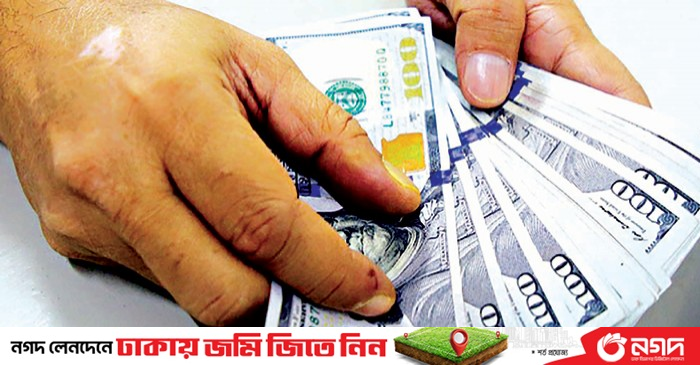
A file photo shows a man counting dollar notes in the capital Dhaka. The gross foreign exchange reserves in Bangladesh, according to the International Monetary Fund guidelines, dropped to $19.98 billion on Wednesday. — New Age photo

The gross foreign exchange reserves in Bangladesh, according to the International Monetary Fund guidelines, dropped to $19.98 billion on Wednesday.

According to Bangladesh Bank data, the foreign exchange reserves reached the current level on the day from $20.78 billion at the end of January 2024 and $21.86 billion at the end of December 2023.


However, based on the Bangladesh Bank’s conventional valuation, the foreign exchange reserves were reported as $25.24 billion on that day.

The reserves did not fall significantly as the central bank received more than $1 billion from banks under recently launched swap arrangements, bankers said.

As the banks are facing serious liquidity crisis, they are searching for options for local currency under the arrangements, they said.

So, the dollar rate declined by Tk 4-6 each on the open market to Tk 117 each.

The foreign exchange reserves had previously dropped to $19.13 billion on December 6, 2023, but recovered to $21.74 billion on January 4 after receiving $689 million in loans from the International Monetary Fund and $400 million from the Asian Development Bank.

The Bangladesh Bank follows the IMF’s BPM6 for calculating gross and net international reserves.

The decline in the country’s foreign exchange reserves continued due mainly to a significant dollar shortage on the market, which has compelled the central bank to continue selling dollars to the banks from its reserves, BB officials said.

Due to payments made to the Asian Clearing Union, the reserves also declined.

The Asian Clearing Union is a payment settlement forum whereby the participants settle payments for intra-regional transactions through participating central banks on a net multilateral basis.

Payment obligations of transactions among Bangladesh, Bhutan, India, Iran, the Maldives, Myanmar, Nepal, Pakistan and Sri Lanka are settled through the ACU payment system.

Apart from the payment obligations to ACU, the ongoing sales of foreign currency to the country’s banks by the central bank contributed to the reduction in the country’s foreign exchange reserves.

The central bank has been selling dollars to commercial banks, with more than $30 billion sold over the past 32 months.

This included $9 billion allocated to banks in July-February of the financial year 2023-24, $13.5 billion in FY23 and $7.62 billion in FY22.​
 

Window for easy loans narrowing​

Market-based interest rates raise govt’s development expenses

1711231840304.webp


Bangladesh's access to cheap loans is closing in with its rising per capita income, making foreign borrowing costlier.

The country now has to go for borrowing at the costlier market-based rates to keep up development spending, according to a report of the Economic Relations Division.

The interest rate risk is high when the debt portfolio is dominated by market-based rates as the size of interest payment is based on the vagaries of the global economy.
For instance, Bangladesh's cost of foreign loans has been on the rise in recent times as the interest rates have shot up globally.

In 2023, the government borrowed about $2.6 billion at the market-based rate, which accounted for 30.7 percent of the total committed loans. In 2022, it was $3.42 billion, which was 43.9 percent of the total.

Take the case of the World Bank, one of the major lenders of Bangladesh. Until 2018, its loans carried no interest; all the government had to bear was a 0.75 percent service charge, which was sometimes waived.

When the country's status was upgraded to a lower middle-income country in October 2018 from a low-income nation, the WB fixed a 2 percent interest rate and the repayment period was adjusted downwards to 25 years from 30 years previously. The grace period was halved from 10 years.

The reason for the tougher loan terms is Bangladesh is now a "GAP" country, meaning the country is currently at a stage where it can borrow at a market-based interest rate if it wants.

It is the same in the case of the Asian Development Bank, another major development partner, which allocated loans at a fixed and low-interest rate previously. Before 2000, the interest rate was only 1 percent, which jumped to 2 percent in 2013.

From January 2022 to July 2023, the government signed loan deals worth $4.4 billion with the ADB, with 54.5 percent of the amount taken at market-based interest rates.

Bangladesh started borrowing from the Asian Infrastructure Investment Bank since its inception in 2016 and the Beijing-based lender ramped up lending during the pandemic to help the economy recover from the shock by the way of extending budgetary support.

As of June 2023, the government secured $3.4 billion from the bank and the interest rate on the loans is market-based.

A portion of the market-based loans from the ADB and AIIB are budget support taken during the pandemic.

Russia lent about $11.9 billion for the country's biggest infrastructure project: the Rooppur nuclear power plant. The interest rate is Libor plus 1.75 percent.

The London Interbank Offered Rate (Libor) was a benchmark interest rate before it was phased out in June last year and replaced by the Secured Overnight Financing Rate (SOFR).

The SOFR stands at more than 5 percent currently whereas it was less than 1 percent before the latest surge in the cost of funds.

Moscow has already disbursed about $6.5 billion.

Some additional charges take the borrowing rate to 8 to 9 percent, finance ministry officials said.

Japan, the largest development partner of Bangladesh among the bilateral donors, gave out loans at less than 1 percent before it changed its official development assistance policy to increase the interest rate for low-middle-income countries in October 2023.

As a result, the new deals with Japan were signed at a 1.6 percent interest rate.

The upward revision of the interest rate also came as development partners have taken into account the country's growing repayment capacity manifested from the growing per capita income.

In the last fiscal year, the per capita income rose to $2,765 from $1,130 in fiscal 2011-12.

As of January, the total outstanding external loans of the government were $66.8 billion, with about 61 percent of the sum disbursed in the last three fiscal years.

Usually, the loan repayment starts after a loan matures, but the interest payments begin immediately after the release of the funds. Since the loan portfolio has ballooned, the debt servicing has widened simultaneously.

Foreign loan repayments rose 32.4 percent in fiscal 2022-23 while interest payments surged 88.8 percent.

The trend has continued into the current fiscal year: loan payments climbed 44.5 percent and interest servicing rocketed 108.2 percent in the first seven months.

Annual loan repayment was less than $2 billion before fiscal 2021-22. In fiscal 2022-23, it rose to $2.67 billion.

As per the finance ministry projection, $3.57 billion will be required this fiscal year to service debts and $4.5 billion in the next fiscal year.

If the interest rate and loan utilisation keep increasing, repayment will cross $5 billion by that time, said a finance ministry official.

The escalating interest spending will put pressure on the budget.

"We pay Tk 1 as an interest payment for every Tk 4 expenditure from our budget. Therefore, if we can't increase the revenue mobilisation, our budget will be under pressure," said Zahid Hussain, a former lead economist of the World Bank's Dhaka office.

In recent times, the government has taken various steps to raise taxes.

Still, at less than 9 percent, Bangladesh has one of the lowest tax-to-GDP ratios in the world.

To keep the risks stemming from rising debt servicing under check, the government now has two options: one is to collect more revenue or to take on more loans.

"The government should take the decision now. Besides, it should reduce its expenditure. We need to make our state-owned enterprises profitable, cut illogical subsidies and allocate more foreign loans to development projects on a priority basis," Hussain said.

Complicating matters for the government is the unprecedented appreciation of the dollar. The greenback has gained by as much as 30 percent against the taka in the past two years.​
 

Steps needed to enjoy LDC-like benefits after graduation: experts
Staff Correspondent | Published: 22:23, Mar 24,2024


1711320026088.webp

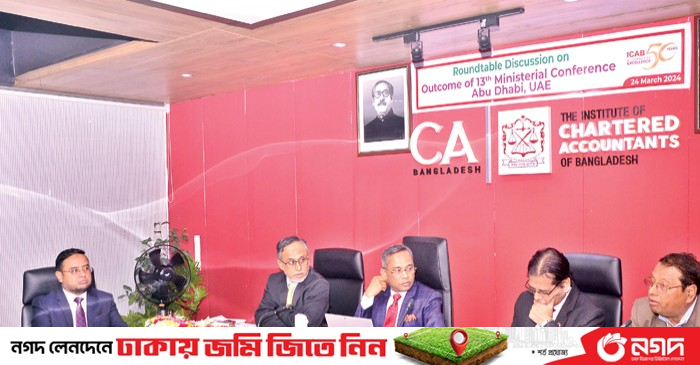
Centre for Policy Dialogue distinguished fellow Mustafizur Rahman and Institute of Chartered Accountants of Bangladesh president Mohammed Forkan, among others, are present at a roundtable discussion organised by ICAB at CA Bhaban, Karwan Bazar in the capital Dhaka on Sunday.— New Age photo

In order to enjoy benefits of a least developed country, Bangladesh needs to think from three perspectives – as an LDC, graduating from LDC and as a developing country, to negotiate the benefits to the country’s side, said Mustafizur Rahman, distinguished fellow of the Centre for Policy Dialogue.

During a roundtable discussion on Sunday, he said that benefits enjoyed by LDCs, such as duty-free access and preferential treatment on the international markets, will go away once Bangladesh graduates from the list in November 2026,

The roundtable discussion titled ‘Outcome of 13th Ministerial Conference, Abu Dhabi, UAE’ was organised by the Institute of Chartered Accountants of Bangladesh at CA Bhaban, Karwan Bazar in the capital Dhaka.

‘Product diversification in the export sector is required for the survival of the sector after graduating from the LDCs. We need to sign more free trade agreements and comprehensive trade agreements and development of transport sector should be used to establish economic corridors,’ he added.

He further said that action must be taken to transform comparative advantage into competitive advantage.

ICAB president Mohammed Forkan Uddin said, ‘We need to think about the situation after LDC graduation, in terms of preferential market access, preferential treatment for services and service suppliers and special treatment regarding obligations and flexibilities under WTO rules.’

Federation of Bangladesh Chambers of Commerce and Industries adviser Manzur Ahmed said that foreign trade should be integrated through regional agreements, bilateral agreements and some alternative commercial agreements. In future, Bangladesh needs to pay particular attention to the implementation of multilateral trade, he added.

Former ICAB president and taxation and corporate laws committee chairman Md Humayun Kabir moderated the discussion with other government officials, researchers and experts present.​
 

Govt aims for a cashless economy by 2031​

BB official tells BASIS workshop

1711404534845.webp

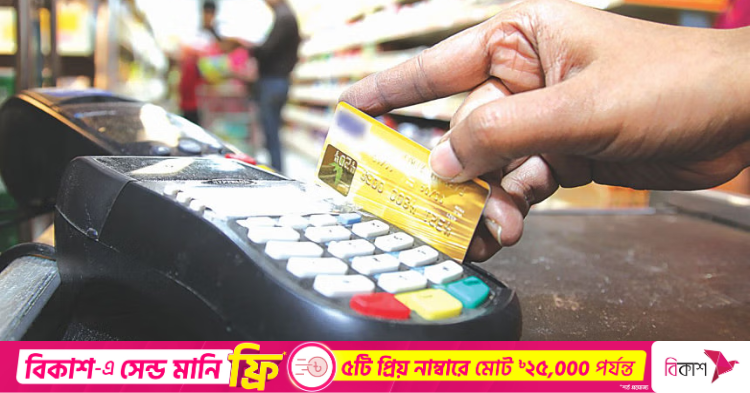
Photo: Amran Hossain

The government has set a target to transform the country into going completely cashless, that is when payments will be made solely online, by 2031, said a top official of Bangladesh Bank.

"The honourable prime minister has set a target of achieving 30 percent of transactions in the cashless format by 2025 and 100 percent by 2031," said Md Mezbaul Haque, executive director of the central bank.

The cabinet has assured the banking regulator of its support through interventions wherever necessary, he told a workshop titled "Way Forward to Increase Cashless Payment" organised by the Bangladesh Association of Software and Information Services (BASIS) on its Dhaka premises.

Haque criticised banks' app promotional initiatives, saying that most of their Dhaka branch officials do not know anything about their own apps.

"I acknowledge that many banks have very beautiful apps…they are not marketing it. The use of apps is mainly confined to fund transfers. But the smoothest service is over making payments, which is not being used," he said.

That means customers are being taught only to transfer money and so, banks have a role to play in this regard, he said, adding that bank officials would also have to learn how to make cashless payments.

Haque criticised some banks for failing to generate any transaction in spite of acquiring merchants, saying that their efforts to go cashless such as developing apps and acquiring merchants have now become a ceremonial function.

"I want to be very clear with you that I don't believe in ceremonial activity. If you think that you are making losses (by going cashless), we will make every service costlier for you too," he said.

"You (banks) get many services free of cost (from Bangladesh Bank)…Why are we giving this free of cost service? It's for the customers. So, if the customers are not served, why should we give you free of cost services," he asked.

If customers do not get digital payment services, Bangladesh Bank will discontinue some of the free of cost services, he said.

He urged banks and fintech institutions to assist the government in in achieving its goal of expanding cashless transactions in Bangladesh, assuring that the central bank would provide necessary policy support.

There needs to be more coordination between Bangladesh Bank and the National Board of Revenue (NBR), said Fahim Mashroor, chairman of the BASIS standing committee on fintech and digital payment.

"Some of the recent rules and actions of the NBR are discouraging people from making digital payment and causing them to opt for cash transactions only," he said.

He also suggested greater collaboration between banks and fintech companies to jointly promote digital payment.

Representatives from banks, mobile financial service and payment service providers, payment system operators as well as representatives of small, medium and large retail businesses and networks participated in the workshop.

To popularise BB's uniform digital payment method Bangla QR, every bank should introduce a mobile app for customers while existing apps should be simplified and made more user-friendly to encourage greater usage, they said.

Small shop owners should ensure that digital payments received from customers can be seamlessly transferred to suppliers or wholesalers without cash involvement while digital funds should be easily withdrawable just as cash, they added.

Bangladesh Bank needs to ensure real-time payments and interoperability among different payment systems, they said.

Waseem Alim, CEO of online grocery and food provider Chaldal, said although he was witnessing more digital transactions on the Chaldal platform, 75 percent of payments were still being made in the form of cash.

"Also, as a merchant I am incentivised to use cash because my cost is 0.6 percent, which includes maintaining a cashier at 19 locations in an AC room, cost of transporting cash etc," he said.

But the cost of mobile financial service is 1.5 per cent and card is 2.5 percent. So digital transaction cost needs to be less than 0.6 percent, he added.

Mohammad Arif Hossain, CEO of payment service provider Dmoney, said if the government gives merchants a 1 percent incentive and customers a 2 percent cashback, it could yield big results.

"This move would boost government revenue through higher VAT and tax collections. It would also make transactions easier to track, promoting honesty and transparency," he added.

Moderating the event, Syed Mohammad Kamal, country manager for Bangladesh at Mastercard, said incentives were crucial at both the consumer and small merchant ends for encouraging digital payments.​
 

Devalue taka for exchange rate stability​

Experts tell BIDS seminar

1711491197398.webp


Researchers and economists yesterday suggested that the local currency be devalued further by 10 percent to 15 percent against the US dollar to match unofficial exchange rates and restore market stability.

The exchange rate was kept almost fixed artificially till 2022 and it did not follow the market trend. But as the foreign exchange reserves dwindled owing to higher US dollar outflows compared to inflows, the taka has lost its value by about 30 percent in the past two years.
Still, the exchange rate stability is yet to be there.

"The exchange rate situation worsened due to faulty macroeconomic management while the interest rate, inflation and international reserve management contributed to the current crisis," said Monzur Hossain, a research director of the Bangladesh Institute of Development Studies (BIDS), while presenting a keynote paper.

He spoke at a seminar on "Unpacking the Economic Manifesto of the Awami League: Trends and Challenges for Tomorrow's Bangladesh" organised by the BIDS on its premises in the capital.

Speaking at the event, researchers and economists said allowing the Bangladesh Foreign Exchange Dealers Association (Bafeda) and the Association of Bankers Bangladesh (ABB) to fix the exchange rate is unacceptable.
Foreign exchange management must be under Bangladesh Bank's jurisdiction, added the experts.

The analysts also recommended a dynamic exchange rate management with indicative adjustments following the real effective exchange rate (REER) and accommodative monetary policy with interest rate deregulations.

The REER is a measure of the value of a currency against a weighted average of several foreign currencies divided by an index of costs.

"Efficient management of authorised dealers' banks is needed for exchange rate stability," said Hossain.

"Policies to sell foreign currencies through money exchanges need to be revisited while they can be replaced by bank booths."

He said strict enforcement of laws must be ensured against loan defaulters, money launderers and financial irregularities to boost the confidence of customers.

Hossain welcomed the mergers and acquisitions move initiated by the central bank. He, however, warned decisions must be taken carefully and loan rescheduling and write-offs need to be discouraged.

He thinks a banking commission comprising experts, economists and policymakers could be useful in fulfilling reforms in the sector.

"New banks should not be allowed at least for the next five years."

Regarding the current problems of the financial sector, Hossain highlighted the high non-performing loans, inadequacy in capital requirements and the sorry state of a good number of private banks.

He also blamed weak regulatory control over some banks, weak corporate governance in the banking sector, politically active board members and owners and a lack of enforcement of laws.

On the post-pandemic crisis, Hossain cited multiple exchange rates, restrictions on imports, sharp depletion of reserves and rising inflation amidst a depreciating taka as the major reasons.

While presenting a keynote paper, Binayak Sen, director general of the BIDS, focused on nine priority issues for tomorrow's Bangladesh, including educational quality and equality and drawing in more foreign direct investment.

He said more efforts are needed in a shift from import tariffs and trade taxes to direct taxes.

"We need a 15 percent to 17 percent tax-to-GDP ratio to be consistent with the middle-income status and we have to increase the latter at half a percentage point every year."

Planning Minister Maj Gen (retd) Abdus Salam was the chief guest at the seminar's first session titled "Macroeconomic Stability, Fiscal Efforts and Agriculture" while Mashiur Rahman, economic affairs adviser to the prime minister, spoke as the special guest.​
 

Foreign loan commitment jumps 300% in Jul-Feb​

Disbursement rises 2%

1711664665110.webp


Although foreign aid commitments made to Bangladesh by global lenders surged more than 300 percent year-on-year in the first eight months of the current fiscal year of 2023-24, disbursement has remained almost flat.

In the July-February period, loan commitments from development partners increased to $7.2 billion, up 304 percent, according to the Economic Relations Division (ERD) of the finance ministry.​

Around $6.74 billion came in the form of loans while the remaining $461.14 million were grants.
But at a time when Bangladesh is badly in need of foreign currencies, the loan disbursement stood at $4.99 billion, only up by 2 percent from that in the same period a year ago.

Lower disbursement of foreign assistance is a perennial problem for Bangladesh, driven by the country's failure to implement projects on time and meet conditions attached to loans by lenders.

The lower release of funds has prompted the government to order ministries to accelerate the use of loans to give a much-needed fillip to the foreign exchange reserves, which have halved in a span of two years.

Besides, the country's foreign debt servicing rose by 43 percent in the first eight months of the current fiscal year, which was mostly driven by rising interest rates.

In the July-February period, the government paid $2.03 billion for interest and principal payments to international lenders, up from $1.42 billion in the same period of the previous year.

The finance ministry projects that foreign debt repayments, including interest, will reach $4.5 billion in 2025-26.

In the current fiscal year, repayments are likely to jump by 33.52 percent to $3.57 billion, crossing the target of $2.79 billion set in the national budget.

Asian Development Bank (ADB) released most of the money in the eight-month period, totalling $1.30 billion, followed by America and Japan of a total of $1.04 billion.

Furthermore, World Bank disbursed $877.87 million, Russia $807.50 million, and China $361.71 million.
In terms of commitment, the ADB also secured the top position with $2.62 billion, followed by America and Japan with $2.02 billion.​
 

Forex reserves keep eroding despite currency swap​


1711750703385.webp


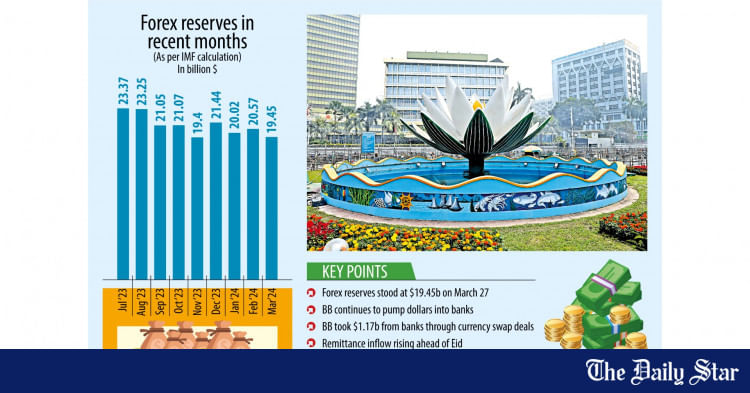
Bangladesh's foreign currency reserves are yet to reach a comfortable position despite introducing currency swap deals with commercial banks, growing remittance inflows ahead of Eid, falling imports and a spike in exports.

The reserves stood at $19.45 billion on Wednesday, down by a staggering $533.82 million in the span of a week due to the selling spree of the American greenback by the central bank to commercial banks.​

Under the currency swap agreements introduced last month, the banking regulator took $1.17 billion from commercial banks and injected around Tk 20,000 crore in the form of local currencies into the banking system, according to several central bankers.

The inflow of remittance has been increasing since January and it is expected to receive a major boost this month and next month owing to Eid-ul-Fitr as remitters transfer a higher volume of funds to help their families and relatives at home celebrate the occasion with festivity.

Between March 1 and March 22, Bangladesh received $1.41 billion in remittances and this might cross $2 billion at the end of the month.

Imports fell 7.62 percent year-on-year to $5.45 billion in January, the latest for which the central bank data is available. Exports rose 12.04 percent to $5.19 billion in February.

Despite the positive developments, the forex reserves are still not out of the woods and it fell further owing to an elevated demand for the US dollars and the recent Asian Clearing Union (ACU) payments by the central bank.

The Union is a payment arrangement whereby the participating countries -- Bangladesh, Bhutan, India, Iran, the Maldives, Myanmar, Nepal, Pakistan, and Sri Lanka -- settle payments for intra-regional transactions among themselves.

The reserves were $21.15 billion in the first week of March before slipping to $19 billion after the clearance of $1.35 billion in ACU payments, said a number of central bank officials.

The officials say the BB is now trying to keep the reserves within the limit set by the International Monetary Fund (IMF) with its $4.7 billion loan programme. However, it will be difficult to do so since the central bank has to supply US dollars from its reserves to help them settle import bills.

Currently, the net forex reserve stands at less than $18 billion. The country will have to ensure a minimum reserve of $19.27 billion by March and $20.11 billion by June to meet the conditions of the Washington-based lender.

The net international reserves are calculated as reserve assets minus predetermined net short-term foreign currency drains.

The banking watchdog needs to support state-run enterprises to clear import obligations.

State-run banks are particularly securing US dollars from the BB for settling import payments of the Bangladesh Petroleum Corporation, the Bangladesh Agricultural Development Corporation, and the Bangladesh Chemical Industries Corporation, among other government agencies.

In July-December of the current financial year, the BB sold $5.68 billion to banks, BB data showed. The BB has pumped more than $28 billion into the banking sector from its reserves in just two years, a development that caused the reserves to halve.

The chief executive of a private commercial bank told The Daily Star that the currency swap arrangement is not helping the central bank to improve its net reserve situation because it is a liability.

He, however, acknowledges that the deals are boosting the gross reserves.

Banks are buying US dollars at Tk 119 to Tk 122 from remitters but they have to sell them at Tk 110 per dollar to the central bank. As a result, banks are incurring losses.

Emranul Huq, managing director of Dhaka Bank, however, said the currency swap is a win-win situation for both the central bank and commercial banks.

"Some banks have idle US dollars and they now can keep them with the central bank because the interbank exchange rate is not fully active now."

"The arrangement is also allowing banks confronting liquidity shortage to avail local currencies from the central bank in exchange for the international currencies."​
 

Govt plans securing $10b foreign loan
31 Mar 2024, 12:00 am0
Staff Reporter :

In the fiscal year 2023-24, the government has planned to secure loans amounting to nearly $10 billion from international financial institutions and its development partners, including the World Bank, Asian Development Bank (ADB), and Japan.

This move comes as the government aims to address economic challenges and bolster reserves amidst a global financial landscape fraught with uncertainties.

According to sources within the Economic Relations Division, the government has set a target of securing agreements for loans equivalent to $993 million for the current fiscal year from various donors.

Considering the prevailing market exchange rate, which stands at approximately Tk. 1.09 trillion, this represents a substantial financial injection into the economy.

Notably, loan agreements totaling $720 million have already been signed in the past eight months (July-February), accounting for 72% of the planned borrowing for the entire fiscal year.

Economists emphasize the urgent need for foreign assistance amid the current economic scenario.

They argue that increasing the supply of dollars is essential to alleviate the ongoing dollar shortage and maintain foreign currency reserves.

Ahsan H. Mansur, Executive Director of the Policy Research Institute (PRI), suggests that securing loans through projects rather than budgetary support would be more beneficial for the country.

Mansur stresses the importance of careful consideration and analysis before entering into loan agreements, as these loans entail interest payments that must be factored into the budget. With government spending on interest rising, there is mounting pressure on the budget.

To expedite the implementation of foreign loan projects and accelerate the disbursement of foreign aid, a committee was formed under the leadership of the Principal Secretary to the Prime Minister, Tofazzal Hossain Mia, on January 24th of this year.

The largest portion of planned loan agreements falls under the pipeline of the ADB, with agreements totaling $2.99 billion. Of this amount, agreements worth $262 million have been signed with the ADB from July to February.

Japan follows closely, with planned loan agreements totaling $2.41 billion for various projects with the government. During the first eight months of the fiscal year, agreements amounting to $202 million have been signed with Japan.

Additionally, the World Bank's pipeline includes agreements amounting to $1.42 billion.

Agreements for new loans have been finalized with the World Bank in the past eight months, totaling an estimated $142 million.

At present, there are no new projects in the pipeline awaiting loan agreements.

However, discussions and negotiations with international partners continue as the government seeks to secure necessary financing to support economic growth and development initiatives.​
 

Latest Posts

Back