[🇧🇩] Reforms carried out by the interim/future Govts.

[🇧🇩] Reforms carried out by the interim/future Govts.
233
9K
More threads by Saif

G Bangladesh Defense
Securing an advance america cash advance is one of the easiest ways to get the funds you need without unnecessary delays.

With a quick application process, you can apply from the comfort of your home and avoid the hassle of endless documents.

Many online lenders offer:
* Customizable lending solutions
* Affordable rates
* Quick approval times

This makes it possible to get your money almost instantly. Choose online loans for a fast and trustworthy option to cover urgent expenses or upcoming purchases.
 

BANGLADESH'S TRADE REGIME

Why deeper reform can no longer wait

Last week the World Bank launched a report, "Bangladesh Trade Policy at a Crossroads". The message coming out of that report could not be more prescient. Tariff and trade policy reforms cannot wait any longer. Furthermore, what was made clear is that reforms would actually pay for themselves. The argument about revenue loss that has thus far stalled reforms for over two decades are no longer valid. Latest modelling techniques are able to project outcomes based on the latest economy-wide applications that can coalesce second and third effects showing that reforms actually can generate growth which yield higher revenues.

With Least Developed Country (LDC) graduation approaching and the need for export diversification becoming increasingly urgent, the country can no longer afford to treat trade policy reform as a marginal or incremental policy issue. The structure of protection has implications not only for import prices and customs revenue, but also for export competitiveness, investment incentives and the prospects for entering into deeper trade agreements.

Rapid implementation of the National Tariff Policy (NTP) has become more urgent than ever because Bangladesh's tariff regime has long needed a coherent policy framework rather than piecemeal adjustments.

The setting for trade policy today remains fundamentally unchanged over the past 25 years. Thanks to the high tariff and protection regime, exporting -- outside the RMG industry -- is not a profitable activity relative to selling in the domestic market. The domestic market has effectively been created behind high tariff walls. And the divergence is not marginal; it is significant. This is the anti-export bias that has become a widely used expression in policy circles.

Trade policy reforms must therefore be formulated within these limiting parameters. If Bangladesh is serious about export diversification and competitiveness, correcting this anti-export bias has to be at the heart of tariff reform.

There is also an important methodological point in assessing protection. Much tariff analysis uses import-weighted tariffs because disaggregated tariff data by countries and products are difficult to obtain. But if existing tariffs are effective in restricting imports, import-weighted tariffs will understate the magnitude of protection. There is a stark difference between ex ante protection (tariff-induced) and ex post tariff protection (outcome of restricted imports).

For Bangladesh, Policy Research Institute of Bangladesh (PRI) has a repository of disaggregated tariff data covering more than three decades, allowing us to undertake ex ante nominal protection analysis. On this basis, the average nominal protection rate in FY2027 is around 28 per cent, with roughly half coming from para-tariffs, while average trade taxes are considerably higher.

Surprisingly, despite pronouncements to the contrary, the proposed measures under the short-term stabilisation programme and the FY2027 Budget fall short of the commitments under the National Tariff Policy 2023. Implementation of the NTP is a critical part of preparation for LDC graduation. The question is: why is it still stuck at the proposal stage?

Among the principal tariff rationalisation measures proposed by the World Bank is a reduction in tariffs on intermediate goods. While this is an absolutely correct posture of tariff reform, and is found to have worked well in Indonesia and Vietnam, the context in Bangladesh is so different that this reform measure has to be reformulated in the Bangladesh context. There exists a deep wedge between output and input tariffs that ensure super-high effective protection. While deep cuts in intermediate goods tariffs can improve competitiveness (if producers were to export), reducing input tariffs without a commensurate reduction in output tariffs could actually raise effective protection and intensify the anti-export bias for non-RMG exports, driving such exporters away from world markets. Therefore, unlike Indonesia, Vietnam, or even India, downward adjustment in intermediate goods tariffs must be associated with a commensurate downward adjustment in output tariffs. Note that this concern is not relevant to RMG exports, which operate under a duty-free import regime.

Exemption rationalisation in the tariff structure is another area where reform is warranted. There is ample justification for eliminating end-user tariff concessions applied to a plethora of industrial sectors and subsectors, except for capital machinery imports. Protective Most Favoured Nation (MFN) output tariffs average around 42 per cent, compared with around 17 per cent for MFN input tariffs. This is already a wide divergence and provides significant protection, which need not be amplified with more input tariff concessions for specified sectors and sub-sectors.

The question of immediate revenue loss will inevitably arise. But tariff reform should not be assessed only through its first-round fiscal impact. Second- and third-round effects can generate more revenue through higher economic activity. Economy-wide models such as TRIST and GTAP can help simulate alternative reform scenarios and assess their wider effects. The World Bank has done that and found clear evidence of Free Trade Agreements (FTAs) and tariff cuts adding $4 billion to GDP.

Before touching customs duty, regulatory duty (RD) and supplementary duty (SD) have to be addressed. RD is effectively an additional customs duty, meaning the top customs duty is not 25 per cent but 28 per cent when the 3 per cent standard RD is included. RD should be eliminated in a couple of years, while SD needs to cut sharply and become trade-neutral before LDC graduation. This would be an essential part of preparation for LDC graduation.

Protection is concentrated particularly in consumer goods industries. Export producers have to sell at world prices over which they have no control, while high tariffs keep domestic prices of durable and non-durable consumer goods well above international prices. Beyond customs duty and RD, SD has increasingly become a protective instrument. In effect, half the protection comes from para-tariffs-RD and SD.

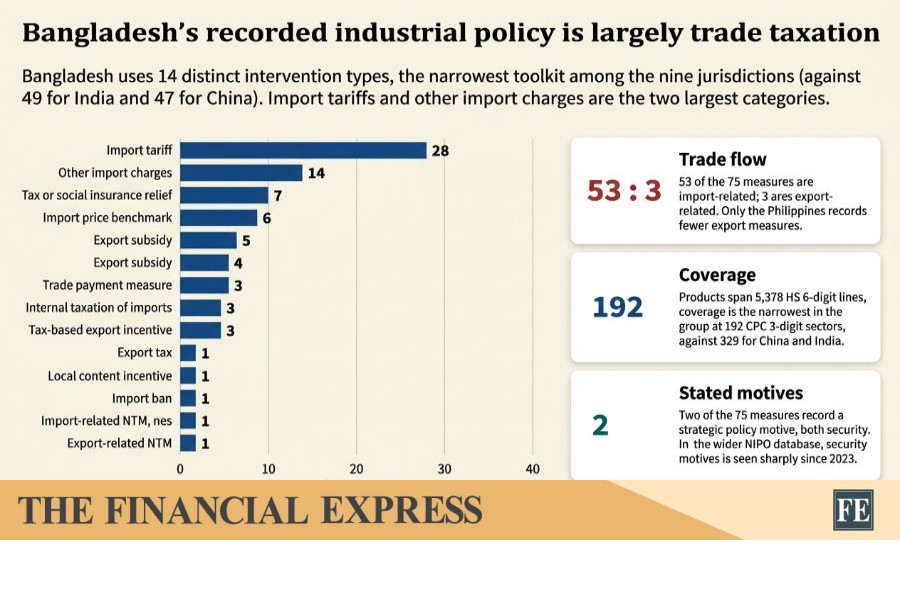
The industrial policy dimension is equally important. Industrial policy in Bangladesh is essentially trade policy -- or, by and large, import tariff and export subsidy policy, applied to thrust sectors, priority sectors, development sectors, and so on. In recent times distortive and trade restrictive measures have multiplied, according to WTO reports. It is interesting that the New Industrial Policy Observatory (from Global Trade Alert) finds Bangladesh to have adopted as many trade distortive as trade liberalising measures since 2009. However, there is a catch. Such international comparisons based on WTO tariff policy reviews can be misleading because Bangladesh does not always notify all distortive measures, while WTO assessments typically focus on MFN customs duty and give limited attention to para-tariffs.

The bottom line is that economy-wide impacts of tariff reform can offset short-term revenue losses. Bangladesh's deep tariff reforms in the 1990s showed no reduction in customs revenues throughout the decade, during which customs revenue grew by 11 per cent during the decade despite average tariffs were cut by half.

The implications for trade agreements are equally important. With the current tariff structure, an FTA agenda will remain difficult, if not impossible. Note that Bangladesh has not been able to sign one FTA in the past 25 years despite several initiatives that were widely broadcasted. Bangladesh may be limited largely to EPAs (Economic Partnership Agreement) and CEPAs (Comprehensive Economic Partnership Agreement). How about an FTA with EU? If we cannot sign an FTA with Bhutan, can we realistically sign one with the EU? The competitive implications are becoming more urgent as India and Vietnam - our main competitors in garment exports to EU -- have already signed FTAs with EU.

The bottom line is clear: doing nothing will be costly; reform will pay for itself. The challenge is to move from tariff and trade policy reform as a stated policy objective to tariff and trade policy reform as an implemented economic strategy.

Dr Zaidi Sattar, Chairman, Policy Research Institute of Bangladesh (PRI).​
 

Latest Posts

Back