Home Login Watch Videos Wars Movies

[🇧🇩] Student Revolution: Lessons from Bangladesh

[🇧🇩] Student Revolution: Lessons from Bangladesh
120
4K
More threads by Saif

G Bangladesh Defense

‘Will break the pen that writes for fallen fascists’
Says Hasnat Abdullah

1736896353799.webp

Photo: Star

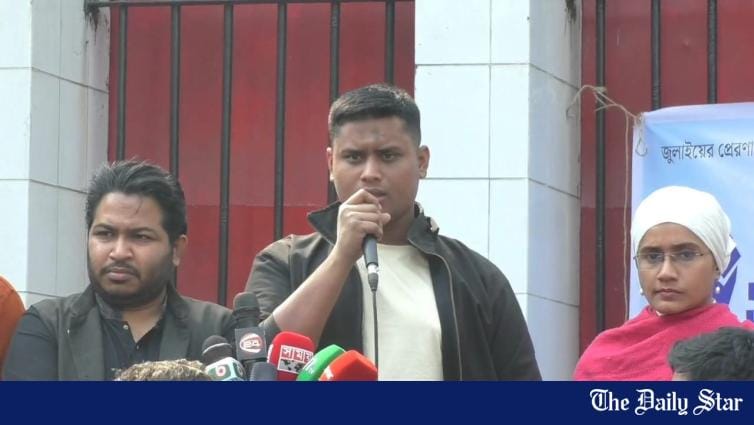
Media and intellectuals who speak in favour of the fallen fascists will face the same fate as them, said Hasnat Abdullah, the convener of the Anti-Discrimination Student Movement, today.

"Those talk show hosts and intellectuals, who are now vocal about human rights of Awami League men, supported fascism before," he said yesterday at the Shaheed Minar in Chashara of Narayanganj city before distributing leaflets supporting the "Proclamation of the July Uprising".

"We will break the pens that write in favour of fascism," said Hasnat, vowing a strong stand against any media, teacher or intellectual who speaks in favour of fascism.

"If you fail to understand the young generation's spirit, then your fate will be like that of the fallen Awami League," he warned.

Hasnat also said it is too early to consider rehabilitating the Awami League in politics.

"Whether the Awami League will be rehabilitated in politics is not a relevant question for now. First, every leader and worker must face justice.

"Those who speak of rehabilitation before the trial, those who say the elections will not be participatory without Awami League, we think, are also complicit in the oppressive politics that the Awami League had established," he said.

He also alleged that the state apparatus made various attempts to rehabilitate the AL.

However, it won't be tolerated, he added.

In a strong message to the interim government, Hasnat gave an ultimatum until January 15 to announce the declaration of the July revolution based on political consensus.

"We gave an ultimatum, and the interim government has committed to declaring it based on the consensus of all political parties. However, it is unfortunate that we have not seen any visible action yet. We have made you our advisers, you represent us. … If you fail, step down from your advisory role," he said.

Samanta Shermeen, spokesperson for the Jatiya Nagorik Committee, also addressed the event.

Later, as part of the event, leaders of Jatiya Nagorik Committee and the Anti-Discrimination Student Movement distributed leaflets in Chashara, Shimrail, and Kanchpur areas in Narayanganj.​
 
Analyze

Analyze Post

Add your ideas here:
Highlight Cite Fact Check Respond

TRANSITION TO NEW BANGLADESH: The good, the bad and the ugly
15 January, 2025, 00:00

1736984956553.webp

New Age

Bangladesh is now at a crossroads. Politics as usual will only waste the victory of the people. The challenge in front of the interim government is to put Bangladesh back on the path of genuine democracy, writes Mohammad Zaman

BANGLADESH is faced with many tricky challenges in its quest for transition to a truly democratic system of governance. The student-led mass uprising of July-August 2024 forced Sheikh Hasina to flee the country after her 15-year iron-fisted rule, albeit under the façade of a democratic system of government. In 2021, when the country reached it 50-year milestone, many experts recognised the significant gains that her government achieved in infrastructure, economic growth, poverty reduction, women’s empowerment, longer life expectancy and literacy.

However, over the years, there was also extreme inequality in income, pounded by corruption, cronyism and almost complete disenfranchisement of the rights and representation of the people through sham elections.

As the leader of the party and the government, Hasina turned an autocrat and authoritarian ruler, ultimately running the country as a government of, what one analyst called, ‘Hasina League’ devoid of any participation and/or decision-making by the Awami League as the governing political party. She brought the party to her knees and forced party people to submit and remain subservient to her ego and wishes. The uprising, with demands for the abolition of quota for public jobs for the dependents of the 1971 war veterans, very quickly turned into a mass movement that brought down the Hasina government like a house of cards. The anger of the students and masses against Hasina that spilled onto the street in 2024 ultimately took a toll both on Sheikh Hasina and her legacy.

The sweeping reform agenda by the interim government of Dr Muhammad Yunus that replaced Sheikh Hasina’s seems ready to address the issues, with the hope for an inclusive and peaceful democratic transition. Indeed, the young student leaders, who led the mass movement, stated in clear terms to establish a new Bangladesh with democratic rights and freedom for all. The interim government has in less than six months arguably succeeded in bringing some stability, improved law and order and appointed commissions for the much-needed reforms to steer the country towards free and fair elections. In sum, the government has put the country on track although consistent high inflation is causing economic pain, with worker unrest in the garment sector remaining a major concern. Experts fear that soaring prices of food and fuel and a powerful syndicate controlling key sectors may block any meaningful economic and social transformation.

It appears that the interim government is trying to strike a balance between competing demands of various progressive forces and fundamentalist groups — both within and outside the government. The demand for elections by some political parties without real institutional reforms would not bring about any good for the country. As witnessed in the past, elections are not the ‘cure’ or remedy for all hurdles ahead. Despite this, many parties, including the Bangladesh Nationalist Party and the Bangladesh Jamaat-e-Islami, are waiting in the wings for power. Amid the current politicking, right-wing zealots and fanatics who opposed the creation of Bangladesh are talking about ideological ‘re-branding’ of the country, with attacks on the Bengali identity and its images. Both Jamaat and Shibir, along with their allies, are trying to make a political comeback with an alternative Islamic model to rule the country. Their resurgence in politics during the transition is noticeable after a strict curb on its activities during the Hasina era.

Much to the dismay of many, the interim government has removed Sheikh Mujib’s picture from offices, signalling a shift and, perhaps, a new course without any baggage of the history and legacies of Bangladesh’s independence. The Bangladesh Bank has also taken a move to gradually phase out customary picture of Sheikh Mujibur Rahman from currency notes. According to some experts, while Hasina’s government did excesses on ensuring Mujib’s seal on everything as the father of the nation, the removal of Sheikh Mujib’s picture shows the intent of the interim government, perhaps more so by a group of students, to crush every symbol of Bangladesh’s history. The government has already banned the Chhatra League, the student wing of the Awami League. Now, there is a call for banning the Awami League as a political party. There are reports of people being harassed for chanting Joy Bangla or victory for Bangladesh. At the same time, we hear a loud noise of Inqilab zindbad. Quite alarming, to say the least! Bangladesh in transition does not need a resurgent Jamaat politics.

The mass uprising was not to erase the history of Bangladesh, but to establish democracy and the rights of the people. The political development in the country sounds like erosion of Bangladesh’s history and legacy. These are ominous and alarming signs. The history of 1971 cannot be erased or rewritten. Sheikh Mujibur Rahman was a folk hero who, among others, inspired the Bengali nation to rise up against injustice, leading to the independence of the country. Analysts and political observers are of the view that any amount of vandalised and defaced statue of Sheikh Mujibur Rahman cannot vilify or defame his legacy and footprint from Bangladesh’s history. Sheikh Mujibur Rahman should not be judged by what the government of the Hasina League did. Sheikh Hasina and her cronies should be brought to justice for misdeeds, the abuse of power, corruption and the violation of rights. The Hasina government made a lot of mistakes. The Jamaat-e-Islami, which opposed the Bangladesh movement for independence, cannot make up for Hasina government’s past misdeeds.

Bangladesh is now at a crossroads. Politics as usual will only waste the victory of the people. The challenge in front of the interim government is to put Bangladesh back on the path of genuine democracy. What Bangladesh needs is a democratic governance model rooted in the ideal of justice, accountability and opportunities for all and yet honour the history, culture and identity of the country. The country is expecting the dawn of a new future.

Dr Mohammad Zaman is a writer and columnist.​
 
Analyze

Analyze Post

Add your ideas here:
Highlight Cite Fact Check Respond

Will we have to remain satisfied with just Hasina’s fall?
The students feel that if a parliament is formed through an election under the existing constitution, there is no guarantee that it will reform or rewrite the constitution
AKM Zakaria Contributor image
AKM Zakaria
Prothom Alo Deputy Editor
Updated: 15 Jan 2025, 15: 58

1736987149303.webp

The autocratic rule of Sheikh Hasina's government was toppled in August last year by the student and general people's movement. AFP

Reforms, elections – and the politics over these issues – all seems to be in a state of confusion. The student community which led Hasina’s ouster, its associate and supporting political forces and the interim government – none seems to on the same page anymore.

The students want significant changes in the state and society. They feel that so many people did not sacrifice their lives just for a fresh election. They want to ensure a state structure where no autocratic rule like Hasina’s can rise up again. This requires certain reforms, including reforms of the constitution and the election system. They want to make sure of this before the election. The students feel that if a parliament is formed through an election under the existing constitution, there is no guarantee that it will reform or rewrite the constitution.

An autocratic leader like Sheikh Hasina was ousted at the cost of much bloodshed, but in literal terms, this cannot be called a revolution (though many feel that 5 August created possibilities of a revolution). But this was no typical uprising. The uprising of 1990 and the July uprising are not the same. Not so many people gave their lives in 1990, not so many people took to the streets. The July uprising had some elements of revolutionary zeal and stance. This uprising generated much aspiration among the students and the public. The students have the fear of a new election leading back to the old system and the people who took part in the uprising have similar apprehensions. Many have also been gripped with the fear that the mass uprising may ultimately fail.

In the meantime, the stand of BNP and certain other political parties who backed in the mass uprising, is different. They want elections soon, they want a framework for the election. They feel that the reforms or any other changes that are required, will be carried out by the elected government. They are putting pressure on the government in various way to hold the election very soon.

Meanwhile, chief advisor of the interim government Professor Muhammad Yunus in his 16 December speech announced a possible timeframe for the election. His government has several commissions for reforms. His government probably wanted to carry out reforms and hold the election. However, from his Victory Day address it is clear that he has moved away from his position.

Professor Muhammad Yunus said, “I have repeatedly appealed to you about completing all the major reforms and then going on to hold the election. But due to political consensus if, and I repeat ‘if’, we have to draw up an accurate voters list and hold the election, then perhaps it will be possible to hold the election towards the end of 2025. And if we add to a reasonable degree the reforms based on the recommendations of the electoral process and election reforms commission, then it may take at least another six months more. Broadly speaking, the date for the election can be fixed for the end of 2025 or the first half of 2026.”

Mistrust between the student community that led the mass uprising and the major political force that helped in organising the mass uprising, BNP, have made the political situation murky.

It is clear that he had come up with the possible timeframe for the elections following the demands of BNP and certain political parties. We recall that in an earlier interview he had said, a four-year term is being considered for the interim government and the term of any interim government should not be longer than that of an elected government. It was then assumed that the interim government’s term may be three to three and a half years.

There was no lack of clarity about the possible timeframe for the election in Professor Muhammad Yunus’ 16 December speech. He clearly said that the election would be held between the end of this year and the middle of 2026. He also announced the formation of a national consensus council to establish a consensus concerning the proposals being made by the reform commissions. He had given a roadmap for the elections to be held in the basis of consensus with the political parties. Professor Yunus’ speech, however, could not appease BNP. The party held a meeting and expressed their disappointment. BNP does not find the chief advisor’s election timeframe to be reasonable.

The BNP secretary general said. “We had hoped that the chief advisor would present a roadmap within a specific timeframe. He did not do so. This has disappointed us to an extent and, at the same time, has disappointed the nation. Why is BNP disappointed? It is clear that BNP is filled with various apprehensions. They cannot place their full confidence in this announcement. BNP is an old political party and they will not have unfounded concerns. There must be reasons for their concern.

Over the past few months BNP leaders have been referring to the minus theory, depoliticisation and such. Only recently BNP’s standing committee member Amir Khasru Mahmud Chowdhury said, minus two aspirations will never be fulfilled. He said, election is the first step to establishing democracy in Bangladesh. Election is the first reform. He said, “Those who talk about minus two here, are voicing their wishful thinking. That will never be fulfilled. Ershad failed to do that, and this couldn’t be done in 1/11. And BNP is now stronger than ever. It cannot be wiped out.”

It is clear that BNP is apprehensive about the depolticisation of the political minus theory. They even believe that there is a certain quarter actively working to eliminate them. The fallen Awami League and its allies parties are not longer in the political field. BNP is now the largest active political party in the country. A distance may have grown with Jamaat, but in the new circumstances new allies have emerged. The question is, being the largest political party in the country, why does BNP have any apprehensions? Who can be such a big and powerful opponent that can cause BNP concern?

The students who led the mass uprising are now in the process of forming a political party. The present interim government was formed at their behest. They have representation in this government too. At the same time they criticise the government on various issues and put pressure on the government too. The relationship between the students and the government is unclear. But many feel that the formation of a political party by the students is an attempt to create a King’s Party. There are also allegations of the involvement of the intelligence in creating the new political party. There are questions about their source of funds. All this is possibly a cause of concern for BNP.

Differences over various issues, suspicions and mistrust between the student community that led the mass uprising and the major political force that helped in organising the mass uprising, BNP, have made the political situation. Unless a consensus is established on a minimum number of issues at least, uncertainty will simply increase in the country’s political arena. One cannot discard the students’ apprehensions that elections without reforms may simply be a return to the old trend of politics. That’s what past experience says. As it is, extortion has simply changed hands. Forced occupation and control of various areas continues all over the country. At the same time, BNP’s apprehensions will not dissipate unless there is transparency in the process of the students forming a political party, the role of the government or intelligence agencies, their source of income, etc.

The topple of Sheikh Hasina in the mass uprising is certainly a huge achievement, but this should not be the only achievement. If the student community that led the mass uprising and the assisting political parties cannot maintain a unity, then we will simply have to be satisfied with the fall of Hasina. The aspirations for a new state that emerged among the students and the general people, will remain a pipe dream.

* AKM Zakaria is deputy editor of Prothom Alo.

* This column appeared in the print and online edition of Prothom Alo and has been rewritten for the English edition by Ayesha Kabir​
 
Analyze

Analyze Post

Add your ideas here:
Highlight Cite Fact Check Respond

July proclamation after intensive discussions: Asif Nazrul

1737067861173.webp

File photo: STAR

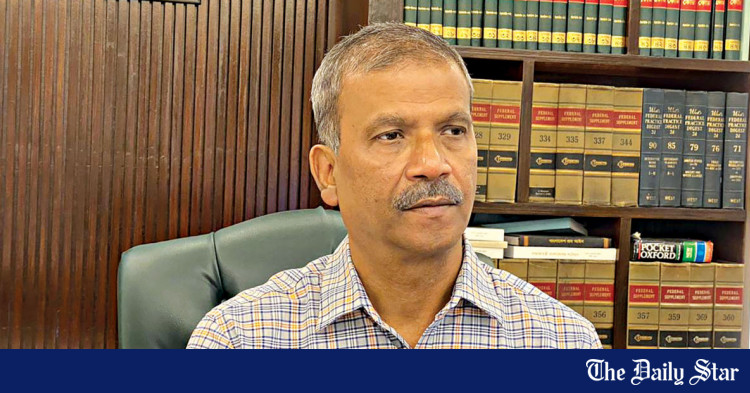
The July proclamation will be made after intensive discussions with all the stakeholders of the uprising, including all political parties, said Law, Justice and Parliamentary Affairs Adviser Asif Nazrul.

He said all the leaders who joined today's meeting had told them to take time to prepare the documentation.

"They advised us to take the time required to reach consensus among the stakeholders, but it should not be time wasted," he said, adding that they have taken the suggestions today.

In the meeting with the chief adviser regarding the formation of the July proclamation, most of the forces in favour of the July uprising and political parties including BNP, Jamaat, Ganatantra Mancha and Nagorik Committee joined, he said at a briefing after the meeting.

"All of them said that such documentation is necessary. Consensus was created to form the proclamation where everyone's contributions must be properly acknowledged, the continuity of the uprising must be properly mentioned. The political or legal nature of the documentation should be clarified," he added.

He said, further discussions are needed in this regard. "The national unity should be the same as it was achieved through the July uprising, which led to the downfall of Sheikh Hasina."

During today's meeting, some suggested forming a committee to carry forward the decisions, he said, adding that they found no distance among the political parties. "The only difference among them is the method of further discussions they proposed."

"We will consider all the proposals and will make a decision within a short time," he added.​
 
Analyze

Analyze Post

Add your ideas here:
Highlight Cite Fact Check Respond

'A staged drama'
Say 12-party alliance; CPB and BSD too boycott proclamation dialogue

1737068005179.webp

Photo: Sajjad Hossain/Star

Leaders from 14 political parties, including the Communist Party of Bangladesh (CPB), Bangladesher Samajtantrik Dal (BSD), and the 12-party alliance, today boycotted a dialogue with various political groups held to discuss the proclamation of July uprising.

The parties cited inadequate time, lack of proper preparations, and a problem with the invitation process as reasons for their absence in the meeting.

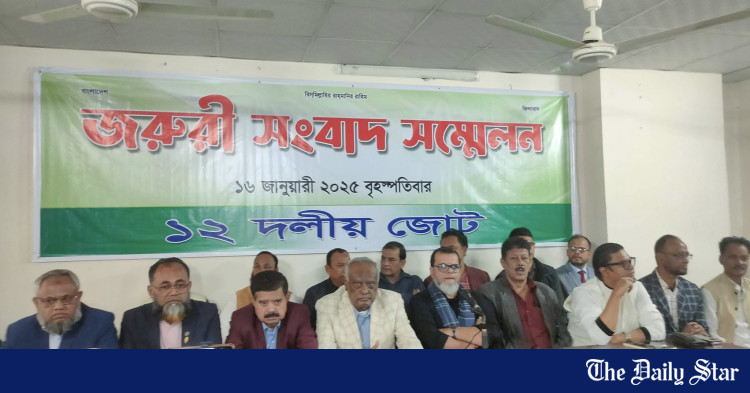
Meanwhile the 12-party alliance at a press conference termed the process of conducting the discussion a "staged drama."

The all-party meeting, aimed at finalising the proclamation of the July uprising, was held at 4:30pm at the Foreign Service Academy in Dhaka, chaired by Chief Adviser Professor Muhammad Yunus.

Leaders of 16 parties, including BNP, Jamaat-e-Islami, Islami Andolan Bangladesh, and Jatiya Nagorik Committee participated in the discussion.

However, in a statement, CPB General Secretary Ruhin Hossain Prince said he received an anonymous text message about the meeting at 1:29pm today, just hours before the meeting.

"The message requested us to send a representative to share our perspective on a draft proclamation, but it is unrealistic to consult our alliance and other democratic groups on such an important matter within such a short time," he said.

"Considering these, the CPB decided not to attend the meeting," he added.

Talking to The Daily Star, Razekuzzaman Ratan, assistant general secretary of BSD, said, "Proper preparation was essential. It is doubtful whether the invitation was even formal. Without adequate preparation, we cannot present our opinions."

The 12-party alliance, who previously organised joint movements with the BNP against the ousted Awami League government, expressed frustration over the meeting invitation.

"We believe a staged drama is being performed at the Foreign Service Academy today," said Syed Ehsanul Huda, coordinator of the alliance, during a press conference.

Shahadat Hossain Selim, spokesperson for the alliance, has criticised the government for its handling of the invitation process.

"If an all-party meeting is to be held, those who have fought for 16 years should be prioritised. They deserve a formal invitation, not an SMS sent at 10:00pm. A state cannot operate this way," he said.

The 12-party alliance includes a faction of Jatiya Party, LDP-Bangladesh, Bangladesh Jatiya Dal, Bikalpa Dhara Bangladesh, Jatiya Ganotantrik Party, and Bangladesh Labour Party, among others.​
 
Analyze

Analyze Post

Add your ideas here:
Highlight Cite Fact Check Respond

Posts you haven't read yet..

Members Online

No members online now.

Latest Posts

Back
PKDefense
G
O
 
H
O
M
E