New Tweets

[🇧🇩] The fate of big guns/beneficiaries of Awami League after the student revolution

G Bangladesh Defense
[🇧🇩] The fate of big guns/beneficiaries of Awami League after the student revolution
342
11K
More threads by Saif


Bangladesh court orders Interpol red notice against British MP Tulip

Seizure of 518 UK properties of Saifuzzaman ordered

Staff Correspondent 26 February, 2026, 15:40

1772155666338.webp

British MP Tulip Siddiq | BSS photo

A metropolitan senior special judge court in Dhaka on Thursday ordered the authorities to take appropriate measures to issue a red notice through Interpol for the arrest of British lawmaker Tulip Siddiq, niece of deposed prime minister Sheikh Hasina, in a case filed over acquiring a flat in the capital’s Gulshan-2 area illegally by providing undue benefits to a private developer.

The court also asked the Anti-Corruption Commission for seizure of 518 properties worth £271.85 million in the United Kingdom owned by former land minister Saifuzzaman Chowdhury, following allegations of corruption.

Judge Md Sabbir Faiz of the court passed the orders following separate petitions filed by the commission, said the commission’s deputy director for public relations Aktarul Islam.

ACC assistant director AKM Mortuza Ali Sagar submitted a petition to the court seeking order to take steps for a red notice through Interpol against Tulip, a lawmaker from the UK’s ruling Labour Party.

On February 18, the court issued arrest warrants against Tulip and Rajuk’s former assistant legal adviser Sardar Mosharraf Hossain, after accepting the charge sheet in the case.

On April 15, 2025, the anti-graft body filed the case against Tulip, Mosharraf and Rajuk’s former assistant legal adviser Shah Md Khasruzzaman for allegedly illegally acquiring the flat from Eastern Housing Limited.

According to the case documents, the accused allegedly, in collusion with each other, abused their power and illegally took possession of a flat in Eastern Housing’s Gulshan-2 project without paying any money, and later got it registered.

The ACC on January 13 this year submitted a charge sheet against Tulip and Mosharraf in the case.

Between November 27, 2025 and February 2 this year, ousted prime minister Sheikh Hasina was jailed for 36 years in six cases in connection with the Purbachal plot scam in Dhaka.

Apart from this, Tulip was also sentenced to six years’ imprisonment in three of the six cases filed over the Purbachal plot scam.

Meanwhile, the court ordered the seizure of 518 properties worth £271.85 million in the UK owned by former minister Saifuzzaman Chowdhury, following allegations of corruption.

According to the commission’s petition, on September 21, 2025, ACC raided a Chittagong home and recovered 23 sacks of documentary evidence, including contracts, deeds, payment orders, cheques, vouchers, and original documents related to property acquisitions abroad by Saifuzzaman.

Investigators compiled a list of properties acquired in different countries, including the UK, prompting the court to order their seizure to prevent any transfer or disposal.

In January this year, the court asked the commission to take measures to seize over 300 houses and apartments abroad owned by Saifuzzaman and his related entities.

Among these properties, 40 houses are in the United States, 23 in Thailand, 47 in Malaysia, 59 in Dubai, 117 in Cambodia, four houses and 30 apartments in Vietnam, nine houses in India, and two houses in the Philippines.

The court also ordered the freezing of $1 million that the ex-minister had invested in the US.

In June 2025, the UK’s National Crime Agency had frozen some properties in the United Kingdom owned by Saifuzzaman, reports Al Jazeera.

The move follows legal requests from Bangladesh authorities to take action against assets owned by Saifuzzaman, a political ally of deposed prime minister Sheikh Hasina of the Awami League.

Saifuzzaman is under investigation by the ACC in Bangladesh for corruption, including money laundering. Several cases have already been filed against him over various graft charges.

Saifuzzaman served as the state minister for land from 2014 to 2018 and as the land minister from 2019 to 2023 during the Awami League regime.

After Hasina’s departure and the fall of the Hasina-led regime on August 5, 2024 amid a student-led mass uprising, the Bangladesh authorities launched an investigation into allegations of widespread corruption in her government.​
 
Analyze

Analyze Post

Add your ideas here:
Highlight Cite Respond
  • Love (+3)
Reactions: Bilal9

ACC to sue ex-land minister Saifuzzaman over Tk 1.41bn loan fraud

bdnews24.com
Published :
Mar 11, 2026 00:45
Updated :
Mar 11, 2026 00:45

1773188041551.webp


The Anti-Corruption Commission (ACC) is set to file three new cases against former land minister Saifuzzaman Chowdhury Javed and his wife Rukmila Zaman over the “embezzlement” of Tk 1.41 billion through "shell companies" and fraudulent bank transactions.

According to an investigation report by the anti-graft watchdog, the funds were syphoned off under the guise of raw material procurement for Aramit Cement PLC, a subsidiary of the Aramit Group.

The money was allegedly diverted to "fake" suppliers that existed only on paper.

ACC Director General Akhtar Hossain told bdnews24.com, "Around 30 cases have already been filed against the former land minister and his associates."

The investigation revealed a sophisticated scheme involving "Imperial Trading", a shell company purportedly owned by Abdul Aziz, who was actually an assistant general manager (AGM) at Aramit Group.

Despite having no physical office, warehouse, or actual business operations, Imperial Trading was used as a front to show fraudulent supply deals, the ACC investigation revealed.

Billions were disbursed through 54 "Bai-Murabaha" deals across multiple banks based on these fake invoices.

The commission noted that while the total approved loan limit for five Aramit Group companies at Islami Bank’s Jubilee Road branch was Tk 4.67 billion, the current outstanding balance has ballooned to Tk 5.88 billion.

Of this, Aramit Cement alone accounts for Tk 5.07 billion, shown as a classified loan.

Saifuzzaman served as the state minister for land from 2014 to 2018 and as the land minister from 2019 to 2023.

Ahead of the 2024 general election, reports emerged regarding his massive undisclosed wealth and properties abroad.

A special task force led by ACC Deputy Director Mashiur Rahman is currently investigating money laundering allegations against him.​
 
Analyze

Analyze Post

Add your ideas here:
Highlight Cite Respond
  • Love (+3)
Reactions: Bilal9

Bangladesh HC grants bail to ex-CJ Khairul in last case
Staff Correspondent 11 March, 2026, 16:12

1773278366990.webp

ABM Khairul Haque

The High Court on Wednesday granted bail to detained former chief justice ABM Khairul Haque in another case filed over his alleged acquisition of a 10-katha plot from the Rajdhani Unnayan Katripakkhya by submitting false information and abusing his power.

With the latest order, he has secured bail in all five cases filed against him, clearing the way for his release from jail.

The bench of Justice Sheikh Md Zakir Hossain and Justice Md Jakir Hossain passed the order after disposing of a rule that had asked the government to explain why he should not be granted bail.

On March 8, another High Court bench granted bail to Khairul Haque in four other cases — one linked to a murder during the July 2024 protests and three related to fraud allegations over scrapping the verdict on the caretaker government.

Senior lawyers Munsurul Hoque Chowdhury and Motaher Hossain Sazu appeared for Khairul Haque during the hearing.

Motaher later said there would be no bar to his release from jail as he had secured bail in all five cases filed against him since his arrest on July 24, 2025.

The three cases, filed by three individual lawyers, accused Khairul Haque of corruptly and maliciously altering the caretaker government verdict after his retirement, in violation of Section 219 of the Penal Code, which carries a maximum seven-year jail sentence.

According to the complaint, the change in the written text of the caretaker verdict had undermined citizens’ voting rights and enabled former prime minister Sheikh Hasina to remain in power for three consecutive terms.

In the murder case statement, Khairul, 80, was named the 44th accused along with several hundred people, including Sheikh Hasina and Obaidul Quader, over their alleged involvement in the violence that led to the death of Juba Dal leader Abdul Quiyyum.

Khairul Haque was arrested on July 24, 2025 in connection with the killing of Quiyyum during protests at Kajla in Dhaka on July 18, 2024.​
 
Analyze

Analyze Post

Add your ideas here:
Highlight Cite Respond
  • Like (+1)
Reactions: Bilal9

Prosecution claims former general Masud orchestrated torture to kill Tarique, eliminate Zia family

bdnews24.com

1774397066615.webp


Retired three-star general Masud Uddin Chowdhury tried to eliminate the Zia family and kill incumbent Prime Minister Tarique Rahman during the 1/11 military-controlled caretaker government, a court has heard.

Dhaka Metropolitan Public Prosecutor Omar Faruk Faruqi made the remarks while making the case for remanding Gen Masud into police custody, hours after he was arrested at his Baridhara DOHS residence in the early hours of Tuesday.

Masud, who was also identified as a key architect of the "minus-two formula" -- forcing the late Khaleda Zia and Sheikh Hasina into exile -- was presented before the court in connection with a case involving alleged embezzlement of Tk 240 billion and human trafficking.

The case was filed on Sept 3 last year at Paltan Police Station by Altab Khan, proprietor of Afia Overseas.

Presenting the grounds for remand before Metropolitan Magistrate Aminul Islam Junaid, the public prosecutor described the controversial role Masud had played during the 2007-2008 caretaker regime.

"During the so-called 1/11 government, this accused and others formed a 'Truth Commission' to detain and torture businessmen, extorting money from them under the guise of granting pardons," Faruqi told the court.

He alleged that the military-controlled administration specifically targeted the Zia family.

"They wanted to finish the Zia family. But look at the twist of fate, the person they tried to kill through torture [Tarique Rahman] is now the prime minister of this country," the public prosecutor said.

Masud, also the managing director of Five M International Limited, allegedly established a monopoly over manpower export, reportedly embezzling approximately Tk 240 billion in "extortion fees" from various recruiting agents.

Following the hearing, the court granted a five-day remand for the former general.

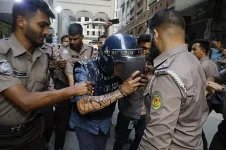
As police escorted Masud from the courtroom to the lock-up via elevator, a chaotic scene unfolded on the court premises.

Agitated lawyers and protesters gathered at the court building, hurling eggs at the former general while chanting slogans against him.

Despite the heavy police presence, several eggs struck Masud, soaking his bulletproof vest.

Masud served as general officer commanding (GOC) of the Army’s 9th Division in 2007 with the rank of major general. After the political changeover sparked by the events of Jan 11, 2007, he was promoted to lieutenant general.

Masud subsequently played a key role in the 2007-08 military-controlled caretaker government’s hunt for “criminals” of various kinds. He acted as chief coordinator to a powerful government committee dealing with “serious crimes”.

The committee was chaired by retired major general MA Matin, the then advisor in charge of the home ministry.

Masud was elected from the Feni-3 constituency on a Jatiya Party ticket in 2018.​
 
Analyze

Analyze Post

Add your ideas here:
Highlight Cite Respond

‘Masud tortured the man who is now PM,’ public prosecutor tells court

Prosecution accuses retired lt gen of implementing ‘Minus Two’ formula and running a network of abduction, torture, and extortion

Star Online Report

1774400257873.webp

Masud Uddin Chowdhury. Photo: Collected

Dhaka Metropolitan Public Prosecutor Omar Faruq Faruqi told the Dhaka CMM Court today that the person Lt Gen (retd) Masud Uddin Chowdhury had "tortured and tried to kill" is now the prime minister.

“Masud led the entire operation -- harassing political leaders, torturing and crippling them, and implementing the ‘Minus Two’ formula,” he said.

Faruqi made these remarks during a five-day remand hearing in a case over human trafficking and forgery of documents filed with Paltan Model Police Station.

Amid tight security, Masud was escorted to a packed courtroom of the Chief Metropolitan Magistrate’s (CMM) Court of Dhaka today.

As he was being escorted back to the CMM Court lockup after the hearing, a group of people shouted slogans against him. Some of them even threw eggs at him.

During the hearing, the public prosecutor said, “We saw this man (Masud) during the 1/11 (caretaker government) period... Under his leadership, thousands of crores of taka were collected. He also led a task force -- which meant abducting people, torturing them, and extorting money. He was the head of this operation.”

“During 1/11, there was hardly any businessman in Bangladesh who was not detained and extorted from. Masud was the mastermind,” he further said.

Defence lawyer Morshed Hossain Shahin sought bail and cancellation of the remand.

“The final report was already submitted in this case once before. Now it is being reinvestigated. The allegations against him are fabricated,” the defence lawyer told the court.

After hearing both sides, Dhaka Metropolitan Magistrate Aminul Islam Junaid granted a five-day remand for Masud.

Masud was arrested earlier today from his home at Dhaka's Baridhara DOHS by a team of detectives.

He previously served as general officer commanding (GOC) of 9 Infantry Division in Savar during the state of emergency declared on January 11, 2007.

Later, he was appointed chief coordinator of the National Coordination Committee on Serious Crimes and Corruption, promoted to lieutenant general, and posted to the National Defence College on June 2, 2008.

He was transferred to the foreign ministry and appointed to the Bangladesh High Commission in Canberra on June 8, 2008.​
 
Analyze

Analyze Post

Add your ideas here:
Highlight Cite Respond

Masud Uddin Chowdhury: 1/11, power, reward and controversy
1774486265631.webp

A person throws dirty water on Masud Uddin Chowdhury on the court premises on 24 March 2026 Collected
 

Attachments

  • 1774486286061.webp
    1774486286061.webp
    53.8 KB · Views: 1
Analyze

Analyze Post

Add your ideas here:
Highlight Cite Respond

Arrest of 1/11 figure Masud Uddin: Army intervention and crisis of democracy

Mohiuddin Ahmad
Updated: 26 Mar 2026, 16: 06

1774571707869.webp

Arrested former army official Masud Uddin Chowdhury inside the DB vehicle Collected

Retired Lieutenant General Masud Uddin Chowdhury of the Bangladesh Army has been arrested. Apart from HM Ershad, there are few precedents in Bangladesh of such a high-ranking military officer being arrested. The issue of civil–military relations in the country’s politics remains highly sensitive and is often kept beyond public debate in the name of national security.

Recently, a high-profile case involving enforced disappearances and killings has emerged at the International Crimes Tribunal, where proceedings are underway against several retired and serving military officers. One key question that has arisen is whether military personnel should be tried under military law or under ordinary civil law. In such contexts, the special status of the armed forces tends to be emphasised.

The cases currently filed against Masud Uddin concern criminal offences. He is no longer in military service. His arrest has sparked speculation that the government may revisit his role during the 1/11 upheaval and the subsequent military-backed caretaker government.

Among the most notorious businesses in Bangladesh is the so-called manpower export trade. Allegations are widespread that unscrupulous operators lure young men with promises of prosperous careers abroad, extracting large sums of money before sending them overseas under uncertain and often exploitative conditions. If such allegations are to be pursued seriously, then all major figures in these trafficking syndicates should be held accountable. That this is not happening raises the question: why only Masud Uddin? This inevitably brings attention back to 1/11.

It is worth noting that during the 1/11 administration, Masud Uddin served as coordinator of the National Coordination Committee on Combating Serious Crimes. There have long been allegations of arrests, harassment and coercive interrogations of politicians, businesspersons and others, as well as extortion under threat of detention. One alleged victim of such treatment was Tarique Rahman, son of former Prime Minister Khaleda Zia and now Prime Minister himself. How far this matter will be pursued remains to be seen.

When does a mass uprising take place? It is not that some people sit together and decide - we don’t like this government; let’s topple it. Such upheavals do not occur arbitrarily. They arise gradually when governments lose legitimacy, governance deteriorates, and a significant portion of the public and political class becomes receptive to change.

The Bangladesh Nationalist Party (BNP) is now in power and considers itself a victim of the 1/11 incidents. Subsequent developments, including revelations in the memoir of India’s former foreign minister (and later president) Pranab Mukherjee, point to India’s involvement at the time. The December 2008 election, held when the BNP was politically weakened, resulted in a landslide victory for the Awami League, bringing Sheikh Hasina to power.

Senior military figures involved in the 1/11 intervention were largely unable to remain in the country. Masud Uddin, however, appeared to be an exception. Following a power struggle with Army Chief General Moeen U Ahmed, he was removed from the army but subsequently appointed High Commissioner to Australia in 2008. The Awami League government extended his tenure several times. Upon returning, he entered business and later became a Member of Parliament from Feni from the Jatiya Party, largely because of the coaxing of Sheikh Hasina.

It is not difficult to infer that, while other architects of 1/11 were sidelined, Masud Uddin retained considerable influence and secured a place in the highest legislative body. Many interpret this as a form of political reciprocation by Sheikh Hasina. Some go further, suggesting that the so-called “grand design” behind 1/11, facilitating the Awami League’s return to power, resulted in his reward.

After returning to power for a second term, Sheikh Hasina is widely accused of undermining the electoral system in an attempt to prolong her rule. Given that 1/11 created the conditions for her grip over the political affairs and power, it has often been characterised as a conspiracy. Was it indeed a conspiracy?

Military intervention is not new in Bangladesh. It began in 1975, re-emerged in 1982, and occurred again in 2007 under the banner of 1/11. The perpetrators of the 1975 coup were punished for the assassination of Sheikh Mujibur Rahman, while the leader of the 1982 coup, HM Ershad, was later convicted in corruption cases. However, neither coup was formally investigated or tried. We don’t know why it was so. Sheikh Hasina described the 1/11 episode as the outcome of their movement, so taking action against those involved was never considered. However, she remained aggrieved over her own arrest.

Where democratic norms are robust, where elections are credible, political consensus exists on national interests, freedoms of expression and organisation are upheld, and justice is accessible, military intervention becomes highly unlikely.

Bangladesh has witnessed both military coups and mass uprisings, most recently in 2024. When does a mass uprising take place? It is not that some people sit together and decide - we don’t like this government; let’s topple it. Such upheavals do not occur arbitrarily. They arise gradually when governments lose legitimacy, governance deteriorates, and a significant portion of the public and political class becomes receptive to change. This pattern was evident in 1975, 1982, 2007 and 2024. However, the military’s role in 2024 was somewhat different.

The armed forces in Bangladesh constitute one of the most cohesive professional groups in the country. Their discipline and command structure set them apart from other professions. Their relative distance from everyday political and economic life often shields them from corruption, enhancing their reputation for professionalism. As a result, they command public respect. Yet, when they perceive political governance to be failing, they may come to view themselves as saviours, a perception that segments of the public sometimes welcome. We sometimes heard people saying–why is the military still not taking charge?

In times of crisis, the military has rarely missed opportunities to intervene, often seeing it as their duty to “correct” errant politicians. It must also be acknowledged that politicians themselves frequently create the conditions that invite such interventions. When coups occur, those removed from power consider themselves as victims, while those outside power often welcome and benefit from them.

Military intervention is ultimately detrimental to democracy. Although such interventions have declined globally, particularly in Asia, Africa and Latin America, they still occur in countries where democratic institutions are weak and ruling elites are corrupt. In such contexts, electoral systems often mask the dominance of family- or party-based syndicates.

Where democratic norms are robust, where elections are credible, political consensus exists on national interests, freedoms of expression and organisation are upheld, and justice is accessible, military intervention becomes highly unlikely.

Thus, military involvement in politics must be understood as a manifestation of democratic failure. Until democracy is firmly institutionalised, the risk of intervention will persist. The fundamental requirement is responsible politics and a broad national consensus against military interference. One can only hope that, even belatedly, this lesson will be learned.​
 
Analyze

Analyze Post

Add your ideas here:
Highlight Cite Respond

Latest Posts

Back
PKDefense - Recommended Toggle