Home Watch Videos Wars

[🇧🇩] Trump's Victory/Tariff/ Bangladesh

[🇧🇩] Trump's Victory/Tariff/ Bangladesh
209
6K
More threads by Saif

G Bangladesh Defense

Time is running out for a deal with the US
Govt should have been better prepared and more proactive

1752712848538.webp

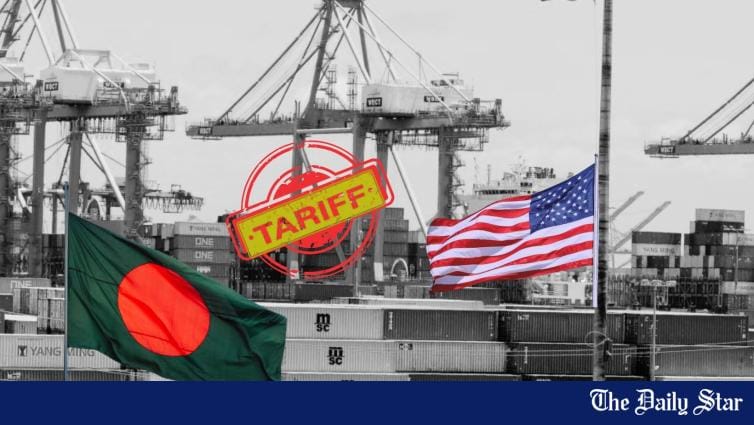
VISUAL: STAR

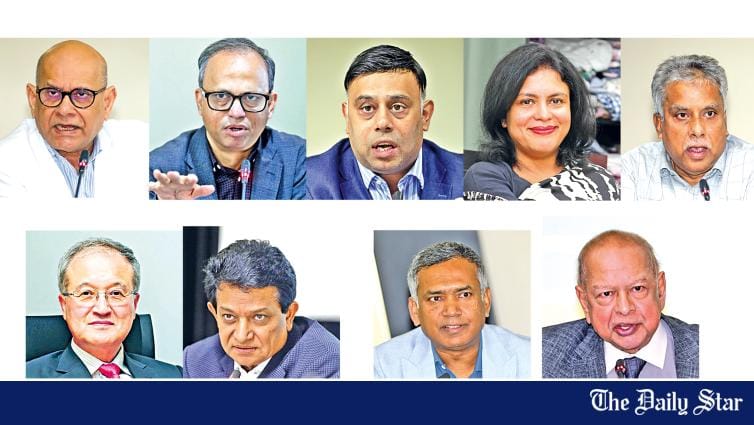
The concerns raised by trade experts and private-sector representatives regarding the interim government's handling of the US tariff negotiations are quite justified. At a roundtable organised by this daily, they expressed frustration over the government's poor preparation, lack of transparency, and minimal private-sector involvement in the trade talks with the US. They warned that a steep 35 percent tariff on Bangladeshi exports including garments to US markets—scheduled to come into effect from August 1—would have greater ramifications for the apparel sector and the wider economy than the government appears to realise. The lack of urgency displayed by it in the face of this enormous threat, and the limited progress made as time runs out to conclude the negotiations, has therefore placed our economic future in a precarious position.

Dhaka is now preparing for a third round of negotiations with the US, but it remains unclear when the talks will take place. While other countries, including our direct trade competitor Vietnam, have either already secured a favourable deal or made significant progress in that direction, Bangladesh still seems to lack any concrete plans. Until recently, the government kept the private sector largely at arm's length. And with very little time left before August 1, how much of the sector's input it can incorporate remains a major question. What the government should have done is establish both a steering committee and a working committee to ensure stakeholder inclusivity and proper preparation.

Moreover, inter-ministerial issues relating to the negotiations also appear to remain unresolved. At this stage, it is not even clear who exactly is leading the talks on Bangladesh's behalf. According to experts, the uncertainty surrounding a deal may prompt buyers to adopt a "wait and see" approach when considering orders from Bangladesh. This could leave businesses idle for several months. Small and medium-sized enterprises, in particular, will struggle to absorb such losses, potentially leading to factory closures and significant job losses.

The uncertainty triggered by the threat of harsher US tariffs will likely have spillover effects in other markets as well. Garment suppliers from other countries may also move quickly to capture European and other export markets, posing further risks to Bangladesh's market share.

Bangladesh, being heavily dependent on garment exports, has always been vulnerable to such external shocks. Despite repeated warnings, little has been done over the years to diversify the export basket, resolve longstanding structural bottlenecks, and enhance overall competitiveness. Given the current global trade landscape, experts believe Bangladesh now has no choice but to reduce trade and business costs through improved logistics and a more enabling business environment, while also boosting productivity through investments in technology and skills development.

However, such changes cannot be achieved overnight—they require consistent, long-term commitment. In the meantime, what the government must urgently do is bring all stakeholders on board and use all possible diplomatic and institutional channels to secure a win-win deal with the US.​
 
Analyze

Analyze Post

Add your ideas here:
Highlight Cite Fact Check Respond

Govt plans to include private sector in US tariff talks
Move comes as third round of negotiations looms

1752714696519.webp


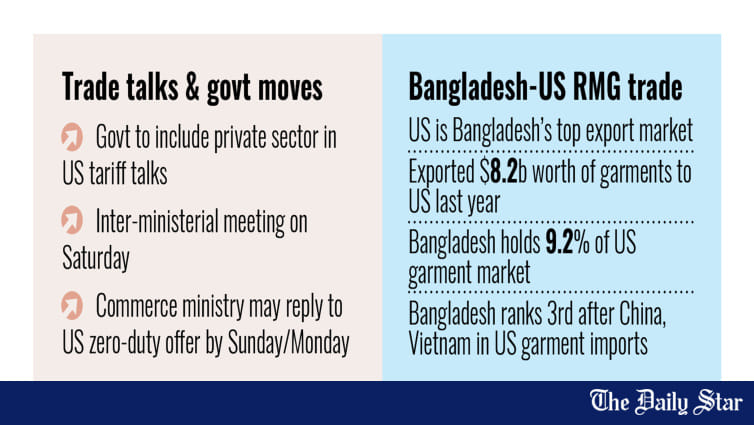
The government is considering bringing private sector representatives on board for upcoming tariff negotiations with the United States, as Bangladesh prepares to respond to the proposed tariff schedules by Sunday or Monday next week.

The US Trade Representative (USTR), which leads trade talks for Washington, has already sent Bangladesh three detailed tariff schedules.

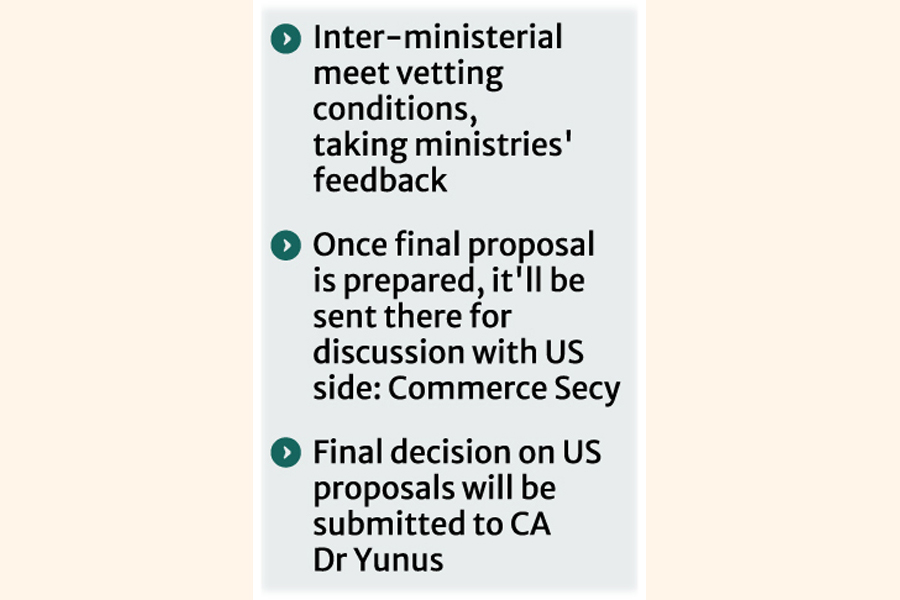
Bangladesh is currently reviewing the proposals and will send a response within the next couple of days, Commerce Secretary Mahbubur Rahman told The Daily Star yesterday over the phone.

"As the tariff issue includes multiple ministries, the commerce ministry has called an inter-ministerial meeting on Saturday to approve the agreed tariff lines submitted by the USTR," he said.

Rahman added that Bangladesh had agreed on most of the tariff issues but declined to elaborate, citing the non-disclosure agreement (NDA) signed by both sides before the talks began.

He also refrained from commenting on non-tariff matters that had been discussed, saying they too fall under the NDA.

However, the secretary said the ministry plans to involve private sector stakeholders in the negotiations. "We will be reaching out to business leaders from leading chambers and trade bodies," he said.

The commerce secretary did not disclose how many products the US had sought to be granted zero-duty access to the Bangladeshi market, but mentioned that the number is far lower than Bangladesh's total list of 7,446 tariff line items.

No new date has yet been set for the third round of talks, which is scheduled to take place in Washington before August 1, when the new import duties imposed by the Trump administration are due to take effect.

The commerce secretary said he would formally request the USTR to set a fresh date for the talks after Saturday's inter-ministerial meeting finalises Bangladesh's position on the zero-duty proposals.

Earlier this week, after returning from the second round of talks in the US, Commerce Adviser Sk Bashir Uddin and Mahbubur Rahman told a press conference that Bangladesh was preparing for the third round and that a team would fly to Washington next week.

However, the names of the delegation members have not yet been made public.

Meanwhile, economists and exporters are warning of serious repercussions for Bangladesh's economy due to the Trump administration's additional 35 percent reciprocal tariff on Bangladeshi goods.

They predict that overall US apparel imports could fall from nearly $80 billion last year to between $65 billion and $70 billion this year, as higher tariffs discourage sourcing from affected countries.

This could spell trouble for Bangladesh, especially its garment exports to the US, which may take a hit as American retailers and brands scale back their imports due to the steeper costs.

In contrast, the country's market competitors like Vietnam, India, and Indonesia have been hit with much lower rates, which may affect Bangladesh's garment share in the American market.

Bangladesh currently holds a 9.2 percent share of the US apparel market, making it the third-largest supplier after China and Vietnam. Last year, the country exported $8.2 billion worth of garments to the US.

Shovon Islam, managing director of Sparrow Group, which exports $350 million worth of garments a year—$150 million of which goes to the US—said his American buyers are already pressing him to cut prices, even though the final tariff rate is yet to be confirmed.

He said that he had to offer much lower prices to secure an order of one million shirts, as the buyer was considering shifting it to India, where tariffs are lower.

"Multinational clothing brands are also negotiating prices for goods meant for other markets like India and Japan, even though Bangladesh enjoys duty-free access there," Islam said.

"They think production in India is more cost-effective than in Bangladesh because of the lower tariff imposed on India by the Trump administration," he added. "I am deeply disappointed with the lack of progress demonstrated by the Bangladesh government."

"As a stakeholder and one of the largest exporters to the US market, I feel utterly helpless and frustrated," Islam commented.

Fazlee Shamim Ehsan, executive president of the Bangladesh Knitwear Manufacturers and Exporters Association (BKMEA), said the commerce ministry had not yet communicated with them about including private sector representatives in the talks.

"Maybe the ministry will contact us later," he told The Daily Star yesterday.​
 
Analyze

Analyze Post

Add your ideas here:
Highlight Cite Fact Check Respond

IMPENDING US TARIFF SHOCK TO BANGLADESH ECONOMY
Millions of jobs may face wipeout


Jasim Uddin
Published :
Jul 18, 2025 00:29
Updated :
Jul 18, 2025 00:29

1752796375223.webp


Bangladesh's export-led economy faces a potential employment crisis as the US prepares to impose a 35-percent countervailing tariff on imports from the country on August 1.

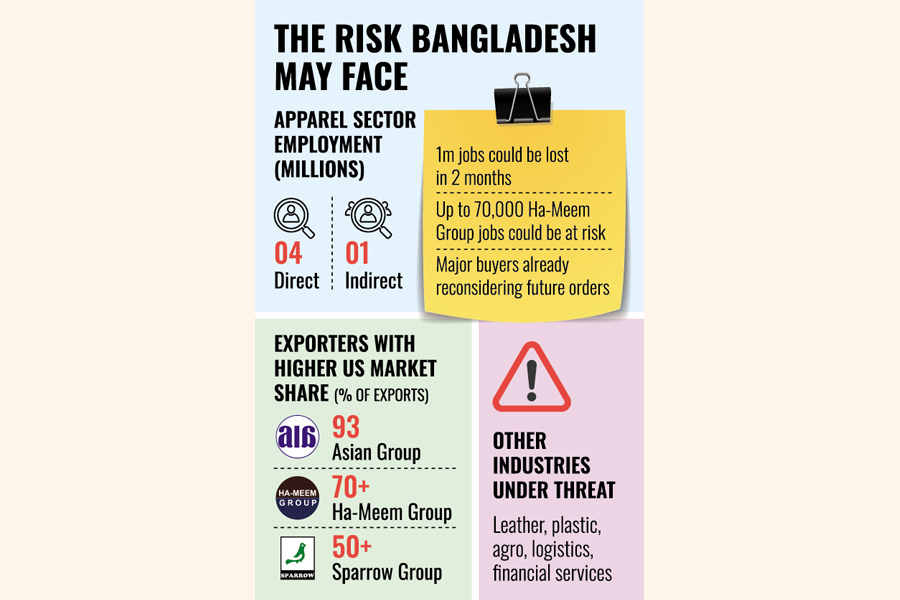
Industry leaders warn that the impact will be widespread - threatening not just the readymade garment (RMG) sector but also related industries, such as leather, plastic, agriculture, logistics, and financial services.

As the countdown to August 1 begins, stakeholders fear that failing rapid and coordinated government action, Bangladesh could lose its competitive edge on the US market - a loss that could take years to recoup and cost millions of jobs.

"This is not just a trade issue, it's a national emergency," says Shovon Islam, managing director of Sparrow Group.

"If we think only our US-bound RMG exports will suffer, we are gravely mistaken. Buyers source from one country for multiple markets. The consequences will cascade."

Speaking on condition of anonymity, the country manager of a European apparel brand said, "If the tariff issue is not resolved in Bangladesh's favour, it could reduce our business opportunities here."

He also said, "Although the US market accounts for less than 10 per cent of our total sales, it would no longer be a viable business case for us to produce goods for them from Bangladesh. We may have to consider alternative sourcing options."

The RMG and textile sectors alone directly employ nearly 4.0 million workers, with another million jobs supported indirectly in the backward-linkage industries and support services.

If the tariff hike comes into effect and order volumes fall, industry insiders say, a million jobs could be lost within two months.

Sparrow Group, which employs 18,000 workers and pays over Tk 400 million in monthly wages, exports products worth around $300 million annually, and half of that are destined for the US.

"If this market collapses, we will not last more than two months," Islam forewarns.

Similarly, Asian Group, a leading Chattogram-based apparel exporter with nearly $340 million annual exports - 93 per cent of which go to the US - has expressed serious concern.

"If the government fails to secure a favourable arrangement, we may not survive," says its Executive Director Khondaker Belayet Hossain.

"We pay Tk 600 million in monthly wages, while the overall operating cost stands at Tk 700 million."

He also says he is worried about how he would manage in the coming days if the tariff issue does not end in Bangladesh's favour.

"One of our major buyers - US retail giant Walmart - has continued current orders but is uncertain about the next season. They are already evaluating the situation," Hossain notes.

He further says the entire industry is vulnerable and about 95 per cent of RMG-factory owners would not be able to pay workers beyond a month if the situation does not improve.

"We have failed to convey to the nation the true nature of RMG profitability. When we acquire new factories, it is not for immediate profit but to consolidate operations and reduce overheads," Hossain explains.

Major buyers like Walmart, Gap, Levi's, American Eagle, and C&A, whose combined annual sourcing from Bangladesh exceeds $5 billion, are already reconsidering future orders.

Several buying houses have asked factories to delay production and shipments until further notice.

Ha-Meem Group, Bangladesh's top RMG exporter, pays Tk 900 million in monthly wages to its employees.

Industry sources say up to 70,000 jobs at Ha-Meem alone could be at risk if exports slow down.

Data from the National Board of Revenue (NBR) show 2,377 Bangladeshi firms exported to the US in FY25.

Among them, 801 depend on the US for more than 50 per cent of their total exports, making them particularly vulnerable.

Collectively, these companies exported $6.62 billion worth of goods globally in FY25, with $5.05 billion - 58 per cent of Bangladesh's total exports - to the US.

Bangladesh exports nearly $10 billion worth of goods to the US annually, including leather, plastic, and agro items.

"If order volumes decline, the spill-over effect will ripple across spinning mills, dyeing units, accessory makers, transport operators, banks, and insurers," says Fazlee Shamim Ehsan, a member of the Bangladesh Employers' Federation executive committee.

Backward-linkage industries - such as spinning, dyeing, accessories, and chemicals - are heavily dependent on export volumes.

A reduction in the US-bound shipments would inevitably hurt their operations, leading to layoffs and financial strains, experts say.

Similarly, thousands of jobs in the domestic logistics and transport businesses - freight forwarding, clearing and forwarding (C&F) agents, and warehouse operators - are tied to the export- supply chain.

These businesses fear revenue losses if US buyers scale back orders or shift sourcing to alternative countries.

Financial services, such as export financing, trade insurance, and customs brokerage, too, are expected to come under pressure.

"Any disruption to trade volume affects our loan performance. Many exporters rely on back-to-back letters of credit (LCs) and factoring support, which will get strained if US orders shrink," says a senior official at a leading commercial bank.

Insurers are also bracing for a possible drop in marine and export-credit insurance premiums, with fewer goods being shipped abroad.

Meanwhile, local small and medium enterprises (SMEs) that supply to export factories fear they could be the first to face closures.

Despite being one of the largest sources of imports for the US, Bangladesh currently lacks preferential-market access.

In contrast, countries like Vietnam, India, and Sri Lanka have pursued strategic trade diplomacy by offering the US imports, such as liquefied natural gas (LNG) or cotton, in exchange for tariff relief.

"India, Vietnam, Indonesia, and others have negotiated effectively. We failed to present reciprocal offers," Sparrow Group's Islam observes.

"We have seen how Chinese exports to the US dropped by over $100 billion under the Trump-era tariffs. Bangladesh could face the same fate," he adds.

He has called for urgent high-level diplomatic interventions, suggesting economists and experienced business leaders be dispatched to Washington to negotiate a settlement before the tariff becomes effective.

On Tuesday, after a meeting with business leaders, BNP standing committee member Amir Khasru Mahmud Chowdhury urged the government to strengthen its negotiations with the US by involving businesses, political parties, and industry leaders.

"If not addressed properly, the tariff issue could severely impact our economy, employment, and exports," he said.

He warned that over $8 billion in exports and 1.5 million jobs are at risk, stressing that political consensus is essential on the matters of national interest.​
 
Analyze

Analyze Post

Add your ideas here:
Highlight Cite Fact Check Respond

Bangladesh-US tariff talks
Negotiations dragging on over non-trade issues

Staff Correspondent Dhaka
Updated: 16 Jul 2025, 13: 57

1752797744609.webp

Flags of Bangladesh and the US Prothom Alo illustration

Although there is consensus on trade-related matters, negotiations between Bangladesh and the United States are currently stalled over non-trade issues, including some sensitive topics.

A Bangladeshi delegation is scheduled to travel to Washington next week for a third round of negotiations after consultations with the interim government’s chief adviser and others.

This information was gathered from conversations with several business leaders. However, due to a non-disclosure agreement with the United States, government advisers and officials are not commenting publicly on the negotiations.

On 7 July, US President Donald Trump announced new tariff rates on imports from 14 countries, including Bangladesh, South Korea, and Japan. For Bangladeshi products, an additional tariff of 35 per cent was imposed. While the tariffs were initially scheduled to take effect from 9 July, implementation has been deferred to 1 August.

If successful negotiations take place within this period, the tariff rate may be lowered; otherwise, the rate declared by Donald Trump will go into effect. Notably, three months ago, the US had already imposed a 10 per cent counter tariff on imports from all countries.

A delegation led by Commerce Adviser Sheikh Bashir Uddin returned to the country last Sunday after holding discussions in Washington from 9 to 11 July.

The US wants to deepen its geopolitical and strategic involvement with Bangladesh, primarily to ensure that Bangladesh does not tilt too far toward China. Washington wants Dhaka to avoid significantly expanding trade relations with China or encouraging Chinese investment.

At a press conference last Monday, the adviser said, “Preparations are underway for the third phase of discussions with the United States. We’ve requested a timeframe from them. We are hopeful that Bangladesh, leveraging its capabilities, will be able to continue doing business in the US market, and the US will set a reasonable tariff level on Bangladeshi goods. Last week’s discussions with the US were encouraging and quite engaging.”

A business leader, requesting anonymity, told Prothom Alo that the discussions with the United States go beyond trade. The US wants to deepen its geopolitical and strategic involvement with Bangladesh, primarily to ensure that Bangladesh does not tilt too far toward China. Washington wants Dhaka to avoid significantly expanding trade relations with China or encouraging Chinese investment.

Sources confirm that among the conditions being discussed are clauses requiring Bangladesh to comply with any sanctions imposed by the United States. This means Bangladesh will have to refrain from trade, business, or investment activities with countries sanctioned by the US. Furthermore, there is a condition that goods granted duty-free access to Bangladesh from the US should not be offered similar benefits to any other country.

Another business leader, also speaking on condition of anonymity, said that the US wants Bangladesh to import military products from the United States and, in return, reduce its military procurement from China.

Another business leader, also speaking on condition of anonymity, said that the US wants Bangladesh to import military products from the United States and, in return, reduce its military procurement from China.

The United States is the single largest export destination for Bangladesh. In the fiscal year 2024–25, Bangladesh exported goods worth USD 8.69 billion to the US, which accounts for just over 18 per cent of the country’s total export earnings. More than 85 per cent of these exports were ready-made garments. Other major exports included caps, leather shoes, home textiles, and wigs.

When contacted, Commerce Secretary Mahbubur Rahman told Prothom Alo on Tuesday, “We’ve held a meeting with business leaders and economists and gathered their opinions. Another inter-ministerial meeting will be held soon to gather further input. Altogether, we are preparing thoroughly for the third phase of negotiations in the US We are optimistic that we can achieve the best possible outcome for the country before 1 August.”

Business leaders meet with BNP official

Meanwhile, on Tuesday afternoon, BNP Standing Committee Member Amir Khasru Mahmud Chowdhury met with leaders of various business organisations at a hotel in Banani, Dhaka, to discuss the US reciprocal tariffs.

Following the meeting, Amir Khasru Mahmud Chowdhury said that to strengthen negotiations over the imposed tariffs, it is essential to move forward with unified input from all stakeholders.

He said, “Discussions regarding the US-imposed reciprocal tariffs must be reinforced. The BNP will try to initiate dialogue with the government, where we will also present the business community’s concerns so that a coordinated approach can be developed.”

Business leaders attending the meeting included ICC Bangladesh President Mahbubur Rahman; former BTMA President Tapan Chowdhury; former FBCCI President A. K. Azad; BCI President Anwar-ul Alam Chowdhury Parvez; BGMEA President Mahmud Hasan Khan; BKMEA President Mohammad Hatem; MCCI President Kamran T. Rahman and Vice President Simin Rahman; LFMEAB President Syed Nasim Manzur; and Ahsan Khan Chowdhury, Chairman of Pran-RFL Group.

After the meeting, Mohammad Hatem told reporters, “The BNP invited us to this meeting. We told them that if there is anything they can do politically, they should take those steps. Nothing should be done that harms the country. If the counter tariff stays close to the levels imposed on India and Vietnam, we can maintain our competitiveness in that market.”​
 
Analyze

Analyze Post

Add your ideas here:
Highlight Cite Fact Check Respond

FITCH FINDINGS ON TRUMP TARIFF DISPARITIES
BD set to bear highest duty among US trade partners

Existing 15, new 35 aggregate to 50pc

Jasim Uddin Haroon
Published :
Jul 19, 2025 09:00
Updated :
Jul 19, 2025 09:00

1752971734638.webp


Bangladesh could face the highest effective tariff rate (ETR) among US trading partners-approximately 50 per cent -under the Trump tariff regime effective August 01, Fitch Ratings shows such duty disparities, released on July 18.

The newly announced 35 per cent, outlined in formal letters from the US government, and the existing 15-percent duty on Bangladeshi exports to the American market aggregate to this steep figure.

Fitch's latest update to its U.S. Effective Tariff Rate (ETR) Monitor, an interactive tool tracking tariff developments, shows Bangladesh will bear the brunt of the new measures as it does not benefit from tariff exemptions or carve-outs offered to some other countries.

Meanwhile, as the countdown to the cutoff time for the unusual tariff hike progresses, Bangladesh is engrossed in finding response to US-set conditions deemed beyond trade and tariffs so Washington could rethink levying the ramped-up duty.

The global ratings agency has developed the interactive tariff tool to calculate the ETR on imports from US partners in trade and quantify current duties.

This calculation considers exclusion like "carveouts for oil and gas, copper, and pharmaceutical imports". This tool is updated whenever significant changes in US tariff policy occur.

In contrast, China's ETR remains unchanged at 41.4 per cent due to no revisions in its reciprocal tariff rate.

Meanwhile, the US ETR itself is set to rise to 19.4 per cent, up from 14.1 per cent, driven by increased reciprocal tariffs and the implementation of new duties on copper imports.

These changes align with the rates detailed in recent bilateral communications and announced trade arrangements.

Further upward pressure on the US ETR is anticipated if additional tariffs on semiconductors, electronic components, and pharmaceuticals-currently under section 232 investigation-take effect as expected on August 01. A scenario modeled by Fitch includes a 25-percent tariff on these imports, which would raise the overall ETR to approximately 23.7 per cent.

President Donald Trump has extended a pause on country-specific reciprocal tariffs announced in April but has sent letters to select countries outlining new rates ranging from 25 per cent to 50 per cent.

For the majority of countries not covered by these letters, the US will continue to impose a baseline tariff of 10 per cent.

However, Trump has indicated the possibility of introducing a blanket tariff of 10 per cent to 15 per cent on about 150 countries.

New bilateral trade deals with Vietnam and Indonesia were also announced, setting reciprocal tariffs at 20 per cent and 19 per cent respectively.

Among other notable changes, copper imports will now carry 50-percent duty, while Canada and Mexico face increased tariffs of 35 per cent and 30 per cent , raising their respective ETRs to 11.7 per cent and 13.1 per cent, up from 7.5 per cent and 9.5 per cent .

These projections assume that about half of previously tariff-free imports will be reclassified as compliant under the USMCA agreement.

In the case of the European Union, reciprocal tariffs are set to rise to 30 per cent from 20 per cent, resulting in varying ETRs for individual EU countries-ranging from 12 per cent to over 30 per cent-depending on their trade mix with the United States. ETR reflects the total duties paid as a percentage of total import value and varies based on changes in import composition and source countries.

Fitch's ETR Monitor provides sector-specific and country-specific breakdowns of import volumes and duties through 2025, covering key US trade partners, including China, the EU, Japan, Vietnam, Canada, and Mexico.

The interactive tool allows users to simulate different tariff scenarios by adjusting sectoral and country-specific rates and import volumes. It will be updated in real-time as major shifts in US trade policy unfold.​
 
Analyze

Analyze Post

Add your ideas here:
Highlight Cite Fact Check Respond

Members Online

No members online now.

Latest Posts

Back
 
G
O
 
H
O
M
E