Home Watch Videos Wars

[🇧🇩] Trump's Victory/Tariff/ Bangladesh

[🇧🇩] Trump's Victory/Tariff/ Bangladesh
209
6K
More threads by Saif

G Bangladesh Defense

US sends list of items, seeking zero duty

1752454497922.webp

Photo: Collected

The US has demanded zero duty facility for a large number of its products from Bangladesh.

Commerce Secretary Mahbubur Rahman said the United States Trade Representative (USTR) sent a list of these products to him yesterday via email.

He spoke to The Daily Star over the phone last night upon his return from the US after participating in the talks in Washington, DC. Commerce Adviser Sk Bashir Uddin also returned to Dhaka after the talks with the chief trade negotiation body of the American government.

"Both the countries have agreed on almost all the issues, except a few things during the negotiations with the USTR in Washington, DC," he said.

Speaking about the products for which the US demanded the zero duty facility, Mahbubur could not specify a number immediately but said the list is "very long".

He said Bangladesh has already been providing zero duty benefit to many American goods over many years. For instance, the import of cotton, wheat, soybean seeds and oil and other agricultural products from the US is free of duty.

But adding more products to the list does not solely depend on the commerce ministry, so a meeting will be held next Saturday to take the opinions of the other ministries, Mahbubur said.

Later, Bangladesh will hold another important meeting with the US to finalise the tariff rate before the 35 percent announced by Trump takes effect on August 1.

During the talks in the US, Bangladesh requested tariff rates between 10 percent and 20 percent. The next meeting is also scheduled to take place in Washington, DC.

After Trump announced reciprocal tariffs on April 2, Bangladesh offered zero duty facility for many American goods and also promised to increase import volume of products such as aircraft, LNG, cotton, wheat, soybean and other agricultural products.

The US is the single largest export destination for Bangladesh, which shipped goods worth more than $8 billion to the US and imported $2 billion American products last year.

FRAMEWORK DEAL

Power and Energy Adviser Fouzul Kabir Khan yesterday said that before engaging in further talks on tariff and non-tariff issues, the US is first looking to sign a framework agreement with Bangladesh, which would include a range of matters, including its security concerns.

The adviser said the tariff talks with the US extended beyond the scope of trade negotiations.

"Not just tariffs, there have been discussions on non-tariff barriers as well. They [the US] are prioritising their national security," Fouzul told reporters at a press conference on NBR reforms at the energy ministry.

According to him, the US was assessing how Bangladesh interacts bilaterally with other countries. "A framework is being worked out in this regard, and​
 
Analyze

Analyze Post

Add your ideas here:
Highlight Cite Fact Check Respond

Second round of tariff talks with US ‘encouraging’: Sk Bashir

Published :
Jul 14, 2025 21:05
Updated :
Jul 14, 2025 21:05

1752534103704.webp


Commerce Adviser Sk Bashir Uddin on Monday described the second round of tariff policy discussions between Bangladesh and the United States as ‘encouraging’.

“We returned from the US yesterday (Sunday) after concluding the second round of talks. Today, we briefed our stakeholders on various aspects of the discussions,” he told reporters following a meeting at the Ministry of Commerce.

Sk Bashir shared insights into the draft Reciprocal Tariff Agreement currently under negotiation between the two countries and confirmed that preparations are already underway for the third round of discussions, reports UNB.

“We are preparing to visit the United States again this month. We’re hopeful of a positive outcome,” he said.

Referring to the latest round of talks held in Washington, the adviser said, “The discussions were quite engaging and overall encouraging. I also had a meeting with the US Secretary of Commerce. We interacted with 35 to 40 people directly involved in the negotiations from their side. A number of useful suggestions came out of those engagements. We’re optimistic that through this dialogue, the US will agree to a rational tariff rate for our exports.”

He said Bangladesh has maintained a strong presence in the US market for nearly a decade.

“We have been doing business in the US since 2015, paying tariffs. Our enterprises rely on their own capabilities. As long as there’s no discriminatory treatment, our businesses will continue to perform successfully,” Sk Bashir said.

When asked what Bangladesh considers a ‘rational tariff rate’, he responded simply, ‘zero’.​
 
Analyze

Analyze Post

Add your ideas here:
Highlight Cite Fact Check Respond

US tariff challenge and BD's exports

Syed Fattahul Alim
Published :
Jul 14, 2025 23:11
Updated :
Jul 14, 2025 23:11

1752535119047.webp


Industry leaders in the Readymade Garment (RMG) sector should have been elated by the fact that in the last financial year (FY2024-25), export of their products to the USA registered a sharp rise by 14 per cent compared to the previous fiscal (FY24). But at the moment, they may not be in the mood to rejoice at the latest development. The reason is, the tariff talks with the USA, the single biggest market for Bangladeshi woven garment products, have not produced any positive results so far. Notably, the Trump administration, in addition to the existing 15 per cent, has imposed another 35 per cent as reciprocal tariff on Bangladesh's exports to the USA. Now it is also demanding a 40 per cent local value addition to our RMG products to qualify for 'Made-in-Bangladesh' label. But this condition, if not relaxed, is going to deal a heavy blow to the woven garment's export to the US market. Bangladesh's trade delegation in Washington, D.C. has been holding negotiations with the Office of the US Trade Representative (USTR) seeking relaxation of the Rules of Origin (RoO) requirement related to the condition of 40 per cent local value addition. The problem with this particular requirement is that 70 per cent of the fabric for the woven sector is imported from China. Obviously, that is a big issue for Washington, as it is at the moment in a trade war with China. The Trump administration's policy is to reduce global value chain's reliance on Chinese raw materials. According to the Export Promotion Bureau (EPB), in the fiscal year 2024-25, Bangladesh exported RMG products worth USD7.54 billion to the US market. It marked a substantial volume of apparel goods shipment to that country. So, it is not hard to understand the challenge Bangladesh is now faced with. And of that US bound apparel goods, woven garment was the dominant component. To reduce Bangladesh's dependence on China-origin fabric for its woven sector, domestic capacity is required to be developed for meeting the US's condition of local value addition. Since developing the necessary backward linkages to produce the fabric (for woven garment) domestically, Bangladesh would be hard put to meet USTR's RoO requirements. Since Bangladesh-US tariff talks have also their geopolitical dimensions, the team conducting the negotiations led by commerce adviser Sk Bashiruddin may require additional diplomatic support.

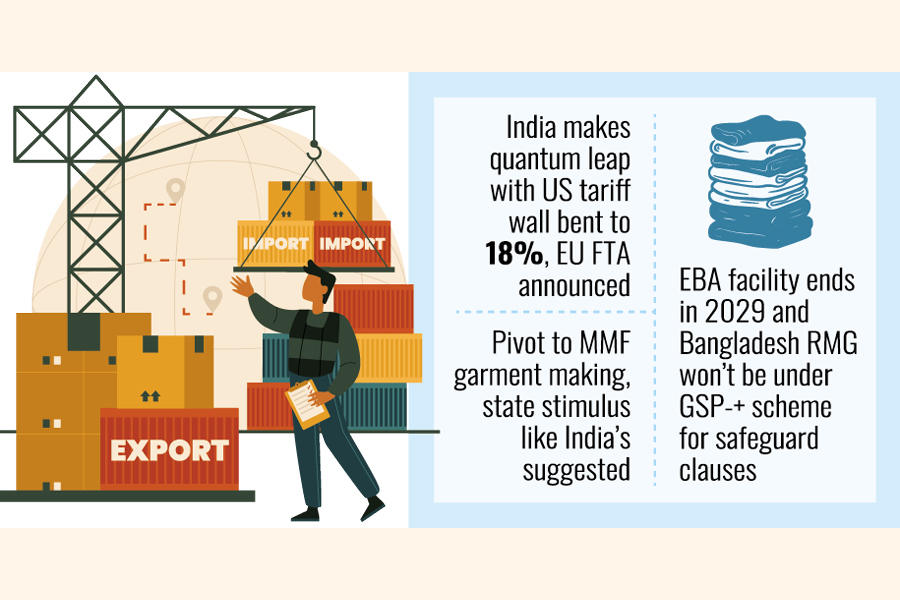
It is worthwhile to note here that according to a Bloomberg report, India, which is also holding tariff talks with the USA might win a below 20 per cent reduction in the proposed tariff, which will be lower than what Vietnam has secured (20 per cent tariff) from the USA. In that case, Bangladesh risks losing its competitive edge vis-a-vis its regional competitors.

Unless the tariff is reduced, or the RoO is relaxed, the high US tariffs on Bangladesh-origin RMG products will make those very expensive leading US retailers to look for alternative sources like India or Pakistan whose products would be cheaper due lower rate of US tariff imposed on them. According to industry insiders, some importers of our RMG products in the USA, have already put their purchase orders on hold. Suppliers to the Walmart, too, are learnt to have suspended some orders from Bangladeshi manufacturers. These are definitely not a good omen for Bangladesh's exports to the US market. Meanwhile, some quarters including the international media have been portraying a bleak future for Bangladesh's RMG sector. There are also reports of how the garment workers are now in fear of losing their jobs.

No doubt US market is important for Bangladesh. But that is not the end of the world.

In the circumstances, Bangladesh should continue its tariff negotiations with the USA. At the same time, the search should be on to look for alternative markets for Bangladesh's RMG exports. It is also time the country intensified its efforts to further widen and diversify its export basket.​
 
Analyze

Analyze Post

Add your ideas here:
Highlight Cite Fact Check Respond

Bangladesh to further negotiate US tariff: Commerce secretary
Special Correspondent Dhaka
Updated: 14 Jul 2025, 18: 27

1752537837023.webp

Commerce adviser Sk Bashir Uddin also attended a meeting with the country’s business leaders and economists at the commerce ministry on Monday. Collected

Commerce secretary Mahbubur Rahman said that Bangladesh has sought time from the US to negotiate the tariff issue further.

He made these remarks while addressing a press briefing at the conference room of the commerce ministry on Monday.

The briefing was organised on his recent official visit to Washington, DC, for three-day negotiations on Bangladesh-US tariff.

The commerce secretary in his welcome speech said, "We have return to Bangladesh from the US on Sunday after the negotiations on tariff. We have sought time for negotiations for the 3rd phase and we are still exchanging views through e-mail."

Mahbubur Rahman said, "We have held a meeting with business leaders and economists. We have got advice from them. We hope we will be able to reach a positive decision by 1 August."

"We know that US tariff will have a negative impact on our export. So We are working with utmost priority," he added.

Commerce adviser Sk Bashir Uddin also attended the meeting with the country’s business leaders and economists.

Mahmud Hasan Khan Babu, president of Bangladesh Garment Manufacturers and Exporters Association (BGMEA); Mohammad Hatem, president of Bangladesh Knitwear Manufacturers and Exporters Association (BKMEA); Anwar-ul Alam Chowdhury Parvez, president of Bangladesh Chamber of Industries; Syed Nasim Manzur, managing director of Apex Footwear; Selim Raihan, executive director of South Asian Network on Economic Modelling (SANEM); M Masrur Reaz, chairman of Policy Exchange Bangladesh; and Mohammad Abdur Razzaque, chairman of RAPID, were present at the meeting. Besides additional secretary Nazneen Kauser Chowdhury was also present.

Earlier, the second round of tariff negotiations between Bangladesh and the US concluded in Washington DC on 11 July 2025, with several issues still unresolved.

On 8 July, US President Donald Trump announced a 35 per cent reciprocal tariff on Bangladeshi goods, which is set to come into effect from 1 August, sparking concern among Bangladeshi exporters with active trade links to the US.

Data from National Board of Revenue (NBR) shows 2,377 companies exported 1-100 per cent of their products to the US during the 2024–25 fiscal.

Among them, 801 companies sent more than 50 per cent of their total exports to the US, making them particularly vulnerable due to their overreliance on a single market.

US total goods trade with Bangladesh was an estimated $10.6 billion in 2024. US goods exports to Bangladesh in 2024 were $2.2 billion, down 1.5 per cent ($34.0 million) from 2023.

US goods imports from Bangladesh totalled $8.4 billion in 2024, up 1.1 per cent ($89.3 million) from 2023. The US goods trade deficit with Bangladesh was $6.2 billion in 2024, a 2 per cent increase ($123.2 million) over 2023, according to the Office of the United States Trade Representative (USTR).

For Bangladesh, export of ready-made garments to US alone accounted USD 7.59 billion in last fiscal.​
 
Analyze

Analyze Post

Add your ideas here:
Highlight Cite Fact Check Respond

BNP pledges support to government on US tariff challenges, business leaders warn of market losses

Published :
Jul 15, 2025 22:10
Updated :
Jul 15, 2025 22:10

1752622844788.webp


Senior BNP leader Amir Khosru Mahmud Chowdhury on Tuesday said that his party will offer coordinated cooperation to the government on US tariff and security issues, to help address the tariffs imposed by the United States.

Chowdhury made the remarks during a briefing to journalists at a hotel in Banani, following an exchange of views with business leaders concerning the US tariffs, UNB reports.

The BNP Standing Committee member emphasized that the livelihoods of 15- 16 lakh people are linked to exports to the US market, so the tariff issue is a serious matter for Bangladesh.

Khosru said business leaders fear that the recent US tariff impositions will severely impact Bangladesh's trade and commerce.

Therefore, the BNP is prepared to cooperate with the government in the ongoing tariff discussions with the United States, aiming to achieve a pragmatic solution for Bangladesh.

In response to a question, Amir Khosru pointed out that India and Vietnam are Bangladesh's direct competitors in the international garment export market.

If Bangladesh fails to reach a solution regarding the tariffs, these competitor countries will gain a significant advantage in exporting to the US, causing great concern among local exporters.

He warned that Bangladesh cannot afford to bear the risk of millions of job losses, the closure of industrial factories, and thousands of backward linkage industries due to unresolved tariff issues.

BGMEA President Mahmud Hasan Khan, BKMEA President Mohammad Hatem, former President of FBCCI AK Azad, Chairman of Apex Tannery Ltd

Syed Nasim Monzur, Chairman of Bangladesh Chamber of Industries (B I) Anwar-ul-Alam Chowdhury Parvez, Chairman of Prank RFL Group Ahsan Khan Chowdhury, among others joined in the meeting.​
 
Analyze

Analyze Post

Add your ideas here:
Highlight Cite Fact Check Respond

Members Online

Latest Posts

Back
 
G
O
 
H
O
M
E