[🇧🇩-Airforce] A trainer jet crashes, 19 people die.

[🇧🇩-Airforce] A trainer jet crashes, 19 people die.
115
3K
More threads by Saif

G   Bangladesh Defense

Dhaka aircraft crash death toll rises to 31, injured 165: ISPR
Staff Correspondent Dhaka
Updated: 22 Jul 2025, 16: 44

1753231185257.webp


The death toll in the aircraft crash into a Milestone School building in the capital’s Uttara increased to 31 until 12:00 pm on Tuesday, while the number of injured was 165.

The Inter Services Public Relations Directorate disclosed this in a press release today.

Of the deceased, Combined Military Hospital (CMH), Dhaka registered 16 deaths, National Institute of Burn and Plastic Surgery registered 10 deaths, Lubana General Hospital and Cardiac Centre 2 and Dhaka Medical College Hospital, Uttara Adhunik Medical College Hospital 1 and United Hospital recorded 1 death each.

According to the ISPR list, the fatal crash injured 165 people. Eight of them have been undergoing treatment at Kuwait Bangladesh Friendship Government Hospital, 46 in Burn Institute, three in Dhaka Medical College Hospital, 28 in CMH, Dhaka, 13 in Lubana General Hospital, 60 in Uttara Adhunik Hospital, one in Uttara Crescent Hospital, one in Shaheed Monsur Ali Medical College Hospital, two in United Hospital, and three were receiving treatment at Kurmitala General Hospital.

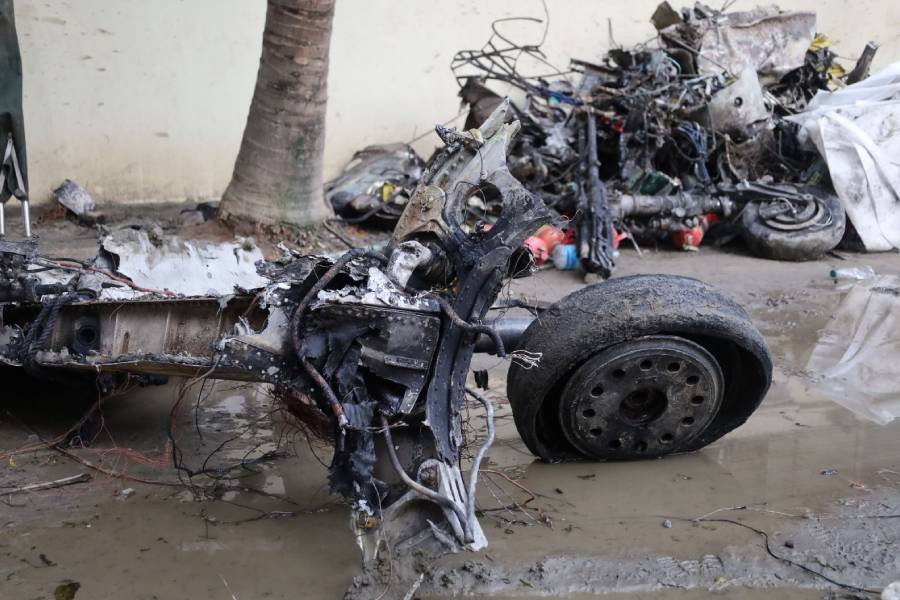
An Air Force FT-7 BGI training fighter jet crashed into a two-story building of Milestone School and College on Monday afternoon.

This Chinese-made fighter aircraft, used for training purposes, slammed into the school building in Uttara due to a mechanical failure.

According to the Inter-Services Public Relations (ISPR), the aircraft took off from the Kurmitola Air Force Base AK Khandaker in the capital at 1:06 PM and crashed into the school building shortly after. The Fire Service and Civil Defence received the report of the incident at 1:18 PM.

Immediately after the plane crash, a fire broke out in the school building. The surroundings became heavy with the screams of burned children, the desperate cries of parents frantically searching for their sons and daughters, and the wailing of relatives.​
 

HC bans risky flights over populated areas
It orders BAF crash probe in 45 days

M Moneruzzaman 22 July, 2025, 17:31

1753233557047.webp


The High Court on Tuesday directed the government to form a high-powered technical committee within seven days to investigate the Monday crash of the Bangladesh Air Force training aircraft into a building of a school and college in the capital’s Uttara area and identify the defects of the training aircraft.

The court also ordered a ban on the flight of faulty training planes over all populated areas — including Dhaka — after completing the investigation within 45 days.

The bench of Justice Fahmida Quader and Justice Sayed Jahed Mansur issued the directives and asked the government to submit monthly compliance reports in this regard.

The court asked the secretaries of the ministries of Defence and of Disaster Management and Relief, the Health Service Division, Air Chief Marshal, the Department of Fire Service and Civil Defence’s senior secretary and its director general, and the Department of Disaster Management and Relief’s director general to submit the compliance reports and respond to the rule.

The court issued the directives in response to a public interest litigation writ petition filed by Supreme Court lawyer Anisur Rahaman Raihan on Tuesday, the day after the crash of the BAF aircraft into a building of Milestone School and College at Uttara New Model Town on Monday left at least 31 people — mostly primary school students — killed and 165 others injured.

The committee shall find out the reasons behind the Monday’s aircraft crash, identify the defects in the aircraft, and to make necessary recommendations to ban flights of faulty training aircraft on the populated areas in Dhaka and other parts of the country, deputy attorney general Tanim Khan told New Age.New age services

Tanim told New Age that relocating training aircraft flights from populated areas would require moving the Bangladesh Air Force base from Kurmitola.

The base — known as BAF Base Bir Uttam AK Khandker — is located in Dhaka’s Kurmitola area, near the Hazrat Shahjalal International Airport.

The court also asked the government to explain in four weeks why it should not pay Tk 5 crore to each of the families of the deceased and Tk one crore to each of the injured.

It further ordered the education ministry secretary to arrange for issuing student ID cards with names, guardian contact numbers, and blood groups of all schools and colleges and submit the compliance report to the court.

The court further directed the authorities to explain why it would not be made it mandatory to have firefighting equipment in every school across the country.

According to the writ petition, since 1992 the Bangladesh Air Force has recorded at least 27 crashes involving fighter jets and training aircraft, raising concerns over flight safety, aging aircraft, and increasing urban encroachment near military bases.

The deadliest of the incidents took place on Monday when an F-7 BGI fighter jet crashed into the Milestone School and College campus at Uttara, killing at least 31 people and injuring 165 while two individuals remained missing.

The pilot, Flight Lieutenant Towkir Islam Sagar, was on his first solo fighter flight and died after being taken to the Combined Military Hospital at Dhaka Cantonment.

The Inter Services Public Relations directorate said in a statement on Monday that the fighter jet suffered mechanical failure after taking off from Base AK Khandaker.New age services

Despite the pilot’s efforts to steer the plane away from the populated area, it crashed into a school building.

A high-level Air Force committee has been formed to investigate the crash.

The writ petitioner, referring to a media report, said that between 1993 and 2006, 16 crashes involving BAF aircraft and helicopters claimed the lives of 14 pilots.

Many of the crashes involved Chinese-made FT-7, PT-6, and F-7MB model aircraft.

Crashes involving BAF aircraft occur almost every year, with Chinese-made aircraft accounting for the majority. Between 2005 and 2024, at least 11 Air Force aircraft crashes were reported — seven involving Chinese models, three Russian, and one Czechoslovakian.

Notable incidents included that on May 9, 2024 when a Russian Yak-130 aircraft crashed during training in Patenga, Chattogram, killing Squadron Leader Asim Jawad.

On November 23, 2018, a Chinese F-7BG crashed in Madhupur, Tangail, killing Wing Commander Arif Ahmed Dipu.

On July 1, 2018, a K-8W trainer crashed in Jashore in which two squadron leaders died.

On December 27, 2017, two Yak-130 jets collided mid-air over Maheshkhali, but all four pilots ejected safely.

On June 29, 2015, a Chinese F-7MB crashed into the Bay of Bengal, with the pilot, Flight Lieutenant Tahmid, going missing.

On April 8, 2012, a Czechoslovakian L-39 trainer crashed in Tangail, killing the pilot.

On December 20, 2010, two PT-6 trainers crashed near Barisal, killing two squadron leaders.

Senior lawyers Zainul Abedin, Kayser Kamal, and Gazi Kamrul Islam Sajal placed arguments on behalf of the writ petitioner.

Deputy attorneys general Mohammed Shafiqur Rahman and Tanim Khan along with assistant attorney general Eakramul Kabir Romel, who appeared for the state, did not oppose to the rule.​
 

Bangladesh Air Force fighter jet crashes due to technical malfunction: ISPR
Staff Correspondent 21 July, 2025, 19:58

1753233951822.webp

Bangladesh's fire service and security personnel conduct a search and rescue operation after an Air Force training jet crashed into school in Dhaka on July 21, 2025. | AFP Photo

The FT-7 BGI fighter jet of the Bangladesh Air Force crashed due to a technical malfunction it faced immediately after taking off from BAF Base Bashar in Dhaka’s Kurmitola at 1:06pm on Monday, killing 20 people, including the pilot, Flight Lieutenant Md. Towkir Islam, said an ISPR release.

According to the Inter-Services Public Relations (ISPR), Flight Lieutenant Towkir Islam attempted to steer the aircraft away from densely populated areas.

Despite his efforts, the aircraft crashed into a two-storey building of Milestone School and College in the Diabari area in Dhaka, causing significant casualties, the release said.

The accident also left 171 others injured.

The BAF has already formed a high-level investigation committee to determine the exact cause of the crash.

Emergency services, including the Bangladesh Air Force, Army, Police, Rapid Action Battalion (RAB), and Fire Service, launched immediate rescue operations.

Helicopters and ambulances were deployed to transport the injured to the Combined Military Hospital (CMH) and other nearby hospitals for urgent medical treatment.

The Bangladesh Air Force expressed profound sorrow over the incident and confirmed that all necessary measures are being taken to assist the victims and their families.

Senior military officials, including the Assistant Chief of Air Staff (Administration), visited the crash site, as the Chief of Air Staff is currently on an official visit abroad.

Top-level government and military officials, including the Chief of Army Staff and the Principal Staff Officer of the Armed Forces Division, were also present to oversee rescue and relief efforts.​
 

The system forgot to be reliable
Abdul Monaiem Kudrot Ullah 23 July, 2025, 00:00

1753234142201.webp

An injured student is taken to National Institute of Burn and Plastic Surgery, where dozens of injured students are being treated. | Focus Bangla

The crash of the F-7 aircraft over Dia Bari is not merely a tragic accident; it is the tragic symptom of a deeper and chronic institutional pathology. What we are witnessing is not the result of a single point of failure, but rather the slow-motion collapse of an organisational logic that tolerates decay, rewards negligence and defers accountability — until the cost is measured in human lives.

Yes, we mourn the pilot. Yes, we mourn the children. But mourning must not become a ritualised coping mechanism. We must remember — and remembering must compel us to confront the architecture of failure that made this disaster possible.

The very location of a school complex along the known approach and departure paths of the only runway at Hazrat Shahjalal International Airport reveals a planning culture that is either unforgivably uninformed or institutionally indifferent. Despite prior incidents along this corridor, no mitigation has been implemented. This is not just negligence — it borders on culpable ignorance.

But the rot runs deeper.

Across our military establishments, a common aesthetic drift has set in — gloss replacing grit, show replacing substance. The air force is not alone. From the bottom-lit walls of cantonments to the glass-panelled gates at headquarters, we’ve replaced concealment with spectacle. Tiles have replaced camouflage. The architecture of deterrence has become theatre. These are not markers of modernisation. They are the hallmarks of performative decay.

The continued use of the F-7 aircraft — a platform phased out by other nations, discouraged even by its own manufacturer — exemplifies this decay. We acquired these jets in the twilight of their viability, and have clung to them long after others moved on. The question is not just why — but who allowed it? What nexus of political patronage, procurement opacity and military prestige overruled operational logic and human safety?

Here, too, the interim government must accept its burden. Nearly a year since assuming power, the public has seen neither a forensic investigation into airworthiness nor the institutional reforms it was promised. The rhetoric of renewal has not translated into systemic action. The silence of the state grows louder with each passing day.

This is not just a political failure. This is a collapse of organisational reliability.

As a former naval logistician and current researcher of supply chain resilience, I turn to a benchmark that remains relevant across high-risk domains — the High-Reliability Organisation (HRO). These institutions — like nuclear aircraft carriers or air traffic control systems — operate in environments where failure must be anticipated, studied, and preempted. Their strength lies not merely in machinery, but in institutional culture: a culture that resists simplification, fears complacency and values redundancy and feedback.

A system in need of rewiring

BANGLADESH’S defence ecosystem mirrors the operational complexity of High-Reliability Organisations, but not their discipline, culture or institutional humility. Where HROs cultivate a relentless focus on avoiding failure, our system instead indulges in symbolic rituals, circular blame and dangerous afterthoughts. The result is a brittle ceremonial force — visibly modern, but hollow in preparedness. A show without substance.

Preoccupation with failure: One of the core principles of HROs is their preoccupation with failure. These institutions do not wait for disasters to erupt before taking action. They treat minor incidents, close calls and system glitches as urgent warning signs, to be analysed, learned from and resolved before they escalate into catastrophe.

Now let us ask: in the years leading up to the F-7 crash, were the warning signs there? Yes. Were they studied, documented or publicly debated? No.

The airframe in question — the Chinese F-7 BGI — had already earned a reputation for poor survivability across multiple air forces. The manufacturer itself had phased out production by 2013. Accidents were reported in China, Pakistan, Myanmar and Egypt. And yet we continued flying the aircraft, knowing full well its operational and structural limitations.

In an HRO, this fleet would have been flagged as high-risk. Its continued use would have triggered safety audits, scenario planning and eventually decommissioning. But in our system, aging equipment is tolerated as long as it still performs under ceremonial fly-pasts — until the day it crashes into a school.

Deference to expertise: In most traditional hierarchies, decisions travel downward from rank to rank. But in HROs, especially during a crisis, power is delegated to the person with the most situational competence — not necessarily the highest rank. The technician who understands the aircraft’s hydraulic failure better than the commander is empowered to act, speak and lead.

Ask yourself: could such a culture exist within our military or regulatory institutions? Would a junior engineer or squadron technician be allowed to halt a sortie due to recurring but undocumented engine anomalies? Or would they be pressured to maintain ‘readiness’ regardless?

Deference to expertise is not about insubordination; it is about protecting lives. It reflects trust in knowledge over hierarchy, and the understanding that competence is not always signalled by medals or office size.

We must ask why engineers, aircrew and planners did not speak up — or if they did, why they were not heard. In an HRO, silence is a red flag. In our system, it is a career survival strategy.

From hollow ritual to genuine resilience: A military — or any critical institution — is only as strong as its ability to respond under pressure. HROs build this resilience not through rituals or polished PR, but through deep investments in training, redundancy and systemic learning.

They cross-train personnel. They create backups, not only in hardware but in human capability. They reward transparency. They simulate worst-case scenarios repeatedly — not to impress visitors, but to harden operational instincts. And they invest in systems that fail safely, not just systems that look good.

Contrast that with our own reality: extravagant cantonment beautification projects, choreographed rehearsals and a leadership culture often more invested in prestige than in preparedness. How many of our institutions genuinely incentivize learning from failure? How many reward honest reporting of systemic risk?

Let us be honest — we have invested in appearances, not in resilience.

A framework for crisis: The Dia Bari crash was not a routine failure — it was a chaotic event, where decisions had to be made quickly, in the absence of full information. HRO literature teaches us that in such scenarios, the priority is not to follow rigid protocols but to establish order, gain situational clarity and deploy expertise dynamically.

Instead, our crisis response — across civil aviation, air force and city planning — revealed fragmentation and helplessness. Who was in charge? Who assessed the risk corridor around the crash site? Why were these zones not pre-identified as ‘non-permissible’ for dense civilian infrastructure?

In less extreme but still complex crises, HROs adopt experimental management — working collaboratively, adjusting responses as new data emerges. That requires an agile system that trusts specialists, shares data and evolves in real-time. It requires precisely what we lack: institutional humility and inter-agency trust.

A mandate for reliability

THE heart-breaking loss of young lives at Dia Bari must not be relegated to a moment of mourning. It is a stark indictment of a system that has long favoured ceremonial optics over the core tenets of high-reliability organisations. This tragedy demands more than remembrance — it calls for a radical redefinition of operational integrity across our defence infrastructure.

HROs are not theoretical ideals; they are practical frameworks built on vigilance, expertise-driven decision-making and resilient systems. The Dia Bari incident was not a random misfortune — it was the predictable result of entrenched hierarchies, outdated assets and a culture that confuses ritual with readiness. The consequences are irreversible and the accountability must be uncompromising.

This is not a plea for symbolic gestures or patriotic silence. It is a call to dismantle performative structures and replace them with a culture of reliability — one that permeates every command, every procurement decision and every maintenance protocol. The supply chain, as the backbone of operational capability, must be governed by rigorous standards, transparent oversight, and continuous evaluation. A single weak link can compromise the entire system, and in defence, that cost is measured in lives.

Towards a culture of relentless vigilance

WE MUST move beyond ceremonial grief to institutional reform. The memory of Dia Bari should not be immortalised in monuments but in a transformed doctrine — one that refuses to tolerate complacency and insists on systemic accountability. Without this shift, future tragedies are not just possible — they are inevitable. The evidence is clear, and the mandate is urgent: reliability must become our unwavering standard.

Abdul Monaiem Kudrot Ullah, a retired captain of the Bangladesh navy, is an informed voice on institutional reform, geo-strategy, strategic governance and supply chain management.​
 

Uttara air crash exposes deadly gaps
It should serve as a wake-up call for aviation safety and emergency response

1753234583137.webp

VISUAL: STAR

The death toll from Monday's tragic aircraft crash at Milestone School and College in Dhaka's Uttara has risen to 31 as of the latest count. At least 165 others also remain injured, as per the ISPR press release issued around 2:15 pm on Tuesday. As we have noted in our initial response, this is not the first tragedy involving air force training missions. While none has been as deadly, it is deeply alarming that few—if any—precautionary measures have been taken over the years to protect either military pilots or civilians from the risks posed by such exercises over a densely populated area like Dhaka.

In the aftermath of the crash, aviation experts as well as military and civilian pilots have rightly questioned the logic of allowing training flights over the capital. One expert pointed out that, given Dhaka's extreme population density, conducting such exercises here is far riskier than doing so in less populated regions where the air force also operates. Despite these dangers, air force aircraft continue to use the only runway at the Hazrat Shahjalal International Airport. Experts have long advocated for relocating the adjacent air force base, not only due to safety concerns but also because its operations often disrupt commercial aviation.

According to one air force pilot, flying in such a congested urban environment presents additional challenges. Flight paths should ideally be clear of buildings taller than one or two storeys, yet numerous high-rises now lie directly in their way. Unplanned urbanisation around the Dhaka airport—including the construction of schools, colleges, and shopping malls near approach paths—further complicates the situation. Pilots are forced to ascend rapidly and maintain higher altitudes, placing extra strain on their aircraft. Given the limitations of these machines, even a few seconds lost can prove critical.

Experts have questioned why such high-risk operations are still being carried out from Dhaka when alternative air force bases are available in Jashore and Chattogram. They have also criticised the Civil Aviation Authority of Bangladesh (CAAB) for failing to safeguard civilian passengers, whose safety is compromised by the continued presence of military flights at the capital's airport.

Another disturbing issue is the chaos prevailing at hospitals where injured victims were taken. Political leaders, journalists, and others were seen crowding these facilities, despite the fact that burn patients are acutely vulnerable to complications such as infections. How were so many unauthorised individuals allowed near the victims? What does this reveal about our emergency response protocols and disaster preparedness? Do the authorities have a comprehensive plan in place for such crises—or are we merely reacting in the face of a disaster?

These are questions that demand clear answers and prompt responses from the authorities. Most importantly, it is critical that this does not become yet another tragedy from which we learn nothing and allow history to repeat itself.​
 

‘Important to have strong air base at Kurmitola’
Says chief of air staff

1753235028550.webp

Photo: Videograb

Air Chief Marshal Hasan Mahmood Khan yesterday urged all to shun rumours and remain united during these trying times, stressing that it was essential for national sovereignty to have a strong air base in Dhaka's Kurmitola.

He also extended his condolences to the families of all those who were killed and injured in the crash of a fighter jet on the Milestone School and College campus in Dhaka's Uttara.

"Accidents like this are very difficult to control, especially in a densely populated country like ours. When I first flew from this base in 1985, there was nothing around here. Uttara was just empty land. But now, look at it."

He made the remarks while addressing journalists on the tarmac of the Bangladesh Air Force (BAF) Base Bir Uttam AK Khandker located next to the Hazrat Shahjalal International Airport in Kurmitola.

"This is our main base... this is our most important space. All the VIPs live here, our structures are here, and the parliament is here. There is a matter of protection. So, it's very important to have a strong air base here."

On Monday afternoon, shortly after taking off from this air base, the F-7 BGI jet, piloted by flight lieutenant Towkir Islam, encountered a "mechanical faliure", before plunging from the air into the school building in Uttara's Diabari.

"There's been talk that these aircraft are old. But fighter jets don't become outdated quickly," he said, adding, "They typically have a 30-year life cycle. One or two decades is not an issue; it's about proper maintenance. And I assure you, we make no compromises."

The air chief said BAF receives all necessary maintenance support and technology from the countries from which it procures the aircraft.

"The engines are maintained according to flight-hour limits, never beyond. Technologically, they may be old, but the aircraft are airworthy. We're also working on bringing in newer-generation jets. But even modern jets crash; there's no guarantee. What matters is proper maintenance, and we do that here and abroad."

Asked whether the crash was caused by a mechanical failure, he said a high-level investigation committee has been formed.

"The committee will determine the cause of the accident. If we find any fault or shortcoming, we will take corrective action."

He said speculation spread online due to a lack of complete information.

"Many people don't understand aviation. That's why misinformation spreads. I can't give my personal assumption before the investigation report. If the pilot had survived, or the aircraft remained intact, we'd have known more. But both are gone. So please, have patience."

The air chief also described the pilot's final actions before the crash.

"When the aircraft went out of control, the pilot made every effort to steer it toward an empty space. He found a field and tried to land there. But his effort didn't succeed; the aircraft struck the building instead.

"In trying to avoid civilian casualties, he delayed ejecting from the plane. That delay cost him his life. We held his funeral today. He gave his life in the line of duty, and I offer my deepest condolences to his family."

Hasan Mahmood was visibly emotional throughout the briefing, held shortly after a visit to the Combined Military Hospital (CMH), where many of the injured were being treated.

"Before coming here, I visited CMH. I will go to the burn unit soon. The air force stands firmly beside the victims' families. This death toll is deeply painful to me. But I hope it will not rise much further, in sha Allah."

"I pray for the souls of the deceased and extend heartfelt condolences to their families."

He urged the public not to believe rumours circulating on social media.

"A strong air force is essential for our sovereignty. Do not weaken this pillar with rumours. We are releasing all updates through ISPR as soon as they are available. There's nothing to hide; what would we hide from our own people?"

The air chief ended his briefing with a call for unity.

"This has broken my heart, as I'm sure it has yours. While we may not be able to remove the grief completely, we will do everything possible to support the families. Let us stay united. This is very, very important."​
 
A video on the jet fighter crash has been published by a tv channel. Please click the link below:


Milestone incident: 22 bodies handed over to families

BSS
Published :
Jul 23, 2025 21:24
Updated :
Jul 23, 2025 21:24

1753315665483.webp


A total of 22 bodies, who were killed in a training jet crash into a building of Millstone School and College in the city’s Uttara, were handed over to their families after identification.

A total of 29 persons were killed in the incident till now, said a handout of PID.

The bodies of six persons have been kept at the morgues of Combined Military Hospital, while body of one person is at the morgue of Lubana General Hospital and Cardiac Centre.

DNA sample testing is underway to hand over the bodies to their families.​
 

Latest Posts

Back