[🇧🇩] Bangladesh Railway

Post a Reply — Share your thoughts or reply to this thread...
Reply
Quick Reply ✓ Posted!
[🇧🇩] Bangladesh Railway
98
6K
More threads by Saif

G Bangladesh Defense
EIB pledges €705m support for Bangladesh's rail sector

JAHIDUL ISLAM

Published :
Apr 24, 2026 09:09
Updated :
Apr 24, 2026 09:09

1777075828154.webp


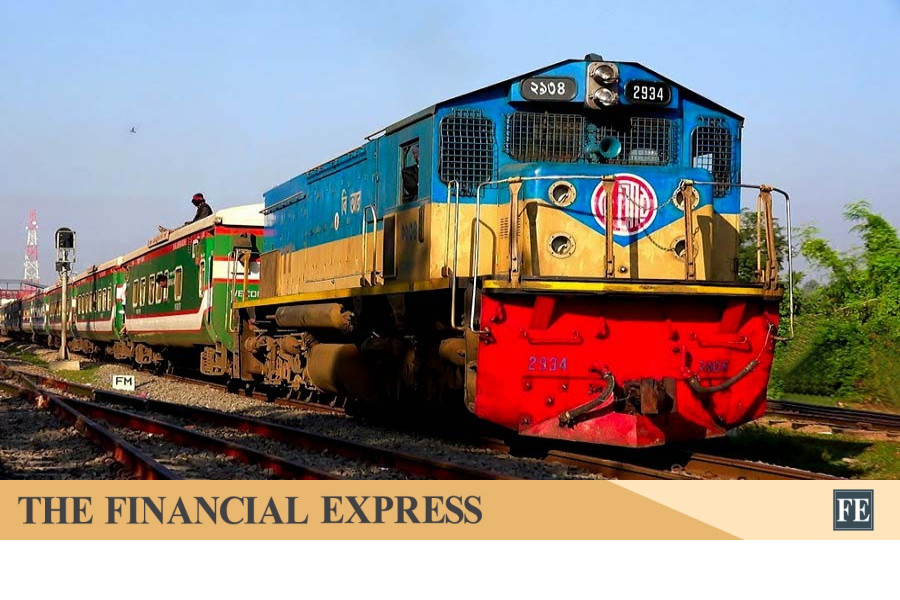
The European Investment Bank (EIB) has pledged to support Bangladesh's railway sector through financing for key infrastructure projects, rolling-stock procurement and capacity development.

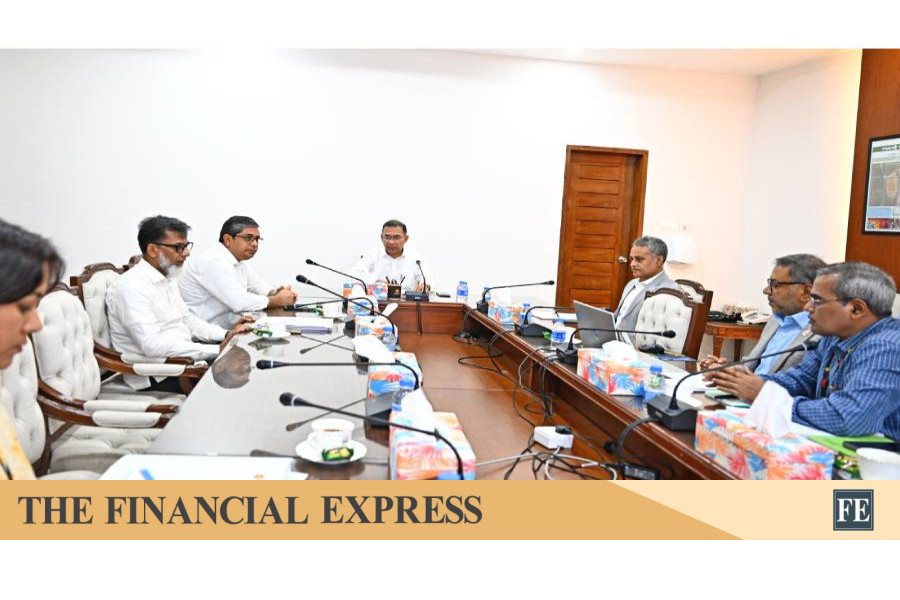
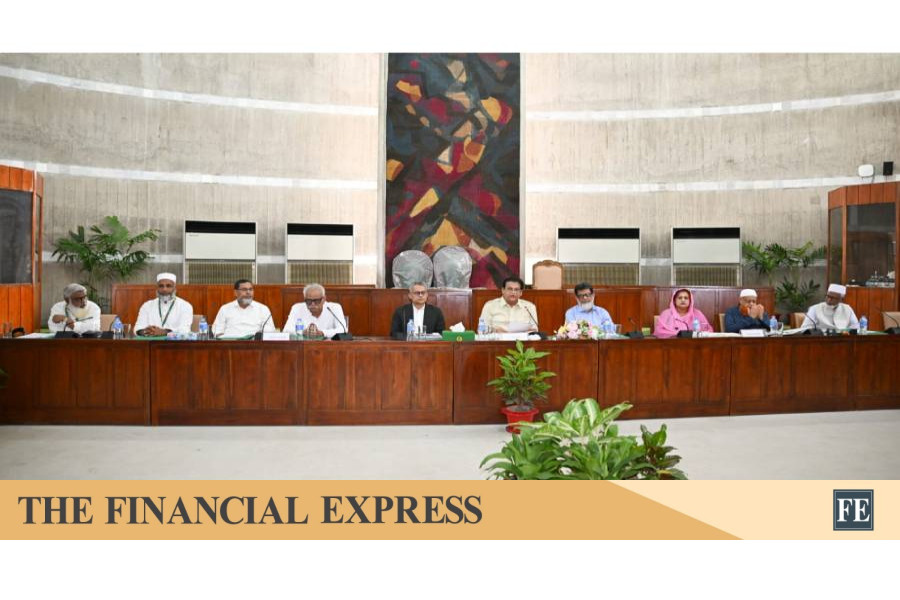
The assurance came at a bilateral meeting between the Economic Relations Division (ERD) and a delegation from the European Union (EU) and the EIB on Thursday, where the lender indicated total support amounting to €705 million, ERD officials said.

ERD Secretary Shahriar Kader Siddiky led the Bangladesh side at the meeting held at Sher-e-Bangla Nagar in the capital, while Libuše Soukupová, Head of Sector for South Asian Countries at the Directorate-General for International Partnerships (DG INTPA), led the EU side.

As part of the engagement, the EIB expressed interest in financing the Laksam-Chattogram dual-gauge double-track project and the electrification of the Joydebpur-Dhaka-Narayanganj commuter line.

Bangladesh also sought EU support for manufacturing European-standard locomotives, coaches and wagons.

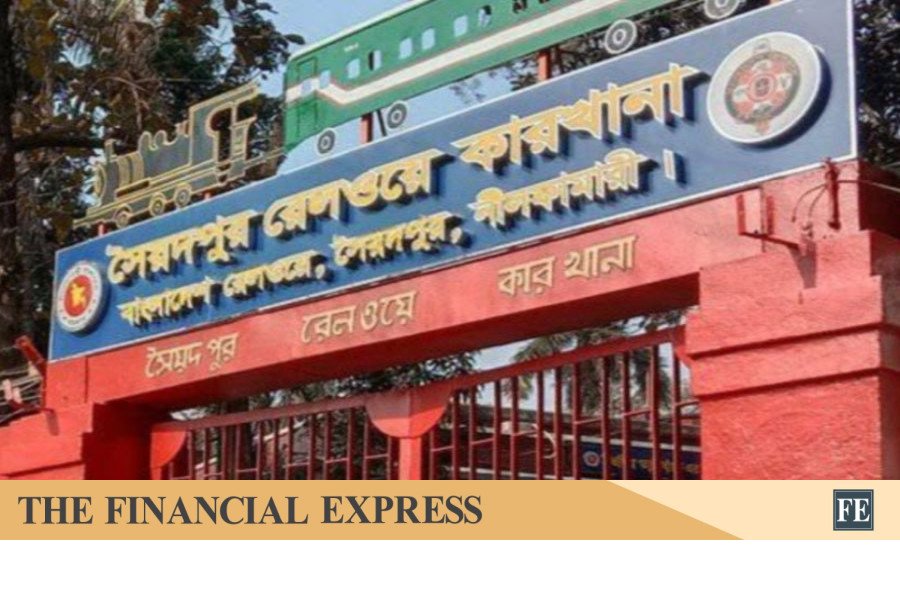
Officials said the government requested assistance to upgrade railway workshops in Saidpur, Ishwardi and Chattogram, including the supply of machinery and training to strengthen local capacity.

The EIB is expected to co-finance the Laksam-Chattogram dual-gauge project alongside the Asian Development Bank (ADB). Under the proposed arrangement, the EIB will provide €600 million in loans, while the ADB will extend $400 million in the first tranche.

Another project -- the Tongi-Bhairab Bazar-Akhaura dual-gauge double-track railway -- is also expected to receive ADB financing, according to ERD sources.

Meanwhile, the EIB has indicated €105 million in loan support for implementing the country's first electric traction railway project on the Narayanganj-Dhaka-Joydebpur corridor. Beyond railways, the EU delegation expressed interest in supporting regional power connectivity among Bangladesh, India, Bhutan, Nepal and Sri Lanka, including investments in cross-border electricity generation and transmission.

The EU also signalled willingness to provide technical assistance for banking sector reforms, alongside grant support.

The focus will be on reducing non-performing loans (NPLs), while the EU advised against recapitalising banks facing capital shortages, officials said.

On average, the EU provides development assistance to Bangladesh worth around €90-100 million annually, entirely in the form of grants. Priority areas include economic development, human rights, governance and environmental sustainability.​
 

Revolution in the railway, if...

Mohiuddin Ahmad
Published: 01 May 2026, 13: 48

1777680341558.webp


Last week, I went on a quick trip to three western districts. First Khulna, then Rajshahi, and finally Kushtia. The entire journey was by broad-gauge train. So, this seems like a good opportunity to write a bit about trains and railways.

Two Englishmen, Richard Trevithick and George Stephenson, were pioneers in the invention of the locomotive or steam engine, In 1804, Richard Trevithick built the world’s first successful steam locomotive. Later, in 1825, George Stephenson developed “Locomotion No. 1” for the world’s first public railway. Another of his famous engines was the “Rocket.”

At that time, India was the largest and most valuable colony of the British, a proverbial "milch cow". Formal railway travel there began on 16 April 1853. The first passenger train in India ran 34 kilometers from Bori Bunder in Bombay (now Mumbai) to Thane.

In what is now Bangladesh, the first railway line was introduced by the Eastern Bengal Railway Company. On 15 November 1862, a 53-kilometer line was opened from Darshana (Chuadanga) to Jagati (Kushtia). Gradually, the railway network expanded to other parts of the country.

There was a time when railway engines ran on steam produced by burning coal, huffing and puffing down the track. Those engines are no longer in use. Diesel has replaced coal.

Sometimes getting on or off train carriages can be a hazard. Many people slip and fall under the wheels, leading to serious injury or even death.

In our country, railway station platforms were not passenger-friendly. One had to climb steep metal steps holding onto the carriage handle.

Recently, there has been some change. Platforms have been raised, so now one can simply enter the carriage straight through the door, even with a wheelchair. Still, many stations remain unchanged. Even in the capital’s Kamalapur, a new platform has been built for the railway line heading toward the Padma Bridge. I fail to understand why this platform was not elevated.

Kushtia Court Station lies within the town. Its platform also remains as low as before. Children, women and the elderly find it a struggle while boarding or alighting the train. I noticed several banners at the station reading: “We demand implementation of the Kushtia Court Station platform elevation project.”

We have a reputation for building one mega project after another, often with borrowed money. The leaders under whose tenure these projects are undertaken are elevated to almost divine status. We give them all the credit. We say that development would be impossible without them. Small, low-budget improvements do not catch their attention. Or perhaps the place lacks political or commercial importance. Is Kushtia such a place? This town and its surrounding areas are associated with several figures we can take pride in, such as Lalon Shah, Kangal Harinath, Gagan Harkara, Rabindranath Tagore and Mir Mosharraf Hossain.

Rabindranath’s Kuthibari in Shilaidaha and Lalon’s shrine in Cheuriya are essentially cultural pilgrimage sites. Yet they seem to be falling into crude and clumsy hands. The structures built around them lack both planning and aesthetic sense, concrete boxes resembling warehouses. If instead there were only greenery, flower gardens, and open spaces, one might find a sense of transcendental peace there. The problem is, the minds of the authorities are always filled with brick, stone, rods, cement, and sand.

There are instances where even bamboo has been used instead of steel rods.

Beside Lalon’s shrine, an unwieldy auditorium has been constructed. Within a stone’s throw of the Kuthibari, a guesthouse has been built. In the adjacent open area, a stage has sprung up for music and speeches. None of this was necessary. One wonders what ''fertile'' mind produces such absurd ideas.

The road transport lobby in the country is very powerful and does not allow the railway system to become profitable. There are also demands to acquire vast amounts of agricultural land to build airports in various districts.

Of course, we may not have to tolerate these for long. As a certain group of zealots continues demolishing shrines one after another in the name of religious doctrine, it is uncertain how long Lalon’s shrine will survive. And Rabindranath? Who knows when he will be branded as an agent or a collaborator of tyranny, and his beloved Kuthibari reduced to rubble? Not long ago, we saw a rehearsal of such tendencies in Dhaka.

I stayed in Khulna for two nights. One evening, I went to see the Rupsa River. It is a port area, with many cargo ships anchored nearby. Along the riverbank, people sat on plastic chairs and stools, some locals, others visitors. Most come here for chotpoti and fuchka. However, the place is not tourist-friendly at all. I nearly broke my bones slipping while trying to descend from the road to the riverbank. Yet, if a simple walkway were built along the slope with some open space, it could become a wonderful evening spot.

In Rajshahi, the groyne known as “T-Bandh” along the Padma River, built by the Water Development Board, can be considered the city’s lungs. Residents flock there in the evenings for fresh air. Vendors there sell chotpoti, fuchka, and ice cream. Something similar could be done along the Rupsa.

Rajshahi is truly a beautiful city. Compared to any other district town in Bangladesh, its distinctiveness stands out. One can tell that those who managed the city had a sense of aesthetics. It is not just about spending money, taste matters.

Returning to rail travel, this was my first journey across the Padma Bridge by train. I also crossed the Hardinge Bridge for the first time. It was a remarkable experience. I keep thinking about the Hardinge Bridge. This 1,800-meter-long bridge was completed in 1915, taking six years to build. Even after more than a century, it remains intact. It can truly be called an engineering monument.

There was a time when trains ran from Kolkata to Siliguri and Assam via the Hardinge Bridge. After the Indo-Pak war of 1965, this route was closed. India then constructed the Farakka Barrage across the Padma. It is not just a dam, it is a four-in-one structure. It carries both a road and a railway line, generates hydroelectric power, and includes a system to divert water from the Padma into the Bhagirathi. This has had negative consequences for Bangladesh: we receive less water in the dry season and more during the monsoon. We often refer to the Farakka Barrage as a “death trap.”

The idea of such a structure dates back to the British era, when it was considered necessary to maintain the navigability of the Kolkata port. At that time, there was no India-Pakistan divide. The context was entirely different. After Hardinge Bridge became inaccessible to India, the construction of the barrage became immediately important for them. This is what one might call cutting off one’s nose to spite another.

Be that as it may, the Padma Bridge, Hardinge Bridge, and Jamuna Bridge have effectively turned Bangladesh into a more unified country. It was not quite so before. There were notions of East Bengal, North Bengal, and South Bengal, if not in geography, then certainly in mindset. These bridges have tied us together. Now, we can travel from one end of the country to the other in much less time.

I recently traveled from Dhaka to Khulna, Rajshahi, and Kushtia, all by train. It was the most comfortable rail journey I have experienced so far. If the entire country could be covered by broad-gauge rail, it would spark a true revolution in train travel.

However, there is a challenge: the road transport lobby in the country is very powerful and does not allow the railway system to become profitable. There are also demands to acquire vast amounts of agricultural land to build airports in various districts. Yet, if the railway system were improved, the demand for domestic flights would decrease significantly.

We inherited most of our railway network from the British. What we now need are more locomotives, more coaches, increased train frequency, and better passenger services. Investment in this sector is essential for the public good.

* Mohiuddin Ahmad is a writer and researcher​
 

Bangladesh Railway’s service woes persist
Its mismanaged system needs more than investment

View attachment 22473
VISUAL: STAR

Bangladesh Railway (BR) continues to bleed financially and fail its passengers despite years of heavy investment. According to a recent Bonik Barta report, the government currently spends over Tk 4,000 crore annually on railway operations, with much of it directed towards maintenance, cleaning, and on-board services. Yet, passengers have seen little return from this investment, as complaints about dirty trains and stations, irregular schedules, ticket black marketeering, and technical failures persist. What's more baffling is that investment in the rail sector has increased significantly over the last 10 to 15 years, yet neither its services nor its profits have improved much.

In the fiscal year 2023-24, the Ministry of Railways was allocated a total of Tk 19,010.69 crore, including both operating and development expenditure. BR's income fell to Tk 1,845 crore in FY2024-2025—down 4.15 percent from the previous year—marking its first post-pandemic negative growth. While revenues rose slightly in the first quarter of FY2025-26, losses are projected to exceed Tk 1,574 crore for the fiscal year.

Meanwhile, even at the busiest station of the country in the capital's Kamalapur, there are still not enough toilets, waiting rooms, or functioning fans. Existing facilities are unhygienic, and many passengers have little choice but to wait on crowded platforms. Similar conditions exist at regional stations. Inside trains, passengers face broken seats, unclean toilets, and overcrowded compartments, often filled with "standing" and ticketless commuters beyond official capacity. Frequent derailments and incidents of coaches detaching mid-journey indicate a serious lapse in maintenance. Such conditions contradict the official claim that the purpose of increased operating expenditure is to improve passenger service.

Experts attribute the failures to inefficiency and lack of accountability. The railways ministry's adviser further admitted that the maintenance system "is not functioning properly" and that many of the workshops lack the required technical standards. Although the ministry claims to have reduced the operating ratio from 2.4 to 1.8, the improvement has not translated into visible benefits for passengers. Furthermore, cases of wasteful procurement, including non-operational track machines and defective train models, have been reported in recent years. These incidents point to a pattern of project design driven more by bureaucratic and procurement interests than by service needs.

To address these issues, BR must move beyond ad-hoc spending and prioritise structural reforms. Regular technical audits, transparent procurement, and independent monitoring of ongoing projects are essential. Resources should be directed towards maintenance, safety upgrades, and passenger facilities rather than ill-conceived projects. Without strict accountability and long-term planning, even large budget allocations will continue to yield little improvement in railway service or its financial performance.​

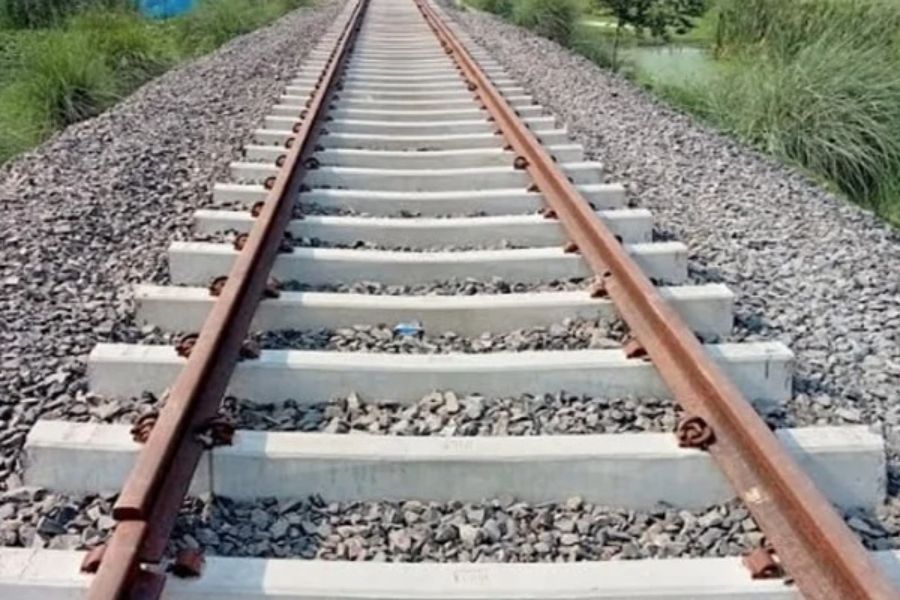
The reasons for frequent derailments in Bangladesh are because they always choose and source third rate low class low weight Indian rail trackage, 40/50 lbs at best.

The high speed bullet rain trackage used in USA (and Korea as well, as I've personally observed) is 100 lbs or 50 KGs. Yes - Koreans also source Indian made Rail Track sections for all their rail lines (even bullet train lines), but their quality acceptance standards are very strict. Indians know that they can pass on third-rate trackage product to corrupt Bangladesh Railway haramis by bribing them.

Mainline rail track sections in India for broad gauge are 52 kg and 60 kg rails. The 52 kg rail is designed for speeds up to 130 km/h, while the 60 kg rail is suitable for speeds up to 160 km/h.

In Bangladesh, they use very low weight Indian rail track, low stability ties (slippers), low quality ballast, rail fasteners and rail joints - so derailments happen on a regular basis and speeds cannot be raised beyond 70 km/h (even with powerful US made locomotives and quality Chinese or Indonesian passenger coaches/carriages).

Both India and Pakistan have higher quality mainline tracks as well as high quality passenger coaches and it helps that they don't have to contend with flooding and moisture.

Bangladesh Railway corrupt senior manager haramis who steal money from Railway funds like this should be all lined up and shot (or at least publicly named and shamed).
 
Last edited:

Revolution in the railway, if...

Mohiuddin Ahmad
Published: 01 May 2026, 13: 48

View attachment 26202

Last week, I went on a quick trip to three western districts. First Khulna, then Rajshahi, and finally Kushtia. The entire journey was by broad-gauge train. So, this seems like a good opportunity to write a bit about trains and railways.

Two Englishmen, Richard Trevithick and George Stephenson, were pioneers in the invention of the locomotive or steam engine, In 1804, Richard Trevithick built the world’s first successful steam locomotive. Later, in 1825, George Stephenson developed “Locomotion No. 1” for the world’s first public railway. Another of his famous engines was the “Rocket.”

At that time, India was the largest and most valuable colony of the British, a proverbial "milch cow". Formal railway travel there began on 16 April 1853. The first passenger train in India ran 34 kilometers from Bori Bunder in Bombay (now Mumbai) to Thane.

In what is now Bangladesh, the first railway line was introduced by the Eastern Bengal Railway Company. On 15 November 1862, a 53-kilometer line was opened from Darshana (Chuadanga) to Jagati (Kushtia). Gradually, the railway network expanded to other parts of the country.

There was a time when railway engines ran on steam produced by burning coal, huffing and puffing down the track. Those engines are no longer in use. Diesel has replaced coal.

Sometimes getting on or off train carriages can be a hazard. Many people slip and fall under the wheels, leading to serious injury or even death.

In our country, railway station platforms were not passenger-friendly. One had to climb steep metal steps holding onto the carriage handle.

Recently, there has been some change. Platforms have been raised, so now one can simply enter the carriage straight through the door, even with a wheelchair. Still, many stations remain unchanged. Even in the capital’s Kamalapur, a new platform has been built for the railway line heading toward the Padma Bridge. I fail to understand why this platform was not elevated.

Kushtia Court Station lies within the town. Its platform also remains as low as before. Children, women and the elderly find it a struggle while boarding or alighting the train. I noticed several banners at the station reading: “We demand implementation of the Kushtia Court Station platform elevation project.”

We have a reputation for building one mega project after another, often with borrowed money. The leaders under whose tenure these projects are undertaken are elevated to almost divine status. We give them all the credit. We say that development would be impossible without them. Small, low-budget improvements do not catch their attention. Or perhaps the place lacks political or commercial importance. Is Kushtia such a place? This town and its surrounding areas are associated with several figures we can take pride in, such as Lalon Shah, Kangal Harinath, Gagan Harkara, Rabindranath Tagore and Mir Mosharraf Hossain.

Rabindranath’s Kuthibari in Shilaidaha and Lalon’s shrine in Cheuriya are essentially cultural pilgrimage sites. Yet they seem to be falling into crude and clumsy hands. The structures built around them lack both planning and aesthetic sense, concrete boxes resembling warehouses. If instead there were only greenery, flower gardens, and open spaces, one might find a sense of transcendental peace there. The problem is, the minds of the authorities are always filled with brick, stone, rods, cement, and sand.

There are instances where even bamboo has been used instead of steel rods.

Beside Lalon’s shrine, an unwieldy auditorium has been constructed. Within a stone’s throw of the Kuthibari, a guesthouse has been built. In the adjacent open area, a stage has sprung up for music and speeches. None of this was necessary. One wonders what ''fertile'' mind produces such absurd ideas.

The road transport lobby in the country is very powerful and does not allow the railway system to become profitable. There are also demands to acquire vast amounts of agricultural land to build airports in various districts.

Of course, we may not have to tolerate these for long. As a certain group of zealots continues demolishing shrines one after another in the name of religious doctrine, it is uncertain how long Lalon’s shrine will survive. And Rabindranath? Who knows when he will be branded as an agent or a collaborator of tyranny, and his beloved Kuthibari reduced to rubble? Not long ago, we saw a rehearsal of such tendencies in Dhaka.

I stayed in Khulna for two nights. One evening, I went to see the Rupsa River. It is a port area, with many cargo ships anchored nearby. Along the riverbank, people sat on plastic chairs and stools, some locals, others visitors. Most come here for chotpoti and fuchka. However, the place is not tourist-friendly at all. I nearly broke my bones slipping while trying to descend from the road to the riverbank. Yet, if a simple walkway were built along the slope with some open space, it could become a wonderful evening spot.

In Rajshahi, the groyne known as “T-Bandh” along the Padma River, built by the Water Development Board, can be considered the city’s lungs. Residents flock there in the evenings for fresh air. Vendors there sell chotpoti, fuchka, and ice cream. Something similar could be done along the Rupsa.

Rajshahi is truly a beautiful city. Compared to any other district town in Bangladesh, its distinctiveness stands out. One can tell that those who managed the city had a sense of aesthetics. It is not just about spending money, taste matters.

Returning to rail travel, this was my first journey across the Padma Bridge by train. I also crossed the Hardinge Bridge for the first time. It was a remarkable experience. I keep thinking about the Hardinge Bridge. This 1,800-meter-long bridge was completed in 1915, taking six years to build. Even after more than a century, it remains intact. It can truly be called an engineering monument.

There was a time when trains ran from Kolkata to Siliguri and Assam via the Hardinge Bridge. After the Indo-Pak war of 1965, this route was closed. India then constructed the Farakka Barrage across the Padma. It is not just a dam, it is a four-in-one structure. It carries both a road and a railway line, generates hydroelectric power, and includes a system to divert water from the Padma into the Bhagirathi. This has had negative consequences for Bangladesh: we receive less water in the dry season and more during the monsoon. We often refer to the Farakka Barrage as a “death trap.”

The idea of such a structure dates back to the British era, when it was considered necessary to maintain the navigability of the Kolkata port. At that time, there was no India-Pakistan divide. The context was entirely different. After Hardinge Bridge became inaccessible to India, the construction of the barrage became immediately important for them. This is what one might call cutting off one’s nose to spite another.

Be that as it may, the Padma Bridge, Hardinge Bridge, and Jamuna Bridge have effectively turned Bangladesh into a more unified country. It was not quite so before. There were notions of East Bengal, North Bengal, and South Bengal, if not in geography, then certainly in mindset. These bridges have tied us together. Now, we can travel from one end of the country to the other in much less time.

I recently traveled from Dhaka to Khulna, Rajshahi, and Kushtia, all by train. It was the most comfortable rail journey I have experienced so far. If the entire country could be covered by broad-gauge rail, it would spark a true revolution in train travel.

However, there is a challenge: the road transport lobby in the country is very powerful and does not allow the railway system to become profitable. There are also demands to acquire vast amounts of agricultural land to build airports in various districts. Yet, if the railway system were improved, the demand for domestic flights would decrease significantly.

We inherited most of our railway network from the British. What we now need are more locomotives, more coaches, increased train frequency, and better passenger services. Investment in this sector is essential for the public good.

* Mohiuddin Ahmad is a writer and researcher​

This "researcher" needs to do a bit more "research" about railway history (even Bangladesh Railway related history) in his retirement. My apologies, his article reminds me of the American truisms "Captain Obvious" and "No $hit - Sherlock!"
 
The reasons for frequent derailments in Bangladesh are because they always choose and source third rate low class low weight Indian rail trackage, 40/50 lbs at best. The high speed bullet rain trackage used in USA (and Korea as well, as I've personally observed) is 100 lbs or 50 KGs. Yes - Koreans also source Indian made Rail Track sections, but their quality acceptance standards are very strict. Indians know that they can pass on third-rate trackage product to corrupt Bangladesh Railway haramis by bribing them.

Mainline rail track sections in India for broad gauge are 52 kg and 60 kg rails. The 52 kg rail is designed for speeds up to 130 km/h, while the 60 kg rail is suitable for speeds up to 160 km/h.

In Bangladesh, they use very low weight Indian rail track, low stability ties (slippers), low quality ballast, rail fasteners and rail joints - so derailments happen on a regular basis and speeds cannot be raised beyond 70 km/h (even with powerful US made locomotives and quality Chinese or Indonesian passenger coaches/carriages).

Both India and Pakistan have higher quality mainline tracks as well as high quality passenger coaches and it helps that they don't have to contend with flooding and moisture.

Bangladesh Railway corrupt senior manager haramis who steal money from Railway funds like this should be all lined up and shot (or at least publicly named and shamed).
Bangladesh should work with China and Indonesia to manufacture railway coaches domestically. We have factories to maintain and repair railway coaches which can be turned into railway production facilities with technological help from China and Indonesia.
 
Bangladesh also sought EU support for manufacturing European-standard locomotives, coaches and wagons.

Officials said the government requested assistance to upgrade railway workshops in Saidpur, Ishwardi and Chattogram, including the supply of machinery and training to strengthen local capacity.

Banglkadesh has to decide first whether it will model its locomotives on European-standard or US standard locomotives, coaches and wagons. They are very different in practice and usage.

US standard locomotives, coaches and wagons are simpler and far more robust in comparison. Although standard gauge is used in the USA, unlike broad gauge in Bangladesh and India, carriages and freight infra are not very different.

Both India and China have long licensed and used US-made GE and EMD locomotives, though Indian high speed carriages have been modeled after European (German) LHB technologies. LHB joint venture passenger carriage products made in India were initially built at Kapurthala Coach factory in Punjab (who supplied them to Bangladesh), but nowadays these LHB designed coaches were built at other Indian coach factories like the Integral Coach Factory in Chennai and the Modern Coach Factory at Raebareli.

If Bangladesh decides to build passenger coaches locally according to LHB or other EU designs, that will be a good step.

However - Locomotives should be license built from American/Canadian designs, which most experts say, are suited to conditions in the subcontinent and are more or less indestructible. Even China license built GE and EMD designs for locos. For the limited number needed in Bangladesh, we can try assembly from parts first.

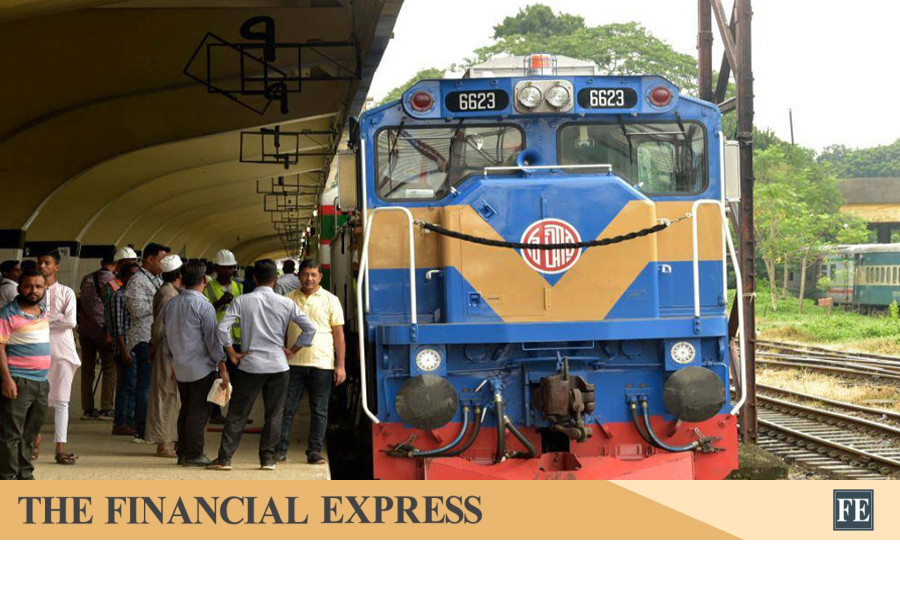
Here is an 80 year old Canadian Meter gauge GMD-Ontario-Made loco (EMD B-12) deployed in East Pakistan in 1953 or so - and still working pulling container and tanker trains between Dhaka and Chittagong port to this day. This was oldest diesel electric loco deployed in the subcontinent (yes, ahead of India as well when most of their locos were vintage steam locos).

The EMD B12 (classified by Bangladesh Railway as the Class 2000) holds a legendary status as the first diesel-electric locomotive series to operate in the region. Manufactured by General Motors Diesel (GMD) in Canada (Canadian division of EMD USA) between 1953 and 1956, a total of 40 units were delivered to the then Eastern Bengal Railway (later named East Pakistan Railway or EPR). Affectionately nicknamed "Dadu Vai" (Grandpa) by local rail enthusiasts due to their age, these meter-gauge locomotives are powered by a 12-cylinder EMD 567C engine producing approximately 1,125 hp.

1777683716350.webp

.
 

Bangladesh Railway eastern zone
Rail revenue up Tk 1.5b; questions over service quality remain

Sujan Ghose
Chattogram
Published: 05 May 2026, 08: 13

1777947646699.webp


Bangladesh Railway File photo.


In the first nine months of the current fiscal year, Bangladesh Railway’s Eastern Zone has earned Tk 1.50 billion more than the previous year. Most of this income has come from passenger transport. However, revenue from freight transport has declined again this year.

Until March of the current fiscal year, the Eastern Zone earned about Tk 9.10 billion, which is higher than the target. In the same period last fiscal year, earnings were over Tk 7.59 billion.

The railway earns revenue from a total of eight sectors, but the main sources are passenger and freight transport. This time, 86.5 per cent of total revenue came from passenger transport. Income from freight and parcel transport stood at Tk 717.7 million, which is only 7.9 per cent of total earnings.

Although passenger transport revenue has increased due to various charges and withdrawal of previous benefits, there have been no effective measures to improve passenger service quality. Issues such as trains not running on schedule, failing to reach destinations on time, engine failures en route, derailments, suffering despite having tickets but not getting seats, and stone-throwing incidents on popular routes continue.

Freight transport has failed to meet targets this year, and revenue has declined compared to last year. Due to an engine shortage, the organisation is struggling to run freight trains. In contrast, neighbouring India and many other countries emphasise freight transport.

The Eastern Zone of the railway includes Dhaka, Chattogram, Sylhet, and Mymensingh divisions. While there is a large gap between passenger and freight revenue in this zone, the situation in South Asian countries like India and Pakistan is different.

In the last fiscal year (2024–25), Indian Railways earned over 2.65 trillion rupees. Of this, over 1.71 trillion rupees came from freight transport, while passenger revenue was 753.67 billion rupees—meaning freight earnings were 2.3 times higher than passenger earnings.

Once, the railway offered distance-based concessions to attract passengers. According to railway data, passengers received a 20 per cent discount for travel between 101–250 km, 25 per cent for 251–400 km, and 30 per cent for distances over 401 km. However, these were withdrawn in April 2024.

In the same fiscal year, Pakistan Railways earned 83 billion rupees, including 42 billion from passenger services and 29 billion from freight, with the rest coming from other sectors.

Passenger revenue rises due to added charges

Analysis of railway data shows that passenger transport is now the main source of income. Revenue from passenger transport reached Tk 7.87 billion, compared to over Tk 6.23 billion in the previous year. That means an increase of about Tk 1.64 billon, or 26 per cent, within one year.

In the first nine months of the current fiscal year (July to March), about 37 million people travelled by train in Dhaka and Chattogram divisions. The target was about 28 million passengers. That means nine million more passengers travelled than the target.

Railway officials say the increase in passenger numbers is due to traffic congestion on roads, risk of accidents, higher fares, time savings, and avoidance of various hassles. New routes, including Cox’s Bazar, have been introduced. Interest in train travel has increased significantly as people seek safer and more comfortable journeys.

However, as interest in trains has grown, the railway has imposed various charges and withdrawn earlier benefits. Previously, there was no VAT on first-class non-AC coaches, but a 15 per cent VAT was imposed in 2022.

Once, the railway offered distance-based concessions to attract passengers. According to railway data, passengers received a 20 per cent discount for travel between 101–250 km, 25 per cent for 251–400 km, and 30 per cent for distances over 401 km. However, these were withdrawn in April 2024.

To increase passenger revenue, additional coaches have been added to intercity trains, and upon application, reserved AC tickets carry an extra 30 per cent charge and non-AC tickets 20 per cent above normal fare.

Most recently, in December last year, the railway introduced a pontage charge for bridges longer than 100 meters, increasing fares by Tk 5 to Tk 226 depending on train and seat.

In the first eight months of the 2024–25 fiscal year, some 1,838 freight trains operated. In the same period of the current fiscal year, only 985 trains ran—nearly half. The target was to transport 199,715 wagons, but only 49,476 wagons were carried, about one-fourth of the target.

According to the railway, a pontage charge is an additional fee applied when a bridge or similar infrastructure is included in the route. In such cases, a 100-meter bridge is counted as 2.5 kilometers in distance, effectively increasing the calculated travel distance.

Mahbubur Rahman, Chief Commercial Manager of the Eastern Zone, told Prothom Alo that various measures have been taken to increase revenue. For example, long-distance seats on intercity trains often remained empty, while mid-distance passengers were discouraged by higher fares. The quota system for tickets was revised to allocate more seats to stations with higher demand, increasing both passenger numbers and revenue.

Freight revenue declining; investment not yielding results

Despite overall revenue growth, the situation in freight transport remains disappointing. The railway has failed to take effective measures in this sector, and revenue has not increased. For 11 fiscal years, income in this sector has been declining. Although there was a slight increase in between, it could not be sustained. In the 2015–16 fiscal year, freight revenue was Tk 731 million. From 2021–22 to 2023–24, it crossed Tk 1 billion annually. However, in the last fiscal year, it dropped to Tk 775 million.

This year, revenue from this sector is lower than last year. While it was Tk 723 million last year, it has fallen to Tk 651 million this year, against a target of Tk 2.27 billion. Additionally, parcel sector income was Tk 57 million, against a target of Tk 188 million.

During the 15 years of the Awami League government, which was ousted following the mass uprising of students and the public, more than Tk 1 trillion was invested in railway development. However, most of the spending went into building new rail lines, without corresponding investment in new engines. As a result, while rail lines increased, the number of operating trains declined—especially freight trains.

In the first eight months of the 2024–25 fiscal year, some 1,838 freight trains operated. In the same period of the current fiscal year, only 985 trains ran—nearly half. The target was to transport 199,715 wagons, but only 49,476 wagons were carried, about one-fourth of the target.

The main reason is a shortage of engines. While 13 engines are needed daily to maintain normal freight operations, only three to four are available, and sometimes even fewer. Due to disrupted train operations, businesses are losing interest in using rail for freight transport.

Experts and railway officials say that despite massive investment, the railway has effectively ‘derailed’ due to poor planning, corruption, inefficiency, and waste. A major example is the purchase of luggage vans. In 2023, as many as 125 luggage vans were bought for Tk 3.58 billion with the aim of making rail profitable through freight transport. However, instead of generating profit, they have become a burden.

Railway documents show that 125 new luggage vans were added in September 2023. Previously, there were 50 old vans, of which only 18 were operational.

Before adding the new vans, revenue from parcel transport in the first three months (July–September) of the 2023–24 fiscal year was Tk 22 million. Even after adding the vans, revenue did not increase significantly. In the first nine months of the current fiscal year, parcel revenue was only Tk 67 million. Although the vans were expected to transport 882 quintals of goods, they carried only 286 quintals.

Professor Md Shamsul Hoque, a transport expert at Bangladesh University of Engineering and Technology (BUET), told Prothom Alo that despite heavy investment, neither service quality nor passenger capacity has improved significantly. This indicates that investments were not well planned.

According to him, many purchases were made in ways that benefited suppliers, with luggage vans being a prime example. These were bought without proper assessment of utility and ultimately failed to deliver results.​
 

Six more trains set to go private

BR says move will improve revenue; activists criticise outsourcing

Sifayet Ullah

1780186245744.webp


​
  • Move will take number of privately managed trains in the zone to 14​
  • Private firms will handle onboard services, ticket checks, cleaning, passenger management​
  • Officials cite manpower shortages, ticketless travel as key reasons for outsourcing​

Bangladesh Railway has approved handing over six more trains to private operators in its Eastern Zone, aiming to increase revenue and improve services by expanding private involvement in passenger train operations.

The trains are Jharia Local, Joydebpur Commuter, Narsingdi Commuter, Noakhali Express, Samatat Express, and Nazirhat Local. They operate on routes covering Dhaka, Chattogram, Mymensingh, and Noakhali.

With the latest move, 14 trains will be privately managed under BR’s Eastern Zone.

Officials said BR has increasingly relied on outsourcing in recent years amid persistent manpower shortages and rising operational losses. They said privately operated trains have generated relatively stable revenue.

Under the arrangement, private firms oversee onboard services, ticket verification, cleaning, and passenger management, while core train operations remain under BR’s control, said Mohammed Mahbubur Rahman, chief commercial manager of BR’s Eastern Zone.

He said monthly earnings from privately run trains increased by 15-25 percent compared with previous railway-run operations.

For example, before being handed over to private management, the Mohua Commuter generated Tk 68.55 lakh in revenue in the 2014-15 fiscal year. In FY 2024-25, the same train earned Tk 2.78 crore, according to BR’s Eastern Zone commercial department.

The same has been the case for all other seven trains previously handed over to private operators, officials said.

An official of the department, wishing anonymity, said passengers often travel without tickets as proper checking is not always possible because of BR’s manpower shortage.

“Private operators, however, strictly ensure fare collection as their revenue depends on it,” he said.

BR data from 2025 show that only 11,522 posts are filled against 22,358 approved posts in the Eastern Zone. The shortage is particularly acute in operational support services, maintenance, and field-level management.

However, passenger rights activists criticised the move.

BR is following a dual policy by investing public funds to improve services while simultaneously handing over trains for private operations, said Md Mozammel Hoque Chowdhury, secretary general of the Bangladesh Jatri Kalyan Samity.

He questioned how private operators were able to generate profits from the same services if BR itself could not.

If private operators can run train operations profitably with existing passengers and fares, why can’t BR do the same? This indicates corruption and a lack of transparency within the railway, he said.

Instead of expanding private operations, the government should take action against syndicates and irregularities within the railway system, Mozammel added.

Contacted, Md Subakhtgeen, general manager of BR’s Eastern Zone, said all outsourced services would continue under railway supervision and ticket prices would remain fixed by the government.

Therefore, even under private operation, passengers have no reason to be concerned about fares or service conditions, he added.​
 
Bangladesh Architectural firm VOLUMEZERO Limited (Architect Mohammad Foyez Ullah, Dhaka, Bangladesh) designed the new Iconic Railway Station at Cox’s Bazar, Bangladesh


Railway burdened by longstanding neglect

THE derailment of the power car of a passenger train on the Dhaka–Jamalpur route in Mymensingh on June 10, followed by the derailment of a relief train sent for recovery on the same track, exposes a disturbing level of vulnerability in railway infrastructure. The fact that both incidents occurred within hours on the same section, disrupting train communications for around three hours, underscores not merely an operational failure but a deep structural weakness. In April, train communication between Sylhet and the rest of the country was suspended after a train carrying fuel derailed at the Mantala station of Madhabpur in Habiganj. In March, at least 66 passengers were injured in the derailment of the Nilsagar Express at Bagbaria in Bogura. While authorities have suggested that the investigation will determine the cause of the recent derailment, the recurrence of such incidents on ageing tracks draws attention to the condition of the railway network. Passengers are, thus, left to travel on sections officially acknowledged as vulnerable, awaiting long-promised repairs that have yet to materialise.

The railway sector is burdened with longstanding neglect and systemic underinvestment. Official acknowledgements have pointed to old sleepers, deteriorating tracks and the need for urgent rehabilitation across key routes, including the Dhaka–Tangail corridor, which branches into the affected Dhaka–Jamalpur line and is reportedly in a poor condition. Despite multiple rehabilitation projects now being under way, the pace of renewal remains slow relative to the rate of deterioration. A 2019 study jointly presented by Paribesh Banchao Andolan and the Work for Better Bangladesh Trust found that nearly 75 per cent of derailments were linked to poor track condition, with a similar proportion of lines falling below acceptable standards because of insufficient maintenance, inadequate machinery, staff shortage and a lack of proper ballast stones. The findings highlight a pattern of institutional neglect rather than isolated technical faults. Compounding the problem is the absence of a comprehensive, updated assessment of vulnerable points across the network. Without a clear mapping of risk-prone sections, maintenance becomes reactive rather than preventive, responding to accidents rather than anticipating them.

The repeated derailments should serve as a wake-up call for the government to prioritise railway modernisation as a core infrastructure agenda. It should, therefore, take steps for an urgent nationwide safety audit to identify and publicly document all high-risk railway segments. The rehabilitation should shift from piecemeal repairs to comprehensive track renewal, supported by modern equipment and adequate funding. The Bangladesh Railway should invest in predictive maintenance systems, including digital monitoring of track conditions, to reduce dependence on crisis-driven repairs. Equally important is to strengthen institutional capacity through skilled human resources, transparent procurement and accountability mechanisms that ensure the timely execution of projects.​
 

Govt plans modern, time-efficient nationwide rail network

UNB

Published :
Jun 16, 2026 22:02
Updated :
Jun 16, 2026 22:02

1781669413857.webp


The government has decided to develop a seamless and time-efficient rail communication network across the country, aiming to modernise Bangladesh’s railway system.

The decision was taken at a meeting on the future planning of Bangladesh Railway held on Tuesday morning at the Cabinet Division’s Public Administration Room at the Secretariat, chaired by Prime Minister Tarique Rahman.

Briefing reporters, Prime Minister’s Deputy Press Secretary Hasan Shiplu said the meeting discussed both medium- and long-term development plans for the railway sector.

“Detailed discussions were held on the modernisation of Bangladesh Railway, including phased conversion of metre-gauge lines from Panchagarh to Cox’s Bazar into broad-gauge lines and upgrading the signalling system,” he said.

Shiplu also said issues related to financing of these plans were discussed at the meeting, with the Prime Minister giving necessary directives.

Railways Minister Shaikh Rabiul Alam, State Minister Habibur Rashid, State Minister for Local Government, Rural Development and Co-operatives Mir Shahe Alam, Prime Minister’s Adviser Rashed Al Mahmud Titumir, Principal Secretary ABM Abdus Sattar, Railways Secretary Md Fahimul Islam, and Director General of Bangladesh Railway Afzal Hossain, among others, were present.​
 

Cord line project in budget
Dhaka to Chattogram by train in three and a half hour

Sujan Ghose
Chattogram
Published: 18 Jun 2026, 14: 10

1781827217412.webp

Chattogram station File photo

Although the distance between Dhaka and Chattogram is currently 248 kilometres by road, the railway route extends to 320 kilometres. At present, trains take between five and six hours to travel from Dhaka to Chattogram.

To shorten this lengthy journey, the long-discussed Dhaka–Cumilla Cord Line, or direct railway connection project, has once again come to the forefront.

Finance Minister Amir Khasru Mahmud Chowdhury announced the project in the proposed national budget for fiscal year 2026-27.

According to Bangladesh Railway officials, implementing the project would reduce the Dhaka–Chattogram rail route by nearly 80 kilometres and reduce travel time to approximately three and a half hours.

The officials emphasised that this is not merely a passenger transport project.

They believe it could also become a crucial piece of infrastructure for future freight transportation associated with Chattogram Port, the planned Bay Terminal, and the Matarbari Deep-Sea Port.

Cord line returns to the budget agenda

During his budget speech in the Jatiya Sangsad (National Parliament), the finance minister stated that Bangladesh Railway had already completed the feasibility study for constructing a cord line on the Dhaka–Cumilla section of the Dhaka–Chattogram railway corridor.

Among three proposed alignments, planners have provisionally selected a route extending from Shyampur in Narayanganj to Cumilla.

The budget speech further stated that freight trains carrying goods from Chattogram Port, the Bay Terminal, and the Matarbari Deep-Sea Port would be able to use the existing Chattogram–Feni–Cumilla–Brahmanbaria–Bhairab–Narsingdi railway line to connect directly with the proposed Dhirashram Inland Container Depot (ICD).

We have completed the feasibility study. Among the three alternative alignments, we have provisionally selected a route from Shyampur in Narayanganj to Lalmai in Cumilla. This route will reduce the distance between Dhaka and Chattogram by 80 to 90 kilometres and save approximately two hours of travel time-------Md Afzal Hossain , Bangladesh Railway Director General.

This connection would strengthen both the national economy and the country's logistics sector.

The Bangladesh Nationalist Party (BNP), in its election manifesto, pledged to revitalise the railway system as the central backbone of the national transport network. The budget speech reflected that commitment.

However, the budget did not specify any separate allocation for the project, its estimated cost, or a timeline for implementation.

Railway officials said they are currently preparing the detailed design for the project. They aim to finalise the Development Project Proposal (DPP) by June next year.

Why cord line is necessary

At present, trains travelling between Dhaka and Chattogram operate via Cumilla, Brahmanbaria, Bhairab, and Narsingdi. As a result, the railway route is considerably longer than the road route.

According to Bangladesh Railway, passenger trains require between five and six hours to travel from Dhaka to Chattogram.

In practice, various operational factors often increase the journey time further. Meanwhile, following the opening of the four-lane highway, road travel in many cases now takes less time than rail travel.

Railway officials said they are currently preparing the detailed design for the project. They aim to finalise the Development Project Proposal (DPP) by June next year.

The proposed cord line would bypass the lengthy Akhaura–Bhairab detour and establish a direct railway connection through Dhaka–Narayanganj–Cumilla.

This would reduce both travel time and transportation costs for passengers and freight services alike.

According to information published by Bangladesh Railway and various media outlets, the concept of the Dhaka–Chattogram Cord Line is not new.

Discussions first began in 1968. Although successive governments revived the proposal at different times, none advanced it to the implementation stage.

Speaking about this, Bangladesh Railway Director General Md Afzal Hossain told Prothom Alo, “We have completed the feasibility study. Among the three alternative alignments, we have provisionally selected a route from Shyampur in Narayanganj to Lalmai in Cumilla. This route will reduce the distance between Dhaka and Chattogram by 80 to 90 kilometres and save approximately two hours of travel time.”

Railway officials emphasise that this is not merely a passenger transport project. They believe it could also become a crucial piece of infrastructure for future freight transportation associated with Chattogram Port, the planned Bay Terminal, and the Matarbari Deep-Sea Port.

Md Afzal Hossain added, “We will also move forward gradually with the necessary preparatory work, including land acquisition, to implement the project.”

Significant potential for freight transportation

The Dhaka–Chattogram corridor is the country's most important economic corridor. Chattogram hosts Bangladesh’s principal seaport.

The planned Bay Terminal and the Matarbari Deep-Sea Port will further expand the region’s strategic importance. Once these facilities become fully operational, demand for freight transportation will increase substantially.

Business leaders in Chattogram have long argued that, despite hosting the country’s principal seaport, the city still lacks a fast and reliable railway connection with the capital.

Consequently, freight transportation remains heavily dependent on road networks.

At present, freight trains require between 12 and 15 hours to travel between Dhaka and Chattogram. In some cases, shortages of locomotives and train services force businesses to wait even longer.

According to Bangladesh Railway data, the freight transportation sector has not achieved its expected level of growth.

In the previous financial year, Bangladesh Railway generated Tk 723.1 million in revenue from freight operations.

In the current financial year, revenue has declined to Tk 650.9 million, despite a target exceeding Tk 2.27 billion.

During the first eight months of the 2024–25 financial year, 1,838 freight trains operated on the network. During the same period of the current financial year, only 985 freight trains operated.

In other words, the number of freight trains has fallen by almost half within a year. During the same period, Bangladesh Railway had set a target of transporting 199,715 wagons but transported only 49,476 wagons.

Railway officials identify locomotive shortages as the principal cause of this decline. Although operations require an average of 13 locomotives each day, only three to four are available.

As a result, freight train services face continual disruption, and businesses are losing confidence in rail transport.

According to railway officials, the introduction of the cord line would allow operators to run more trains within the same timeframe. This would increase capacity for both passenger and freight transportation.

Business community expectations

Business leaders in Chattogram have advocated the construction of the cord line for many years.

Amirul Haque, president of the Chattogram Chamber, told Prothom Alo, “The implementation of the Dhaka–Chattogram Cord Line will bring a transformative change to both passenger and freight transportation. As economic activities continue to expand around Chattogram Port, the Bay Terminal, and the Matarbari Deep-Sea Port, the country also requires railway connectivity that matches this growth.”

“The announcement of the project in the budget has made us optimistic. However, to address the logistics challenges of the future, there is no alternative to a 10-lane expressway,” he added.​
 

Investment in BR deserves better scrutiny

Published :
Jun 24, 2026 23:58
Updated :
Jun 24, 2026 23:58

1782343683129.webp


Almost a decade ago, Bangladesh Railway launched a 30-year master plan to expand rail coverage to all 64 districts of the country and modernise its services. The master plan included a total of 230 projects scheduled to be implemented by 2045 in six phases at a cost of Taka 5.53 trillion. As one-third of the plan period is ending this year, it is imperative to assess the progress made so far. The railway ministry, apparently, is not interested in making such an assessment. Rather, it is venturing into yet another expansion drive. It has decided to implement 13 projects worth Tk 839.90 billion over next 15 years. A report published in this paper Tuesday last noted that funding support from development partners for execution of the projects has been largely confirmed.

It is not known whether these projects are among the master plan projects. But the FE report has indicated that most of these projects are in the master plan and those have now been prioritised for implementation, If so, it is a positive move on the part of the BR because it suggests continuity with the initiatives taken earlier for the greater good of the country's railway system. However, some projects now prioritised require extensive review before any implementation decisions, particularly those that could severely affect densely populated areas and neighbouring ecosystems.

There is no denying that railway is a secure, economical, and environment-friendly mode of transport and, as such, it needs expansion. An efficient railway can transfer, transit and mobilise millions of commuters without much trouble, which is not possible by road transports. Unfortunately, five and a half decades after its independence, Bangladesh is yet to optimise its railway services. At present, it covers only about 3,500 route kilometres across the country, whereas the road network is about 23,000 km long. As a result, 73 per cent of passengers and 82 per cent of cargoes are transported using road transports, although demand for railway remains high. By over-focusing on the road network, successive governments have pushed back the required extension of the rail network. Instead, a number of rail projects have been taken up to feed a section of rent-seekers having political backing. The addition of 20 Diesel Electric Multiple Unit (DEMU) trains to the railway fleet in 2013, at a cost of Tk 6.86 billion, is an example. Though the claimed lifespan is 20 years, most of the trains have become inoperative, and the rest will be abandoned shortly. No question has been asked about the wastage of taxpayers' money. Unfortunately, there have been no coordinated efforts to establish a well-designed, well-integrated rail-road-river transportation system. More than 90 per cent of passenger train services have been incurring losses for decades, clearly showing their operational inefficiency. Again, a large part of the existing rail tracks is in a dilapidated condition, resulting in slower train speeds and occasional derailment.

To move forward, the key priority should be to modernise and introduce dual rail tracks across the network. Concurrently, setting up more railway workshops is essential. The truth is, the BR is still far away from introducing a modern and efficient railway service though billions of taka has been spent on its improvement. The government policymakers, seemingly, are also not serious about ensuring a better railway service when a number of far and near countries are operating fast and ultra-modern trains.​
 

Govt should change obsolete railway law to better services

THE state of the Bangladesh Railway’s legal framework is concerning. A New Age report says that efforts by successive governments to amends the 136-year-old British-era railway law with a view to improving passenger services, safety and preventing fraud have remained stalled for seven years without any tangible progress. Railways ministry officials say that the Railway Act 1890 needs to be revised to reflect technological advancement, incorporate provisions against digital fraud and update fines for various offences, many of which have become outdated and ineffective. They also say that the proposed reform would provide for harsher punishments for offences, improve passenger services and address allegations of underhand ticket sales by dishonest railway employees despite the introduction of online ticketing. The government has initiated a fresh review of the draft amendment to the law prepared during the previous administration after deciding that the earlier draft was inadequate. Officials, however, have indicated that the process of finalising the legislation will require further reviews and consultations and could still take several years. The proposed law with 157 sections is expected to replace the existing law and incorporate modern provisions aimed at better protection of passengers and railway property.

The prolonged failure to update the law has implications that extend far beyond an outdated statute. A legal framework that does not keep pace with technological and operational changes weakens the state’s ability to prevent emerging forms of fraud, hold offenders accountable and protect passenger rights. The introduction of online ticketing was expected to improve transparency. Yet, studies find that mismanagement, corruption and procedural weaknesses continue to undermine service quality and public confidence, indicating that technological innovation alone cannot overcome institutional shortcomings. The reported resistance of vested interests to stronger penalties further suggests that the reform process is constrained by institutional interests rather than guided by passenger welfare. Such resistance should reinforce, rather than weaken, the government’s resolve to enact meaningful reforms. The Anti-Corruption Commission earlier identified corruption in at least 10 areas of the Bangladesh Railway, including ticket sales, procurement, recruitment and land management, and recommended measures to improve accountability. The proposed legislation should, therefore, be accompanied by transparent implementation rules, digital audit mechanisms, regular independent oversight and defined accountability for officials responsible for enforcing the law. The new law is, otherwise, unlikely to deliver the institutional transformation necessary to improve governance, curb corruption and restore public confidence.

The government should, therefore, expedite the amendment process and ensure that the new law is accompanied by robust enforcement mechanisms, independent oversight and institutional accountability instead of allowing it to remain another delayed legal exercise. Legal reform will have little practical value if the institutions entrusted with implementing it continue to operate under the same culture of impunity that has impeded efficient railway services.​
 

Fast-tracking railway's latest master plan

1787354097109.webp


The Bangladesh Railway (BR), one of the oldest public transport systems in the country, has remained for far too long a neglected sector despite the railway emerging globally as the most modern, efficient and rapidly developing mode of land-based mass transport. Against this backdrop, the report that the BR has drafted its third master plan, envisaging an investment of around Tk2.9 trillion by 2060, is no doubt a development worth noting. The draft, prepared reportedly with BR's own resources, proposes 118 civil projects focusing on demand-based track development, electrification, unification of the mixed-gauge network and expansion of railway services to 10 more districts. Priority schemes include the Bogura-Sirajganj, Joydebpur-Ishwardi, Akhaura-Sylhet and Tongi-Bhairab dual-gauge double lines. What is more, the plan is expected to integrate track development with procurement of coaches and locomotives, maintenance facilities, workshops and manpower development. This is important because railway development cannot simply mean laying new tracks while trains, skilled hands and maintenance facilities remain in short supply.

Indeed, Bangladesh's experience with railway planning has not always been an enviable one. The first master plan, approved in 2013, envisaged 235 projects, while its revised version, approved in 2019, proposed 215 projects to be completed by 2045. Some important schemes including the Padma Bridge rail link and the Dohazari-Cox's Bazar line have since been completed, yet many projects under the existing plan are unlikely to be implemented within its stipulated period. Meanwhile, the country now has around 3,400 kilometres of rail network, but shortages of locomotives, coaches and operational facilities have often prevented the infrastructure already built from being utilised fully. More significantly, railway's share in freight movement remains below 5.0 per cent, though the government's transport strategy reportedly aims to raise it to at least 20 per cent. Small wonder that expansion of tracks alone has failed to transform the BR into a dependable passenger and freight carrier a densely-populated and fast-urbanizing economy needs. The third master plan should, therefore, learn from the mismatch between physical expansion and actual service delivery.

At this point, however, the government needs to distinguish between what can be delivered now and what necessarily belongs to the longer horizon. Projects capable of improving the quality, frequency and reliability of train services within the tenure of the incumbent government should be identified and put on the fast track. Issues like double-tracking congested corridors, completing missing links, modernising signalling, procuring adequate locomotives and carriages, introducing electric traction on suitable busy routes and so on are hardly ambitions that should remain on paper for decades. In particular, the proposed electrification of the Narayanganj-Dhaka-Joydebpur corridor and its extension towards Chattogram deserves serious attention. The point is that people should be able to experience visible improvement in railway service during the present government's term. Otherwise, another long list of projects extending to 2060 may end up becoming yet another catalogue of aspirations whose deadlines are repeatedly shifted and costs revised.

Long-term planning should not be confined to catching up with what other countries have achieved. Notably, high-speed rail is expanding rapidly, with over 56,000 kilometres in operation globally, and Bangladesh cannot indefinitely remain outside that transition. In fact, there is history of earlier moves to explore a high-speed railway between Dhaka and Chattogram. Even if today's fiscal realities do not permit immediate construction of such an expensive system, the third master plan should reserve corridors, undertake feasibility studies, protect land and create infrastructure standards compatible with high-speed trains. For a small, densely populated country where major economic centres are separated by manageable distances, faster rail can change the geography of travel, business and regional development. But visions for 2060 will have value only if today's basic railway is first made efficient, safe and reliable. So, the government would do well to act fast on achievable railway modernisation projects while laying the infrastructural groundwork for the high-speed railway in the future.​
 

US Ambassador highlights American engineering in Bangladesh’s railway connectivity

Staff Correspondent
Published: 01 Sep 2026, 20: 30

1788306978772.webp

US Embassy in Dhaka

US Ambassador Brent T Christensen visited Bangladesh Railway’s Central Locomotive Workshop in Parbatipur, where Bangladeshi technicians maintain American-made locomotives supporting passenger and freight transportation across the country.

The US Embassy in Dhaka said this in a press release sent to the media by US Mission spokesperson Poornima Rai on Tuesday.

1788307008930.webp

US Embassy in Dhaka

Ambassador Christensen toured the workshop, viewed a locomotive manufactured by US company Progress Rail, and met the Bangladeshi railway professionals who maintain the locomotives.

He then traveled by train to Saidpur, spoke with passengers, and visited the historic Saidpur Railway Workshop and Museum.

1788307041006.webp

US Embassy in Dhaka

Bangladesh Railway’s purchase of 40 Progress Rail locomotives demonstrates how US exports and technology can support Bangladesh’s infrastructure and development priorities.

The visit highlighted the practical and enduring value of expanded trade and commercial cooperation between the United States and Bangladesh.​
 

Bangladesh Railway plans first electric train project worth Tk 38.23b

Project likely to be placed before the ECNEC today


1789533602353.webp


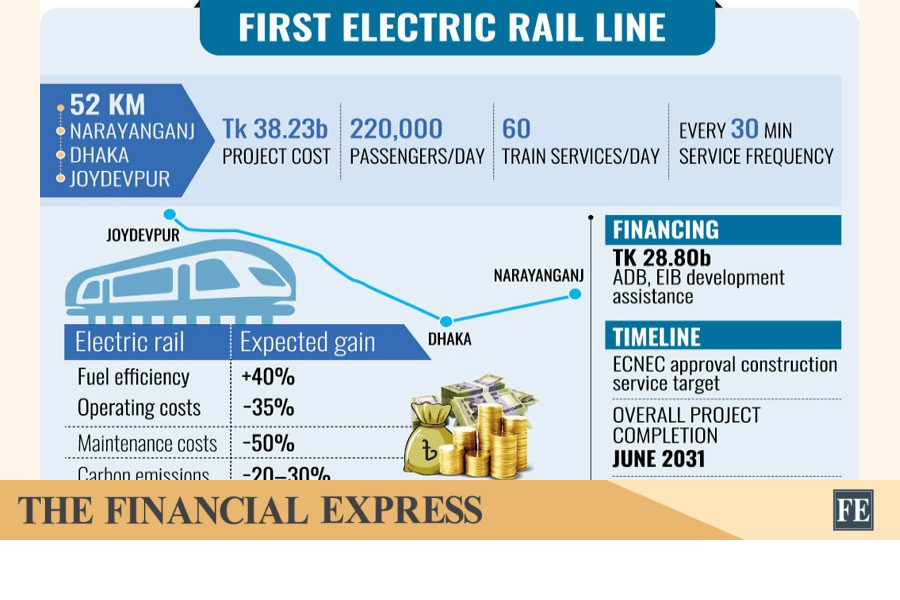
Bangladesh Railway is set to take its first major step towards electrifying the country's rail network with a Tk38.23-billion project to build an electric train line connecting Narayanganj, Dhaka and Joydevpur.

Upon its completion, the project aims to run 60 daily services every 30 minutes and carry around 220,000 passengers a day on the 52-kilometre route, BR officials said.

Each of the trains will carry up to 3,600 passengers, with five-car EMUs (Electric Multiple Units) plying the route, they said.

Two sets of EMUs will operate every 30 minutes from 6:00am to midnight, the BR said.

The project is likely to be placed before the ECNEC (Executive Committee of the National Economic Council) today (Wednesday) for approval.

"It will be our first initiative to build an electric train line in Bangladesh. If the ECNEC approves the project, we will go ahead with constructing the railway line," said a senior official at the Ministry of Railways (MoR).

He said the train would be a commuter service carrying thousands of passengers daily between Narayanganj, Dhaka and Joydevpur.

Dhaka is one of the busiest cities in the world and suffers from massive traffic gridlock. The proposed electric train will operate at a higher speed than conventional trains.

According to the BR, a workshop for electric trains and EMUs will be constructed somewhere between Joydevpur and Mouchak in Gazipur.

According to the BR project proposal, the Asian Development Bank (ADB) and the European Investment Bank (EIB) will provide Tk28.80 billion in development assistance.

The project is scheduled to be implemented by June 2031, BR officials said.

Electric trains offer 40 per cent greater fuel efficiency and are expected to reduce operating costs by 35 per cent and maintenance costs by up to 50 per cent compared with current levels. Additionally, carbon emissions are expected to decrease by 20 to 30 per cent.

Initially, the service will operate across three districts, with plans also in place to introduce electric trains on the Dhaka-Chittagong route.

The Development Project Proposal (DPP) states that electric trains will bring significant changes to the economy and transport sector.

Electric trains can accelerate and decelerate much faster than diesel engines, allowing them to reach top speeds quickly after departing from stations.

Consequently, travel time on the Narayanganj-Dhaka-Joydevpur route is expected to be cut by more than half.

Bangladesh Railway currently uses diesel-electric traction. Official documents say the proposed electric system will be roughly 40 per cent more fuel-efficient and allow significantly higher operating speeds.

Indian Railways has electrified 99.6 per cent of its broad-gauge network, completing one of the world's largest infrastructure transformation programmes in a decade.

Switzerland is the first country to have 100 per cent electric train lines across the country.​
 

Three more trains to be handed over to private management to increase revenue

Sujan Ghose
Chattogram

1790381496020.webp

Bangladesh Railway File photo.

Railway Eastern Zone has taken an initiative to hand over the commercial operations of three more trains to private management to increase revenue. The trains are the Jaria Local on the Mymensingh–Jaria Jhajhaingail route, Narayanganj Commuter on the Dhaka–Narayanganj route and Narsingdi Commuter on the Dhaka–Narsingdi route.

At present, eight trains in the Eastern Zone are operated under private management. With the addition of the three new trains, the number will rise to 11.

Railway officials say that because of a shortage of manpower, tickets cannot be checked regularly for all passengers. Many people board trains without tickets. Others buy tickets for shorter distances but travel to destinations farther away.

Against this backdrop, the three trains are being considered for private management. Officials expect this to make ticket sales, ticket inspection and fare collection more effective.

Sujit Kumar Biswas, chief commercial manager of Railway Eastern Zone, told Prothom Alo that the railway expects to earn more revenue from the three trains once they are placed under private management.

The eight trains currently operating under private management in the Eastern Zone are Karnaphuli Commuter on the Dhaka–Chattogram route, Sagarika Commuter on the Chattogram–Chandpur route, Balaka Commuter on the Dhaka–Jaria Jhajhaingail route, Titas Commuter on the Dhaka–Akhaura route, Titas Commuter on the Dhaka–Brahmanbaria route, Mahua Commuter on the Dhaka–Mohanganj route, Jamalpur Commuter on the Dhaka–Dewanganj Bazar route and Dewanganj Commuter.

Decision taken for six trains, three for now

According to railway sources, a decision was taken in April this year to place six trains under private management to improve passenger services and increase revenue.

Besides Jaria Local, Narayanganj Commuter and Narsingdi Commuter, the list included Samatat Express on the Noakhali–Laksam route, Noakhali Express on the Noakhali–Dhaka route and Nazirhat Local on the Chattogram–Nazirhat route.

However, sources in Railway Eastern Zone said only three trains are being handed over to private management for now. Samatat Express and Noakhali Express are currently out of service because of a shortage of locomotives.

Nazirhat Local, meanwhile, is not being handed over to private management at this stage because an initiative has been taken to upgrade its coaches. Once the upgrade is complete, the train is also planned to be placed under private management.

The Jaria Local, which is being considered for private management for now, operates eight times a day (four pairs), Narayanganj Commuter 16 times (eight pairs) and Narsingdi Commuter twice (one pair). Railway recently published a tender notice to appoint private contractors to handle the commercial operations of the three trains. Tender forms can be collected until 5 October, and the deadline for submitting bids is 6 October.

Ticket inspection difficult

Railway officials say passenger turnover is high on local and commuter trains. These trains operate over short distances and stop at many stations along the way. As a result, large numbers of passengers board and get off at each station. Adequate manpower is needed to check their tickets and manage passengers.

However, the railway has been facing a manpower shortage for a long time. In particular, because of shortages in the commercial department, including ticket examiners, it is not possible to check tickets regularly on all trains.

As a result, passengers can sometimes board trains without buying tickets at the station. Others travel to destinations farther away after buying tickets for only part of the journey. This causes revenue losses for the railway. Railway officials believe that assigning responsibility for ticket sales and inspection, fare collection and record-keeping to private companies could help reduce the number of passengers travelling without tickets.

Three trains generate nearly Tk 45 million

According to railway data, Narayanganj Commuter, Narsingdi Commuter and Jaria Local generated Tk 44.4 million in revenue in the latest 2025–26 fiscal year. During the period, the three trains carried 1.095 million passengers. Railway officials expect these trains to generate more revenue after being placed under private management.

According to railway data, the eight trains whose commercial operations are currently being managed privately generated Tk 105.1 million in revenue when they were last operated under government management. After being placed under private management, they generated Tk 263.3 million in the 2024–25 fiscal year. That means revenue increased by Tk 158.2 million.​
 

Increase carriages for freight compared to passengers in Railways: JS committee


1791157566876.webp


A parliamentary committee has recommended increasing the number of freight carriages compared with passenger carriages to boost Bangladesh Railway’s revenue and help turn the sector into a profitable one.

The recommendation was made at a meeting of the Parliamentary Standing Committee on the Ministry of Railways held at the Jatiya Sangsad on Sunday, according to a press release issued by the Parliament Secretariat after the meeting.

The committee directed the Ministry of Railways to increase freight carriages to raise the railway’s income. It also recommended increasing revenue through the export of cargo from Bangladesh by rail.

The committee further advised taking necessary measures to transform the railway sector from a loss-making sector into a profitable one.

At the meeting, officials presented information on Bangladesh Railway’s existing digital services, initiatives to manufacture locomotives according to specified requirements and increase their number, and measures taken by the ministry to stop ticket black-marketing.

The progress of the proposed Panchagarh-Cox’s Bazar railway line was also discussed at the meeting.

The meeting was chaired by committee chairman Mohammad Ali Asgar.

Railways Minister Sheikh Rabiul Alam, State Minister Habibur Rashid, and committee members Abdul Mohit Talukdar, Israt Sultana Elen Bhutto, Md Abu Said Chand, Md Robiul Awal, Mizanur Rahman, Muhammad Azizur Rahman and Golam Rabbani attended the meeting.​
 

Elevated chord line to cut Dhaka-Ctg rail distance by 80km


1791933464691.webp


The government plans to construct an 81-kilometre elevated railway line from Shyampur in Dhaka to Cumilla to shorten the Dhaka-Chattogram rail distance by 80 kilometres and reduce travel time by around 1.5 to two hours.

Prime Minister's Information and Broadcasting Adviser Dr Zahed Ur Rahman disclosed the plan at the weekly press briefing at the Press Information Department (PID) on Tuesday..

The proposed double-track broad-gauge railway line will have a maximum design speed of 160 kilometres per hour and an operational speed of 140 kilometres per hour. It will also include provisions for operating high-speed electric trains in the future, reports BSS.

The initial estimated cost of the fully elevated railway project is Tk 83,901 crore, while construction is expected to take four years after the completion of land acquisition.

The elevated structure is expected to save around 322 acres of land. An initial proposal for the project was submitted to the Ministry of Railways on October 5.

The briefing also revealed that data collection has begun nationwide to develop a central database covering an estimated 4.45 crore families by December under the Family Card programme.

The database will incorporate near-field communication (NFC) and quick response (QR) code technologies to facilitate women's empowerment and strengthen social protection.

The government has allocated Tk 14,500 crore for the programme in the 2026-27 fiscal year, including Tk 12,300 crore for direct allowances.

Another 40 lakh women heads of households will be brought under the programme during the current fiscal year, with the government aiming to cover all eligible household heads within three years.

Senior Deputy Principal Information Officer Most. Mobassera Kadery and officials from the relevant ministries attended the briefing.​
 

Privatisation fails to cut railway losses, improve services
Part-1 of railway stories

Shahin Akhter . Dhaka


1792197234341.webp


Bangladesh Railway began privatising some of its services more than three decades ago in an effort to improve passenger services and reduce losses.

However, services have remained poor or deteriorated in many areas, while the state-run railway continues to incur mounting losses despite repeated fare increases and substantial government budget allocations.

Over the past three decades, the authorities have raised the railway’s base fare on three occasions, increasing it nearly two and a half times, while the railway’s losses have risen over 16-fold over the same period.

Experts and governance advocates say the experience exposed serious weaknesses in railway management, including lack of accountability, professional inefficiency, inadequate supervision, and alleged corruption and monopoly by some private companies.

The railway introduced a computerised ticketing and reservation system with a private company in 1994. In 1997, it began leasing out commercial operations of passenger trains, initially on the Dhaka-Narayanganj route.

Currently, five private companies operate 32 of Bangladesh Railway’s 285 local, mail and commuter trains.

They sell tickets at railway-fixed fares, while the railway provides locomotives, coaches, tracks, platforms, ticket counters, signalling infrastructure and locomotive drivers.

Among Bangladesh Railway’s various services, onboard services and cleaning, catering, fibre-optic telecommunications and train tracking have been fully privatised, with private operators using railway infrastructure.

The railway has also begun discussions on amending the Railways Act, 1890. A proposed Section 38 deals with track-access agreements involving private companies, joint ventures and foreign railway companies or administrations.

Railways state minister Habibur Rashid told New Age on October 4 that the government planned to allow private companies to hire railway tracks to operate newly purchased passenger and freight trains by the end of the year.

Outsourcing begins

The railway introduced computerised ticketing and reservation under a build-operate-transfer arrangement with Technohaven Company Ltd on March 21, 1994.

Former railway director general Tafajjal Hossain said outsourcing was introduced to improve services following recommendations from stakeholders, development partners and civil society.

Another former DG, Shamsuzzaman, said recruitment was suspended in 1984 for several years. Manpower shortages and operational problems contributed to losses and prompted the railway to lease trains to private companies, he said.

A former senior railway official, however, alleged that leasing was also encouraged by pressure from business groups linked to road transport, donors and other vested interests seeking to weaken the railway.

Train leasing

The 32 trains are operated by SR Trading, TM Trading, LR Trading, NL Trading and SA Trading, selected through competitive bidding.

Railway data show that before private management, the railway earned Tk 15.77 crore a year from the trains, including the Dewanganj, Karnaphuli, Mohua, Jamalpur, Titas, Turag, Sagarika, Balaka and Padmarag commuters, Mohananda and Nakshikatha expresses, Rocket Mail, Chilahati Express, and Rajshahi commuter and local trains.

Under private management, the railway receives Tk 41.88 crore a year, excluding income the companies retain after paying travelling ticket examiners and booking assistants. This is around 165 per cent increase in railway receipts.

Transparency International Bangladesh executive director Iftekharuzzaman said state-owned enterprises in Bangladesh rarely become profitable through reform or outsourcing alone.

‘Concrete evidence shows that private companies operating partial services are turning a good profit; otherwise, they would not be regularly paying millions of taka annually,’ he said.

He said this indicated inefficiency, corruption or neglect among state personnel and increased the financial burden on the state and the public. ‘Ultimately, this privatisation initiative serves as clear proof of the state entity’s operational failure,’ he said.

Privatisation has also failed to stem the railway’s losses.

Bangladesh Railway information books show that net operating income of Tk 5.02 crore in FY1969-70 turned into a loss of Tk 110.33 crore in FY1989-90. The loss reached Tk 2,072.52 crore in FY2023-24.

According to the draft Railway Master Plan 2026-2060, prepared by Bangladesh Railway in July, its operating expenditure increased from Tk 1,808.30 crore in 2015 to Tk 3,546.29 crore in 2024, an increase of about 96 per cent.

In contrast, railway’s operating income increased from Tk 1,060.82 crore in 2015 to Tk 1,473.77 crore in 2024, an increase of about 39 per cent.

Over nine years between FY2015-2016 and FY2023-2024, the railway incurred a cumulative net operating loss of Tk 15,918 crore despite Tk 1,38,251 crore in government budget allocations.

A base-fare system was introduced in 1988, when the unit fare was Tk 0.16. It rose to Tk 0.24 in 1992, Tk 0.36 in 2012 and Tk 0.39 in 2016.

Fares increased by 50 to 115 per cent on October 1, 2012, and by an average of 7.23 per cent on February 20, 2016.

In December 2025, the eastern zone revised pontage charges for the first time in nearly 43 years, raising fares by Tk 5 to Tk 226 per ticket.

The income of the private companies has nearly tripled from using railway resources while the railway continues to incur losses.

Questions over operators

Questions have also been raised about the companies operating the trains. According to addresses supplied by the railway, SR Trading, LR Trading, NL Trading and TM Trading had an office at 78 Motijheel Commercial Area. Another address given for TM Trading was 110 Shantinagar.

During a visit on August 30, only SR Trading’s nameplate was found at the Motijheel address, and staff declined to comment.

No office was found at the Shantinagar address, which was a residential building.

Railway officials said the companies were owned by Salauddin Ripon of Madaripur, who contested the 2024 national election from Barishal-5 as an independent candidate and was defeated.

A senior railway commercial official said Ripon first obtained a train-operation contract through an open tender in 2012 and continued through extensions.

In 2023, he sought a 273-day extension, arguing that train services had remained suspended for that period during the Covid-19 pandemic. After the request was rejected and fresh tenders were invited, he filed seven cases against Bangladesh Railway under the names of SR Trading, NL Trading and TM Trading, and secured stay orders.

Railway senior law officer Shakhawat Hossain Chowdhury said seven cases concerning commuter trains were pending in the High Court.

‘The cases are ongoing and at the hearing stage. We hope they will be resolved quickly,’ he said.

Ripon could not be reached for comment.

Ticketing and onboard services

Online ticket sales were introduced in 2007, with Computer Network Systems Ltd operating the computerised system until March 2022.

On February 15, 2022, the railway signed a five-year contract with the Shohoz-Synesis-Vincen JV to manage the Bangladesh Railway Integrated Ticketing System.

Passengers have repeatedly complained of technical problems and the black-market sale of tickets, particularly AC-class tickets.

Under the agreement, the JV gets Tk 0.25 in commission or service charge for each offline intercity ticket sold at counters.

For each online intercity ticket, Shohoz gets Tk 20, which is distributed among VAT, banks, payment gateways and ticketing service providers such as bKash and Nagad. Shohoz’s commission is Tk 6.50 of this amount.

Shohoz director (tickets) Shakil Jowad Rahim said about 25 per cent of tickets were sold online when the JV started work, while now all tickets are open to online and counter sales at the same time.

He said the JV had set up offices at stations, monitors and a GPS system, and distributed pause machines on trains as per the contract.

The railway said in a written statement that the JV was investing in its own management to develop the software, hardware and server maintenance systems needed to run the IT infrastructure.

The railway first leased out onboard services of Subarna Express on the Dhaka-Chattogram route on April 14, 1998. Cleaning services for all intercity trains were handed to caterers on January 1, 1999.

Passengers and railway officials alleged that some private stewards collect money from passengers travelling without tickets instead of depositing it with the railway.

A senior eastern-zone official was recently transferred to the western zone, allegedly after taking strict action against onboard and cleaning services on routes including Dhaka-Chattogram.

Additional director general (operation) Mohammad Nazmul Islam said catering services had been under private management from the beginning, though the railway provides limited catering on some trains.

Passengers have long complained about poor-quality food.

In June 2024, railway police arrested three catering employees over allegations of raping a female passenger aboard the Udayan Express on the Sylhet-Chattogram route.

The railway leased its fibre-optic telecommunications system to a private company on September 17, 1997. The Train Tracking and Monitoring System was launched on January 16, 2014, with support from Malaysia-based Suncrops.

‘Privatisation exposes failure’

According to TIB’s ‘Corruption in Service Sectors: National Household Survey 2025’, released in June, Around 34.6 per cent of surveyed households reported experiencing corruption, including bribery, while obtaining railway services.

Iftekharuzzaman called for an investigation into why profitable opportunities were being squandered and whether outsourcing followed open and fair competition or involved irregularities and collusion with railway insiders.

‘While privatisation was intended to reduce losses, structural problems such as single-track infrastructure and professional corruption continue to hinder progress,’ said professor Md Shamsul Hoque of Bangladesh University of Engineering and Technology.

‘Railway management lacks both the capacity to deliver quality services directly and the oversight capability to enforce standards on private vendors,’ he said, calling for institutional reforms and greater transparency to prevent the railway from becoming a permanent financial liability.

Md Mozammel Hoque Chowdhury, secretary general of the Passenger Welfare Association of Bangladesh, said outsourcing catering, ticketing and commuter train operations had failed to improve passengers’ experience.

In a written statement, state minister Habibur Rashid said the private sector was given responsibility for operating trains commercially on certain routes to improve passenger service and reduce operating costs.

‘However, we are seriously reviewing whether the expected goals in terms of service and revenue have been achieved in the long experience of three decades,’ the statement read.

It said that if the desired service was not maintained as per the contract and the railway’s economic interests were not protected, the contracts would be re-evaluated.

The statement described the issue of multiple trains being leased anonymously under a single organisation, exerting monopoly influence, as very sensitive.

The authorities concerned have been instructed to investigate whether any irregularities, syndicate or anonymous ownership were involved in the contract process, it said, adding that appropriate action would be taken if any were found.​
 

Beyond locomotive crisis
The untapped promise of Dhaka-Mongla rail corridor


1792626495371.webp


Bangladesh's rail-based container logistics is facing an uncomfortable contradiction. On the eastern network, a shortage of serviceable metre-gauge locomotives is disrupting the established Chattogram-Dhaka container service. Meanwhile, substantial investment in broad-gauge rail connectivity across the Padma Bridge and towards Mongla Port has yet to produce a regular container freight service. This is more than a railway operating problem. It raises a national logistics question: can Bangladesh use infrastructure already built to create a second reliable rail-linked maritime gateway for Dhaka and surrounding industries?

The urgency is difficult to ignore. An investigation published by a local daily on October 15 reported that 18 of 30 relatively new Hyundai Rotem locomotives had become inoperative within four years of entering service, partly because of unavailable spares and technical support. According to the same account, only two of eight container trains were operating regularly. Eastern Zone container-train trips fell from 2,878 in FY2022-23 to 1,467 in FY2025-26. This undermines the reliability traders require.

The government has responded. On October 7, ECNEC approved a Tk 2,769.86-crore project to acquire 30 additional metre-gauge locomotives, with implementation scheduled through December 2029. Procuring these engines is necessary: the eastern network still depends on metre gauge. But new purchases cannot repair existing engines or guarantee early delivery. The long procurement horizon creates a compelling case for a parallel operational strategy.

AN INVESTMENT AWAITING A SERVICE: That strategy should begin with the Dhaka-Mongla broad-gauge corridor. The Padma Bridge Rail Link was expressly designed to connect Dhaka and Jashore through a new broad-gauge alignment; its official objectives include national and international freight and broad-gauge container trains. The Khulna-Mongla railway connects the port with the wider western network. Together, these investments create a possible rail route between Dhaka, Jashore and Mongla, subject to operational verification.

Yet the final step-from railway alignment to commercial freight operation-remains largely missing. Reports in September 2026 still described the Khulna-Mongla line as operating without regular freight trains. In effect, one part of the railway system is losing container services because of locomotive constraints, while another possesses substantial new infrastructure without sustained freight traffic. It warrants a corridor-readiness assessment, not assumptions about immediate cargo diversion.

The distinction matters. A through container train requires more than compatible rails. Bangladesh Railway must confirm available broad-gauge locomotives and suitable flat wagons, axle loads, signaling, train paths and locomotive rotation. At Mongla, containers need efficient transfer between ships, customs-controlled yards and rail wagons. At Dhaka, an inland terminal needs track access, handling equipment, storage, roads, security and customs arrangements. Every extra lift or unnecessary road transfer may destroy the supposed advantage of rail.

KAMALAPUR MUST NOT BECOME A CASUALTY: This question is particularly consequential for ICD Kamalapur, historically the centre of Dhaka's rail-linked container movement. Its present difficulties cannot be resolved simply by announcing that broad-gauge trains will arrive from Mongla. Its sidings and loading arrangements need to be checked for broad-gauge operations. Until that is demonstrated, the proposed corridor must not be represented as an immediate replacement for the Chattogram-Kamalapur metre-gauge service.

There is also a longer-term terminal-location issue. Kamalapur faces land and urban-access constraints. Dhirasram has been advanced as a future ICD, with a planned dual-gauge rail link from Pubail, but its cost, timing and access deserve scrutiny. Pubail itself also merits objective comparison as an alternative or complementary terminal site because of its location on the existing corridor. The national priority should be a functional, commercially accessible Dhaka inland-container network, not unconditional commitment to one location. In the transition, Kamalapur's operating capability must be maintained while options for a broad-gauge interface are assessed.

MONGLA'S MARKET MUST BE EARNED: There are promising signs at Mongla. The port handled 29,714 TEUs in FY2025-26, up 38.49 per cent year on year, alongside rising cargo and vessel activity. Nevertheless, this volume remains modest relative to the main container gateway at Chattogram. The opportunity is therefore to cultivate a viable additional traffic stream, rather than assume an automatic diversion of established shipping services.

In September, the Bangladesh Knitwear Manufacturers and Exporters Association and Mongla Port Authority discussed wider use of Mongla for garment exports. BKMEA's insistence on reliable schedules and competitive charges should be taken seriously. Shipping lines decide port calls according to cargo volumes, vessel economics and network connections; exporters choose routings according to confirmed sailing dates and buyers' deadlines. The navigability of the Pashur channel, maintenance dredging, vessel limitations, shipping frequency and empty-container repositioning are equally material. Rail will become attractive only if the entire chain from factory to vessel-and from vessel to consignee-performs predictably.

There is consequently a strong case for rail-linked container-handling and off-dock or container freight station capacity in the Mongla area, subject to customs licensing, port planning and commercial feasibility. Such facilities could consolidate garment exports, handle eligible import cargo, support container stuffing and de-stuffing, and reduce avoidable port-area delays. Licensing and investment must reflect actual terminal functions. The 2026 customs rules for private ICDs and CFSs make such regulatory diligence especially important.

Over time, a functioning Mongla rail interface could also serve suitable cargo from Jashore-Benapole, Ishwardi and northwestern industrial centres through the wider broad-gauge network. Such extensions should follow verified origins, destinations and train paths, rather than optimistic lines on a map. The longer-term opportunity is a multi-gateway inland-depot network, not merely a Dhaka-Mongla shuttle.

WHAT NEIGHBOURS AND GLOBAL PORTS HAVE LEARNED: India offers a relevant operational lesson. Its Dedicated Freight Corridors separate substantial volumes of freight from passenger-dominated routes, but their benefits also depend on terminals, wagons and customer-facing services. An August 2026 Indian government statement reported an average of approximately 443 trains a day on the two corridors. Under the Gati Shakti Cargo Terminal programme, 142 terminals had been commissioned, with private investment supporting rail-connected cargo facilities. Bangladesh need not copy India's scale, but must match infrastructure to paying demand.

A second lesson comes from neighbouring Nepal. In July 2026, a direct container freight train travelled from Kolkata Port to Biratnagar Customs Yard under a revised India-Nepal transit arrangement. Its significance lies in linking railway movement with the necessary customs and operational permissions, avoiding an unnecessary handling break. The message for Bangladesh is that agreements between railway, port and customs authorities are essential components of infrastructure utilisation.

China provides a further illustration: Ningbo-Zhoushan port moved more than two million TEUs by sea-rail intermodal transport in 2025, supported by scheduled services and inland dry ports. Its scale is not comparable with Mongla's, but the principle is universal. Customers purchase integrated services, not isolated railway journeys. A port-to-ICD corridor succeeds when cargo can be booked, monitored, cleared and delivered with confidence.

A PRACTICAL TEST OF LOGISTICS POLICY 2025: The National Logistics Policy 2025 already provides the institutional basis for this approach. Section 3.2 calls for rail links to ports, industrial areas and ICDs; phased metre-gauge conversion; scheduled freight trains; private participation; and optimum utilisation of existing infrastructure. Its seaport provisions encourage integrated connections and off-dock and inland-depot facilities. Most importantly, the policy requires time-bound implementation, not simply another inventory of proposed projects.

The government's five implementation working groups-covering multimodal infrastructure, investment, trade facilitation, digitalisation and skills development-could make the Dhaka-Mongla corridor a practical joint work programme. The infrastructure group should lead an operational audit; the investment group should test a terminal and train-service business model; the trade facilitation group should address bonded movement and inland customs clearance; the digitalisation group should organise container visibility across railway, port and customs systems; and the skills group should address terminal operations and equipment maintenance. Bangladesh Railway, Mongla Port Authority, customs, terminal operators, shipping lines and cargo owners must participate from the outset.

Private participation should be commercially explicit. Bangladesh Railway could provide network access and traction under an agreed haulage framework, while an appropriately selected operator invests in wagons, terminals or logistics services where viable and legally permissible. Transparent access charges, service standards, liability rules and long-term arrangements would be needed. India's experience with private container-train participation shows that state ownership of track need not exclude competitive investment in the freight business. Commercial viability must decide the structure.

FROM FEASIBILITY TO A WORKING TRAIN: A focused, 90-day joint assessment should be the starting point. It should map a physically operable route, check rolling stock and terminal capacity, verify a suitable Dhaka railhead, estimate the investment needed at Mongla and identify customs procedures. The same exercise should compare the full logistics cost of Mongla with Chattogram, including ocean freight, sailing frequency, rail haulage, handling, empty containers, road delivery and the financial consequences of delays. Any claimed savings or emissions benefits should emerge from this comparison, not from assumptions about railway transport being universally cheaper.

Within the following six months, the authorities should seek genuine volume commitments from exporters, importers, shipping agents and freight forwarders. If the operational and commercial tests are passed, one or two scheduled container train pairs each week could be trialed, initially using existing suitable facilities rather than waiting for an elaborate new depot. The pilot should be judged by train punctuality, end-to-end transit time, wagon turnaround, container dwell, delivered cost, safety and repeat customer demand. If tests fail, the design must change before further investment.

The Dhaka-Mongla proposition should therefore complement, not compete with, efforts to restore Chattogram-Kamalapur services and strengthen the country's primary port corridor. It would diversify maritime access, provide another choice to suitable cargo owners and use the broad-gauge network more productively. It would not remove the need for metre-gauge locomotive maintenance, nor guarantee that shipping lines will relocate services.

Bangladesh has spent heavily to connect its regions by rail. The next measure of success should not be kilometres of track inaugurated but containers moved reliably at a competitive cost. The locomotive crisis offers a reason to act urgently; the Dhaka-Mongla corridor offers a credible opportunity to test whether the National Logistics Policy can turn existing assets into an integrated freight service. The task now is to prove that proposition with a working train, a functioning terminal and customers who return.

Ahamedul Karim Chowdhury is maritime, logistics and supply chain policy analyst. Adjunct Faculty, Bangladesh Maritime University.​
 

Capacity building of BR workshops


1793060356518.webp


Indifference to development of the Bangladesh Railway (BR) could not be more glaring if the capacities of its three workshops at Saidpur, Pahartali and Parbatipur are taken into account. In a small country with an oversize population, the misplaced priority for development of road communication based on long-route and imported luxurious buses is the result of a wrong policy pursued by successive governments. Cheaper, safer, faster and relatively more comfortable, railway is a mass transportation service. This is exactly why railway networks have been expanded alongside radical improvement of services all across the world. But in Bangladesh, it has followed a retrogressive course over the past decades. Only recently did the BR receive some renewed attention. When there was a need for expanding the railway network, its services on several routes were either curtailed or abandoned. Several rail stations on the existing routes too fell into disuse.

Against this dismal picture of the BR, the initiative taken to bolster the capacity of the Saidpur railway workshop in Nilphamari district is highly laudable. The authorities have at last recognised that dependence on imported passenger coaches makes no sense particularly when the government plans to expand and modernise railway service. Under a foreign-aided project to be funded by the Jeddah-based Islamic Development Bank (IsDB), the workshop will be upgraded for assembling and manufacture of passenger coaches. Insiders are optimistic that addition of advanced machinery will not only manufacture enough passenger carriages and freight wagons to meet the domestic need but also be able to export coaches. This sounds far too ambitious at this moment. Before giving a thought to exporting coaches, proper use of the proposed fund amounting to US$60 million for upgrading the workshop has to be ensured.

Capacity building is more than just procurement of machines and equipment. During an earlier initiative for modernisation of the workshop, machinery worth about Tk1.53 billion was installed only to be underused. Responsible for this was the lack of technical and skilled hands. The workshop recruited only 716 staff members against 2,859 vacant posts. Details of the recruited staff are not known but, as reported, none among them are skilled enough to operate many of those installed machines. There is no guarantee that this will not happen again. Without readying skilled operators, procurement of sophisticated machines is a futile exercise. Staff members should be trained abroad to make sure they can efficiently handle the advanced machines and equipment. Alternatively, such operators can be hired from abroad for a certain period during which local technicians can receive on-job training.

Again, assembling is one thing and manufacture of whole new coaches is an altogether different proposition. Those who have initiated the move must be clear about the agenda. To assemble imported parts, there is no need for the deeper knowledge and special skills required for producing passenger carriages or freight wagons. Moreover, the workshop yard has to be expanded in case of manufacture of such coaches and wagons. Similar programmes should be taken for capacity building of the two other workshops. Apart from massive investment, the need for iron billet and other materials will prove critical. In fact, development of allied industries is likely to happen in order to maintain steady supply of the various fitting materials and gadgets needed to furnish passenger coaches. If the project is undertaken seriously, it will spur economic activities and create job opportunities for a large number of people.​
 

Govt eyes electric train services on Dhaka-Chittagong route

A Tk3,500 crore pilot project on the Narayanganj-Dhaka-Joydebpur corridor will pave the way for expansion, with trains designed to run at up to 140kph

1794619636703.webp

Representational Photo: Collected

The government plans to extend electric train services to Chittagong after launching a pilot project on the Narayanganj-Dhaka-Joydebpur corridor as part of efforts to modernise the country's railway network.

The expansion would bring electric trains to the busy Dhaka-Chittagong route, improving passenger services, speeding up freight transportation and reducing dependence on fossil fuels.

Bangladesh Railway Chief Planning Officer Engineer Md Rafiqul Islam said the government plans to introduce electric multiple-unit (EMU) trains capable of running at speeds of up to 140kph.

The pilot project has received approval from the Executive Committee of the National Economic Council (ECNEC), with an estimated cost of Tk3,500 crore. The Asian Development Bank (ADB) is expected to provide most of the financing, while the government will cover domestic costs, including duties and VAT.

The tendering process is expected to be completed by 2027, with major construction work scheduled to progress from mid-2028.

A total of 16 EMU train sets will be imported for the pilot corridor. The trains will have driving facilities at both ends, allowing them to operate without being turned around.

Rafiqul Islam said the Dhaka-Chittagong corridor was a priority because of its importance for passenger and freight movement, connecting the capital with the country's main seaport and commercial centres.

Currently, only 60,000-70,000 twenty-foot equivalent units (TEUs) of containers are transported annually by rail from Chittagong to Dhaka, accounting for around 3% of total container traffic.

The Dhirashram Inland Container Depot project aims to increase annual rail container transportation to 450,000 TEUs, creating scope for greater freight movement by rail.

To support railway electrification, Bangladesh Railway is also developing infrastructure along key routes. Construction of the third and fourth railway lines between Dhaka and Tongi is progressing, while double-line construction on the Tongi-Joydebpur section has been completed.

Additional land is being acquired at Joydebpur for an EMU depot and workshop. Meanwhile, metre-gauge lines on the Tongi-Akhaura and Laksam-Chittagong routes are being converted into dual-gauge double lines.

Rafiqul Islam said Bangladesh Railway was prioritising electric trains capable of running at 140kph rather than bullet trains, which can reach speeds of around 350kph.

Introducing bullet trains would require an estimated Tk150,000-250,000 crore, alongside major land acquisition and other challenges in the country's densely populated landscape, he said.

Electric trains are also expected to reduce carbon emissions, air pollution and fuel consumption. Bangladesh Railway is assessing the potential environmental benefits and opportunities to earn carbon credits through internationally recognised mechanisms.

The pilot corridor is expected to lay the groundwork for a wider electric railway network, with Chattogram identified as the next major expansion destination.​
 
Back
Top