โ˜• Support Us โ˜•
[๐Ÿ‡ง๐Ÿ‡ฉ] - Banking System in Bangladesh | Page 5 | PKDefense

[๐Ÿ‡ง๐Ÿ‡ฉ] Banking System in Bangladesh

Reply (Scroll)
Press space to scroll through posts
G Bangladesh Defense
[๐Ÿ‡ง๐Ÿ‡ฉ] Banking System in Bangladesh
245
8K
More threads by Saif


New rules in the making to give more autonomy to Bangladesh Bank

1720659539954.png


The government is going to amend the Bangladesh Bank Order, 1972 to align it with global best practices and give the central bank more autonomy so that it can initiate steps to help the economy deal with pressure.

The central bank authorities have prepared the primary draft to modify the order and sent it to the government for approval.

It comes as the BB faces criticism for its failure to restore macroeconomic stability, bring down inflation, and bring back good governance in the ailing financial sector.

The International Monetary Fund (IMF) also raised questions about the current level of the autonomy enjoyed by the BB and recommended changes to the order.

"The order needs to be substantially amended so that price stability is the overriding objective of the new monetary policy regime, and governance arrangements are aligned accordingly," said the IMF in its technical assistance report regarding the central bank's activities.

1720659589680.png


There is no doubt that the central bank should enjoy full autonomy. At present, there is autonomy when it comes to rules and regulations. However, it is being impacted by the political economy
โ€” Atiur Rahman Former governor of BB

Due to a lack of autonomy, the IMF said that the central bank is not able to take steps necessary for the economy, which has been witnessing one of its worst crises in recent times.

It said the Bangladesh Bank Order (BBO) saw improvements following changes in 2003. However, no changes have occurred to the BB's governance arrangements regarding its autonomy, transparency and accountability since an assessment undertaken in 2018.

"BB's de jure autonomy โ€ฆ. could constrain BB actions in times of pressure."

"The amendment is needed so that it can enhance the de jure autonomy of the BB, enhance its accountability arrangements, and limit its direct lending to priority sectors."

1720659636113.png


The BB governor's post can be a constitutional one or the tenure of the post can be six years. If the post of the PSC chairman and ACC chairman can be constitutional, why not the governor's post?

โ€” Mohammed Farashuddin Former governor of BB
The IMF said amendments should be considered as soon as possible, taking advantage of the momentum provided by the BB's announcement of the transition to an interest rate-targeting monetary regime.

The government told the Washington-based lender during the second review of the $4.7 billion loan programme in April that it would seek IMF's assistance while reviewing the draft amendments to the BBO to ensure that the order is consistent with international best practices by December.

It intends to submit the amendments for the cabinet's approval within the programme period. The 42-month programme was approved in January last year.

According to the draft amendments, notwithstanding anything contained in any other law in force, the BB will have the sole authority to issue any directive, directly or indirectly, to any bank or financial institution.

Mohammed Farashuddin, a former central bank governor, said if the central bank has strong power, it is good for the country. On the other hand, if it lacks power, its activities are still not disrupted.

Atiur Rahman, also a former governor, said there is no doubt that the central bank should enjoy full autonomy.

"At present, there is autonomy when it comes to rules and regulations. However, it is being impacted by the political economy."

According to Rahman, if the central bank enjoys autonomy, it would be helpful to keep the economy stable. When the government realises the autonomy's importance, it will be in favour of independence.

Both Rahman and Farashuddin emphasised making the post of the governor constitutional.

1720659672095.png


The tenure of the governor can be six years, said Farashuddin, who held the post from November 1998 to November 2001.

"However, when I say this, I get the response that the governor enjoyed limited power when you were the governor, but you were not blocked by anyone."

He said a governor has power legally. "The power is a symbolic issue. It depends on who uses the power."

The ninth governor of the BB said he did not allow the government to take any loans from the central bank.

Farashuddin said he depreciated the currency several times before informing the then finance minister though the power was vested with the finance ministry.

The seventh governor of the BB said there were strict policies about the number of people who could sit on a board of banks and their tenure.

However, in recent years, the rules have been relaxed. For example, the forbearance for loan repayments and the relaxed loan rescheduling policy had been offered by the central bank. Still, it has failed to rein in the upward trend of non-performing loans (NPLs).

Another mistake on the part of the BB was to introduce a 9 percent lending rate ceiling in April 2020, which made loans cheaper. The interest rate was made market-based only on May 8 this year following advice from the IMF.

"Loan rescheduling is being allowed nine or ten times too. Interest waiver was given but it has to be stopped," Farashuddin added.

The IMF said some provisions of the order have given the government power that could constrain the BB's ability to "do whatever it takes" to achieve its objectives of price stability.

"The BBO section 82 also places the BB under the de facto control of the government of Bangladesh," it said.

A provision of the order called for establishing a council comprising the finance and commerce ministers, the governor, the secretary of the finance division, the secretary of the Internal Resources Division, and a member of the Planning Commission, for the co-ordination of fiscal, monetary and exchange rate policies.

The BB will ensure that the macro-economic framework as coordinated by the council is reflected in the policies of the BB, according to the provision.

"Therefore, the autonomy of the BB is not guaranteed," the IMF said.

The establishment of a dedicated body chaired by the ministry of finance to perform such coordination could also constrain BB actions in times of pressures, it added.​
 
1720662106640.png


During the watch of this Shameless ghatiya BB Governor, we had mal actors attempt to hack almost a Billion dollars from BB. Only by the grace of almighty Allah, the NYC MFR Hanover Bank noticed the hacks and shut down most of the illegal money transfer worth hundreds of millions of dollars. We still lost almost 60 Million hacked funds to Philippine banks, which they are yet to return.

This guy eluded complicity (and due criminal prosecution) by conveniently resigning from his post and go into retirement, as a reward for his complicity with illegal loans-without-collateral acts perpetrated by govt. functionaries. The FBI and NSA from US who investigated this incident, says that there was internal complicity from within BB, some from Indian IT contractors hired by the bank.

Just look at his shameless smile (and comb-over) - may Allah's lakh lana'at befall this incompetent individual appointed by even more incompetent fools under Hasina. He helped make the hapless poor people of Bangladesh even poorer. Wonder how he sleeps at night.
 
Last edited:
View attachment 6872

During the watch of this Shameless ghatiya BB Governor, we had mal actors attempt to hack almost a Billion dollars from BB. Only by the grace of almighty Allah, the NYC MFR Hanover Bank noticed the hacks and shut down most of the illegal money transfer worth hundreds of millions of dollars. We still lost almost 60 Million hacked funds to Philippine banks, which they are yet to return.

This guy eluded complicity (and due criminal prosecution) by conveniently resigning from his post and go into retirement, as a reward for his complicity with illegal loans-without-collateral acts perpetrated by govt. functionaries. The FBI and NSA from US who investigated this incident, says that there was internal complicity from within BB, some from Indian IT contractors hired by the bank.

Just look at his shameless smile (and comb-over) - may Allah's lakh lana'at befall this incompetent individual appointed by even more incompetent fools under Hasina. He helped made the hapless poor people of Bangladesh even poorer. Wonder how he sleeps at night.
He is an opportunity seeker. Most of the people who support Awami League fall in this category. It was on the media that Sheikh Hasina's son Joy was also involved in the Bangladesh Bank's financial scam.
 
He is an opportunity seeker. Most of the people who support Awami League fall in this category. It was on the media that Sheikh Hasina's son Joy was also involved in the Bangladesh Bank's financial scam.

Not unlikely. Stealing million of dollars from banks in various ways by powerful folks in Bangladesh has become too easy nowadays. Just think about how people close to the govt. can illegally transfer thousands of crores to Dubai or Singapore banks and get away with it.
 
Not unlikely. Stealing million of dollars from banks in various ways by powerful folks in Bangladesh has become too easy nowadays. Just think about how people close to the govt. can illegally transfer thousands of crores to Dubai or Singapore banks and get away with it.
เฆถเง‡เฆ– เฆฎเงเฆœเฆฟเฆฌ เฆฏเฆฅเฆพเฆฐเงเฆฅเฆ‡ เฆฌเฆฒเง‡เฆ›เฆฟเฆฒเง‡เฆจ เฆฏเง‡, 'เฆธเฆฌเฆพเฆ‡ เฆชเฆพเงŸ เฆคเง‡เฆฒเง‡เฆฐ เฆ–เฆจเฆฟ เฆ†เฆฐ เฆ†เฆฎเฆฟ เฆชเฆพเฆ‡ เฆšเง‹เฆฐเง‡เฆฐ เฆ–เฆจเฆฟ'เฅค
 

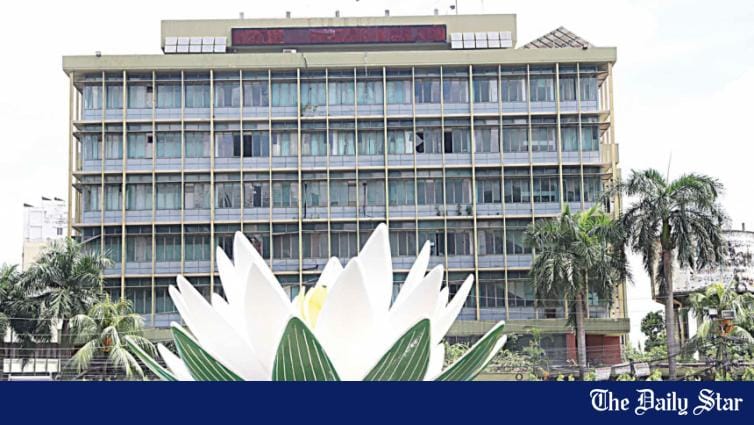
Central bank's autonomy crucial for the economy
Its lack of independence has had disastrous effects

1720745565939.png

VISUAL: STAR

It's heartening to see the government acknowledge the importance of having an independent central bank. Reportedly, the authorities are set to amend the Bangladesh Bank Order, 1972 to supposedly align it with global best practices and give it more autonomy. The development comes at a time when the economy is going through one of the worst downturns in recent memory, with inflation continuing to break records. As experts have pointed out, failed government policies have been a major factor for the runaway inflation and other economic problems we are currently experiencing. And the role of government-controlled Bangladesh Bank in this debacle is particularly notable.

It is reasonable to assume that many of our problems could have been avoided or better addressed if we had an independent and courageous central bank. The government-imposed interest-rate caps on both the lending and deposit ratesโ€”at 9 and 6 percentโ€”is a perfect example of this. Perhaps a more independent central bank would have realisedโ€”and indeed listened to expertsโ€”that this was a flawed policy that would only end up fuelling inflation. The decision to artificially inflate the value of the taka was another disaster that, too, could have been avoided.

Even before the recent economic crisis began, the unchecked "looting" of our banking sectorโ€”under political patronageโ€”had damaged our economy beyond comprehension. Those cracks are widening today as the government, including the central bank, fails to curb default loans with the policies for defaulters continuing to be relaxed. The government's decision to provide continuous loan rescheduling facilities and interest rate waivers to loan defaulters has not been beneficial whatsoever. Therefore, we hope the Bangladesh Bank is given autonomy to pursue stricter policies with regard to wilful defaulters, without political interventions.

In its technical assistance report regarding the Bangladesh Bank, the IMF said that the bank "order needs to be substantially amended so that price stability is the overriding objective of the new monetary policy regime, and governance arrangements are aligned accordingly." We cannot agree more. What's concerning, however, is that a provision of the order called for establishing a council comprising finance and commerce ministers, the bank governor, and others. This will ultimately constrain the bank's actions in times of pressure.

Therefore, while the amendment initiative may sound good, its success in terms of making prudent economic decisions will be determined by the degree of autonomy ultimately granted to the central bank. Previously, despite talks of providing it with autonomy, we have seen the government do the exact opposite. Hence, we hope the amendment is not simply an eyewash amid pressure for reforms. It must be able to address longstanding concerns about the bank's function and mandate. An expert-driven Bangladesh Bank that protects the nation's best interests is the need of the hour.​
 

A former governor's unpleasant truths about the banking sector

1720745711286.png

FILE VISUAL: REHNUMA PROSHOON

Economists are always noted for telling unpleasant truths because they go by numbers, research, theory, and judgement. Rarely do politiciansโ€”who can manufacture arguments to suit their purposeโ€”endorse economists who are objective. Former Bangladesh Bank Governor Dr Mohammad Farashuddin has unveiled some truths about the country's banking sector where regulations have remarkably been relaxed in recent years. Seldom have we seen such blistering comments coming from a governor in Bangladesh's history. Farashuddin's statement, though commendable at a critical moment, creates enormous doubt over whether the government will really pay any attention to it.

The doubt is genuine because the looters are quite well-known to all of us, and they are flocking around the people in power. Not only have they indulged in misdeeds, but they are extravagantly empowered with high positions as well. To the bad luck of the nation, these people have been masquerading as the "true saviours" of the financial industry, if not that of the whole nation. These wolves in sheep's clothing, if not checked, will bring an economy of otherwise high potential down.

It would be a mistake for politicians to label Farashuddin as a supporter of the opposition. He was very well liked by Bangabandhu, who appointed him as his personal secretary. The Awami League government appointed him as governor of the central bank after coming to power in 1996. And most importantly, his performance at the helm of the central bank was academically sound and professionally pro-business.

Few retired bureaucrat-turned governors could do what he did. Dr Farashuddin remained committed to economic knowledge and the country's interest, not the interest of the wilful defaulters whose businesses always pretend to be in the red despite the economy's respectable growth. Sadly, growth is showing signs of a premature slowdown, justifying the clamours of economists who advocate bringing a semblance of law and ethics into business.

The great 18th-century economist Adam Smith once wrote, "Little else is requisite to carry a state to the highest degree of opulence from the lowest barbarism but peace, easy taxes, and a tolerable administration of justice." Smith was so sure about his articulation that he asserted that all the rest would be brought about by the natural course of things once justice is safeguarded. The history of all developed countries has evidently proven that organised financial corruption and economic prosperity can never be siblings. They are mutually exclusive and many politicians in power seem to have brushed the trade-off aside for a game of personal wealth-making and very short-term interest.

Farashuddin's worry in this regard is quite explicit although he seems to be afraid of being mistreated if he speaks against the financial hooligans pampered by power. He literarily resorted to the poignant lines of Rabindranath Tagoreโ€”Morite chahina ami sundoro bhubone (I don't want to die in this beautiful world). So subtle was his sense of melancholy and humour.

The truth hidden under his humour points out that if high-scale bank looters are pardoned so easily, the banking sector's future must be cancerous, suggesting the emergence of further plunderers under the political coddling of the regime. His warning rightly echoes that of Dr Wahiduddin Mahmud, former economic adviser to the caretaker government, who allegorically labels the default culture as the rotten heart of the nation.

Some critics have recently labelled Dr Farashuddin's outburst at the seminar of the Economic Reporters' Forum (ERF) as his personal frustration for not being placed in a policymaking position by the regime. This is a defective interpretation of Farashuddin's standpoint. First, we need to judge whether he is statistically right about what he has said. Second, we need to check whether his recommendations don't serve him personally or his business. We get a "yes" in response to both these questions. His concern is that the family-based directorship proposal was passed at parliament without any resolution or debate. In fact, this law has turned many private banks into a mudir dokanโ€”the single family-run petty shops sprawling in villages, fostering a perverse move of private banks from corporate structures to family dynasties.

The sneaky way of passing this family directorship law is the antithesis to the spirit of parliamentary democracy where we hope to see debates over economic policymaking. But there are many members of parliament who never utter a single word about anything during their tenure, while most of them are familiar with the art of accumulating personal wealth at magical speed. Thus, simply addressing the banking sector won't solve the current economic predicament. Parliament and the legal system must function better to make the economy as robust as it was before the pandemic.

Farashuddin is correct in pronouncing that some groups of people are taking bigger slices of the pizzaโ€”which we earned through independence. And hence, he is against the trend that brings more retired bureaucrats to politics. It will dampen the quality of bureaucratic services as we have already degraded the quality of our universities by infusing political enthusiasm. He is right in reiterating the unholy triangle of tax dodgers, bank defaulters, and money launderers. They are the same group of people who are dragging the economy to the cliff's edge, and waiting for the time to fly overseas with their trafficked fortunes.

This must be stopped for the sake of the nation where income inequality has been on an unbroken crescendo of unsustainability, defying any sensible records of peer nations. Putting a farmer in jail for defaulting on loans by Tk 1,000, while letting a bank looter sit beside government officials, signal a cancerous future for the financial industry, and Farashuddin's artistic portrayal of the injustice and asymmetry in this regard warrants serious attention from the government.

Dr Birupaksha Paul is professor of economics at the State University of New York at Cortland in the US.​
 

The concept of a public institution eludes our central bank

1720745838630.png

Illustration: Biplob Chakroborty

In the mid-1980s, military dictator HM Ershad banned BBC's journalistic operations in Bangladesh. In March 2022, the Taliban banned BBC's local language services in Afghanistan. It can thus be theorised that authoritarian rulers simply hate any journalistic investigations because the press is detrimental to their longevity. But for journalists' normal, professional access into a financial institution in Bangladesh to be barred is an untimely absurdity. It raises a question as to whether something is really wrong within Bangladesh Bank (BB) right now, given that the regulator is floundering in the theatrics of mergers and trying to convert rotten apples to fresh oranges by covering up multiple loopholes.

BB has recently restricted the journalists' access for no reason in sight. Of course, BB's policy restlessness in recent months surrounding default loans, the dollar's exchange rates, reserves, remittance, inflation, and mergers have drawn in more criticism than praise from the media. Meanwhile, journalists have been reporting BB's half-baked ideas and erratic steps. They are only doing their job, as they have been for so long. It is their noble duty to report any public or private sector wrongdoings so as to alert the nation. So what's the problem?

The BB governor has attempted to explain the decision as trying to protect some "top secrets" of the central bank. If the so-called top secrets aren't religiously private, he is supposed to share these with the public via the media. People have every right to know such information since the central bank is the regulator of banks which live and thrive on people's money. And the BB is not like police headquarters; it doesn't handle murder cases which may warrant confidentiality. The culprits BB might be dealing with are wilful defaulters who are at the root of plundering the financial sector and thus placing the economy on the cliff's edge. But even these cases shouldn't be kept secret. The BB governor is a custodian of the state's interests, not those of loan defaulters. Being a hundred percent transparent is the first point of his oath.

The culture of central banks addressing journalists has been there since the early 1990s. Economist Alan Blinder, the then vice-chair of the Federal Reserve System, championed the culture of making central banks more accessible for and accountable to the public. His campaign, "Fed listens," has been a paragon of how a central bank must ensure free flow of information. The journalists help establish communication between policymakers and the public. The current Fed chair Jeromee Powell regularly meets with journalists after every policy decision; so does the governor of the Bank of England, Andrew Bailey. The current president of the European Central Bank (ECB), Christine Lagarde, previously the chair and managing director of the International Monetary Fund (IMF), invites the press for question-and-answer sessions quite regularly. The ECB also welcomes public tours to improve the common understanding of how central banks work and what purposes they serve.

The IMF outlines four principles of communication by central banks. It asserts that communication should be clear, candid, and transparent. Second, communication should reach all segments of the population. Third, communication should take place regularly. Fourth, all economic agents should have equal access to the same information. Ben Bernanke, who chaired the Fed and won the economics Nobel Prize, made it clear that central bank governors are public servants, and it is their responsibility to provide the public with as much explanation of their decisions as possible. Former Reserve Bank of India governor Raghuram Rajan faced journalists quite confidently because he understood economics well and didn't fear being dethroned by any tycoon groups. None of those mentioned above resorted to using their spokesmen to justify their stances because the respective governments appointed them knowing that these leaders know how the economy functions and thus can speak for themselves. At any central bank, every information is public information, and hiding anything is equivalent to doing a disservice to the government.

The economy is facing high inflation and reserve depletion. The banking sector in particular is in its most appalling state, requiring constant checkups like a patient in the ICU. In such a situation, journalists are akin to those devices surrounding the patient which work tirelessly to report BB's financial symptoms to the public.

BB needs extensive interactions with journalists more than ever before, because journalists can read the public pulse and communicate with stakeholders efficiently. No other service can replicate the functions which the media carries out for the public. Journalists mustn't be seen as counterparties, nor are they enemies of state interests. BB should rather engage with journalists as well-wishers and counsellors in regards to policy steps. Had BB adopted this practice in early 2022 when the prevailing crises began to surface, the governor would have been regarded as a good policymaker by now. But BB's attitude towards journalists has recently been more bureaucratic than accommodative, and that is doing more harm than good.

Restricting journalists in the secretariat should in no way be a good example that is blindly replicated in an institution like BB or the Bangladesh Securities and Exchange Commission. These bodies deal with citizens' savings and investments and citizens have the right to inquire about what the custodians of their assets are doing with them at any point in time. Thus, preventing journalists from discharging their duties is unconstitutional and demeans the noble objectives of the Bangladesh Bank Order, 1972 which was framed under Bangabandhu's guidance after independence. BB must revise its approach to journalism by following global best practices and thus improving its knowledge base.

Dr Birupaksha Paul is a professor of economics at the State University of New York at Cortland in the US.​
 

Roadmap for banking reforms: Old wine in a new bottle?
1720745972532.png


A few days before the one-sided election of January 7, Prime Minister Sheikh Hasina asked voters to forgive her (and her party, I assume) for any mistakes that were made since the Awami League came to power, with a promise to rectify them if her party returned to office. And nothing, perhaps, requires as urgent a rectification as the AL's policy in regards to the country's banking sector.

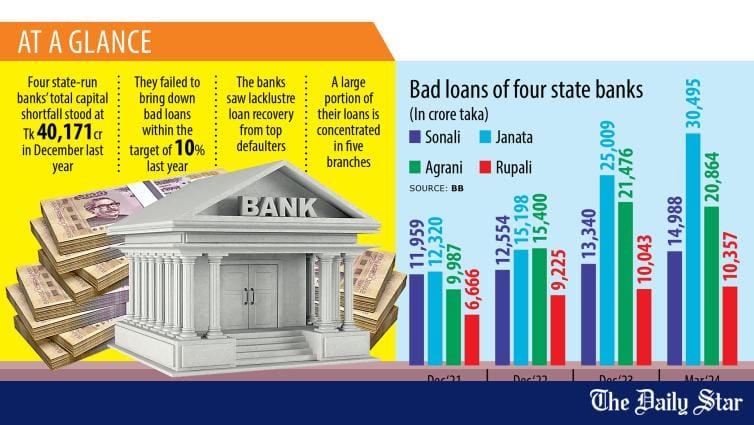
When the AL assumed office in 2009, the total defaulted loans amounted to Tk 22,481 crore, whereas at the end of September last year, non-performing loans (NPLs) stood at Tk 155,397 crore. During the last July-September period, NPLs in the banking sector decreased slightly. But that was only because Janata Bank rescheduled the defaulted loans of Beximco and S Alam, two of the country's biggest business groups which have received quite a few favours from the government. Such rescheduling tricksโ€”which create the illusion of NPLs going down by hiding the figure from banks' balance sheets even though the liabilities still remainโ€”have been at the core of the AL's banking sector policy. They have allowed the governmentโ€”and vested interest groupsโ€”to continually hide the real amount of NPLs in the sector.

According to Moinul Islam, a former professor of economics at Chittagong University, "If the entire amount of the loans involved in the court cases and the written-off loans are taken into consideration, the total bad loans in the banking sector will be Tk 450,000 crore." Similarly, according to economist Ahsan H Mansur, the actual amount of bad loans accounts for around 24-25 percent of the total loans disbursed, whereas via accounting tricks, this is being shown to be below 10 percent.

This buildup of NPLs, according to the Asian Development Bank (ADB), poses a serious risk to the health of banks' balance sheets and financial soundness, reducing interest income, lowering profitability, and depleting their capital bases. They also require higher risk weights and minimum loss coverage in banks' capital requirements, putting a strain on liquidity and increasing funding costs. Hence, it should come as no surprise that the central bank has had to provide increasing amounts of liquidity to credit-hungry banks.

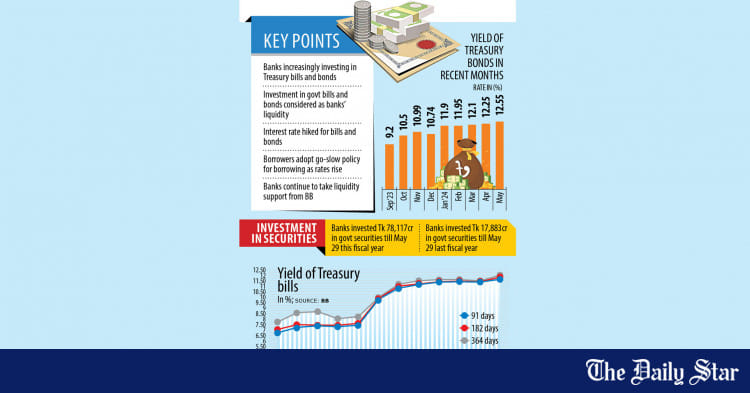
According to Bangladesh Bank statistics, the central bank provided liquidity support amounting to Tk 633.47 billion to banks in June 2023. In the following month, the handouts more than doubled, to Tk 1.28 trillion. And since then, it has been rising every month, ultimately reaching Tk 3.63 trillion in January 2024.

According to a central bank official, if Bangladesh Bank does not "continue cash feeding to the banks as per their requirements," they "will be in severe liquidity crisis." Among other consequences, the interest rate would go up to a level that may be difficult for the economy to absorb. Already, a tight liquidity situation facing both the government and banks has pushed up yields of treasury bills and bonds, as well as the lending rate, in the banking sector. And overall, there is a lack of trust in the financial sector which is adversely impacting the country's economy.

With the banking sector in so much trouble and the authorities walking a tightrope to balance the economy and finance, the Bangladesh Bank on February 4 unveiled its roadmap for reining in defaulted loans and bringing good governance to the sector. The most obvious concern about it, of course, is how genuinely it will be implemented. Given our track record, proper implementation remains highly unlikely. Moreover, some of the action plans and policy reforms already exist or were added in the Bank Company (Amendment) Act, 2023. Yet, none of those prevented things from getting worse.

For example, the roadmap says that the banking regulator will provide necessary instructions to prevent lenders from exceeding the single-borrower limit. However, the same provision existed in the Bank Company Act for more than a decade. And yet, exceeding the single-borrower limit has become the norm in our banking industry, with around 89 borrowers of four state-run banks exceeding it as of June last year, as per a central bank report. What is worse is that, in its attempt to reduce the higher volume of bad loans in the banking sector, the roadmap further relaxed the loan write-off policy by letting banks write off from their balance sheet defaulted loans that have been in the "bad and loss category" for two years, down from three years previously. Again, this will only "artificially" reduce bad loans as the liabilities will remainโ€”meaning that this so-called reform is just old wine in a new bottle.

In February 2019, the central bank lowered the timeframe to three years from five years. And what has that achieved? Default loans since then have gone up from Tk 943 billion to as high as Tk 1,560 billion.

During the discussions prior to the unveiling of the roadmap, the Bangladesh Bank governor was apparently told to bring down default loans by taking any measures necessary, including ignoring political pressure. After its unveiling, former BB Governor Salehuddin Ahmed said the central bank must have enough strength to tackle political interference and pressure from influential groups to implement the roadmap.

However, what is interesting is that back in January, central bank Governor Abdur Rouf Talukder said that the BB's activities have never been influenced by outside forcesโ€”a blatant farce of a statement that no one in their right mind would believe.

So, if the governor does not have the courage to even admit the fact that the central bank has bowed to political pressure time and again, has broken its own rules, and made special concessions for vested interests, how can he be counted on to have the courage to stand up to them now? And unless Bangladesh Bank can carry out the necessary reforms by standing up to political pressureโ€”which will most definitely be thereโ€”this new roadmap will be nothing but another failed reformation plan.

It is time for the prime minister to prove that her promises to the people were legitimate, and ensure that the regulators have her backing in carrying out the reformsโ€”in spite of any and all political pressure.

Eresh Omar Jamal is a journalist at The Daily Star.​
 

How default culture plagues Bangladesh's banking sector
1720746120398.png

The role of the central bank to regulate the banking industry has come under criticism since the 1980s. VISUAL: STAR

A pre-Socratic Greek philosopher named Parmenides first articulated the famous idea: "Nothing comes from nothing." Later, it appeared in Aristotle's Physics. The Roman philosopher, Lucretius, echoed the same, and so did William Shakespear in his famous play "King Lear." The quote was also used in a song from the famous classic movie, "The Sound of Music." The same is true for Bangladesh's banking sector and the emerging default culture which has reached an extreme level because of three things: i) inept institutional leadership; ii) various wrong policies in banking and loan management; and iii) the indulgence of financial plundering by politically mighty business tycoons.

Simply put, Bangladesh's default bonanza did not emerge from either economic debility or financial crises. Nor was it the consequence of political instability. Not a single global factor is attributable to this steadily rising trend in bad loans. It is simply the outcome of government indulgence to habitual defaulters who somehow managed to get crooked politicians to back them no matter which party comes to power. And this is threatening the country's prospect of becoming a developed nation by impinging on private investments, reducing employment opportunities, promoting money laundering, and eventually dampening GDP growth.

BANKS, FIS, AND FINANCIAL INCLUSION

The banking industry after independence included six nationalised commercial banks, three specialised banks, and nine foreign banks. They operated under the guidance of the Bangladesh Bank (BB), the central bank of the country. The BB Order 1972 was the de facto constitution which BB followed in regulating the industry. Due to policy changes in the 1980s and financial deregulation in the 1990s, the industry kept on expanding because private banks were allowed to enter the field under the Banking Company Act 1991.

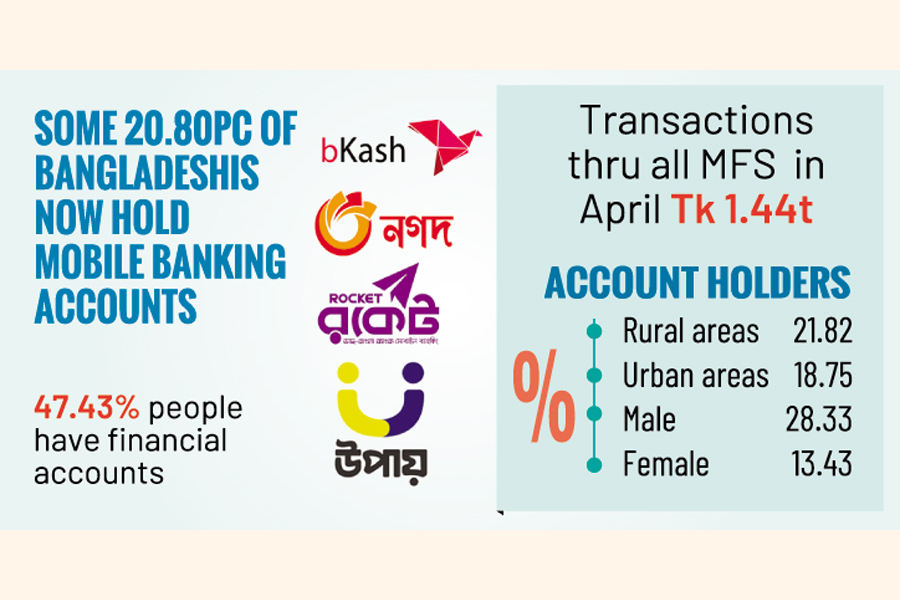
Currently, the list of scheduled banks includes six state-owned commercial banks, three specialised banks to serve agriculture and industry, 33 conventional private commercial banks, 10 Islami Shariah-based commercial banks, and nine foreign banks. Non-Bank Financial Institutions (FIs) are those types of financial organisations which are regulated under the Financial Institution Act 1993 and controlled by BB. Now, 35 FIs are operating in the market. The architecture of banking and finance is huge, even though the measure of financial inclusion among adult Bangladeshis is not correspondingly satisfactory. According to the Global Findex Database 2021, financial account ownership in Bangladesh has grown substantially since the Awami League took office in 2009. Among Bangladeshi adults particularly, it grew by 22 percentage points, from 31 percent in 2011 to 53 percent in 2021.

However, as Brac observes, the momentum is deceleratingโ€”account ownership rose by just three percentage points from 50 percent to 53 percent between 2017 and 2021, suggesting that nearly half of the adult population remains outside of the financial sector's purview. And the current state of banking being mired in malfunctions does not bode well to accelerate the pace of financial inclusion anytime soon.

THE BELEAGUERED BANKING SECTOR

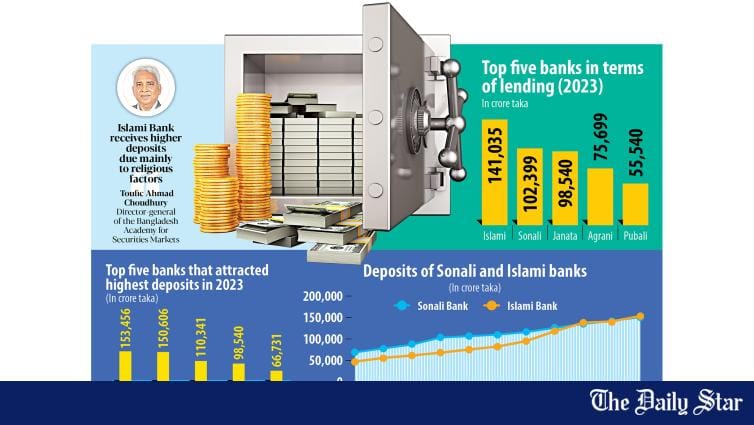
A BB fortnightly report in November 2023 revealed that the total bank deposits that include both demand and time deposits amounted to Tk 16.4 lakh crore in November 2023. Domestic credit amounted to Tk 19.6 lakh crore while credit to the private sector was Tk 15.5 lakh crore, and the rest is credit to the public sector. The banking sector is deeply troubled with a huge share of nonperforming loans (NPLs)โ€”which did not occur as a result of economic distress, but because of judicial tardiness and political favouritism toward wilful defaulters.

The BB Financial Stability Report 2022, released in August 2023, revealed that Bangladesh's banking sector's risky loans amounted to Tk 377,922 crore by December 2022. This amount is the summation of total NPLs, outstanding rescheduled and restructured loans, as well as written-off loans. At the end of 2022, the banking sector's NPL stood at Tk 120,649 crore, outstanding rescheduled loans at Tk 212,780 crore and outstanding written-off loans at Tk 44,493 crore. The report also acknowledged that the overall asset quality has dropped and the NPL ratio has edged up. The percentage share of classified loans peaked at 10.11 percent of total outstanding loans in June 2023, while it was 7.66 percent in December 2020.

DEFAULT LOANS AND SOFT DEFINITIONS

The number game in the banking sector is complicated because of the mismatch between the timeliness of data and its mischievous quality. BB often finds some banks hiding their real data to show a lower amount of NPL and less amount of capital provisioning which enables them to show higher profits. The circus goes on. Roughly, while Tk 16 trillion remains as outstanding loans to the private sector in the economy, almost one-fourth of that amount comprises risky loans. Thus, Tk 4 trillion turns out to be the amount of risky loans, of which, around 40 percentโ€”around Tk 1.6 trillionโ€”appears to be declared as defaulted loans. A Prothom Alo report on October 3 of last year found the total amount of defaulted loans to be Tk 1.56 trillion, while the actual amount would have been more than double had the soft definition of default loans not been used.

The default figure remains highly undervalued on purpose. The report refers to the World Bank website that publishes data and analysis on default loans by collecting information from various central banks. Bangladesh occupied the second highest position in South Asia following Sri Lanka, whose default loans amounted to 13.33 percent of total loans. Bangladesh's default loan stood at 10.11 percent, while it was only 4.8 percent in 2013 according to the report. The corresponding figure for Pakistan was 7.4 percent and India only 3.9 percent.

While Sri Lanka should be seen as an exception because of its unprecedented financial disaster in 2023, Bangladesh turns out to be South Asia's champion in generating default loans, even though the country witnessed a respectable GDP growth rate above six percent since 2013, illustrating that the rise in defaulted loans in Bangladesh has not been economy-driven for sure. It is entirely due to an indulgent culture orchestrated by wilful financial delinquents who are fuelled by political patrons. The lobbyists and advocates of default loans eventually benefit from this institutional method of embezzling funds and rent seeking.

Hence, the first public impression about the banking sector is that it is obliged to embrace the looting of funds by big business tycoons who maintain solid lobbying power with powerful politicians. They can manage delaying numerous cases on default loans in courts, convince the finance ministry to pressurise the central bank to act in their favour and, finally, compel the central bank to reschedule or restructure their loans so they can either contest in the election or take further loans to cater for money laundering, or both. In case the banks sue the defaulters, the litigations take ages to be resolved and, meanwhile, the defaulters manage to get the authorities to come up with new ways to whitewash their misdeeds.

1720746279522.png

Bangladesh occupied the second highest position in South Asia following Sri Lanka, whose default loans amounted to 13.33 percent of total loans. VISUAL: STAR

GLOBAL OR DOMESTIC REASONS FOR DEFAULT LOANS?

The banking sector suffers from leadership issues. The role of the central bank to regulate the banking industry has come under criticism since the 1980s. But it has been much worse during the third term of the Awami League government (2019-2023) when both threats and opportunities reigned the market. The Covid-19 pandemic paralysed the world economy. Global GDP growth was on average three percent from 2013 to 2019. It plunged to negative 3.1 percent in 2020 during the pandemic.

However, the rebound of the world economy was spectacularly rewarding with global growth as high as six percent in 2021โ€”an unprecedented rate in the postwar era. Growth reached 3.1 percent again in 2022, suggesting that it had returned to normal. The Russian attack on Ukraine in early 2022 caused a spike in inflation globally, but GDP growth did not fall from its average of three percent or so. Moreover, the labour market was tight and unemployment rates did not go up in most developed countries. The US had an unemployment rate of 3.6 percent in 2022โ€”never seen in its past 50 years.

As WB data suggests, Bangladesh's growth always remained in the positive territory since the 1990s, and the country never saw a recession. Its growth even in the Covid year of 2020 turned out to be 3.45 percentโ€”still in the positive territoryโ€”while it was 7.88 percent in 2019, 6.94 percent in 2021, and 7.1 percent in 2022. The figure is expected to be around 6.5 percent in 2023, as the government predicts. Thus, the average growth rate during the third term of Awami League becomes 6.4 percent, while it was 6.7 percent in the second term (2014-2018), suggesting that the economic performance during Awami League's third term does not justify a drastic rise in the volume as well as the ratio of NPLs.

Under the Awami League government, defaulted loans amounted to Tk 225 billion in 2009, Tk 502 billion in 2014, Tk 943 billion in 2019, Tk 887 billion in 2020, and surprisingly as high as Tk 1,560 billion in 2023โ€”almost double the amount of what it was during the Covid year. This upward trend does not justify any rationale related to the real economic situation.

1720746345551.png

The percentage share of classified loans peaked at 10.11 percent of total outstanding loans in June 2023. VISUAL: SALMAN SAKIB SHAHRYAR
POOR LEADERSHIP AND POLITICAL INDULGENCE

The central bank and the ministry of finance (MOF) are jointly responsible for the default loan culture. While the central bank is primarily responsible for regulating the banking sector, the Bangladesh story is different. Here, the MOF keeps the central bank in its grip. Since the mid-2010s, central bank governors have usually been retired secretaries of the MOF. And the central bank leadership has virtually obliged with what the MOF has wished politically. This mechanism is pushing the state of the banking sector from bad to worse.

The amount of default loans that we see today is just the tip of the iceberg. The provision of rescheduling, which is dominantly the brainchild of a previous finance minister and has been unquestionably carried out by the obedient governors since 2016, perverted the definition of default loans. The restructuring provision allowed the big loan takers to extend their repayment dates for an unconscionable amount of time for loans of Tk 500 crore or above. The rescheduling provisions allowed defaulters to make their loans regular and normal by adjusting only 5-10 percent of their default loans. This a perversion that corrupted the normal practice of prudential banking governance. And that is how the default rate has been forcibly shown as low as 10 percent, which would be above 20 percent otherwiseโ€”had these two redefinitions not been adopted.

To read the rest of the news, please click on the link above.
 

Members Online

No members online now.

Latest Posts

Latest Posts