[🇧🇩] Banking System in Bangladesh

[🇧🇩] Banking System in Bangladesh
440
20K
More threads by Saif

G Bangladesh Defense

Can Bangladesh finally fix its NPL problem?

Mamun Rashid

1785021949250.webp


Bangladesh Bank has unveiled an 18-month roadmap to tackle mounting non-performing loans (NPLs) and restore banking stability. The plan combines stronger supervision, loan restructuring, faster recovery of distressed assets, legal reforms, capital restoration, and the new Bank Resolution and Deposit Protection Acts. It also introduces a much-debated one-time settlement scheme, under which borrowers repay only the principal while accumulated interest may be fully waived.

The announcement has drawn cautious optimism, but it revives a familiar question: is this a genuine break from the past, or another attempt to defer a deeper problem?

Our banking history offers reason for caution. Over the past decade, policymakers have leaned repeatedly on rescheduling, forbearance, and special repayment or restructuring facilities to contain defaults. In 2019, the then finance minister, an accountant, pledged that NPLs would not rise "by even a single penny".

Instead, they climbed to nearly Tk 5.9 lakh crore – almost a third of total outstanding loans. If we include the written-off amount, the number would be much higher. Rather than resolving the crisis, successive policies largely delayed the recognition of losses and masked the true health of banks.

Banking crises rarely emerge overnight. They accumulate from weak governance, political interference, and poor credit discipline. When borrowers expect endless restructuring regardless of repayment behaviour, financial discipline erodes; when banks cannot enforce prudent lending, bad loans mature into a systemic risk.

The 2024 political transition marked an important shift, as Bangladesh Bank initiated Asset Quality Reviews (AQRs), exposed troubled banks’ true condition, identified capital shortfalls, and began exploring consolidation. The new roadmap appears to build on those reforms rather than reverse them.

The most debated element is the complete interest waiver. There is some logic to it – not every defaulter is wilful, and many businesses have struggled through economic shocks, rising energy costs, and financing costs. A realistic path back into the formal system could revive recovery and productive investment.

Yet a question remains: banks mostly lend depositors’ savings, apart from their meagre equity. If interest income is waived, who absorbs the loss – shareholders, depositors, or taxpayers? If weak banks eventually need recapitalisation, today’s relief becomes tomorrow’s fiscal burden. Cleaning up balance sheets is necessary, but not at the cost of long-term financial stability.

International experience shows successful reform never rests on a single instrument. After the Asian financial crisis, South Korea’s asset management company (KAMCO) purchased distressed loans, restructured viable assets, and restored confidence. Malaysia’s Danaharta played a similar role, acquiring troubled assets and disposing of unviable ones under a strong legal framework. Both governments recovered a substantial share of the public resources deployed. Carlyle, from the USA, played a significant role in cleaning up toxic assets in some Chinese banks after the Asian meltdown.

Not every such initiative has succeeded. Similar efforts in Indonesia and Nigeria were undermined by political interference and drawn-out legal processes. The lesson is simple: an asset management company is no cure by itself. It works only within a broader reform agenda – independent supervision, efficient courts, transparent governance, and the will to pursue influential defaulters without favour.

This is directly relevant as our central bank moves to establish its own AMC. Its success will hinge less on legal creation than on operational independence and freedom from political interference.

Encouragingly, the ADB, IMF, and World Bank have tied support to measurable improvements in banking governance. External pressure cannot replace domestic leadership, but it does raise the cost of complacency.

Bangladesh’s banking sector stands at a critical juncture. Success will depend not on ambition but on the credibility of execution. If political considerations override financial discipline, this too will join a long list of missed opportunities. But if policymakers recognise losses honestly and enforce accountability without exception, this roadmap could yet become the country’s most meaningful banking reform in decades.

Reducing NPLs is not merely about repairing balance sheets; it is about restoring public trust, protecting depositors’ savings, and safeguarding long-term growth. The real test will not be whether reported NPLs fall over the next 18 months, but whether the institutional failures behind the crisis are finally addressed.

Mamun Rashid is an economic analyst and chairman at Financial Excellence Ltd.​
 

Islamic, 4th-gen banks buckle under NPL, liquidity crises

Star Business Report

1785196567823.webp


Full-fledged Islamic banks and fourth-generation private commercial banks are facing mounting pressure from rising default loans and worsening liquidity shortages, making them the most vulnerable segments of the country’s banking sector, according to Bangladesh Bank.

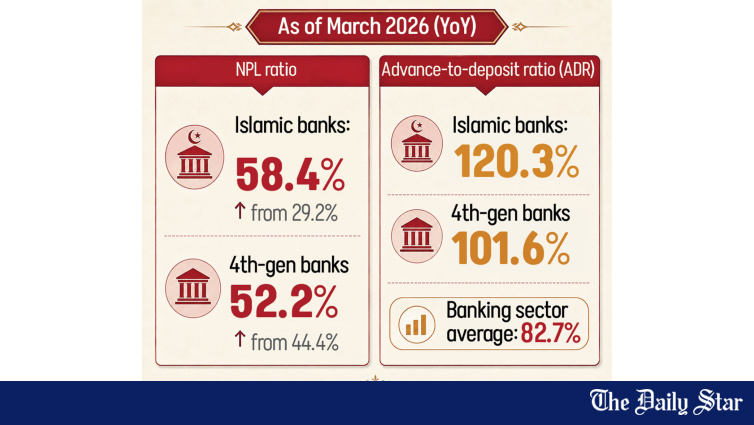
The central bank’s latest Banking Sector Update shows that the non-performing loan (NPL) ratio of full-fledged Islamic banks surged to 58.4 percent in March 2026, up from 29.2 percent a year earlier.

Tap here to add The Daily Star as a trusted source google-preferred-source-badge
Fourth-generation private commercial banks -- the nine banks established in 2013 -- recorded the second-highest NPL ratio at 52.2 percent, compared with 44.4 percent in March 2025.

The report said both groups are under severe liquidity pressure due to aggressive lending and elevated credit risk.

Full-fledged Islamic banks remained heavily exposed, with their Advances-to-Deposit Ratio (ADR) climbing to 120.3 percent in March 2026. The average ADR of fourth-generation banks stood at 101.6 percent, with several lenders posting ratios above 100 percent.

Bangladesh Bank said the elevated ADRs reflect aggressive lending by fourth-generation banks as they rapidly expanded their loan portfolios. The ADRs of both groups were well above the banking sector average of 82.7 percent, raising concerns over liquidity risk.

The report noted that Islamic banks have long struggled with structural weaknesses, including limited liquidity management tools and rapid credit expansion.

Last year, the government merged five troubled Islamic banks -- First Security, Global, Social Islami, Union and EXIM Bank -- to form Sammilito Islami Bank PLC after they suffered acute liquidity shortages and alleged loan irregularities linked to the S Alam Group and Nazrul Islam Mazumder.

According to the report, the sharp increase in bad loans at these banks points to weak credit discipline and possible governance failures.

While the overall banking sector reduced its ADR to strengthen liquidity, Islamic and fourth-generation banks remained highly exposed despite relatively slow deposit growth.

Other banking segments performed comparatively better.

Second-generation private commercial banks maintained an NPL ratio of 19.2 percent. Foreign commercial banks remained in a stronger position, with an NPL ratio of 6.3 percent and an ADR of 53.4 percent, enabling them to maintain comfortable liquidity buffers.

Bangladesh Bank warned that aggressive lending and rising default loans at Islamic and fourth-generation banks pose a significant risk to the stability of the banking sector.

It said urgent measures are needed to reduce NPLs and bring ADRs under control. Without corrective action, the existing weaknesses could evolve into broader systemic risks, threatening financial stability and economic growth.​
 

Q1 green financing by banks dips 22pc
Staff Correspondent 31 July, 2026, 00:20

1785455035751.webp


Green financing by banks fell by around 22 per cent in the January-March quarter compared with the previous quarter, according to Bangladesh Bank’s latest Quarterly Review Report on Sustainable Finance. Diasporacommunity news

Banks disbursed Tk 4,662.66 crore in green finance during January-March 2026, down from Tk 5,990.83 crore in the October-December quarter and Tk 7,070.45 crore in the June 2025 quarter.

Green finance covers projects such as renewable energy, waste management, energy efficiency and environment-friendly establishments.

Non-bank financial institutions, or finance companies, recorded a sharper fall.

Their green financing dropped to Tk 534.04 crore in the reporting quarter from Tk 989.86 crore in December, a decline of about 46 per cent.

Green finance made up 12.22 per cent of banks’ total term loan disbursement during the quarter, against a target of 5 per cent set by the central bank.

Bangladesh’s private sector credit growth stood at 4.98 per cent in May, well below historical trend, and banks have been sitting on unusually large surplus funds which points to general caution in lending.

Default loans surged to Tk 5.89 lakh crore at the end of March 2026 and distressed assets hit near Tk 11 lakh crore which also made it difficult for banks to lend fresh loans.

Moreover, some good performing banks hold ample liquidity, but they found it lucrative to invest in risk-free government treasury bonds.

Sustainable finance, a broader category that includes green finance along with sustainable agriculture, sustainable financing for cottage, micro, small and medium enterprises (CMSME), and socially responsible lending, accounted for 34.35 per cent of total loan disbursement, compared with the 40 per cent target Bangladesh Bank has set for banks and finance companies from 2025 onward.

Forty-two banks out of 61 and 10 finance companies out of 34 disbursed green finance during the quarter, the report said.

A wider set of institutions, 56 banks out of 61 and 11 finance companies out of 34, had exposure to sustainable finance.

Unlike green finance, sustainable finance disbursement by banks rose in the quarter.

Banks disbursed Tk 97,558 crore in sustainable finance, up from Tk 81,124 crore in December, though still below the Tk 138,395 crore recorded in June 2025.

Finance companies’ sustainable finance disbursement slipped marginally to Tk 2,498 crore from Tk 2,621 crore in December.

Within sustainable finance, other sustainable-linked finance held the largest share at about 42 per cent, followed by sustainable CMSME financing at around 37 per cent.

The outstanding balance of sustainable finance across banks and finance companies stood at Tk 4,15,983 crore as of March 31, of which banks accounted for Tk 3,92,125 crore.

Outstanding green finance alone stood at Tk 81,055 crore, with energy and resource efficiency projects making up the largest portion at Tk 33,919 crore.

Banks recovered Tk 49,723 crore and rescheduled Tk 3,660 crore of their sustainable finance loans during the quarter.

Finance companies recovered Tk 2,654 crore and rescheduled Tk 64 crore.

The Climate Risk Fund, which banks and finance companies must maintain under Bangladesh Bank rules, saw utilisation of just Tk 4.95 crore during the quarter, split between four events and eight projects. Diasporacommunity news

On environmental and social risk management, 48 banks and 10 finance companies carried out risk ratings on 2,11,953 projects during the quarter, of which 1,95,559 rated projects were financed for a total of Tk 1,78,995 crore.

Bangladesh Bank introduced the Sustainable Finance Policy in December 2020 and updated it in 2023, requiring all scheduled banks and finance companies to set up dedicated sustainable finance units and meet prescribed disbursement targets.​
 

17 banks to give Tk 41,000cr to revive sick businesses
Mostafizur Rahman 16 August, 2026, 22:55

1786925653698.webp

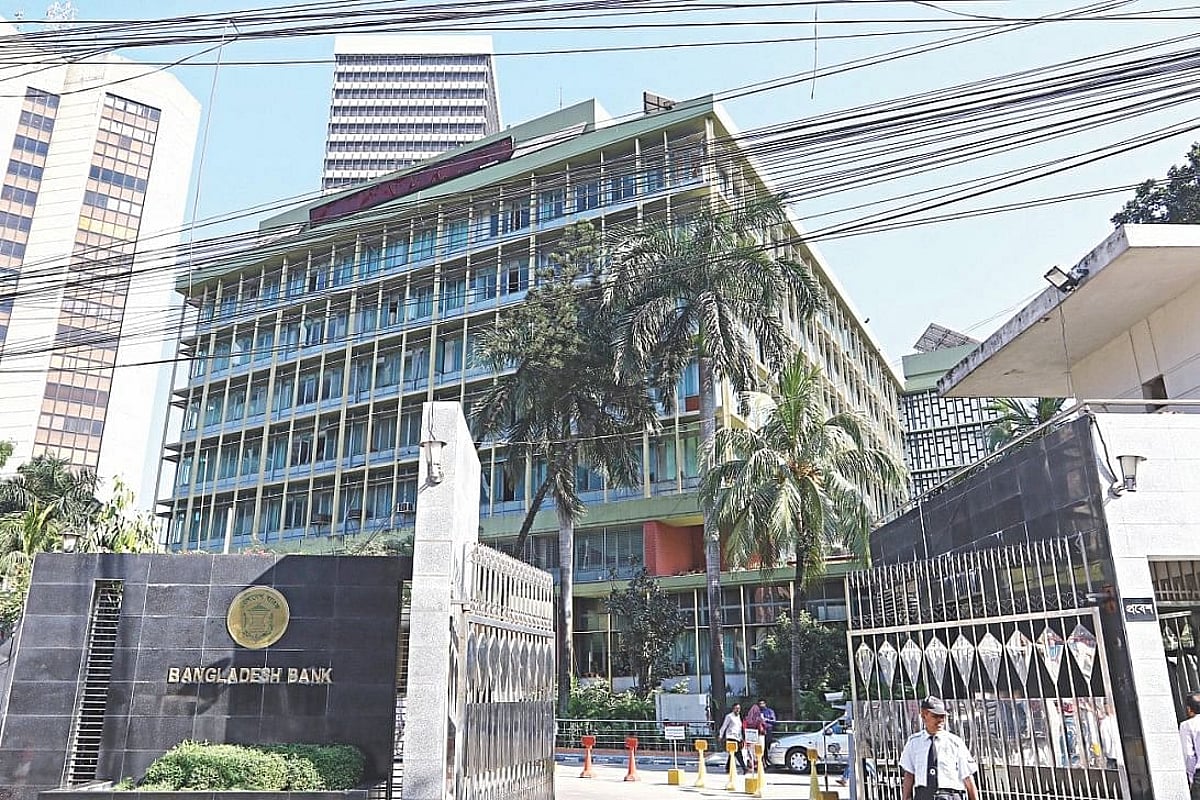
A file photo shows a man walking past the headquarters of the Bangladesh Bank at Motijheel in the capital. | New Age photo

Some 17 banks have agreed to provide Tk 41,000 crore to revive sick companies under the Bangladesh Bank’s Tk 60,000 crore stimulus package aimed at reviving closed factories and restoring private-sector investment.

The banks are Sonali Bank, Agrani Bank, Rupali Bank, BRAC Bank, City Bank, Pubali Bank, Eastern Bank, Jamuna Bank, Dutch-Bangla Bank, Mutual Trust Bank, Uttara Bank, Prime Bank, Bank Asia, NCC Bank, Mercantile Bank, Trust Bank and Southeast Bank, according to Bangladesh Bank officials.

The central bank will collect the Tk 41,000 crore from these banks and provide the funds to about 37 banks for onward lending to eligible sick companies after they meet the Bangladesh Bank’s conditions.

The arrangement is designed to channel surplus funds held by relatively stronger banks to lenders that will identify and finance viable distressed businesses.

BB officials said that the participating banks had sufficient excess liquidity to provide the funds.

Banks receiving the money will have to carefully assess borrowers before approving loans. They must ensure that the selected companies meet the Bangladesh Bank’s eligibility requirements, use the funds for the approved purposes and have realistic prospects of resuming or expanding operations, they said.

The lending banks will also have to monitor the companies regularly to ensure that the money is not diverted and that the businesses are actually being revived, they added.

To strengthen monitoring, the Bangladesh Bank plans to introduce a digital dashboard through which participating banks will regularly report the amount disbursed and how the funds are being used.

The initiative comes as private-sector credit growth has weakened sharply. It fell to a historic low of 4.47 per cent year-on-year in June amid tight monetary conditions, high loan defaults, weak business confidence and sluggish investment.

Banks’ surplus liquidity also crossed Tk 4 lakh crore in June, creating an opportunity to channel idle funds into productive businesses.

Mutual Trust Bank managing director and chief executive officer Syed Mahbubur Rahman told New Age that banks providing their surplus funds to the Bangladesh Bank would face limited risk because the central bank would subsequently provide the money to other banks for lending to sick companies.

Investment opportunities are limited now, so it is also attractive for banks to place their surplus funds with the central bank at a good return, he said.

He said that the initiative was positive, but its success would depend largely on the banks distributing the funds.

How the banks select the companies and whom they lend to will be very important, he said, adding that the recovery of businesses could take time because of continuing problems with utilities and other operating conditions.

The Bangladesh Bank launched the Tk 60,000 crore package on May 23 to reopen closed industrial and service-sector units, expand agricultural production, support small businesses, diversify exports and revive economic activity.

Of the package, Tk 41,000 crore will come from commercial banks’ own funds. Another Tk 19,000 crore will be provided by the Bangladesh Bank through refinancing schemes.

The government will provide a 6 per cent interest subsidy, allowing eligible borrowers to obtain loans at 7 per cent interest.

Under the Tk 41,000 crore component, Tk 20,000 crore has been earmarked for reopening closed industrial and service units, Tk 10,000 crore for agriculture and rural activities, Tk 5,000 crore for cottage, micro, small and medium enterprises, and Tk 3,000 crore each for export diversification and developing northern Bangladesh as an agricultural hub.

Under the separate Tk 19,000 crore refinancing scheme, the Bangladesh Bank will provide funds to banks at 4 per cent interest for onward lending.

Bangladesh Bank governor Mostaqur Rahman at a press conference on May 23 said that the programme aimed to create 25 lakh direct and indirect jobs by reviving productive sectors and increasing private investment.

He said that the banking sector had been weakened by widespread irregularities and diversion of funds in previous years and the stimulus programme was intended to restore business and trade activity, increase productivity and exports and support economic growth.​
 

Govt sets five-year plan to clean up banking sector

It puts bad-loan recovery at the top of the agenda

Rejaul Karim Byron and Ahsan Habib

1787182102347.webp


The government has set out a five-year plan to clean up the banking sector, with a focus on recovering bad loans, tightening supervision, improving governance and restoring depositor confidence.

The plan comes as banks grapple with record non-performing loans (NPLs), weak governance, political interference and lending to politically connected businesses. These problems have eroded both capital and profitability of many banks, with state-owned lenders particularly exposed.

By December last year, NPLs in the country’s banking sector reached Tk 5.57 lakh crore, equivalent to 30.6 percent of total loans, according to official data.

Over the same period, banks’ return on equity fell from 9.42 percent in 2016 to minus 16.11 percent in 2025.

The five-year framework, titled “Five-Year Strategic Framework for Reform and Development (July 2026-June 2031)”, was prepared by the General Economics Division of the Planning Ministry and approved by the National Economic Council on May 18. It was released yesterday.

The government will roll out the reforms in three overlapping phases.

Those are containing immediate risks in the first year, rebuilding banks over the next two years and pursuing deeper reforms in years three to five.

FIRST YEAR: CONTAIN THE DAMAGE

The first year will focus on high-risk banks, bad loans and depositor protection.

Operational autonomy of the Bangladesh Bank will be enforced on an interim basis, while high-risk banks will face stricter supervision and regulatory action.

The central bank will identify willful defaulters and take legal action against them. It will also enforce stricter loan classification and provisioning rules to prevent bad loans from piling up.

The government will apply fit-and-proper criteria to bank boards and senior management and restructure boards that fail to meet the requirements.

The Deposit Protection Fund will be made operational. The government will strengthen the capital position of merged banks and begin reimbursing depositors, while interim arrangements will be introduced to repay depositors of distressed banks.

The immediate priority will be to enforce rules, address governance failures, recover bad loans, protect depositors and maintain liquidity.

NEXT, REBUILDING BANKS

Over the next two years, the government plans to strengthen governance, risk management and loan recovery while building stronger financial safety nets.

The central bank will receive full operational autonomy, with risk-based supervision and stress testing introduced.

Loan rescheduling will be tightened, large borrowers will face closer monitoring, and banks will have to comply more strictly with lending rules. Board appointment procedures will also be standardised, with limits on board tenure and family representation.

Banks will have to disclose financial data at the individual bank level and follow reporting standards aligned with Basel III -- a global regulatory framework.

DEEPER REFORMS IN FINAL PHASE

The final phase will focus on making banks more efficient and competitive while reducing risks to the wider financial system.

The plan calls for stronger governance, greater transparency, better data systems and stronger supervisory capacity at the Bangladesh Bank. Legal and institutional changes will also be introduced to strengthen its operational independence and bring regulations closer to international standards.

The government plans to improve the recovery of bad loans through specialised financial tribunals, stronger legal enforcement and faster resolution mechanisms.

The plan also proposes a fully functioning deposit protection system, including the pay-box model, to protect depositors and strengthen market discipline.

BANKS MUST FIX THEIR BALANCE SHEETS

The framework makes clear that simply increasing credit will not solve the banking sector’s problems.

Banks must first repair their balance sheets through restructuring, disciplined write-offs and faster recovery of defaulted loans. Then they can expand lending safely to small and medium-sized enterprises, agriculture and productive industries.

The plan also identifies political interference as a major problem.

Weak board oversight, preferential lending and limited accountability have contributed to poor risk management and the buildup of bad loans, it says.

WHO WILL OVERSEE THE REFORMS?

The Bangladesh Bank will lead regulatory and supervisory reforms, while the Financial Institutions Division will coordinate legal and policy changes involving state-owned banks and other government-owned financial institutions.

Progress will be measured against indicators covering capital adequacy, asset quality, liquidity, governance, depositor confidence and transparency.

The central bank will conduct annual reviews, with a mid-term assessment in FY2028 to measure progress and recommend changes.

The government says the reforms are urgent as Bangladesh prepares for LDC graduation, which could reduce access to concessional financing and external liquidity support and increase reliance on the domestic financial system.

The bigger challenge, however, will be implementation.​
 

A legal weapon against NPL menace

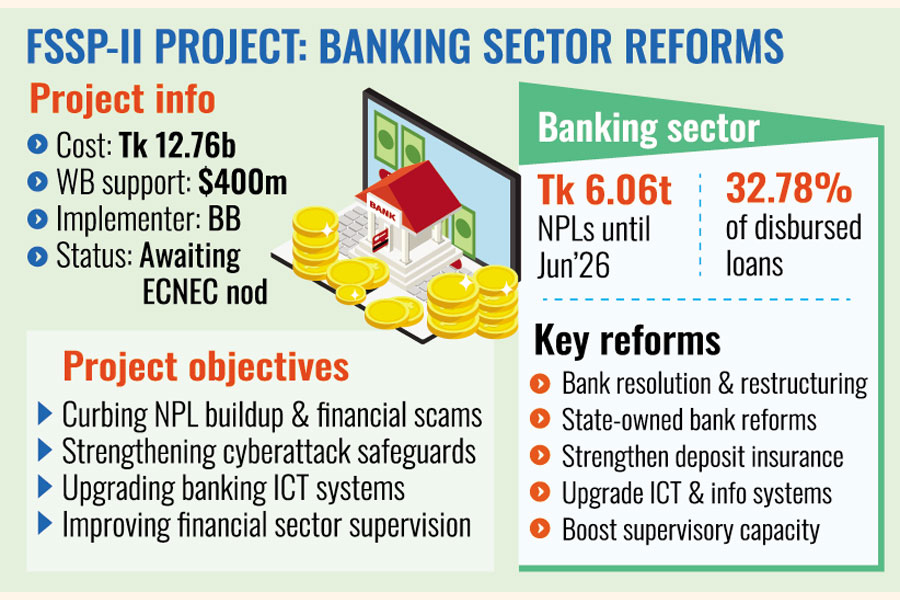
There is something profoundly unsettling about the fact that Bangladesh now needs a new legal arsenal to deal with non-performing loans (NPLs) that should have been contained by normal banking discipline. The proposed Distressed Asset Management Act (DAMA) 2026 and amendments to the Money Loan Court Act are, therefore, welcome, but they also represent an uncomfortable reality: the banking system has allowed the problem of bad loans to grow far beyond the management capacity of its existing institutions. The scale of bad loans is staggering. Classified loans stood at Tk 6.06 trillion at the end of the 4th quarter of fiscal year 2026, equivalent to 32.78 per cent of total outstanding bank credit. In other words, roughly one in every three taka lent by the banking system had entered a troubled territory. Even more revealing is the broader definition of distressed assets --- including defaulted, written-off, rescheduled and court-stayed loans --- which reached nearly Tk 11 trillion, or about 60 per cent of outstanding loans, at the end of 2025.

Under the circumstances, the government's move to equip itself with stronger legal instruments is thus both necessary and overdue. The proposed Distressed Asset Management Act, together with amendments to the Money Loan Court Act, seeks to turn loan recovery from a slow, cumbersome process into a more dynamic mechanism. More importantly, DAMA envisages a formal market in which distressed loans can be bought and sold, allowing private firms to acquire bad loans, take possession of mortgaged assets and, where necessary, assume control of indebted companies.

There is indeed logic behind such an approach. Once bad loans remain trapped on banks' balance sheets, their ability to extend fresh credit is diminished, capital is impaired and the entire financial system becomes less efficient. A functioning distressed-asset market could, in principle, give banks an avenue to clean, at least partially, their balance sheets while allowing specialised investors to recover value from assets that banks themselves may be unable to manage effectively. The proposed Distressed Asset Management Unit (DAMU) under the Bangladesh Bank, and a specialised enforcement taskforce, could further strengthen this process. The proposal to settle Money Loan Court cases within six months and introduce mechanisms for appeals, auctions and recovery officers also points to an effort to address one of the most persistent weaknesses of the system involving the extraordinary delay between default, litigation and recovery.

In view of the wrongs facing the banking industry, one may find it easy to be convinced that legislation alone will correct the system. Bangladesh's NPL problem did not emerge simply because recovery laws were inadequate. It also grew out of politically connected lending, absence of due diligence, regulatory lapses and wilful default. The proposed law should be seen not only as an instrument for recovering old loans but also as a larger effort to prevent creation of new bad loans. Ultimately, success of the DAMA will be measured not by how efficiently it recovers yesterday's bad loans, but how successfully it prepares ground for sound borrowing practices for tomorrow.​
 

Agent banking accounts rise to 27.22m in June


1789253238292.webp


The number of accounts opened through agent banking in Bangladesh rose to 27.22 million at the end of June 2026, marking a 2.77 percent increase from the previous quarter, according to a Bangladesh Bank report.

The Quarterly Report on Agent Banking, April-June 2026, said 30 banks were providing agent banking services through 20,597 outlets operated by 15,424 agents as of June 30.

The number of agents increased by 1.58 percent and outlets by 1.27 percent during the quarter.

Of the total 27,224,256 agent banking accounts, 13,558,918, or around 50 percent, belonged to female customers, while 23,027,755 accounts, or 85 percent, were held by customers in rural areas.

The report said the growing number of accounts reflected rising demand for agent banking services among different segments of the population. Female-owned accounts increased by 3.06 percent during the quarter, surpassing male-owned accounts.

Deposits held through agent banking also continued to rise. The cumulative deposit reached Tk 519,072.92 million at the end of June, up 1.96 percent from the previous quarter and 13.82 percent from a year earlier.

Lending through agent banking recorded stronger growth, with cumulative loan disbursement reaching Tk 408,703.97 million. The amount increased by 8.26 percent during the quarter and 40.89 percent year-on-year.

The loan-to-deposit ratio rose to 78.74 percent in June from 74.16 percent in March, indicating increasing momentum in loan disbursement through agent outlets. Twenty-three of the 30 banks engaged in agent banking were involved in lending activities.

Rural customers received Tk 262,263.99 million, or 64.17 percent, of the total loans disbursed through agent banking. However, women accounted for only Tk 52,002.06 million, or 12.72 percent, of total lending, indicating significant scope for increasing women’s access to credit.

Agent banking also continued to play a major role in distributing inward remittances. The cumulative amount of inward remittances disbursed through agents reached Tk 2,149,041.57 million at the end of June, up 1.76 percent from the previous quarter and 16.87 percent year-on-year.

Rural beneficiaries received 90.44 percent of the total inward remittances distributed through agent banking, highlighting the channel’s importance in bringing remittance money to people outside major urban centres.

The report said agent banking was contributing significantly to financial inclusion by providing banking services to underserved populations, particularly in rural areas.

It noted that the increasing lending-to-deposit ratio indicated growing availability of finance for entrepreneurship through agent outlets. Bangladesh Bank is encouraging banks to facilitate CMSME and women entrepreneurship loans and refinance schemes for marginalised people through agent banking.

Meanwhile, female participation in agent banking as entrepreneurs is also increasing. As of June 2026, 28 banks were offering services through 2,106 female-owned outlets operated by 1,776 female-owned agents.

The report said female-owned outlets accounted for 10.22 percent of the country’s total agent banking outlets and had 2.34 million accounts, including 1.94 million accounts in rural areas.

Bangladesh Bank introduced agent banking in 2013 to provide an alternative delivery channel for banking services, particularly to people living in geographically remote areas. Customers can use the outlets for deposits, loans, remittances, payments and government social safety-net benefits.​
 

What lies behind Bangladesh Bank’s huge profit?

Shawkat Hossain


1789428597186.webp

Bangladesh Bank headquarters Prothom Alo

When the financial sector is beset by multiple crises, the Bangladesh Bank’s net profit of more than Tk 260 billion raises fresh questions. Does the central bank’s record profit reflect weaknesses in the financial sector, or is it a sign of economic strength? Shawkat Hossain writes about the central bank’s profit and the financial sector.

When the financial sector is beset by multiple crises, the Bangladesh Bank’s net profit of more than Tk 260 billion raises new questions. Does the central bank’s record profit reflect weaknesses in the financial sector, or is it a sign of economic strength? Shawkat Hossain writes about the central bank’s profit and the financial sector.

At a time when bad news is coming from all directions about the country’s financial sector, a surprising piece of information has emerged about Bangladesh Bank. The country’s central bank made a net profit of more than Tk 260 billion in the 2025–26 fiscal year.

Its profit increased by about 15 per cent from the previous fiscal year. Bangladesh Bank is not a commercial enterprise. So how did it make such a large profit? Is this evidence of a healthy economy?

How much did Bangladesh Bank’s profit increase?

In the 2025–26 fiscal year, Bangladesh Bank’s gross profit stood at Tk 350.16 billion. Its expenditure during the year was Tk 89.93 billion. As a result, its net profit stood at Tk 260.23 billion. In the previous fiscal year, its net profit was Tk 226.20 billion.

Of this profit, Bangladesh Bank transferred Tk 259.77 billion to the government treasury. In other words, the government received almost the entire net profit. At the same time, a decision has been taken to provide the central bank’s officers and employees with an incentive bonus equivalent to six months’ basic salary.

Interestingly, although Bangladesh Bank’s income increased, part of it came from the weakness of the banking sector. If banks were stronger and better governed, they would not have needed such large amounts of emergency liquidity support.
Why did profit increase this time?

According to preliminary information, three main factors contributed to the increase in Bangladesh Bank’s profit in the 2025–26 fiscal year.

First, several weak banks in the country became dependent on Bangladesh Bank’s liquidity support to return depositors’ money and keep their day-to-day transactions running.

The central bank provided these banks with large amounts of money through repo, the Standing Lending Facility and special liquidity support. The interest earned on this lending was one of Bangladesh Bank’s main sources of income.

Interestingly, although Bangladesh Bank’s income increased, part of it came from the weakness of the banking sector. If banks were stronger and better governed, they would not have needed such large amounts of emergency liquidity support.

Second, Bangladesh Bank pursued a contractionary monetary policy to control inflation. As policy interest rates remained high for most of the year, banks had to pay higher interest on money borrowed from the central bank.

1789428693746.webp

Shawkat Hossain Prothom Alo

As a result, Bangladesh Bank’s income from lending and liquidity support increased. The central bank also earned interest from loans to the government and investments in government Treasury bills and bonds. Because of shortfalls in revenue collection and foreign financing, the government had to borrow more from the banking system.

At the same time, interest rates on government securities were also high. In other words, the interest-rate policy pursued to combat high inflation also helped increase Bangladesh Bank’s profit.

Third, Bangladesh Bank invests a large portion of its foreign exchange reserves in deposits with the central and commercial banks of various countries, foreign government bonds and other safe short-term financial assets. As international interest rates remained higher than in previous years, these investments also generated good returns.

What are Bangladesh Bank’s responsibilities?

The Bangladesh Bank Order, 1972 sets out six principal functions of the central bank. These include formulating and implementing monetary policy; formulating and implementing policies for intervention in the foreign exchange market; advising the government on the interrelationship between monetary, fiscal and exchange-rate policies and the economic effects of these policies; holding and managing Bangladesh’s official foreign exchange reserves; establishing and regulating a safe and efficient payments system, including the issuance of banknotes; and regulating and supervising banking companies and financial institutions.

Why profit is not a measure of success

The central bank’s principal responsibilities are to control inflation and maintain financial stability. Its success therefore should not be judged by the size of its profit or loss. The real question is whether a policy is serving the national interest and achieving its intended objectives.

A central bank’s profit can increase even as an economy faces growing crises. When policy interest rates are raised to curb inflation, the central bank earns more interest from loans to commercial banks. It can also earn money by selling dollars to prevent a depreciation of the domestic currency.

Again, when banks facing liquidity shortages borrow more, the central bank’s interest income increases. In other words, higher profit is not always a sign of a healthy economy; it may reflect high inflation, pressure on the currency or weaknesses in the banking sector.

Conversely, the central bank’s profit may decline, or it may even incur losses, because of measures taken to maintain economic and financial stability—such as providing funds at low interest rates, intervening in the foreign exchange market or taking on risky assets from distressed banks. But if such measures protect price and financial stability, they cannot be considered failures simply because they result in losses.

Let us now look at the experience of the central banks of several other countries.

Foreign assets are India’s main source of income

The Reserve Bank of India (RBI), recorded total income of around 4.28 trillion Indian rupees in the 2025–26 fiscal year, up 26 per cent from the previous fiscal year. However, it transferred 2.86 trillion rupees to the central government.

A large portion of the RBI’s income came from foreign assets.

Returns on investments in foreign government securities, foreign exchange transactions and income from domestic government bonds all increased. Pressure on the rupee has also been rising.

To counter this pressure, the RBI sold dollars in the market. Some of those dollars had earlier been purchased at relatively lower rupee rates. Selling them later at higher rupee rates generated a profit.

India, however, did not transfer the entire amount of its income to the government. Around 1.09 trillion rupees was transferred to the contingency fund, or an emergency risk reserve. The value of a central bank’s assets can fall rapidly when foreign exchange rates, gold prices, interest rates or the market value of government bonds change. To manage these risks, the RBI strengthened its own financial capacity before transferring the surplus to the government.

Higher interest rates boost profit in Pakistan

The State Bank of Pakistan made a net profit of 1.99 trillion Pakistani rupees in the 2025–26 fiscal year. Of this, 1.932 trillion rupees was given to the federal government. In other words, the government received around 97 per cent of the net profit.

However, the profit of Pakistan’s central bank declined by around 20 per cent from the previous fiscal year. At one point, the policy interest rate had risen to 22 per cent as the country sought to control inflation and meet the conditions of its IMF programme. Commercial banks were major buyers of government Treasury bills and Pakistan Investment Bonds.

When they needed liquidity, they pledged these securities with the central bank and borrowed through Repurchase Agreement (repo) and open market operations. High interest rates and the large volume of liquidity provided caused the State Bank’s interest income to rise as well.

Later, as inflation declined, the policy rate was gradually reduced to 11.5 per cent. This caused the central bank’s interest income and profit to decline as well. Therefore, the decline in profit cannot be directly described as a failure; rather, the fall in inflation made it possible to reduce interest rates. However, the profit of Pakistan’s central bank was one of the government’s major sources of non-tax revenue.

In Sri Lanka, lower profit but greater capacity

Sri Lanka’s example is different from those of Bangladesh, India and Pakistan. In 2025, the Central Bank of Sri Lanka made a net profit of 193.1 billion Sri Lankan rupees. Its profit declined by 29.7 per cent from the previous year.

One of the main reasons for the decline was lower net income from foreign currency assets. At the same time, net income from domestic currency assets also declined. The economy and markets are gradually returning to normal. As a result, income from the unusually high interest rates, exchange-rate movements and revaluation gains seen during the crisis period has declined.

Despite the fall in profit, the Central Bank of Sri Lanka’s financial capacity did not weaken. Rather, its foreign exchange reserves and total assets increased, while its equity almost doubled.

At the same time, the outstanding amount of funds obtained through a swap arrangement with the Reserve Bank of India declined, reducing pressure to repay foreign currency liabilities. In other words, a decline in profit does not necessarily mean that a central bank’s financial position has deteriorated; its capital, reserves, assets and liabilities must also be taken into consideration.

Although Sri Lanka’s central bank made a substantial profit, the government received only around 22 per cent of the total profit. The rest was retained to offset previous losses, build reserves, manage market risks and strengthen the central bank’s capital.

Profits in four countries, but different meanings

In Bangladesh, profit increased mainly because of interest earned on funds provided to distressed banks and the government, as well as income from investments of reserve assets.

In India, income increased from foreign assets, dollar sales and government bonds. In Pakistan, high policy interest rates and liquidity provided to banks boosted profit; after interest rates were lowered, profit also declined. In Sri Lanka, profit fell, but reserves, capital and financial capacity increased.

In other words, high profit is not definitive evidence of economic strength, just as low profit is not definitive evidence of weakness.

There are also differences in how profits are distributed. Bangladesh and Pakistan transferred almost their entire net profits to their respective governments, whereas Sri Lanka transferred around 22 per cent. India retained a large amount in its risk reserve before transferring the surplus to the government.

In Bangladesh, however, it is necessary to maintain adequate reserves to absorb future losses against the large volume of lending provided to weak banks. Therefore, before transferring almost the entire profit to the government, the central bank’s capital and its capacity to absorb credit risks should have been assessed.

The government is already facing a substantial shortfall in revenue collection. Receiving almost the entire amount of Bangladesh Bank’s profit will therefore provide the government with some relief.

The real measure of success

It is not unusual for a central bank to make a profit. Maintaining financial strength is also essential to a central bank’s independence and effectiveness. But profit is not its ultimate objective.

Bangladesh Bank’s success should be judged by whether inflation has been reduced and stabilised; whether excessive volatility in the exchange rate has declined; whether the dependence of weak banks on the central bank has decreased; how secure depositors’ money is; whether non-performing loans and banking fraud have come under control; and whether foreign exchange reserves are sufficiently safe and usable.

So the real question is not simply how much profit Bangladesh Bank has made. What matters is where the profit has come from, what risks lie behind it, how much represents genuine income and how much is accounting profit, and how the money has been distributed among the government, risk reserves and the central bank’s own capital.

*Shawkat Hossain is Head of Online at Prothom Alo​
 

Growth in NPLs weakening Bangladesh's banking sector: Experts

The growing trend of non-performing loans (NPLs) in Bangladesh's banking sector is placing severe pressure on the nation's financial system, with default loans now exceeding 32 percent of total disbursements and disrupting the natural cycle of credit recycling.

Mahbub Ullah, former Professor and Chairman of the Department of Development Studies at University of Dhaka, highlighted these concerns while delivering the 23rd Nurul Matin Memorial Lecture on "Ethics in Banking," organized by the Bangladesh Institute of Bank Management (BIBM) on Saturday, reports UNB.

Bangladesh Bank Governor and Chairman of the BIBM Governing Board, Md Mostaqur Rahman, presided over the event. BIBM Director General Dr. Md. Ezazul Islam delivered the welcome address, while Professor and Director (Research, Development and Consultancy) Md. Shihab Uddin Khan offered the vote of thanks.

In his memorial lecture, Dr. Mahbub Ullah observed that the core engine of the banking system—the continuous recycling of loan funds through deposit collection, lending, and reinvestment—has been severely disrupted. Because a significant portion of disbursed loans is not returning on time, banks are facing severe liquidity pressures and constrained lending capacity.

He pointed out that prolonged financial losses and mounting NPLs have left several banks struggling to maintain required capital reserves under international Basel-II standards. Consequently, even solvent institutions are adopting hyper-cautious lending postures, leaving eligible entrepreneurs and industrial enterprises starved of working capital and investment financing—a scenario that threatens national production, employment, and overall economic growth.

Dr. Mahbub Ullah warned that without sustainable measures, systemic risks will escalate, calling for immediate good governance, ethics, accountability, and proper risk management in loan approval and recovery processes.

Presiding over the function, Bangladesh Bank Governor Md Mostaqur Rahman emphasized that a bank's true strength relies not just on capital, technology, or liquidity, but fundamentally on public trust. He urged bankers to uphold the highest professional and ethical standards to safeguard depositor confidence.

BIBM Director General Dr. Md. Ezazul Islam stressed that banking decisions impact the broader economy because banks handle public funds. He noted that board members and top executives must lead by example to establish a culture of integrity, transparency, and accountability across financial institutions.

Concluding the session, BIBM Director Md. Shihab Uddin Khan stated that ongoing banking sector reforms aim not merely to keep troubled banks afloat, but to build a robust, governance-driven financial architecture that protects depositors, directs credit toward productive sectors, and ensures operational transparency.

The lecture was attended by economists, senior bankers, academics, and representatives from various professional sectors.​
 

Taxpayers should not have to bear the cost of bad loans

M Kabir Hassan

1789861364667.webp


Bangladesh’s bad loan situation raises a question that accounting alone cannot answer: who should bear the losses? At the end of June 2026, non-performing loans (NPLs) reached about Tk 6,06,555 crore, or 32.78 percent of bank loans. A New Age report says Bangladesh Bank is considering extending the overdue period for classification from three months to nine. That would improve the reported NPL ratio without recovering any money. Delaying recognition leaves the loss where it was.

Besides, repeated loan rescheduling has brought little lasting relief. As a recent commentary published in The Daily Star argues, concessions to large defaulters can make non-payment seem acceptable. Bangladesh needs to acknowledge losses, establish which borrowers can recover to pay off loans, and rebuild viable banks. Further concessions without these decisions will only prolong the problem.

Notably, much of the debate treats loan classification, provisioning, restructuring, write-offs and recapitalisation as interchangeable. Each serves a different purpose, and each has different consequences for the public purse.

Provisions—amounts banks set aside to cover potential losses in case a borrower fails to pay—reduce a bank’s income and capital. They are not government expenditure. Writing off a fully provisioned loan removes it from the bank’s balance sheet, but the borrower’s obligation and the bank’s recovery efforts continue. Public funding becomes relevant only when private capital cannot absorb losses and intervention is needed to protect systemic stability.

The Tk 6,06,555 crore NPL stock therefore does not imply an equivalent taxpayer bill, i.e., it is not an automatic government liability. Banks should first absorb the losses from these NPLs through provisioning and write-offs. Several studies co-authored by me show that how a bank provisions for its loans depends on a number of factors, ranging from institutional incentives to changes in accounting standards and provisioning regulations. Discretionary provisioning can also reduce a bank’s liquidity.

Therefore, the Bangladesh Bank’s move towards risk-based supervision of banks and IFRS 9—an international accounting standard for banks to classify, measure and report loans—requires credible asset-quality reviews of individual banks to establish losses. Besides, the IMF emphasises addressing undercapitalisation in the banking sector, depositor protection, and minimising the fiscal cost of restructuring banks.

Some businesses default because currency shocks, import disruptions, energy shortages or higher interest rates undermine their cash flow. Therefore, restructuring is justified where an independent assessment shows that recovery is possible. Borrowers should contribute equity by putting in more of their own capital, disclose information on beneficial ownership (actual owners who control the business) and accept restrictions on dividends and related-party transfers, and agree on measurable repayment milestones. Non-viable firms, serial reschedulers and diverted funds—used for purposes other than the stated business purpose—warrant different treatment.

Recovery also depends on how quickly disputes are settled. An article in The Daily Star describes Thailand’s out-of-court workouts and specialised bankruptcy procedures. Bangladesh already has a legal basis for mediation: section 22 of the Artha Rin Adalat Ain, 2003, requires court-referred mediation after the defendant (in this case the borrower) has submitted a written statement; section 23 allows a further attempt at alternative dispute resolution (ADR) before judgment.

Banks should use these provisions through mediation lasting 60-90 days, with independent mediators and representatives authorised to settle. Borrowers must disclose their assets and beneficial ownership, and settlements must be enforceable. Recovery proceedings should resume promptly if mediation fails. Parliament could introduce a pre-litigation ADR window for small and medium enterprises and viable corporate borrowers. Clear eligibility rules would help prevent willful defaulters from using mediation to obtain another waiver.

Professionally managed distressed asset companies—specialised firms that buy and manage troubled financial assets—could help banks recover value under Bangladesh Bank oversight. Their usefulness depends on honest transfer prices. Suppose a Tk 100 bad loan has a recovery value of Tk 30. Selling it to an asset management company (AMC) for Tk 90 with a public guarantee conceals a Tk 60 recapitalisation cost, which the taxpayer ultimately bears.

South Korea’s KAMCO and Malaysia’s Danaharta illustrate the importance of credible valuations, professional management, recovery powers and a limited operating life. Ukraine wrote off fully provisioned loans while continuing recovery. These experiences suggest that asset sales work best alongside borrower restructuring, bank recapitalisation and efficient foreclosure, backed by political commitment.

The FY2026-27 budget allocates Tk 36,706 crore to bank mergers and restructuring; the revised FY2025-26 allocation was Tk 41,558 crore. Before drawing on these funds, banks should absorb losses through earnings and capital. Shareholders should face dilution or loss of their investment, and culpable insiders should face clawbacks. Borrower repayments, collateral recoveries and asset sales should reduce the remaining gap. Viable banks should then seek private capital. Taxpayers should supply only the residual capital needed by systemically important banks.

Any public recapitalisation should secure an equity stake in the bank or another recoverable claim. Management changes, recovery targets and a timetable for government exit should be conditions of support.

Bonds issued by the government to recapitalise banks defer cash payments but add to public debt. At an assumed 10 percent financing cost, Tk 36,706 crore would require roughly Tk 3,671 crore in annual interest, alongside about Tk 1,27,500 crore already budgeted for interest payments. Financing insolvency by printing money would create further pressure. Therefore, central bank liquidity should serve only solvent banks experiencing temporary stress.

A three-year timetable should be set up for bad loan clean-up. During the first six months, the asset-quality-review results must be published, distinguishing viable from non-viable banks and restricting dividends at undercapitalised institutions. Over the following 18 months, viable borrowers should be restructured through disciplined workouts and ADR; distressed assets should be sold and fully provisioned loans written off without abandoning recovery. Then, government should recapitalise viable banks and resolve or merge those that cannot survive.

The final year should concentrate on preventing another accumulation of bad loans. Better underwriting (assessment of borrower risk), fit-and-proper tests (strict screening of bank management/directors), board accountability, disclosure of related-party lending and faster collateral enforcement must become routine practice.

A lower reported NPL ratio will mean little if banks still cannot recover their loans. The test is whether Bangladesh restores credible balance sheets, preserves viable businesses and recovers diverted assets while protecting depositors. Taxpayers have a role where stability requires public support, but they should not carry the losses that borrowers, bank owners and responsible insiders can bear.

Dr M Kabir Hassan is professor and Moffett Chair in finance at LSU-New Orleans, US, and member of the AAOIFI Ethics and Governance Board and chairman of its education board.​
 

Islamic banks' deposits, investment grow in July


1789962457426.webp


Islamic banks in Bangladesh witnessed mixed trends in deposits, investments, remittances and trade transactions in July, 2026.

Their deposits and investments registered a year-on-year growth while remittances and export receipts declined in the month, according to Bangladesh Bank (BB) data.

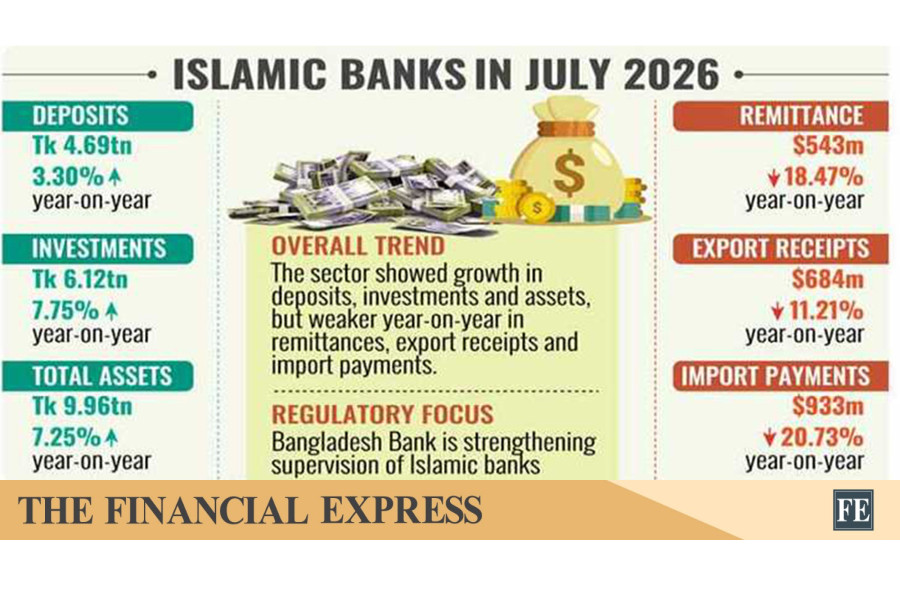
The volume of deposits with Islamic banks stood at Tk 4.69 trillion in July 2026, Tk 20 billion or 0.39 per cent up from Tk 4.67 trillion in the previous month (June).

On a year-on-year basis, the amount of deposits increased by Tk 150 billion, or 3.30 per cent, from Tk 4.54 trillion in July 2025.

The central bank data showed that Mudaraba-based deposits continued to dominate Islamic banks' deposit base, accounting for about 87.04 per cent of total deposits.

Private-sector deposits accounted for around 90.01 per cent of the total in July.

Investments by Islamic banks remained almost static at Tk 6.12 trillion in July over the previous month.

However, on a year-on-year basis, their investments increased by Tk 440 billion, or 7.75 per cent, from Tk 5.68 trillion in July 2025.

Islamic banks' workers' remittances rose to $ 543 million in July from $448 million in June, increasing by $ 95 million, or 21.28 per cent.

But on a year-on-year basis, remittances declined by $123 million, or 18.47 per cent, from $ 666 million in July 2025.

On the other hand, total assets of Islamic banks stood at Tk 9.96 trillion in July compared to Tk 9.88 trillion in June, marking an increase of Tk 80 billion, or 0.83 per cent.

Their assets increased by Tk 670 billion or 7.25 per cent year-on-year, from Tk 9.29 trillion.

Islamic banks handled $684 million in export receipts in July, which was $59 million or 7.90 per cent down from US $743 million in June.

The year-on-year export receipts declined by $87 million, or 11.21 per cent, from $771 million.

Despite the decline, Islamic banks continued to handle a relatively stable share of the country's export proceeds, ranging between 17 per cent and 22 per cent.

Import payments through Islamic banks declined to $ 933 million in July from $ 991 million in June, falling by $58 million or 5.91 per cent.

On a year-on-year basis, import payments decreased by $244 million, or 20.73 per cent, from $1.177 billion.

Bangladesh Bank has been strengthening its supervision on Islamic banks, including measures related to liquidity support, identifying weaknesses and improving management capacity, amid efforts to stabilise the sector.​
 

Banks fret over deposit buildup sans investment scope
Many banks receiving much money from depositors but finding little avenues for rolling it in economy


1789962712682.webp


Liquidity crunch looks to be a thing of the past now as affluent commercial banks in particular fret over deposit buildup amid squeezing investment avenues for economic slowdown,

An analysis of the paradoxical situation shows various regulatory moves and deposit-mobilising drives by the country's banks helped in gradually restoring people's once-shaken trust in the banking sector. As such, the deposit growth keeps rising, which basically helps boost their stock of excess liquidity.

But such liquidity buildup fails to lighten up mood of the bankers because the demand for private-sector credits has not picked up despite various regulatory moves. On the other hand, yields on government securities are on a downturn feeding on an abundance of liquidity in the banking system.

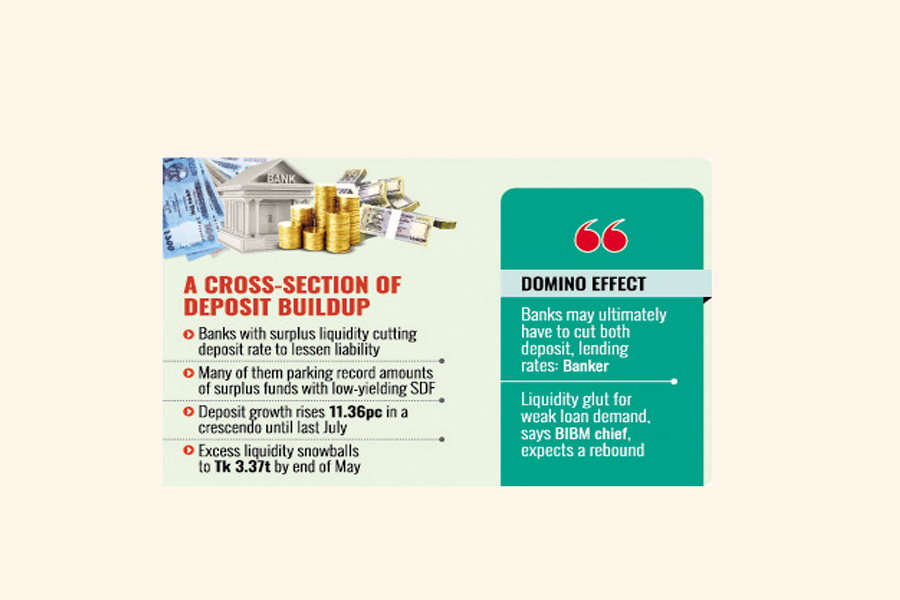
As such, depositors begin to bear its domino effect as banks having surplus liquidity keep cutting deposit rate to lessen the liability while many of them are parking record amounts of surplus funds with the central bank's low-yielding deposit window called Standing Deposit Facility (SDF).

The SDF rate has come down to 7.50 per cent, much lower than that of call money.

According to Bangladesh Bank (BB) data, the deposit growth in the banking system was recorded at 7.77per cent in June last year. Afterwards, it started rising to reach 10.44 per cent in January this year followed by 10. 74 per cent and 11.36 per cent in June and July last respectively.

Seeking anonymity, a BB official said the volume of excess liquidity in the banking industry continued to rise in recent months due mainly to shrinking investment avenues under this macroeconomic sluggishness.

Citing data, the central banker said the volume of excess liquidity was less than Tk 2.80 trillion few months ago but it rose to Tk 3.37 trillion by end of May last--and the rising trend continued.

"So, this (excess liquidity) puts the banks in a problem as loan demand weakens. That's why banks are heavily relying on SDF," the BB official said.

According to the BB data, affluent banks all together kept around Tk 1.50 trillion in the SDF in June last, which is a record in the history of the banking sector.

The official data showed the monthly volume of funds banks parked into the SDF were recorded Tk 545 billion, Tk 578 billion, Tk 444 billion and Tk 444 billion in February, March, April and May last.

Syed Mahbubur Rahman, Managing Director and Chief Executive Officer of Mutual Trust Bank (MTB), feels the growing buildup of excess liquidity is likely to become a pressing challenge for many banks as investment avenues continue to shrink amid prolonged economic sluggishness.

He explains that, in terms of incremental deposit costs, banks are barely making any money, while blended deposit costs remain manageable for some institutions-at least for those considered better managed.

However, Mr. Rahman has cautioned that if the situation persists, commercial banks may ultimately have no alternative but to reduce both deposit and lending rates. In such a scenario, deposit rates may even fall further, thereby rendering the real income of depositors negative.

Managing Director and CEO of Southeast Bank Md. Khalid Mahmood Khan has said the bank has a target of reaching deposit portfolio of Tk 500 billion by the end of upcoming December but they have already reached the milestone.

The lender is concentrating on profitability buildup through reducing the cost of deposit. They have already cut the deposit rate by 50 basis points and the bank will hold an ALCO meeting later this week where further cut in deposit is expected.

Managing Director of Shahjalal Islami Bank Mosleh Uddin Ahmed says the rising stock of un-invested liquidity in banks is turning into a headache for many of them in recent months due to plummeting loan demand.

On squeezing investment avenues, the seasoned banker says the use of central bank's overnight deposit window called SDF by affluent banks is increasing.

According to the BB data, the private-sector-credit growth reached 4.62 per cent by end of July, the second lowest in the history of Bangladesh.

Director-General of Bangladesh Institute of Bank Management (BIBM) Dr Md. Ezazul Islam notes that the liquidity glut in the banking sector is being created because of weak loan demand.

But the number and volume for the opening of LCs or letters of credit are increasing gradually, which gives early indication of economic recovery under the regime of this elected government.

"It's a temporary problem. I believe the credit demand from private sector would go up from the last quarter this year," the economist said, on a note of optimism.

The yields on 91 Days, 182 Days and 364 Days treasury bills stood at 8.31 per cent, 8.45 per cent and 8.47 per cent on Sunday.​
 

Crisis in Bangladesh’s Islamic banks: Liquidity is not capital, and a merger is not a cure

M Kabir Hassan

On September 9, Parliament shut a door that shouldn’t have been opened to begin with. The Bank Resolution (Amendment) Bill repealed Section 18A of the Bank Resolution Act 2026. This section allowed the previous owners of a resolved bank to buy it back for 7.5% of the public money spent to bail it out. The previous owners would pay off the remaining 92.5% over two years at 10% simple interest. Those responsible for the lending that destroyed those banks can now repurchase them at a discount using money from the very taxpayers who cleaned up the lenders' initial mess.

One day later, the numbers came. At the end of June, classified loans throughout the entire banking system totalled Tk 6,06,555 crore, representing 32.78% of all disbursed loans. Just ten banks hold over 72% of that total. Bangladesh ranks higher than other countries in South Asia, where the regional average is 7.9%. However, Bangladesh is not an outlier within a regional trend. Rather, Bangladesh stands alone.


1790135107635.webp

The crisis in our banking system indicates both an ethical and institutional collapse. Visual: Salman Sakib Shahryar.

The crisis in our banking system is not a technical failure of intermediation, where there also happen to be ethical questions. Rather, the crisis is that the balance sheets show Bangladesh is experiencing both an ethical collapse and an institutional collapse. Capital requirements, provisioning standards and risk weights are the tools used to measure how much damage has occurred, but they do not represent the origin of that damage.

What the numbers were hiding

Let us start with the question that should unsettle every supervisor, auditor and bank manager in the country. In 2023, the NPL ratio was reported at approximately 10%. It is more than 32% today. Very little of that percentage change reflects loan defaults occurring during the past 24 months. Most of the change indicates losses that were incurred earlier but were swept under the rug through repeated rescheduling, court stay orders and supervisory forbearance.

Evaluating the situation honestly leads to a grave conclusion. If a reported 10% non-performing loan ratio hid a true economic ratio of nearly 30%, the banking system was essentially insolvent for many years while reporting sufficient capital. An error of such magnitude cannot simply be a clerical oversight. Significant portions of the regulatory, accounting and auditing systems were failing in their duties. Insolvency of this scale did not appear in any published data until a political transition removed those who had a vested interest in hiding it.

The mechanisms that hide the truth remain partially intact. According to Bangladesh Bank’s own data, the reported ratio fell from 35.73% in September 2025 to 30.60% in December, before rising again to 32.26% in March. The fall was not a recovery. It was merely a window of time that allowed defaulters to reclassify their outstanding balances on the basis of a down payment as small as 2%.

A ratio that falls when the rules are relaxed and rises again when the rules return to normal is indicative of policy changes and does not measure actual repayment.

Seven banks deferred provisioning against bad assets under a special regulatory arrangement that allowed them to disguise about Tk 1.16 lakh crore in losses in their closing financial statements for 2025. Islami Bank Bangladesh, associated with ethical finance in Bangladesh for decades, reported a consolidated profit of Tk 136 crore for 2025 despite having a shortfall of Tk 84,615 crore in provisions. Reported system capital, even at the World Bank's estimate of minus 2.6% at the end of 2025, understates the true state of affairs.

The test case nobody wanted

Islamic banking in Bangladesh provides an acute test case of whether formally stated ethical commitments provide protection for institutions operating in an environment where governance is compromised. The sector holds close to a fifth of national deposits and accounts for about a quarter of all financing. The sector holds nearly half of agent banking deposits and facilitates about one in every six taka of inbound remittances. It is systemically important by any definition a supervisor would use.

According to the same supervisor's numbers, it is also the most damaged part of the system. According to Bangladesh Bank’s updated figures released in March, the NPL ratio for full-fledged Islamic banks was 58.4%. By contrast, for foreign commercial banks, this figure was just 6.3%, with those banks operating within the same economy, under the same macroeconomic conditions and lending to the same class of borrowers. Similarly, while the average advances-to-deposit ratio for the entire banking system was 82.7%, Islamic banks had an advances-to-deposit ratio of 120.3%.

Forensic audits conducted on the five banks ultimately involved in the merger revealed default ratios ranging from 48% to as high as 98%, with three exceeding a default rate of 95%. These two columns resolve an important issue. If macroeconomic pressures were the primary driver of the crisis, then distress should be relatively evenly distributed among exposed institutions. That is clearly not happening here. Instead, the crisis exists in proportion to where ownership was concentrated, where related-party financing ran unchecked and where controlling shareholders exercised full control over the boards.

BIBM’s Governance Index marked foreign banks at 76 points, private banks at 58 points, Islamic banks at 49 points and state-owned banks at 42 points. This ordering almost perfectly mirrors the distribution of default ratios.

Reading this as evidence against Islamic finance would be a categorical mistake, and I want to be precise about why.

Islamic banking in Bangladesh did not fail because it followed its principles too closely. The Islamic banking sector failed because it adopted formal structures while diverging from its purpose.
Form certified, substance abandoned

Islamic banking in Bangladesh did not fail because it followed its principles too closely. The Islamic banking sector failed because it adopted formal structures while diverging from its purpose. Mark-up and lease-like contracts, including murabaha, bai-muajjal and hire purchase under shirkatul melk, make up about four-fifths of the sector's financing. On the asset side, these contracts behave like debt. The bank's profit is fixed from the beginning, and the contracts do not truly allow the bank to share the borrower's commercial risk. On the liability side, 86.87% of deposits are mudaraba accounts whose holders are theoretically capital providers who bear losses. In reality, no Bangladeshi Islamic bank has ever distributed losses to account holders. Profit equalisation, investment risk reserves and state support have kept returns close to conventional deposit rates.

The sector therefore combined the credit risk of debt-based intermediation with none of the loss absorption that risk-sharing was supposed to provide. The implementation gap in the risk-sharing ideal ultimately became a source of capital fragility.


1790135164363.webp

Audits of the merged banks showed default ratios ranging from 48% to 98%, with three exceeding 95%. Visual: Star.

Shariah supervisory boards did not catch this, and it is worth understanding why not. Such a board asks whether a murabaha has a genuine underlying asset, whether ownership was transferred correctly and whether profit was properly fixed as a mark-up. It does not usually ask whether financing is concentrated in entities related to the dominant shareholder, whether the collateral was valued at three times its worth or whether single-borrower limits have been breached. Those are prudential questions assigned to boards, internal audit and the regulator, which is to say precisely the controls that ownership concentration had disabled.

Picture a murabaha extended to a shell company controlled by the dominant shareholder, secured against an inflated asset, with no real transfer of ownership. This murabaha can satisfy all the written conditions of the Shariah board yet, at the same time, fail to protect properly what depositors have entrusted to the bank. This would violate the general principles underlying murabaha structures.

A board that certifies contracts but never examines controlling-shareholder risk confers legitimacy without providing protection. That is more dangerous than no certificate at all because it attracts exactly those depositors least able to bear a loss.

The principles violated here are fundamental Islamic principles: amanah in the safeguarding of deposits, adl in the allocation of credit, truthfulness in reporting and Hifz al-mal (the preservation of wealth). If protecting wealth is an objective of the Shariah, then concentration limits, related-party rules and honest provisioning are not merely matters of prudence. They are matters of Shariah, and boards that decline to examine them are not discharging their duty.

Liquidity is not capital

One principle should organise everything that follows. Liquidity support can carry a solvent institution through a temporary shock. It can never substitute for capital in an insolvent one.

Bangladesh has now run that experiment at scale. Roughly Tk 35,300 crore of central bank liquidity went into the five weak Shariah-based banks before their resolution. It kept them open. It did not make them solvent, because their combined defaults stood at Tk 1.66 lakh crore, or 84.22% of their loans, by March. What was eventually required was capital: Sammilito Islami Bank PLC began operations in August, capitalised at Tk 35,000 crore, of which Tk 20,000 crore is direct government money, and the balance comes from converting depositors' balances into shares.

Liquidity support, fiscal recapitalisation and depositor bail-in are fundamentally different tools used to address three fundamentally different problems. Using the term "rescue" for each of these tools hides the actual cost to society and obscures who will bear the financial burden. Turning deposits into equity is a legitimate tool for resolving institutions, but it imposes a loss on those who neither requested nor priced the risk involved. Bangladesh has one of the lowest tax-to-GDP ratios in the world. Every taka of public capital is directly competing with schools and clinics.

The merger preserved depositor protection and operational continuity, and that was worth doing. But it is important to recognise that operational continuity is not proof of solvency. Participation banking in Turkey offers a lesson in how rapidly state-sponsored programmes can increase the sector's market share while transferring governance risks when they should instead be eliminating them. A new state-owned Shariah-based bank with 760 branches inherits that lesson, regardless of whether anyone in Dhaka chooses to learn from it.

What should be done, in order

Repealing Section 18A was necessary yet insufficient. Eight measures are now the top priority, and they are listed in the order in which they should be tried.

Publish a bank-by-bank asset quality review within six months. It should be conducted independently and cover institutions holding at least 90% of system assets. At present, no one trusts the numbers that inform all subsequent decisions. Disclosure will move deposits towards stronger banks, which makes it essential to have expanded deposit protection and resolution protocols ready at the outset rather than introducing them only after the process has begun.

Set a public, bank-specific and dated path towards expected-credit-loss provisioning ahead of the December 2027 IFRS 9 deadline. A published deadline and a clearly identified set of institutions would provide a clear picture of the transition away from forbearance.

Trigger corrective action on measured capital rather than reported capital. Escalating and largely non-discretionary consequences at each threshold should accompany these corrective actions. Where an override is legitimately warranted, it should be documented and publicly reported. Informal discretion helps explain how the last decade transpired.

New capital placed into an unchanged board and an unchanged related-party book is not restoration. It is refinancing the original loss.
Make recapitalisation conditional on governance change. New capital placed into an unchanged board and an unchanged related-party book is not restoration. It is refinancing the original loss. Board reconstitution, exposure limits and binding remediation plans should be written into the terms. A simple test should come twelve months later, asking whether the bank holds its minimum capital ratio on AQR-adjusted numbers.

Designate payments, remittances, trade finance and agent banking as critical functions within the resolution framework, with pre-arranged transfer mechanisms. Improvisation is not an option when repairing a sector that handles more than one-sixth of national remittances.

Create a standing Shariah-compliant emergency liquidity facility on mudaraba or collateralised wakalah terms. Published eligibility conditions, pricing and a solvency precondition should accompany it. Islamic banks cannot use an interest-based lender of last resort, which is why their emergency support has been ad hoc and discretionary. This discretion was an underlying cause of abuse.

Pass an Islamic Banking Act that expands risk-sharing rather than codifying its absence. Bangladesh regulates approximately 25% of its deposits with guidelines that have only been marginally revised since being introduced in 2009. There is no statute providing guidance on the capital treatment of profit-sharing investment accounts, no legal definition of the rights of mudaraba depositors during liquidation proceedings, and no tax neutrality associated with the numerous asset transfers required by these contracts. Malaysia's Islamic Financial Services Act 2013 provides a useful example of legislation that could serve as a model for the development of regulatory frameworks in Bangladesh. It is nonetheless important to recognise that Malaysia's Islamic Financial Services Act 2013 was effective because of the influence of Bank Negara's binding Shariah Advisory Council and specialised supervisory personnel, rather than simply because of the provisions of the law. Ultimately, the primary concern is that Bangladesh could develop a law that merely sanctions the debt-mimicking contract structures that exist today and then consider the mission complete.

Abolish the minimum shareholding requirement for bank directors. Developing a regulatory framework based on fit-and-proper person assessments would represent one of the most impactful and least costly reforms currently available. No comparable jurisdictions, including India, Malaysia, Singapore and the UK, allow ownership to be considered an element of qualification for membership of bank boards. Bangladesh does allow ownership to be an element of qualification. Control exercised through family and business-group membership constitutes a systemic feature rather than merely an abusive practice. Boards should function as checks on owners and not as mere extensions of ownership. Establishing genuine fit-and-proper assessments, requiring independent board members who meet an objective test for independence, and limiting family-member representation constitute essential reforms.

Two additional elements must accompany these reforms. The proposed amendments to the Bangladesh Bank Order 1972, scheduled for 2025, which grant the central bank administrative and financial autonomy and accountability to Parliament rather than to the executive, should be implemented. The IMF's 2025 Article IV Consultation similarly identified this issue in more diplomatic terms. Finally, deposit insurance coverage for Islamic banks should transition from a general-purpose deposit insurance fund with fixed premium rates to a takaful-based fund with risk-based premiums corresponding to the types of contracts it insures, particularly given that deposit insurance coverage has increased to Tk 2 lakh.

The harder half

None of these reforms can occur without meaningful enforcement. Single-borrower lending limits, related-party rules, classification standards and corporate governance guidelines have existed for years. These regulations did not disappear. Rather, they became unenforceable against individuals who could not be held accountable.

In my BIBM survey of 205 bankers, regulators, academics and customers, 28% named political interference as the single largest cause of eroding banking ethics. Seventy-five percent pointed to loan approval and rescheduling as the most compromised functions. Eighty percent doubted that cases against senior executives are properly investigated. Deterrence works through expectation. If supervisors are perceived as unable to act against connected defaulters, then no deterrent exists.

The recently announced one-time exit programme, which permits large-scale defaulters to settle debts through lump-sum payments, with interest waived at the discretion of bank boards, before the end of December, should be closely monitored rather than praised. A similar programme was introduced in 2019, permitting large-scale defaulters to regularise payments under temporarily lenient conditions, only for some to default again shortly thereafter. Recovery schemes should reflect the costs of funding sources and target legitimate failures. When they turn into time-sensitive amnesties, recovery schemes risk enabling systemic corruption.


1790135219340.webp

Forced mergers between struggling banks risk exacerbating capital fragility without addressing the underlying liquidity drain. Visual: Slow Reads.

Bangladesh reached a level at which approximately 25% of total national financing was provided through Shariah-based banking before establishing laws specifically regulating Islamic banking, along with the necessary supervisory and depositor protection mechanisms. Market share was mistakenly interpreted as evidence of systemic integrity. Emerging countries seeking to develop Shariah-based finance markets should draw the lesson in its clearest form. Establishing regulations must happen before markets expand. Once markets have developed, regulation cannot simply follow without someone bearing the consequences.

Bangladesh's reform question has never truly been about what the rules should say. Rather, the reform question is about who has both the authority and the incentives to enforce them. On September 9, Parliament provided part of this answer by denying failed owners permission to purchase their way back into failed entities. The remainder will be demonstrated over time by whether a supervisor can publish an unfavourable rating, downgrade a connected borrower and still keep her job.

Trust in banking is not restored through mergers or ordinances. Rather, trust in banking is restored when a powerful defaulter realises that he, too, is subject to the rules, and when the people watching believe that things will continue to work this way.

Dr M Kabir Hassan is a professor of finance and the Moffett Chair in the Department of Economics and Finance at LSU-New Orleans, USA. He is a Senior Fulbright Scholar, recipient of the 2016 IsDB Prize in Islamic Banking and Finance, a member of the AAOIFI Ethics and Governance Board, and Chairman of its Education Board.​
 

Role of brand communication in banking industry: Challenges and prospects

Khairul Hasan
Published: 25 Sep 2026, 08: 33

1790317753286.webp

File photo

A commercial bank does not sell something a customer can see, touch or take home. It sells a promise—the promise that money will be safe, transactions will be secured and services will be delivered with care. When a customer deposits savings, takes a loan or sends money, it is more than a financial transaction. It is an act of trust.

Banking is therefore, at its heart, a business of trust. In today's competitive and increasingly digital financial world, that trust is closely connected with how a bank communicates, behaves and serves its customers.

This is particularly important for Bangladesh's banking industry. Bangladesh Bank data indicate that bank deposits reached approximately Tk 20.94 trillion in July 2026, while bank credit/investment stood at around Tk 25.81 trillion. Behind these figures are millions of customers, businesses and institutions whose economic activities depend on banks. Yet the sector also faces serious challenges. Bangladesh Bank's Financial Stability Report 2025 reported gross non-performing loans of Tk 5.57 trillion at the end of December 2025, with the gross NPL ratio reaching 30.60 per cent.

Against this backdrop, brand communication is no longer simply about advertising the products and services of the banks. It is an important tool for building confidence, explaining services, managing expectations and protecting reputation.

The traditional image of bank branding is familiar: newspaper advertisements, television commercials, billboards and campaigns for deposits, loans or cards. These remain relevant, but customers now experience banks through many more channels. They may see a Facebook post, use a mobile app, receive an SMS, withdraw money from an ATM, contact a call centre or read a news report—all without visiting a branch.

This has changed the meaning of a banking brand. A brand is no longer merely a logo, colour or slogan; it is the sum of customers' experiences with the institution. The ease of opening an account, speed of complaint resolution, reliability of digital services, clarity of communication and behaviour of frontline employees all shape perception. Every customer touchpoint is now a brand touchpoint.

Furthermore, Bangladesh's rapid digital transformation has accelerated this trend. Internet banking, mobile financial services, cards, QR payments and agent banking have expanded access, while payment systems such as BEFTN, NPSB, TakaPay and Bangla QR have strengthened the digital ecosystem. The smartphone has, in effect, become a branch in the customer's pocket.

But digitalisation has also multiplied reputational risks. A complaint that once remained inside a branch can become a social-media post within seconds. A screenshot can travel widely, while an unverified rumour can reach thousands before a bank completes its investigation.

Social-media management can therefore no longer mean simply posting promotional content. Banks must listen as carefully as they communicate, respond to genuine complaints, correct misinformation responsibly and provide accurate information quickly. When concerns arise about asset quality, governance or financial stability, communication itself becomes part of the institutional response. Silence may create uncertainty, while contradictory or exaggerated statements can damage credibility. Responsible communication must be factual, timely and consistent.

Bangladesh's banking sector currently includes 43 private commercial banks, of which 33 are conventional and 10 are fully Shariah-based Islamic banks, alongside state-owned, specialised and foreign banks. Many offer similar deposits, financing, cards, remittance and digital services. Products can be copied, campaigns matched and technology replicated. A strong reputation, however, is much harder to copy.

This is why marketing needs to evolve. It should begin not with how to advertise a product, but with understanding the customer: What problem does the customer have? What solution does the bank offer? Why should the customer trust it?

A young professional may need salary services, digital payments, cards, savings facilities and eventually housing or investment finance. An SME entrepreneur may require financing, transaction banking, digital collections, trade services and financial guidance. Understanding these broader needs enables a bank to build relationships rather than simply sell products.

Customer experience is therefore inseparable from brand communication. A bank may describe itself as customer-centric, digital or fast, but customers judge those claims against reality. If an advertisement promises convenience while a customer repeatedly visits a branch to resolve a simple issue, the brand promise loses credibility.

Communication creates the promise. Service creates the experience. Experience creates the reputation.

This principle is especially important in Islamic banking. Customers may expect not only financial services but also Shariah compliance, ethical conduct and fairness. Terms such as Mudaraba, Musharaka, Murabaha, Ijarah and Al-Wadiah carry substantive meaning and should not be used merely as marketing language. The credibility of an Islamic banking brand depends on alignment among communication, products, governance, Shariah oversight and actual practices. Shariah governance is therefore an important foundation of trust.

Employees are equally important brand representatives. Customers may see hundreds of advertisements but remember a single conversation with a branch employee for years. Employees explain products, handle complaints and represent the institution every day. Internal communication must therefore ensure that employees understand the bank's purpose, products, values and service standards. A well-informed employee can strengthen a campaign; a poorly informed one can undermine it.

The future of banking marketing will also be increasingly data-driven. Reach and impressions remain useful, but banks should measure outcomes: Did customers open accounts? Did deposits increase? Did digital adoption improve? Did complaints decline? This represents a shift from measuring activity to measuring outcomes.

Artificial intelligence and analytics can help banks understand customer needs, personalise communication and identify service problems. Yet banking data are highly sensitive. Personalisation must not become intrusion, and technology cannot replace accountability.

Financial literacy offers another opportunity. Customers need practical guidance on saving, responsible borrowing, digital fraud prevention, household finance and SME cash-flow management. When banks provide such knowledge, they do more than promote products—they build confidence and stronger relationships.

Corporate social responsibility can reinforce this role through financial literacy, SME development, women's entrepreneurship, youth employment, sustainable finance and financial inclusion. When such initiatives are meaningful and measurable, CSR becomes part of the bank's identity rather than merely another publicity exercise.

Ultimately, the future requires an integrated approach. Public relations, marketing, digital communication, customer experience and internal communication may remain separate functions, but customers see only one institution. A bank cannot have one personality in its advertisements, another at its service points and a third on social media.

For Bangladesh's banking industry, the challenge is to move from slogans to evidence, from publicity to transparency and from short-term visibility to long-term reputation. Digital channels can bring banks closer to customers, data can make communication more relevant, financial education can deepen relationships and meaningful social initiatives can strengthen public confidence.

But no technology or campaign can substitute for integrity. A bank can buy visibility, but it cannot indefinitely buy trust. Trust is earned when the advertisement matches the service, the product matches the promise, employees reflect the brand values and public statements are supported by actions.

The most important transformation in banking marketing, therefore, is not technological but philosophical. The traditional question is: How can we persuade customers to choose our bank? The more important question is: How can we become a bank that customers have genuine reasons to trust?

In an increasingly competitive industry, a powerful banking brand is built not merely by communicating loudly, but by communicating clearly, serving consistently and remaining credible when circumstances become difficult. Ultimately, the most powerful banking advertisement is neither a billboard nor a television commercial. It is the quiet confidence with which one customer tells another: “I trust my bank.” In an industry built on confidence, that may be the most valuable brand message of all.

Khairul Hasan is an Assistant Vice President at the Brand Communication Division of Sammilito Islami Bank PLC​
 

Four more digital banks get BB’s initial approval
Staff Correspondent . Dhaka 25 September, 2026, 00:52

The Bangladesh Bank has given initial approval to four more digital banks.
1790319161306.webp


The four new applicants are bKash Digital Bank, sponsored by bKash shareholders, Digital Banking of Bhutan, backed by Bhutan’s DK Bank, Nova Digital Bank, sponsored by Vion, the parent company of Banglalink, and Boost Digital Bank, sponsored by Robi Axiata Ltd.

The central bank also allowed Nagad Digital Bank PLC and Kori Digital Bank PLC, approved during the Awami League government, to move ahead under revised conditions.

The decisions were taken at a board meeting on Thursday chaired by governor Md Mostaqur Rahman.

The four new applicants are bKash Digital Bank, sponsored by bKash shareholders, Digital Banking of Bhutan, backed by Bhutan’s DK Bank, Nova Digital Bank, sponsored by Vion, the parent company of Banglalink, and Boost Digital Bank, sponsored by Robi Axiata Ltd.

The new framework requires each digital bank to start with Tk 300 crore in paid-up capital, compared with the previous requirement of Tk 125 crore. The capital must be fully paid in cash.

The central bank will also introduce a trial period before granting final licences. Newly approved banks will have to operate for six months on a trial basis and meet regulatory requirements before receiving final approval. Failure to do so could result in the final licence being withheld.

Bangladesh Bank issued Nagad’s final licence in June 2024, shortly before the fall of the Awami League government.

It had earlier issued letters of intent to Nagad and Kori at its August 2023 board meeting. The central bank later suspended Nagad’s licence following allegations concerning the ownership and funding of companies involved in the bank.

Kori faced a similar problem. Its main sponsor is technology company Technohaven, founded by Habibullah Nayeemul Karim, husband of former finance secretary Fatima Yasmin. Bangladesh Bank could not obtain information on four US-registered companies linked to its ownership.

A Bangladesh Bank official said Nagad’s licence had already been issued, while Kori’s letter of intent remained valid. Both can proceed if they accept the new conditions, but controversial or absconding sponsors cannot remain involved.

Bangladesh Bank invited applications for digital banks in June 2023, receiving 52 applications. Nagad and Kori were the only two initially approved.​
 

What is a digital bank and how does it work?
New Age Online 26 September, 2026, 10:27

1790468756542.webp

Collage: New Age

A digital bank is a bank without physical branches, where customers can open accounts, deposit and transfer money, make payments and apply for loans through a mobile app or website.

On September 25, the Bangladesh Bank has given initial approval to four more digital banks.

The first guidelines were issued on June 14, 2023, and the framework has since been revised.

How customers will use a digital bank

Open an account from a phone: Customers will be able to open accounts through an app without visiting a branch. Their KYC, or identity verification, will be completed digitally.

Manage money through the app: Customers can check balances, transfer money, pay utility bills, save money and make other banking transactions through the app or website instead of visiting a branch.

Make digital payments: Digital banks can provide virtual cards and QR-based payment facilities. They cannot issue physical cards.

Withdraw cash through other networks: A digital bank will not have its own ATMs or branches. Customers needing cash will have to use ATM and agent networks of other banks, permitted cash-out channels or other approved facilities.

Apply for loans digitally: Customers can apply for loans through the app. Digital banks may use transaction records and AI-based credit scoring to assess borrowers, potentially allowing people without traditional collateral to access credit.

Why customers may choose a digital bank

The main attraction is convenience. Customers will not need to travel to a branch, wait at a counter or conduct banking only during branch hours. Most routine services can be accessed through a phone at any time.

Digital banks may also reach customers who have remained outside conventional banking because there is no nearby branch or because they lack assets that can be pledged as collateral. Small traders and other borrowers with a reliable digital transaction history could potentially use that record to establish their creditworthiness.

Lower operating costs could also allow digital banks to offer competitive fees and services, although this will depend on how individual banks price their products.

What customers will not get

Digital banks are not simply conventional banks operating through an app. They face restrictions on their activities. They cannot open letters of credit or provide loans to large and medium industries. Their lending is intended to focus on individuals and smaller borrowers.

Customers will also have to accept that there will be no branch to visit when they need face-to-face service and no ATM network belonging to the digital bank.​
 

Banks born of political favour now drowning in bad debt

Economists say banks approved on non-financial grounds were bound to run into trouble

Ahsan Habib and Md Mehedi Hasan

1790553600327.webp


Three of the nine banks that entered the market in 2013 after receiving licences from the then Awami League government are now weighed down by non-performing loans (NPLs), according to Bangladesh Bank data and audited financial statements.

Of the remaining six, two have double -digit NPLs, while three have NPL ratios above the tolerable threshold.

At the time the licences were granted, there were allegations that political considerations, rather than financial merit, had influenced the decision. Economists say approving banks on political grounds rather than financial need has contributed to the sector’s current woes.

The nine new-generation lenders are Padma Bank, NRB Commercial Bank, NRB Bank, Global Islami Bank, Union Bank, Modhumoti Bank, Midland Bank, Meghna Bank and South Bangla Agriculture & Commerce (SBAC) Bank.

Global Islami Bank and Union Bank have since been folded into Sammilito Islami Bank, along with four other troubled lenders. Their deteriorating financial health came to light after the 2024 political changeover exposed bad loans that had long been concealed.

Both banks were controlled by the controversial S Alam Group and, by the time of the merger, Tk 97 of every Tk 100 they had lent had gone bad.


Union Bank made a profit of Tk 160 crore in 2023, then posted a loss of Tk 25,790 crore in 2024. By June this year, its non-performing loans reached Tk 27,134 crore, or 97 percent of total lending.

Global Islami Bank posted a profit of Tk 128 crore in 2023. The following year, it recorded a loss of Tk 1,246 crore. Its bad loans jumped from Tk 221 crore to Tk 12,661 crore in 2024 and stood at Tk 14,219 crore, or 97.27 percent of total loans, by June this year.


Padma Bank is in almost as dire a state, having struggled for years to return money to depositors. By June, its bad loans had reached Tk 4,933 crore, or 89 percent of its loan book.

It has not published accounts for a couple of years, and the Bangladesh Bank (BB) is now considering a merger.

NRB Commercial Bank and SBAC Bank are in less critical but still dangerous territory, with bad loan ratios of 21 percent and 16 percent respectively.

NRB Bank, Modhumoti Bank and Meghna Bank all have single-digit bad loan ratios, but each is above the 5 percent ceiling that regulators generally regard as safe.

Midland Bank stands out as the exception.

It has remained profitable while its bad loans increased only slightly, from Tk 182 crore in 2023 to Tk 189 crore in 2025. But asset quality deteriorated in the first half of 2026, with bad loans reaching Tk 412 crore, or 5.67 percent of total loans, by June.

THE WALKING WOUNDED

Of the nine commercial lenders, SBAC Bank and NRB Commercial Bank have double-digit NPL ratios as their profits have fallen in recent years.

SBAC Bank’s profit fell from Tk 54 crore in 2023 to just Tk 70 lakh in 2025, while bad loans surged from Tk 460 crore to Tk 1,724 crore.

By June this year, bad loans stood at Tk 1,557.27 crore, or 16.27 percent of total loans.

NRB Commercial Bank has followed a similar trajectory. Its profit fell from Tk 198 crore in 2023 to just Tk 7 crore in 2024, before recovering to Tk 13 crore in 2025.

Google News LinkFor all latest news, follow The Daily Star's Google News channel.
Over the same period, bad loans climbed from Tk 615 crore to Tk 2,524 crore. By June this year, they had risen further to Tk 3,218.78 crore, or 21.43 percent of total loans.

“We are now busy reducing our bad loans,” said Md Touhidul Alam Khan, the bank’s managing director and chief executive officer.

He said that before he joined, NRB Commercial Bank’s provision shortfall stood at Tk 3,600 crore, which has since fallen to Tk 802 crore.

The bank aims to bring bad loans below 20 percent, Touhidul said, adding, “We are trying to reduce the bad loans through the one-time exit policy, easy loan rescheduling and other policy support introduced by the banking regulator.”

STILL ABOVE THE SAFE THRESHOLD

NPL levels at NRB Bank, Meghna Bank and Modhumoti Bank are in single digits but are above the 5 percent level considered safe.

Bad loans at NRB Bank climbed from Tk 255 crore in 2023 to Tk 749 crore in 2024, before easing to Tk 593 crore in 2025 and Tk 585 crore, or 7.58 percent of total loans, by June this year.

Tarek Reaz Khan, managing director and chief executive officer of NRB Bank, said the bank has recovered a significant share of its bad loans through BB’s policy support and legal action.

By August this year, the bad loan ratio had fallen further to 7.40 percent, with a target of 5 percent by year-end. “NRB Bank now has strong liquidity,” Tarek added.

Over the past three years, Meghna Bank has expanded rapidly, with both loans and deposits increasing.

But its profit has slumped from Tk 77 crore in 2023 to just Tk 5 crore in 2025. During the same period, its bad loans rose.

By the end of June this year, its bad loans rose further to Tk 432.87 crore, or 5.60 percent of total loans, according to BB data.

Similarly, Modhumoti Bank’s profit fell from Tk 125 crore in 2024 to just Tk 6 crore in 2025, while bad loans reached Tk 561 crore by June, or 6.88 percent of total loans.

A SECOND ROUND, THE SAME STORY

A second round of bank approvals by the Awami League government followed in late 2018 and 2019, bringing Community Bank, Bengal Commercial Bank, Citizens Bank and Shimanto Bank to the market.

Among them, Community Bank is in the strongest position. Its profit rose from Tk 71 crore in 2024 to Tk 102 crore in 2025, while its bad loans had fallen by June to just Tk 5.32 crore, or 0.33 percent of total loans.

Citizens Bank, established in 2020, has also kept bad loans low while expanding quickly, although its profit was just Tk 2 crore in 2025. Its NPLs stood at Tk 162.46 crore, or 2.65 percent of total loans, by June this year.

Bengal Commercial Bank’s profit fell last year, but its deposits and loans grew strongly.

“As a new bank, the overall performance of Bengal Commercial Bank is not bad,” said its managing director, KM Awlad Hossain.

“Some loans were turning overdue because of the wider business climate. We are focusing on loan recovery through different methods, including loan rescheduling and cash recovery,” he told The Daily Star.

Meanwhile, Shimanto Bank’s financial performance has also deteriorated.

Its profit rose from Tk 24 crore in 2023 to Tk 39 crore in 2024, then swung to a loss of Tk 82 crore in 2025 as bad loans jumped from Tk 11.68 crore to Tk 151 crore. By June this year, they had eased slightly to Tk 133.73 crore, or 4.88 percent of total loans.

Banks approved in 2013, and those approved later should not be compared directly because newer banks generally face fewer asset-quality problems in their initial years of operation.

POLITICAL PRICE

Mustafa K Mujeri, executive director of the Institute for Inclusive Finance and Development and a former chief economist of BB, said the country is now seeing the results of banks that were approved because of political considerations.

He said the approval of financial institutions and the appointment of their officials should rest on financial rather than political grounds.

“If that happens, then we can see good results,” he said, adding that the then finance minister had himself acknowledged the banks got licences on political considerations.

“If you take any policy based on political considerations, then you must fail, or there will be no good results,” he told The Daily Star.

“Not only those banks, but the country’s banking sector as a whole is now struggling due to political influence. We should come out of such practices; otherwise the banking sector will not recover soon,” the economist added.​
 

Four more digital banks get BB’s initial approval
Staff Correspondent . Dhaka 25 September, 2026, 00:52

The Bangladesh Bank has given initial approval to four more digital banks.
View attachment 29392


The four new applicants are bKash Digital Bank, sponsored by bKash shareholders, Digital Banking of Bhutan, backed by Bhutan’s DK Bank, Nova Digital Bank, sponsored by Vion, the parent company of Banglalink, and Boost Digital Bank, sponsored by Robi Axiata Ltd.

The central bank also allowed Nagad Digital Bank PLC and Kori Digital Bank PLC, approved during the Awami League government, to move ahead under revised conditions.

The decisions were taken at a board meeting on Thursday chaired by governor Md Mostaqur Rahman.

The four new applicants are bKash Digital Bank, sponsored by bKash shareholders, Digital Banking of Bhutan, backed by Bhutan’s DK Bank, Nova Digital Bank, sponsored by Vion, the parent company of Banglalink, and Boost Digital Bank, sponsored by Robi Axiata Ltd.

The new framework requires each digital bank to start with Tk 300 crore in paid-up capital, compared with the previous requirement of Tk 125 crore. The capital must be fully paid in cash.

The central bank will also introduce a trial period before granting final licences. Newly approved banks will have to operate for six months on a trial basis and meet regulatory requirements before receiving final approval. Failure to do so could result in the final licence being withheld.

Bangladesh Bank issued Nagad’s final licence in June 2024, shortly before the fall of the Awami League government.

It had earlier issued letters of intent to Nagad and Kori at its August 2023 board meeting. The central bank later suspended Nagad’s licence following allegations concerning the ownership and funding of companies involved in the bank.

Kori faced a similar problem. Its main sponsor is technology company Technohaven, founded by Habibullah Nayeemul Karim, husband of former finance secretary Fatima Yasmin. Bangladesh Bank could not obtain information on four US-registered companies linked to its ownership.

A Bangladesh Bank official said Nagad’s licence had already been issued, while Kori’s letter of intent remained valid. Both can proceed if they accept the new conditions, but controversial or absconding sponsors cannot remain involved.

Bangladesh Bank invited applications for digital banks in June 2023, receiving 52 applications. Nagad and Kori were the only two initially approved.​

Digital Banks are a bad idea. They are the equivalent of Hai Hai Company. Everything is in the cloud, and they can vanish at a moment's notice.
This kind of thing already happened in the US. Deposits are not guaranteed by the central bank (US Reserve). I don't think Bangladesh Bank should encourage these companies.

Taka marar ek number fondi.
 

Financial sector safeguard project up for govt approval
Technology-enabled banking to check NPL buildup, fiscal scams in focus


1790637097552.webp


A financial-sector project for promoting technology-enabled banking to check NPL buildup and fiscal scams is up for government seal of approval, officials say.

Checking digital heist and cyberattack into financial institutions is one of core objectives of the comprehensive project.

Bangladesh Bank is going to execute the scheme to strengthen safeguards for the country's financial sector through technology-enabled banking, the officials said Monday.

"Under the US$400-million financial support from the World Bank, the central bank is going to implement the Financial Sector Support Project-II (FSSP-II) for conducting massive reforms and improvement in the country's banking operations," said one official.

Bangladesh Bank officials have said they will strengthen supervisory capacity and ICT systems through development of ICT infrastructure and capacity building of the financial sector in Bangladesh.

At a cost of Tk 12.76 billion, the project is likely to be approved by the Executive Committee of the National Economic Council (ECNEC) at its meeting today (Tuesday).

Following numerous challenges facing the country's banking sector, including high levels of NPLs, weak governance, liquidity and capital pressures in some banks, and outdated information and communication technology (ICT) systems, the central bank has undertaken the project.

The NPLs in Bangladesh's banking sector ballooned to Tk 6.06 trillion as of June 2026, representing 32.78 per cent of total disbursed loans, central bank data showed.

According to the BB, the project will also provide advisory and consultancy services to improve institutional capacity and procurement related to ICT infrastructure.

A senior central bank official said, "Strengthening the financial-sector safeguards, technology-enabled banking and banking-sector reforms are among the core objectives of the project."

On completion of the project, the country's banking system will be "very tech-driven and scam like the reserve heist in 2016 would be checked", he hopes.

The central bank will strengthen financial-sector safeguards and banking-sector restructuring, including the financial-sector safeguards, bank resolution and reform of state-owned banks.

It will also seek to enhance the financial capacity of the Deposit Insurance Trust Fund (DITF) and improve the effectiveness of bank resolution and restructuring.

The BB official has said outdated ICT infrastructure and a lack of integrated information management have made it difficult for regulators to respond effectively to emerging risks, including cyberattack and trans-border financial risks.

"These challenges have collectively threatened depositor confidence and financial and economic stability," he added.

The project is being taken as a continuation of the first phase of the Financial Sector Support Project (FSSP), implemented by Bangladesh Bank.

In the next phase of the FSSP-II, the strengthening of the financial-sector safeguards through Performance-Based Conditions (PBCs) and facilitating banking-sector-reform activities will be continued.

"Increasing the financial capacity of the DITF for deposit-insurance operations, ensuring effective implementation of bank resolution and restructuring, including reducing payment periods, and improving governance and financial stability of state-owned banks will be our major reform areas," the central banker said.​
 

FDI hopes through digital banking

1790637446243.webp


Bangladesh Bank (BB)'s approval of a digital bank licence for a joint venture between international digital operator VEON Ltd. and Bangladesh's Square Group has added a new dimension to the country's search for foreign investment. VEON, the parent company of Banglalink, has committed an initial USD250 million as anchor investment under its "Invest in Bangladesh NOW!" initiative, while the broader programme aims to help mobilise USD1 billion in foreign direct investment across connectivity, digital infrastructure, digital financial services and artificial intelligence. The scale of the commitment makes the development significant.

The timing is also important. Bangladesh's net FDI inflow recovered to around USD1.77 billion in 2025, but fresh equity investment was only about USD555 million. In fact, much of the rise came from reinvested earnings and intra-company loans by businesses already operating here. So, a new commitment of USD250 million, if translated into actual projects and local infrastructure, would represent a substantial addition to recent fresh foreign capital. It could also help indicate whether international technology companies see Bangladesh as a market where they can build, not merely sell.

There is also the issue of financial inclusion. World Bank Global Fintex Database shows that only around 43 per cent of Bangladeshi adults had an account with a financial institution or a mobile money service provider in 2024. Mobile financial services have already familiarised millions with digital transactions. But a full-fledged digital bank can potentially go further by offering savings, small loans, payment products and other formal financial services without requiring customers to visit a conventional branch.

VEON reportedly has its digital financial platforms across Pakistan, Kazakhstan and Uzbekistan. The potential foreign investor's local partner too has a substantial business network. The proposed combination, therefore, is of international technological experience and local commercial reach. Whether that combination can actually reach small businesses, rural users and people now outside conventional banking will be one of the important tests of the venture.

The BB approval also raises a broader policy question. Bangladesh Bank recently approved several proposed digital banks, including ventures backed by foreign and local groups. The issue now is whether a transparent and predictable licensing environment can continue to attract other credible international digital operators with novel ideas. Investors willing to build data centres, cloud infrastructure, cybersecurity systems, payment platforms and other local digital facilities would bring a different kind of value from those interested only in selling imported digital services to Bangladeshi consumers.

For, foreign investment is not only about the amount of dollars entering the country. Technology transfer, managerial knowhow and skill formation matter equally. A growing digital banking and financial technology ecosystem would require software engineers, cybersecurity specialists, data analysts, compliance professionals, customer-service workers and other skilled personnel. That can expand employment opportunities while exposing local professionals to advanced systems and operating practices. Over time, such experience may also strengthen Bangladesh's own digital service companies.

However, the enthusiasm surrounding foreign technology investment has to be matched by equal attention to data security. In digital banking, data are at the heart of the business. Bangladesh Bank's digital-bank guidelines require cloud services used by such banks to remain within Bangladesh, prescribe cybersecurity and privacy safeguards and require periodic external ICT audits. They also restrict the use of customer information beyond designated business purposes. These are not minor technical conditions. They concern control over sensitive financial information.

That would also require coordination between Bangladesh Bank, telecom regulators, investment authorities and cyber security agencies, because digital finance sits at the intersection of banking, telecommunications, identity verification and data governance rather than within a regulatory silo.

The concern becomes wider as digital operators increasingly interact with payment systems, identification tools, public services and institutional databases. Sensitive government, institutional and citizens' data cannot be treated as another commercial asset. The test test would be whether Bangladesh can use such investments to deepen financial inclusion and digital capacity without compromising data security. If foreign capital helps build local infrastructure, create skilled jobs and strengthen domestic technological capacity while data remain protected under enforceable rules, then the VEON-Square project could provide a useful model for assessing future digital investment proposals.​
 

Rate cut vs investment outlook


1790895855266.webp


Bangladesh Bank's recent 50-basis-point reduction in its policy rate, from 10 per cent to 9.5 per cent, was intended to give a weakening economy some breathing room. Yet the signal sent from the central bank has barely changed the calculation being made at the desk of an entrepreneur. The weighted-average lending rate remained close to 12 per cent, while private-sector credit growth had slid to roughly 4.5 per cent by mid-2026-a 33-year low. Bangladesh Bank itself acknowledged weak private investment and deteriorating growth prospects when it lowered the policy rate. [Central bank, however, in its quarterly monetary policy statement, issued on Wednesday, kept the policy repo rate unchanged at 9.50 per cent.]

The conventional explanation is that interest rates remain too high. That is true, but incomplete. Investment is not generated by one interest rate moving up or down. It is determined by a matrix of interacting economic, financial, institutional and political variables. The lending rate is only one cell in that matrix. Expected profitability, unused capacity, energy availability, banking-sector health, past loan defaults, money laundering, exchange-rate expectations, political stability, governance and confidence in monetary-policy independence all enter the same investment calculation. Some reinforce one another; others magnify risks originating elsewhere. The weakness of investment therefore cannot be understood by moving one monetary dial while assuming everything else remains unchanged.

THE RATE THAT REALLY MATTERS: A business does not borrow merely because the lending rate has declined. It borrows when the expected risk-adjusted return from an investment exceeds the financing cost by a sufficiently comfortable margin. With commercial borrowing still around 12 per cent, earning 12 or 13 per cent on a long-term project is plainly not enough. The investor must cover interest expenses, depreciation, taxes, operating risks, possible cost overruns, exchange-rate movements, supply disruptions and the opportunity cost of committing capital to an illiquid investment for years.

There is another comparison that matters just as much. Productive investment must compete with what the same capital can earn elsewhere with considerably less risk. Bangladesh Bank's September Treasury-bill auctions produced yields of about 8.3 per cent on 91-day bills and 8.45 per cent on 182-day bills, while its 91-day reference rate was still above 9 per cent later in September. An entrepreneur contemplating a factory, machinery purchase or ten-year expansion therefore asks a simple question: why accept business, regulatory, exchange-rate and political risks unless the expected return is substantially higher than what relatively safe financial assets already offer?

Under such conditions, an expected return of perhaps 20 to 25 per cent can become a plausible hurdle for some long-term private investments-a risk-free floor near 8-9 per cent, plus a premium wide enough to compensate for years of business, currency and policy uncertainty. This is not a universal numerical threshold; industries, leverage ratios, gestation periods and risk profiles differ substantially. The economic point is more important than the particular number: risky productive capital must promise a return comfortably above both the borrowing rate and the return available from safer financial alternatives. A 50-basis-point reduction in the policy rate does relatively little if the entrepreneur's required return remains many percentage points above it.

THE INVESTMENT MATRIX: The problem becomes clearer once the remaining cells of the matrix are brought into the calculation. Firms operating with unused capacity have little reason to borrow for expansion when their existing plants can produce more without additional fixed investment. Weak demand lowers expected sales and profitability. Energy constraints raise production costs. External supply disruptions add uncertainty to imported inputs, transportation and inventory management. Exchange-rate uncertainty can transform a profitable project on paper into an unprofitable one once imported machinery, intermediate goods and foreign obligations are repriced.

Banking history adds another dimension. Bangladesh enters the present slowdown carrying the legacy of large loan defaults, politically connected lending, money laundering and damaged bank balance sheets. These are not merely records of past misconduct-they shape present expectations. Repeated misallocation of credit changes how both lenders and sound borrowers evaluate the financial system. Banks grow more cautious about genuine commercial risk, even as well-connected borrowers have historically faced different incentives. The result can be a paradox: monetary conditions ease, but productive investment does not respond proportionately.

This is what may be described as an investment-confidence trap. The price of money can decline while the willingness to undertake productive investment remains subdued, because the expected return has not risen sufficiently relative to the total risk surrounding the investment. Monetary easing can make credit cheaper, but it cannot by itself manufacture profitable investment opportunities.

MONETARY CREDIBILITY: Confidence in monetary governance belongs in the same matrix. Md Mostaqur Rahman became governor of Bangladesh Bank in February 2026. Bangladesh Bank describes him as a cost and management accountant with decades of professional experience and extensive involvement with business organisations and financial governance; contemporary reporting identified him as the first businessman to head the central bank.

The issue is not whether a businessman is inherently incapable of managing a central bank. The relevant economic question is one of institutional credibility. The appointment represented a departure from the more conventional background of economists, monetary specialists and career regulators. At a time when confidence in banking governance was already fragile, such a departure inevitably places greater weight on demonstrating that monetary-policy decisions remain insulated from the immediate preferences of the political government.

Markets price institutions as well as interest rates. Businesses making investments with ten- or twenty-year horizons must form expectations about inflation, exchange rates, banking regulation and future monetary policy. Central-bank independence therefore matters not simply as an institutional ideal but as an input into the investor's calculation of risk. Advanced economies reinforce this credibility through different mechanisms-long or staggered terms, specialist monetary-policy committees, formal protections against direct government instruction. The arrangements differ, but the underlying logic is the same: monetary policy works more effectively when economic actors believe its formulation will not fluctuate with short-term political convenience.

POLITICAL RISK: The investment matrix cannot stop at the doors of Bangladesh Bank. The continuing disagreement over implementation of the July National Charter and the referendum has added another layer of uncertainty. The Jamaat-led 11-party alliance has rejected the government's preferred parliamentary route for constitutional amendments and has continued to demand implementation of the referendum verdict through the mechanism it considers mandated by the July Charter. The alliance has also warned of broader political mobilisation if the dispute remains unresolved.

The constitutional merits of that dispute are separate from its economic consequences. Investors do not need to take sides politically to price political uncertainty economically. A long-term investment is a wager on future rules as much as on future sales. The entrepreneur must form expectations about taxation, regulation, import policy, energy pricing, exchange-rate management, credit conditions and the broader institutional environment over the life of the project-and political confrontation adds one more governance premium to that calculation.

Each variable in the matrix alters the others, and their combined effect determines whether a proposed project clears the entrepreneur's hurdle rate. A 50-basis-point monetary easing can be overwhelmed if the matrix simultaneously adds several percentage points of perceived economic, institutional and political risk.

BEYOND A 50-BASIS-POINT SOLUTION: Bangladesh Bank's rate cut was not pointless. Lower borrowing costs help existing borrowers and can encourage new investment when other conditions are favourable. But 50 basis points cannot repair bank balance sheets, eliminate bad loans, recover laundered money, generate reliable energy supplies, improve capacity utilisation, settle institutional disputes, or persuade entrepreneurs that the rules governing tomorrow's investment will resemble those governing today's.

Bangladesh's investment problem is consequently deeper than expensive money. It is a problem of the expected return on productive capital relative to the total price of assuming risk. An entrepreneur facing borrowing costs near 12 per cent, comparatively attractive returns on safer financial assets, weak demand, and substantial banking, exchange-rate, governance and political uncertainties will require an unusually attractive prospective return before committing capital to a long-lived productive asset.

The policy challenge, therefore, is not merely to lower the price of money. It is to raise the expected return to productive investment while simultaneously reducing the matrix of risks surrounding it. Only then can cheaper credit translate reliably into factories, machinery, employment and productive capacity-and Bangladesh can begin climbing out of its investment-confidence trap, rather than cutting rates at its edge.

The writer is a Professor Emeritus of economics at Eastern Michigan University, USA, and former nuclear engineer at Bangladesh Atomic Energy Commission.​
 

Digital bank vs digital banking: Competing to bank the unbanked

Mamun Rashid


1791071006170.webp


Last week, a friend called after learning that Bangladesh Bank had given initial approval to five digital banks, including bKash Digital Bank, Boost backed by Robi Axiata, Nova backed by VEON and Square, DK Digital Bank and Kori, approved under the earlier political regime. His question was simple: “I already use my bank’s app. Why do we need another bank without a branch?”

It is a fair question.

Established banks have done commendable work. Citytouch, Astha, SkyBanking, Cellfin, NexusPay, MyPrime and Smart Banking show that customers are comfortable paying bills, transferring funds and managing deposits by phone. But digital banking is largely a new window on an old house. It still carries branch costs, legacy systems and, in too many cases, a mountain of default loans.

A digital bank starts without branches and can potentially lend smarter. Wallet and telecom usage data can help identify people who earn regularly and repay on time. Small loans based on alternative data could carry lower default risks than the concentrated corporate lending that has strained the banking sector. Sceptics point out that several sponsors are telecom and fintech operators rather than traditional bankers. They bring reach and agility. bKash brought mobile financial services to remote villages, while telecom companies built nationwide networks. Banking expertise can be hired, but digital banks need experienced risk managers and technology-focused product teams. Bangladesh Bank should require that balance from the start.

The model will work only if digital banks do more than replicate mobile financial services. MFS providers rely heavily on cash-out, send-money and merchant fees. Digital banks need wider revenue streams, including lending, merchant payments, cards, remittances, insurance, savings and investment products. Transfers within the bank should be free or nearly free, while agent withdrawals should cost less than current wallet charges.

Product design will also matter. Beyond young customers, salaried professionals and corporates, digital banks could serve elderly people through simple pension accounts with Bangla voice assistance, healthcare payments and easy support from children abroad. Students, homemakers, farmers and small shopkeepers also need tailored products. The Tk300 crore paid-up capital should strengthen technology, risk management and lending, not just marketing.

The biggest risk is a closed ecosystem. If a digital bank serves only its parent network’s customers, deposits and risks could become concentrated. Universal interoperability through NPSB and Bangla QR should therefore be enforced across SIMs and wallets. Financial inclusion will also require partnerships with RMG payrolls, microfinance institutions, cooperatives and agricultural networks. Existing agent networks, ATMs and deposit machines should be used where regulations allow. In rural and suburban areas, local agents and voice helplines can help customers move to digital banking.

Purpose-built technology can further distinguish digital banks. Cloud-native systems, behavioural credit scoring, real-time fraud detection, biometric onboarding and open APIs could turn people without formal credit histories into bankable customers.

The regulator’s role remains crucial. Digital banks need a functional sandbox, clear data-hosting rules, access to credit bureaus, liquidity facilities and strong cybersecurity requirements. Consumer protection is equally important, as easy access to digital credit must not become easy debt.

To my friend, my answer remains: You may not need another bank. But millions of Bangladeshis still outside formal finance do. If these institutions keep that purpose at their core, they could open a new chapter in financial inclusion.

The writer is a lead partner with Financial Excellence Limited.​
 

Rebuilding investor trust: developing BD's capital market


1791157234564.webp


Bangladesh today faces challenges in both pillars of its financial system-the banking sector and the capital market.

The banking sector is under significant stress, withhigh levels of non-performing loans, capital inadequacy, liquidity pressures and weak asset quality. At the same time, Bangladesh's capital market suffers from a serious lack of investor confidence.

These two problems must not be solved by transferring the weakness of one financial sector into the other.

The capital market should certainly become a stronger alternative source of long-term financing for Bangladesh's businesses. It must not become a dumping ground for distressed companies, non-performing businesses or habitual loan defaulters seeking public money primarily to repay problematic bank loans.

At its core, a capital market ultimately operates on trust. Investors must believe that financial information is reliable, issuers are genuine businesses, public money will be properly utilised, intermediaries will perform meaningful due diligence, trading will be fair, regulators will act independently and fraud or misuse of investors' money will have consequences.

Normal investment losses are part of market risk. However, losses arising from manipulation, false disclosure, poor-quality issues, misuse of public money, governance failure or regulatory inaction.

The capital market therefore needs a strong firewall between raising capital for productive business and risk transfer from distressed borrowers to public investors.

However, financially distressed but fundamentally viable companies should not be automatically excluded from capital-market access. Where a credible turnaround plan, transparent disclosure, independent due diligence and a sustainable path to recovery can be demonstrated, such companies.

A company should not qualify for public investment merely because banks are unwilling or unable to provide further financing. Before allowing public fundraising, regulators need to assess its business viability, cash flow, debt history, repayment record, sponsors' responsibility and use of new capital. Its banking and credit history should also be appropriately assessed, including CIB Status, classified or rescheduled loans, default history and material outstanding liabilities.

Loan repayment from IPO proceeds requires particular caution. Repaying debt with equity capital is not inherently wrong. A fundamentally sound company may legitimately use part of an IPO to optimise its capital structure, reduce expensive borrowing and improve future profitability.

The governing principle, therefore should be clear: IPO money should create future shareholder value-not merely repair yesterday's balance sheet.

Bangladesh Securities and Exchange Commission (BSEC) need to ensure quality issuers, protect investors, maintain fair and compliant trading and monitor listed companies. At the same time, Dhaka Stock Exchange (DSE) and Chittagong Stock Exchange (CSE) requires to undertake a coordinated review of non-operational companies, chronically non-compliant issuers, seriously distressed listed companies with significant unresolved investor or regulatory concerns.

Bangladesh should strengthen mechanisms for restitution, compensation and asset recovery. Genuine business failure must be distinguished from fraud: business failure is an investment risk, fraud is not.

Accountability should also extend across the entire IPO chain, including issuers, merchant banks, issue managers, brokers and other intermediaries.

Alongside, DSE and CSE must become market-development institutions, contributing to issuer monitoring, market surveillance, transparent price discovery, foreign investment, bond-market development and appropriate new products.

A nationwide investor awareness and financial literacy Program should also be established to educate investors on investment risks, corporate disclosures, market conduct, investor rights and responsible investment decisions.

Merchant banks must become true gatekeepers. An issue manager's objective cannot simply be to get IPO approval, then raise the money and collect the fee. Likewise, brokers must protect their investor base. Brokerage houses should increasingly become professional investment-service institutions rather than transaction-generation businesses.

We should also work on developing strong mutual funds and institutional investors. Good companies should be brought to the market. Fundamentally strong businesses in productive sectors should be encouraged to this list.

Continuously monitoring use of public money is also important criterion for retaining investors' trust. Technology can make much of this monitoring systematic, while material deviations should be investigated promptly.

The focus needs to be placed on protecting investors, not artificial prices. Regulators should protect investors against fraud, manipulation, insider abuse, false disclosure and misuse of investor assets.

There is no alternative to coordinating the policies of Bangladesh Bank and BSEC without transferring losses from one sector to another. Bangladesh Bank is responsible for banking-system stability, whereas BSEC is responsible for capital-market integrity and development.

A strong capital market is essential to reduce excessive dependence on bank financing. Long-term industrial expansion should increasingly be financed through a balanced combination ofequity capital, corporate bonds, sukuk, institutional investment and appropriate bank financing.

The fundamental purpose of the capital market is capital formation, mobilising savings and directing long-term capital towards productive enterprises, employment, infrastructure and sustainable economic growth. That is when confidence and liquidity can return, good companies will have greater incentive to list.

In this regard, a national Capital Market Trust-Restoration Program can be initiated. BSEC should lead the coordinated program, with DSE, CSE and appropriate participation from other relevant stakeholders.

For the national way forward, Bangladesh needs a simple financial-market framework on reform, investor protection, recovery, enforcement and fairness. Weak banks and distressed assets should not be shifted to public investors while viable companies and genuine entrepreneurs should be encouraged to raise equity through rigorous due diligence and accountability across the IPO process.

We need to rebuild trust before asking for more money. Bangladesh has entrepreneurs, businesses, substantial savings and millions of potential investors at home and abroad. What the capital market most urgently lacks is confidence.

Investors cannot be repeatedly asked to bring fresh money into a market without demonstrating that existing investors' rights are respected, problematic issuers are addressed, and public money is properly monitored.

The ultimate test of reform should therefore not be tomorrow's index. It should be whether an ordinary investor can confidently say: "I trust the information, I trust that my rights are protected and I am willing to invest again."

That is when confidence and liquidity can return, good companies will have to incentive to list, and Bangladesh's capital market can become a genuine engine of capital formation, employment and sustainable economic growth.

The writer is banking, capital market and financial analyst.​
 

Banks sink deeper into distress
Central bank submits report to JS body on finance ministry

Moinul Haque . Dhaka 05 October, 2026, 00:29


1791159518753.webp


Financial distress in Bangladesh’s banking sector is deepening despite a series of reform and rescue measures, exposing deep-rooted fragility that continues to undermine depositor confidence and the broader economy.

A Bangladesh Bank report placed before the parliamentary standing committee on the finance ministry on Sunday showed soaring non-performing loans, mounting losses and capital shortages across the sector.

The report also highlighted banks’ growing dependence on central bank support, with asset quality and profitability under severe strain.

BB recommendations

- Quarterly reviews of banks with classified loans above 10pc

- Recovery action plans and NPL Resolution Strategy

- Legal review of wilful defaulter lists

- Tighter limits on single-borrower exposure

Economists said weak corporate governance, new influential syndicates and banks’ growing dependence on BB support were making it harder to restore financial discipline and implement meaningful reforms.

They said that the sector was facing a deepening financial crisis as major loan defaulters remained largely untouched by effective recovery and legal action, while repeated rescheduling failed to bring in funds.

The BB report showed that NPLs across the banking system exceeded Tk 6,06,555 crore as of 30 June 2026, which accounted for 31.41 per cent of total loans, underscoring the scale of the asset-quality crisis.

The sector’s profitability has also deteriorated sharply. Despite recording Tk 789 crore in operating profit, banks incurred a collective net loss of Tk 8,417 crore after accounting for provisioning, credit losses and other expenses.

The cumulative losses of the 22 loss-making banks reached Tk 2,53,938 crore.

The figures expose how little operating profit means when banks are forced to absorb the consequences of bad lending, weak asset quality and inadequate provisioning.

The banking sector faced a provision shortfall of Tk 2,22,980 crore against the required Tk 4,80,039 crore, having maintained provisions of Tk 2,57,004 crore.

Private commercial banks accounted for Tk 1,48,385 crore of the deficit, while state-owned banks faced a shortfall of Tk 75,639 crore.

Foreign and specialised banks maintained provision surpluses.

Policy Exchange Bangladesh chairman Masrur Reaz said the sector’s continued deterioration stemmed from past governance failures, the discovery of previously concealed NPLs through audits and a lack of decisive corrective measures.

He said the failure to resolve 10 distressed banks accounting for around 70 per cent of total NPLs, enact legislation for asset-management companies and implement timely restructuring had hindered recovery, leaving the sector’s average capital adequacy ratio negative, the lowest in South Asia.

Masrur added that despite recognition of the crisis and extensive policy discussions, concrete action remained lacking.

Institute for Inclusive Finance and Development executive director Mustafa K Mujeri told New Age that banking reforms would continue to fail without strict legal enforcement and genuine corporate governance.

He said there had been little progress in recovering loans from major defaulters, while repeated rescheduling had failed to ensure actual recovery and legal action remained largely unimplemented.

Mujeri said replacing bank directors had also failed to improve governance, with new board members forming fresh syndicates instead of bringing meaningful changes.

The BB report presented in the standing committee meeting indicated that high classified loans, provisioning requirements, capital shortages and poor asset quality were weighing heavily on banks’ earning capacity.

The central bank has also had to provide massive emergency support to keep troubled banks afloat. It has extended Tk 84,946 crore in emergency loans as the lender of last resort, with the facilities being rolled over after interest payments.

The continued reliance on central bank funding highlights the persistent financial weakness of these banks and their inability to address their underlying problems.

The central bank has also introduced a special exit facility for borrowers affected by factors beyond their control, allowing them to settle their entire liabilities in a single payment.

Separately, a five-member screening committee has provided policy support to nearly 300 business groups. The initiative is aimed at restructuring debts, reviving viable businesses and accelerating loan recovery.

The central bank also laid out short-, medium- and long-term plans to contain the NPL crisis.

These include quarterly reviews of banks with classified loans above 10 per cent, recovery action plans, an NPL Resolution Strategy, expected credit loss-based credit-risk rules, legal review of wilful defaulter lists, recovery incentives and benefits for good borrowers.

It also planned tighter limits on how much a single borrower can obtain from the banking system and legal measures to prevent borrowers from using court proceedings to stall loan recovery.

The central bank is considering two measures to reduce the pressure on banks. It is considering requiring financing of more than Tk 500 crore to be raised through bonds rather than bank loans and creating a legal framework to allow private asset-management companies to take over distressed assets from banks, according to the report presented in the meeting.

The meeting was chaired by committee chairman Mushfiqur Rahman and attended by committee members, including finance minister Amir Khosru Mahmud Chowdhury, chief whip Nurul Islam Moni, Jalal Uddin, Moinul Islam Khan, Shafiqur Rahman Kiron, Saiful Alam, Syed Zainul Abedin and Abul Hasnat.

Speaking to reporters after the meeting, Jamaat lawmaker Saiful Alam said his party had proposed measures to restore discipline in the financial sector, including reducing the number of banks. Bangladesh, with around 63 banks, did not need so many financial institutions for its size.

He also proposed requiring BB approval before bank chairmen or boards could remove managing directors, additional managing directors or deputy managing directors.

Saiful said conventional audits were inadequate and called for forensic audits to determine banks’ actual NPLs, deposits and capital.

Meeting sources said Hasnat Abdullah called for steps to expedite the disposal of 74,679 cases involving loan recovery and those pending with the High Court, including the formation of separate benches if necessary.

Hasnat, a National Citizen Party lawmaker, also proposed sweeping reforms to address the NPL crisis.

He called for independent national credit scoring, strict enforcement of the 90-day loan-classification rule, suspension of relaxed rescheduling facilities for loans above Tk 10 crore and personal accountability for false credit reporting.​
 

BB takes short, long-term steps to curb NPLs


1791675455037.webp


The Bangladesh Bank has undertaken short, medium, and long-term measures to reduce non-performing loans (NPLs) alongside strengthening credit discipline and improving governance in the country's banking sector.

The central bank has taken a number of measures to accelerate recovery of classified loans, strengthen banks' credit risk management and establish a more disciplined lending culture, according to a report presented at the fourth meeting of the Parliamentary Standing Committee on the Ministry of Finance.

The committee, at its fourth meeting recently held at the Jatiya Sangsad Bhaban with its chairman Mushfiqur Rahman, MP, in the chair, stressed ensuring transparency, accountability and economic stability in the country's financial institutions, particularly banks, reports BSS.

As part of its short-term plan covering one year, Bangladesh Bank will hold quarterly discussions with the senior management of banks where the classified loan ratio exceeds 10 per cent. The discussions will identify obstacles to loan recovery and require the concerned banks to prepare action plans to address those problems.

The central bank will also review the recovery progress of the top 20 defaulted or classified borrowers at every bankers' meeting.

It plans to formulate guidelines on NPL resolution strategy for banks with high classified-loan ratios and update the Credit Risk Management Guideline.

The central bank also plans to implement loan classification and provisioning based on Expected Credit Loss (ECL) in line with IFRS 9. The measure aims to improve governance in banks' loan management and mitigate credit risks.

The legal aspects of publishing lists of defaulted and willful defaulters are also under review.

When sought comments, World Bank Division Director for Bangladesh and Bhutan Jean Pesme said the discussion aims to encourage the progressive exit of forbearance. "We think that more needs to be done on the NPL to accelerate the NPL resolution mechanism by creating more incentives for the banks and the debtors to find a solution."

Under the medium-term plan ranging between two to three years, Bangladesh Bank will formulate a policy to provide special allowances to officials who work to recover classified loans and encourage them to intensify recovery efforts.

It will also review and update the existing policy for identifying and providing incentives to good borrowers - those who regularly repay their loans - with the aim of developing a sound credit culture in the country.

Under its long-term strategy ranging four to five years to contain the rising volume of defaulted loans, Bangladesh Bank plans to strengthen the overall credit management framework of banks and ensure greater discipline in loan sanctioning, monitoring, recovery and classification.

The long-term measures focus on addressing the structural weaknesses that contribute to the accumulation of non-performing loans rather than relying only on recovery drives after loans become classified.

The need for such long-term reforms has become more urgent as defaulted loans reached Tk 5,81,237.56 crore, or 31.41 per cent of total loans, as of June 30, 2026, up from Tk 5,64,105.64 crore, or 30.92 per cent, on March 31, 2026. The amount increased by Tk 17,131.92 crore, while the ratio rose by 0.49 percentage points during the three-month period.

In essence, the long-term strategy seeks to shift the banking sector from reactive recovery of already-defaulted loans toward preventive credit risk management, stronger governance, effective recovery mechanisms and greater accountability in lending.

The presentation also outlined progress in amending and modernising laws considered necessary for strengthening banking governance and recovering defaulted loans.

The draft Bank Companies (Amendment) Act, 2026 seeks to strengthen governance in the banking sector. A revised draft was sent to the Financial Institutions Division on August 24, 2026, following decisions taken at an inter-ministerial/stakeholder meeting on April 22 and instructions issued by the division on April 26.

The latest inter-ministerial/stakeholder meeting was held on September 20, 2026.

The authorities are also working to enact the Artha Rin Adalat (Amendment) Act, 2026, to improve loan recovery and related activities in the banking sector.

An inter-ministerial meeting was held at the Law and Justice Division of the Ministry of Law, Justice and Parliamentary Affairs on January 7, 2026, to discuss the modernisation of the law.

Earlier, the Financial Institutions Division formed a committee headed by an additional secretary on January 19, 2026, to review the draft. The committee prepared a draft proposal and sent it to the Law and Justice Division on January 26, 2026, for necessary action.

A separate committee headed by an additional secretary of the Financial Institutions Division is currently working on preparation of the draft of the amended law.

The authorities are also working on the Distressed Asset Management Act (DAMA), 2026 to improve the recovery of defaulted loans in the banking sector.

In addition, the proposed Insolvency and Bankruptcy Act, 2026 seeks to modernise the existing Insolvency Act, 1997, align the insolvency regime with international best practices, strengthen the overall bankruptcy framework and support financial institutions in managing credit risks.

With assistance from the International Finance Corporation (IFC) of the World Bank Group, the English draft of the new insolvency law has been finalised in a modern format.

The authorities have requested IFC's assistance in translating the draft into Bangla. After finalisation of the Bangla version, it will be sent to the Financial Institutions Division for further action.​
 

How Islamic are Islamic banks?


1791675691275.webp


Although around one-fourth of the country's banking activities are now considered Shariah-based, some quarters have already raised a few troubling questions. The main questions they ask is: to what extent do Islamic banks follow Shariah principles (Islamic law)? Several Islamic scholars have also expressed reservations about the current state of Islamic banking. Some believe most Islamic banks are not yet fully Shariah-compliant. A few even have harsher assessment; none of the Islamic banks is at all Islamic.

Currently, 10 full-fledged Islamic banks operate in the country, and 17 conventional banks have 53 Islamic bank branches. Another 23 conventional banks have 23 Islamic banking windows. Thus, among 63 scheduled banks, 50 have Islamic banking operations, either fully or partially. Bangladesh Bank statistics also showed that at the end of the last fiscal year (FY26), the Islamic banking sector accounted for 22.53 per cent of the total banking industry's deposits and 29.19 per cent of the industry's total advances or investments.

Besides Islamic banks, Islamic financing activities by Non-Bank Financial Companies (NBFCs) are rising modestly. Currently, 35 NBFCs operate, of which two are full-fledged Islamic. In addition, one conventional NBFC provides Islamic financial services through seven Islamic branches, while seven conventional NBFCs provide Islamic financial services through 69 Islamic windows. A bank or NBFC with an Islamic window provides limited Islamic financial services through a dedicated desk or counter at a branch. A bank or NBFC with an Islamic branch indicates that the dedicated branch provides Shariah-compliant services.

Organisation of Islamic Cooperation (OIC), the inter-governmental platform of the Muslim majority countries, defined the Islamic bank as "a financial institution whose status, rules and procedures expressly state its commitment to the principle of Islamic Shariah and to the banning of the receipt and payment of interest on any of its operations." The core guiding principles that govern Islamic banking are 'mutual risk and profit sharing' between parties, the 'assurance of fairness for all ', and that 'transactions are based on an underlying business activity or asset.' Because Islamic law strictly prohibits interest (riba), gambling (maisir), and speculative trading (gharar), the Islamic banking and financing framework does not allow any commercial activity linked to interest or gambling. Instead, it encourages activities that cultivate entrepreneurship, trade and commerce and bring social development or benefit.

Thus, the main challenge for an Islamic bank or financial company is to ensure that it has no exposure to interest-based activities, the core driver of conventional banking worldwide. Riba is the Arabic term for interest charged on loans and covers all interest, not just excessive interest (usury). Islamic law forbids a Muslim from paying and accepting interest at a predetermined rate. So, when conventional banks offer interest on deposits and charge interest on loans, it breaches Islamic Shariah. Islamic banks offer Shariah-compliant alternatives by providing profit-and-loss sharing tools.

Many Muslims in Bangladesh do not want to receive interest on their deposits. So, they prefer Islamic banks that offer no predetermined profit. In practice, Islamic banks set a provisional profit rate, subject to revision and adjustment at year-end. Some argue that the pre-determined profit is also interest in disguise, since there is no way to escape it. Why would depositors park their money if they get nothing in return? And without collecting deposits, how will an Islamic bank finance or invest in industries and commercial activities? Banking governance guide

Unlike conventional banks, Islamic banks do not disburse loans or advances; instead, they finance business and trade through investment. This is because traditional banks charge and earn interest on loans or advances without being directly involved in commercial activities. For Islamic banks, this means becoming business partners or investors to earn profits and share them with the partners. To facilitate investment, Islamic banks and financial companies have developed and practised several modes. These are: partnership, ownership-sharing, sale-based, lease-based, and loan-based investments. Under partnership, one partner (the bank) invests in the business, and the other partner (the client) manages it. Finally, they both share the business profits in a predetermined ratio. In case of losses, the bank bears them alone. This kind of partnership is known as Mudarabah. Another type of partnership is Musharaka, where both the bank and the client contribute capital, and the client also provides entrepreneurial skills through labour and management. Profits are shared according to agreed ratios, and losses are borne in proportion to capital contributions. These two types of investments are considered more Shariah-compliant than others.

Other options include Ijara (lease financing), hire purchase, and Qard-e-Hasan (interest-free lending). In leasing or hire purchase, an Islamic bank purchases a specific asset and lets the client use it in exchange for rent for a set period. Once the rent is paid off, the client acquires the asset.

Finally, Bai-Salam is one of the most famous modes of Islamic financing, and Bai-Muajjal is another. The first is a contract in which the buyer pays in advance for goods to be delivered later. The latter is a credit sale. There is also Bai-Murabaha, a cost-plus sale in which the seller discloses the cost of a product and sells it to the buyer by adding an agreed profit margin.

In Bangladesh, Bai-Murabaha and Bai-Muajjal are two of the most commonly used investment modes of Islamic banks. Because the return on these two investment types is fixed or predetermined, Shariah compliance appears questionable. Nevertheless, more than two-thirds of the country's total Islamic bank investment is concentrated in Bai-Murabaha and Bai-Muajjal, or sale-based modes of investment. Bangladesh Bank, in a policy note titled 'An Analysis of Mode-wise Investment of Islamic Banks in Bangladesh', released last month, highlighted the issue. It argued that excessive concentration in sale-based investment modes by Islamic banks may replicate key features of conventional banking. The policy note also pointed out that the overwhelming dominance of sale-based modes reflects a lack of emphasis on profit-and-loss sharing (PLS) modes. Currently, partnership-based PLS accounts for less than 1 per cent of Islamic banks' total investments in the country. This is alarming for the future of the Islamic banking system, as PLS is considered more Shariah-compliant than other investment modes. PLS is based on a risk-sharing partnership in commercial activities and places more responsibility on banks as co-investors. In other words, banks must assess risk more cautiously before investing in a trade. This ultimately reduces overall investment risk, although it may also limit opportunities to invest more.

Moreover, Islamic banks must rigorously ensure the ethical aspects of any commercial activity to comply with Islamic law. If a proposed venture appears harmful to society or the environment, an Islamic bank may not invest in it. For instance, a brickfield pollutes the air, degrades soil, and sometimes causes deforestation. So, an Islamic bank should not invest in a brickfield project.

Nevertheless, the central bank's policy note sends a timely message to rigorously examine the overall status of Islamic banking in the country. Over the decades, many irregularities and unethical practices have occurred in the country's Islamic banking sector. Cronies of the Hasina regime systematically distorted the country's Islamic financing, making it highly questionable and unreliable. So, it is time to move ahead and correct the course of the Islamic banking sector.​
 

BB hands govt Tk 600b annual bill for banking-sector recovery


1791675938167.webp


Bangladesh Bank has sought Tk 600 billion annually from the government over the next five to eight years for recovery of the banking industry that witnessed a massive looting, said the central bank chief.

"Last week, we forwarded a draft proposal to the government on how to fix the banking sector. And, in the proposal we have sought Tk 600 billion annually over the next five to eight years to recover the banking sector that suffered massive money plundering," BB Governor Md Mostaqur Rahman told a meet on Saturday.

He made the remarks while replying to a question at a question-answer session with students. He attended the function as the chief guest at a function arranged to launch Bangla QR transactions at the United International University (UIU) by ONE Bank PLC in Dhaka.

"When we started working at the central bank, we saw that one -third of the total money in the banking sector had already been stolen. This is the main problem in the sector," he continued.

The governor said they need the money from the national budget and it is people's money. "Now the taxpayers' money will be given to the depositors."

He admitted that the country's revenue collection is about Tk 4.5 trillion and taking away Tk 600 billion from there yearly, surely, is a pressure.

"Until this June, you saw people gather before banks as they failed to withdraw their deposit," he said while replying to a student as to when the situation will improve.

He added they have eased the process so that depositors now can withdraw their money, particularly at some Islamic banks.

"It was outright looting in the banking sector. The plundering group looted taxpayers', public money from the banks," he said, urging society and young generation to be vigilant so that none can loot people's money in the future.

Vice-chancellor of UIU Prof Md. Abul Kashem Mia emphasized implementing and incorporating the advanced technological system in the financial sector so that corruption and irregularities can broadly be controlled.

He said introducing Bangla QR will make UIU a first cashless campus, enabling tuition fees, other fees, retail transactions on the campus charge-and hassle -free.

Managing Director of ONE Bank Muhit Rahman said that their transactions volume has significantly increased in recent times through Bangla QR Code, signaling a fast popularity of it among the users.

He announced they won't charge for using their service through Bangla QR usually being charged outside the campus.

Because of the rapid change in the financial and banking system, there will be a major shift in the transactions with security challenges, he continued.

Emphasizing the cashless transaction, the central bank boss also said that they have to spend an additional Tk 200 billion on paper-cash transactions, including its transportation, making, delivery to booths and banks, which will be half if the Bangla QR sees success.​
 

Making public pay for bank looting


1791760987937.webp


Bangladesh Bank (BB) governor Md Mostaqur Rahman has said that the country's banking sector would require Tk600 billion annually from the national budget over the next five to eight years to recover from the damage caused to the banking system through looting. Speaking at a Bangla QR promotion event on Saturday, the governor said that a third of the money lent by banks had been stolen before he took office. The story of how the banks were plundered under the previous political regime is by now an old one. What is new, and more disturbing, is the proposition that the government will have to pick up the bill for the crime committed by plunderers of the banks. And who would pay? Obviously, the taxpayers, who had no part in the crime.

To put the proposed bailout in perspective, Tk 600 billion a year over five to eight years would amount to between Tk3.0 trillion and Tk4.8 trillion. That is no small change for an economy struggling to fund education, healthcare, agriculture and social protection. The government cannot create money without consequences. It will either have to raise taxes, borrow more or divert resources from other urgent needs. Borrowing, too, means repayment with interest. So, the ordinary people stand to be penalised twice: first when political cronies in business stole their deposits through the banking channel and again when their taxes would be used to replace the stolen money. Is this what is meant by rescuing the banking sector?

Notably, as of the end of June last, the banks' Non-Performing Loans (NPLs) stood at Tk6.06 trillion, or 32.78 per cent of outstanding loans, according to central bank data. In other words, about one-third of the money lent by the banks is not performing. More revealingly, just 10 of the country's 61 banks account for over 72 per cent of the entire NPL amount. Together, they held Tk4.39 trillion in classified loans. Clearly, the banking sector's distress is not evenly spread. It is concentrated in institutions where lending to influential borrowers, often through proxies, wrecked banking discipline. One wonders how such transactions could continue for years without the knowledge, or at least the acquiescence, of those responsible for supervising the banks.

The traditional role of a bank is to collect savings from depositors and lend the funds to productive enterprises against reasonable assurance of repayment. The bank earns from lending at interest. But the arrangement collapses once lending ceases to be a commercial decision and becomes a privilege extended to persons enjoying political protection. During the fallen autocratic regime, the nexus of big businessmen, bank directors, compliant officials and their political patrons turned a large section of the banks into instruments of private enrichment. Banks were left with doubtful claims, while depositors were left with promises some institutions cannot honour. That is the structural damage the BB governor is talking about.

Now the question is, what has happened to those who caused the damage? To be fair, there have been investigations, court cases and orders for freezing assets. The Bangladesh Financial Intelligence Unit (BFIU), for instance, disclosed in July that assets valued at around Tk760 billion, at home and abroad, had been frozen in eleven money-laundering cases. Sammilito Islami Bank, formed through merging five troubled banks, has also reportedly filed around ten thousand cases for recovery of classified loans. These are developments of consequence. But freezing an asset or filing a case is not the same as recovering the money and returning it to the banking system. How much has been recovered? How many of the principal perpetrators have been convicted, their assets realised to repay depositors?

Consider in this connection the recovery performance of six state-owned banks. A report published last April showed that their top twenty defaulters owed Tk926.27 billion, while the banks had recovered only Tk562 billion. What does such a dismal figure say about the effectiveness of the recovery drives? Borrowers fleeing abroad do not make their domestic properties disappear. So, before asking the public to pay trillions of taka, the government must explain its efforts to realise those assets. Otherwise, the message going out to the next generation of bank-looters would be simple: take the money, leave the bank in ruins and let the taxpayers settle the account.

Of course, one cannot allow troubled banks simply to collapse, since innocent depositors would suffer and the crisis could spread. The government has already injected Tk200 billion into Sammilito Islami Bank, while the BB has provided substantial liquidity assistance to other distressed lenders. But providing temporary liquidity to honour legitimate withdrawals is one thing and committing public funds for years to cover losses without recovering stolen assets is quite another. Nor can merging hollowed-out banks make stolen money reappear. Consolidating five sick institutions under one name may simplify their management, but does not, by itself, cure their financial sickness.

Interestingly, the Bangladesh Bank's own monetary policy statement earlier referred to a proposed Distressed Asset Management Act intended to allow banks to dispose of bad assets without relying on taxpayers' funds. There is also the Bank Resolution Act, 2026, and the prospect of reforming the Money Loan Courts so that defaulted loans can be recovered faster. The proposal should first be tested against that alternative, rather than being accepted as the only possible course. Why then should a long-term budgetary bailout become the first, rather than the last, resort? Shareholders and those directors and executives responsible for the losses must face the consequences before public funds are committed. The authorities should distinguish between wilful defaulters and genuine entrepreneurs who have failed because of market shocks. For the latter, restructuring may be justified; for the former, repeated rescheduling only prolongs the fraud.

What is needed immediately is a time-bound and publicly verifiable programme for recovering the large defaulted loans, confiscating assets lawfully, pursuing offenders through international cooperation and ensuring accountability of complicit bank officials and regulators. Any unavoidable fiscal assistance should be conditional, transparent and primarily directed at protecting small depositors, not preserving the wealth of failed owners. Most importantly, the government must disclose how much is being recovered against how much it proposes to spend. Unless the cost of plundering banks is made to fall first on those who plundered them, the exercise of banking reform will become another way of transferring the losses of the powerful to the powerless. This cannot be called justice, let alone reform.​
 

Fixing our banking sector

If setting strict deadlines is what is needed to cleanse our balance sheets and end the culture of loan default, then so be it


1791867703339.webp


Reports that the International Monetary Fund will likely press for strict, time-bound deadlines to fix weak banks and reduce the astronomical non-performing loans (NPLs) we have racked up should serve as a wake-up call for our leaders.

Despite dreams of self-sufficiency, the reality we must contend with is that, at present, our economic delegations are preparing to negotiate a fresh financial package with international lenders.

To that end, it is also abundantly clear that if we are to continue to receive the financial assistance our economy needs, Bangladesh can no longer afford half-measures in reforming what can safely be referred to as its crippled banking sector.

Decades of political patronage, reckless default cultures, and opaque loan write-offs have brought our financial architecture to the brink. As such, we simply no longer have the option to treat bank reform as an optional administrative exercise.

The rot in our financial system is neither hidden nor new. For years, massive amounts of liquidity have been siphoned off through fraud, insider lending, and willful defaults, leaving state-owned and private commercial banks saddled with staggering piles of debt.

It goes without saying that a banking sector choking on defaulted loans cannot be of help to the economy, thereby stunting our growth and deepening the broader fiscal crisis.

While no nation likes external pressure, we would do well to not view it as an infringement on sovereignty, but rather as a catalyst for accountability.

Financial stability is the backbone of national security and economic survival, and it is a shame that Bangladesh has not experienced it for some time now, if ever.

If setting strict deadlines is what is needed to cleanse our balance sheets and end the culture of loan default, then so be it. We must do what we can to restore public trust and build a modern, transparent banking system.​
 

Illusion of independence: Why Bangladesh Bank needs market instruments, not just legal autonomy

Without a functional secondary government securities market, flexible exchange rate discovery, and automated resolution tools, Bangladesh Bank defaulted to administrative fiat—paralyzing monetary transmission and institutionalising supervisory forbearance.

Sajed ul Islam


1791934790324.webp

Bangladesh Bank emblem Collected

Whenever systemic distress in Bangladesh’s banking sector surfaces, "central bank independence" is invoked as the sovereign remedy. Strip the Ministry of Finance of its informal veto, insulate Bangladesh Bank from executive directives and institutional discipline—we are told—will return.

Yet this diagnosis confuses legal autonomy with operational capacity.

Central bank independence is not merely a statutory shield inscribed in an amended Bangladesh Bank Order; it is an institutional technology. When a monetary authority lacks market-clearing transmission tools and non-discretionary supervisory mechanisms, even an ostensibly autonomous regulator is forced to govern by administrative decree. In finance, administrative discretion is the primary currency of cronyism.

To understand why autonomy has repeatedly unraveled, we must first ask: independence from whom?

Conventional macroeconomic theory fixates on fiscal dominance—preventing elected governments from printing money to finance deficit spending ahead of elections. In Bangladesh, however, the far deadlier capture has been commercial. Over recent decades, concentrated conglomerates colonised commercial bank boards and captured the regulatory perimeter.

Ordinary depositors are widely dispersed, unorganised, and possess zero lobbying power. Chronic delinquent borrowers, by contrast, are concentrated, highly capitalised, and politically entrenched. A central bank’s essential mandate is to act as the fiduciary guardian of public savings against the insatiable appetites of concentrated capital. When that independence fails, depositors bear the quiet tax of negative real yields, currency misalignments, and systemic bailouts.

Why was Bangladesh Bank structurally unable to defend this perimeter? Because it suffered from an acute dual instrument deficit across both monetary policy transmission and banking supervision.

True autonomy will arrive not when a governor is granted absolute personal discretion, but when the central bank is equipped with the market instruments to govern impersonally, and bound by statutory rules to let the consequences fall where they may.

The monetary impasse: Governing without markets

In a functioning architecture, a central bank steers the macroeconomy impersonally. It adjusts its policy rate, which transmits through an active interbank market, anchors a competitive yield curve across liquid secondary government debt, and prices commercial credit and deposits.

The foreign exchange market clears based on external supply and demand. In Bangladesh, these mechanisms were systematically suppressed:

• Absence of a Secondary Debt Market: Government securities remained a captive, buy-and-hold space dominated by statutory reserve requirements rather than active trading. Primary Treasury auctions were routinely subjected to yield caps and direct devolvement onto Bangladesh Bank's balance sheet, destroying yield-curve discovery and rendering Open Market Operations (OMO) toothless.

• Managed Exchange Rate Distortions: Rather than allowing market-clearing price discovery, the central bank maintained an artificially defended exchange rate. When external balances deteriorated, authorities resorted to fragmented administrative rates, moral suasion on Authorized Dealer banks, and import-letter-of-credit rationing. This depleted foreign exchange reserves, fueled wide curb-market premiums, and delayed macro adjustments.

• Administrative Rate Ceilings: To suppress borrowing costs by fiat, the central bank enforced rigid 9% lending and 6% deposit caps. This severed the link between monetary policy rates and commercial bank pricing, penalised savers with negative real returns, and subsidized corporate leverage while inflation accelerated.

The supervisory collapse: Discretion over rules

This reliance on administrative fiat in monetary policy mirrored an identical failure in bank supervision. In mature jurisdictions, supervisors rely on automated Prompt Corrective Action (PCA) frameworks and statutory resolution tools. When capital or asset quality deteriorates past statutory thresholds, mandatory sanctions trigger by law: dividends are halted, balance-sheet expansion is frozen, and non-viable management is removed without political negotiation.

Crucially, an effective PCA regime relies on timely, honest provisioning. In Bangladesh, banks systematically fail to make adequate or timely provisions, aided by external auditors who rubber-stamp cosmetic balance sheets. Because Bangladesh Bank lacks automated supervisory tools to detect and penalise balance-sheet misrepresentation in real time, profound information asymmetry is created. Depositors and investors are kept in the dark, believing distressed institutions are well-capitalised until capital deficits become catastrophic.

Deprived of objective, automated tools, the central bank substituted supervision with administrative circulars:

• Instead of enforcing non-discretionary provisioning and Basel III deductions, it issued ad-hoc circulars that repeatedly relaxed loan classification criteria to conceal bad debt.

• Instead of forcing credit recognition, it permitted repeat defaulters to regularize massive bad debts through nominal 2% down payments and multi-year rescheduling windows.

• When distressed assets choked interbank liquidity, the central bank quietly deployed emergency liquidity lifelines to keep zombie lenders alive.

The result of this supervisory vacuum is the catastrophe of Non-Performing Loans (NPLs). Today, bad loans represent a massive share of the banking sector's balance sheet, with total distressed assets exceeding Tk 600,000 crore and several captured institutions completely decapitalised.

The pathology of discretion

The lesson across both mandates is identical: administrative measures are never a systemic substitute for market instruments.

A market-determined Treasury yield, a floating exchange rate, or an automated PCA trigger is impersonal—blind to borrower identity, bank ownership, or political clout. An administrative decree, by contrast, requires an official’s signature.

The moment monetary transmission and supervisory enforcement hinge on a signature—whether granting an LC quota, fixing a rate cap, or approving an ad-hoc loan-rescheduling circular—that signature becomes a prize to be lobbied for, pressured, or bought. Administrative discretion did not resolve market frictions; it created a lucrative marketplace for regulatory forbearance, the evergreening of bad debt, and policy capture.

Housing both mandates under one roof without statutory separation worsened this: central bank liquidity was repeatedly deployed to prop up failing banks under its supervisory watch, compromising price stability to conceal supervisory failure.

Restoring functional autonomy

If Bangladesh Bank is to escape this trap, reform must focus on operational instruments rather than legal platitudes:

1. Build Secondary Sovereign Debt Markets: End Treasury bill devolvement onto the central bank. Establish genuine auction discovery and secondary liquidity so the policy repo rate transmits across an authentic yield curve.

2. Transition to Market-Clearing Exchange Rates: Eliminate administrative rationing in foreign exchange pricing, letting an authentic market rate clear external balances and protect reserves.

3. Statutory PCA with Automated Provisioning Triggers: Enact legally binding Prompt Corrective Action legislation where asset impairment and provisioning shortfalls trigger mandatory restrictions automatically. Integrate automated supervisory audit systems to penalise misrepresentation by banks and their external auditors, eliminating information asymmetry.

4. End the Bureaucratic Duopoly: Dismantle the Financial Institutions Division’s administrative oversight over state banks, establishing a single supervisory standard for all deposit-taking institutions.

5. Establish a Modern Resolution Architecture: Equip the central bank with statutory resolution powers to haircut wholesale creditors, wind down insolvent lenders, and transfer viable deposits to bridge institutions without judicial delays.

Central bank independence cannot survive as an abstract legal virtue. As long as Bangladesh Bank lacks secondary debt markets, flexible pricing channels, and automated resolution tools, it will remain hooked on administrative discretion—and wherever discretion reigns, capture will follow.

True autonomy will arrive not when a governor is granted absolute personal discretion, but when the central bank is equipped with the market instruments to govern impersonally, and bound by statutory rules to let the consequences fall where they may.

*Sajed ul Islam is a senior banking executive and financial markets specialist with three decades of global institutional experience across treasury, capital markets, and corporate governance.​
 

Sonali Bank lends Tk 7,000cr to National Bank with Bangladesh Bank guarantee

Star Business Report


1791935993182.webp


State-owned Sonali Bank PLC has lent Tk 7,000 crore to financially distressed National Bank PLC to help the private lender meet customers’ withdrawal demands.

The Bangladesh Bank has provided a 100 percent guarantee for the three-month loan, Md Shawkat Ali Khan, managing director of Sonali Bank, confirmed to The Daily Star yesterday.

The loan carries an interest rate of 10 percent, he said, adding that the transaction had been completed.

“We face no risk here because Bangladesh Bank is providing the guarantee,” Shawkat said, explaining that if National Bank fails to repay the loan within the stipulated period, the central bank will repay Sonali Bank.

He expressed hope that the funds would help restore depositors’ confidence but stressed that National Bank must use the money for the intended purposes.

“The National Bank needs to use this money properly. It must be utilised for the right purposes,” he said.

Prof Melita Mehjabeen, chairman of National Bank, said the bank was preparing to resume full banking services on October 15, allowing customers to withdraw their deposits. The bank has already started taking withdrawal requests as part of its preparations to restore customer services.

It had received nearly 7,000 requests as of yesterday, Melita said.

“We are making arrangements to ensure that funds reach every branch by tomorrow. From the day after tomorrow, we will try to provide services to all our customers,” she said.

National Bank’s top executives had met Bangladesh Bank Governor Md Mostaqur Rahman to seek support last week. The central bank assured the lender of liquidity assistance to help it repay depositors.

At the meeting, Governor Mostaqur said protecting depositors would remain the regulator’s priority.

He instructed National Bank to take the necessary measures to ensure that depositors could withdraw money according to their needs from all branches and ATM booths.

“Depositors must not be turned away under any circumstances. From October 15, they will get their money back. In this regard, the bank will be provided with liquidity support as needed,” BB Executive Director and Spokesperson Arief Hossain Khan said after the meeting.

Melita said while the Bangladesh Bank instructed National Bank to reopen and resume operations, the regulator had not specified the exact mechanism through which assistance would be provided.

National Bank incurred losses of nearly Tk 9,000 crore in the four years since 2022. In 2025, the bank posted a loss of Tk 2,430 crore, up 41 percent from Tk 1,722 crore in the previous year, according to its annual report.

Its non-performing loans accounted for 59.69 percent of total outstanding loans at the end of 2025.

The latest liquidity support comes after four National Bank depositors approached the High Court last month seeking access to their savings.

One of Bangladesh’s oldest private lenders, National Bank has received uncollateralised liquidity support from Bangladesh Bank over the past several years amid funding shortages and a high level of non-performing loans.​
 

BANKS' FINANCIALS AND STATE OF ECONOMY

Forty commercial banks report losses in corporate tax returns

Of total 62 commercial banks, 22 show profits despite some financial hurdles


1792537952752.webp


Forty of Bangladesh's 62 commercial banks reported losses in their corporate-tax returns for the past tax year, reflecting sluggish business activity and a slowdown in private-sector credit growth.

The remaining 22 banks reported profits for assessment year 2025-26, contributing varying amounts of corporate-income tax. However, several of the lenders also experienced deterioration in their financial performance.

An internal assessment by the National Board of Revenue (NBR), obtained by The Financial Express (FE), on corporate-tax collection from the banking sector and its projections reveals the banking and overall economic trends.

However, a senior tax official at the NBR said banks having incurred loss paid taxes too due to turnover tax and tax deducted at source from sales of bonds.

"It does not mean that decline in income means negative tax payment in a particular tax year," he added.

State-owned Sonali Bank ranked among the top corporate taxpayers in the banking sector, followed by Dutch-Bangla Bank. BRAC Bank ranked among the leading private commercial banks in terms of tax payments.

Pubali Bank, HSBC, City Bank PLC, Eastern Bank, Agrani Bank, Shahjalal Islami Bank, Uttara Bank and Prime Bank were also among the top 10 corporate taxpayers in the sector during the year.

The assessment, however, shows a significant deterioration in the tax-return positions of several banks, with losses deepening over in the 2026-27 assessment year.

One public and some first-generation private commercial banks reported losses in the latest assessment year.

Of the 22 banks that reported profits for assessment year 2025-26, 11 subsequently reported losses in the assessment year, while 21 banks reported losses in assessment year 2026-27, according to the assessment. Bangladesh Krishi Bank's figure for the latter period was unavailable.

The situation deteriorated further in assessment year 2026-27, when 21 banks reported aggregate losses of approximately Tk 382 billion, excluding Bangladesh Krishi Bank.

The assessment also identifies banks that relapsed from profit into loss, including the state-owned Janata Bank and few private banks.

The deterioration is particularly concerning for lenders that had previously remained profitable, as the shift may indicate mounting pressure on their financial performance.

Despite reporting losses, the banks continued to pay some taxes, partly because tax deducted at source on bond sales is included in their reported tax payments.

Talking to the FE, former commissioner of Large Taxpayers Unit (LTU) income tax Apurba Kanti Das said income from businesses is separate from income from securities for corporate taxpayers.

"This results in payment of taxes despite incurring losses," he added.

Income tax also imposes tax on provisions of bad loans, he noted.

Regular tax payments remained positive for almost all the banks, suggesting that some payments may reflect minimum or turnover-based tax liabilities rather than taxes on profits.

The figures suggest that weak earnings and mounting losses are affecting a growing number of lenders, potentially constraining their capacity to contribute to corporate income-tax revenue.

Former chairman of Sonali Bank Muslim Chowdhury says unless the banking sector is completely revamped through a major policy shift, particularly in governance and ownership structures, the crisis cannot be resolved.

Two major problems are money laundering and lending without adequate collateral. In many cases, loans were disbursed in the names of projects but the funds were never invested in those projects.

"Instead, the money was siphoned off and laundered abroad," he says.

"When public confidence in Islami Bank declined, many depositors shifted their money to Sonali Bank. The bank has invested the surplus funds in treasury bills and treasury bonds, generating profits through treasury management," he explains.​
 

Private-bank seniors being hired to fill public banks' MD posts

Govt move meant to better manage banking operations, public banks' aspirants fear career blockage


1792626217487.webp


A plan is under active consideration of the government to appoint private commercial banks' senior executives as managing directors in state-owned commercial banks in a management reshuffle.

Meanwhile, the top executive posts in some public banks lay vacant following marching orders for the incumbents, ostensibly as the banks facing various problems.

The move comes after the Ministry of Finance opened the scope for appointing executives from outside the state-owned banks under a recently issued policy, sources have said.

According to the sources, the financial institutions division (FID) under the ministry of finance is busy making a list of potential candidates to be placed to the special committee led by the finance minister for final approval.

Contacted, FID additional secretary for the Central and Commercial Banks Wing Md. Azimuddin Biswas said the government can appoint anyone from existing pool of executives to state-owned banks, such as retired bankers or executives from the private-sector banks.

"There is no bar or restriction that senior executives from privately-operated banks cannot be appointed," he said, adding that a high-powered special committee led by the finance minister will finalise the names before sending it to the central bank for its clearance.

The government reportedly believes that bringing in executives from the private sector could improve corporate governance in state-owned banks and help reduce irregularities and corruption to bring back vibrancy in banking operations.

However, the possible appointments have triggered dissatisfaction among employees at different levels of state banks, who fear that such move could effectively block the career progression of deputy managing directors (DMDs) and other senior officials who have spent years working in the state-owned banking sector and traditionally aspire to become MD.

Bankers, speaking on condition of anonymity, have argued that some private-sector bank executives had failed to prevent their institutions from falling into serious financial distress.

Several private banks are currently undergoing merger processes amid mounting problems in the banking sector, they have pointed out.

A senior executive of a private bank, on condition of not being quoted by name, raised the question why executives drawing significantly higher salaries in private banks would be interested in taking relatively lower-paid positions at state-owned banks.

He said employees had legitimate expectations of reaching the top position after serving their institutions for many years.

"We have served the banks for years. Naturally, we expect to become managing director before retirement. But that opportunity is now being taken away," said one public-sector banker.

Another executive who spent more than 25 years in public banks said that irregularities and corruption in state-owned banks could not be attributed solely to managing directors as political interference and the role of bank boards were also responsible for many of the problems.

"Such appointments could create disorder within state-owned banks. Officials may not readily accept an MD coming from outside. That could ultimately hurt the bank," he told the FE.

He added that an outsider would also need considerable time to understand the bank's operations, financial condition and internal dynamics, potentially limiting the effectiveness of the appointment.

The government recently removed the managing directors of Sonali Bank, Janata Bank and Rupali Bank. Earlier, it had cancelled the remaining terms of the managing directors of BASIC Bank and Agrani Bank.

But the government did not publicly clarify whether the removals were made on political considerations or based on performance assessments.​
 

Learning nothing from past mistakes in banking


1792797234424.webp

A bank teller is counting notes at a bank branch in Dhaka — FE File Photo

The distress in the banking sector is hardly news to anyone following the economy. Nor did it arise overnight. Deliberate policy decisions and the organised plundering of banks during the latter half of the Awami League's 15 years misrule have created and compounded this banking crisis. The situation became so dire that five banks had to be merged into a single entity called Sammilito Islami Bank after massive loan defaults wiped out their share value. The alternative was simply to shut them down. Even this rescue has yielded little improvement as Sammilito Islami Bank continues to struggle. Of the remaining 56 banks, 22 to 23 remain burdened by heavy losses and capital shortfalls still today.

Just as banks are still absorbing the costs of those earlier policy missteps, the government is considering changes to the Bank Company Act that could allow powerful business families and their allies to keep their grip on banks. Rules designed to curb family control and limit directors' tenure are being relaxed, while provisions that hold directors accountable for loans taken by companies linked to them may also be weakened. This gives the impression that the authorities have learnt nothing from past mistakes and their devastating consequences.

Much of the damage inflicted on the banking sector stemmed from the very problem that the proposed changes risk perpetuating which is control over bank boards. Banks operate largely with money that belongs to other people, and their directors decide how the savings of ordinary citizens are to be used. When a family or a close circle of associates dominates the boardroom, distinction between a bank and family business can disappear. Lending decisions then serve the interests of the directors and their businesses rather than the long-term health of the bank. Depositors may believe their savings are entrusted to regulated financial institutions, but in effect, those in control may empty out the banks as though the money belongs to them.

The country paid a heavy price for such arrangement under the Awami League regime. Powerful business groups like S Alam, Beximco, Premier and Sikder reportedly took control of several banks by putting spouses, children, in-laws and other close associates on their boards. The rules that allowed this kind of concentration were tweaked again and again to favour the owners. In 2018 and then again in 2023, laws were changed to let directors serve longer continuous terms, first up to nine years and later to 12. These changes were never about improving efficiency. They were done to meet the demands of influential people who wanted to hold on to power. Some of these directors lent money to their own business groups on easy terms violating rules and then laundered it abroad. Consequently, those banks are now drowning under the weight of non-performing loans.

Against this record, the reform plan prepared under the interim government was a necessary step towards restoring discipline in the banking sector. It proposed reducing the maximum number of directors from a single family from three to two and shortening the maximum continuous tenure from 12 years to six. To prevent owners from bypassing these limits through extended family members, it also sought to widen the legal definition of family to include in-laws and siblings. The plan further proposed that independent directors make up half of each bank's board and that directors face consequences when companies linked to them default on loans. After the experience of recent years, it is difficult to justify a retreat from these safeguards. Yet, the current administration is considering changes that could once again allow influential business groups to treat banks as their personal piggy banks.

The bankers' association has reportedly defended the proposed changes by claiming that longer tenures preserve experience and that reducing family representation threatens operational stability. Such arguments do not hold. Increasing family representation and director tenures do more to strengthen nepotism and family dominance and open the door to irregularities than any benefit from longer experience could justify. True stability comes from independent oversight and professional management rather than from keeping power inside a closed circle of relatives.

Thus, this current approach clearly undermines the very foundation of good governance and is not good for the banking industry. It is really hard to see how regulators could think allowing denser family control could bring in anything positive when many past irregularities took place through the collusion of board members. Thanks to those outright lootings of the past, Bangladesh has effectively become a global leader in non-performing loans. The present government shows little visible commitment to reverse the situation. Nor is there any clear process in sight to recover the stolen money siphoned out of the country. The effect on the wider economy is already clear and the International Monetary Fund warning that growth may fall below four per cent this year is evidence enough of the weakness that continues to weigh on overall performance.

Those responsible for these decisions should not assume that their actions will carry no consequences. Bangladesh is due to undergo its fourth round of mutual evaluation by the Financial Action Task Force (FATF) in 2027-28 when the country's safeguards against money laundering and other financial crimes will face close scrutiny. After one of the worst episodes of bank looting in history, this assessment will be a serious test of the country's commitment to financial integrity. Although allowing more family members on bank boards or extending directors' tenure would not, by itself, violate FATF standards, weakening safeguards against conflicts of interest and lending abuses could raise concerns about the effectiveness of financial sector oversight. This could be read as enabling the same powerful business families to regain or keep control of banks that were behind the previous lending irregularities. Should that view take hold, grey listing becomes a credible risk, and its costs would fall on the whole economy, not just on the banking sector.​
 

BB to run alternative to SWIFT for local LCs

Mostafizur Rahman . Dhaka

1792974755412.webp


Bangladesh Bank will shift the processing of local back-to-back letters of credit (LCs) from the international SWIFT network to a domestic messaging system next month, aiming to reduce banks’ transaction costs.

BB officials said the system is ready and is expected to become operational next month.

The central bank met commercial banks on October 22 and instructed them to begin trial runs from Sunday.

The new system will handle only back-to-back LCs between banks in Bangladesh and will not affect international payments or communications with foreign banks.

They said that the system will reduce around Tk 75 crore costs for banks annually.

A back-to-back LC is a credit arrangement in which a bank opens a second letter of credit against an existing LC issued in support of an export order. It allows an exporter to purchase raw materials and other supplies needed to fulfil the order without paying the full cost upfront.

For example, a foreign buyer in Europe places an order worth $1 million with a Bangladeshi garment exporter and opens a master LC through its bank.

The exporter needs fabric from a local textile mill to manufacture the garments. The exporter’s bank then opens a back-to-back LC in favour of the textile mill, using the foreign buyer’s LC as security. The mill can supply the fabric against the bank’s payment commitment, while the exporter uses the proceeds from the export order to settle the financing.

Such LCs are central to Bangladesh’s garment industry, as exporters frequently depend on credit to purchase fabric, yarn and accessories before receiving payment from foreign buyers.

Back-to-back LCs do not necessarily involve only two local banks. A foreign bank may issue the master LC, while a Bangladeshi bank opens the second LC for a local supplier. In that case, the transaction involves international banking communications as well as domestic financing.

BB’s new system will replace SWIFT only for messages exchanged between Bangladeshi banks under the local arrangement, not for communications with foreign banks.

SWIFT, or the Society for Worldwide Interbank Financial Telecommunication, is a Belgium-based cooperative that provides a secure, standardised network for banks to exchange financial messages.

It does not itself transfer money; payments are settled through accounts held by banks. Banks pay SWIFT fees for using its services, and these costs may be passed on to customers through LC and messaging charges.

Under the new arrangement, local banks will exchange messages relating to eligible back-to-back LCs through a system operated by BB, avoiding SWIFT charges on those messages.

The central bank will not charge banks for using the domestic system, but the extent of any savings for businesses will depend on whether banks reduce their customer fees.

However, experts have cautioned that a domestic messaging network could become a target for cyberattacks if security controls are inadequate. The system will carry sensitive information about exporters, suppliers, contracts and credit arrangements, making data protection and uninterrupted service important for the garment supply chain.

Experts recommend independent security audits and penetration tests, strong authentication, multiple approvals for transactions, tamper-resistant records, isolated bank connections and continuous monitoring for suspicious activity.

Mashrur Arefin, Managing Director & CEO of City Bank PLC, said local LC messages can be transmitted through Foreign Exchange Transaction Management System (FxTMS) of Bangladesh Bank rather than SWIFT, potentially reducing foreign-currency message transmission fees.

The new system uses message formats similar to SWIFT’s and connects directly to banks’ trade systems, which reduces manual work. Banks must still set up secure links, test the system and bear integration and maintenance costs.

Its message structures and data fields largely follow familiar SWIFT MT templates, including MT 700, MT 707 and MT 799.

API connectivity is intended to support integration with banks’ core trade systems and reduce reliance on separate manual processes, he added.

He said the move does not by itself raise fraud risk. Only authorised head-office staff can access it, the computers are hardened and isolated, the link between banks and BB is private, and only approved IP addresses can connect. Banks will test it by sending LCs to each other before launch.

SWIFT stays for international trade, so exports are unaffected. The main risk is mismatched data between FxTMS and banks’ own systems. Banks and BB should follow international message standards, map data consistently and keep traceable transaction references for reconciliation, he said.​
 

11th Annual Banking Conference begins at BIBM today

The Bangladesh Institute of Bank Management (BIBM) will hold the two-day 11th Annual Banking Conference at its Mirpur-2 premises in Dhaka from today, Wednesday, 28 October 2026. Bangladesh Economic Report

Md Mostaqur Rahman FCMA, Governor of Bangladesh Bank and Chairman of the BIBM Governing Board, will attend the inauguration as Chief Guest, according to a media release.

The inaugural session will take place in the BIBM Auditorium.

Dr. Prashanta Kumar Banerjee, Professor of BIBM and Chair of the Conference Organizing Committee, will deliver the address of welcome.

Dr. Zaidi Sattar, Chairman of the Policy Research Institute of Bangladesh (PRI), will present the keynote speech on “Bangladesh Banking System and Monetary-Fiscal-Trade Policy Coordination for Macroeconomic Stability and Growth.”

The following will speak as Special Guests: Dr. Md. Kabir Ahmed, Deputy Governor, Bangladesh Bank; Mr. Jean Pesme, Division Director, World Bank-Bangladesh and Bhutan; Mr. Abdul Hai Sarker, Chairman, Bangladesh Association of Banks (BAB) and Chairman, Dhaka Bank PLC; Mr. Mashrur Arefin, Managing Director & CEO, City Bank PLC, and Chairman, Association of Bankers Bangladesh Limited (ABB)

Dr. Wahiduddin Mahmud, Distinguished Economist and Former Professor of the Department of Economics, University of Dhaka, will speak as Guest of Honor. Bangladesh Economic Report

The Chief Guest will then address the gathering and formally inaugurate the conference.

Books will be unveiled, and Dr. Md. Ezazul Islam, Director General of BIBM, will deliver a speech as Conference Chair.

The conference will feature 13 plenary sessions and the presentation of 104 research articles.

More than 800 participants are expected, including experts, bankers, researchers and students from home and abroad.

The media partners of the event are DBC, Daily Bonik Barta, Dhaka Stream and The Business Standard.​
 

BB should have equal authority over public and private banks


1793231315769.webp


Former adviser of the interim government Dr Wahiduddin Mahmud has said the culture of bank-loan default has transformed into a culture of looting, badly impacting the banking sector.

"That is why the financial sector has reached its current state," he said at the inaugural session of a two-day annual banking conference organised by the Bangladesh Institute of Bank Management (BIBM) in the capital on Wednesday.

Recalling earlier banking reforms, he said considerable efforts had been made to curb loan default through rules and regulations, as well as restore discipline in the sector.

"We managed to come out of the culture of loan default after much effort. We also brought some private banks closer to international standards.

"But afterwards, a culture of bank looting emerged. This is more serious. Money was taken out of banks without following any rules and regulations," he said.

Dr Mahmud said Bangladesh had repeatedly failed to learn from its past banking experience.

Private banks were allowed to be established in the late 1980s without an adequate regulatory framework, he said, resulting in sponsor directors borrowing an amount equivalent to around one-third of some banks' deposits.

"There should have been rules on whether a group or family could control multiple banks. This should come under an anti-trust law. We still do not have an anti-trust or anti-monopoly law," he said.

He also criticised political influence over state-owned banks, saying such institutions had often been used to distribute political patronage.

"Using the banking or financial sector for political patronage is absolutely inappropriate," he said, adding that the Bangladesh Bank should have equal authority over state-owned and private banks.

He warned against repeating the previous policy of relaxing regulations to rescue weak banks.

"Now, to rescue weak banks, we may have to relax some rules again. But where is the guarantee that we will not repeat the same process that brought us to the current situation?" he asked.

Policy Research Institute (PRI) Chairman Dr Zaidi Sattar said the banking sector was facing severe balance sheet stress, marked by exceptionally high non-performing loans (NPLs), provisioning shortfalls, and widespread undercapitalisation.

"Bangladesh can neither restore growth with a crippled banking system nor defeat inflation through high interest rates alone," he said while discussing the country's macroeconomic challenges.

Dr Sattar said exchange rate depreciation has become a major driver of inflation, raising the domestic cost of imported fuel, food, intermediate goods, and capital machinery.

He noted that the taka had depreciated from around Tk 86 per US dollar in May 2022 to about Tk 123, representing roughly 40 per cent depreciation.

He proposed a "compensated depreciation" policy involving tariff reductions to offset the inflationary impact of currency depreciation and improve export competitiveness.

Tariffs could be reduced by 10-20 per cent, he suggested.

Bangladesh Bank Deputy Governor Dr Md Kabir Ahmed said the current banking crisis had developed through a chain of external shocks, reserve depletion, exchange rate pressure, corporate sector stress, and rising banking sector risks.

As non-performing loans increased, capital weakened, provisioning capacity declined, and credit growth slowed, eventually affecting economic growth, he said.

He said the central bank's immediate response had been to rebuild foreign exchange reserves and maintain exchange rate stability.

The banking regulator rebuilt reserves to roughly six months of import cover before the Iran-US conflict and avoided purchasing dollars during the conflict, helping preserve exchange rate stability, he also said.

Dr Ahmed said the banking sector must now be repaired because banks are the principal suppliers of capital to the real economy.

Association of Bankers, Bangladesh (ABB) Chairman and City Bank Managing Director and CEO Masrur Arefin said recent reforms and restructuring of bank boards could pave the way for recovery, but he warned that the damaged culture could not be corrected overnight.

He expressed concern over virtually stagnant credit growth, saying businesses remained reluctant to open large letters of credit for capital machinery and factory expansion.

Sluggish imports and exports also reflected weak economic activity, he said, noting that the Purchasing Managers' Index (PMI) had fallen to 48 from around 57-58 earlier, indicating contraction.

Mr Arefin said business confidence remained weak despite political stability following the election, while cash flow problems were discouraging businesses from expanding.

Bangladesh Association of Banks (BAB) Chairman Abdul Hai Sarker said policies designed for developed economies should not be imposed mechanically on developing countries.

Policy, he said, must reflect a country's level of development, institutional capacity, and national circumstances. Applying developed countries' compliance standards without adequate support could ultimately make developing countries unable to comply, he said.

Chairing the conference, BIBM Director General Dr Md Ezazul Islam called this year's conference theme "both timely and compelling".

High financing costs, subdued investment, infrastructure bottlenecks, and global uncertainty had intensified economic challenges, he said, while weaknesses in governance, asset quality, and accountability had eroded confidence in financial intermediation.

"Banking, above all, rests on trust," he said. "Without it, savings cannot be efficiently channelled into productive investment."

He called for a practical, credible, and balanced reform agenda, including stronger corporate governance, improved asset quality, and capital adequacy. World Bank Division Director for Bangladesh and Bhutan Jean Pesme also spoke in the opening session of the conference.​
 

Banking sector recovery expected by March-April 2027: BB


1793231756502.webp


Bangladesh Bank (BB) is implementing a series of reforms to restore stability in the banking sector, improve governance and normalise investment and credit flows, with visible improvements in banks' financial conditions expected by March-April next year.

"The central bank is prioritising control of non-performing loans (NPLs), assessment of asset quality, addressing capital shortfalls, strengthening corporate governance and improving risk management," said BB Deputy Governor Dr Md Habibur Rahman today (Wednesday), BSS reports.

He made the remarks while speaking as a special guest at the inaugural session of the 11th Annual Banking Conference (ABC) 2026, organised by the Bangladesh Institute of Bank Management (BIBM).

Renowned economist and former interim government adviser Dr Wahiduddin Mahmud, a former professor of economics at Dhaka University, attended the programme as the chief guest.

Other special guests included Jean Pesme , World Bank Division Director for Bangladesh and Bhutan; Mohammad Abdul Hai Sarker, chairman of the Bangladesh Association of Banks (BAB) and Dhaka Bank PLC; and Mashrur Arefin, managing director and CEO of City Bank PLC and chairman of the Association of Bankers, Bangladesh Limited (ABB).

Dr Habibur Rahman said the first phase of measures to address the banking sector's challenges focused on rebuilding foreign exchange reserves, settling outstanding external liabilities and maintaining exchange rate stability.

The target of building foreign exchange reserves sufficient to cover nearly six months of import expenditure has also been achieved, he said.

Drawing lessons from the global financial crisis and the Southeast Asian financial crisis, he said, the central bank is prioritising financial stability, in line with the approach adopted by central banks in other countries.

An initiative has also been taken to amend the Bangladesh Bank Order to strengthen the central bank's role in maintaining financial stability, he added.

Explaining the ongoing banking reforms, the deputy governor said asset quality reviews were being conducted to assess banks' actual financial conditions and restore confidence among depositors and investors.

The reviews have already been completed in 15 banks, while assessments of the remaining banks are progressing with support from the World Bank, he said.

The banking sector's non-performing loan ratio, which stood at 36 percent in December 2025, has declined to 31 percent, he said, expressing hope that it would fall further significantly by December this year.

The Money Loan Court Act and the new Special Asset Management Act would help accelerate the recovery of defaulted loans, he added.

Restoring the financial capacity of state-owned and private banks facing capital shortfalls is another major priority of the central bank, Dr Habibur Rahman said.

The central bank is working with the Finance Ministry on the issue. If the planned measures are implemented as intended, visible improvements in banks' financial conditions are expected by March-April 2027, he said.

He noted that conventional policies alone might not always be sufficient to address a financial crisis, making exceptional measures necessary in certain circumstances.

During the 2008 global financial crisis in the United States, liquidity support and government investment were used to help banks and financial institutions recover. Bangladesh is also focusing on improving banks' financial health, governance and transparency after containing risks, he said.

The deputy governor stressed the need for independent decision-making by bank boards, accountability of management and effective authority for risk management and compliance departments.

He urged banks to make lending decisions based on borrowers' repayment capacity, cash flows and realistic business prospects rather than influence or personal relationships.

Proper loan classification, adequate provisioning and sound capital planning are also essential to restoring discipline in the banking sector, he added.

Dr Habibur Rahman emphasised regular stress testing to strengthen banks' liquidity and capital management.

Banks must assess their capacity to withstand simultaneous shocks, including declining export orders, rising energy costs, exchange rate fluctuations and pressure from deposit withdrawals, he said.

He also called for stronger cybersecurity, measures to prevent digital fraud and improved capacity to ensure uninterrupted customer services.

The central bank is taking an initiative to establish a 'Bank Restructuring and Resolution Fund' to address the problems of weak banks and financial institutions.

The proposed fund would provide an effective and cost-efficient mechanism for resolving distressed institutions without increasing dependence on government funds, he said.

The deputy governor also stressed the need to modernise the central banking system to harness regional economic opportunities.

Initiatives are underway to expand the use of technology in banking, establish performance-based management and promote cashless transactions, he said.

Alongside the existing Bangladesh Electronic Funds Transfer Network (BEFTN), Real Time Gross Settlement (RTGS), National Payment Switch Bangladesh (NPSB) and Bangla QR systems, an inclusive payment system is planned for introduction next year.

The proposed system would make person-to-person digital transactions easier, he said.

Corporate restructuring and related risk management have also been included in future plans to prevent financial distress at large corporate groups from adversely affecting multiple banks.

He further said an initiative was underway to implement a Tk 60,000 crore package by rearranging existing assets and financing within the financial system, without creating excessive inflationary pressure.

Addressing researchers, academics and bankers, Dr Habibur Rahman underscored the importance of evidence-based policymaking, improving loan quality and expanding safe financial inclusion.

He called for continuous monitoring by policymakers, effective resolution of problems in weak institutions and measures to protect depositors' interests.

Banks, meanwhile, must ensure good governance, identify risks at an early stage and provide fair and quality services to customers, he said.

Expressing optimism about the country's economic prospects, the deputy governor said the main objective was to build a banking system capable of harnessing Bangladesh's skilled workforce, entrepreneurs and economic potential.​
 

BB autonomy remains elusive amid IMF reform demands

Md Mehedi Hasan

The IMF-World Bank annual meetings in Thailand ended amid growing pressure on the global economy, particularly on low-income and fragile countries, from conflicts, trade tensions, energy insecurity and the uneven impact of artificial intelligence.

The International Monetary Fund (IMF) stressed the importance of central bank independence for price stability and credible policymaking. Mohammed Aljadaan, chair of the International Monetary and Financial Committee, also called for credible medium-term fiscal plans and structural reforms at a press briefing on October 17.

When the IMF approved a $4.5 billion support programme for Bangladesh in 2023, it included around half a dozen reform conditions, including ensuring central bank independence.

The BNP-led government decided in May this year to leave the programme eight months before its scheduled expiry. It later sought a new package, according to a June 3 statement by Ivo Krznar, the IMF’s mission chief for Bangladesh. Central bank independence could again be a condition of the new programme.

A STALLED REFORM

The political changeover in August 2024 exposed deep-rooted weaknesses in the banking sector, which had been hit by scams during the Awami League-led government’s 16-year rule. The central bank’s lack of independence was widely seen as a major factor behind the problems.

The interim administration, under then Bangladesh Bank (BB) governor Ahsan H Mansur, moved to amend the Bangladesh Bank Order 1972 to strengthen the central bank’s autonomy. BB sent a draft amendment to the finance ministry, but it remained pending until the February 12 national election.

Then finance adviser Salehuddin Ahmed said the next government would pass it.

However, central bank autonomy remains elusive. Economists and banking experts have criticised the dual-control system under which BB and the finance ministry’s Financial Institutions Division share oversight of the banking sector.

Before taking office, Finance Minister Amir Khosru Mahmud Chowdhury pledged, “When we come to power, there will be no dual control in the banking sector.”

Arief Hossain Khan, executive director and spokespersonof BB, told The Daily Star that the draft amendment was sent to the finance ministry during the interim administration, but he did not know what happened to it afterwards.

Fahmida Khatun, distinguished fellow at the Centre for Policy Dialogue, said central bank independence was essential to restore good governance in banking, ensure sound policymaking and improve transparency.

“Politically influential people sit on the boards of various banks, so they try to interfere in policymaking,” she said. The BNP had pledged to ensure central bank independence before taking office. Given the time that has passed, the government should fulfil that promise and start work immediately, she added.

INDEPENDENCE NEEDS ACCOUNTABILITY

Zahid Hussain, a former lead economist at the World Bank’s Dhaka office, said the need for a merit-based, independent central bank had long been established. The key question now was how to ensure accountability.

Independence means freedom from fiscal dominance, or control by the finance ministry, he said. In the past, finance secretary Abdur Rouf Talukder, who later became BB governor, effectively controlled the central bank.

A truly independent central bank would make policy decisions on technical and merit-based grounds, but it would also need effective accountability mechanisms, Zahid said.

He said amendments to the Bangladesh Bank Order drafted in 2025 were intended to strengthen autonomy. The changes were also required under the IMF programme and linked to the release of the next loan tranche.

According to Zahid, Salehuddin held up the draft for about four months before clearing it in October 2025. However, he returned it without directing anyone to send it to the president for promulgation as an ordinance. Salehuddin later argued that an elected government should take the step, by which time the February election was approaching, Zahid said.

Zahid pointed to the United States, where the Federal Reserve chair can stand firm despite public criticism from the president because the institution faces scrutiny through other channels. These include questions from financial journalists, press conferences, and regular Senate and congressional hearings.

Google News LinkFor all latest news, follow The Daily Star's Google News channel.
In Bangladesh, the central bank governor is supposed to answer to a parliamentary committee, but the committee rarely meets, perhaps once every three to four months. Lawmakers are often occupied with constituency issues and development allocations, Zahid said. The response to this weakness, he added, was to “cut off the head to cure the headache”.

He acknowledged that Salehuddin had a valid concern about weak parliamentary oversight, as the new parliament was not yet fully functional. But accountability should also come from the media, civil society and think tanks.

For instance, the governor could hold quarterly press briefings to explain the Monetary Policy Statement. The IMF programme proposes strengthening existing accountability mechanisms, Zahid said, although it remains unclear how this will be done.

REFORMS CAN BEGIN NOW

Zahid said several steps could be taken immediately, including forming a search committee, preparing a shortlist, holding interviews and requiring the selected candidate to appear before a parliamentary committee, as in the United States.

Bangladesh recently replaced its central bank governor and named a successor within two hours, he noted. Appointments and removals should instead follow a transparent process free from political interference. Legal safeguards are also needed to prevent the government from abruptly dismissing a governor simply because it disagrees with their decisions.

Clear rules on the composition of the search committee and criteria for assessing candidates would prevent arbitrary appointments, Zahid said. He added that these reforms would not conflict with Salehuddin’s concerns.

He cited regional examples to show that central bank autonomy can take different forms. India’s Reserve Bank does not enjoy the same level of independence as central banks in developed countries, but remains a centre of excellence.

Raghuram Rajan, appointed before Narendra Modi became prime minister, had pledged to act independently of the government but was later pushed to resign, Zahid recalled. The current governor also works independently, backed by strong legal protections, he said.

The central banks of Thailand, South Korea and Vietnam also enjoy considerable autonomy, while Nepal’s central bank maintains a reasonable degree of distance from political influence, Zahid added.​
 

Why are foreign banks moving away from Bangladesh?
The decisions by Standard Chartered and HSBC to wind down their retail banking operations in Bangladesh have raised several questions. Does this signal a crisis of confidence among international banks in the Bangladeshi market, or does it reflect a shift in global banking strategies? Mamun Rashid examines the issue.

Mamun Rashid

1794180628375.webp


At one time, the presence of international banks in Bangladesh’s banking sector was regarded as a symbol of professionalism, modern technology, superior customer service and good governance. Over the years, several generations of customers have developed relationships of trust and confidence with institutions such as Standard Chartered and HSBC.

It is therefore only natural that Standard Chartered Bank’s decision to sell its retail banking business in Bangladesh, following HSBC’s earlier announcement that it would wind down its retail banking operations, has raised questions: Are international banks losing confidence in the Bangladeshi market, or is the international banking business model itself undergoing a fundamental transformation?

To find answers to these questions, we need to examine global banking strategies, competition in the local market and the economics of operating costs.

First, one point needs to be made clear: withdrawing from retail banking does not necessarily mean leaving Bangladesh altogether. Retail banking includes services such as deposits from individual customers, credit cards, home loans, personal loans, payment services and wealth management.

Corporate banking, international trade finance, treasury operations and institutional banking, on the other hand, are separate business segments. In many cases, international banks are scaling back their retail banking operations while placing greater emphasis on these other areas of business.

One of the most important reasons behind this shift is the economics of banking operations. A multinational bank has to bear more than just the costs of running branches and providing customer services. It must also make substantial investments in global technology infrastructure, cybersecurity, anti-money laundering measures, international sanctions screening, risk management, capital preservation and group-level oversight.

A significant portion of these costs does not decline even when the number of customers falls. Consequently, unless a bank has a sufficiently large customer base, deposit portfolio, loan book and transaction volume in a particular country, its operating costs per customer tend to rise.

Profitability is not the only consideration in a bank’s business decisions; the return generated on invested capital is equally important. If a bank invests substantial amounts of money in operating retail banking in a particular country but earns relatively modest profits, it will naturally consider alternative opportunities if the same capital could generate higher returns in another market or in corporate banking. In other words, the efficient allocation of capital has now become one of the key considerations in the business strategies of international banks.

In Bangladesh, domestic banks have extensive branch networks, long-standing customer relationships and a deep understanding of the needs of local businesses and consumers. At the same time, the expansion of mobile financial services, internet banking and digital payments has transformed the way banking services are delivered to customers.

At one time, international banks enjoyed a significant competitive advantage in credit cards, technology, international transactions and customer service. Over time, however, domestic banks have also increased their investments in these areas. As a result, much of the competitive advantage once enjoyed by foreign banks has diminished. Nevertheless, the expansion of digital services does not necessarily mean that all domestic banks are now capable of providing services that meet international standards.

Bangladesh’s banking sector is currently grappling with problems such as non-performing loans, capital shortfalls, weak corporate governance, irregularities and a crisis of depositor confidence.

Such business restructuring is by no means confined to Bangladesh. Around the world, major banks are increasingly seeking to concentrate their capital in markets and business segments where they can generate relatively higher profits and better returns on investment. India offers an important example in this regard. In 2023, Citibank N.A. sold its consumer banking business in India to Axis Bank.

Standard Chartered has also sold its personal loan portfolio to Kotak Mahindra Bank and, in 2026, entered into an agreement to transfer a large portfolio of credit card customers to Federal Bank. However, the bank is also pursuing a strategy of maintaining relationships with high-net-worth customers.

There are similar precedents in Pakistan, where the local operations of RBS, Barclays and HSBC have been transferred to various domestic banks. These experiences demonstrate that when strong local banks develop the necessary capabilities, opportunities emerge for them to acquire businesses relinquished by international banks.

HSBC’s decision in Bangladesh should also be viewed as part of its broader global reassessment. The bank has decided to restructure its retail banking operations in several markets, including Australia, Indonesia and Sri Lanka. Therefore, global strategy, capital management and profitability considerations have played important roles in its decision to scale back operations in Bangladesh. At the same time, the country's own market conditions cannot be ignored.

Bangladesh’s banking sector is currently grappling with problems such as non-performing loans, capital shortfalls, weak corporate governance, irregularities and a crisis of depositor confidence. Politically influenced lending, loans to related parties and the failure to take effective action against major loan defaulters have further exposed the sector’s institutional weaknesses. According to data published by Bangladesh Bank, by the middle of 2026, nearly one-third of the country's total banking sector loans had become non-performing. The World Bank has also highlighted capital weaknesses in the country's banking system.

In such circumstances, the withdrawal of two prominent international banks from retail banking could create negative perceptions among investors and customers. However, it would be inaccurate to interpret these decisions as evidence of a complete loss of international confidence in Bangladesh's economy or banking sector. Withdrawing from retail banking and completely exiting a country are two different things.

If international banks continue their corporate banking, trade finance and institutional banking operations, their long-term business interest in Bangladesh cannot be dismissed. The real question, rather, is how Bangladesh can ensure a business and regulatory environment that sustains international banks' interest in investing in the country.

The transfer of foreign banks' retail banking businesses to domestic banks could also create new opportunities. An acquiring bank can gain access to deposits, credit card customers, skilled employees and an established customer base all at once. This reduces the time and investment required to develop a new market from scratch.

However, acquiring a large portfolio does not automatically guarantee success. Such transactions also involve significant challenges, including assessing loan quality, retaining customers, integrating technology systems, ensuring cybersecurity and protecting customers' personal information. Bangladesh Bank must therefore ensure proper valuation of the businesses, assess the financial capacity of acquiring institutions and safeguard the interests of both customers and employees.

The key challenge facing Bangladesh’s banking sector today is to restore institutional credibility. This requires appointing qualified and competent individuals to bank boards, ensuring transparency in lending, controlling related-party lending, taking effective measures to recover non-performing loans, and ensuring independent and rigorous oversight by the regulatory authorities. Domestic banks must not limit themselves to competing over branch expansion or customer acquisition. They must also ensure efficient capital allocation, sound risk management, technological capabilities and compliance with international standards.

The withdrawal of international banks from retail banking should therefore not be viewed from a single perspective. While it reflects a shift in global banking strategies, it also presents an opportunity for domestic banks in Bangladesh to demonstrate their capabilities. However, acquiring the customers or business portfolios of foreign banks is relatively easy. The real challenge lies in retaining those customers’ trust and ensuring that they continue to receive services that meet international standards.

* Mamun Rashid is the Lead Partner at Financial Excellence Limited​
 

Banks back away from Standard Chartered Bangladesh retail business sale

Weak private-sector credit growth and the cost of taking on 1,500 employees deter buyers, with City Bank the only lender to sign an NDA

Md Mehedi Hasan

1794268733382.webp


Most of the top local banks that lined up to buy the retail business of Standard Chartered Bangladesh are now leaving the race, officials at the banks say, indicating that the business sale by the foreign lender announced last month might be challenging.

For taking over the local retail business of the British multinational bank, at least six commercial lenders showed strong interest over the months. They include BRAC Bank, City Bank, Pubali Bank, Mutual Trust Bank, Dhaka Bank and Dutch-Bangla Bank.

So far, only City Bank has signed a non-disclosure agreement (NDA) with Standard Chartered Bangladesh.

Officials of BRAC, Pubali and Mutual Trust told The Daily Star that their banks have decided in principle not to engage with the deal under its current conditions. Officials at other lenders said Dutch-Bangla Bank does not have the capacity under current conditions for the takeover.

The main attraction for most of the local commercial lenders was the low-cost deposits portfolio of Standard Chartered Bangladesh’s retail banking. They now ask what they would do with that money if lending keeps sliding.

In September, credit to the private sector grew by just 4.17 percent, down from 4.75 percent in August, according to Bangladesh Bank. Senior central bank officials said they cannot recall such a slump, and that growth has not been this weak since at least 1993.

“We have decided not to proceed now,” said a top official at one of the banks that lined up for the retail business buying.

“Private sector credit growth is at a historic low. What would we do with their low-cost deposits? Where would we lend? That is why we have backed away from their plan,” he said.

“It is not a good time for Standard Chartered to sell its retail business because trade and commerce are in poor shape,” he added, while speaking on condition of anonymity.

The size of the retail banking staff at Standard Chartered Bangladesh is also another issue.

The foreign lender has around 1,500 employees on high salaries and has made it a condition of the sale that the buyer takes them on. Many potential buyers said they would struggle to absorb such a large, highly paid workforce.

“What would we do with such a large payroll? What outcome would we get?” the official of the potential buyer asked.

Another senior official said his bank has also stepped back for the same reason. “We do not want to take over the bank’s retail business. We have stepped back because of the 1,500 employees, whose salary packages are very high.”

Selling the retail business is not easy, he said, and taking it over along with 1,500 employees would be difficult. “Many banks simply do not have the capacity to bear the cost of these staff.”

In a statement in early October, Standard Chartered Bangladesh announced the sale of its wealth and retail banking business as it sharpens its focus on corporate and investment banking. Many local lenders had been in talks with the bank for a long time before the formal announcement.

Standard Chartered Bangladesh said the transition of the Wealth and Retail Banking (WRB) business is expected to take 18 to 24 months, subject to the deal process and regulatory approvals.

The first official said Standard Chartered makes decisions from a global perspective, but circumstances differ from country to country.

“Its plan should be customised. A plan that succeeded in Sri Lanka cannot simply be replicated in Bangladesh. Every country’s situation is different,” he said. “If it cannot find a buyer, it may put its plan on hold. But backing out after announcing a decision would damage its reputation.”

Meanwhile, a City Bank official, who also asked not to be named, said the bank is the only one to have signed an NDA but is still watching the situation before making any further decision.

Abdul Hai Sarker, chairman of Dhaka Bank, told The Daily Star, “We are thinking it over. They have 1,500 employees who are highly paid.”

“We haven’t moved forward yet. Discussions are ongoing. We are trying to see whether this would be profitable. Taking on 1,500 employees would be a burden. That is one issue,” he said.

The London-based multinational has operated in Bangladesh for 120 years. Five years ago, it had 24 branches and around 90 ATM booths.

It now has 18 branches and 70 self-service terminals, including ATMs and cash recycling machines, according to its website.

When contacted, Bitopi Das Chowdhury, head of corporate affairs, brand and marketing at Standard Chartered Bangladesh, said the bank will not comment because of the need to maintain confidentiality under the NDA with prospective buyers.

Last year, HSBC Bangladesh announced winding down its retail banking operations in the country.

STAFF SEEK 10 YEARS’ PAY AS SEVERANCE

Employees of Standard Chartered Bangladesh have formally asked for an enhanced settlement package after the proposed sale of the WRB business to another bank, according to a letter seen by The Daily Star.

In the letter, dated October 5, 2026 and addressed to the bank’s chief executive, an “Affected Employee Group” acknowledges that strategic decisions rest with the global group but says the impact on staff warrants transparent and fair talks.

The group demands severance equal to 120 months of last drawn gross salary and full payment of the 5 percent Workers’ Profit Participation Fund.

It also demands a waiver of outstanding loans and credit card liabilities, with the bank covering any extra interest once staff lose the employee rate after their loans move to another bank.

It asks for protection of performance bonuses and quarterly incentives for 2026-28, and for settlement of share-plan benefits and gratuity, including for staff with less than five years of service.

The group also wants promotions and fair increments for those who have spent three or more years in one role. During the transition, it says, no employee should be placed on a performance improvement plan or terminated, except for disciplinary reasons.

It wants standard messaging for clients about the transfer and direct consultations with affected employees before any final arrangements are made.​
 
Back
Top