[🇨🇳] China vs USA

[🇨🇳] China vs USA
243
10K
More threads by Saif

G   Chinese Defense

Trump says he does not want to ‘integrate’ with China on AI
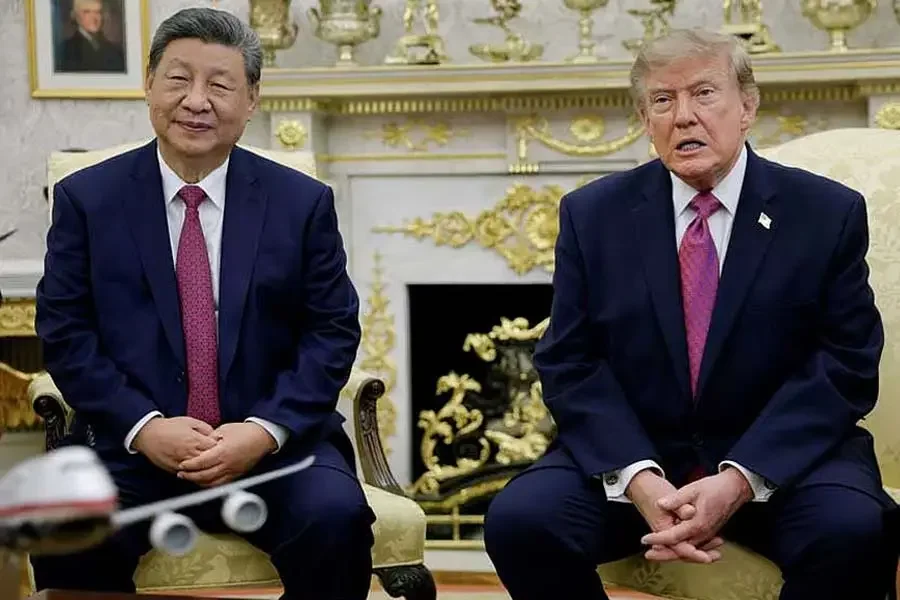

1790551968780.webp


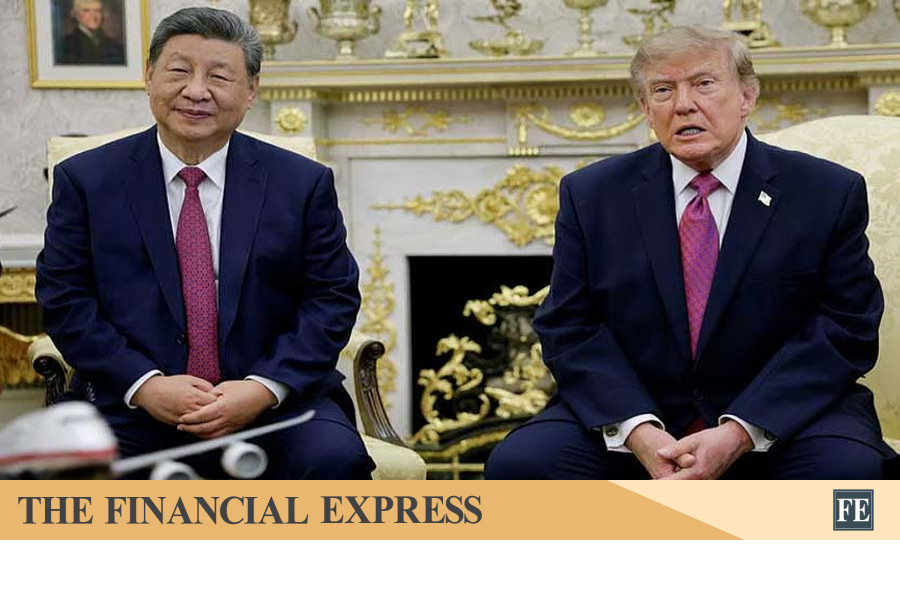
US President Donald Trump said on Saturday that despite a "big talk" this week with Chinese President Xi Jinping on AI, the US should not join efforts with China on the technology.

"We had a big talk on SI," Trump told reporters at the White House, using his preferred name of super intelligence.

"What they want to do is stop our progress because we're leading China by a lot, and we're going to keep it that way. We didn't spend that much time talking about it," he added.

Trump said he did not want to "integrate" AI initiatives with China because of US dominance.

"I would rather not integrate because we're leading by a lot," he said, adding: "When you're leading, you don't open it up to each other".​
 

US-China differences remain after Trump-Xi summit in Washington

​
1790638372035.webp

​
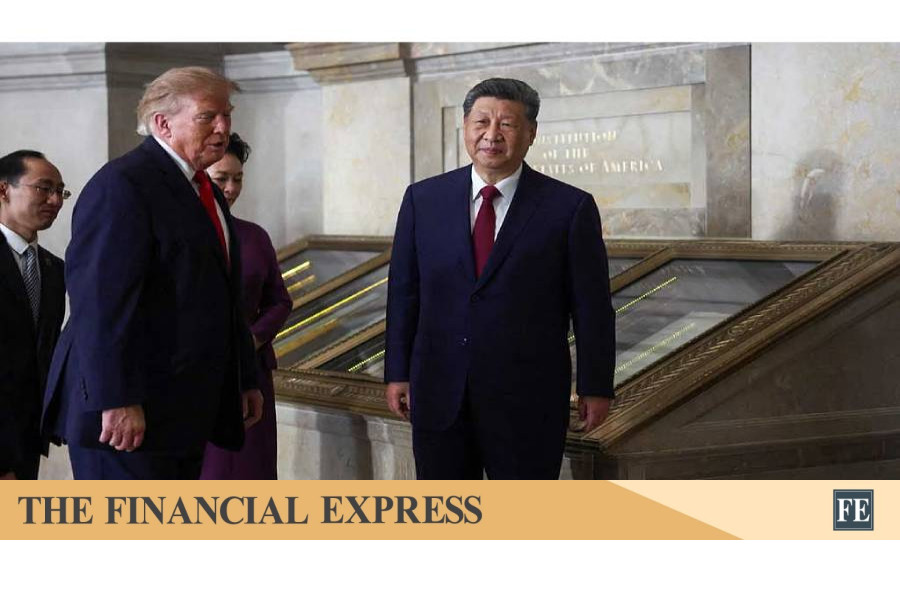
US President Donald Trump and Chinese President Xi Jinping tour the National Archives in Washington, DC, US, Sept 25, 2026. Reuters/Kevin Lamarque

President Donald Trump hoped his pomp-filled summit with Xi Jinping in Washington last week would showcase the strength of his personal relationship with the Chinese leader.

Instead, the limited outcomes showed just how far apart Washington and Beijing remain on key issues, and reinforced a view among analysts that Xi sees little reason to grant Trump major political victories ahead of November’s midterm elections.

“The US-China relationship has settled into a managed stalemate,” said Craig Singleton, senior director for China at US-based think tank, the Foundation for Defense of Democracies.

“The elaborate pageantry matters precisely because there is still relatively little substantive progress to showcase.”

Both sides said they reached consensus on lowering tariffs for a $60 billion batch of non-sensitive goods, but there was no timeline for adoption. At the same time, a deadline for a broader trade accord was pushed into next year.

The absence of a Chinese CEO delegation accompanying Xi also highlighted the challenges of overcoming US suspicion of Chinese investment, casting doubt on the viability of a two-way investment scheme the leaders unveiled at a Beijing summit in May, analysts said.

“The Trump-Xi summit created a positive political atmosphere but did nothing to narrow differences, or reduce mutual suspicions,” said Drew Thompson, a senior fellow at the S Rajaratnam School of International Studies in Singapore.

‘PR Win’ For China

White House officials had tempered expectations before the summit, pointing out that the leaders would also meet at international forums in Shenzen and Miami before year end.

But while the uneventful meeting capped off a diplomatic week that exposed the limits of Trump’s powers, Joe Mazur, geopolitics analyst at Beijing-based consultancy Trivium, said it served as a “PR win” for China.

From the outset, Trump went out of his way to fete Xi – the leader of a country he has previously said is “killing America” with unfair trade practices.

He broke protocol to greet him at the airport, the first time a US president has done so for a world leader in 11 years.

Later, addressing a coterie of top government officials and tech magnates assembled for a lavish state banquet in his honour, Trump said they “had never gotten along better”.

“The extraordinary courtesy the Americans extended to Xi Jinping met and far exceeded China’s expectations,” said Shen Weizhong, a former Chinese foreign ministry official and vice president of Beijing-based think tank Global Governance Institution.

“The Chinese do not feel that a visit necessarily has to result in a specific number of agreements, or in tariff reductions or other such outcomes ... The mere fact that they meet, nod to one another, and shake hands speaks volumes.”

Xi is also in no rush to make concessions, analysts say.

China’s dominance in production of rare earths, minerals critical for sectors from tech to autos and defence, gives it a powerful source of leverage, while its trade with the world has surged despite Trump’s tariff threats.

Trump did not come away completely empty-handed, however.

China has proposed cutting tariffs on a range of US agricultural goods, from corn to dairy, a commerce ministry list showed on Monday. In return, the US will reduce levies on Chinese imports such as toys, fireworks and Christmas ornaments.

That will be welcome news for American farmers, who form one of Trump’s key voting blocs, ahead of midterm elections that look challenging for his Republican party.

But commodity analysts were also quick to add that soybeans, one of the US’ largest exports, did not feature on China’s list, leaving those purchases potentially hostage to any deterioration in ties.

Buying Time on Taiwan

China also gave little indication it is willing to help Trump end the war in Iran that has dragged the US president’s approval rating to the lowest in his political career.

Shortly after Xi’s departure, Chinese Vice President Han Zheng pushed back against the US on Iran and its threats against Cuba at a UN General Assembly meeting in New York.

The Chinese leader also did not shy away from pressing Trump on thornier topics such as US support for Taiwan, the democratically-ruled island claimed by Beijing.

Trump avoided the subject in his public comments, in a stark contrast with the May summit, at which he called a pending $14-billion package of arms sales to Taiwan a “negotiating chip” with Beijing.

Washington has cast the busy summit schedule with Xi as important to keeping ties on even keel between the world’s two biggest economies.

But frequent interactions of the leaders also buy Beijing time on unwanted US actions such as the arms sales to Taiwan, said Jeremy Chan, a senior analyst at political risk consultancy Eurasia Group.

“That’s a major strategic win for the Chinese and a major loss for Taiwan and a lot of US allies and partners in the region,” said Chan, a former US diplomat in China.​
 

China better in Latin America than US: poll
Agence France-Presse . Bogotá, Colombia 04 October, 2026, 00:00

China’s influence in Latin America is now viewed more positively than that of the United States, a major poll conducted in 17 Latin American countries showed Friday.

The 2026 Latinobarometro survey showed that China overtaking the United States in terms of influence for the first time since the annual survey began in 1995.

It showed 57 per cent of people in Latin America considering the United States to be a positive influence, down from 60 per cent in 2020.

China, meanwhile, was considered a positive influence by 65 per cent of respondents, a jump from 48 per cent six years ago.

Costa Rica and the Dominican Republic were the only countries in the region where US influence was deemed more positive than that of China.

The report partly attributed the shift to Washington’s ‘almost complete absence’ from the region in the two decades after the 2003 Iraq War.

During that time, Latin America ‘drew closer to other powers, to China, to the European Union, to Japan,’ Marta Lagos, director of Latinobarometer, told AFP.

Lagos said China had won over Latin American populations by allowing them to access cheaper imports.

‘The void that China fills is the void in people’s pockets, more than anything else,’ she said.

The growing disaffection towards the United States comes nearly halfway through Trump’s second term, during which he has openly asserted his desire for hegemony over Latin America, as part of what he calls the ‘Donroe Doctrine.’

As a country, the United States remains more popular than China, with 63 per cent saying they had a favourable view of the world’s top economy, compared to 58 per cent for its arch-rival.

But America’s popularity was markedly down compared to 2024, when Democratic president Joe Biden was in the White House and 73 per cent had a favorable view of the United States.

The ‘Donroe Doctrine’ blends Trump’s first name with that of James Monroe, the fifth US president, who more than two centuries ago declared Latin America the United States’ exclusive sphere of influence.

Trump’s push to restore US dominance in what Washington calls ‘our hemisphere’ was in evidence in January when the United States overthrew Venezuelan president Nicolas Maduro.

The Latinobarometro poll showed a majority of people in all but one country—Argentina—approving of Maduro’s capture by US special forces.

But only 35 per cent considered it benefited Venezuela, compared to 28 per cent who said it harmed the Caribbean country.

Citizens of Venezuela itself were, however, among those who viewed US influence most positively.

Chile-based Latinobarometro is a non-profit organization that surveys opinions on a range of issues, from democracy to the economy, security and migration.

The 2026 survey was based on some 19,200 face-to-face interviews carried out in 17 countries between May 7 and June 17, with a margin of error of 1 per cent.​
 

Evolving dimensions in China-USA relationship


1791156694387.webp

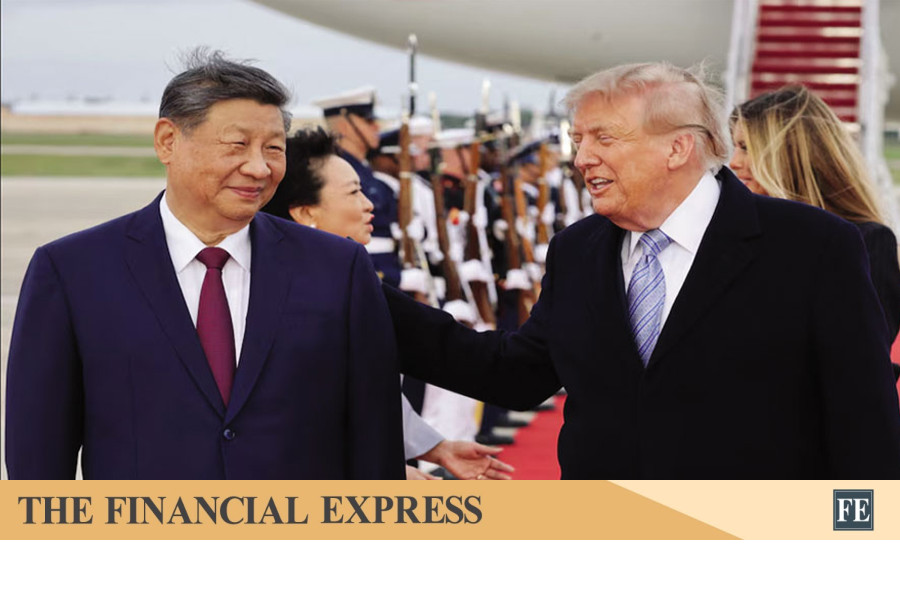
US President Donald Trump ( R ) and Chinese President Xi Jinping ( L) react as Xi arrives ahead of a state visit at Joint Base Andrews, Maryland, US, September 23, 2026 —REUTERS Photo

It may be recalled that when Trump first returned to the White House for his second term, he announced severe tariffs on Chinese goods that quickly set off a trade war between the world's two largest economies and warnings of wider fallout around the globe. However, despite such a rocky start, Trump and Xi have sought to dial back tensions and improve their personal ties, even if there is an understanding that core areas of disagreement are not likely to change.

US President Donald Trump's red-carpet welcome for Chinese President Xi Jinping to the White House for a sumptuous Summit was heavy on symbolism but light on substance, with no sign of breakthroughs on thorny issues including AI, trade, Taiwan and the war with Iran.

The Summit, Xi's first visit to Washington in more than a decade, was the second meeting this year between the leaders of the world's two biggest economies. A day earlier, Trump had personally gone to greet Xi at the airport -- the first time a US president has ever done so for a Chinese leader, and a courtesy Xi did not afford him during Trump's Beijing State visit in May.

The meeting was striking for where it took place -- in Washington, even as scores of world leaders were in New York for the United Nations General Assembly.

Xi, at the White House, took a cooler tone in his remarks. As Trump hailed their friendship, Xi spoke of their "responsibility" to coexist peacefully and set out what he said were Beijing's red lines on key issues including AI, Taiwan and Iran. Xi also noted that US companies were welcome in China, but he also hoped that "Chinese companies are treated fairly here in the United States."

Xi also said both militaries should maintain regular dialogue to improve crisis prevention.

For Trump, who relishes ceremonies with powerful leaders, the visit was as much a matter of national prestige as an opportunity for high-stake diplomacy. However, unfortunately Trump and Xi's remarks were not carried live by any US television networks, which refused to provide footage in protest of the White House's ban on CNN, MS Now and Politico.

During his comments on Thursday, Xi said both countries must "ensure that the development of AI is always under human control." Analysts say intense competition between the two powers in AI is likely to limit the scope for anything beyond symbolic agreements. Big tech bosses however attended the dinner that took place for Xi. It included Tesla's Elon Musk, Apple's Tim Cook, OpenAI's Sam Altman and Nvidia's Jensen Huang.

There has been little clear indication that Beijing is willing to exert pressure on Iran to yield to US demands. During Xi's meeting with Trump on September 24, Xi expressed support for the US and Iran to return to a ceasefire and eventually negotiate a peace deal according to a Xinhua report.

During the bilateral discussion, Xi urged the US to oppose "Taiwan independence", according to a readout from the official Chinese news agency.

Analysts say that while the Chinese leader is happy to let Trump feel they are friends, he also appears to be playing for time in view of the fact that he knows Trump will be out of Office in just over two years.

It may be recalled that China has previously warned that supporting Taiwan independence could lead to military conflict. US ties with Taiwan, a self-governing island that China claims as part of its territory, remain a core flashpoint in relations between Washington and Beijing. During their meeting on Thursday, the Chinese state news agency Xinhua reported that Xi urged Trump to oppose Taiwanese independence and handle the issue "prudently". Analysts have, however, indicated that there was no immediate response pertaining to Taiwan from the White House. The US has not issued a statement on Thursday's meeting. Xi also called on the US to responsibly manage the development of artificial intelligence with China. The ability of cutting-edge AI models to break out of human control has spurred calls for greater oversight, particularly for the US and China as the world's leading players.

It may be noted here that while the leaders of America's biggest AI companies, OpenAI and Anthropic, have agreed that the race to develop better models needs to slow down, Trump has claimed that the fears over AI are a "hoax" that benefits China. The rapid advancement of Chinese AI, despite US tech export controls, has caused alarm among US officials, who have accused Chinese companies of essentially ripping off US models and raised the possibility of sanctions. In this context, China has also threatened to take countermeasures if the US tries to hinder Chinese AI.

But on 24th September in Washington Xi's message was that the relationship didn't have to come to that -- "we should coexist in peace," he said.

Xi said they had held in-depth discussions and reached "common understanding on many issues" that provided "new strategic guidance for China-US relations", without elaborating. "China and the United States must act as responsible major countries," he said, calling for "a new approach for major countries to get along with each other."

Major TV news networks did not air the meeting, after Trump barred reporters from CNN, MS Now and Politico from the White House press pool. While a court later overturned the ban, Trump's actions raised concerns among US and Chinese officials over how the Summit would be perceived, according to CNN reporting. Subsequently, analysts from CNN- Stephanie Yang and Sylvie Zhuang made an observation that "Trump-Xi meeting was heavy on pomp but light on substance and China is just fine with that".

Analyst Stephen Collinson has in the context of USA China relations drawn particular attention to how AI has raised huge global expectations for Trump and Xi. It may be recalled that Humanoid robots take part in the opening ceremony of the 2nd World Humanoid Robot Games in Beijing, on August 22. The Xi-Trump summit was lent extra relevance by recent warnings by AI developers and leaders that their products could soon slip out of control and threaten humanity.

But on September 22, Trump rebranded AI as "super intelligence" and told the United Nations General Assembly that he "totally rejects any attempt to construct a globalist scheme to control" the technology. The fast-expanding use of AI in military applications, meanwhile, adds another layer of complexity, because any move by either Beijing or Washington to limit the technology could give the rival superpower a potential battlefield edge.

US President's opposition to any regulation, at home or abroad, has already closed off the potential of a major US-China deal on the issue. While China balks at outside control, it has shown more openness to building institutional safeguards and a global consensus on how to deal with AI's development, although its willingness to go beyond rhetoric is unclear.

Like Trump's, Xi's remarks were heavy on smooth talk during their meeting and also shared on focusing on cultural ties and shared history between the US and China. Xi said that he and Trump had "concrete" discussions that led to further understanding between the two countries, furthering what he has described as "strategic stability". This friendship, he added, was "forged in blood and fire" during the fight against Japan in the Second World War, before being furthered during the "ping pong" diplomacy of the Nixon administration. The remarks were significantly more historical in nature than Trump's.

To be fair to President Trump, most global summits normally under-deliver. In this context, some analysts have recalled how the meetings between US and Chinese leaders unfold amid unflattering comparisons to epochal 1970s meetings between President Richard Nixon and China's Mao Zedong.

Ione Wells reporting for BBC from Washington has made the interesting observation that the next few months will be a real test. Will their trade truce hold beyond January? Will the USA push ahead with arms sales to Taiwan and will Xi return for December's G20 in Florida?

The trade truce that saw both countries pause a tit-for-tat tariff war and prevent a further escalation, was extended by only a few months -- from November to January. This means that key disputes on tariffs is likely to remain. China's dominance on rare earth supplies and access to advanced US chips are being kicked forward into yet another round of negotiations.

This suggests that US wants China to do more to fulfill its side of the bargain before offering longer-term concessions. Laura Bicker has also observed that "the uncomfortable truth for Xi is that his domestic economy is in trouble. While the country sells a record number of goods around the world, consumers at home are holding back. Youth unemployment remains stubbornly high and property prices have slumped in a country where 80 per cent of people own their own homes. However, trade is helping to prop up their growth, making access to overseas markets more important than ever.

In this context, Bicker has mentioned that Xi needs to protect those exports from the kind of debilitating tariffs the US imposed last year.

Muhammad Zamir, a former Ambassador is an analyst specialised in foreign affairs, right to information and good governance​
 

Latest Posts

Back