[🇧🇩] Monitoring Bangladesh's Economy

[🇧🇩] Monitoring Bangladesh's Economy
1K
47K
More threads by Saif

G Bangladesh Defense

Will tight monetary stance alone deliver?

1790984289136.webp


In an economy exposed to fast-changing global energy prices, exchange-rate pressures, inflation and uncertain growth, waiting six months to reassess monetary conditions could prove too long. So, the Bangladesh Bank (BB)'s new three-month review cycle should enable the central bank to respond quickly to emerging risks. Against this backdrop, its maiden quarterly Monetary Policy Statement (MPS) for October-December 2026 is a continuation of the contractionary monetary regime by retaining the policy rate at 9.50 per cent. The decision is understandable. Headline inflation, though easing to 8.26 per cent in August, is still high, while non-food inflation remained at 9.32 per cent. Worse still, the recent fuel-price hike and the new national pay scale threaten to add fuel to cost-push inflation. Evidently, the BB is walking a tightrope between combating stubborn inflation and preventing economic activity from slowing further.

But the question is whether reviewing the monetary stance more frequently would help the policy achieve its objectives. The central bank reduced the repo rate from 10 per cent to 9.50 per cent in July to support investment and private credit. Yet private-sector credit growth stood at 4.75 per cent in August, remaining below 5.0 per cent for six months and far short of BB's 6.80 per cent target for December. This suggests that changes in the policy rate transmit quickly to market lending rates, but do not necessarily translate into stronger credit demand and contribute to investment or production. High borrowing costs are one part of the problem. Energy shortage, weak business confidence, depressed demand and banks' reluctance to lend to risky borrowers are equally important. So, the central bank's cautious stance is defensible, but caution alone cannot revive the real economy. More important than frequent policy changes in monetary policy or otherwise can actually address inflation without depriving productive businesses of credit required for investment and employment.

There is a danger that fiscal pressures could work against the central bank's tight monetary stance. If revenue earnings fall short and the government relies on bank borrowing or creation of high-powered money to finance deficits, the tight stance would be defeated. Excess money chasing limited goods would further erode households' purchasing power, weaken the taka and fuel another round of inflation. At the same time, excessive public-sector borrowing could crowd out private businesses already suffering from anaemic credit growth. Notably, reserve-money growth has risen sharply in recent months, while the central bank has been providing liquidity support to stressed banks and undertaking refinance operations. In such a situation, monetary and fiscal policies cannot afford to move in opposite directions. The government will have to exercise fiscal discipline, improve revenue mobilisation and avoid treating the central bank as an easy source of financing. Otherwise, continuation of the tight monetary stance would amount to pressing the brake and accelerator simultaneously.

But the gravest obstruction to effective monetary policy lies in the impaired banking system itself. Non-performing loans reached 32.78 per cent of total bank loans, reportedly the highest ratio in the world. With nearly one taka in every three lent by banks classified as non-performing, capital eroded in many institutions and liquidity unevenly distributed, how can monetary policy work normally? The MPS acknowledges banking-sector stress, but appears to treat it as one among several problems rather than the central weakness limiting monetary policy. In truth, adjusting the price of money cannot produce desired outcome when the machinery distributing that money is itself dysfunctional. So, alongside quarterly monetary reviews, the BB needs to accelerate recovery of bad loans, restructure weak banks, enforce stricter supervision, curb lending under political influence and restore depositor and investor confidence. Quarterly reviews are welcome, but institutional frequency cannot substitute institutional effectiveness. Banking reform has to be at the heart of making monetary policy work.​
 

National savings fall as consumption spending rises: What does it mean for the economy?

Shafiqul Islam
Dhaka


1791069939534.webp


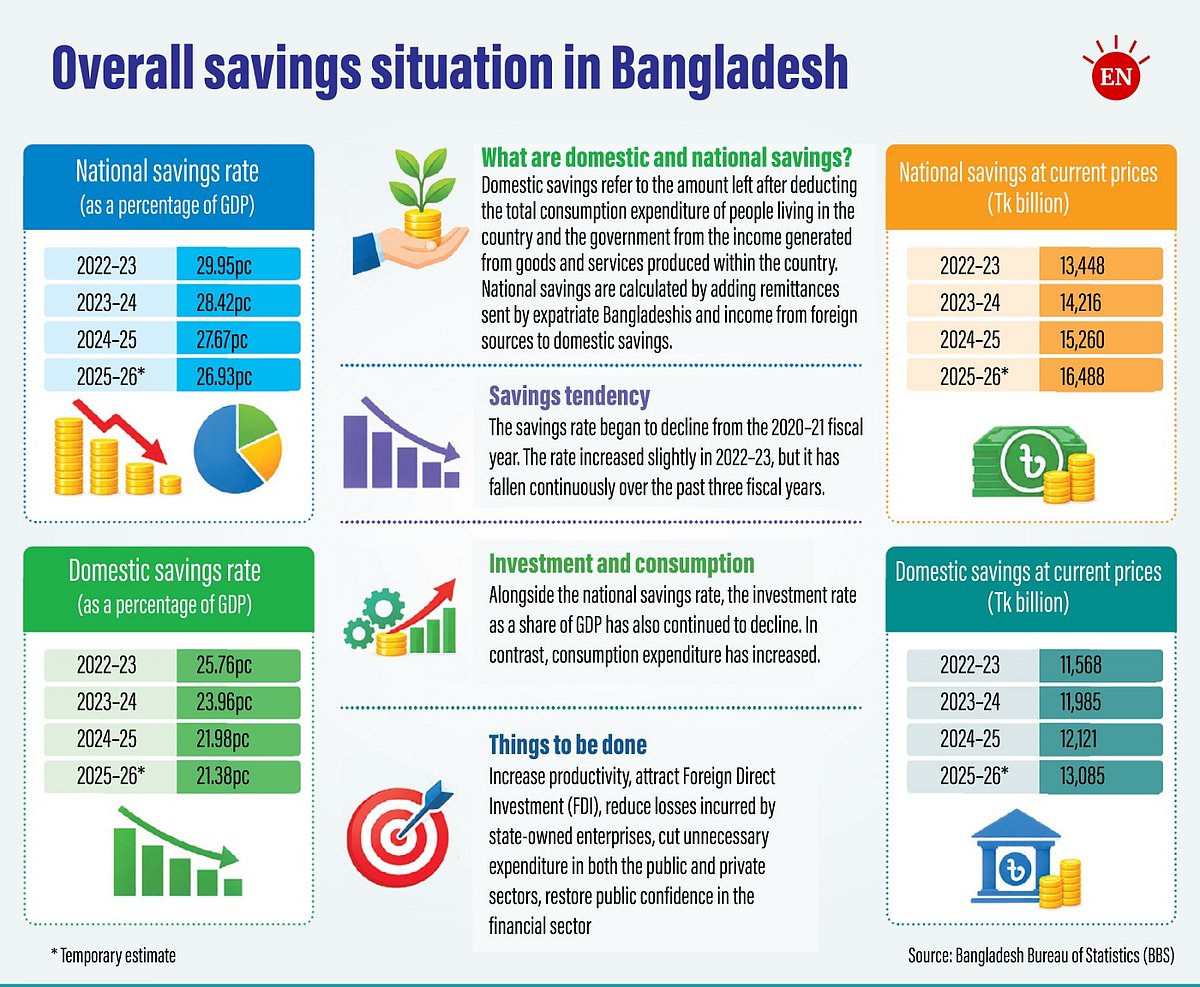
As the country’s economy has expanded, both domestic and national savings in current-price terms have increased. However, savings as a proportion of gross domestic product (GDP) have not risen accordingly. Instead, both ratios have declined steadily.

National savings as a share of GDP have fallen for three consecutive fiscal years. In other words, although the economy has grown in size, the savings rate has failed to keep pace.

The latest edition of the Bangladesh Bureau of Statistics’ (BBS) National Accounts Statistics report contains these findings. According to the report, alongside national savings, investment as a share of GDP has also declined steadily. In contrast, consumption spending has increased.

According to BBS data, national savings stood at 29.95 per cent of GDP in the 2022–23 fiscal year. In the provisional estimate for the latest 2025–26 fiscal year, the ratio had fallen to 26.93 per cent. This means national savings declined by nearly 3 percentage points over three fiscal years.

Meanwhile, domestic savings accounted for 25.76 per cent of GDP in 2022–23, falling to 21.38 per cent in 2025–26. By that measure, domestic savings declined by 4.38 percentage points over the three-year period.

Economists say that a decline in savings relative to GDP means less capital is available for investment. Lower investment, in turn, affects employment and people’s incomes. A decline in national savings may also increase dependence on foreign or domestic borrowing.

Therefore, maintaining relatively high levels of savings and investment in relation to GDP is essential for sustainable economic growth. However, these indicators have been moving in a negative direction over the past several years.

Asked about the issue, Mustafizur Rahman, distinguished fellow at the private research organisation Centre for Policy Dialogue (CPD), said rising prices of essential goods and services had increased the cost-of-living burden on ordinary people.

Economists say that a decline in savings relative to GDP means less capital is available for investment. Lower investment, in turn, affects employment and people’s incomes. A decline in national savings may also increase dependence on foreign or domestic borrowing.

According to him, as consumers try to balance their incomes with the cost of living, their capacity to save has fallen significantly.

He added that slower growth in remittances and losses incurred by various state-owned enterprises were also among the reasons for the decline in the national savings rate.

For context, domestic savings refer to what remains after total consumption expenditure by households and the government is deducted from the income generated from goods and services within Bangladesh’s borders.

National savings comprise domestic savings together with remittances sent by expatriate Bangladeshis and income from foreign sources.

Savings rate declining steadily

The savings rate began to decline during the Covid-19 pandemic, starting in the 2020–21 fiscal year. It increased slightly only in 2022–23, before declining steadily over the following three fiscal years.

Before the pandemic, in 2019–20, domestic savings accounted for 27 per cent of GDP, while national savings accounted for 31.42 per cent. In the provisional estimate for the latest fiscal year, domestic savings had fallen to 21 per cent of GDP, while national savings had declined to around 27 per cent.

However, savings in current-price terms have increased compared with previous years. BBS data show that national savings amounted to around Tk 1.345 trillion in 2022–23, rising to Tk 1.648 trillion in 2025–26.

Economists, however, place greater emphasis on savings as a proportion of GDP when assessing the actual savings trend and the economy’s capacity for capital formation.

A decline in national savings reduces investment because lower savings mean that banks and other financial institutions have fewer funds available. As a result, entrepreneurs have less access to loans to expand their businesses. This constrains overall investment and business expansion in the country--------MA Razzaque, RAPID Chairman.

That is because an increase in savings in nominal monetary terms does not necessarily mean that people’s real capacity to save has increased. Calculating savings as a share of GDP, on the other hand, provides an indication of how strong or weak the economy’s savings capacity is relative to its current size.

Inflation hits savings

MA Razzaque, chairman of the private research organisation Research and Policy Integration for Development (RAPID), said one of the main reasons for the decline in the national savings rate was persistently high inflation over an extended period.

Inflation has caused a large portion of people’s incomes to be spent on consumption — goods and services — leaving them with less capacity to save after meeting their living expenses.

According to BBS data, total consumption expenditure as a share of GDP rose from 74.24 per cent to 78.62 per cent over the past three fiscal years. The main factor behind the increase in consumption spending has been the high inflation that has persisted for several years.

Inflation rose in India, Sri Lanka, Pakistan and several other countries after the Russia–Ukraine war began. Bangladesh, too, has experienced high inflation for four consecutive years. Overall inflation stood at 8.26 per cent in August, while inflation was above 10 per cent in the 2024–25 fiscal year.

Negative impact on investment

According to BBS data, total investment as a share of GDP was above 31 per cent six years ago. It has now fallen below 28 per cent. During this period, both private and public investment have declined.

RAPID Chairman MA Razzaque said a decline in national savings reduces investment because lower savings mean that banks and other financial institutions have fewer funds available. As a result, entrepreneurs have less access to loans to expand their businesses. This constrains overall investment and business expansion in the country.

CPD Distinguished Fellow Mustafizur Rahman said a decline in the savings-to-GDP ratio means it is becoming increasingly difficult to meet domestic investment needs using capital accumulated within the country. In such a situation, dependence on domestic and foreign borrowing increases in order to sustain investment. This, in turn, increases the pressure associated with securing loans, managing them and repaying the borrowed funds.

What needs to be done?

To overcome the existing challenges and restore a positive trend in the economy, CPD Distinguished Fellow Mustafizur Rahman recommended increasing productivity, attracting foreign direct investment (FDI), and reducing losses incurred by state-owned enterprises.

He said that, alongside these measures, unnecessary spending should be reduced at both the public and private levels, while efforts should be made to restore public confidence in the financial sector.​
 

Fresh remittance investment plan follows stalled diaspora initiative
Staff Correspondent . Dhaka 04 October, 2026, 00:00

1791071711186.webp


The Wage Earners’ Welfare Board plans huge investment to channel remittances into productive investment and reduce transfer costs, years after an earlier government initiative to attract expatriate investment stalled.

The preliminary proposal, sent to the planning ministry by the Ministry of Expatriates’ Welfare and Overseas Employment, seeks substantial spending on financial services and training without specifying measurable investment targets.

The proposed ‘Leveraging Remittance in Bangladesh’ project would be implemented by June 2031 with an estimated cost of Tk 1,013 crore, reveals the proposal.

It allocates Tk 300 crore to facilitating transfers, Tk 250 crore to reducing sending costs and Tk 440.82 crore to training on capital-market investment and income-generating activities.

The Bangladesh Bureau of Statistics’ Survey on the Use of Remittance 2013 found that 25.32 per cent of recipient households invested a portion of the money, while 74.68 per cent reported no investment.

A World Bank analysis found that 72 per cent of households making direct investments put money into dwelling-house construction, followed by flat purchases, highlighting the concentration of investment in housing.

Responding to those reports, the Economic Relations Division in 2018 recommended a national steering committee, a specialised diaspora engagement wing and separate units for investment, philanthropy and expert engagement.

ERD subsequently established an NRB Cell and an online portal and undertook overseas outreach in 2019, but the broader coordination framework made little progress.

The study identified customs delays, inadequate utility connections, demands for unofficial payments, land acquisition complications and fund-transfer difficulties as investment barriers.

The new proposal emphasises financial literacy and digital services. It also proposes improving access to formal transfer channels and informing migrants about cheaper options.

The project plans reducing the average transfer costs of remittances below 3 per cent by 2030 and eliminating corridors charging above 5 per cent. It also proposes linking remittances with pensions and long-term savings without detailing the arrangement.

ERD officials said that the division is seeking external financing to implement the project and sent the Asian Development Bank has expressed initial consent.​
 

Inflation control, banking governance, tax reform top priorities: Khosru


1791157867189.webp


The government's economic priorities include restoring macroeconomic stability, controlling inflation, reforming the tax system and strengthening governance in the banking sector, Finance Minister Amir Khosru Mahmud Chowdhury said on Saturday.

He also identified restoring confidence in the banking sector, increasing investment and creating employment as major challenges for the economy.

The minister made the remarks as chief guest at the Grand Finale of ECONTHON 2026, a national inter-university economics competition, held at United International University (UIU) in the capital.

"Inflation was putting pressure on people's purchasing power, while tax collection as a share of gross domestic product remained far below the level required to meet the country's development needs," he said.

Calling for structural reforms in the tax system, Khosru said it should be made fair, simple and technology-driven. He also stressed the need to improve the environment for private investment to support economic growth and employment.

The finance minister said the country also needed to ensure better returns from public spending on education, health and social protection. "Policy should be based on data and evidence," he said, adding that policymakers must assess whether a policy is implementable, how much it will cost, who will benefit and who will bear the burden.

He said Bangladesh's export sector would increasingly need to rely on competitiveness rather than trade preferences as the country prepares for graduation from the least developed country (LDC) category.

"There is no benefit in hiding problems; acknowledging them is where solutions begin," he said.

Khosru also pointed to growing uncertainty in the global economy, citing slower growth, higher financing costs, rising protectionism and tariff barriers, geopolitical conflicts and increasing economic losses caused by climate change.

"Uncertainty in the global economy has become a normal reality," he said.

For an import-dependent and export-oriented economy like Bangladesh, such global shocks directly affect commodity prices, the exchange rate and export orders, he added.

He also said the country was preparing for LDC graduation irrespective of the timeline, stressing the need to strengthen economic competitiveness to cope with the changing global trade environment.

The programme was organised by the Junior Economists Forum (JEF) of UIU in collaboration with its Department of Economics.

A total of 224 teams from universities across Bangladesh registered for ECONTHON 2026, which sought to help students apply classroom knowledge to real-world economic challenges while developing analytical thinking, problem-solving, adaptability, creativity and economic reasoning.

ECONTHON 2026 had a total prize pool of Tk 265,000. The team "Vini Vedi Vici" from North South University was crowned grand champion and received Tk 100,000.

Team "Shield" from the University of Dhaka secured the first runner-up position and received Tk 75,000, while team "Dhaka-99" from UIU secured the second runner-up position and received Tk 50,000.

Hasan Mahmood Raja, chairman of the Board of Trustees of UIU and chief adviser of United Group, attended the programme as the guest of honour, while KMA Shamim, member of the Board of Trustees of UIU and adviser of United Group, was present as a special guest.

The programme was presided over by Md Abul Kashem Mia, vice chancellor of UIU, and moderated by Mohammad Omar Farooq, head of the UIU Department of Economics.​
 

What is the most worrying indicator in the economy now?

Shawkat Hossain


1791158084661.webp


The first three months of the fiscal year, or one quarter, have ended. The government’s revenue collection and spending during this period, the amount it has borrowed from banks, and the extent to which the private sector has received loans all provide an indication of where the economy may be headed.

These figures are not relevant only to economists and policymakers. People’s incomes and livelihoods are directly linked to inflation, employment, business credit, government spending and the foreign-exchange situation.

There is also a legal obligation to conduct quarterly reviews of budget implementation. The Government Finance and Budget Management Act 2009 states that the finance minister must review revenue collection and expenditure trends on a quarterly basis against the budget targets.

A report on the findings of the review and the necessary measures must be presented at the next session of parliament.

During the previous government, however, we saw the assessment of the first three months sometimes being presented in parliament six months later. Towards the end, the regular presentation of such reports also stopped. At least this time, we hope that will not happen.

Even without waiting for the government’s review, however, it is possible to get some idea of the direction of the economy. Much of the economic data is now readily available.

Bangladesh Bank publishes 19 economic indicators every week on its website, in just two pages. If the reports published on 28 June and 27 September this year are placed side by side, they provide a preliminary picture of which indicators improved over the quarter, which deteriorated and where new risks emerged.

There is no scope here to analyse all the indicators. Not all the data have been updated for the full three-month period. Overall, however, it can be said that there is no indicator that is in particularly good shape. Rather, it appears that a further decline has been prevented, but there are no clear signs of recovery.

An analysis of the indicators inevitably raises five questions. Has inflationary pressure really eased? How much has government borrowing increased? Why is private-sector credit growth so low? Is the money supply growing too rapidly? And how sustainable is the improvement in the foreign-exchange and reserve situation?

For today, however, I would like to discuss two of these questions: the growth of government and private-sector borrowing from the banking system. The annual growth in government borrowing stood at 30.37 per cent on 28 June; three months later, it had risen to 34.11 per cent. Over the same period, private-sector credit growth fell further, from 4.75 per cent to 4.62 per cent.

The two figures are deeply concerning. Private-sector credit growth is now at its lowest level in 33 years. This makes an unpleasant picture of the economy clear. Credit growth in the banking system is increasingly being directed towards the government, while private-sector lending remains stagnant.

We know that the government’s revenue is far too low, while expenditure continues to rise. As a result, the government is having to rely increasingly on bank borrowing. At the same time, it is not simply that the private sector is receiving less credit because the government is borrowing more.

In reality, the private sector is not taking loans because of uncertainty surrounding investment. Loans are not cheap either, given the high interest rates. As a result, businesses are not approaching banks unless they really need to.

The energy crisis is one of the major obstacles at present. Some point to high interest rates as well. But historical data from Bangladesh do not support the argument that high interest rates alone are the main reason for the lack of investment.

There is an organisation under the Ministry of Finance called the Institute of Public Finance. In 2025, two joint secretaries of the Ministry of Finance, Abdul Mannan and Asif Iqbal, published a study in its journal.

The central argument of their research is that when the economy performs well and grows, private investment increases subsequently as a result. If businesspeople do not see the potential for markets and the economy to expand, it is difficult to significantly increase investment simply by lowering interest rates or providing incentives.

That is where the problem lies. Our average economic growth has fallen to almost half its previous level. Wages are rising more slowly than inflation. People’s purchasing power has declined. This has reduced overall demand. No one knows when the energy crisis will be resolved. If this is the situation, then who will invest?

For the past four years, the economy’s worst indicator has been high inflation. Setting that aside, the most worrying indicators are perhaps private-sector credit growth and the government’s continued borrowing from banks.

This is because bank credit is increasingly being directed towards government financing rather than the productive private sector. This may allow the government to keep spending for some time, but it will not generate sustainable growth or create employment.

Unless this is addressed quickly, today’s weak credit growth will translate into lower investment, fewer jobs and slower economic growth in the future. Combined with high inflation, that would make for a dangerous picture.

*The author is Prothom Alo’s Head of Online.​
 

Latest Posts

Back