Donate ☕
[🇧🇩] - Civilian/Military Nuclear Program in Bangladesh | Page 2 | PKDefense

[🇧🇩] Civilian/Military Nuclear Program in Bangladesh

Reply (Scroll)
Press space to scroll through posts
G Bangladesh Defense
[🇧🇩] Civilian/Military Nuclear Program in Bangladesh
83
4K
More threads by Saif

Analyze

Analyze Post

Add your ideas here:
Cite Fact Check Highlight Respond

Chinese company willing to build second nuke power plant in Bangladesh​

ISMAIL HOSSAIN FROM SICHUAN

1710983596725.png

Nuclear power plants in Cattenom, France seen in this representational photo (Collected)

China's state-owned company -- Dongfang Electric Corporation (DEC) -- wants to build the proposed second nuclear power plant in Bangladesh.

A top official of the corporation said recently that the Chinese company had shown interest to build the second nuclear power plant which the government of Bangladesh is planning to set up.

"Bangladesh is our traditional market. We have constant communication with our Bangladeshi counterpart. But there is no promising result until now about the nuclear power plant," Vice President of Dongfang Electric Corporation (DEC) Hu Weidong told the FE while responding to a question at its head office in Chengdu, the capital city of Sichuan.

In November 2017, Bangladesh started the construction work of its first nuclear power plant at Rooppur of Pabna district.

Russia's state-owned nuclear corporation Rosatom is implementing the project at a cost of $ 12.65 billion.

According to Rosatom, the first unit at Rooppur is scheduled to go into commercial operation in 2023 while the second unit in 2024.

However, Bangladesh has already made a list of eight sites for building the second nuclear power plant. Of the eight sites, four are in Khulna, close to the Sundarbans, and four others are at Majher Char in Barguna, Gangamati in Patuakhali, Boyar Char in Noakhali and Muhurir Char in Feni.

While talking to the FE, Mr Weidong said, "Nuclear power is clean and safe. It is future reply to increasing demand for power."

In reply to a question about mounting concerns over safety and security of nuclear power, he said DEC is capable of building and running safe and secured nuclear power plant.

He said DEC provides nuclear power plant machinery to France, the UK and Pakistan. It also runs nuclear power plants in China.

He said every country has its own way of choosing business deal.

"Certainly Bangladesh has its preferences. We are trying our best," he added.

According to Bangladesh officials, once the site for second nuclear power plant is finalised and an elaborate feasibility study will be conducted, and the power generation capacity of the nuclear plant will be fixed.

The state-owned Bangladesh Atomic Energy Commission (BAEC) is working on the project.

BAEC started the project following a directive by Prime Minister Sheikh Hasina in 2014 to set up a second nuclear power plant in the south.

DEC, headquartered in Chengdu, is one of the most influential enterprise groups under the direct administration of the Chinese central government.

With the development over half a century, DEC has become a comprehensive group specialised in manufacturing industry, research and development of cutting edge technology, contracting international engineering projects, exporting complete plants and equipment, and conducting international economic and technical cooperation.

DEC represents top-class technological and manufacturing level for China's heavy machinery and equipment industry, and is appointed by the Chinese central government as one of the most important state-owned enterprise groups concerning the national economy.

Being an active international contractor, DEC takes the lead in China particularly in contracting international power stations and a wide variety of large engineering projects, and exports complete plants and equipment to almost 70 countries involving projects in such diverse fields as power generation, electric and mechanical works, power distribution and transmission, railways, environmental protection, heavy duty mining and metallurgy equipment, traffic and transportation, communication etc.

It has also power projects in Bangladesh.​
 
Analyze

Analyze Post

Add your ideas here:
Cite Fact Check Highlight Respond
  • Love (+3)
Reactions: Bilal9

Is Bangladesh's 'nuclear prestige' an illusion?

1713651839194.webp

Do we really need, or can we really afford, to build another nuclear power plant? PHOTO: SANVI AHMED SAIM/WIKIMEDIA COMMONS

It came as an unexpected surprise in early April when Prime Minister Sheikh Hasina asked Rosatom, the Russian state corporation that specialises in nuclear energy, to consider building another nuclear power station in Rooppur. The revelation came at a time when Bangladesh has already been struggling with depleting foreign exchange reserves, high inflation, load-shedding, poor human development, and an increasing debt burden. The country has already begun to seek new loans to repay its existing ones, as per a recent CPD analysis. In addition, Bangladesh is also taking fresh loans at high interest rates to buy oil and LNG from foreign sources. The country finds itself in an exceedingly precarious situation as both its external borrowings and debt-servicing obligations are increasing at a rapid pace. There is also uncertainty over securing a fresh source of foreign currency inflow to cover future debt.

In this circumstance, does Bangladesh really require another nuclear power plant? Or is the decision partly motivated by the pursuit of prestige?

"Nuclear prestige" refers to the high status that governments believe they can acquire by building nuclear weapons. Countries armed with nuclear weapons perceive it as a symbol of prestige because it represents the exclusive ability of employing an advanced technology, and the image of leadership it projects to the international community.

Research has shown that at key historical junctures, countries pursued nuclear weapons to gain prestige. Harvard political scientist Alastair Iain Johnston's research in 1995 showed that Mao's decision to construct a nuclear bomb was motivated in part by a desire to gain international prominence. American foreign policy and intelligence executive Gregory F Treverton used in his book, Framing Compellent Strategies, the example of Chandrasekhara Rao, whose reason for India's first explosion in 1974 was that nuclear weapons would enhance the country's prestige. Similar observations were made about France's Charles De Gaulle by Princeton academic Wilfried Kohl in 1971, and by Yale professor Barry O'Neill in 2006 about Iraq's Saddam Hussein pondering the use of nuclear weapons to acquire prestige and regional leadership.

Only 32 of the world's 195 countries have nuclear power facilities. With the exception of two lower middle-income countries, Pakistan and India, the majority of these nations belong to the high- or higher-middle-income category. These two nations' plans to build nuclear power facilities went hand in hand with their strategy to increase their nuclear weapons capabilities. India's nuclear programme began in the mid-1940s, when then Prime Minister Jawaharlal Nehru envisioned the potential to cover the complete fuel cycle, and India purchased its first reactor from Canada in the 1950s.

Similarly, China's nuclear programme was established in 1955, led by Mao Zedong. Ultimately, Pakistan took a significant step towards nuclear armament under the guidance of Bhutto following the loss of East Pakistan in 1971. These countries exhibited a common pattern of nuclear adoption. They developed their nuclear weapon programmes due to concerns about national security and the need to assert their national identity in a tense geopolitical landscape. The potential of conflict drove these nations to construct and solidify their national and military identities.

Interestingly, when Bangladesh decided to construct a nuclear power plant, certain interest groups portrayed it as a symbol of prestige. What they overlooked is that the historical concept of prestige is associated with gaining technical competence to produce weapons and energy, rather than importing nuclear technology and expertise from overseas and remaining indefinitely dependent on external power. The nuclear collaboration between Bangladesh and Russia is not a reflection of Bangladesh's financial capabilities, nor does it demonstrate its technical capacity to develop nuclear power plants on its own using domestic technology.

Russia is providing 90 percent of the funds in the form of loans. In other words, Russia is bankrolling this project so that Bangladesh can purchase Russian nuclear equipment and employ Russian consultants, specialists, and personnel. This so-called financial capacity, in reality, is a future debt burden for our citizens. And then, once the nuclear power plant is built, Russia will operate it as long as Bangladesh does not develop the capacity to run the project itself. Furthermore, the tripartite agreement between Bangladesh, Russia, and India enabled India to develop Bangladesh's human resource capacity for Rooppur Nuclear Power Plant (RNPP). It is reasonable if India is proud of its human resource development efforts in Bangladesh. But is it a matter of prestige for Bangladesh to receive human resource training from India?

This leads us to the questions that are central to this discussion. Is this nuclear prestige false? Who benefits from this constructed sense of prestige?

Megaprojects are commonly recognised as effective means to demonstrate modernity and development. In numerous developing nations, dominant political parties frequently employ large-scale projects as a strategy to push the prominence of development, despite the fact that the benefits derived from these projects hardly ever reach the people.

For a weak state, lacking the ability to manage inflation, guarantee public service provision, and enforce laws, it is easier to create a false impression of progress than to allow the citizens to reap the benefits of true development. Building a nuclear power plant gave politicians a chance to create an illusion of attaining technical prowess when, in reality, we are simply boasting about the abilities and expertise of others.

It is noteworthy that around one-third of countries with nuclear power plants produce less than 10 percent of their total electricity from nuclear energy. These countries include Japan, Germany, China, Brazil, South Africa, Argentina, Mexico, Netherlands, Iran, and India. If nuclear power is such an efficient and ecologically beneficial energy source, why aren't these countries building more nuclear power plants?

The answer is straightforward. Even nations with sophisticated capabilities refrain from relying on nuclear power due to the inherent risks, exorbitant costs, and the long-lasting damage caused by radioactive waste for thousands of years. Despite India's nuclear weapons capacity, why was the contribution of nuclear power in its energy generation only 3.1 percent by 2022, as reported by the International Atomic Energy Agency (IAEA)? Once the RNPP commences operation, the share of nuclear power in Bangladesh's electricity output will be approximately seven percent, subject to future capacity increases. Constructing a second one will further increase the share.

Bangladesh has already borrowed $11.38 billion from Russia to build the first 2,400MW RNPP. The 20-year repayment period will begin in 2027, with $500 million per year for the first three years and then less in subsequent years. The first and second units were originally planned to be finished in 2023 and 2024, respectively. However, so far, 85 percent of the construction has been completed, with a revised completion date set for 2026.

How can a country consider building a second nuclear power plant when it doesn't know whether the first one will be able to operate successfully? We are not sure whether it will take two to three years or more for Bangladesh to be fully capable of operating RNPP on its own. With all of these uncertainties and risks, how can a country risk another one?

Since the days of Mao Zedong and Jawaharlal Nehru, the world has seen significant transformation. In the international arena, prestige is now defined as the ability to invest in research and development to exploit cutting-edge solar, wind, and green hydrogen technologies. Ironically, Bangladesh continues to adhere to a misleading definition of nuclear prestige. The country needs to realise its true potential, rather than relying on the illusion of nuclear prestige.

Moshahida Sultana Ritu is associate professor at the Department of Accounting and Information Systems of the University of Dhaka.​
 
Analyze

Analyze Post

Add your ideas here:
Cite Fact Check Highlight Respond

Is Bangladesh's 'nuclear prestige' an illusion?

View attachment 5214

Do we really need, or can we really afford, to build another nuclear power plant? PHOTO: SANVI AHMED SAIM/WIKIMEDIA COMMONS

It came as an unexpected surprise in early April when Prime Minister Sheikh Hasina asked Rosatom, the Russian state corporation that specialises in nuclear energy, to consider building another nuclear power station in Rooppur. The revelation came at a time when Bangladesh has already been struggling with depleting foreign exchange reserves, high inflation, load-shedding, poor human development, and an increasing debt burden. The country has already begun to seek new loans to repay its existing ones, as per a recent CPD analysis. In addition, Bangladesh is also taking fresh loans at high interest rates to buy oil and LNG from foreign sources. The country finds itself in an exceedingly precarious situation as both its external borrowings and debt-servicing obligations are increasing at a rapid pace. There is also uncertainty over securing a fresh source of foreign currency inflow to cover future debt.

In this circumstance, does Bangladesh really require another nuclear power plant? Or is the decision partly motivated by the pursuit of prestige?

"Nuclear prestige" refers to the high status that governments believe they can acquire by building nuclear weapons. Countries armed with nuclear weapons perceive it as a symbol of prestige because it represents the exclusive ability of employing an advanced technology, and the image of leadership it projects to the international community.

Research has shown that at key historical junctures, countries pursued nuclear weapons to gain prestige. Harvard political scientist Alastair Iain Johnston's research in 1995 showed that Mao's decision to construct a nuclear bomb was motivated in part by a desire to gain international prominence. American foreign policy and intelligence executive Gregory F Treverton used in his book, Framing Compellent Strategies, the example of Chandrasekhara Rao, whose reason for India's first explosion in 1974 was that nuclear weapons would enhance the country's prestige. Similar observations were made about France's Charles De Gaulle by Princeton academic Wilfried Kohl in 1971, and by Yale professor Barry O'Neill in 2006 about Iraq's Saddam Hussein pondering the use of nuclear weapons to acquire prestige and regional leadership.

Only 32 of the world's 195 countries have nuclear power facilities. With the exception of two lower middle-income countries, Pakistan and India, the majority of these nations belong to the high- or higher-middle-income category. These two nations' plans to build nuclear power facilities went hand in hand with their strategy to increase their nuclear weapons capabilities. India's nuclear programme began in the mid-1940s, when then Prime Minister Jawaharlal Nehru envisioned the potential to cover the complete fuel cycle, and India purchased its first reactor from Canada in the 1950s.

Similarly, China's nuclear programme was established in 1955, led by Mao Zedong. Ultimately, Pakistan took a significant step towards nuclear armament under the guidance of Bhutto following the loss of East Pakistan in 1971. These countries exhibited a common pattern of nuclear adoption. They developed their nuclear weapon programmes due to concerns about national security and the need to assert their national identity in a tense geopolitical landscape. The potential of conflict drove these nations to construct and solidify their national and military identities.

Interestingly, when Bangladesh decided to construct a nuclear power plant, certain interest groups portrayed it as a symbol of prestige. What they overlooked is that the historical concept of prestige is associated with gaining technical competence to produce weapons and energy, rather than importing nuclear technology and expertise from overseas and remaining indefinitely dependent on external power. The nuclear collaboration between Bangladesh and Russia is not a reflection of Bangladesh's financial capabilities, nor does it demonstrate its technical capacity to develop nuclear power plants on its own using domestic technology.

Russia is providing 90 percent of the funds in the form of loans. In other words, Russia is bankrolling this project so that Bangladesh can purchase Russian nuclear equipment and employ Russian consultants, specialists, and personnel. This so-called financial capacity, in reality, is a future debt burden for our citizens. And then, once the nuclear power plant is built, Russia will operate it as long as Bangladesh does not develop the capacity to run the project itself. Furthermore, the tripartite agreement between Bangladesh, Russia, and India enabled India to develop Bangladesh's human resource capacity for Rooppur Nuclear Power Plant (RNPP). It is reasonable if India is proud of its human resource development efforts in Bangladesh. But is it a matter of prestige for Bangladesh to receive human resource training from India?

This leads us to the questions that are central to this discussion. Is this nuclear prestige false? Who benefits from this constructed sense of prestige?

Megaprojects are commonly recognised as effective means to demonstrate modernity and development. In numerous developing nations, dominant political parties frequently employ large-scale projects as a strategy to push the prominence of development, despite the fact that the benefits derived from these projects hardly ever reach the people.

For a weak state, lacking the ability to manage inflation, guarantee public service provision, and enforce laws, it is easier to create a false impression of progress than to allow the citizens to reap the benefits of true development. Building a nuclear power plant gave politicians a chance to create an illusion of attaining technical prowess when, in reality, we are simply boasting about the abilities and expertise of others.

It is noteworthy that around one-third of countries with nuclear power plants produce less than 10 percent of their total electricity from nuclear energy. These countries include Japan, Germany, China, Brazil, South Africa, Argentina, Mexico, Netherlands, Iran, and India. If nuclear power is such an efficient and ecologically beneficial energy source, why aren't these countries building more nuclear power plants?

The answer is straightforward. Even nations with sophisticated capabilities refrain from relying on nuclear power due to the inherent risks, exorbitant costs, and the long-lasting damage caused by radioactive waste for thousands of years. Despite India's nuclear weapons capacity, why was the contribution of nuclear power in its energy generation only 3.1 percent by 2022, as reported by the International Atomic Energy Agency (IAEA)? Once the RNPP commences operation, the share of nuclear power in Bangladesh's electricity output will be approximately seven percent, subject to future capacity increases. Constructing a second one will further increase the share.

Bangladesh has already borrowed $11.38 billion from Russia to build the first 2,400MW RNPP. The 20-year repayment period will begin in 2027, with $500 million per year for the first three years and then less in subsequent years. The first and second units were originally planned to be finished in 2023 and 2024, respectively. However, so far, 85 percent of the construction has been completed, with a revised completion date set for 2026.

How can a country consider building a second nuclear power plant when it doesn't know whether the first one will be able to operate successfully? We are not sure whether it will take two to three years or more for Bangladesh to be fully capable of operating RNPP on its own. With all of these uncertainties and risks, how can a country risk another one?

Since the days of Mao Zedong and Jawaharlal Nehru, the world has seen significant transformation. In the international arena, prestige is now defined as the ability to invest in research and development to exploit cutting-edge solar, wind, and green hydrogen technologies. Ironically, Bangladesh continues to adhere to a misleading definition of nuclear prestige. The country needs to realise its true potential, rather than relying on the illusion of nuclear prestige.

Moshahida Sultana Ritu is associate professor at the Department of Accounting and Information Systems of the University of Dhaka.​
The writer has conveniently forgotten that laundering tens of billions of dollars is the prime cause of dollar shortages in the country. Building second nuclear power plant won't cause economic hardship in the country as this nuclear plant will provide cheapest electricity once completed. For Bangladesh nuclear plant is not national prestige rather necessity as our gas reserve, which is used to run power plants, is about to exhaust within a few years. If we take a long term view of energy security of the country then nuclear technology is an absolute necessity to generate electricity and safeguard our energy interest.
 
Analyze

Analyze Post

Add your ideas here:
Cite Fact Check Highlight Respond
  • Love (+3)
Reactions: Bilal9

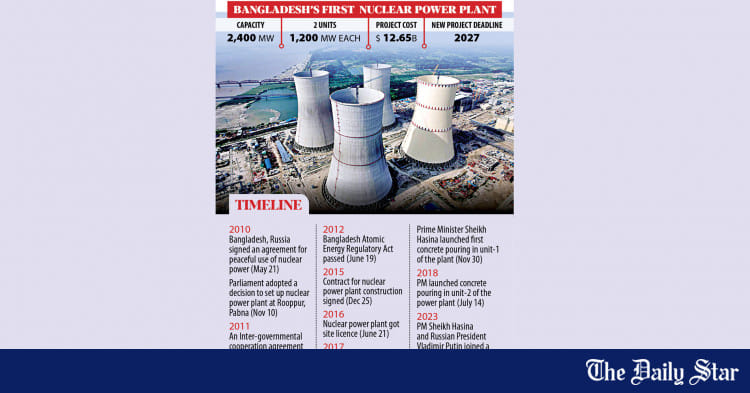
Rooppur Nuclear Power Plant: First unit to start production in Dec
Project deadline extended by 2 years, but authorities hope to complete grid line work before scheduled commissioning

1714172762987.webp


One of the two units of the Rooppur Nuclear Power Plant will be commissioned this December if transmission lines are ready although the deadline for the project's completion has been extended to 2027.

The decision to extend the deadline by two years was made at a meeting between Russian and Bangladeshi officials in Dhaka in the second week of February.

Officials, however, said no specific date for the project's completion has been fixed yet.

The 2400MW power plant is being built in Rooppur, Pabna, at a cost of $12.65 billion. Of the amount, $11.38 billion will be provided by Russia as soft loans. It is the most expensive development project in the country ever.

"Since this is a turnkey project, time extension will not result in additional costs," Yafes Osman, minister for science and technology, told The Daily Star.

Construction work was hampered by the coronavirus pandemic, the Russia-Ukraine war and delays in the construction of power lines, said several officials who attended the Joint Coordination Committee's meeting in February.

The original project proposal said unit-1 would be in operation on December 23, 2022, unit-2 on October 8, 2023, and the entire project would be done by December 31, 2025.

Construction of unit-1 formally began on November 30, 2017, and unit-2 on July 14, 2018.

In October 2023, the first Russian shipment of uranium reached the site on the bank of the Padma in Ishwardi, earning Bangladesh the recognition of being the 33rd country in the world to produce nuclear energy.

According to Project Director Zahedul Hasan, the Power Grid Company of Bangladesh will set up four lines by October this year.

"If we get the lines on time, we believe unit-1 will be in operation in December," he said.

The PGCB is building six lines with a combined length of 669km.

From unit-1, there will be a 60km transmission line to Baghabari, 102km line to Bogura, 144km line to Gopalgonj, and 2km line across the Padma.

From Unit-2, there will be an 147km line to Dhaka, 14km of which will be over the Jamuna.

"A mission from the International Atomic Energy Agency is likely to visit the site for an inspection... we will start training the key personnel from May," said Zahedul, who replaced Shawkat Akbar, the first project director, on April 16.

The plant also needs an operational licence before nuclear fuel is loaded, he said.

Shawkat, now chairman of Bangladesh Atomic Energy Commission, which is implementing the project, said the deadline extension was not a matter of concern.

Delwar Hossain, project director of Transmission Lines for Power Evacuation of Rooppur Nuclear Power Plant, told this newspaper that installation of lines on land had seen over 90 percent progress. The line across the Padma saw 40 percent progress and will be completed by October.

The part over the Jamuna will be done by 2025, he added.

Shafiqul Islam, a professor of nuclear engineering at Dhaka University, said, "To lower economic risks and to maintain a good reputation, a project like this must be completed within eight years. Delays will give the wrong message to the international community about our capability to handle such a sensitive project."

Yafes Osman said, "The main construction work did not begin on time. There were obstacles like Covid and Russia-Ukraine war… Almost all similar projects around the world need at least 10 years to complete."

Nuclear power will be a game-changer in Bangladesh's fight against climate change, he said.

Russia's state-owned Rosatom is constructing the plant with two VVER-1,200 reactors.​
 
Analyze

Analyze Post

Add your ideas here:
Cite Fact Check Highlight Respond
  • Love (+3)
Reactions: Bilal9
Bangladesh wants Russia to extend loan repayment time by two years as the country is hard hit by Covid-19 and Russia-Ukraine war.


Analyze

Analyze Post

Add your ideas here:
Cite Fact Check Highlight Respond
  • Love (+3)
Reactions: Bilal9

Rooppur Nuclear Power Plant: leave fear, know the facts
SWAPAN KUMAR KUNDU
Published :
May 28, 2024 14:17
Updated :
May 28, 2024 14:17

1717289083285.webp


The use of nuclear energy is not new for Bangladesh. Bangladesh has been successfully using nuclear technology in the fields of medicine, agriculture, and research for a long time. However, Bangladesh is completely new to power generation using this technology. In this endeavor, Bangladesh is receiving financial and technical support from its long-standing ally, Russia.

Although nuclear power generation is new to Bangladesh, it has been a global practice for almost half a century. Giventhe financial, technical, and environmental benefits, around thirty countries worldwide are already using nuclear technology in power generation. As the global population increases and the available landdecreases, densely populated and developing countries with limited energy resources are increasingly turning to nuclear power to support their socio-economic development.

Countries like Bangladesh considering nuclear energy for power generation are naturally apprehensive about accidents at Three Mile Island, Chernobyl, or Fukushima. In this regard, the Bangladesh government has prioritized safety in the implementation of the Rooppur nuclear power project which is now under construction. The project uses one of the world's safest technologies, the VVER-1200 reactor developedby Russia.This decision means that the Bangladesh government and related institutions, Bangladesh Atomic Energy Commission, have placedutmost importance onselecting the reactor technology. This reactor is the latest version of the VVER-type reactor family. This technology will include all security features of the Russian Federation.The Rooppur project is being implemented step by step following all safety standards. It is being implemented by the current government with utmost importance. Even when the entire world came to a virtual standstill during the COVID-19 pandemic, the work on the Rooppur project went ahead maintainingproper hygiene protocols.

To read the rest of the news, please click on the link above.
 
Analyze

Analyze Post

Add your ideas here:
Cite Fact Check Highlight Respond
  • Love (+3)
Reactions: Bilal9

Members Online

Latest Posts

Latest Posts