[🇧🇩] Energy Security of Bangladesh

Afghanistan Albania Algeria Andorra Angola Antigua Austria Azerbaijan Bahamas Bahrain Bangladesh Barbados Canada China Egypt Finland Germany India Iran Israel Japan Lebanon North Macedonia Pakistan Palestine Qatar Russia Syria Turkey Ukraine United Kingdom United States Yemen
[🇧🇩] Energy Security of Bangladesh
717
26K
More threads by Saif

G Bangladesh Defense

Renewables’ ambitions face financing bottlenecks: experts
Staff Correspondent 03 August, 2026, 00:35
1785715072746.webp

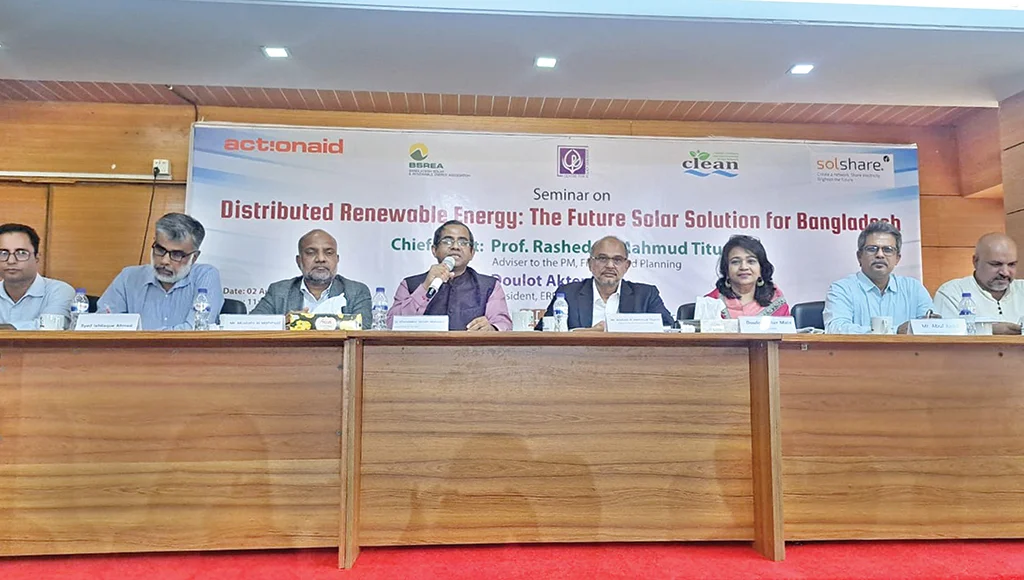
Prime minister’s finance and planning adviser Rashed Al Mahmud Titumir, among others, is present at a seminar organised by the Economic Reporters’ Forum in collaboration with the Distributed Renewable Energy Platform in the capital on Sunday. | Press release

Experts on Sunday identified inadequate access to finance as the biggest obstacle to Bangladesh’s renewable energy transition, warning that the country’s ambitious clean energy drive could fall behind unless entrepreneurs receive easier access to finance and a more supportive policy environment.

They also said that the country needed a coordinated financing framework, simplified access to credit, consistent policies and stronger institutional coordination to accelerate the transition towards distributed solar power and reduce dependence on imported fossil fuels.

The observations came at a seminar titled ‘Distributed Renewable Energy: The Future Solar Solution for Bangladesh,’ organised by the Economic Reporters’ Forum in collaboration with the Distributed Renewable Energy Platform, a forum of organisations working on renewable energy, at the ERF auditorium in the capital Dhaka.

Researchers, industry leaders and development experts said that Bangladesh’s evolving energy landscape had made distributed renewable energy increasingly important in addressing power reliability gaps, improving climate resilience and reducing costly fuel imports.

They said that many aspiring renewable energy businesses struggled to obtain affordable financing, while existing support mechanisms remained complicated and inaccessible.

Experts also identified policy inconsistency as another major obstacle, saying that although the government had adopted several supportive renewable energy policies, entrepreneurs frequently received conflicting directions from different ministries and agencies, creating uncertainty for investors and business associations.

Prime minister’s finance and planning adviser Rashed Al Mahmud Titumir said that Bangladesh’s renewable energy transition would require more than policy support, arguing that a broad-based public movement was needed to create sustained demand for clean energy.

‘If people demand renewable energy, the supply system will follow,’ he said, adding that society needed to be mobilised to recognise access to modern energy as a basic right.

Titumir said that renewable energy should be recognised as a fundamental right rather than a commodity and urged the government, civil society organisations, non-governmental organisations and financial institutions to work together to make clean energy accessible and affordable for all.

The adviser said that Bangladesh should build domestic manufacturing capacity for solar photovoltaic panels, batteries, inverters and electric vehicles to develop local industries, promote innovation and create employment.

At the event, keynote papers were presented by Centre for Policy Dialogue research associate Md Mehedi Hasan Shamim, Bangladesh Sustainable and Renewable Energy Association company secretary ASM Munir, Coastal Livelihood and Environmental Action Network chief executive officer Hasam Mehedi, SOLshare director Ishtique Ahmed and ActionAid Just Energy Transition manager Abul Azad.

They said that Bangladesh now faced a significant retention crisis, with nearly 47 per cent of the country’s six million installed solar home systems no longer functioning.

They said that these stranded assets demonstrated the need to shift towards grid-connected rooftop solar systems capable of supporting long-term electricity demand.

The keynote speakers observed that households accounted for 57.2 per cent of Bangladesh’s electricity consumption.

They estimated that if only 10 per cent of the country’s 40.3 million households installed rooftop solar systems ranging from one to five kilowatt-peak, Bangladesh could add 8,600 MWp of capacity by 2030.

They said that such a scenario alone could supply about 15 per cent of the country’s annual electricity demand while creating another 1.5 million green jobs in addition to the 1.37 million already generated by the solar industry by the end of 2021.

The keynote papers recommended accelerating battery energy storage systems and promoting virtual power plants using the country’s estimated six million electric three-wheelers.

The papers said that the vehicles collectively represented about 6 GW of potential storage capacity and that smart charging technologies could enable them to store electricity during off-peak hours and feed unused power back into the grid during evening peak demand, reducing reliance on expensive furnace oil-fired power plants.

The experts estimated that Bangladesh would require about $980 million in annual investment to achieve its distributed renewable energy targets by 2030.

They said that high upfront installation costs, ranging from Tk 80,000 to more than Tk 2,50,000 for residential systems, continued to discourage wider adoption, while commercial banks remained reluctant to finance such projects because of perceived risks and stringent collateral requirements.

To overcome these challenges, the Distributed Renewable Energy Platform proposed establishing a unified DRE coordination body under the Sustainable and Renewable Energy Development Authority to streamline licensing, planning and data management.

Titumir said that the government had already introduced major fiscal incentives, including tax benefits for solar projects and incentives for electric vehicles, to encourage investment in the sector.

He said that Bangladesh needed innovative storage technologies capable of balancing electricity supply and demand while keeping energy affordable for consumers.​
 

Chevron's onshore search offer under fresh vetting

1785798063137.webp


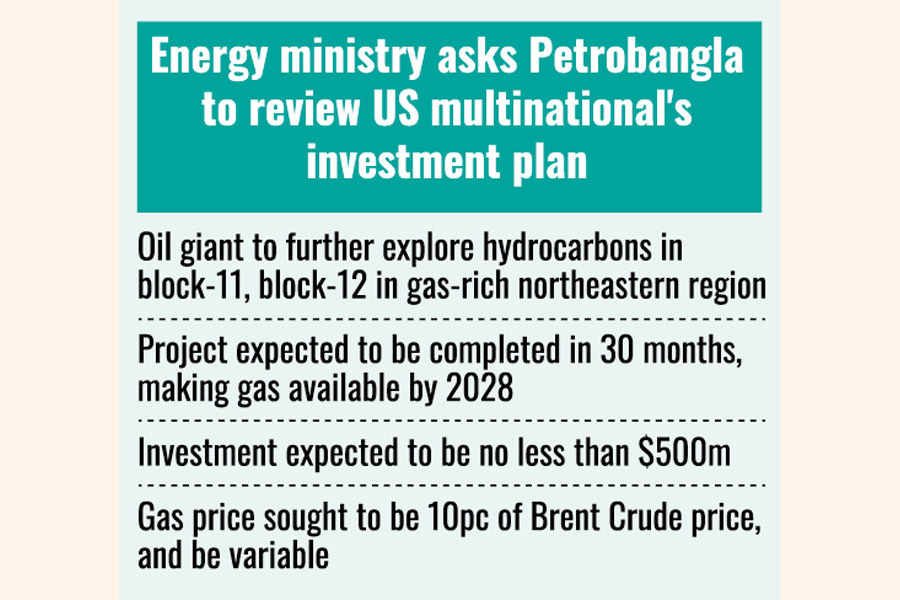
Chevron Bangladesh's fresh investment proposal to ramp up onshore gas exploration gets under processing, sources say, amid a thrust on energy search to meet shortages of fuels in the country.

The energy ministry has asked state-run Petrobangla to review the investment proposal from the US multinational.

Chevron Bangladesh, a part of the global energy company Chevron, submitted the investment proposal for further hydrocarbon exploration in block-11 and block-12 in the country's gas-rich northeastern region.

The American company is currently installing a compression station near Jalalbad gas field at a cost of around US$65 million to increase gas production from nearby producing gas fields.

The project is expected to be completed within 30 months, making additional gas available by 2028.

Chevron's investment proposal for these unexplored onshore areas in the Surma basin is long pending for approval by Bangladesh government.

The company has recently renewed interest in making further investment there to ramp up the country's overall natural-gas output against the backdrop of growing energy crisis since the beginning of the Middle East crisis late February, dwindling local gas reserves and mounting demand in industries, power plants and fertiliser factories.

Sources could not confirm how much investment Chevron will pour into these onshore blocks, but said that it would be no less than US$500 million.

"Chevron has planned to drill a good number of wells in new exploration areas and would be able to supply natural gas within the shortest possible time," said one source.

The US company is learnt to have sought to link the gas price to the price of Brent Crude on the international market and demanded that the price should be 10 per cent of the Brent Crude price, which will be variable.

Under the current international market rate, the price would be US$9.0 per cubic meter, considering the Brent Crude price at US$90 per barrel, which is around three times higher than the price at which it sells gas to Petrobangla from the currently operational gas fields.

Chevron placed the proposal after carrying out 'exploration study' in 11 onshore blocks, fully or partially, to delineate new hydrocarbon prospects over the past couple of years.

Among the blocks 1, 2A, 2B, 3A, 3B, 8, 9, 11, 12, 13 and 14, which were studied by Chevron, few are still vacant, or unexplored, some owned by state-run Bangladesh Gas Fields Company Ltd (BGFCL) and some owned by Sylhet Gas Fields Ltd (SGFL) and the remaining are Chevron's.

During the study, the company attained access to relevant data and carried out study in reservoir 'stratography', and unconventional reservoir 'farcies.'

Officials have said the US firm attained a 60-square-kilometer 'flank' area from Petrobangla outside its existing contract zone to the north of the Bibiyana gas field in the gas-rich region during the previous Awami League government.

It also invested around US$150 million in drilling a couple of new wells BY-27 and BY-28.

The onshore block-11 is one of the several blocks that were kept ring-fenced for development by BAPEX.

Chevron Bangladesh is currently the largest producer of natural gas in Bangladesh with its output of around 890 million cubic feet per day (mmcfd) from three of its onshore fields -- Bibiyana, Jalalabad and Moulavi Bazar, which are located in blocks 12, 13 and 14 respectively, according to official data of Petrobangla as on August 1, 2026.

The country's overall natural-gas output hover around 2,151mmcfd, including 500mmcfd regasified liquefied natural gas (LNG) and the remaining 1,651mmcfd from local gas fields that include the Chevron-operated ones.

Previously, the Bangladesh Oil, Gas and Mineral Corporation or Petrobangla had turned down a similar proposal from Chevron to develop onshore Rashidpur gas field, owned by the corporation's subsidiary Sylhet Gas Fields Ltd (SGFL).

Chevron then also had sought 10 per cent of the Brent Crude price for Rashidpur gas after development of the field and initiating production.

Instead of allowing it to develop Rashidpur gas field, Petrobangla has engaged its subsidiary Bangladesh Petroleum Exploration and Production Company Ltd (BAPEX) to drill extensively over there.

More than a decade back in 2015, Chevron also had proposed to invest around US$650 million in installing a new compression station at Bibiyana gas field and drilling three more wells in Jalalabad gas field, tagging condition of annual tariff hike by 3.0 per cent for Bibiyana gas.

The US firm later dropped the investment plan as Petrobangla rejected its plea for annual hike in gas tariffs. Chevron instead announced sellout of its Bangladesh stakes to Chinese joint-venture Himalaya Energy in April 2017.

The US firm reversed its decision in October 2017 when Petrobangla moved to acquire its assets. It decided not to sell off its Bangladesh stakes but to stay in Bangladesh.​
 

Old rules still shape energy transition

Electricity is more than illuminating homes. It sparks opportunities to learn, earn and build a dignified life. Yet Bangladesh’s energy history shows that access alone does not guarantee reliability, affordability or justice.

Back in 2003, only 27 per cent of the rural households had electricity, compared with a national rate of 37 per cent. This disparity contradicted the 1972 constitutional commitment to transform rural areas through electrification. Fast forward five decades, near-universal electricity access is a reality. However, rural households and businesses continue to experience less reliable supply, poor power quality and greater financial pressure than their urban counterparts.

Bangladesh’s energy sector mirrors a deeper flaw in its development model: fragmented policymaking combined with a preference for visible infrastructure. Large power plants become trophies for politicians and a gateway for well-connected businesses. The 2024 White Paper Committee documented how major power-sector contracts were frequently awarded through opaque processes and political connections.

As a result, Bangladesh boosted its power generation but neglected to build an electricity system that is reliable, affordable and financially sound. Infrastructure rose, but the supporting institutions often failed to take shape.

The same contradiction is visible in the shift to renewable energy. Past governments have acknowledged the need to break free from fossil fuels and set bold clean energy targets for 2041. Still, long-term planning remains a missing piece.

The solar home system programme demonstrates both the possibilities and failures of this approach. Launched in 2003 through the Infrastructure Development Company Limited, it became one of the world’s largest off-grid electrification programmes. By 2018, it had provided electricity services to around 20 million people, particularly beyond the national grid.

Yet as the national grid expanded further, demand for these systems faded. Although this development was predictable, no clear strategy was prepared to phase out, repurpose, upgrade or integrate the off-grid infrastructure. Bangladesh still lacks a visible roadmap for transforming it into grid-connected, mini-grid or hybrid renewable energy systems.

Recent policies provide tax incentives for renewable energy products and give greater priority to rooftop solar. This represents an important technological shift, but it also changes who is most likely to benefit.

The earlier solar home system programme was socially oriented and supported by public institutions, NGOs, microfinance organisations and private suppliers. The emerging rooftop solar model is more strongly led by businesses and property owners with the capital, buildings and technical capacity to invest. Without safeguards, it may favour industries, affluent households and urban consumers while leaving poorer rural households with fewer opportunities to participate.

Private sector participation is necessary, but privatisation alone does not ensure affordability or fairness. As seen in Bangladesh’s health and education sectors, private provision has often expanded access while raising costs for poorer households. This is precisely what Sustainable Development Goal 7 calls for — not just access, but affordable and reliable energy for all.

Experiences of implementing past solar programmes offer an important lesson. A 2025 study conducted by Duke University researchers found that under the publicly distributed TR/Kabita Solar Programme, politically connected villages, particularly the home areas of elected representatives, often received more benefits. Political discretion weakened the objective of reaching energy-deprived communities.

The IDCOL programme avoided some of these problems through partnerships with NGOs and microfinance institutions. Yet its loan-based model created another inequality. Poor households able to afford only small down payments needed longer repayment periods and therefore paid more in total. Researchers described this as a ‘poverty penalty’: those with the least financial capacity bore the greatest relative cost.

The delivery mechanism differed, but unequal access persisted.

Ultimately, renewable technology alone cannot deliver a just transition. Without transparent beneficiary selection, affordable finance, accountable institutions and community participation, the new energy system may reproduce political favouritism and economic exclusion.

Local governments will be central to implementation, but their role must be governed by clear criteria, public disclosure and independent monitoring. Existing off-grid systems should be mapped and assessed for integration into mini-grids, community systems or productive-use projects. Subsidies and concessional finance should prioritise low-income households, small farmers, rural enterprises and marginalised communities.

Following the mass uprising of 2024, reform must sit at the centre of Bangladesh’s national agenda. In the energy sector, true reform is not just swapping fossil fuels for solar panels. It must also replace an inherited model of fragmented planning, elite capture and unequal benefit distribution.

Bangladesh’s energy transition will be transformative only when disadvantaged population are placed at the core of policy, financing, implementation and ownership. Otherwise, the country may adopt new technologies while continuing to play by the old rules of development.

Ataur Rahman holds an MA in Sustainable Development Management from Rhine–Waal University of Applied Sciences, Germany.​
 

BD eyes rapid LNG import from next-door Myanmar

PM gives the go-ahead, says minister
1785884121797.webp


Bangladesh hopes to procure liquefied natural gas from next-door neighbour Myanmar in 12-hour transportation once a much-expected LNG sales-and-purchase deal is done, as the country faces exigencies of energy.

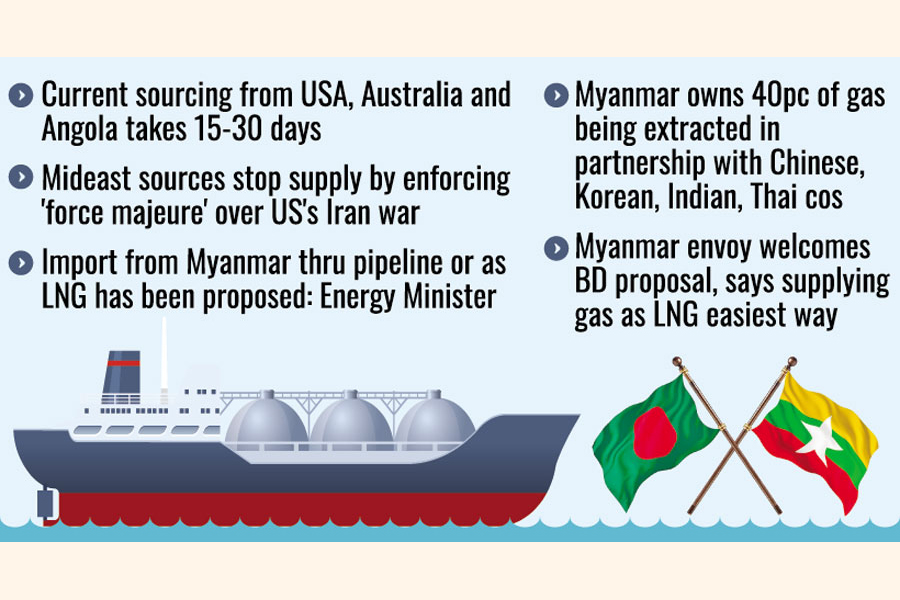
Currently, the country sources LNG from the United States, Australia and Angola wherefrom import consignments take 15 to 30 days.

It, however, takes around six to seven days to import the fuel from the nearest sources in Middle-Eastern countries.

But Bangladesh has not got LNG from its Mideast sources -- QatarEnergy and OQ Trading -- over the past several months as they have stopped supplying the gas by enforcing 'force majeure' since late February immediate after the war between the USA and Iran broke out.

"If both countries agree and settle price negotiations, Bangladesh will be able to import LNG from Myanmar within 12 hours -- the shortest possible time to import the fuel," Iqbal Hasan Mahmood, Minister for Power, Energy and Mineral Resources (MPEMR), told The Financial Express on Tuesday.

"We have proposed importing gas from neighbouring Myanmar through pipeline or as LNG," he said.

"I made the proposal on Sunday after having the green signal from Prime Minister Tarique Rahman to import gas from our neighbour, which is a gas-rich country in this region, to resolve our mounting natural-gas crisis," said the minister.

Myanmar has around 40 per cent of gas of its own in various oil-and gas-exploration projects being implemented under partnership with Chinese, Korean, Indian and Thai energy companies, from where the country can export LNG to Bangladesh, said the Bangladeshi minister.

The option was discussed during a meeting with Myanmar's ambassador in Bangladesh, Kyaw Soe Moe, on Sunday at the secretariat.

As a close neighbour, Bangladesh is prioritising enhanced energy cooperation with Myanmar, he said, as industries, households and other consumers are in a crying need for gas amid a fuel crunch.

Importing LNG from Myanmar could further cut Bangladesh's dependence on the volatile spot market, he added.

Bangladesh has significant domestic demand for natural gas, and the government is particularly interested in sourcing energy from Myanmar via pipeline in the long term and as LNG in the short term, Mahmood said.

Meanwhile, the Myanmar ambassador welcomed Bangladesh's proposal and said supplying gas as LNG would be the easiest way for energy cooperation between the two bordering countries.

The envoy suggested that the matter could be reviewed at a Bangladesh-Myanmar joint technical-committee meeting.

The minister also extended a formal invitation to Myanmar's energy minister to visit Bangladesh and expressed his own willingness to undertake a trip to Myanmar to discuss the gas import. Bilateral energy cooperation could play a supportive role in establishing the proposed China-Myanmar-Bangladesh corridor, which was discussed during the Bangladeshi prime minister's recent visit to China, the energy minister said.

Currently, Myanmar exports gas to Thailand and China through pipelines.

Bangladesh is currently struggling to meet its gas demand amid elevated LNG prices, and as contracted long-term LNG suppliers continue to restrict scheduled cargo deliveries.

Due to disruptions to long- and short-term LNG supply, Bangladesh's LNG spot cargo purchases this year are set to reach 41 by August, 39 of which have come after the start of the war in the Middle East.

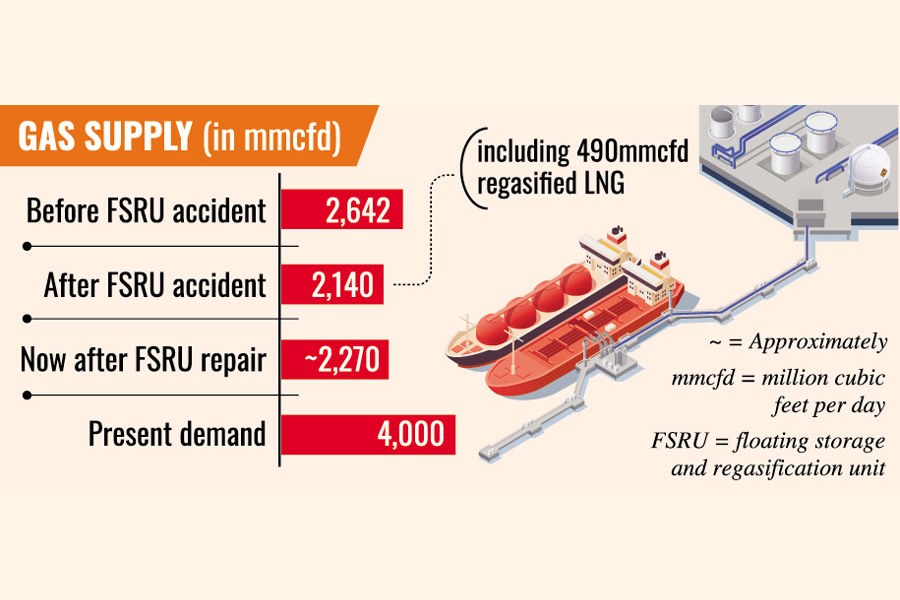
In addition to limited contractual supplies due to the war in the Middle East, Bangladesh is currently facing a restriction in natural gas supply following the abrupt shutdown of operations at one of its two FSRUs on July 21.

Bangladesh's overall natural gas supply fell to about 2,139 million cubic feet per day (mmcfd) on August 2, with 493mmcfd of regasified LNG, down from the pre-accident level of 2,642mmcfd, according to official Petrobangla data.

The country's natural gas demand is about 4,000mmcfd, according to Petrobangla, which far outstrips the availability from domestic production and imports.

Gas-fired power plants are the worst hit, with electricity generation of about 2,500 megawatts being affected due to the FSRU disruption, state-owned Bangladesh Power Development Board (BPDB) Chairman Md Rezaul Karim said.

The gas-fired power plants are currently receiving about 680mmcfd, down from about 950mmcfd in the pre-accident period, he said.

The shutdown of the FSRU has reduced gas pressure in many areas, disrupting industrial production, too, he said.​
 

Myanmar gas through a pipeline, how feasible it is

Mohiuddin
Dhaka

1785885608378.webp

Employees at a filling station sit idle due to a gas shortage at the Royal Filling Station in Mahakhali, Dhaka, in the afternoon on 3 August 2026 Suvra Kanti Das/Prothom Alo

The government is looking for new sources of gas to tackle the country's ongoing gas crisis. Following its initiative to import liquefied natural gas (LNG) from Malaysia, the issue of importing gas from Myanmar has now come under discussion.

Bangladesh has proposed importing gas directly through a pipeline. As an alternative, Myanmar has also expressed interest in discussing the possibility of supplying LNG to Bangladesh.

However, the proposal is still at the preliminary stage of talks. It remains unclear how much gas could be supplied, from which gas field it would come, what route the pipeline would take, and how its cost and security would be ensured.

Although Myanmar has gas reserves, the country's production is declining. It also has long-term gas export agreements with China and Thailand. In addition, there are the conflict in Rakhine, the Arakan Army's control over border areas, and diplomatic tensions between the two countries stemming from the Rohingya crisis.

Energy sector experts say that, for these reasons, gas from Myanmar cannot provide an immediate solution to Bangladesh's ongoing gas shortage. If the political and security situation changes, it could be considered a long-term source of supply. Before that, however, a detailed feasibility study is needed on gas availability, pricing, transportation routes and the project's economic costs and benefits.

Last Sunday, Myanmar Ambassador to Bangladesh Kyaw Soe Moe met Power, Energy and Mineral Resources Adviser Iqbal Hasan Mahmud at the Secretariat. During the meeting, the energy adviser expressed Bangladesh's interest in importing gas from Myanmar through a pipeline to help address the country's natural gas shortage.

According to a press release issued by the Ministry of Power, Energy and Mineral Resources, Bangladesh has proposed reopening talks on constructing a gas pipeline from Myanmar to Chattogram.

The Myanmar ambassador responded positively to the proposal. At the same time, he also expressed interest in holding detailed discussions on the possibility of supplying gas to Bangladesh in the form of LNG alongside the pipeline option.

The practicality of the two options, however, is not the same. Importing gas through a pipeline would require a lengthy process involving identification of the source gas field, a long-term gas purchase agreement, route selection, security arrangements, financing and construction.

By contrast, importing gas as LNG would not require a new cross-border pipeline. However, LNG could be more expensive because of the costs associated with liquefaction infrastructure, transportation by ship and regasification at terminals in Bangladesh. It is also not yet clear whether Myanmar has the necessary infrastructure and capacity to export LNG.

1785885674190.webp

Machinery lies idle at a dyeing factory due to gas crisis. Photo taken in BCIC Industrial Estate in Fatullah, Narayanganj. Prothom Alo file photo

According to data from Myanmar's Ministry of Energy, the World Bank and the International Energy Agency (IEA), the country has proven gas reserves of about 22 trillion cubic feet. It produces around 1.5 billion cubic feet of gas per day. At the current rate of production, those reserves would, on paper, last for about 40 years.

However, the country's gas production has declined compared with previous years. Myanmar has been facing a political crisis since 2021 and has come under economic sanctions.

Two international oil and gas companies have withdrawn their investments from the country's gas sector. Western oil and gas companies have also refrained from making new investments. By contrast, Myanmar was producing about 2 billion cubic feet of gas per day in 2016–17.

According to the World Bank, in 2024, 50 per cent of the gas produced in Myanmar was exported to Thailand, 25 per cent to China, while the remaining 25 per cent was used domestically.

Myanmar has long-term supply agreements with both countries. Demand for gas for power generation is also increasing within Myanmar. Meanwhile, the country recently announced the discovery of an offshore gas field with reserves four times larger than its current proven reserves.

However, these are not yet proven reserves. They can only be confirmed after additional exploratory wells are drilled. Experts say any decision on a pipeline should be made only after verifying all the information and assessing its economic viability.

Geologist Badrul Imam told Prothom Alo that Bangladesh is facing a gas shortage and production from its own gas fields has been declining steadily. Since Myanmar has gas reserves, it could be a potential source. However, he said, any decision must take into account whether Myanmar has the capacity to supply the gas, what the price would be and how it would be transported.

People associated with the energy sector say discussions on a gas pipeline with Myanmar date back nearly three decades. In 1997, a private company proposed constructing a pipeline from Myanmar through Bangladesh to Tripura in India.

The proposal, however, was not intended to bring gas to Bangladesh; rather, it was aimed at exporting gas to India. Bangladesh would have earned regular transit fees from the pipeline. The government at the time did not attach importance to the proposal.

Formal talks on the issue among the three countries—Bangladesh, Myanmar and India—began in 2004. In 2005, a technical committee was also formed with the agreement of all three countries. At the time, Bangladesh sought transit access through India to Nepal and Bhutan. As India did not agree to that condition, the pipeline initiative was effectively abandoned. Discussions on a gas pipeline from Myanmar have now resumed. This time, Bangladesh wants to import the gas for its own use.

Bangladesh has been facing a gas shortage since 2007. Gas production has been declining steadily since 2017. Over the past nine years, production has fallen by 1.05 billion cubic feet per day. Current production stands at 1.65 billion cubic feet per day. Although this is higher than Myanmar's production, Bangladesh's gas demand is much greater. To meet the additional demand, Bangladesh has been importing LNG since 2018. Even so, the shortfall has not been eliminated. The gas crisis has worsened since 21 July, when a fire forced the closure of one of the country's LNG supply terminals. Since then, the government has been searching for new sources of gas.

Experts say the current reality is different. The situation in Myanmar remains unstable. Constructing and operating an overland pipeline through territory outside the control of the Myanmar government would be nearly impossible without some form of security and political understanding with the Arakan Army. In addition, Bangladesh and Myanmar remain at diplomatic odds over the Rohingya crisis. Myanmar has yet to agree to repatriate the Rohingya refugees. A genocide case against Myanmar is also pending before an international court.

South Asian geopolitics researcher Altaf Parvez told Prothom Alo that Bangladesh effectively no longer has a border with Myanmar, as almost the entire frontier is under the control of the Arakan Army. He said it would be difficult to build a pipeline without peace being established in Myanmar, as it could come under attack at any time. He added that the situation would be different if the pipeline were laid beneath the seabed. He also said that, under the current circumstances, a cooperation agreement between the two countries would be beneficial for Myanmar, but it could weaken Bangladesh's position on the Rohingya issue.​
 

Rooftop solar nears 1,000MW despite policy hurdles

Asifur Rahman

1785886533146.webp


Bangladesh’s rooftop solar industry is nearing a milestone of 1,000 megawatts (MW) in installed capacity, but regulatory and policy barriers could undermine its growth momentum, according to the Institute for Energy Economics and Financial Analysis (IEEFA).

A briefing note published by the think tank yesterday said the new tax structure has raised the tax on industrial rooftop solar equipment to about 17 percent from the previous 1 percent, making such projects significantly more expensive.

Tap here to add The Daily Star as a trusted source google-preferred-source-badge
Delays in approving net-metering connections, which allow rooftop solar systems to feed surplus electricity into the national grid, continue to hamper adoption, it added.

Official data show Bangladesh had 418.1MW of rooftop solar capacity as of June 2026. However, IEEFA found that 239 large establishments and business groups alone account for 667MW.

The institute estimates the country’s actual rooftop solar capacity could be around 1,000MW after including smaller installations below 0.15MW that are not fully reflected in official statistics.

The estimate is notable because Bangladesh’s grid-scale variable renewable energy capacity stood at 859MW as of June 2026, according to the briefing note, Role of Distributed Resources in Energy Transition: A Multi-Country Perspective, which examines the growth of distributed energy resources (DERs) in Bangladesh, Australia and India.

“Compared to the grid-scale variable renewable energy capacity of 859MW as of June 2026, the country’s growing rooftop solar capacity provides an encouraging signal for Bangladesh’s power sector,” said Shafiqul Alam, co-author of the report and lead analyst for Bangladesh Energy at IEEFA.

“The rooftop solar sector is expected to grow further, with engineering, procurement, and construction (EPC) companies holding a project pipeline of more than 500MW,” he told The Daily Star.

The growing use of rooftop solar also appears to be easing pressure on the national grid. IEEFA’s analysis of half-hourly daytime electricity demand between April 16 and June 11 in 2024 and 2026 found demand fell by as much as 6 percent.

While weather conditions and weaker industrial activity also contributed to the decline, the institute said rooftop solar appeared to have played a catalytic role.

However, IEEFA identified the current tax and duty structure as one of the main obstacles to expanding rooftop solar and solar irrigation.GROWTH FACES POLICY OBSTACLES

The new tax structure has raised the effective tax burden on industrial rooftop solar projects to 17 percent from 1 percent under the previous capital-machinery provision, IEEFA said.

According to industry stakeholders, the 17 percent comprises 15 percent value-added tax (VAT) and 2 percent advance income tax, while customs duty and supplementary duty remain zero.

The impact is particularly severe for smaller rural projects, as many are unlikely to qualify for duty benefits because project implementation contracts are often beyond the reach of small suppliers and traders undertaking remote installations.

The institute recommended a full duty waiver for rooftop solar projects.

“With the government stipulating a target to install a renewable energy capacity of 10,450MW between 2026 and 2030 in its strategy document, relying on rooftop solar for more than 50 percent new capacity, a full duty waiver to all rooftop solar projects will likely help achieve the goal,” said Shafiqul Alam.

The report said rising electricity tariffs are encouraging industries to adopt rooftop solar, while higher diesel prices are driving investment in solar-powered irrigation.

Delays in net-metering approvals remain another major obstacle. Although government guidelines require applications to be approved within 10 to 15 days, rooftop solar and solar irrigation projects continue to face delays.

IEEFA estimated that more than 93 percent of Bangladesh’s solar irrigation capacity remains off-grid. As irrigation pumps are used for only 110 to 150 days a year, the absence of net metering leaves them idle for much of the year, weakening project economics.

Bangladesh has more than 10 lakh diesel-powered irrigation pumps but only 3,556 solar-powered ones, the briefing note said. Converting one-third of the diesel-powered pumps to solar could reduce the annual diesel import bill by about $244 million, or Tk 3,000 crore.

The institute urged the Sustainable and Renewable Energy Development Authority (SREDA) and the Ministry of Power, Energy and Mineral Resources to monitor online net-metering applications and prevent approval delays.

Access to finance is another challenge. Despite the availability of low-cost green financing, lenders remain reluctant to finance distributed energy projects because of perceived risks and high collateral requirements. IEEFA recommended credit-risk guarantees to encourage lending to smaller businesses and farmers.

The institute also recommended promoting battery storage alongside distributed energy resources and gradually adopting smart meters. It said supportive tax policies, faster net-metering approvals and better access to finance are essential to achieving Bangladesh’s renewable energy targets.​
 

Latest Posts

Back