Donate ☕
[🇧🇩] - Israel and Hamas war in Gaza-----Can Bangladesh be a peace broker? | Page 75 | PKDefense

[🇧🇩] Israel and Hamas war in Gaza-----Can Bangladesh be a peace broker?

Reply (Scroll)
Press space to scroll through posts
G Bangladesh Defense
[🇧🇩] Israel and Hamas war in Gaza-----Can Bangladesh be a peace broker?
944
24K
More threads by Saif


Hamas says talks start on second phase of Gaza ceasefire deal
REUTERS
Published :
Feb 04, 2025 21:24
Updated :
Feb 04, 2025 21:24

1738712466494.webp

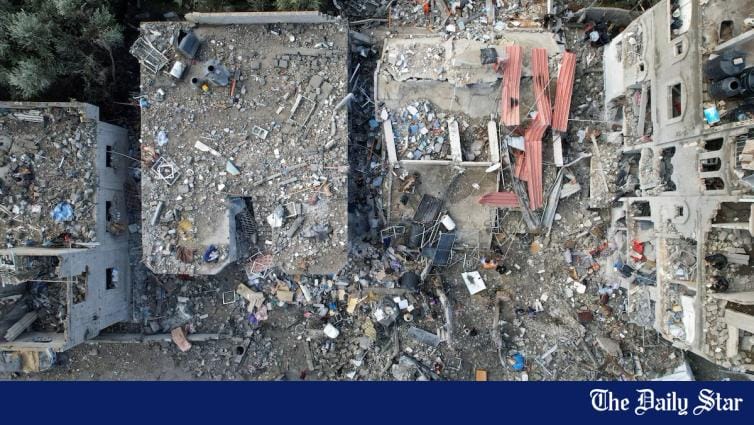
A Palestinian man operates heavy machinery to open the road and remove the rubble, amid a ceasefire between Israel and Hamas, in the southern Gaza Strip, February 4, 2025. Photo : REUTERS/Hatem Khaled

Talks have started on the second phase of the Gaza ceasefire deal, the spokesperson for the Palestinian militant group Hamas said on Tuesday.

The first phase of the ceasefire between Israel and Hamas went into force on Jan 19 after 15 months of war and involved a halt to fighting, the release of some of the Israeli hostages held by Hamas and the freeing of some Palestinian prisoners.

Phase two of the three-phase deal is intended to focus on agreements on the release of the remaining hostages and the withdrawal of Israeli troops from Gaza.

"Contacts and negotiation on the second phase have begun," Hamas spokesperson Abdel-Latif Al-Qanoua said, without providing further details.

Israeli Prime Minister Benjamin Netanyahu's office said earlier on Tuesday that Israel was preparing to send a high-level delegation to the Qatari capital Doha to discuss continued implementation of the deal.

Netanyahu was due to hold talks with US President Donald Trump on Tuesday, with the focus likely to be on the ceasefire as well as a possible normalisation of relations with Saudi Arabia.

The initial six-week truce, agreed with Egyptian and Qatari mediators and backed by the US, has remained largely intact but prospects for a durable settlement are unclear.

The war began with the Hamas-led attack on Israel on Oct 7 in which 1,200 people were killed and more than 250 taken hostage, according to Israeli tallies. Israel's military campaign in Gaza since then has killed more than 47,000 Palestinians, Palestinian health authorities say.

Hamas and Netanyahu's government, which includes hardliners who opposed the ceasefire deal, say they are committed to reaching an agreement in the second phase although each has criticised the other over its implementation.

Israeli leaders say Hamas cannot remain in Gaza, but the movement has taken every opportunity it could to show the control it still exerts despite the loss of much of its former leadership and thousands of fighters during the war.

Qanoua said Israel had stalled in implementing the humanitarian protocol of the ongoing first phase, hindering the repair of hospitals, roads, water wells and infrastructure destroyed by Israel's 15-month offensive.

Israel did not immediately comment on Qanoua's assertion although Israeli deputy foreign minister Sharren Haskel told MSNBC's "Morning Joe" show that Hamas had broken a lot of the rules that had been set.

Despite this, she said: "We are hopeful. We want to bring back all of our family members, and we need to make sure that Israel's security can be guarded."​
 
Analyze

Analyze Post

Add your ideas here:
Cite Fact Check Highlight Respond

What to expect from Netanyahu’s visit with Trump

1738797336684.webp

Palestinians transport aid supplies on an animal-drawn cart, amid a ceasefire between Hamas and Israel, in Gaza City, on February 3, 2025. PHOTO: REUTERS

Since Donald Trump returned to the White House for a second term, global, regional and domestic changes have been accelerating at an unprecedented pace. Trump's inaugural speech and his deluge of executive orders exemplify a nationalist rhetoric, which includes barring student visas of those who participated in "pro-Palestinian" protests that shook the country last year. He heralded "a golden age," in his inaugural address, and his policies have put Washington—and the rest of the world—on notice that Trump is determined to turn his campaign promises into reality. His promises come with a liking of openly self-serving agendas. Nowhere is this more evident than in his administration's approach towards the Middle East, which is defined by a complete bias for Israeli expansionism at the expense of Palestinians.

The policy not only disregards Palestinian rights but also strengthens Israeli hegemony, offering illusions through hardline figures such as Massad Boulos and Steve Witkoff. Under Trump's first administration, the US showed no interest in supporting the establishment of an independent Palestinian state, further exacerbating Palestinian suffering and pushing towards the dissolution of the cause. This time, evidently, will be no different. Israeli Prime Minister Benjamin Netanyahu's visit and upcoming discussions with Trump raises questions, and mostly concerns, about what lies ahead. The ceasefire is currently in a fragile state, held in the Gaza Strip with the next stage of negotiations expected to enter the second phase that includes a more permanent end to the conflict.

Netanyahu, the first foreign leader to meet Trump at the White House, will undoubtedly try to preserve a dynamic between the nations where absolutely no threats for Netanyahu's position as the Prime Minister of Israel, and ensure there are no checks and balance for his government—given those members are "loyal" to him. It is the same dynamic that resulted in the Abraham Accords. In this context, it is important to remember that Netanyahu's decision in Israel has not been in the interest of the Israeli public, majority of whom do not approve of him. He dragged the war on for political gains, and got rid of anyone who objected to his decisions, in order to serve his personal interests, starting with the opposition duo Benny Gantz and Gadi Eisenkot, then Defence Minister Yoav Gallant, and finally the chief of staff who was replaced by Netanyahu's most loyal commander.

He closed the gaps that disturbed him and confused his absolute rule under the pretext of achieving absolute victory. When speaking to Trump, Netanyahu's logic that "I am Israel" will inarguably dominate. His expansionist aims will be presented, days after Trump has offered—and been rejected—to relocate Palestinians from Gaza to Egypt and Jordan.

Netanyahu's equation with Trump in his first term doubled Israel's dependency on US financial, armed and political wars, and will remain a constant threat to the Middle East, a region whose map both leaders want to change, and the region where they presume authority to throw around citizens and people across borders.

False promises and intermediary characters

Massad Boulos, a billionaire of Lebanese origin and the father-in-law of Tiffany Trump, played a role in crafting deceptive assurances to the Palestinians, suggesting there was a real opportunity for political relief under the Trump administration. These promises follow a long-standing US pattern of selling illusions to Palestinians, offering grand economic or political solutions without any substantive commitments.

Similarly, Steve Witkoff, US billionaire real estate investor and Trump's Middle East envoy, sought to position himself as a mediator, even reportedly visiting Gaza. However, these gestures will only remain as mere theatrics that fall in line with the administration's broader policies that actively reinforce Israeli occupation, settlement expansion, and annexation projects.

Israeli hegemony as a pillar of US strategy

The US-Israel alliance is deeply rooted in strategic interests, making the idea of an independent Palestinian state fundamentally at odds with Washington's long-term vision of "peace" in the Middle East. Israel serves as the linchpin of US influence in the region, and as such, Trump's policies, including his support for Israeli settlements, the relocation of the US embassy to Jerusalem, and the recognition of Jerusalem as Israel's unified capital confirm that Washington sees the continuation of Israeli hegemony as a long-term strategic goal.

In the same vein, the Trump administration brokered a truce between Hezbollah and Israel that pushed the deadline for the complete withdrawal of the Israeli occupation forces from Lebanon, further extending Israel's military presence in the country. Trump has completely sidelined Jordan from his strategic calculations, seeking to impose an economic blockade to pressure Amman into aligning with his regional agenda, most notably, by forcing Jordan to absorb Palestinians from Gaza. That is a revival of a proposal that Jordan rejected during Trump's first term, which is now being pushed again through economic coercion, including threats to cut aid.

At the same time, US officials such as Ambassador Mike Huckabee and the US ambassador to the UN have openly championed Israel's "biblical right" to the West Bank. Huckabee, a hardline Anglican, refuses to call the Israeli communities in the West Bank "settlements." The US ambassador to the UN has echoed similar sentiments, reflecting the depth of the indoctrinated anti-Palestinian beliefs in US decision-making.

Trump's policies and his supporters

Trump's support for Israel cannot be separated from his electoral base, which largely consists of Zionists and Evangelical Christians. These groups see support for Israel as a religious and ideological duty. For them, the "Greater Land of Israel" is part of their faith. The usage of religion to occupy land, unfairly, played a major role in pushing the Trump administration to adopt policies that serve the entire Israeli occupation project at the expense of Palestinian human rights.

Since assuming office, Trump has lifted sanctions on Israeli settlers, removed bans on bomb shipments to Israel, and endorsed proposals advocating for the forced transfer of Palestinians under the guise of "evacuating areas."

If we look at Trump's policies realistically, it is clear that his administration is interested in pushing for Israeli hegemony,

Trump's transactionalism

Trump approaches international issues, including the Palestinian cause, through the lens of transactionalism. Rather than addressing the political roots of conflicts or seeking justice, he perceives the region as an opportunity for economic profit. His statements referring to Gaza as a "fantastic place" exemplify his reductionist perspective, trivialising the unimaginable suffering of the Palestinians in Gaza for the past year and a half. Similar to Netanyahu, Trump has also reduced the Palestinians' struggle to a mere commercial project and their land to a profit-making machine. These policies, coated in political hypocrisy, only deepen the suffering of the Palestinian people.

Given this stark reality, it is imperative that we Palestinians, and Palestinian supporters around the world, unite according to a clear strategic vision and work to realign internal political and diplomatic priorities to confront the growing challenges. As the ceasefire in Gaza hangs in the air, the Israeli military, for its part, has shifted its focus over the past two weeks to the West Bank, carrying out airstrikes and blowing up 23 buildings in Jenin on Sunday. If Trump and Netanyahu work to foster the problematic US-Israeli equation that has underlined the conflict with Palestine, the Middle East will only plunge into further unrest. The only hope lies in Trump's economic interests with the Arab states and gulf nations overriding his penchant for far-right nationalists like Netanyahu. The coming days will reveal the future of Gaza in the short-term at least, but that itself is the issue: the future of the besieged strip lies in the hands of two men who, above all, care mostly about themselves.

Yousef SY Ramadan is the ambassador of Palestine to Bangladesh.​
 
Analyze

Analyze Post

Add your ideas here:
Cite Fact Check Highlight Respond

Trump says US will take over Gaza, create 'Riviera of the Middle East'

1738798349590.png

US President Donald Trump (R) meets with Israel's Prime Minister Benjamin Netanyahu in the Oval Office of the White House in Washington, DC, on February 4, 2025. Photo: AFP

President Donald Trump revealed a plan on Tuesday for the United States to take over the Gaza Strip, resettle Palestinians in other countries -- seemingly whether they wanted to leave or not -- and turn the territory into "the Riviera of the Middle East."

Trump made the stunning proposal to audible gasps during a joint press conference with Israeli Prime Minister Benjamin Netanyahu, whom he was hosting at the White House for talks.

In a scheme that lacked details on how he would move out more than two million Palestinians or control Gaza, Trump said he would make the war-battered enclave "unbelievable" by removing unexploded bombs and rubble and economically redeveloping it.

"The US will take over the Gaza Strip and we will do a job with it, too. We'll own it," Trump said.

He said there was support from the "highest leadership" in the Middle East and upped pressure on Egypt and Jordan to take displaced Gazans -- despite both countries and the Palestinians flatly rejecting the surprise idea.

Suggesting "long-term ownership" by the United States, Trump said his plan for Gaza would make it "the Riviera of the Middle East. This could be something that could be so magnificent."

Key US ally Netanyahu said Trump's plan could "change history" and was worth "paying attention to."

Netanyahu was making the first visit of a foreign leader to the White House since Trump's return to power, for what were billed as talks on securing a second phase of the Israel-Hamas truce after an initial six-week ceasefire.

'Miserable existence'

But it quickly turned into the shock revelation of a plan that would completely transform the face of the Middle East.

Trump, who also floated traveling to Gaza, appeared to suggest it would not be rebuilt for Palestinians.

"It should not go through a process of rebuilding and occupation by the same people that have... lived there and died there and lived a miserable existence there," he said.

The Palestinian envoy to the UN had pushed back strongly at Trump's suggestions earlier Tuesday -- before his proposal the United States take the territory over -- for his people to be resettled.

"Our homeland is our homeland," said Riyad Mansour.

"And I think that leaders and people should respect the wishes of the Palestinian people."

Gazans have also denounced Trump's resettlement idea. "Trump thinks Gaza is a pile of garbage -- absolutely not," said 34-year-old Hatem Azzam, a resident of the southern city of Rafah.

Trump was vague on the details of how he would execute the takeover plan, but hinted that it could require US boots on the ground in one of the most volatile places on earth "if necessary."

It is not the first time the former property tycoon has spoken about the Palestinian territory in terms of real estate, saying in October it could be "better than Monaco."

Standing at a podium beside Trump, Netanyahu hailed Trump as Israel's "greatest friend" and praised his "willingness to think outside the box."

The two have had tense relations in the past, but Netanyahu has seized on the Republican's return to power after his ties with former president Joe Biden became increasingly strained over the death toll in Gaza since Israel's invasion.

'Winning the war'

The Israeli leader would not rule out a return to hostilities with Hamas, or with its other foes in the region including Lebanon's Hezbollah and Iran.

"We will end the war by winning the war," Netanyahu insisted, while also vowing to secure the return of all hostages held by Hamas.

He did voice confidence that a deal with regional rival Saudi Arabia to normalize relations was "going to happen."

But after Trump aired his proposal, Saudi Arabia said it would not formalize ties with Israel unless a Palestinian state is established.

Trump's grand Gaza plan however is set to face harsh opposition from Palestinians and Middle Eastern countries.

Egypt, Jordan and ceasefire mediator Qatar have all flatly rejected Trump's suggestion of moving Palestinians from Gaza.

The war began when Hamas attacked Israel on October 7, 2023, taking into Gaza 251 hostages, 76 of whom are still held in the Palestinian territory including 34 the Israeli military says are dead.

Hamas's attack resulted in the deaths of 1,210 people on Israeli side, mostly civilians, according to an AFP tally based on official Israeli figures.

Israel's retaliatory response has killed at least 47,518 people in Gaza, the majority civilians, according to the Hamas-run territory's health ministry. The UN considers these figures as reliable.

The truce that took effect on January 18 has led to a surge of food, fuel, medical and other aid into Gaza, and allowed people displaced by the war to return to the north of the Palestinian territory.

But since the Gaza ceasefire took effect, Israel has launched a deadly operation against militants in the occupied West Bank's north.​
 
Analyze

Analyze Post

Add your ideas here:
Cite Fact Check Highlight Respond
  • Wow (+2)
Reactions: Bilal9

Hamas rejects Trump proposal to take over Gaza
Agence France-Presse . Gaza 06 February, 2025, 00:13

1738799459256.webp

A man rides a donkey-pulled cart past the rubble of destroyed buildings at Saftawi street in Jabalia, in the northern Gaza Strip, on Wednesday during a ceasefire deal in the war between Israel and Hamas. | AFP photo

Palestinian militant group Hamas lashed out Wednesday at president Donald Trump’s shock proposal for the United States to take over the Gaza Strip and resettle its people in other countries, seemingly whether they want to leave or not.

Trump made his announcement to audible gasps during a joint press conference with Israeli prime minister Benjamin Netanyahu, whom he was hosting at the White House for talks.

In a proposal that lacked details on how he would move out more than two million Palestinians or control Gaza, Trump said he would make the war-battered enclave ‘unbelievable’ by removing unexploded bombs and rubble, and economically redeveloping it.

‘The US will take over the Gaza Strip and we will do a job with it, too. We’ll own it,’ Trump said.

He said there was support from the ‘highest leadership’ in the Middle East and upped pressure on Egypt and Jordan to take the Gazans — despite both governments flatly rejecting the idea.

Suggesting ‘long-term ownership’ by the United States, Trump said his idea would make it ‘the Riviera of the Middle East. This could be something that could be so magnificent.’

Hamas, which seized sole control of Gaza in 2007, rejected the proposal, branding it a’ racist’ idea.

‘The American racist stance aligns with the Israeli extreme right’s position in displacing our people and eliminating our cause,’ Hamas spokesman Abdel Latif al-Qanou said in a statement.

Much of Gaza was levelled in a 15-month war triggered by Hamas’s October 2023 attack on Israel, and Trump has repeatedly claimed credit for sealing a ceasefire agreement that took effect last month.

Netanyahu, who has vowed to bring home hostages taken by Hamas and to crush its capabilities, said Trump’s plan could ‘change history’ and was worth ‘paying attention to’.

Netanyahu was making the first visit by a foreign leader to the White House since Trump’s return to power, for what were billed as talks on securing a second phase of the truce.

But it quickly turned into the shock revelation of a proposal that would, if implemented, completely transform the face of the Middle East.

Trump, who also floated travelling to Gaza, appeared to suggest it would not be rebuilt for Palestinians.

‘It should not go through a process of rebuilding and occupation by the same people that have... lived there and died there and lived a miserable existence there,’ he said.

Palestinian president Mahmud Abbas also rejected the proposal.

‘President Mahmud Abbas and the Palestinian leadership expressed their strong rejection of calls to seize the Gaza Strip and displace Palestinians outside their homeland,’ Abbas’s office said in a statement, adding that ‘legitimate Palestinian rights are not negotiable’.

Palestinians in Gaza have also denounced Trump’s resettlement idea.

‘Trump thinks Gaza is a pile of garbage — absolutely not,’ said 34-year-old Hatem Azzam, a resident of the southern city of Rafah.

For Palestinians, any attempts to force them out of Gaza would evoke dark memories of what the Arab world calls the ‘Nakba’, or catastrophe — the mass displacement of Palestinians during Israel’s creation in 1948.

Trump was vague on the details of how he would execute a takeover, but hinted that it could require US boots on the ground in one of the most volatile places on earth ‘if necessary.’

Standing at a podium beside Trump, Netanyahu hailed Trump as Israel’s ‘greatest friend’ and praised his ‘willingness to think outside the box’.

The two have had tense relations in the past, but Netanyahu has seized on the Republican’s return to power after his ties with former president Joe Biden became strained over the death toll in Gaza.

The Israeli premier would not rule out a return to hostilities with Hamas, or with its other foes in the region including Lebanon’s Hezbollah and Iran.

‘We will end the war by winning the war,’ Netanyahu said, while vowing to secure the return of all hostages held by Hamas.

He did voice confidence that a deal with regional rival Saudi Arabia to normalise relations was ‘going to happen’.

But after Trump aired his proposal, Saudi Arabia said it would not formalise ties with Israel unless a Palestinian state is established.

Trump’s Gaza proposal is set to face harsh opposition.

Egypt, Jordan and ceasefire mediator Qatar have all rejected Trump’s suggestion of moving Palestinians from Gaza.

Turkish foreign minister Hakan Fidan said relocating Palestinians was something ‘neither we nor the region can accept’.

China too hit out at the proposal, with its foreign ministry spokesman Lin Jian saying: ‘China has always maintained that Palestinian rule over Palestinians is the basic principle of the post-war governance of Gaza, and we are opposed to the forced transfer of the residents of Gaza.’

The Gaza war began when Hamas attacked Israel on October 7, 2023, resulting in the deaths of 1,210 people, mostly civilians, according to an AFP tally based on Israeli official figures.

Israel’s retaliatory response has killed at least 47,518 people in Gaza, the majority civilians, according to the Hamas-run territory’s health ministry. The United Nations considers the figures reliable.​
 
Analyze

Analyze Post

Add your ideas here:
Cite Fact Check Highlight Respond

Can Trump actually 'take over' Gaza?

1738883988930.webp

US President Donald Trump welcomes Israeli Prime Minister Benjamin Netanyahu at the entrance of the White House in Washington DC, on February 4, 2025. PHOTO: REUTERS

Standing beside Israel's Prime Minister Benjamin Netanyahu, in front of the press in the White House, US President Donald Trump said on Tuesday, "We will take over Gaza. We will own it." He went on to say that Gaza could become "the Riviera of the Middle East," where the "world's people" would live. His statement aligns with that of his son-in-law Jared Kushner, who told an audience at Harvard University last year that Israel should remove civilians while it "cleans up" the Gaza Strip, and that Gaza had very valuable "waterfront property."

Trump's announcement sent shockwaves through the world, including staunch Israeli allies such as Germany. Human rights organisations immediately denounced the proposal as ethnic cleansing of the residents of Gaza, the Palestinians, to neighbouring countries—a plan that was rejected by Jordan and Egypt earlier. Many Democrats, who backed Joe Biden's 15 months of financing the mass murder of approximately 61,000 Palestinians in Gaza, found Trump's plan "insane," and extremely immoral. But, of course, it's morally bankrupt and that's besides the point. To understand Donald Trump's intentions, the man who wrote the book Trump: The Art of the Deal, humanitarian values should be put aside. He views geopolitical relationships and foreign policy as real estate business deals, and realising that can take us closer to understanding whether he actually meant what he said and whether he can, or will, do it.

It's easy to dismiss Trump's remarks as unsurprising White colonisation. It is true that the plan shows a sharp departure from long-standing US policy of symbolic "two-state solution." But it must be noted that we are here today because of decades of double standards of that very US policy in the first place, which unconditionally backed Israeli occupation in Palestinian territories and still talked about "two states" and "peace." Sure, Biden had not suggested a plan so aggressive, but his administration had gone around trying to find an "international coalition" that would temporarily govern Gaza after the war. The fact is, US foreign policy has never intentionally recognised Nakba as a root cause of Palestinian resentment towards Israel, and no government has truly cared about Palestinians' rights to self-determination. US national and geopolitical interests in the Middle East simply lie with strong-arming Israel. One could argue that Trump has replaced "Israel" with "United States" in terms of who will own and govern Palestinian land and Palestinian people.

International law, so to speak, has not really been a force to stop any atrocities in Gaza so far. Israel has openly committed crimes against humanity, and Netanyahu stood in the press conference with the US president despite an arrest warrant against him by the International Criminal Court (ICC). The US government's invasion of Afghanistan, for example—on the premise of self-defence—did kill innocent civilians, despite claims that it was only targeting terrorists and enemy combatants. The US has ratified both The Hague and Geneva conventions that render unjustified killing of innocent civilians or unnecessary destruction of property as a violation of international law (however, they don't constitute war crimes). Though the country ratified both conventions, it repeatedly violated them in Afghanistan. The US government denied many instances of civilian suffering until The New York Times published declassified records. Despite the documentation, none of the US military officials involved in strikes were held accountable. Only the victims paid the price for the US military's "mistake." We have seen Netanyahu use the phrase "tragic mistake" to refer to the deadly fire in refugee tents in Rafah last year, after images of charcoaled bodies and a beheaded child went viral.

As history is laden with unaccountability, it should be clear that laws will not stop Trump's plan. So then, what can? Geopolitical relationships with the Arab states, and especially, Saudi Arabia, the most powerful US ally in the region.

In 2020, Trump managed to persuade UAE and Bahrain to sign his Abraham Accords. UAE's reservation to signing the deal was Palestinian statehood and the condition was suspension of Israeli settlers' plans to annex the West Bank. Trump hit the middle ground between the Israeli far-right and UAE to score the deal. Trump's transactionalism embedded in his foreign policy that predates his outlandish statements presents a few questions: is the plan a calculated move to tame both Hamas and Israeli far-right? Or is it a negotiating tactic with the Arab states, particularly Saudi Arabia? Both are plausible.

For Hamas, Trump's plan applies maximum pressure to give up the control of Gaza and simply maintain a presence there. The flip side of Trump's pressure could be Hamas pulling out of the ceasefire agreement, which jeopardises the Israeli hostages returning, and the second phase of the ceasefire which includes a permanent end to the war and withdrawal of Israeli troops. The latter holds little meaning now as Trump suggests Palestinians should leave their homeland anyways. Hamas, which has been destabilised, might settle for maintaining some sort of presence of the Palestinians in the Gaza Strip, as it would not be able to endure against US troops. On the other hand, far-right extremist Israelis—specifically those who were unhappy with Netanyahu and threatened to collapse his coalition for the ceasefire deal—positively reacted to Trump's plan. An expulsion of 2.5 million Palestinians from the Gaza Strip has been a fantasy of the Israeli far-right, and Netanyahu has faced criticism for not having a "day after Gaza" plan. When Trump made the announcement, Netanyahu seemed incredibly delighted that Trump's idea could reset his own difficult choices in Israel.

Worldwide uproar followed Trump's statement, and Saudi Arabia's foreign ministry was the first to react to the announcement. They affirmed that the nation's position on the establishment of a Palestinian state is "non-negotiable," firm and unwavering with "no compromise," which could presumably refer to the UAE normalisation deal. The statement added that Crown Prince Mohammed bin Salman "clearly and unequivocally reaffirmed this stance."

For the past 15 months of Palestinian slaughter in Gaza, many of the Arab states have been on the sideline, with Egypt, Jordan and Saudi Arabia clamping down on pro-Palestinian protests in their own nations. All these nations have authoritarian governments who view grassroots activism as a threat to their regimes. "Arab states today do not like Palestinian nationalism because Palestinian nationalism is a source of popular mobilisation on the Arab street," according to Nader Hashemi, director of the Prince Alwaleed Center for Christian-Muslim Understanding at Georgetown University's School of Foreign Service. But in order to keep pro-Palestinian sentiments under control, Arab states have catered to public opinion with token gestures to support Palestine against Israel and succumbing to Trump's plan would fuel public anger.

On the geopolitical front, relations with the US have been a source of security aid and financial assistance for some Arab states, and have prevented them from confronting Israel. For Mohammed bin Salman, eliminating Hamas and Hezbollah, who do not exist in Saudi Arabia, has been in his best interest against archrival Iran to maintain his nation's dominance in the Middle East, and to ensure no politicisation of Islam can topple him in his country. Normalising relationships with Israel, too, is in his interest as it's good for business—an ideology he shares with Trump. Mohammed bin Salman wants deals with the US for security and weapons, and Trump has already talked about asking Saudi Arabia to invest $1 trillion in the US economy and lower oil prices. Here, Trump's Gaza plan puts a spanner in the works. Mohammed bin Salman would be careful so as to not anger his citizens by supporting Trump's plan to expel Palestinians from Gaza. Making compromises could risk his position domestically, while losing deals with the US would not serve him geopolitically.

Egypt, on the other hand, needs US money to exist, and also serves as a lynchpin containing a potential powder keg of radical sentiment that, if detonated, would puncture European and US interests. Jordan, as well, is not only a close ally of the US, but dependent on US aid. Trump has already threatened economic blockades for Jordan, and King Abdullah is scheduled to visit the White House next week. But Egypt and Jordan can avert an economic blow if the wealthy Gulf nations unite against Trump's Gaza plan. White House Press Secretary Karoline Leavitt has indicated that Jordan can change its position and accept Palestinian refugees from Gaza.

Whether Trump can coerce Arab States to get what he wants remains to be seen. The US president made the statement with the prime minister of Israel beside him, and to analyse it with a reactionary perspective such as the "madman" theory, as David Remnick of the New Yorker has done, only circulates blame games at those who voted for Trump, believing his campaign promise that the US would end all foreign wars, especially in Gaza. Trump has intentions in saying what he said, and determining what they are is difficult; he is the harbinger of potent unpredictability.

The Trump administration has made it clear that the "Riviera of the Middle East" would not be made with US funds, supposedly expecting Arab states to foot the bill. Trump's proposal to play around with the lives of Palestinians could very well be a far-reaching offer on the table in exchange for normalisation, or Gaza's reconstruction funded by wealthy Gulf nations. If we think of it as a deal, it also means that he could soften his position, and settle for less. He could very well not move forward if Arab states offer concessions acceptable to his geo-economic agendas. Donald Trump does not always follow through. But whether he does usually depends on short-term gains that portray him as the winner and the strongman who is "reviving America" as the sole superpower—in other words, making America great again.

Ramisa Rob is in-charge of Geopolitical Insights at The Daily Star.​
 
Analyze

Analyze Post

Add your ideas here:
Cite Fact Check Highlight Respond
  • Wow (+2)
Reactions: Bilal9

Israel orders army to plan to let Palestinians leave Gaza
Agence France-Presse . Jerusalem 07 February, 2025, 00:47

1738887114714.webp


Israel’s defence minister ordered the army on Thursday to prepare for ‘voluntary’ departures from Gaza, after US president Donald Trump proposed moving Palestinians out of the territory.

The idea sparked uproar from leaders in the Middle East and beyond. On Wednesday, the Trump administration appeared to walk back some of the suggestions.

Hours later, Israeli defence minister Israel Katz said he had instructed the military to formulate a plan for Palestinians to leave Gaza, which has been ravaged by more than a year of war.

‘I have instructed the IDF (military) to prepare a plan to enable voluntary departure for Gaza residents,’ Katz said, adding they could go ‘to any country willing to accept them’.

Trump announced his proposal to audible gasps on Tuesday at a joint press conference with Israeli prime minister Benjamin Netanyahu, the first foreign leader to meet him at the White House since his inauguration.

The United Nations warned any forced displacement of Palestinians would be ‘tantamount to ethnic cleansing’.

Trump insisted ‘everybody loves’ the plan, saying it would involve the United States taking over Gaza, though he offered few details on how more than two million Palestinians would be removed.

His administration later appeared to backtrack, with secretary of state Marco Rubio saying any transfer of Gazans would be temporary, while the White House denied any commitment to sending US troops.

The US president doubled down on his proposal on Thursday, saying no US soldiers would be needed in Gaza as part of the plan.

‘No soldiers by the US would be needed! Stability for the region would reign!!!’ he said in on his Truth Social platform.

Netanyahu hailed Trump as Israel’s ‘greatest friend’ and, speaking to Fox News on Wednesday, called the proposal ‘remarkable’.

‘I think it should be really pursued, examined, pursued and done, because I think it will create a different future for everyone.’

He suggested Palestinians would not necessarily leave permanently.

‘They can leave, they can then come back, they can relocate and come back, but you have to rebuild Gaza.’

Katz said Trump’s plan ‘could create broad opportunities for Gaza residents who wish to leave, help them integrate optimally in host countries, and also facilitate the advancement of reconstruction programs for a demilitarised, threat-free Gaza’.

Far-right Israeli finance minister Bezalel Smotrich — who has repeatedly expressed support for Trump’s proposal to relocate Gazans, and who vowed Wednesday to ‘definitively bury’ the idea of a Palestinian state — said he welcomed Katz’s move.

Much of the Gaza Strip has been levelled by the war sparked by Hamas’s October 7, 2023 attack on Israel, the deadliest in the country’s history, but Palestinians residing in the coastal territory have vowed not to leave.

For them, any attempt to push them out of Gaza recalls the ‘Nakba’, or ‘catastrophe’ — the mass displacement of Palestinians during Israel’s creation in 1948.

‘They can do whatever they want, but we will remain steadfast in our homeland,’ said 41-year-old Gazan Ahmed Halasa.

Israelis in Jerusalem largely welcomed Trump’s proposal, though some doubted it could be carried out.

‘I really like what he said, but in my wildest dreams it’s hard for me to believe it will happen, but who knows,’ said 65-year-old Refael.

White House press secretary Karoline Leavitt said Trump wanted Palestinians to only be ‘temporarily relocated’ out of Gaza.

‘It’s not a liveable place for any human being,’ she said.

Trump, who also suggested he might visit Gaza, appeared to imply it would not be rebuilt for Palestinians.

Even before Tuesday’s announcements, Trump had suggested residents of Gaza should move to Egypt and Jordan, both of which have flatly rejected any resettlement of Palestinians on their territory.

Palestinian president Mahmud Abbas rejected the proposal, calling it a ‘serious violation’ of international law and insisting that ‘legitimate Palestinian rights are not negotiable’.

UN secretary-general Antonio Guterres emphasised ‘the inalienable rights of the Palestinian people to simply live as human beings in their own land’.

His spokesman Stephane Dujarric, when asked about Trump’s plan, said: ‘Any forced displacement of people is tantamount to ethnic cleansing.’

Hamas, which took sole control of Gaza in 2007, rejected the proposal, branding it ‘racist’ and ‘aggressive’.

Israel’s military offensive in response to Hamas’s attack has left much of Gaza in ruins, including schools, hospitals and most civil infrastructure.

Human Rights Watch said the destruction of Gaza ‘reflects a calculated Israeli policy to make parts of the strip unliveable’.

Trump’s plan ‘would move the US from being complicit in war crimes to direct perpetration of atrocities’, said Lama Fakih, an HRW regional director.

In a bid to address the dire humanitarian situation, aid has been rushed into the territory since a fragile ceasefire took effect on January 19.

UN humanitarian chief Tom Fletcher said Thursday that more than 10,000 aid trucks had crossed into Gaza since the truce went into effect, calling it ‘a massive surge’.​
 
Analyze

Analyze Post

Add your ideas here:
Cite Fact Check Highlight Respond
  • Wow (+2)
Reactions: Bilal9

Trump says Israel would hand over Gaza after fighting, no US troops needed
REUTERS
Published :
Feb 06, 2025 20:02
Updated :
Feb 06, 2025 20:02

1738888078698.webp

Palestinians make their way along a road on a rainy day, amid a ceasefire between Israel and Hamas, in Gaza City February 6, 2025. Photo : REUTERS/Dawoud Abu Alkas

US President Donald Trump said on Thursday that Israel would hand over Gaza to the United States after fighting was over and the enclave’s population was already resettled elsewhere, which he said meant no US troops would be needed on the ground.

A day after worldwide condemnation of Trump’s announcement that he aimed to take over and develop the Gaza Strip into the “Riviera of the Middle East”, Israel ordered its army to prepare to allow the “voluntary departure” of Gaza’s residents.

Trump, who had previously declined to rule out deploying US troops to Gaza, clarified his plans in comments on his Truth Social web platform.

“The Gaza Strip would be turned over to the United States by Israel at the conclusion of fighting,” he said. Palestinians “would have already been resettled in far safer and more beautiful communities, with new and modern homes, in the region.”

“No soldiers by the US” would be needed!” he said.

Earlier Israel’s Defence Minister said he had ordered the army to prepare a plan to allow residents who wished to leave to exit Gaza voluntarily.

“I welcome President Trump’s bold plan, Gaza residents should be allowed the freedom to leave and emigrate, as is the norm around the world,” Katz said on X.

Katz said his plan would include exit options via land crossings, as well as special arrangements for departure by sea and air.

Trump’s unexpected announcement on Wednesday, which has sparked anger around the Middle East, came as Israel and Hamas were expected to begin talks on the second round of a fragile ceasefire plan to end almost 16 months of fighting in Gaza.

Regional heavyweight Saudi Arabia rejected the proposal outright and Jordan’s King Abdullah, who will meet Trump at the White House next week, said on Wednesday he rejected any attempts to annex land and displace Palestinians.

Hamas official Basem Naim accused Katz of trying to cover up “for a state that has failed to achieve any of its objectives in the war on Gaza”, and said Palestinians are too attached to their land to ever leave.

Displacement of Palestinians has been one of the most sensitive issues in the Middle East for decades. Forced or coerced displacement of a population under military occupation is a war crime, banned under the 1949 Geneva Conventions.

Israeli strikes which killed tens of thousands of people over the past 16 months have forced Palestinians to repeatedly move around within Gaza, seeking safety.

But many say they will never leave the enclave because they fear permanent displacement, like the “Nakba”, or catastrophe, when hundreds of thousands were dispossessed from homes in the war at the birth of the state of Israel in 1948.

Katz said countries who have opposed Israel’s military operations in Gaza should take in the Palestinians.

“Countries like Spain, Ireland, Norway, and others, which have levelled accusations and false claims against Israel over its actions in Gaza, are legally obligated to allow any Gaza resident to enter their territories,” he said.​
 
Analyze

Analyze Post

Add your ideas here:
Cite Fact Check Highlight Respond
  • Sad (0)
Reactions: Bilal9

Members Online

Latest Posts

Latest Posts