Donate ☕
201 Military Defense Forums
[🇧🇩] - July uprising | Page 14 | PKDefense
Home Login Nation Wars Watch Videos
Serious discussion on defense, geopolitics, and global security.

[🇧🇩] July uprising

Reply (Scroll)
Press space to scroll through posts
G Bangladesh Defense
[🇧🇩] July uprising
68
2K
More threads by Saif

Govt issues ordinance to preserve history of July uprising

Published :
Jun 18, 2025 00:05
Updated :
Jun 18, 2025 00:05

1750201518267.png


The government has issued an ordinance aimed at preserving the history and ideals of the July 2024 mass uprising and ensuring the welfare and rehabilitation of the families of those killed and injured during the movement.

The ordinance, signed by Law, Justice and Parliamentary Affairs Secretary Hafiz Ahmed Chowdhury, was issued on Tuesday under the authority granted by Article 93(1) of the Constitution, as the Parliament currently stands dissolved, UNB reports.

The ordinance notes that Bangladesh’s Liberation War in 1971 was triggered by the systematic oppression and racial policies of the then-Pakistani regime.

Despite the country’s independence and decades of public struggle, the goals of justice, democracy, and equality remain unfulfilled, it says.

It states that since January 2009, under the “fascist Awami League government,” widespread corruption, nepotism, political repression, forced disappearances, extrajudicial killings, and the erosion of democratic rights and institutions have created deep concern among the people.

In this context, the July 2024 student-led anti-discrimination movement transformed into a full-scale public uprising. On August 5, 2024, the then ruling regime was overthrown and forced to flee the country following massive nationwide protests.

The ordinance highlights the sacrifices made during the uprising, including the deaths of thousands of unarmed student protesters and civilians, with many more injured.

It declares that their contribution must be honored and remembered as a proud chapter in the nation’s democratic struggle.

The interim government has pledged to recognise and support the wounded and families of those martyred in the uprising, ensuring their welfare and rehabilitation.

The ordinance was enacted as an urgent measure due to the absence of Parliament and the need for immediate action.​
 
Last edited:
Analyze

Analyze Post

Add your ideas here:
Highlight Cite Fact Check Respond

Does the fall of autocracy automatically restore democracy?

The fall of autocracy does not automatically usher in freedom. It simply gives the citizens a chance. Mohammad Sajjadur Rahman writes about the fall of the autocrat and thereafter.

Mohammad Sajjadur Rahman
Published: 26 Dec 2025, 17: 07

1766797852454.webp


The end of the old autocratic system may not be the last chapter in the struggle for democracy, but may start a dangerous new chapter. The fall of autocracy does not automatically usher in freedom. It simply gives the citizens a chance. Mohammad Sajjadur Rahman writes about the fall of the autocrat and thereafter.

The colossal bronze statue has been pulled down by cranes. Towering pillars are now plastered with rebellious graffiti. Disreputable police headquarters lie in ruins, gutted by the fire of public rage.

These moments immediately following the fall of a despot are often described by international media, observers, and urban society with a kind of romantic optimism as the “early days” or “Day One”, as if the transition from a dark tunnel to the sunny boulevard of liberal democracy were a straightforward and inevitable journey.

Yet from the beer halls of Weimar Germany to the battered thoroughfares of post-Saddam Baghdad, history has repeatedly warned us that the vast vacuum of political authority left in the wake of a dictator’s fall is rarely filled by reasoned parliamentary debate or a revised constitution.

Borrowing from the Italian Marxist theorist Antonio Gramsci, this interim period can be described as an 'interregnum', an in-between. As he wrote, the old is dying, but the new cannot yet be born. It is in this shadowy span of time that a host of morbid symptoms emerge.

Prolonged authoritarian rule leaves deep and lasting scars on the public psyche, particularly on the psychology of young people. In The Origins of Totalitarianism, Hannah Arendt shows that the core strength of totalitarian rule lies not merely in police repression or the reign of fear, but rather in its profound strategy of “atomizing” society—breaking it into isolated individuals.

Rulers deliberately destroy mutual trust, social bonds, and the capacity for collective organization, turning each person into a detached and lonely being. As a result, individuals afflicted by extreme isolation and a sense of meaninglessness surrender themselves blindly to the ideology of the leader or the state as their sole means of survival, and, lacking mutual trust, fail to build any form of collective resistance.

This becomes even clearer through the metaphor of the ordinary greengrocer in Czech thinker and statesman Václav Havel’s classic essay 'The Power of the Powerless'. Every day, the shopkeeper hangs a slogan in his store, “Workers of the world, unite.” Yet he does not believe in this slogan for a moment, and he knows that passers-by do not believe in it either.

Still, he displays it simply to avoid trouble, to keep himself safe. According to Havel, modern authoritarianism does not merely demand obedience from citizens; it demands that they live “within a lie.”

In this context of a culture of falsehood, we may also recall the concept of “Ketman” developed by the Nobel Prize-winning Polish poet Czesław Miłosz. Miłosz borrowed the term from the travel writings of the nineteenth-century French diplomat Gobineau and employed it in his classic work The Captive Mind.

It was said that in ancient Iran, religious dissenters concealed their true beliefs in public in order to survive or to protect themselves from enemies, outwardly conforming to the surrounding society. Miłosz transposed this strategy of religious self-preservation into the modern political context, showing that under authoritarian or totalitarian regimes, some people practice “Ketman.” That is, they openly display blind loyalty to the ruler’s ideology and enthusiastically sing the ruler’s praises, while deep within they harbour entirely different beliefs and continue to despise the regime.

This is not mere cowardice; rather, it is a refined form of intellectual performance, a kind of double life. The practitioner of Ketman derives a secret sense of pride or superiority from the belief that, through outward falsehood, he is deceiving the machinery of the state while keeping his inner “free self” untouched.

Citizens display blind devotion to the ruler’s supposed miraculous powers and greatness in public gatherings and in everyday life, behaving as if they genuinely believe in it. Yet behind this spectacle, both ruler and ruled know perfectly well that this devotion is nothing more than a farcical charade.

But Miłosz issues a brutally sharp warning: over time, as one continues this game of deception and performance against one’s own conscience, the true face and the mask gradually merge, and the individual loses his authenticity and moral integrity, ultimately becoming a slave to the very system of lies he once believed he was outwitting.

To understand how authoritarianism corrodes mutual trust and confidence among citizens, we can turn to political scientist Lisa Wedeen’s 'Ambiguities of Domination', which dissects the regime of Hafez al-Assad in Syria. Through the concept of “as if politics,” Wedeen presents a chilling picture that stands as documentary evidence of psychological domination in modern authoritarianism.

Wedeen shows that under this system, citizens display blind devotion to the ruler’s supposed miraculous powers and greatness in public gatherings and in everyday life, behaving as if they genuinely believe in it. Yet behind this spectacle, both ruler and ruled know perfectly well that this devotion is nothing more than a farcical charade and an exercise in falsehood.

According to Wedeen, shrewd authoritarian rulers do not actually expect love or genuine belief from the populace. Instead, by forcing people to perform these bizarre and false rituals, they seek to crush their moral backbone and their courage to speak the truth. As a result, living day after day in compulsory performance and a double life against one’s own conscience, an entire generation becomes psychologically “schizophrenic,” fragmented and divided selves.

The long-term consequences of this process are profoundly terrifying. It erodes the most fundamental human quality, trust, to such an extent that people later find themselves unable to place deep faith in any political ideology at all. They begin to see politics and state institutions merely as staged performances or elaborate deceptions.

Thus, in the power vacuum and social chaos that follow the fall of authoritarian rule, clandestine pathways for extreme ideologies such as fascism can open anew. If authoritarianism is a sedative, a sleeping pill, then fascism is an explosive “stimulant,” akin to gunpowder.

Authoritarian comfort lies in popular passivity: it wants people to forget politics and lock themselves inside their homes. Fascism, however, has a different appetite. It does not seek passivity but collective frenzy. A fascist system wants masses of people to flood the streets with torches in hand and to sacrifice themselves to a bloody mission of “purifying” the nation.

The tragic irony of this cycle is that the crowd believes it is making a revolution, while in reality it is rapidly descending into darkness and even greater instability. By hollowing out civil society and stunting the moral development of the young, the authoritarian ruler unknowingly serves as the “midwife” to the fascist monster.

The most profound psychological explanation of why people, in the aftermath of authoritarianism, yearn once again for subjugation was offered by Erich Fromm, the Frankfurt School psychologist. In his classic work 'Escape from Freedom,' Fromm argues that modern individuals desire freedom, yet are unable to bear the loneliness, uncertainty, and burden of responsibility that freedom entails.

Most people lack personalities strong enough to withstand this psychological strain. As a result, they choose the “certainty of bondage” and the warmth of security over uncertain freedom. They come to believe that surrendering their selfhood at the feet of a leader is the only way to escape this cosmic loneliness.

Prolonged rule by fear and a culture of performance erase individuality from within and give rise to a peculiar slave mentality. The Russian sociologist Aleksandr Zinoviev gave this pathological human type a name, 'Homo Sovieticus'.

Such people may loathe the state with all their hearts, yet for the sake of livelihood or security they cling to that very state like parasites. They fear personal initiative and shirk responsibility for their own lives. Consequently, when authoritarian rule collapses, this suddenly acquired freedom becomes an unbearable burden for an “orphaned” society.

Post-Saddam Iraq and the history of the Arab Spring remind us of this brutal truth: freedom does not arrive simply by removing the “iron man” or dictator from his throne. Societies crippled by long subjugation often fail to celebrate freedom and instead plunge into a profound existential crisis and the abyss of chaos.

The French sociologist Gustave Le Bon, in 'The Crowd: A Study of the Popular Mind,' showed how an individual’s conscience dissolves within a crowd. The most dangerous aspect of collective frenzy is the disappearance of personal responsibility: a harmless individual who would be incapable of even imagining a crime when alone can, under the excitement of the crowd, set fire to a library. This happens because, under the cover of anonymity, he convinces himself that it is not his personal crime, but rather a reflection of the so-called “will of the people.”

Le Bon himself was a conservative and hostile to democracy, and history bears witness to the fact that it was by exploiting this very “fear of the masses” that dictators such as Hitler and Mussolini designed their propaganda. From Le Bon they learned that crowds are not subdued through reason, but through emotion and hypnosis.

Yet viewing the masses merely as a manipulable entity, as Le Bon did, offers no solution to crises in times of transition. Fascism wants people to remain a mob, an unthinking, frenzied mass. Democracy, by contrast, wants the masses to become citizens.

The collapse of an old authoritarian system, therefore, may not mark the final chapter of the long novel of democratic struggle; it may instead signal the beginning of a dangerous one. The fall of authoritarianism does not automatically bring freedom, it merely creates an opportunity for citizens to attain it.

* Mohammad Sajjadur Rahman is part-time lecturer, IUB​
 
Analyze

Analyze Post

Add your ideas here:
Highlight Cite Fact Check Respond
July uprising now part of textbook history

Staff Correspondent Dhaka
Published: 05 Jan 2026, 16: 30

1767660663622.webp

Free textbooks were distributed to students on 1 January. This year's book includes content on the July Uprising in the history section Prothom Alo

As part of history, the new textbooks now include the July mass uprising. At the same time, the 1990 mass uprising has also been added. These updates have been made mainly in the Bangladesh and World Studies books for sixth, seventh, eighth, and combined ninth–tenth grades.

Some changes have also been made to previously existing historical content. Across various grades, most mentions of Sheikh Mujibur Rahman in the Bangladesh and World Studies books no longer include the title “Bangabandhu,” though a few instances remain. In the eighth-grade literature anthology, the essay “Ebarer Sangram, Swadhinatar Sangram”, which contained Sheikh Mujibur Rahman’s historic 7 March speech, has been removed. As a result, the number of essays in that book is now 11.

For the new academic year, which began on 1 January, students have received the free textbooks. However, at the secondary level, the National Curriculum and Textbook Board (NCTB) has not yet supplied all the books, so not every student has received every book.


More than 214 million copies are being printed for free distribution across secondary and primary levels. NCTB said that by 3 January, 78.69 per cent of secondary books had reached schools: over 85 per cent for sixth grade, 68.69 per cent for seventh, around 55 per cent for eighth, about 88 per cent for ninth, and over 96 per cent for primary students. The number of copies printed exceeds these figures. For primary education, more than 85.9 million books have been fully distributed.

Which books include the mass uprisings?

After last year’s student–public uprising led to the fall of the Awami League government, the interim administration revised textbooks according to the old 2012 curriculum rather than the new one. Following this, poems, essays, prose, and even graffiti covering the July mass uprising were added to Bengali and English books for fifth to ninth–tenth grades. Previously, this was all under literature.

Now, the July mass uprising has been included in history chapters for sixth, seventh, eighth, and ninth–tenth grade Bangladesh and World Studies textbooks. In the sixth-grade book, the second chapter History of Bangladesh includes a section at the end titled Mass Uprisings in Independent Bangladesh. It briefly describes the 1990 uprising and also the 5 August 2024 uprising against Sheikh Hasina’s government, calling it the July Mass Uprising. The text highlights the courage, unity, and democratic aspirations of the Bangladeshi people.

Two photographs are included: one of martyr Noor Hossain during the anti-dictatorship movement and one of Martyr Abu Sayed from the July uprising.

NCTB officials said the length of content was chosen considering students’ ages. While the sixth-grade textbook gives a brief account, the seventh, eighth, and ninth–tenth grade books expand on it.

The seventh-grade book chapter Bangladesh’s Liberation and Mass Uprisings now includes Mass Uprisings in Bangladesh and the July 2024 Uprising, covering both the 1990 and 2024 uprisings with Abu Sayed’s photograph.

The eighth-grade book under Bangladesh’s Liberation War and Democratic Struggles has a new section Mass Uprisings in Bangladesh’s Democratic Journey, again including the 1990 and 2024 uprisings, accompanied by images of Abu Sayed and the Dhaka blockade rally on 10 November 1987.

The ninth–tenth-grade book under Bangladesh’s Independence includes a section on Mass Uprisings in Independent Bangladesh. It provides more detail than the lower grades and cites a UN investigation, noting that around 1,500 people were martyred during the 36-day movement, 12–13 per cent of them children.

The textbooks emphasise that the 2024 uprising was not merely a socio-political event, but a reflection of a new civic consciousness in Bangladesh. This consciousness represents democracy, equality, social justice, and human dignity, and shows that people will no longer accept dictatorship, oppression, or tyranny.

Ensuring accuracy of facts

NCTB sources said these changes were made following the National Curriculum Coordination Committee (NCC) and government directives, with NCTB participation. Some changes were debated.

The NCC includes external educators and specialists. Several experts and scholars played key roles in this update.


Last year, during textbook distribution, A K M Riazul Hasan served as NCTB chairman. He told Prothom Alo that last year’s Bengali and English books had included stories, poems, and graffiti on the July mass uprising. A policy decision had already been made to include the topic in history chapters, but time constraints prevented it. This year, the content is being added to history sections as planned.

He added: “It is a good decision. But care must be taken to ensure the accuracy of information so that no one can raise objections.”​
 
Analyze

Analyze Post

Add your ideas here:
Highlight Cite Fact Check Respond

Where are women in the post–mass uprising election?

The political structure and processes in Bangladesh remain predominantly patriarchal and under male control. The patriarchal society of Bangladesh does not favour women's participation in the country's political framework, resulting in low female representation at all levels of political parties. Selim Jahan explores where women stand in the upcoming elections.

Selim Jahan
Published: 18 Jan 2026, 17: 32

1768784320050.webp


After the July 2024 uprising, a question that emerged was, "Where are the women warriors of July?"

This question had context. During the July uprising, women were at the forefront of the struggle—leading, demanding, and visible. There is no doubt that women's participation was a significant catalyst in the success of the July movement.

Historically, this is not new in our country. In the 1971 Liberation War of Bangladesh, women fought shoulder to shoulder with men—directly on the battlefield and indirectly across the nation.

However, post-independence, neither their heroism nor their role in the liberation war was duly acknowledged.

Often, those women have only been portrayed as victims of the liberation war, not as warriors deserving of proper valuation. Consequently, post-independence, women were largely overlooked in various nation-rebuilding activities. No one considered them, nor thought of utilising their capabilities.


The primary reason is that the political structure and processes in Bangladesh are still predominantly male-dominated and controlled by men. The patriarchal society does not wish for women to participate in the political structure of the country, resulting in lower female representation across all levels of political parties.

Eighteen months after the July uprising, Bangladesh is now preparing for a fair and participatory national election as part of its democratic journey.

The foundation of the July movement was the establishment of a non-discriminatory Bangladesh and the creation of an equal society. With this aim, Bangladesh is moving towards a participatory and fair election to form a democratic government.

In this context, again the question arises, "Where are the women in the elections today?"

There is a justifiable reason for raising this question. According to media reports, a total of 2,568 nomination papers have been filed for the upcoming national elections. Among these, there are 109 female candidates, which is only 4.2 per cent of the total candidates.

Among these female candidates, 72 are party-nominated and 37 are independent. This means, out of every three female candidates, one does not have any party backing.

Politically, 50 political parties in Bangladesh are participating in the upcoming elections. Thirty of these parties have no female candidates, meaning three-fifths of the political parties in the country have not fielded a single female candidate.

More than half of Bangladesh's total population is female. In this situation, it is unfortunate that these 30 parties did not find even one qualified woman to nominate as a candidate.

Naturally, questions arise: Has an implicit hostility towards women and discrimination against them played a role here?

Among the parties that have fielded female candidates, Bangladesh Nationalist Party (BNP) and the Marxist Bangladesh Socialist Party (BSP) top the list with only 10 female candidates each.

It is highly regrettable that a major grassroots-embedded political party like BNP could not or did not include more than 10 female candidates (merely 3 per cent) out of its 328 candidates.

Nine political parties in the country have nominated only one female candidate each. The National Citizen Party (NCP), which emerged from the July 2024 uprising, selected only three female candidates out of its 44 nominees, despite being born in the context of an anti-discrimination movement.

Notably, among the 279 candidates of Jamaat-e-Islami, one of the major political parties in the country, there is not a single female candidate. What message is this party trying to convey?

Recently, several female leaders of the NCP have resigned, citing their discomfort with Jamaat's policies and stance towards women, following the party's alliance with Jamaat.

Moreover, political parties had reached a consensus regarding the elections, pledging that a minimum of 5 per cent of their candidates would be women. It now seems that most political parties have broken this commitment.

Secondly, according to the Representation of the People Order of the country, political parties were supposed to ensure at least 33 per cent female representation in their councils at all levels by 2020. Failing to meet this requirement, the deadline was extended to 2030. Although exact data is unavailable, it seems unlikely that this target has been achieved.

What are the reasons behind this unfortunate picture?

The primary reason is that the political structure and processes in Bangladesh are still predominantly male-dominated and controlled by men. The patriarchal society does not wish for women to participate in the political structure of the country, resulting in lower female representation across all levels of political parties.

In essence, women's presence in the political arena is minimal, and the number of women actively engaged in politics in Bangladesh is limited.

Consequently, fewer women run as candidates, participate in rallies, or campaign during elections. Society is not accustomed to seeing women in these roles. Furthermore, the traditional use of muscle power in elections in Bangladesh does not encourage women to run as candidates.

For women, it is challenging to fund their campaigns, mobilise manpower, or even gather financial support if they are party candidates. Additionally, the spread of "mobocracy" in recent times has discouraged women from running for office. Many women prefer to contest in reserved seats instead.

This is a reserved system and goes against women's competitive political capabilities.

Despite this backdrop, it remains true that for three decades, women have been at the helm of the two most prominent political parties in Bangladesh, and during this period, they took turns serving as the country's head of government.

However, this remained confined to the top level of the political framework and did not significantly impact the reality of women's participation or representation at the grassroots or mid-levels.

Moreover, during their leadership or tenure as prime ministers, they did not take any extensive direct incentivising measures in this regard.

Therefore, even though women are at the top of the collective political structure, it seems their presence has not contributed positively to increasing the overall political participation of women.

Historically, there has not been a significant presence of women participating in rallies or campaigns in support of any candidate during elections in Bangladesh.

The male-dominated society also does not look favourably upon women's participation in election activities. Although women vote, many do not exercise their voting rights based on their preferences.

Household males dictate whom or which symbol they should vote for, giving women little opportunity to use their judgment and discretion in casting their votes.

Consequently, the best answer to the question of where women stand in Bangladesh's elections is that they remain in the position where the patriarchal society wants them to be.

If this circle cannot be broken, elections will come and go, but the women of this country will remain in their male-designated places. Breaking this circle is not just the responsibility of women, but of all of us.

#Selim Jahan is former Director, Human Development Report Office and Poverty Eradication Division, United Nations Development Programme.​
 
Analyze

Analyze Post

Add your ideas here:
Highlight Cite Fact Check Respond

July Uprising Memorial Museum will show path to nation: CA

BSS
Published :
Jan 20, 2026 20:54
Updated :
Jan 20, 2026 20:54

1768955668861.webp


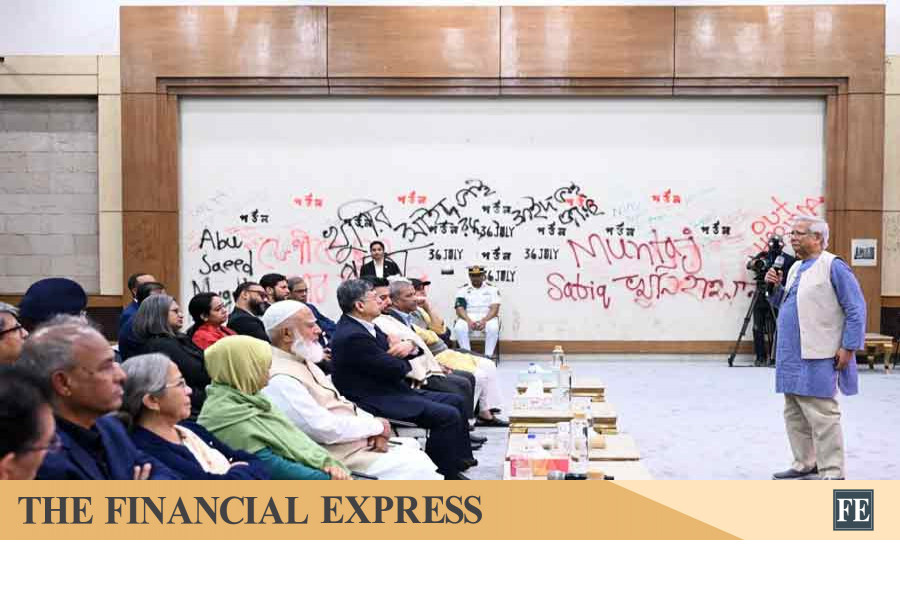
Chief Adviser Professor Muhammad Yunus on Tuesday said that if the nation becomes bewildered for any reason it will find path in the July Uprising Memorial Museum, noting it has been possible to build the museum while the blood of the July martyrs is still fresh.

“It has been possible to build this museum while the blood of the July martyrs is still fresh. It is an unprecedented example for the entire world,” he said.

The Chief Adviser added: “We do not want there to be a need to build such a museum anywhere in the future. If our nation ever becomes perplexed for any reason, it will find its path in this museum”.

Prof Yunus made the remarks this afternoon after inspecting the progress of the final phase work of the July Uprising Memorial Museum at the Gonobhaban here, the residence of ousted Prime Minister Sheikh Hasina.

He said that every citizen of the country should come to the museum and spend a full day, and that students should visit the museum in groups.

Spending a day in this museum will help people understand what kind of brutality the nation had to go through, the Chief Adviser said, adding, if anyone wants to stay in the symbolic ‘Aynaghar’ set up in the museum for some time, a few hours, or even a full day, they should be allowed to do so.

He said by sitting inside the ‘Aynaghar’, visitors could realize the level of brutality in which the detainees were kept.

Prof Yunus further said that everyone must internalize how they can remain united so that such brutal incidents never occur again.

“On this one point, we will all remain united that this nation will never return to such brutal days again,” he said.

When a brutal act was happening, the Chief Adviser said, the youth and students stood up against it and resisted it.

“They had no weapons and nothing at all. That even ordinary people can stand up fearlessly and courageously in front of weapons- this is a lesson for us,” he added.

Prof Yunus expressed gratitude to Cultural Affairs Adviser Mostofa Sarwar Farooki and all those involved in the work of the museum.

Speaking on the occasion, Farooki said that it was a record that the work of this museum has reached this stage in a short time.

He said it has been made possible due to the tireless efforts of many young people, noting that many worked here for eight months without any remuneration.

Farooki expressed his gratitude to all of them.

Noting that work of several more sections will be completed in the next few days, he said the museum will be open to public before the elections slated for February 12.

“The July Museum will stand as a bearer of history and will remain a source of Bangladesh’s past, present, and future politics,” the cultural affairs adviser said.

He also said that the museum will play an important role in future political discourse, education and research, as well as in cultural and literary practice.

Earlier, the Chief Adviser arrived at the museum around 3pm and went around the museum that projects the reasons behind the mass uprising and the history of Awami League's 16-years' misrule under the dictatorship of Sheikh Hasina.

BNP Standing Committee member Salahuddin Ahmed, Bangladesh Jammat-e-Islami Ameer Dr Shafiqur Rahman and National Citizen Party Convener Nahid Islam as well as advisers of the interim government and victims and family members of the victims of enforced disappearance were present on the occasion.​
 
Analyze

Analyze Post

Add your ideas here:
Highlight Cite Fact Check Respond

Members Online

⤵︎

Latest Posts

Latest Posts